Buy IGNOU Project – Covers Complete Guidelines (Topics, Format, Submission) & Download Expert-Written Synopsis and Project Report PDF
An IGNOU Project is a mandatory academic requirement in many undergraduate, postgraduate, and diploma programmes of Indira Gandhi National Open University. It evaluates a learner’s ability to apply theoretical knowledge to practical or research-based problems. Understanding the correct IGNOU project guidelines, including topic selection, synopsis format, project report structure, submission process, and viva requirements, is essential for timely approval and evaluation.
Get IGNOU Project, Synopsis & Report Free Download PDF for all IGNOU courses
In this guide to IGNOU Project, we cover procedures and guidelines across programs (MBA, MAEDU, DNHE, MCOM, MSCENV, MAAN, MSCDFSM and more). You will learn when to start your project, how to get synopsis approval, and how to avoid common pitfalls. We also discuss how professional IGNOU project-writing services and expert-written samples can help ensure your project meets all university norms.
WhatsApp Us to get the Customized IGNOU Project Report and Synopsis of any course
Definition: An IGNOU Project is a mandatory academic task that applies course concepts to practical or research work, the IGNOU Project Synopsis is the approved proposal defining the topic and methodology, and the IGNOU Project Report is the final structured document submitted for evaluation as per IGNOU guidelines.
What is an IGNOU Project?
An IGNOU project (also called a dissertation or research project) is an independent study component required in many IGNOU programs. It is intended as a capstone where you apply theoretical knowledge to real-world problems. In IGNOU’s words, the project work “is an independent investigation undertaken by the student to demonstrate organized academic effort”. Its primary objective is to enable you to critically analyze a real-life issue and apply concepts learned in your coursework. The final deliverables typically include a written report and an oral viva voce. A successful project demonstrates research skills and practical understanding of your field, and it contributes substantial credit towards your degree.
Purpose of Project Work in IGNOU Programs
The project is designed to integrate theory with practice. For example, IGNOU’s MBA project guide states that the project course “aims at developing applied tools and techniques to analyse and validate propositions related to business issues”. In general, an IGNOU project helps you:
- Apply theory to practice: use concepts from your coursework on a live problem.
- Develop research skills: design a study, collect data, and analyze findings.
- Demonstrate specialization: focus on a topic in your field of interest (e.g., marketing, finance, education, nutrition, etc.).
- Enhance employability: a well-done project shows initiative and expertise to future employers or advanced studies.
By completing a project, you demonstrate independence in learning and the ability to handle comprehensive, real-world assignments – a key goal of distance education at IGNOU.
IGNOU Courses That Require an Project Work
Many IGNOU programs include a mandatory project or dissertation. Typically, postgraduate and professional courses have a project component in the final year or semester. For example:
- MBA (Master of Business Administration): has a project course (MMPP-001) in the 3rd semester.
- MA programs (e.g., MA Education, MA Psychology, MA Rural Development, etc.): often require a project or dissertation in the second year.
- MCOM (Master of Commerce): includes a dissertation/project MCOP-001 in the last semester.
- MCA/BCA (Computer Applications): final-semester project reports are required.
- MSCDFSM/MSCENV: students complete a field work or project as part of the curriculum.
- Diplomas (e.g., PG Diploma in Rural Development, Diploma in Nutrition & Health Education): often have applied project or internship components.
Some UG programs also have project courses; for instance, IGNOU’s BBA program includes an 8-credit project in the 5th semester. Popular programs with project requirements include MAPC, MBA, MARD, MAEDU, MCOM, MSCDFSM, MSCENV, BCA/MCA, DNHE and others. In short, any program guide for your course will list whether a project/dissertation is compulsory and in which semester it must be done.
When to Start Working on IGNOU Project
Project work should not start at the last moment. A safe approach is:
- finish most theory papers of the programme
- start thinking about areas of interest at least one semester before the project semester
- discuss early ideas with a potential guide or academic counsellor
- prepare and submit the synopsis well before the final submission window
Early planning leaves time for approval, field work, report writing and corrections before the term end exam.
IGNOU Project Guidelines (As per University Norms)
Before beginning work, students must follow IGNOU’s official guidelines for project work. These rules cover eligibility, project credits, supervision, and administrative processes.
Download the official IGNOU Project Guidelines of any course
Eligibility Criteria
Not every registered learner can start the project at once. Common rules are:
- registration in the correct programme and project course code
- completion of some minimum number of credits or core papers
- selection of a guide who fits IGNOU norms for that programme
The programme guide or regional centre notice normally explains exact eligibility. Starting the project without meeting these conditions can lead to rejection at the time of evaluation.
Also Check Out: IGNOU MBA Project Guideline and IGNOU MCOM Project Guidelines
Project Duration & Marks Weightage
Every project has a fixed credit value. More credits mean more effort and more weight in the final result. Many IGNOU project courses carry four or eight credits and are marked out of 100. Marks are usually divided between:
- written project report
- viva voce or practical presentation
Both parts must be completed. If the learner skips the viva, the project is treated as incomplete even if the report is submitted.
Role of Supervisor & Study Centre
The project supervisor or guide is the academic person who mentors the learner. Usual duties include:
- helping to refine the topic and objectives
- checking the synopsis before submission
- guiding data collection and structure of the report
- certifying that the work is original
The study centre or regional centre acts as the contact point with IGNOU. It receives synopsis, forwards them for approval, accepts final reports as per instructions, and arranges the viva. Learners should stay in regular contact with the centre for dates and updates.
Read Out: Role of an IGNOU MCOM Project Supervisor
How to Choose the Right IGNOU Project Topic
Selecting the right IGNOU project topic is essential for successful approval and evaluation. The topic should be directly related to the course syllabus, match the learner’s interest and background, align with the supervisor’s expertise, and be realistic in scope and timeframe. It should also be based on accessible data or field conditions and focus on a current or practical issue to ensure clarity, relevance, and effective analysis.
Course-wise Topic Selection (MBA, MCOM, MAEDU, DNHE, etc.)
A good topic is clear, focused and linked with the programme. Sample ideas are:
- IGNOU MBA project topics: digital marketing impact, customer satisfaction study, financial performance of small firms, training and development in a company
- MCA or BCA project topics: design of a small software system, mobile app, website, management information system, or data analysis project
- MAEDU project topics: teaching methods, use of digital tools in classrooms, teacher training needs, inclusive education practices
- MA Anthropology (MAAN) project topics: Cultural studies, ethnographic fieldwork topics, human development issues.
- MCOM project topics: banking services, e commerce, taxation practices, financial statement analysis
- MSCENV project topics: solid waste management, air or water quality, climate change awareness, renewable energy use
- DNHE, MAPC, MSCDFSM project topics: diet surveys, nutrition education programmes, food safety in canteens or hospitals
Topics should match local context and data access. A learner who works in a firm, school, hospital or NGO can often use that place as the field area.
Tips to Get Topic Approval Quickly
To increase the chance of fast approval:
- choose a realistic topic with limited and clear scope
- write precise objectives and avoid vague aims
- keep the language simple and direct
- follow the official synopsis template line by line
- attach all required documents, signatures and bio data of the guide
- submit early so that there is time to respond if changes are suggested
Well prepared synopsis documents are more likely to get approval in the first review cycle.
Read Must: How to get Your IGNOU MBA Project Approval?
IGNOU Synopsis – Format & Approval Process
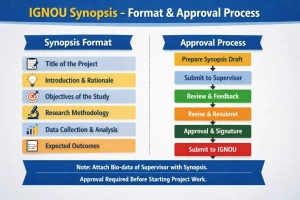
Once you have a topic and a supervisor, the next step is writing and submitting the project synopsis (sometimes called “proposal”). This is essentially your research plan, which must be approved before you start the full project work.
Synopsis Structure (Objectives, Methodology, Scope)
Though each programme may give its own layout, most IGNOU synopsis documents include:
- Title: short and focused, showing what and where is being studied
- Introduction: brief background and problem outline
- Objectives: two to four clear points which state what the study will achieve
- Methodology: study design, tools, sample size, data collection and analysis plan
- Scope and limitations: area, population and any limits of the study
- References: key books, reports or web sources used to frame the idea
The IGNOU synopsis is normally typed, signed by learner and guide, and attached to the official project proposal form before submission to the study centre or regional centre.
Read Our Article: 8 Must Requirements for the IGNOU Synopsis for in-depth learning.
Common Reasons for Synopsis Rejection
Typical causes of rejection include:
- use of a very broad or unclear topic
- missing objectives or mismatch between objectives and methods
- not following the given format or leaving boxes blank in the pro forma
- lack of guide signature or guide not meeting IGNOU eligibility norms
- obvious copy pasting from the internet or earlier projects
- submission after the last date for that session
Download IGNOU Synopsis Sample PDF
If a synopsis is not approved, IGNOU normally asks for changes or a fresh proposal. This can delay the whole project, so care at this stage is important.
IGNOU Project Report Format
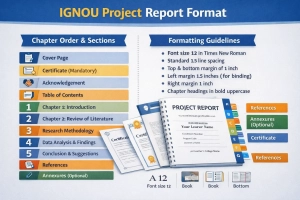
After your synopsis is approved and you’ve completed the research or field work, you will prepare the final project report. This report must follow IGNOU’s prescribed format and quality standards.
Chapter-wise Structure
After completing field work, the learner writes the full project report. A standard structure is:
- Cover page with programme name, code, title, learner name, enrolment number, study centre and session
- Certificate from supervisor confirming guidance and originality
- Declaration by the learner
- Acknowledgement (optional)
- Table of contents, list of tables and figures
- Chapter 1 – Introduction: problem, background, need of study, objectives
- Chapter 2 – Review of literature (if required): summary of earlier studies
- Chapter 3 – Research methodology: design, tools, sampling, data collection, analysis plan
- Chapter 4 – Data analysis and interpretation: tables, charts and discussion
- Chapter 5 – Findings, suggestions and conclusion
- References
- Annexures such as questionnaires or extra tables
Some programmes may merge or rename chapters, but this flow works for most IGNOU project report formats.
IGNOU Project Report Structure Guide (PDF)
Formatting Rules (Font, Margins, Referencing)
Basic format rules usually include:
- A4 white paper, printed on one side
- clear font such as Times New Roman, 12 size
- 1.5 line spacing in main text
- standard margins on all sides
- page numbers at bottom or top
- headings in bold with consistent style
- proper citation of all books, articles and online sources
Neat formatting shows respect for academic standards and makes reading easier for evaluators.
IGNOU Project Sample Overview
Reviewing sample projects can help you visualize the final product. IGNOU’s digital repository (eGyankosh) and study centre may have sample dissertations or project reports from past years. These examples illustrate the proper format, chapter breakdown, and writing style. For instance, IGNOU’s Development Communication project guide advises students to “refer to… Shri Chakradhar Publication” for sample projects. Examining a high-quality sample can guide you in organizing your own content and formatting.
We do provide “expert-written synopsis and report” PDFs for download, which demonstrate compliant formatting and structure. In summary, using authoritative examples helps ensure your project report meets IGNOU’s expectations.
IGNOU Project Sample Pages (Demo PDF)
IGNOU Project Submission Process
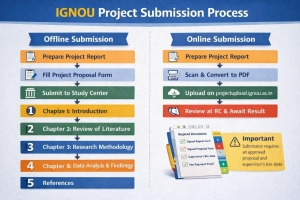
After your project report is complete, you must submit it to IGNOU. The process has evolved recently with online options, but some programs still allow offline submission.
Online vs Offline Submission
- Online Submission: IGNOU has launched an online portal for project report upload (projects.ignou.ac.in). Here, you scan your final report (as a single PDF) and upload it along with supporting documents. Required documents usually include:
- The project report PDF (report + all annexures in one file).
- A signed Supervisor’s Certificate (scanned) approving the project.
- The Approval Letter or Synopsis Approval (if you had to get prior approval, a scan of that).
- Student’s Declaration on originality (scanned and signed).
- Any other documents specified (e.g., project evaluation fee receipt).
After submission, you download an acknowledgment/receipt. Online submission helps track your entry and get quicker processing.
IGNOU’s online guidelines emphasize that all documents be clear and complete. Incomplete submissions will be removed from the portal after the deadline. Also note: you must have paid the project evaluation fee in advance (see below) and uploaded its receipt, else the report will not be considered.
- Offline Submission: Some programs (or regional centres) still accept hard copies. If offline is allowed, you should:
-
- Print and bind: Prepare a spiral or soft-bound copy of your report (with all certificates attached).
- Enclose certificates: Include the signed Supervisor’s Certificate and your Declaration (as separate pages).
- Submit at Regional Centre: Take the bound copy to the designated IGNOU Regional Centre or Study Centre. Get an official receipt/acknowledgment for proof of submission.
Because policies vary, always confirm with your study centre whether offline submission is permitted. The IGNOU Projects guide warns: “Not all RCs accept offline submissions now. Always confirm beforehand.”. If you do submit offline, keep the receipt and copies of everything.
Important Deadlines & Checklist
- Submission Deadlines: IGNOU projects have fixed submission windows. Typically, final project reports must be submitted before term-end exams. For example, for the June TEE session, the deadline is usually around 31st May; for the December TEE, around 30th November. (Official notices confirm dates – e.g., June 2025 report submissions were due by May 31, 2025.) Always plan to submit at least 10–15 days early, to allow for any issues.
- Project Evaluation Fee: From January 2023 onward, IGNOU requires a nominal fee for project evaluation. The fee is Rs 300 for projects up to 4 credits, and Rs 500 for projects above 4 credits. You must pay this fee at the time of filling your Term-End Exam form, and include the fee receipt when submitting the project report. If you fail to pay, IGNOU will not evaluate your project report.
- Submission Checklist: Before you submit (online or offline), ensure:
- Your project report is final, proofread, and in the correct format (bound or as a PDF).
- Title page, certificates, and declaration are included in the submission package.
- You have the official synopsis approval letter (if required by your program).
- You have a copy of the paid fee receipt.
- The project proposal (if used) has original approval form with signatures (for online submission).
- You have kept spare copies of everything for your records.
- Acknowledge Receipt: After submission, get a confirmation (portal acknowledgment or physical receipt). Keep this safe. It is proof that IGNOU received your report.
Failure to meet deadlines or follow checklist items can lead to rejection. IGNOU’s online guidelines make it clear that incomplete submissions will not be considered and you will have to re-submit in the next session. Therefore, treat these submission steps with care.
IGNOU Project Viva Voce
After report submission, IGNOU conducts a viva voce (oral exam) for project courses. This is typically arranged by your Regional Centre or study centre, often a few weeks after submission. The purpose is to verify your understanding and ensure you actually completed the work.
Viva Preparation Tips
To perform well in the viva, consider the following tips:
- read the full project report again with fresh eyes
- make a short summary covering topic, objectives, methods and key findings
- revise basic concepts from related theory papers
- prepare to explain each table or chart in simple terms
- practice answers in front of a friend or mirror
Confidence comes from strong understanding, not from memorising lines.
Common Questions Asked
Typical viva questions include:
- Why was this topic chosen?
- What were the main objectives of the study?
- How was data collected and from whom?
- What tools or tests were used for analysis?
- What are the key findings and suggestions?
- What were the main problems faced during the study?
- If given more time, what would be done differently?
Clear, honest answers show that the learner has actually done the work and understood the subject.
You can also read: IGNOU MCOM Project Viva Questions
Common Mistakes Students Make in IGNOU Projects
Even well-prepared students sometimes make avoidable errors. The most frequent mistakes include:
Plagiarism
Copy pasting from books, websites or previous projects without proper citation is a serious mistake. It can lead to rejection or even disciplinary action. Learners should write in their own words, quote sources correctly and use plagiarism checking tools if possible.
Incorrect Format
Many projects lose marks or face delay because the format does not match IGNOU guidelines. Common issues are missing certificates, wrong order of chapters, no page numbers, poor binding or unreadable scans. Following the project guide carefully solves most of these problems.
Late Submission
Late synopsis or report submission can push the project to the next exam session. This delays the degree. Learners should track all dates, keep reminders and aim to submit at least a week before the final deadline.
Must Read: Mastering IGNOU Projects: A Step-by-Step Guide to avoid mistakes.
Need Our Professional Help with Your IGNOU Project?
While many students manage projects on their own, others choose our professional assistance to ensure compliance and quality. Understanding the why behind project rejections can highlight the value of our expert support.
Why Most IGNOU Projects Get Rejected
Project proposals or reports are often rejected due to:
- unclear or copied topics and objectives
- poor structure and language
- missing forms, signatures or approval proof
- use of wrong format or chapter sequence
- high plagiarism level
- not following updated instructions from IGNOU
Many of these problems are technical or format based, not subject based. Careful planning and expert review can prevent such issues.
How Our Expert Guidance Improves Approval Chances
Our Professional IGNOU project-writing services aim to handle these exact issues, thereby improving your chances of approval:
- Compliance with IGNOU Format: Our Experts know the exact formatting rules and forms required. They ensure that your project follows all structural guidelines (chapter sequence, certificate format, font, margins, etc.) so that the submission is “in order” and not rejected on a technicality.
- 100% Complete Documentation: We make sure every mandatory document is included: approval proforma, supervisor’s biodata, original project proposal, etc. This prevents the common error of missing signatures or forms.
- Plagiarism-Free Writing: Our Professionals prepare original content and often use plagiarism-checking tools. They also cite sources correctly. This addresses the major issue of high similarity that can lead to rejection.
- Subject-Matter Expertise: Our Services often assign a guide who is an expert in your field. For example, an MBA project will be handled by someone from a management background, ensuring the content is relevant and the supervisor’s input is valid.
- Timely Submission: These services track IGNOU deadlines and often help you meet them. Since supervisors at IGNOU are limited (often supervising only 5–6 students), coordinating early can speed up approval. Some services even liaise with your study centre on your behalf.
- Error-Free Writing: Quality services proofread and edit the report for grammar and clarity, reducing the risk of rejection for poor language or technical mistakes.
- Increased Confidence: Knowing that the synopsis and report adhere to “IGNOU’s rules” gives you confidence. For example, guidelines require objectives to be precise; professionals ensure this detail is correct from the outset.
In short, our expert guidance addresses the typical reasons for project failure. By having a fully compliant proposal and report from the start, you avoid resubmissions and delays. Our services save your time and stress, and significantly improve the likelihood that your IGNOU project is approved on the first attempt.
Our IGNOU Project Writing Services (All Courses)
Professional IGNOU project writing services typically offer comprehensive support for every stage of your project, across all IGNOU programs. Key services include:
- IGNOU Project Synopsis Writing: Crafting a full project proposal/synopsis according to IGNOU’s approved format, with clear objectives, methodology, and scope.
- IGNOU Project Report Writing: Preparing the complete project report chapters (cover page, introduction, literature review, methodology, analysis, conclusion, etc.), all formatted as per IGNOU guidelines.
- Topic Selection & Approval Support: Helping you choose a strong, relevant topic and obtaining timely approval. This may include drafting and revising the proposal until your study centre approves it.
- Viva Voce Preparation: Providing guidance and mock practice sessions to help you prepare for the project viva, including likely questions and answers.
Courses Covered: These services typically handle projects for all IGNOU programs that have a project component. Commonly covered courses include MBA, MAEDU, DNHE, MCOM, MSCENV, MAAN, MSCDFSM, MAPC, MCA/BCA, BTS and many PG diploma courses (e.g., PGDRD, PGDFSQM). Essentially, if your IGNOU program requires a project or dissertation, a professional service can usually assist. Each subject area has specialist writers (economists for MCOM, business managers for MBA, nutritionists for DNHE, etc.) to ensure relevant, high-quality work.
Note: For any specific IGNOU course, students can direct WhatsApp us also.
Why Choose Our IGNOU Project Services?
When selecting a project writing service, consider these quality factors:
- Subject-Matter Experts: Professional services employ writers and supervisors who are experts in specific disciplines. This ensures your project content is accurate and relevant.
- 100% IGNOU-Compliant Format: Every report is crafted to match IGNOU’s official formatting rules (cover page layout, chapter sequence, referencing style, etc.) so it meets university approval requirements.
- Plagiarism-Free Content: Work is written from scratch and checked through plagiarism detection tools. You receive a report with zero duplication issues, meeting IGNOU’s originality standards.
- On-Time Delivery: Timely completion is guaranteed. Because IGNOU has strict submission deadlines, professional services track and meet all deadlines, so you don’t miss your exam window.
- Supervisor & Centre Alignment: Good services coordinate with your chosen supervisor’s availability (since supervisors are limited to a small number of students) and guide you through centre-specific procedures. This proactive communication prevents administrative delays.
Watch Us at Youtube
Choosing a reputable IGNOU project service means getting a polished, approved-ready project with less stress. In effect, it combines expert writing assistance with detailed knowledge of IGNOU’s procedures, increasing your chance of success.
Additional Features Provided Along with IGNOU Books
- IGNOU Books / Study Material / Guides
- IGNOU Handwritten Assignment
- IGNOU Solved Assignment
- IGNOU Solved Guess Papers
- IGNOU Previous Years Solved Question Papers
- IGNOU Practical / Internship Work
Free IGNOU Project Synopsis & Report Support Material PDFs
- IGNOU Project Guidelines Overview (PDF)
Explains IGNOU project rules, eligibility, credit system, evaluation, and viva process in simple language. - IGNOU Project Synopsis Format (Blank Template PDF)
A fill-in style synopsis format with headings, word-limit guidance, and instructions for each section. - IGNOU Project Report Structure Guide (PDF)
Shows chapter-wise layout, sequence, certificates, declaration pages, and annexures as per IGNOU norms. - IGNOU Programme-Wise Project Topics List (PDF)
Curated topic ideas mapped to programmes like MBA, MAEDU, DNHE, MCOM, MSCENV, MAAN, MSCDFSM, etc. - IGNOU Project Submission Checklist (PDF)
Step-by-step checklist covering online/offline submission, documents required, and common errors. - IGNOU Project Viva Preparation Notes (PDF)
Common viva questions, how to explain objectives, methodology, findings, and tips for confidence. - IGNOU Project Sample Pages (Demo PDF)
Only sample pages (cover page, certificate, contents page, one chapter excerpt) to demonstrate format—not full projects. - IGNOU Project Plagiarism & Originality Guide (PDF)
Explains plagiarism limits, referencing basics, declaration format, and originality expectations.
FAQs on IGNOU Project, Synopsis and Report Work
Q1: What is an IGNOU project?
A: An IGNOU project is a structured study or practical work done under guidance to apply course theory to a real problem and is a graded part of many IGNOU programmes.
Q2: Is a project compulsory in all IGNOU courses?
A: No. Many but not all courses have a project or dissertation. The programme guides for each course lists whether a project is required and in which semester.
Q3: When should an IGNOU student start the project?
A: It is best to start planning one semester before the project semester so that synopsis approval, data collection and report writing finish before the term end exam.
Q4: How long is a typical IGNOU project report?
A: Length depends on programme, but many reports fall in the range of 8,000 to 15,000 words, excluding annexures. The exact figure is given in the programme guide.
Q5: Can the project be written without a supervisor?
A: No. IGNOU normally requires a qualified guide or supervisor who approves the synopsis, mentors the work and signs the final certificate.
Q6: Is online submission accepted for all IGNOU projects?
A: Many projects now use online submission, but some regional centres or programmes may still follow offline mode. Learners should confirm with their own centre for each session.
Q7: How important is the viva for the final result?
A: The viva carries separate marks and proves that the learner understands the work. Poor performance can reduce the project score even if the written report is strong.
Q8: Can expert help be used for IGNOU projects?
A: Learners often use expert support for topic selection, editing and structure. Final responsibility, understanding and defence of the work in viva, however, always rests with the learner.
Check Availability and Download Course-Wise IGNOU Project PDF
You can download expert-written IGNOU Synopsis and Project Report PDFs prepared strictly as per IGNOU guidelines. Each project is developed by subject experts who understand course objectives, format rules, and evaluation standards. Printed copies are also available in official format for doorstep delivery. Our projects ensure originality, correct structure, and smooth approval for submission and viva.
|
MBA |
MAPC | BTS |
| MADE | MSCCFT | PGDPPED |
| DNHE | MPA | AMT |
| PGDRD | PGDEMA | MEC |
| DECE | DPLAD | MSW |
| PGCPP | MAAE | MSC(MACS) |
| CCP | CPSCM | CES |
| DAQ | PGDDC | PGDIDM |
| PGDBP | PGDCSR | PGDLAN |
| MSCENV | MGPS | MAAN |
| CAHT | PGDWGS | PGDSS |
| PGDET | MAWGS | MADVS |
| MASS | MACSR | MAUS |
| MARDOL | PGDRDOL | BTSOL |
| BAFSM | BAVMSME | PGDECFE |
| MCOMOL | PGDIDMOL | PGDDCOL |
| PGDEOHOL | MBAOL | MBAOL |
| DTSOL | MAGPSOL | MAEC |
| MAJDM | MAJEM | MADJ |
| PGDSSOL | MAEDU | MTTM |
| MED | MED | AHE |
| MPS | MSCDFSM | PGDHE |
| PGDFSQM | PGDCJ | MLIS |
| PGCINDS | DSCDM | PGDHHM |
| BSCANH | BAVTM | PGDEOH |
| MCOM | MAEOH | PGDAB |
| PGCIPWS | PGDINDS | PGDEME |
| DNHEOL | MAJMCOL | MBAOL |
| MAMIDI | MAWGSR | PGDAIC |
| DTS | MARD | PGDDM |
| PGDIS | DIPP | CSWATT |
| PGCIPWS | MAER | MAJMC |
| BAPFHMH | PGDFCS | BAPCH |
| MSCRWEE | MSCFSQM | CETM |
| MADEOL | MBAOL | MAEVS |
| MADP | CHCWM | CIHL |
| MSCIS | MAGD | MAFCS |
| PGDUPDL | PGDMIDI | MASSOL |
| CPSCMOL | DWM |
Completing an IGNOU Project requires strict compliance with university guidelines, subject expertise, and proper academic structuring. With our expert-led IGNOU Synopsis and Project Report Writing Services, students across all IGNOU courses can ensure timely submission, higher approval chances, and stress-free project completion. From topic selection to viva preparation, we offer complete end-to-end support tailored to IGNOU standards.
“Get Your IGNOU Project Written by Experts – Contact Now”
-
Sale!

-
Sale!
IGNOU PGDFSQM Project (MVPP 001) Synopsis/Proposal & Project Report/Dissertation in Soft-Copy (Sample-5)
Original price was: ₹499.00.₹149.00Current price is: ₹149.00. -
Sale!
IGNOU PGDFSQM Project (MVPP 001) Synopsis/Proposal & Project Report/Dissertation in Soft-Copy (Sample-4)
Original price was: ₹499.00.₹149.00Current price is: ₹149.00. -
Sale!
IGNOU PGDFSQM Project (MVPP 001) Synopsis/Proposal & Project Report/Dissertation in Soft-Copy (Sample-3)
Original price was: ₹499.00.₹149.00Current price is: ₹149.00. -
Sale!
IGNOU PGDFSQM Project (MVPP 001) Synopsis/Proposal & Project Report/Dissertation in Soft-Copy (Sample-2)
Original price was: ₹499.00.₹149.00Current price is: ₹149.00. -
Sale!
IGNOU PGDFSQM Project (MVPP 001) Synopsis/Proposal & Project Report/Dissertation in Soft-Copy (Sample-1)
Original price was: ₹499.00.₹149.00Current price is: ₹149.00. -
Sale!
IGNOU PGDEOH Project (MEVP 001) Synopsis/Proposal & Project Report/Dissertation in Soft-Copy (Sample-5)
Original price was: ₹499.00.₹149.00Current price is: ₹149.00. -
Sale!
IGNOU PGDEOH Project (MEVP 001) Synopsis/Proposal & Project Report/Dissertation in Soft-Copy (Sample-4)
Original price was: ₹499.00.₹149.00Current price is: ₹149.00. -
Sale!
IGNOU PGDEOH Project (MEVP 001) Synopsis/Proposal & Project Report/Dissertation in Soft-Copy (Sample-3)
Original price was: ₹499.00.₹149.00Current price is: ₹149.00. -
Sale!
IGNOU PGDEOH Project (MEVP 001) Synopsis/Proposal & Project Report/Dissertation in Soft-Copy (Sample-2)
Original price was: ₹499.00.₹149.00Current price is: ₹149.00. -
Sale!
IGNOU PGDEOH Project (MEVP 001) Synopsis/Proposal & Project Report/Dissertation in Soft-Copy (Sample-1)
Original price was: ₹499.00.₹149.00Current price is: ₹149.00. -
Sale!
IGNOU PGDCJ Project (MLEP 17) Synopsis/Proposal & Project Report/Dissertation in Soft-Copy (Sample-5)
Original price was: ₹499.00.₹149.00Current price is: ₹149.00. -
Sale!
IGNOU PGDCJ Project (MLEP 17) Synopsis/Proposal & Project Report/Dissertation in Soft-Copy (Sample-4)
Original price was: ₹499.00.₹149.00Current price is: ₹149.00. -
Sale!
IGNOU PGDCJ Project (MLEP 17) Synopsis/Proposal & Project Report/Dissertation in Soft-Copy (Sample-3)
Original price was: ₹499.00.₹149.00Current price is: ₹149.00. -
Sale!
IGNOU PGDCJ Project (MLEP 17) Synopsis/Proposal & Project Report/Dissertation in Soft-Copy (Sample-2)
Original price was: ₹499.00.₹149.00Current price is: ₹149.00. -
Sale!
IGNOU PGDCJ Project (MLEP 17) Synopsis/Proposal & Project Report/Dissertation in Soft-Copy (Sample-1)
Original price was: ₹499.00.₹149.00Current price is: ₹149.00. -
Sale!
IGNOU MSCIDS Project (MISP 021/031) Synopsis/Proposal & Project Report/Dissertation in Soft-Copy (Sample-3)
Original price was: ₹499.00.₹149.00Current price is: ₹149.00. -
Sale!
IGNOU MSCIDS Project (MISP 021/031) Synopsis/Proposal & Project Report/Dissertation in Soft-Copy (Sample-2)
Original price was: ₹499.00.₹149.00Current price is: ₹149.00. -
Sale!
IGNOU MSCIDS Project (MISP 021/031) Synopsis/Proposal & Project Report/Dissertation in Soft-Copy (Sample-1)
Original price was: ₹499.00.₹149.00Current price is: ₹149.00. -
Sale!
IGNOU MSCFSQM Project (MVPP 003) Synopsis/Proposal & Project Report/Dissertation in Soft-Copy (Sample-5)
Original price was: ₹499.00.₹149.00Current price is: ₹149.00. -
Sale!
IGNOU MSCFSQM Project (MVPP 003) Synopsis/Proposal & Project Report/Dissertation in Soft-Copy (Sample-4)
Original price was: ₹499.00.₹149.00Current price is: ₹149.00. -
Sale!
IGNOU MSCFSQM Project (MVPP 003) Synopsis/Proposal & Project Report/Dissertation in Soft-Copy (Sample-3)
Original price was: ₹499.00.₹149.00Current price is: ₹149.00. -
Sale!
IGNOU MSCFSQM Project (MVPP 003) Synopsis/Proposal & Project Report/Dissertation in Soft-Copy (Sample-2)
Original price was: ₹499.00.₹149.00Current price is: ₹149.00. -
Sale!
IGNOU MSCFSQM Project (MVPP 003) Synopsis/Proposal & Project Report/Dissertation in Soft-Copy (Sample-1)
Original price was: ₹499.00.₹149.00Current price is: ₹149.00. -
Sale!
IGNOU MAPFHS Project (MEDSP 071) Synopsis/Proposal & Project Report/Dissertation in Soft-Copy (Sample-3)
Original price was: ₹499.00.₹149.00Current price is: ₹149.00. -
Sale!
IGNOU MAPFHS Project (MEDSP 071) Synopsis/Proposal & Project Report/Dissertation in Soft-Copy (Sample-2)
Original price was: ₹499.00.₹149.00Current price is: ₹149.00. -
Sale!
IGNOU MAPFHS Project (MEDSP 071) Synopsis/Proposal & Project Report/Dissertation in Soft-Copy (Sample-1)
Original price was: ₹499.00.₹149.00Current price is: ₹149.00. -
Sale!
IGNOU MAER Project (MERP 001/002) Synopsis/Proposal & Project Report/Dissertation in Soft-Copy (Sample-3)
Original price was: ₹499.00.₹149.00Current price is: ₹149.00. -
Sale!
IGNOU MAER Project (MERP 001/002) Synopsis/Proposal & Project Report/Dissertation in Soft-Copy (Sample-2)
Original price was: ₹499.00.₹149.00Current price is: ₹149.00. -
Sale!
IGNOU MAER Project (MERP 001/002) Synopsis/Proposal & Project Report/Dissertation in Soft-Copy (Sample-1)
Original price was: ₹499.00.₹149.00Current price is: ₹149.00.