IGNOU MCOM Project for MCOP 01: Complete Guidelines with Sample PDFs
For students of Indira Gandhi National Open University (IGNOU), the Master of Commerce (MCOM) program (two-year, four-semester postgraduate course) includes a capstone research project MCOP-001 in the final semester. This IGNOU MCOM Project, coded MCOP-01, often feels challenging, but with the right approach it becomes an invaluable learning experience.
In this guide, we provide a complete, step-by-step walkthrough of the IGNOU MCOM Project – from understanding the official guidelines and choosing a great topic, to preparing the synopsis, writing the report, and successfully submitting your project. By following these structured steps and tips, you can confidently complete the MCOP-01 project and ensure it meets all the requirements for approval and evaluation.
Quick Summary
The IGNOU MCOM project (MCOP-01) is a mandatory 6-credit research component in the Master of Commerce program’s final semester. It requires students to conduct a study on a commerce-related topic—such as consumer behavior or market segmentation—and submit a detailed report. Before beginning the project, students must prepare and submit a synopsis for approval, outlining the research objectives, methodology (including sampling methods and tools like Likert scale surveys), and expected outcomes.
The final report typically spans 15,000 words (around 50–60 pages) and must include specific elements such as a title page, executive summary, acknowledgments, a signed declaration, structured chapters, references, and appendices. The project must be completed under the guidance of an eligible supervisor, conform to IGNOU’s formatting rules, and be submitted before the term’s deadline—usually May 31 or November 30. Students are also required to attend a viva voce to defend their work.
Introduction to IGNOU MCOM Project (MCOP 01)
In the IGNOU Master of Commerce (M.Com) programme, MCOP-001 is the designated course code for the compulsory research project in the fourth semester. It replaces traditional examinations with a mini dissertation that requires students to apply commerce or management concepts to real-world scenarios. Instead of studying from a textbook, learners select a research topic within domains like finance, marketing, HR, accounting, or international business, and conduct an independent study under the supervision of a qualified guide.
The process involves defining research objectives, collecting and analyzing data, and compiling a structured report. Completion of this project, along with a viva voce, is mandatory to obtain the M.Com degree.
Importance of the MCOP-1 Project
The MCOP-1 project plays a pivotal role in the M.Com curriculum for several reasons:
- Academic Application: It allows practical application of theoretical knowledge to real business or financial problems, deepening the learning experience.
- Skill Development: Students gain valuable experience in research methods, data analysis, and academic writing—skills that are transferable to both higher education and professional settings.
- Degree Completion: As a 6-credit component, passing the project is essential to fulfill the M.Com degree requirements.
- Professional Advantage: A well-executed project strengthens a student’s resume by showcasing the ability to perform independent research and focus on a specific issue, thereby enhancing employability and future academic prospects.
Review IGNOU previous year solved papers to understand common topics
When and How to Begin the IGNOU MCOM Project
Planning should ideally begin during the third semester to ensure sufficient time for topic selection, guide approval, and synopsis submission. The following actions help streamline the process:
- Early Planning: Identify a broad area of interest and consult potential supervisors during the third semester.
- Synopsis Preparation: Draft a synopsis outlining the research objectives, methodology, and rationale, and submit it for approval at least 2–3 months before the project submission deadline.
- Project Execution: Once approved, conduct the research—gather data, perform analysis, and begin drafting the report. Manage your timeline to ensure the final version is completed well ahead of the submission date.
Before starting, download the latest IGNOU project & synopsis guidelines.
IGNOU MCOP 01 Project Guidelines
Before beginning your IGNOU M.Com project, it is essential to understand the official requirements regarding topic selection, supervisor eligibility, formatting standards, and submission procedures. Adhering strictly to these guidelines will ensure your project is accepted without delays or rejection.
Synopsis Approval Process
The project begins with a mandatory synopsis (proposal) that outlines your research title, objectives, brief literature review, and methodology. This document—typically 10 to 15 pages—must be submitted to your Regional Centre or through IGNOU’s online portal, accompanied by the proposal form and your supervisor’s bio-data. Project work should only commence after receiving formal synopsis approval from IGNOU. Proceeding without approval can result in disqualification.
Report Structure and Format Requirements
The final project report must be well-structured and formatted according to IGNOU’s specifications:
Outline of the MCOP-01 Project Report
- Front Matter: Includes the cover page, approved synopsis form, Certificate of Originality (signed by both student and guide), optional acknowledgments, and a table of contents.
- Main Body: Should be divided into five chapters:
- Introduction
- Review of Literature
- Research Methodology
- Data Analysis & Interpretation
- Conclusion and Recommendations
- End Matter: Contains the bibliography/references and appendices (e.g., survey forms, raw data).
Formatting & Typing Guidelines
- Length: The report should be approximately 15,000 words, spanning 50 to 60 double-spaced A4 pages.
- Typography: Use a clear font such as Times New Roman or Arial, size 12 pt, with 1-inch margins on all sides. Maintain consistency in headings and pagination.
- Spacing & Paper: Maintain double-spacing throughout, typed on A4-sized paper.
- Binding: The final report must be spiral-bound or hardbound with a clear cover page displaying your name, enrollment number, program title (M.Com), and the course code (MCOP-001).
Sample Cover Page and Certificate Details
- Cover Page: Should include the project title, student’s name and enrollment number, program name, and the guide’s name and designation—centered neatly on the page.
- Certificates to Include:
- The Project Synopsis Proforma (indicating the approved proposal)
- The Certificate of Originality, signed by you and your supervisor, confirming that the work is authentic and has not been copied.
Note: Read our article on “IGNOU MCOM Project Guidelines” to learn more in detail.
Choosing the Best IGNOU MCOM Project Topics
Selecting an appropriate topic is crucial for the success of your MCOM (MCOP-01) project. It must be academically relevant, practically feasible, and aligned with your interests. Here are essential considerations for effective topic selection:
- Interest and Specialization Alignment: Choose a topic within your area of interest or professional goal—such as marketing, finance, human resources, or taxation. This ensures long-term engagement and adds value to your future career path.
- Manageable Scope: Avoid topics that are too broad or narrowly defined. A refined, specific research question—like “Impact of social media marketing on consumer behavior in the FMCG sector”—is more effective than a generic study on digital marketing.
- Data Accessibility: Verify that data is realistically obtainable. If your research involves surveys, ensure access to a relevant audience. For secondary data projects, confirm the availability of financial reports or statistics for your chosen timeframe or industry.
- Theoretical Relevance: Strong projects integrate academic models such as the STP model, marketing mix (4Ps/7Ps), or hypothesis testing. Using frameworks from your coursework enhances analytical depth and academic credibility.
- Early Guide Consultation: Discuss potential topics with your supervisor early on. They can validate your direction and help refine the topic to ensure feasibility and approval. Minor adjustments, like focusing on a specific region or data type, can greatly improve your project’s viability.
Trending Sample Topics for MCOP 01 Project (Stream-Based)
Below are some sample project topics grouped by specialization, reflecting popular themes and current issues. These examples can inspire you, but remember to craft a unique project question of your own:
Marketing & Consumer Behavior
- Evaluating the Role of Influencer Marketing on Millennial Purchase Decisions in the Indian Apparel Sector
- A/B Testing for Email Marketing Effectiveness in Subscription-Based E-Learning Platforms
- Impact of Green Branding on Consumer Loyalty in Urban Markets
- STP Analysis of Emerging EdTech Startups: A Case Study Approach
- Comparative Study of Online vs. In-Store Buying Behavior Post-COVID-19
Finance & Investment
- Risk Perception and Investment Behavior of Young Working Professionals in Mutual Funds
- A Study on the Effect of FinTech Innovations on Traditional Banking Services in Tier-2 Cities
- Financial Inclusion and Credit Awareness Among Women Entrepreneurs in Rural India
- Behavioral Finance and the Role of Herding in Indian Stock Market Trends
- Impact of Cryptocurrency Regulations on Retail Investor Sentiment in India
Accounting & Taxation
- Effectiveness of E-Invoicing in GST Compliance for Small Enterprises
- Comparative Analysis of ESG Reporting in Indian vs. Global Corporations
- Post-IFRS Implementation Challenges in Non-Banking Financial Companies (NBFCs)
- Role of Forensic Accounting in Detecting Corporate Fraud in Indian Startups
- Tax Planning Strategies Adopted by Freelancers in the Gig Economy
Human Resources & Organizational Behavior
- Remote Work and Employee Engagement in the Indian IT Sector: A Post-Pandemic Assessment
- Use of the Likert Scale in Measuring Job Satisfaction Among Mid-Level Managers
- Impact of Diversity and Inclusion Policies on Organizational Culture in MNCs
- Correlation Between Emotional Intelligence and Conflict Resolution in Hybrid Work Teams
- Effect of Performance Appraisal Systems on Employee Retention in Startups
International Business & Trade
- Impact of India’s Free Trade Agreements (FTAs) on Textile Export Competitiveness
- Role of Exchange Rate Volatility in Pricing Strategy of Export-Oriented MSMEs
- Study of Non-Tariff Barriers Faced by Indian Pharmaceutical Firms in Global Markets
- Analysis of Cross-Border M&A Trends in the Indian FinTech Sector (2020–2025)
- Effects of Global Supply Chain Disruptions on India’s Electronic Components Imports
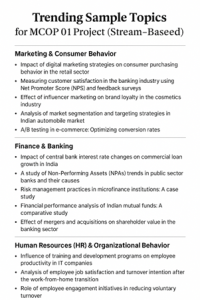
Image: “Trending Sample Topics MCOP 01 Project (Stream-Based)”
IGNOU MCOM Project Synopsis Preparation
Before starting the full project, you must get your project synopsis (proposal) approved by IGNOU. This is a brief plan (~10–15 pages) of what you intend to do. Download the official synopsis format and proposal form from IGNOU, and include the following:
- Introduction & Objectives: Introduce your topic and why it’s important (the rationale). Clearly state the objectives or research questions your project will address.
- Brief Literature Review: Summarize a few relevant studies or theories related to your topic. This shows you understand the context and helps refine your approach.
- Methodology Plan: Explain how you will conduct the research – the design (survey, case study, etc.), data sources you’ll use, your target sample (who or what you will study and how many), and the tools for analysis (e.g., will you use a questionnaire, interviews, and will you analyze data with Excel/SPSS?). This section should convince evaluators your approach is feasible and appropriate.
- Expected Outcome: (Optional) Mention what you expect to find or how the study could be useful. This isn’t set in stone, but it shows you’ve thought about the potential results and significance.
Work with your guide while drafting the synopsis. Once it’s ready, fill out the proposal form (with your and your guide’s signatures) and submit the synopsis to your Regional Centre for approval. Keep a copy of what you send. Approval can take a few weeks; once you receive the green light from IGNOU, you can proceed to the main project work.
Preparing a clear and focused synopsis becomes easier when your subject knowledge is strong. To revise the core concepts effectively, many learners use IGNOU MCOM Previous Year Guess Papers for quick exam-oriented preparation.
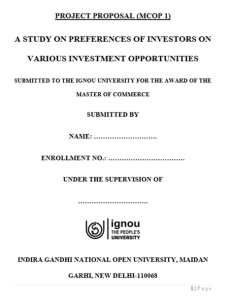
Image: MCOM Project Synopsis Front Page for IGNOU
Selection of IGNOU MCOM Project Guide (Supervisor)
Every IGNOU MCOM project must be supervised by a qualified guide, approved by the university. The guide should hold at least a Master’s degree in Commerce or a related field, with a minimum of five years of relevant academic, research, or industry experience. Eligible supervisors may include IGNOU academic counselors, university faculty, or senior professionals in the subject area.
You can request your Study Centre or Regional Centre to recommend a suitable guide. Alternatively, you may approach qualified college lecturers or domain experts independently. Once a guide agrees, collect their signed bio-data and have them fill in the project proposal form (Annexure I).
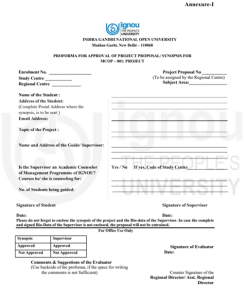
Image: MCOP-001 Project Proposal Form (Annexure I)
Submit your synopsis along with the guide’s details to the Regional Centre for approval. If either the topic or guide is not accepted, you will be required to revise and resubmit. Upon approval, maintain regular communication with your guide for feedback and guidance. Their signature will also be required on your final project certificate. Note that immediate family members are not eligible, and guides typically supervise a limited number of students (usually not more than five at a time).
IGNOU MCOM Project Report Structure & Writing Guide
Once your data is ready, focus on organizing your report as per IGNOU’s standard format. The project must be clear, formal, and properly structured:
Table 1: Report Structure Overview
| Section | Details |
| Preliminary Pages | – Title Page – Declaration of Originality – Guide’s Certificate – Acknowledgements (optional) – Abstract (Executive Summary) – Table of Contents |
| Chapter 1: Introduction | Define the research problem, state objectives, and explain the study’s relevance. |
| Chapter 2: Literature Review | Summarize previous research and theories; identify gaps your study addresses. |
| Chapter 3: Research Methodology | Detail research design (survey/case study), data sources (primary/secondary), sampling methods, and tools used (SPSS, Excel). |
| Chapter 4: Data Analysis & Interpretation | Present findings using tables, charts, and graphs. Interpret results in line with objectives. |
| Chapter 5: Conclusion & Recommendations | Summarize key findings, answer research questions, suggest improvements or decisions, and note limitations. |
| End Matter | – References (APA/Harvard format) – Appendices (questionnaires, raw data, extra tables) |
Table 2: Formatting & Submission Guidelines
| Parameter | Specification |
| Word Count | ~15,000 words (approx. 50–60 pages) |
| Font & Size | Times New Roman or Arial, 12 pt |
| Spacing | Double-spaced |
| Margins | 1 inch on all sides |
| Binding | Spiral or hardbound |
| Cover Page Info | Title, Student Name, Enrollment No., MCOM, and MCOP-001 |
Table 3: Writing Tips & Ethical Standards
| Tip | Description |
| Maintain Formal Tone | Write objectively in a scholarly voice with clear transitions |
| Use Headings & Pagination | Structure content with headings and include page numbers |
| Proofreading | Check for grammar, clarity, and formatting issues before submission |
| Cite All Sources | Use consistent citation style (APA or Harvard) |
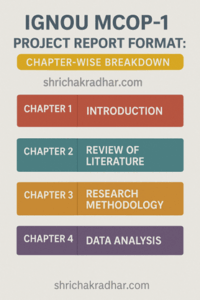
Image: IGNOU MCOP 1 Project Report Format – Chapter-wise Breakdown
IGNOU MCOM Project Submission Process – Step-by-Step
When you’re ready to submit your project, make sure to do the following steps:
-
- Finalize & Bind the Report: Complete all writing and proofreading. Ensure all required pages (title page, certificates, etc.) are included and signed. Print and bind the report (spiral or hardcover as specified by IGNOU).
- Attach Documents: Insert the approved synopsis (or approval letter), the proposal proforma signed by you and the guide, your guide’s bio-data (if applicable), and the fee payment receipt into the report (usually in the beginning or as an appendix).
- Submit to IGNOU: For most distance-mode students, you’ll send the bound report to IGNOU’s Student Evaluation Division in New Delhi (by post or in person). Follow any instructions given by your Regional Centre. Online mode students will upload the project PDF file through the designated portal. Whichever way, keep proof of submission (postal receipt or online confirmation).
- Note the Deadline: Make sure you sent it before the submission cut-off date (May 31 or Nov 30, as applicable). Late submissions typically get evaluated in the next term.
- Prepare for Viva: After submission, prepare for the viva. The Regional Centre will inform you of the schedule. Use the waiting time to review your project so you can confidently answer questions about your work during the oral defense.
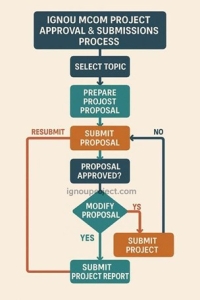
Image: “IGNOU MCOP 1 Project Approval & Submission Process
Common Challenges and Expert Tips for MCOP 1 Project
Even with a solid plan, students encounter some common hurdles during the MCOM project. Here are a few major challenges and how to handle them:
- Poor Time Management: Procrastination can derail your project. Avoid rushing by starting early and sticking to a schedule. Set weekly goals (e.g., finish literature review, draft methodology). An early start also gives you time to deal with unforeseen issues (like a synopsis revision or slow data collection) without missing deadlines.
- Data Collection & Analysis Issues: Sometimes surveys get a low response or data is hard to obtain, or you may feel unsure about analyzing the data. Plan for these early. If responses are low, extend your reach or timeframe. If data analysis (statistics, software, etc.) is challenging, seek help – discuss with your guide, refer to textbooks or tutorials, or consult a peer who’s good with numbers. Don’t hesitate to learn basic tools like Excel or SPSS; they can make analysis easier. Always have a backup plan for data (like an alternate source or a slightly different approach) in case your initial plan doesn’t pan out.
- Ignoring Guidelines/Format: Small mistakes like missing sections, wrong format, or not following IGNOU’s instructions can cost you. Always cross-check your work against the official guidelines (use a checklist). Ensure you have all required elements (for example, the certificate, proper headings, correct margins). Formatting might seem tedious, but it’s important for acceptance.
- Plagiarism Temptations: Under pressure, some consider copying content or using “solved” project reports from others – this is a grave error. IGNOU examiners check for originality, and plagiarism can lead to your project being rejected. Use other projects or online material only as references to guide your approach, never to directly lift content. If you paraphrase or use ideas from somewhere, cite them. Your analysis and writing should be in your own words. Not only will this save you from disciplinary action, it will also ensure you truly understand your project.
Frequently Asked Questions (FAQs) on IGNOU MCOM Project (MCOP 001)
Q1: How long (in pages or words) should the MCOM project report be?
A1: The project report is typically about 50–60 pages of content, which is roughly 15,000 to 20,000 words (typed double-spaced). This length can vary a bit, but aim for that range to meet IGNOU’s expectations.
Q2: Do I need to submit a synopsis before the final MCOM project report?
A2: Yes. You must prepare a project synopsis (proposal) and get it approved by IGNOU first. Only after your synopsis is officially approved can you proceed to data collection and writing the full project report.
Q3: How do I submit the completed MCOP-01 project report to IGNOU?
A3: Distance mode: send a bound hard copy to IGNOU’s evaluation division (SED) in New Delhi (by post or via your Regional Centre). Online mode: upload the report PDF on the IGNOU portal. Include required documents and keep proof of submission.
Q4: Is there a viva voce for the MCOM project?
A4: Yes. After the report evaluation, IGNOU conducts a viva voce (oral defense). You will be asked questions about your work by examiners. You must pass the viva (in addition to the written report) to successfully complete the project.
Q5: Can I use a “solved” MCOP-1 project report or get someone else’s help to write my project?
A5: No. Submitting a pre-written (“solved”) project is considered plagiarism and is not allowed. You can seek guidance from a mentor or tutor, but the writing and analysis must be entirely your own work.
Helpful Resources
IGNOU’s website (or eGyankosh repository) provides a detailed project guidelines PDF for MCOP-001, including the synopsis format and required forms. Also, you may find sample project reports or approved synopses through IGNOU resources – use them only as references to understand the format and scope expected.
- IGNOU MCOM Project Synopsis Sample PDF
- MCOP 1 Project Report Sample PDF
- List of MCOP 001 Project Topics
- You Tube Video on “How to Complete MCOM Project Work in IGNOU”
- IGNOU Project Reports and Synopsis Sample PDFs
Final Checklist for MCOM (MCOP 01) Project Work
Before you submit, ensure the following are in order:
- Topic & Proposal: You have a clear topic, an eligible guide, and your synopsis/proposal was approved by IGNOU.
- Report Complete: The project report contains all required elements (cover page, signed declaration and certificate, chapters, references, appendices). You’ve followed the format guidelines and proofread the document. All necessary signatures are in place and you have attached the approved synopsis, proposal form, and fee receipt as needed.
- On-Time Submission: You are submitting before the deadline for your term (so your work will be evaluated in the intended exam cycle).
- Viva Ready: You’ve kept a copy of your report and prepared to answer questions. You’re monitoring your email/IGNOU updates for your viva voce schedule so you can attend and complete the process.
By checking off these points, you can be confident that you’ve covered everything important for the MCOP-01 project. Good luck with your submission and viva – completing this project is a commendable achievement in your academic journey!
“Need help writing or editing your IGNOU MCOM Project?
Get expert support for topic selection, synopsis approval, and full project drafting.
📞 Contact our team today or Request a free consultation!”
-
Sale!

-
Sale!
IGNOU MCOM Project (MCOP-01) Synopsis/Proposal & Project Report/Dissertation in Soft-Copy (Sample-5)
Original price was: ₹500.00.₹149.00Current price is: ₹149.00. -
Sale!
IGNOU MCOM Project (MCOP-01) Synopsis/Proposal & Project Report/Dissertation in Soft-Copy (Sample-4)
Original price was: ₹500.00.₹149.00Current price is: ₹149.00. -
Sale!
IGNOU MCOM Project (MCOP-01) Synopsis/Proposal & Project Report/Dissertation in Soft-Copy (Sample-3)
Original price was: ₹500.00.₹149.00Current price is: ₹149.00. -
Sale!
IGNOU MCOM Project (MCOP-01) Synopsis/Proposal & Project Report/Dissertation in Soft-Copy (Sample-2)
Original price was: ₹500.00.₹149.00Current price is: ₹149.00. -
Sale!
IGNOU MCOM Project (MCOP-01) Synopsis/Proposal & Project Report/Dissertation in Soft-Copy (Sample-1)
Original price was: ₹500.00.₹149.00Current price is: ₹149.00.