


Description
IGNOU MBAFM 4th Semester Book — Strategy, Markets, International Finance and Insurance in One Revision Guide
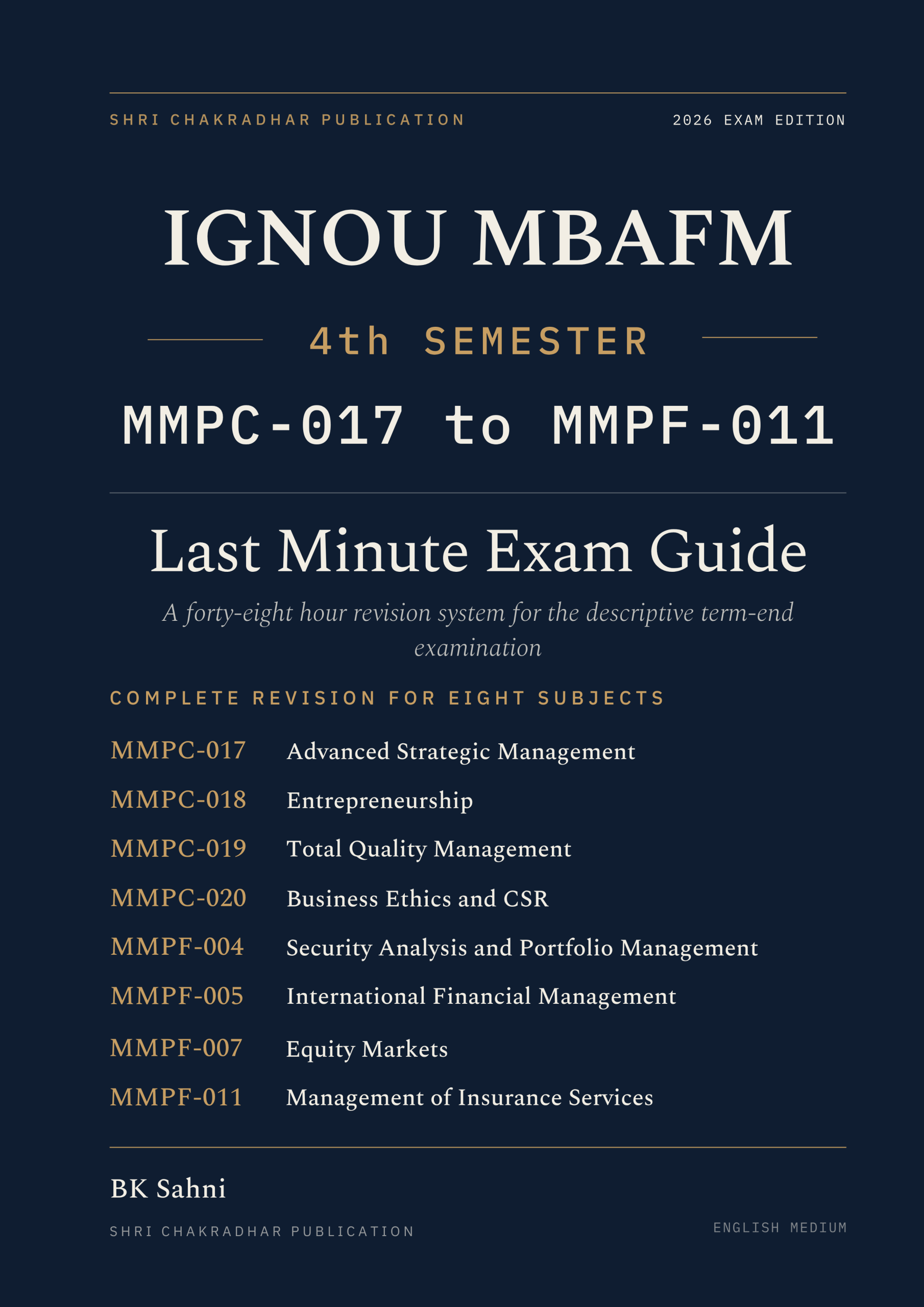
This 2027 English Medium IGNOU MBAFM 4th Semester Book contains 160 pages and brings MMPC-017, MMPC-018, MMPC-019, MMPC-020, MMPF-004, MMPF-005, MMPF-007 and MMPF-011 into a single revision companion for the June and December Term-End Examinations. It forms part of our IGNOU books, study material and helpbooks range for all programmes.
The semester begins with corporate direction, venture design, process quality and responsibility, then advances into securities, currency management, stock-exchange infrastructure and insurance. Because those subjects demand different forms of reasoning, the book does not force them into one generic response pattern. Corporate questions are tested through suitability and exposure; finance numericals are completed through transparent working; market answers identify the institution and sequence; and insurance discussions connect legal principles, products and protection of policyholders.
About the IGNOU MBAFM 4th Semester
The printed course set combines four common MBA papers with four subjects from the Financial Management specialisation. Advanced Strategic Management, Entrepreneurship, Total Quality Management, and Business Ethics and CSR establish the managerial environment within which capital is allocated and controlled. Security Analysis and Portfolio Management, International Financial Management, Equity Markets, and Management of Insurance Services then address financial instruments, cross-border cash flows, Indian exchange systems and risk-transfer institutions.
Revision consequently shifts among authors, formulas, statutes and process chains. A candidate may classify diversification, map a feasibility study, explain the cost of poor quality, preserve CSR thresholds, calculate risk-adjusted performance, test parity conditions, follow a public issue into T+1 settlement, or distinguish indemnity from assurance. The chapter design keeps navigation stable while preserving the special vocabulary and evidence standard of every paper.
What This Book Covers
Each course uses the same six-part pathway from paper orientation to final recall. Students know where to find the next type of study aid, although the models, calculations, institutions and caution points change with the subject.
- Section A — Subject Opener and Topic Heatmap: outlines the course blocks, question style, suggested examination approach and relative weight assigned to prominent areas.
- Section B — Command Verb Decoder and Golden Rule: translates prompts such as compute, discuss, justify, compare, evaluate and describe into the response expected.
- Section C — Five Answer Blueprints: supplies adaptable layouts, compact model skeletons and a terminology set matched to the paper.
- Section D — Sixteen High-Probability Q&As: gives complete numbered revision responses and places an individual Exam Note beneath each one.
- Section E — Revision Toolkit: consolidates theorists, meanings, equations or contrast tables and recurring examination errors.
- Section F — Thirty-Minute Revision Capsule: closes the chapter with essential concepts, selected prompts, ready opening lines and high-value keywords.
Five blueprints in each of eight chapters produce 40 Answer Blueprints. Sixteen model responses per code create 128 high-probability Q&As and 128 Exam Notes. Additional subject resources comprise eight priority heatmaps, eight command-word guides, eight toolkits and eight pre-paper capsules. The closing material contributes a whole-semester dashboard, a two-day emergency schedule, plans for 48, 24, 12, 6, 3 and 1 hour, 100 fact prompts, an examination checklist, eighty MCQs, the solution table and score bands.
Subject-wise Coverage
MMPC-017: Advanced Strategic Management
The MMPC-017 unit examines how firms select, finance and control strategic movement. It includes strategy levels, corporate policy, stability, expansion, retrenchment, integration, diversification, mergers, alliances, international entry, competitive position, resource-based advantage, IT architecture, implementation, evaluation and governance. Its main authorities include Chandler, Ansoff, Porter, Prahalad and Hamel, Barney, Dunning, Bartlett and Ghoshal, Rumelt, Kaplan and Norton. The response must establish strategic fit, execution risk, control and supporting corporate evidence.
MMPC-018: Entrepreneurship
The Entrepreneurship chapter treats finance as part of the venture-building chain rather than an isolated final step. Schumpeter, McClelland, Danhof, Drucker, Timmons, Osterwalder and the lean-startup approach appear alongside idea discovery, business-model testing, market, technical and financial feasibility, the business plan, seed and growth capital, family enterprise, intrapreneurship, social ventures and sickness. Women and rural entrepreneurs receive separate coverage. Udyam, MUDRA, CGTMSE, PMEGP, SIDBI, NABARD, NSIC, KVIC, DICs, Stand-Up India and Startup India supply the institutional context used to explain access, eligibility and stage-appropriate support.
MMPC-019: Total Quality Management
The MMPC-019 material explains why quality affects cost, capacity and financial results. Deming, Juran, Crosby, Feigenbaum, Ishikawa, Shewhart, Taguchi, Shingo and Ohno anchor continuous improvement, prevention, variation, error-proofing and waste removal. Coverage includes TQM principles, PDCA, kaizen, seven QC tools, process capability, cost of quality, Six Sigma, DMAIC, ISO 9001:2015, audits, safety, circles and benchmarking. Responses move from quality philosophy to its measurable mechanism and cost effect.
MMPC-020: Business Ethics and CSR
The MMPC-020 chapter places financial and managerial conduct under philosophical and legal examination. It covers utilitarian, duty-based, rights, justice, virtue, care and discourse approaches through Bentham, Mill, Kant, Aristotle, Rawls, Gilligan and Habermas. Kidder’s dilemma framework, incentives, codes, whistleblowing, shareholder and stakeholder views, governance, activism, reporting and sustainability extend the application. Carroll and Section 135 structure the CSR portion, including the qualifying thresholds, two-per-cent spending obligation, Schedule VII, committee composition and unspent-account rules. Answers are built by naming the moral lens or statutory requirement before applying it to a business decision.
MMPF-004: Security Analysis and Portfolio Management
Security Analysis and Portfolio Management provides the book’s principal risk-return toolkit. Students work with return, dispersion, beta, the Gordon model, multi-stage valuation, Markowitz theory, the efficient frontier, CAPM, SML, Sharpe, Treynor and Jensen measures, duration and benchmarks. The theory side covers the EIC sequence, industry phases, technical patterns, market efficiency, active and passive revision, formula plans and investment conditions in emerging markets. Every calculation is presented as a method rather than a naked figure: the equation is identified, symbols are explained, workings remain visible and the result ends in an investor decision.
MMPF-005: International Financial Management
International Financial Management follows money through exchange-rate systems and multinational operations. Its chronology runs from the gold standard through Bretton Woods, the Smithsonian realignment and the Jamaica Accord. Balance-of-payments structure, direct and indirect quotations, PPP, IRP, covered interest arbitrage, forwards, futures, options, swaps and money-market hedges form the market core. The chapter distinguishes contracted, accounting and operating exposure, then addresses foreign projects, country risk, ECBs, multinational liquidity, export credit, ECGC, depository receipts and Eurobonds. FEMA and RBI arrangements provide the Indian setting, while importer and exporter examples clarify the direction of each hedge.
MMPF-007: Equity Markets
The Equity Markets section describes the Indian market as a connected institutional system. It classifies money and capital markets, primary and secondary activity, risk families and capital-raising routes. Public issues, DRHP filing, merchant bankers, book building, allotment, listing, SEBI regulations, investor-grievance mechanisms, order classifications, price-time matching, central-counterparty clearing, margins, pay-in, pay-out, T+1 settlement and demat credit are traced in sequence. NSDL, CDSL, NSE and BSE appear beside fundamental and technical analysis, portfolio risk, VaR and index construction. Sensex and Nifty weighting is contrasted with price-weighted indices to make methodology explicit.
MMPF-011: Management of Insurance Services
Management of Insurance Services starts with the economics of pooling and then moves through contract, underwriting, product and supervision. The six principles of insurance are applied to life, fire and other classes, with the timing of insurable interest and the limits of indemnity kept distinct. Students revise valid-contract essentials, risk assessment, term and savings-linked life products, annuities, micro and rural insurance, health and group covers, claims, channels, crop schemes and reinsurance. The Insurance Act, Indian Contract Act and IRDAI Act organise the legal framework; solvency, governance and the regulator’s functions connect institutional stability to policyholder interests.
MMPC-017 to MMPF-011 at a Glance
| Code | Subject Title | Main Revision Area | What You Take Away |
|---|---|---|---|
| MMPC-017 | Advanced Strategic Management | Strategic direction, advantage, internationalisation, implementation and review | Corporate alternatives judged by suitability, exposure and execution evidence |
| MMPC-018 | Entrepreneurship | Opportunity, venture testing, institutions, capital and growth | Business ideas evaluated through validation criteria and financing stages |
| MMPC-019 | Total Quality Management | Quality systems, improvement techniques, standards and assurance | Process discipline linked to defect prevention, cost and measurable control |
| MMPC-020 | Business Ethics and CSR | Moral reasoning, dilemmas, corporate responsibility and disclosure | Business conduct assessed with philosophical and statutory support |
| MMPF-004 | Security Analysis and Portfolio Management | Valuation, portfolio risk, asset pricing, revision and evaluation | Investment models solved stepwise and converted into selection conclusions |
| MMPF-005 | International Financial Management | Exchange regimes, parity, currency exposure, hedging and global funding | International treasury choices explained by chronology, equations and mechanics |
| MMPF-007 | Equity Markets | New issues, regulation, trading, clearing, depositories and indices | The Indian equity chain followed from capital raising to electronic ownership |
| MMPF-011 | Management of Insurance Services | Risk pooling, contract principles, underwriting, regulation and products | Insurance choices tied to legal validity, suitability and solvency protection |
Key Features — All Verified From the Book
- One 160-page English Medium book: the edition joins four core management papers with four MBA (FM) specialisation subjects.
- Forty reusable response plans: five blueprints in every course address concepts, processes, contrasts, statutes and numericals.
- One hundred twenty-eight numbered answers: each code contributes sixteen selected revision questions with model responses.
- An individual note after all 128 answers: the reminders flag missing assumptions, workings, examples, dates or provisions.
- Twenty-four subject navigation resources: eight heatmaps, eight verb decoders and eight toolkits support study decisions.
- Eight condensed final reviews: every course concludes with a thirty-minute capsule.
- Six levels of available-time guidance: routes are provided for 48, 24, 12, 6, 3 and 1 hour.
- One hundred one-line fact checks: formulas, thinkers, years, Acts, schemes and model sequences are grouped by subject.
- Eighty answer-keyed MCQs: ten items per paper are followed by solutions and performance ranges.
- Semester planning support: the volume includes a dashboard, a 48-hour timetable and an exam-day checklist.
Who Should Use This Book
The suitable reader is an IGNOU MBA (FM) 4th Semester student enrolled in the exact eight-paper combination displayed in this edition. It is intended for the revision phase after the detailed blocks have been read, especially where management concepts must be integrated with formulas, financial-market institutions, foreign-currency decisions and insurance regulation.
Employed learners may find the standard chapter pathway useful when preparation is divided into short sessions. It also supports candidates who know the topic but lose clarity in presentation, such as failing to define a variable, state a date, identify the responsible regulator, show a hedge direction or add the investment and policyholder consequence.
How This Book Helps Students
The design replaces undirected rereading with a chain of choices. Topic maps establish an order, verb tables decode the examiner’s instruction, and blueprints select the writing or calculation format. The four MMPC papers call for frameworks, institutions, quality mechanisms and ethical provisions. The MMPF chapters then require visible numerical reasoning, international parity and exposure logic, Indian market-process accuracy, and insurance principles connected to contracts and schemes.
Complete answers illustrate the selected format. The note below each response highlights conditions or details that can otherwise disappear under time pressure. Formula and definition banks repair confusion, comparison grids separate similar entities, and the capsules, facts and self-test compress preparation into recall, diagnosis and correction.
This Exam Guide and IGNOU’s Official Study Material
Prescribed IGNOU blocks remain the main academic source for the eight courses. They contain the full development of each unit, broader explanations and contextual examples that a last-stage revision title necessarily condenses. Learners may download the official IGNOU MBA (FM) study material free in PDF from eGyankosh and use the files matching their registration.
This companion has a different role: it turns completed study into structured answers, worked logic and timed retrieval. Its priority symbols organise attention but do not narrow the syllabus, certify a future question or replace official notifications.
Why Choose This Last Minute Exam Guide
The practical difference lies in preserving the correct response discipline for each paper. Strategic management is organised by fit and risk, entrepreneurship by feasibility and institutional access, TQM by principle and technique, ethics by theory and provision, portfolio management by calculation and interpretation, international finance by parity and hedge direction, equity markets by process and regulator, and insurance by doctrine, product and policyholder consequence.
The volume also distinguishes final revision from initial learning. Its compressed schedules assume earlier syllabus study, and the priority markings are not predictions. When project work later becomes relevant, the IGNOU projects, synopsis and dissertation support range is a separate category.
About the Author — BK Sahni
BK Sahni (Bhavya Kumar Sahni) is an IGNOU education expert, author, and the founder of Shri Chakradhar Publication Pvt. Ltd. and ignouproject.com, and he has guided 5,00,000+ IGNOU distance-learning students since 2010. He writes the Last Minute Exam Guide series — including this book — building every title on the method he has refined across a decade of IGNOU-focused work: high-probability questions, reusable answer blueprints, topic heatmaps and quick-revision capsules aligned to the current IGNOU exam pattern. He also publishes open-access research-methodology guides for IGNOU students, archived with permanent DOIs on Zenodo and indexed on Google Scholar and ORCID (0009-0005-8092-459X). Learn more about his work at bksahni.com, or browse his complete catalogue of IGNOU books on the Amazon Author Store.
How to Use the Book Effectively
Start at the semester dashboard and diagnose the form of weakness before choosing a chapter. Use Section A to set priority and Section B to identify what the command word demands. Learn the five response structures, then reconstruct selected material from memory: strategy risks, scheme ladders, quality mechanisms, CSR numbers, risk-return calculations, currency hedges, issue-to-settlement stages and insurance doctrines should be written rather than merely recognised.
Adopt the broadest schedule that existing preparation permits. Separate IGNOU solved previous years question papers can extend full-paper practice, while IGNOU solved guess papers may be used as an additional resource without replacing the syllabus. Complete the eighty MCQs, reopen that course’s toolkit after every mistake and save its capsule for the final half hour before the paper.
Frequently Asked Questions
What eight course codes does this MBA (FM) 4th Semester guide contain?
The included papers are MMPC-017 Advanced Strategic Management, MMPC-018 Entrepreneurship, MMPC-019 Total Quality Management, MMPC-020 Business Ethics and CSR, MMPF-004 Security Analysis and Portfolio Management, MMPF-005 International Financial Management, MMPF-007 Equity Markets, and MMPF-011 Management of Insurance Services. Each course receives a separate six-part revision chapter.
Will I receive one book or a set of eight separately bound guides?
You receive a single 160-page English Medium volume. All eight subjects are divided by code, but one consistent route links the opener, verb decoder, blueprints, model answers, toolkit and capsule. This product is a combined 2027 edition rather than an eight-book parcel.
Is the content relevant to both June and December examination sessions?
Yes. The answer structures, numerical methods, regulatory processes and recall material can be used before either June or December Term-End Examination. Priority ratings only suggest an order for revision; they cannot determine which questions will be selected in an individual session.
Are assignment solutions, handwritten work, complete PYQs or guess papers inside?
No. Those categories are not part of this title. The book supplies 128 model revision Q&As, forty Answer Blueprints, eight toolkits, 100 golden facts and eighty self-test items instead. IGNOU solved assignments and IGNOU handwritten assignments are offered separately.
Is this revision volume sufficient without the university learning material?
No. A compact examination companion cannot reproduce the complete explanations and unit sequence found in the prescribed blocks. Complete the official material for understanding, then use this guide to practise frameworks, calculations, statutes, market chains, product distinctions and concise answer presentation.
Which learners are the intended audience for this finance-specialisation book?
The target user is an IGNOU MBA (FM) student whose registration matches all eight printed codes and who has already started the syllabus. Working professionals, self-directed distance learners and candidates needing one coordinated system for descriptive and numerical papers are the clearest audience.
What is the right way to choose among the six reading schedules?
Base the choice on completed preparation, not only the number of hours left. Longer routes allow broader chapter work, written answers and testing; shorter plans move toward selected responses, framework recall, capsules and fact checks. The 1-hour route is an end-stage refresh rather than initial study.
Do the 128 selected questions identify the next IGNOU paper?
No. They serve as revision priorities drawn from recurring paper themes and their weight within the course resources. Their purpose is to improve time allocation and answer construction, while any applicable topic may still be examined. Use them as practice prompts, not as a forecast.
Do students need to confirm the current MBA (FM) structure before purchase?
Yes. Consult www.ignou.ac.in for the latest course arrangement, registration details, date sheet, official study material and examination directions. This edition is organised around the MMPC-017, MMPC-018, MMPC-019, MMPC-020, MMPF-004, MMPF-005, MMPF-007 and MMPF-011 combination printed in the book. The official notification remains the deciding reference.
Important Note on Syllabus Verification
IGNOU periodically updates its programme structure, assignment requirements, examination schedule and study material. Before purchasing and while preparing, students should verify the latest MBA (FM) syllabus, course list, date sheet and official instructions on the official IGNOU website (www.ignou.ac.in). This book is aligned to the MMPC-017, MMPC-018, MMPC-019, MMPC-020, MMPF-004, MMPF-005, MMPF-007 and MMPF-011 structure and refreshed as an annual exam edition, but official IGNOU sources are always the final authority.
Non-Affiliation Disclaimer
shrichakradhar.com is an independent educational publishing platform. This book and this website are not officially affiliated with, endorsed by, or operated by the Indira Gandhi National Open University (IGNOU). Course codes such as MMPC-017, MMPC-018, MMPC-019, MMPC-020, MMPF-004, MMPF-005, MMPF-007 and MMPF-011 are used solely to identify the subjects the book covers. IGNOU’s official study material and notifications remain the primary and authoritative sources for the programme.
Get Your Copy
Select this combined Financial Management study guide for consolidated preparation across eight courses instead of relying on dispersed notes. Keep the prescribed blocks beside it, solve the quantitative work without copying and reserve the capsules for immediate retrieval. For a digital edition, get the IGNOU MBA (FM) 4th Semester Book (MMPC-017 to MMPF-011) — Combined Last Minute Exam Study Guide as a soft-copy PDF on WhatsApp.