

Description
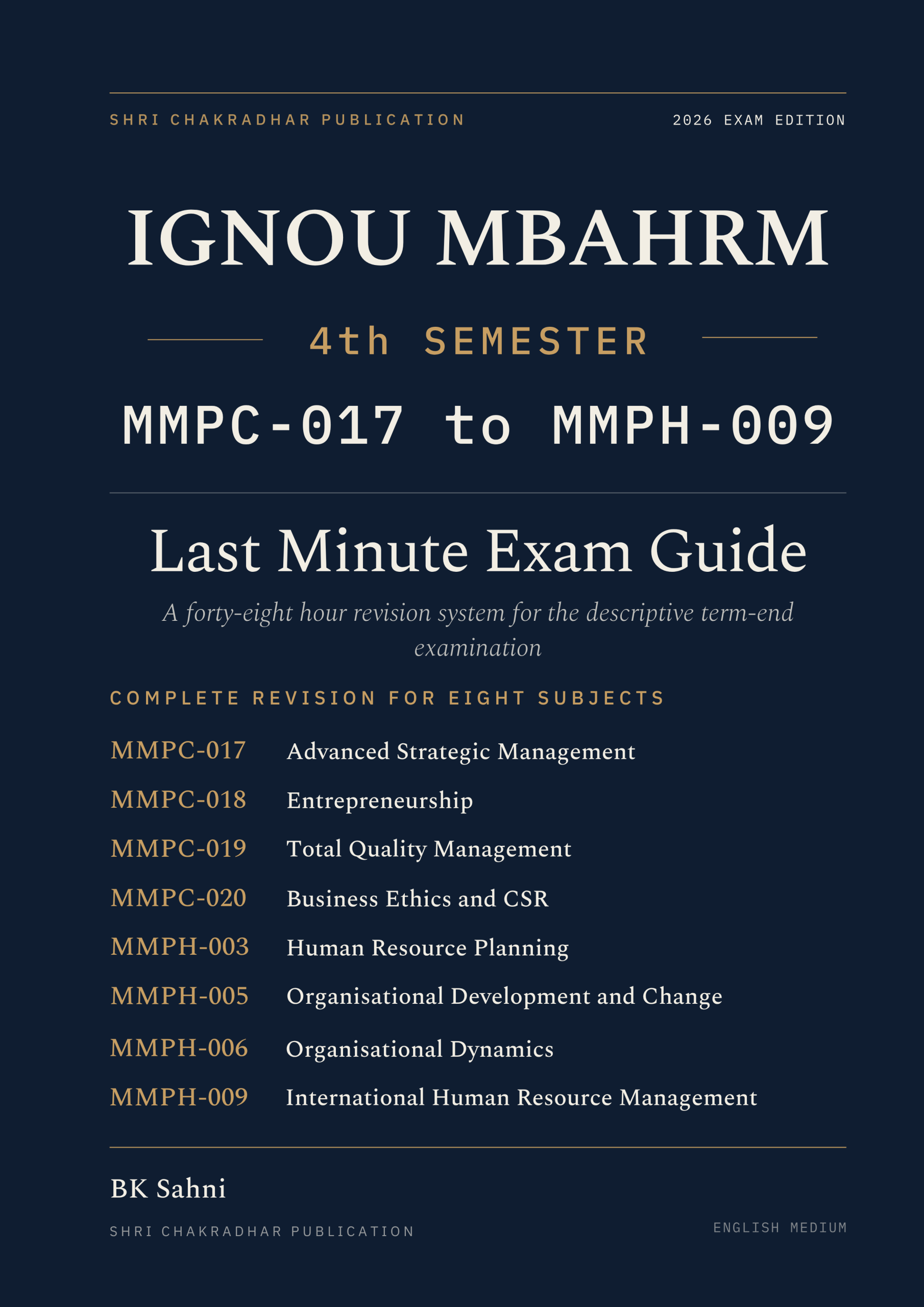
IGNOU MBAHRM 4th Semester Book — Eight Papers from Corporate Strategy to International HRM
This 2027 English Medium IGNOU MBAHRM 4th Semester Book is a 160-page combined revision volume built around MMPC-017, MMPC-018, MMPC-019, MMPC-020, MMPH-003, MMPH-005, MMPH-006 and MMPH-009. It is prepared for final-stage work before the June and December Term-End Examinations and belongs to our IGNOU books, study material and helpbooks range for all programmes.
The semester links decisions about competitive direction, venture formation, quality, responsibility and people systems. As a result, revision cannot rely on one generic answer pattern. Strategy calls for conditions and risks; entrepreneurship needs Indian institutions and feasibility tests; TQM must connect a principle with a tool; ethics requires a named moral lens or legal provision; HR planning turns business goals into workforce numbers; OD follows change from diagnosis to reinforcement; organisational dynamics applies behavioural models; and IHRM compares countries, national categories and assignment practices. The book preserves these differences within a stable chapter map.
About the IGNOU MBAHRM 4th Semester
The course combination shown in this edition joins four shared MBA papers with four Human Resource Management specialisation subjects. Advanced Strategic Management examines portfolio, competitive position and execution. Entrepreneurship studies opportunity, enterprise design and support. Total Quality Management develops prevention and continuous improvement, while Business Ethics and CSR brings philosophical, governance and statutory reasoning into management.
The specialised sequence covers workforce forecasting, planned organisational change, behavioural forces at work and HR activity across national borders. Students may move in one revision sitting from Ansoff and Six Sigma to Section 135, Delphi, Kotter, French and Raven or Perlmutter. Successful preparation therefore depends on knowing whether a prompt requires attributed theory, ordered stages, exact figures, a comparison grid, a workplace illustration or a country contrast.
What This Book Covers
All eight chapters use a repeatable six-part route, allowing students to find the same type of study aid quickly while retaining course-level terminology and method.
- Section A — Subject Opener and Topic Heatmap: summarises the paper style, block focus, answer strategy and relative importance assigned to recurring areas.
- Section B — Command Verb Decoder and Golden Rule: interprets the response demanded by words including discuss, justify, evaluate, differentiate, analyse and describe.
- Section C — Five Answer Blueprints: lays out adaptable response designs, brief model skeletons and high-value vocabulary for the code.
- Section D — Sixteen High-Probability Q&As: supplies numbered model material and places a separate Exam Note beneath every answer.
- Section E — Revision Toolkit: collects contributors, meanings, contrast tables and frequent writing errors into one course check.
- Section F — Thirty-Minute Revision Capsule: closes with core ideas, priority prompts, ready openings and a final keyword bank.
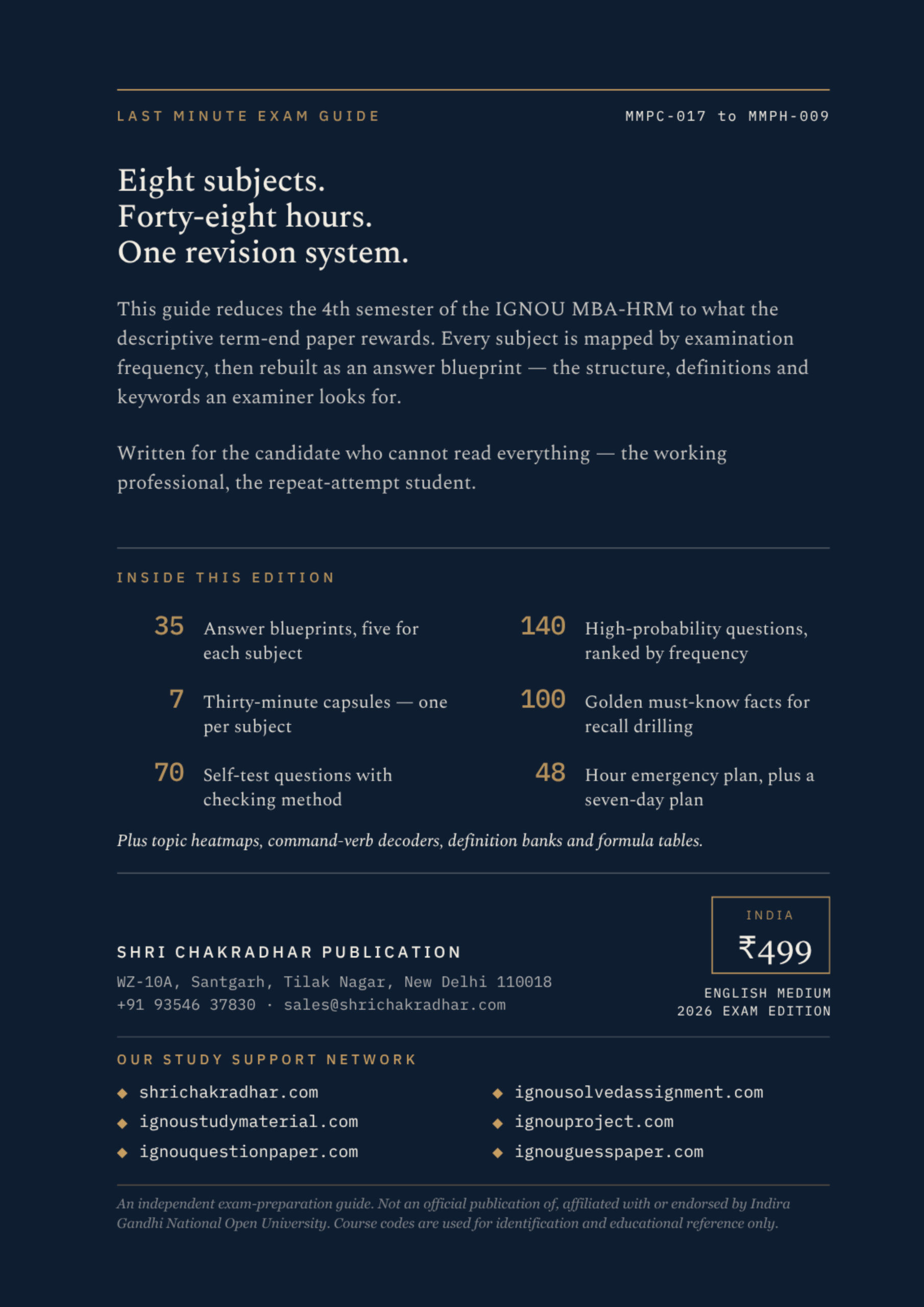
Multiplying five blueprints by eight subjects gives 40 Answer Blueprints. Sixteen numbered responses in each chapter produce 128 high-probability Q&As and 128 Exam Notes. The subject resources also include eight heatmaps, eight command-word guides, eight toolkits and eight half-hour capsules. The semester section adds one dashboard, a two-day emergency schedule, six reading depths from 48 hours down to 1 hour, 100 must-know facts, an exam-day checklist, eighty MCQs, the answer key and score bands.
Subject-wise Coverage
MMPC-017: Advanced Strategic Management
The Advanced Strategic Management chapter studies where a firm competes, how it grows and how strategy is implemented and reviewed. It brings together Chandler, Ansoff, Porter, Prahalad and Hamel, Barney, Dunning, Bartlett and Ghoshal, Rumelt, Kaplan and Norton. Coverage includes corporate policy, stability, expansion, horizontal and vertical integration, related and unrelated diversification, M&A, alliances, internationalisation, global strategy, core competence, VRIO, IT architecture, creativity, innovation, structure, culture, rewards, scorecards, turnaround and governance. Responses are organised around the chosen strategy, the circumstances supporting it, the associated dangers and a corporate illustration.
MMPC-018: Entrepreneurship
The Entrepreneurship unit begins with Schumpeter, McClelland and Danhof, then follows opportunity discovery through model selection, validation, feasibility, planning, funding and growth. It covers women, rural, social and corporate entrepreneurship; Drucker’s innovation sources; the Timmons opportunity-team-resources fit; the business model canvas; lean MVP testing; market, technical and financial appraisal; venture capital; family business; and industrial sickness. Indian institutional detail includes MSME registration, DICs, SIDBI, NABARD, KVIC, NSIC, PMEGP, CGTMSE, MUDRA, Stand-Up India and Startup India. The chapter repeatedly joins a concept to the scheme or support mechanism that makes it operational.
MMPC-019: Total Quality Management
The TQM chapter treats quality as a management system rather than final inspection. Deming, Juran, Crosby, Feigenbaum, Ishikawa, Shewhart, Taguchi, Shingo and Ohno frame the discussion. Students review customer focus, leadership, employee participation, PDCA, kaizen, seven QC tools, process variation, cost of quality, zero defects, poka-yoke, waste reduction, quality circles, Six Sigma, DMAIC, ISO 9001:2015, integrated standards, auditing, safety, benchmarking and award models. Its core examination rule is to identify the quality principle, name the technique that puts it into practice, and show the consequence through a specific organisational example.
MMPC-020: Business Ethics and CSR
The Business Ethics and CSR section combines moral philosophy with Indian corporate requirements. Bentham and Mill, Kant, Aristotle, Rawls, Gilligan, Habermas, Kidder, Friedman, Freeman and Carroll supply the principal perspectives. Topics include ethics versus law, consequential and duty-based reasoning, rights, justice, care, discourse, ethical dilemmas, the navigation wheel, nine checkpoints, organisational incentives, governance, whistleblowing, shareholder and stakeholder positions, activism, sustainability, reporting frameworks and the SDGs. The statutory layer retains the Companies Act, 2013 thresholds, two-per-cent spending rule, Schedule VII, CSR governance and unspent-fund treatment.
MMPH-003: Human Resource Planning
Human Resource Planning converts future organisational activity into a people requirement. The chapter studies the HRP cycle, strategic alignment, demand and supply forecasting, judgement methods, Delphi, nominal groups, trends, ratios, regression, workload calculations, skills inventories, replacement charts, Markov transitions, wastage analysis and external labour supply. It also addresses job descriptions and specifications, careers, succession, readiness ratings, HR audit approaches, HR information systems, analytics, human asset valuation, manpower budgets, redeployment and redundancy. Each technique is explained through its mechanism, information requirement, proper use condition and practical limitation.
MMPH-005: Organisational Development and Change
Organisational Development and Change starts with internal and external triggers and separates incremental, transformational, planned and emergent movement. Lewin, Kotter, ADKAR and Beckhard provide change frameworks; Kotter and Schlesinger structure responses to resistance. OD content includes behavioural-science values, action research, change agents, survey feedback, process consultation, team building, intergroup mirroring, role analysis and Pareek’s role efficacy. Later material examines Schein’s culture levels, culture-shaping systems, turnaround, mergers, radical process redesign, outsourcing, learning and evaluation. Students are asked to name the model, walk its stages and explain why implementation may stall.
MMPH-006: Organisational Dynamics
The Organisational Dynamics paper examines interacting forces behind conduct and change. French and Raven’s power bases sit beside dependence and political behaviour. Burns and Bass distinguish transactional exchange from transformational leadership; Tuckman charts group development and Janis explains groupthink. Pareek’s role theory covers role space, role set, efficacy and stress, supported by the Role Analysis Technique. Additional areas include communication, conflict, teams, Hofstede’s cultural dimensions, Schein’s culture and socialisation, knowledge sharing and diagnostic frameworks such as Weisbord’s six boxes, Nadler-Tushman congruence, McKinsey 7-S and Burke-Litwin.
MMPH-009: International Human Resource Management
International Human Resource Management expands ordinary HR functions across several countries, employee categories, currencies and legal systems. Morgan’s model and the PCN, HCN and TCN categories introduce the subject, while Perlmutter’s EPRG explains staffing orientation. Hofstede, Trompenaars, Hall and GLOBE support cultural interpretation. Expatriate coverage follows selection, spouse and family adjustment, failure, cross-cultural training, appraisal, rewards, taxation and return, drawing on Tung, Mendenhall and Oddou, Black and Tahvanainen. The chapter also addresses global careers, labour relations, high-performance systems, comparative practices and balance-sheet versus host-market compensation.
MMPC-017 to MMPH-009 at a Glance
| Code | Subject Title | Main Revision Area | What You Take Away |
|---|---|---|---|
| MMPC-017 | Advanced Strategic Management | Corporate direction, advantage, internationalisation, execution and review | Strategic alternatives assessed through suitability, exposure and evidence |
| MMPC-018 | Entrepreneurship | Opportunity, venture models, feasibility, finance and institutional support | Enterprise decisions connected to validation criteria and Indian programmes |
| MMPC-019 | Total Quality Management | Quality thinkers, improvement techniques, standards, Six Sigma and audit | Quality philosophy converted into prevention, measurement and control |
| MMPC-020 | Business Ethics and CSR | Moral theories, decision dilemmas, governance and statutory CSR | Ethical positions defended with philosophy, process and legal detail |
| MMPH-003 | Human Resource Planning | Forecasting, workforce supply, job analysis, succession and HR audit | Planning tools matched to available evidence and organisational need |
| MMPH-005 | Organisational Development and Change | Change triggers, resistance, OD interventions, culture and transformation | Change programmes traced from readiness through sustained adoption |
| MMPH-006 | Organisational Dynamics | Influence, politics, leadership, groups, roles and organisational diagnosis | Behaviour at work interpreted through named social-science models |
| MMPH-009 | International Human Resource Management | Culture, staffing, international assignments, appraisal and global rewards | International people decisions compared across employees and countries |
Key Features — All Verified From the Book
- Single 160-page English Medium volume: the printed course set includes four MMPC and four MMPH subjects.
- Forty adaptable response structures: each chapter supplies five Answer Blueprints suited to its question types.
- One hundred twenty-eight numbered answers: sixteen selected Q&As are provided under every course code.
- One hundred twenty-eight answer-level cautions: each model response is followed by an individual Exam Note.
- Twenty-four course navigation resources: priority heatmaps, question-command guides and checking toolkits appear for all eight papers.
- Eight immediate pre-paper reviews: every subject ends with a thirty-minute capsule.
- Six preparation windows: the reading guidance narrows from 48 hours to 24, 12, 6, 3 and 1 hour.
- One hundred final fact prompts: names, dates, frameworks, schemes and statutory details are organised by course.
- Eighty multiple-choice recall items: ten questions per paper are supported by solutions and result bands.
- Whole-semester coordination: a dashboard, two-day schedule and exam-day list connect the eight chapters.
Who Should Use This Book
The suitable reader is an IGNOU MBA (HRM) 4th Semester learner registered for the exact codes listed in this edition. The guide is intended for the revision stage after detailed university reading, when one week or a few study sessions must cover management theory, legal provisions, quality methods, workforce planning and cross-border HR systems.
It can be particularly useful to working learners whose available time comes in short blocks and to students who lose marks because they choose the wrong response form. The chapter framework clarifies when to attribute an author, show numbered stages, retain a statutory threshold, build a contrast table or conclude with an organisational implication.
How This Book Helps Students
Instead of asking the learner to reread 160 pages uniformly, the design turns preparation into decisions. The heatmap establishes order, the verb guide identifies the requested task and the blueprint provides a response route. Course logic then changes deliberately: fit-and-risk for strategy, institution-and-feasibility for entrepreneurship, principle-and-tool for quality, theory-or-provision for ethics, method-and-data for HR planning, diagnosis-and-intervention for OD, framework-and-example for organisational dynamics, and culture-and-country comparison for IHRM.
Full model responses demonstrate those routes. Notes after the answers highlight conditions, names, numbers and conclusions that are commonly omitted. Toolkits consolidate distinctions, while the capsules, fact bank and MCQs reduce the same knowledge into quick recall and error repair.
This Exam Guide and IGNOU’s Official Study Material
The official IGNOU learning blocks remain the primary academic foundation. They contain complete unit explanations, source context and extended discussion beyond the scope of a compact revision companion. Students may download the official IGNOU MBA (HRM) study material free in PDF from eGyankosh and study the files corresponding to their registered courses.
This book serves after that stage. It organises previous learning into answer plans, institutional facts, model applications and timed retrieval. Its probability markers indicate where revision may begin; they are not syllabus exclusions and do not reveal a later question paper.
Why Choose This Last Minute Exam Guide
The factual advantage is the use of eight subject-specific answer systems inside one bound book. Corporate strategy is judged by fit and risk, enterprise questions by feasibility and support, quality by the technique that implements the principle, ethics by defensible reasoning and statutory precision, HRP by method choice, OD by the movement from diagnosis to reinforcement, organisational dynamics by behaviour frameworks, and IHRM by cultural and national comparison. This makes the volume coordinated without making the subjects interchangeable.
Its boundaries are equally direct. It is not a solved-assignment collection, complete PYQ compilation, handwritten-submission service or separate guess paper. Shortened study routes are revision choices for students with earlier preparation, not replacements for the full learning material. When the programme later requires project work, the IGNOU projects, synopsis and dissertation support range is available separately.
About the Author — BK Sahni
BK Sahni (Bhavya Kumar Sahni) is an IGNOU education expert, author, and the founder of Shri Chakradhar Publication Pvt. Ltd. and ignouproject.com, and he has guided 5,00,000+ IGNOU distance-learning students since 2010. He writes the Last Minute Exam Guide series — including this book — building every title on the method he has refined across a decade of IGNOU-focused work: high-probability questions, reusable answer blueprints, topic heatmaps and quick-revision capsules aligned to the current IGNOU exam pattern. He also publishes open-access research-methodology guides for IGNOU students, archived with permanent DOIs on Zenodo and indexed on Google Scholar and ORCID (0009-0005-8092-459X). Learn more about his work at bksahni.com, or browse his complete catalogue of IGNOU books on the Amazon Author Store.
How to Use the Book Effectively
Use the dashboard to identify the paper whose response method is weakest, not merely the one scheduled first. Review the priority table and examiner verbs, then understand the five answer designs before working through individual Q&As. Recreate selected material without looking: strategy conditions, enterprise schemes, quality tools, CSR numbers, demand-and-supply methods, change stages, role or power frameworks and expatriate chains should all be written rather than only recognised.
Select a reading depth that reflects earlier study. Separate IGNOU solved previous years question papers can extend whole-paper rehearsal, while IGNOU solved guess papers may be considered as an additional resource without replacing syllabus preparation. Answer all eighty MCQs, revisit only the toolkit areas connected to mistakes and leave each half-hour capsule for the final review before its paper.
Frequently Asked Questions
What is the complete course combination in this MBA (HRM) 4th Semester guide?
Eight subjects are included: MMPC-017 Advanced Strategic Management, MMPC-018 Entrepreneurship, MMPC-019 Total Quality Management, MMPC-020 Business Ethics and CSR, MMPH-003 Human Resource Planning, MMPH-005 Organisational Development and Change, MMPH-006 Organisational Dynamics, and MMPH-009 International Human Resource Management. Each has a separate A-to-F revision chapter.
Will the order arrive as one volume or an eight-book bundle?
The product is one English Medium book containing 160 pages. Its eight course chapters are independently labelled, yet they follow one consistent navigation pattern. Buyers therefore receive a combined 2027 examination guide rather than eight individually bound course books.
Is the revision system applicable to both yearly TEE sessions?
Yes. The frameworks and recall tools can be used before the June or December Term-End Examination. They cover descriptive, analytical, statutory, comparative and application-based preparation. Priority stars only help order study effort and cannot establish the content of any particular examination paper.
Are solved assignments, handwritten work, complete PYQs and guess papers included?
No. Those separate categories are outside this title. The book instead contains 128 model Q&As, forty blueprints, eight toolkits, 100 fact prompts and eighty self-test items. IGNOU solved assignments and IGNOU handwritten assignments are available independently.
Is the combined guide enough without the prescribed IGNOU study blocks?
No. A condensed exam companion cannot reproduce the full unit explanations and learning sequence of the university material. Read the relevant official blocks for understanding, then use this book to practise framework selection, statutory details, organisational examples, concise writing and last-stage recall.
Which type of learner is this 4th Semester HRM book designed for?
It is designed for students registered in the printed course combination and already progressing through those subjects. Employed learners, self-directed distance students and candidates needing one method across eight conceptually different papers are the principal audience.
How do I decide between the 48-hour and shorter revision schedules?
Match the schedule to knowledge already acquired. The wider plans include more chapter reading, writing and self-testing; the compressed routes increasingly prioritise selected Q&As, answer frameworks, golden facts and capsules. A 1-hour plan functions only as final retrieval after substantial preparation.
Do the selected 128 questions forecast the upcoming IGNOU examination?
No. The question set is presented for prioritised revision on the basis of earlier paper patterns and topic prominence. It demonstrates useful answer construction and helps distribute limited study time, but it cannot determine which syllabus areas the examiner will select.
Must the present programme and code structure be confirmed before purchase?
Yes. Verify the latest MBA (HRM) course list, registration, date sheet, study resources and examination directions on www.ignou.ac.in. This 2027 edition follows the MMPC-017 to MMPH-009 combination printed on its cover, while another notification or specialisation may differ.
Important Note on Syllabus Verification
IGNOU periodically updates its programme structure, assignment requirements, examination schedule and study material. Before purchasing and while preparing, students should verify the latest MBA (HRM) syllabus, course list, date sheet and official instructions on the official IGNOU website (www.ignou.ac.in). This book is aligned to the MMPC-017, MMPC-018, MMPC-019, MMPC-020, MMPH-003, MMPH-005, MMPH-006 and MMPH-009 structure and refreshed as an annual exam edition, but official IGNOU sources are always the final authority.
Non-Affiliation Disclaimer
shrichakradhar.com is an independent educational publishing platform. This book and this website are not officially affiliated with, endorsed by, or operated by the Indira Gandhi National Open University (IGNOU). Course codes such as MMPC-017, MMPC-018, MMPC-019, MMPC-020, MMPH-003, MMPH-005, MMPH-006 and MMPH-009 are used solely to identify the subjects the book covers. IGNOU’s official study material and notifications remain the primary and authoritative sources for the programme.
Get Your Copy
Select this combined HRM exam guide when one organised revision source is easier to manage than disconnected notes for eight courses. Keep the official blocks beside it, recreate the frameworks without copying and use the capsules only for immediate memory retrieval. For digital study, get the IGNOU MBA (HRM) 4th Semester Book (MMPC-017 to MMPH-009) — Combined Last Minute Exam Study Guide as a soft-copy PDF on WhatsApp.