

Description
IGNOU MBAOM 3rd Semester Book — From Mathematical Models to End-to-End Operations Control
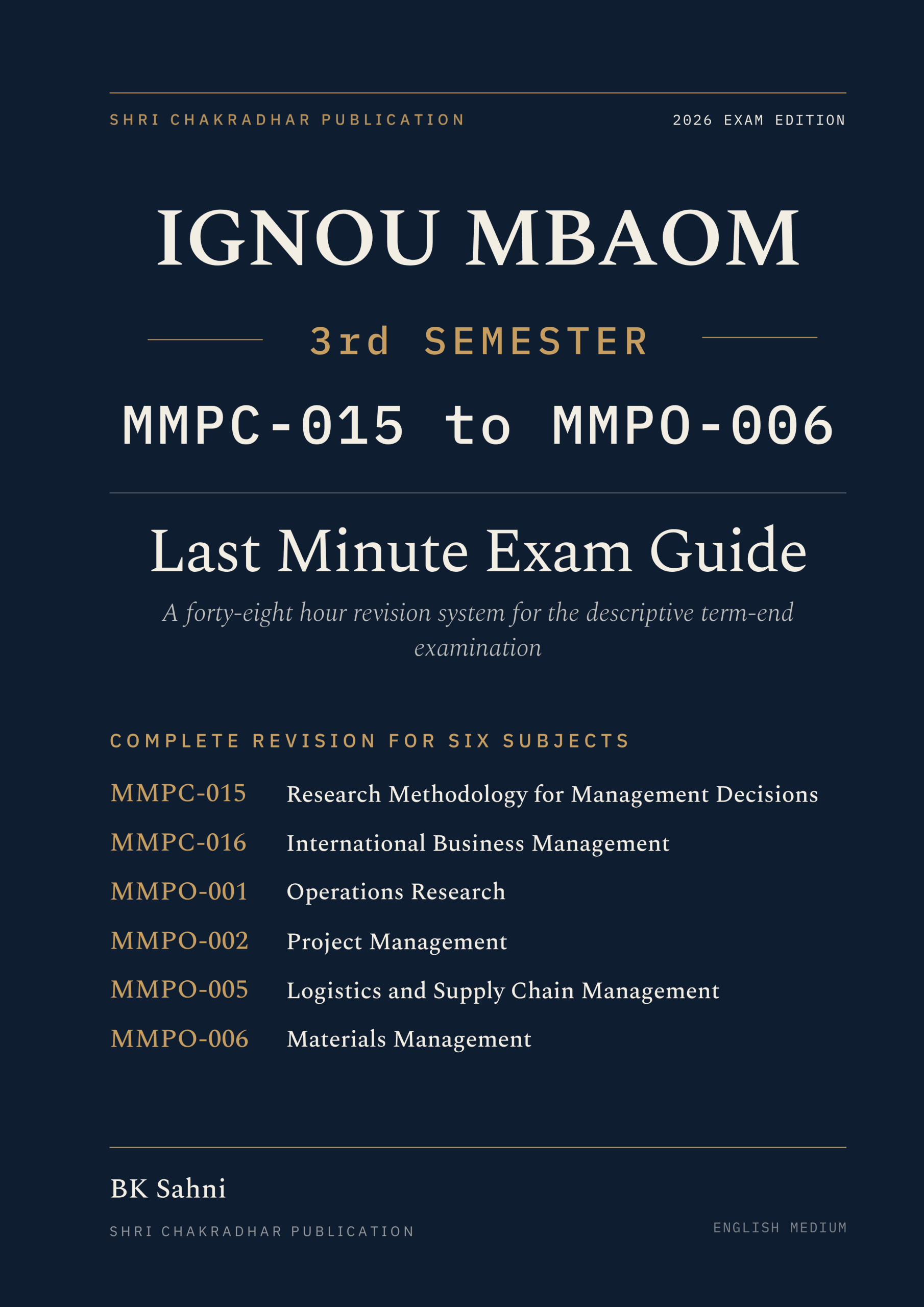
The 2027 English Medium IGNOU MBA (OM) 3rd Semester Book contains 156 pages. Its single-volume plan arranges MMPC-015, MMPC-016, MMPO-001, MMPO-002, MMPO-005 and MMPO-006 for revision ahead of the June and December Term-End Examinations. It forms part of our IGNOU books, study material and helpbooks range for all programmes.
The progression mirrors the work of an operations manager. Sound evidence is needed before a decision, overseas activity changes the operating environment, quantitative models allocate scarce resources, projects convert plans into temporary deliverables, supply chains coordinate movement across firms, and materials systems secure the inputs that production consumes. Rather than treating these as six interchangeable theory papers, the book shifts among hypothesis logic, attributed international models, optimisation algorithms, project documents, network trade-offs and inventory-control policies while keeping navigation predictable.
About the IGNOU MBAOM 3rd Semester
The course set presented here joins two shared MBA subjects with four papers from the Operations Management specialisation. Research Methodology for Management Decisions and International Business Management provide analytical and cross-border foundations. Operations Research introduces model-based allocation; Project Management deals with finite undertakings; Logistics and Supply Chain Management examines interconnected flows; and Materials Management addresses suppliers, purchasing, stores and stock control.
Preparation therefore moves quickly between unlike tasks. A student may frame H0 and H1, cite Ricardo or Dunning, construct an LP, test a MODI solution, identify a critical path, calculate CPI, diagnose order amplification, or assign control intensity to A, V or S-category items. The common six-part chapter pattern lowers the navigation burden without removing the technical vocabulary and calculation sequence each course requires.
What This Book Covers
The book gives every paper an identical route from diagnosis to final recall. Learners can locate the same six stages in each chapter, although the models, equations, thinkers and error warnings change with the discipline.
- Section A — Subject Opener and Topic Heatmap: outlines the course blocks, question character, recommended paper strategy and relative revision weight assigned to major themes.
- Section B — Command Verb Decoder: explains what the examiner expects when a prompt asks students to derive, formulate, distinguish, compute, comment, discuss or recommend.
- Section C — Five Answer Blueprints: provides transferable layouts, miniature worked structures and terminology selected for the particular code.
- Section D — Twenty High-Probability Q&As: presents complete numbered revision answers, each followed by a separate Exam Note.
- Section E — Revision Toolkit: brings named contributors, equations, definition banks, comparison grids and avoidable errors into one checkpoint.
- Section F — Thirty-Minute Revision Capsule: compresses the paper into five central ideas, priority prompts, emergency openings and high-value keywords.
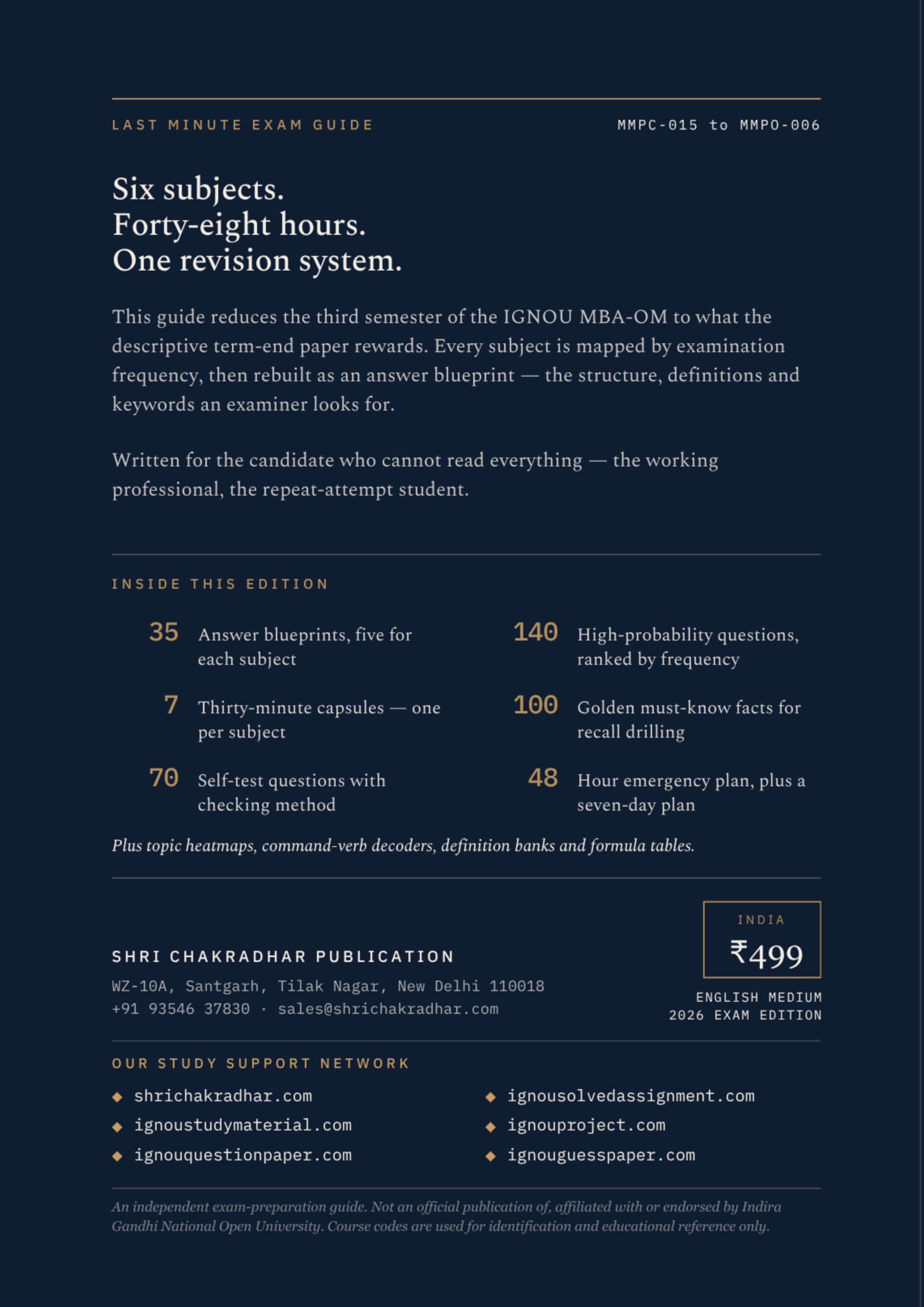
Five frameworks in each of six chapters produce 30 Answer Blueprints, while twenty numbered responses per chapter create 120 high-probability Q&As and 120 Exam Notes. The two common courses also add four distinct case exercises. Beyond the chapters, learners receive a dashboard, a two-day emergency schedule, plans that narrow to 1 hour, six heatmaps, six verb guides, six toolkits and six final-half-hour capsules. The closing pages add sixty MCQs with solutions and score bands, an examination checklist and 100 golden facts.
Subject-wise Coverage
MMPC-015: Research Methodology for Management Decisions
The MMPC-015 unit shows how an operational concern becomes a testable management study. Topics include problem definition, the research sequence, design alternatives, sampling families, primary and secondary sources, questionnaire construction, scales, measurement quality, coding, tabulation, hypothesis procedure, error types, chi-square, t, ANOVA, correlation, regression, reporting and ethics. References to Kerlinger, Kothari, Fisher, Pearson, Likert and Cronbach strengthen attribution. Worked statistical answers begin with assumptions and hypotheses, name every symbol, compare calculated and table values, and finish with the practical meaning of the result. Two cases apply chi-square and the t-test.
MMPC-016: International Business Management
The MMPC-016 chapter supplies the international setting in which operations, investment and sourcing decisions are made. Its theory ladder includes Smith, Ricardo, Heckscher-Ohlin, Vernon, Krugman, Porter, Hymer, Dunning and Johanson-Vahlne. It also covers globalisation, direct investment, contractual and equity entry, alliances, WTO rules, regional agreements, global marketing, multinational organisation, currencies, BOP, culture, expatriates, international logistics and risk controls. Indian corporate illustrations include Maruti-Suzuki, Tata-JLR, Hindalco-Novelis and Infosys. Additional cases require an entry recommendation and a glocal product decision.
MMPO-001: Operations Research
MMPO-001 develops the mathematical toolkit used to optimise constrained operations. Students revise OR foundations and models, LP formulation, corner-point analysis, the simplex algorithm, dual values, sensitivity, integer restrictions, transportation starts and MODI improvement, one-to-one assignment, waiting-line measures, project networks, stock models, risk criteria, competitive games, simulation and asset replacement. The chapter credits Dantzig, Kuhn, Erlang, Kendall, Little, von Neumann, Harris and Wilson. Numerical presentation is treated as a chain: define variables and units, write the model, display each computational test, report the optimum and explain what the final number tells the manager.
MMPO-002: Project Management
The Project Management section organises temporary work from initiation to audit. It includes project characteristics, PMBOK process groups and knowledge areas, feasibility dimensions, life-cycle behaviour, stakeholders, charters, scope, WBS, work packages, responsibility allocation, Gantt scheduling, CPM-PERT, float, risk response, scope-time-cost-quality balance, control, earned value, predictive and Agile methods, organisational forms, team development, resource adjustment, closure and post-project review. Students practise expected time and variance alongside PV, EV, AC, SV, CV, SPI and CPI. Delhi Metro, Chandrayaan and freight-corridor examples connect the frameworks to visible Indian projects.
MMPO-005: Logistics and Supply Chain Management
MMPO-005 studies how customer service, physical movement and capital interact across a network. Coverage begins with logistics scope and the seven Rs, then considers manufacturing-marketing conflict, the total-cost principle, balance-sheet consequences, carrier choice, rail and road, warehouses and cross-docking. The chain section addresses integration, the bullwhip phenomenon, Fisher’s efficient-responsive distinction, product and service designs, digital information, e-SCM, SCOR metrics, benchmarking, supplier collaboration, outsourced logistics, ECR and VMI. Forrester and Lee-Padmanabhan-Whang explain demand amplification, while Amul, Maruti and ecommerce fulfilment provide operational examples.
MMPO-006: Materials Management
MMPO-006 presents materials as a profit, continuity and working-capital lever. It covers functional scope, links with production and finance, supply-base design, vendor appraisal, development, relational purchasing, MPS-BOM-MRP planning, budgeting, selective stock techniques, EOQ, ROP, buffers, push-pull systems, JIT, kanban, WIP, spare parts, coding, standardisation, variety reduction, bills of material, source-number decisions, warehouse location, warehouse hazards, organisational integration, SCOR, value analysis and make-or-buy. ABC, VED, FSN, SDE, HML and XYZ are not merely defined; every category is paired with its appropriate review, authority, stocking or sourcing rule.
MMPC-015 to MMPO-006 at a Glance
| Code | Subject Title | Main Revision Area | What You Take Away |
|---|---|---|---|
| MMPC-015 | Research Methodology for Management Decisions | Questions, designs, samples, measurement, inference and reports | Management claims tested through an ordered evidence process |
| MMPC-016 | International Business Management | Trade, FDI, entry arrangements, institutions, culture and global activity | International choices explained through named theories and live cases |
| MMPO-001 | Operations Research | LP, allocation, queues, networks, stock and decisions under risk | Quantitative techniques completed with visible logic and interpretation |
| MMPO-002 | Project Management | Initiation, feasibility, scope, time, risk, control and completion | Project documents and indicators used in the correct sequence |
| MMPO-005 | Logistics and Supply Chain Management | Service, movement, chain integration, variability and measurement | Network choices balanced across cost, speed, capital and availability |
| MMPO-006 | Materials Management | Suppliers, requirements, stock classes, stores and performance | Material controls selected by value, risk, movement and supply difficulty |
Key Features — All Verified From the Book
- One 156-page English Medium volume: the book contains two common courses and four MBA (OM) specialisation subjects.
- Thirty reusable response plans: five blueprints in every chapter address concepts, procedures, contrasts and calculations.
- One hundred twenty numbered Q&As: all six papers contribute twenty selected revision questions and model responses.
- A separate note beneath every answer: 120 Exam Notes draw attention to missing conditions, tables, computations or applications.
- Four extra application cases: the research and international-business units each contain two scenario exercises.
- Eighteen course-level guides: six priority heatmaps, six command-word decoders and six checking toolkits support study decisions.
- Six compressed paper reviews: every chapter finishes with a thirty-minute capsule.
- Six levels of time-based preparation: instructions are supplied for 48, 24, 12, 6, 3 and 1 hour.
- One hundred back-matter fact entries: formulas, model creators, dates, sequences and control rules are arranged by course.
- Sixty answer-keyed practice items: ten MCQs per paper lead to an answer table and interpretation bands.
Who Should Use This Book
The appropriate reader is an IGNOU MBA (OM) 3rd Semester student enrolled in the six courses named on the cover. The book works after detailed syllabus reading, when revision must connect a statistical paper, an international theory paper and four operations subjects that use algorithms, project artefacts, supply-network reasoning and inventory classifications.
It may be especially practical for employed learners whose study periods are fragmented and for candidates who know the topic but need a clearer examination form. The repeated route helps them decide when to use hypotheses, a dated theory, an iteration table, a network diagram, a cause-remedy chain or a class-specific control recommendation.
How This Book Helps Students
Preparation is divided into choices that can be verified rather than pages that are passively reread. The heatmap proposes an order, and the command table clarifies whether the task is modelling, calculation, criticism or comparison. A matching blueprint then supplies the writing mechanism. Research follows design and evidence; international business joins author, year and example; OR displays the algorithm; projects create documents and indices; logistics measures chain consequences; materials converts classification into policy.
The Q&As demonstrate that mechanism in complete responses. Notes below the answers identify likely omissions, and the toolkits collect formulae, theorists and distinctions that often blur during rapid preparation. The capsules, fact pages and MCQs then shorten the same knowledge into recall, checking and correction cycles.
This Exam Guide and IGNOU’s Official Study Material
Prescribed IGNOU blocks remain the principal academic source for these courses. They provide full unit development, contextual explanation and a breadth that a compact exam companion necessarily reduces. Learners can download the official IGNOU MBA (OM) study material free in PDF from eGyankosh and use those files for complete study of the registered papers.
This guide has a later purpose. It turns prior learning into models, answer patterns, formula rehearsal, error checks and timed retrieval. The star markings suggest an order based on earlier examinations and the visibility of themes within the learning material; they neither narrow the syllabus nor disclose a coming paper.
Why Choose This Last Minute Exam Guide
Its factual differentiator is the preservation of six distinct response systems within one book. MMPC-015 asks whether evidence supports a claim; MMPC-016 explains why and how firms operate across borders; MMPO-001 proves an optimum through a method; MMPO-002 identifies what must be planned, monitored and closed; MMPO-005 balances service against total chain cost; and MMPO-006 assigns a control action to each materials category. The shared map makes these methods easy to locate without flattening them into common prose.
The limits are stated clearly. Assignment solutions, fully worked PYQ collections, handwritten submissions and a separate guess paper fall outside this volume. Its compressed schedules assume earlier reading, and the university material remains the foundation for complete programme learning.
About the Author — BK Sahni
BK Sahni (Bhavya Kumar Sahni) is an IGNOU education expert, author, and the founder of Shri Chakradhar Publication Pvt. Ltd. and ignouproject.com, and he has guided 5,00,000+ IGNOU distance-learning students since 2010. He writes the Last Minute Exam Guide series — including this book — building every title on the method he has refined across a decade of IGNOU-focused work: high-probability questions, reusable answer blueprints, topic heatmaps and quick-revision capsules aligned to the current IGNOU exam pattern. He also publishes open-access research-methodology guides for IGNOU students, archived with permanent DOIs on Zenodo and indexed on Google Scholar and ORCID (0009-0005-8092-459X). Learn more about his work at bksahni.com, or browse his complete catalogue of IGNOU books on the Amazon Author Store.
How to Use the Book Effectively
Begin at the dashboard and diagnose which response method causes the greatest difficulty before opening a course chapter. Study its topic priorities and examiner verbs, then understand the five frameworks before memorising an answer. Recreate calculations and structures from a closed book: hypotheses in MMPC-015, dated propositions in MMPC-016, full algorithm tables in MMPO-001, network and EVM workings in MMPO-002, trade-off chains in MMPO-005, and classification-control pairs in MMPO-006.
Match the reading plan to knowledge already acquired, choosing a longer route whenever possible. Continue paper practice through IGNOU solved previous years question papers, and treat IGNOU solved guess papers as a separate supplementary aid. Complete the MCQs, repair every weak area from Section E and use the relevant capsule at the end. When project work becomes applicable, consult the IGNOU projects, synopsis and dissertation support range separately.
Frequently Asked Questions
What six papers does this MBA (OM) 3rd Semester revision guide contain?
The included subjects are MMPC-015 Research Methodology for Management Decisions, MMPC-016 International Business Management, MMPO-001 Operations Research, MMPO-002 Project Management, MMPO-005 Logistics and Supply Chain Management, and MMPO-006 Materials Management. Every course receives its own A-to-F revision chapter rather than sharing a generic notes section.
Will I receive a single consolidated book or six separately bound guides?
You receive one 156-page English Medium volume for the full printed course combination. Each subject has independent heatmaps, blueprints, questions, definitions and final summaries, yet all content is bound inside the same 2027 edition. The product is consequently one semester-level companion, not a six-book parcel.
Is the material relevant to both IGNOU Term-End Examination sessions?
Yes. Students can use its revision method before the June or December Term-End Examination. The book supports theoretical, computational, comparative and applied questions across the six papers. Its probability symbols are sequencing tools only; they cannot certify which topic an examiner will select.
Are assignments, handwritten submissions, full solved papers or guess papers inside?
No. None of those separate products is included in this volume. It offers 120 model revision Q&As, thirty Answer Blueprints, four cases, formula and definition resources, golden facts and self-testing instead. IGNOU solved assignments and IGNOU handwritten assignments are available separately.
Is this compact book sufficient without studying the university blocks?
No. A revision title cannot reproduce the complete explanations and unit progression contained in the prescribed learning material. Complete the relevant IGNOU units for foundational understanding; afterwards, practise formulations, algorithms, project controls, supply-chain analysis, stock policies and answer presentation through this guide.
Which students are likely to use this operations-specialisation helpbook?
The target user is an MBA (OM) 3rd Semester learner whose registration matches all six printed codes and who has already begun the syllabus. Working professionals, independent distance students and candidates who need one organised system for quantitative and descriptive papers are the clearest audience.
What is the correct way to select a 48-hour, 12-hour or 1-hour route?
Choose by completed preparation as well as available time. The longer schedules allow wider chapter coverage, handwritten answers and self-testing; shorter options move towards selected models, capsules and fact recall. The 1-hour version is only an end-stage memory check and should not be used as initial course study.
Do the high-probability questions identify the next IGNOU paper?
No. The 120 questions function as revision priorities drawn from earlier examination patterns and the relative visibility of themes in the learning material. They cannot establish the contents of a future paper. Students should practise them for answer structure while remaining responsible for every applicable part of the current syllabus.
Do I need to verify the latest course arrangement before purchasing?
Yes. Check www.ignou.ac.in for current MBA (OM) registration details, course codes, date sheets, learning resources and examination directions. This book is built around the MMPC-015 to MMPO-006 combination stated on its cover, and a later notification or different specialisation may contain another arrangement.
Important Note on Syllabus Verification
IGNOU periodically updates its programme structure, assignment requirements, examination schedule and study material. Before purchasing and while preparing, students should verify the latest MBA (OM) syllabus, course list, date sheet and official instructions on the official IGNOU website (www.ignou.ac.in). This book is aligned to the MMPC-015, MMPC-016, MMPO-001, MMPO-002, MMPO-005 and MMPO-006 structure and refreshed as an annual exam edition, but official IGNOU sources are always the final authority.
Non-Affiliation Disclaimer
shrichakradhar.com is an independent educational publishing platform. This book and this website are not officially affiliated with, endorsed by, or operated by the Indira Gandhi National Open University (IGNOU). Course codes such as MMPC-015, MMPC-016, MMPO-001, MMPO-002, MMPO-005 and MMPO-006 are used solely to identify the subjects the book covers. IGNOU’s official study material and notifications remain the primary and authoritative sources for the programme.
Get Your Copy
Choose this combined Operations Management guide when a single structured revision source is more useful than disconnected material for six papers. Keep the prescribed blocks beside it, solve the quantitative routines without copying and save the capsules for immediate retrieval. For a digital edition, get the IGNOU MBA (OM) 3rd Semester Book (MMPC-015 to MMPO-006) — Combined Last Minute Exam Study Guide as a soft-copy PDF on WhatsApp.