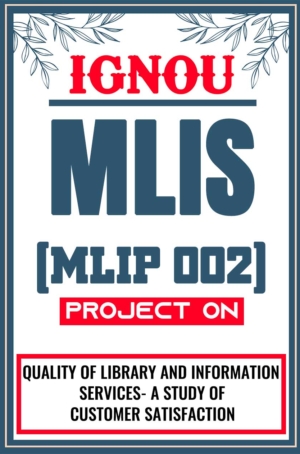
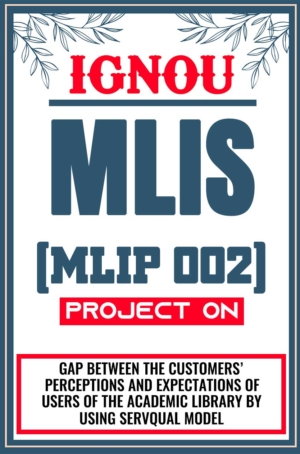
IGNOU MLIS Project (MLIP 2): What This Soft Copy Category Gives You
The IGNOU MLIS project is MLIP-002, printed as MLIP 2 in the Common Prospectus. It is the 4-credit Project Work/Dissertation of the Master of Library and Information Science programme, it carries no assignment, and it needs 50 per cent to pass. This category holds PDF reference editions of MLIP 2 synopsis and dissertation work.
A soft copy set reaches you as a download, so you can read it the same day, search it for a term, and keep it open beside your own draft. Each set is a written sample. IGNOU does not accept repeated projects, as our own listings say, so a sample is there to show you how a library and information science study is planned, written and presented. The study, the library, the data and the title in your own MLIP 2 report have to be yours.
Everything below is checked against the IGNOU MLIS Programme Guide of July 2022 and the MLIP-002 Project Work/Dissertation Guide that the Programme Guide tells students to read. If you want the same material printed, bound and posted, use the IGNOU MLIS project hard copy category, which also covers posting, uploading and the evaluation fee in detail. Students registered for MLIP-008, the PGDLAN project, need the IGNOU PGDLAN project category instead.
MLIS Project Hard CopyMLIS BooksMLIS Solved AssignmentsMLIS Guess PapersAll Project Soft Copies
Choosing an MLIS Project Topic: Strong Titles Versus Weak Ones
A workable MLIP 2 topic names three things: who or what you will study, where, and within which period. The MLIP-002 Project Guide asks the proposal to state the methodology and, if you study a population, the size of that population. A title that cannot answer those questions forces you to redraft the whole synopsis later.
| Title as students often write it | Where it runs into trouble | A version that can be researched | What the rewrite fixes |
|---|---|---|---|
| Use of e-resources | No users, no library, no period, so the methodology section has nothing to describe | Use of e-journals by postgraduate users of a university library in Delhi, 2026 | Names the users, the library and the year |
| Library automation | Names a field rather than a study, so there is no data to collect | Status of library automation in five selected college libraries of a district | Fixes a sample you can actually visit |
| Marketing of information products and services | Covers a whole block of MLI-102, which is far more than one dissertation | Awareness of information products and services among faculty users of a university library | Turns a subject into one measurable question |
| Job satisfaction of library staff | Respondents are undefined, so the population size cannot be stated | Job satisfaction among professional and semi-professional staff of public libraries in one city | Identifies exactly who you will survey |
| Preservation of rare materials | No unit of study and no boundary | Preservation and conservation practice for rare books in two selected research libraries | Sets the number of sites and the material studied |
Anchor the topic in one MLIS course
The Programme Guide asks you to work in an area related to any area of your courses of study. That is a useful test: if you cannot name the course your topic sits in, the topic is probably still too broad. The core courses are MLI-101 Information, Communication and Society, MLI-102 Management of Library and Information Centres, MLII-101 Information Sources, Systems and Services, MLII-102 Information Processing and Retrieval, MLII-103 Fundamentals of ICT and MLII-104 ICT Applications. The electives are MLIE-101 Preservation and Conservation, MLIE-102 Research Methodology, MLIE-103 Academic Library System, MLIE-104 Technical Writing, MLIE-105 Informetrics and Scientometrics and MLIE-106 Public Library System and Services. Research Methodology and Technical Writing are electives, so a student who chose neither should plan extra reading time before drafting the synopsis.
Six study areas the MLIS samples in this catalogue cover
The sample studies listed below sit in six areas that MLIS students return to most often. Each one carries a practical requirement you should settle before the synopsis goes in.
- Customer satisfaction with library and information services in academic libraries. Needs a user group you can reach in numbers and a satisfaction instrument you can defend.
- Marketing of information products and services in university libraries. Needs access to both the staff who plan services and the users who receive them.
- Influence of e-resources in an ICT environment. Needs usage evidence, whether from users or from access records the library is willing to share.
- Preservation and conservation of rare materials in selected libraries. Needs written permission to examine the material and the routines around it.
- Job satisfaction among library professionals and semi-professionals. Needs a staff list you can count and an employer comfortable with the survey.
- Facilities and services in law or special libraries of a city. Needs a defined set of institutions and time to visit each one.
Have a topic in mind and want to know which sample study comes closest to it?
WhatsApp: Match a Sample to My Topic
What Goes Into the IGNOU MLIS Synopsis (MLIP 2 Proposal)
The MLIP-002 Project Guide asks for four papers sent together, and warns that proposals incomplete in any respect are rejected outright. The synopsis itself covers the background of the study, the objectives, the methodology and the expected outcome, and states the size of the population if a population is being studied.
The four papers that travel together
- The Project Proposal Proforma, filled in and signed.
- One copy of the synopsis.
- The bio-data of your guide, signed by the guide. The July 2022 Programme Guide repeats this requirement.
- A consent letter from the guide.
The package goes to the Programme Coordinator, MLIS, Faculty of Library and Information Science, SOSS, IGNOU, Maidan Garhi, New Delhi 110068. It does not go to your Study Centre or Regional Centre, which is where advice written for other IGNOU programmes often sends students. The 2022 Programme Guide also allows a soft copy by email to the address it prints as [email protected], and asks you to send the hard copy or the soft copy, never both. Keep a copy of the synopsis yourself, because approval or non-approval comes back to you in writing and you will need the original wording to compare.
The five things the synopsis has to answer
- Background. What is already known about this question in library and information science, and what remains open.
- Objectives. Two to four statements that your data can actually test.
- Methodology. What data you will collect, from whom, using which tool, and how you will analyse it.
- Population size. The number of users, staff or libraries the study covers.
- Expected outcome. What the study will be able to say once the data is in.
Synopsis Readiness Check Before You Send It
Run this check before the proposal leaves your hands. Each line comes from something an IGNOU MLIS document asks for, and a proposal that fails any of them can be rejected as incomplete, which costs you the waiting time for a written reply and then a fresh submission.
- The title names the population, the place and the period.
- Each objective can be answered with data you can realistically collect.
- The methodology names the tool, the sampling method and the number of respondents.
- The population size is written down as a number.
- The expected outcome is stated in your own words.
- Your guide meets one of the two eligibility routes in the Programme Guide and has signed the bio-data.
- The consent letter and the proforma are signed and dated.
- You have kept your own copy of everything.
- You have decided on post or email, and are sending only one of them.
Guide eligibility in one line. The July 2022 Programme Guide allows a PhD in Library and Information Science, or a master’s in LIS with library, information centre or LIS teaching experience, and in both cases a post in the Assistant Professor scale or at Pay Level 10 under the 7th Central Pay Commission.
Choosing a Research Method for Your MLIS Dissertation
Neither IGNOU MLIS document prescribes a research method for MLIP-002. Both ask you to explain the methodology you adopt, in the synopsis and again in the report. The method therefore follows the question you set in the title, and the four shapes below cover most MLIS studies.
- User survey. Suits questions about awareness, use or satisfaction. Needs a defined population, a sampling method and a questionnaire.
- Case study of one library. Suits questions about practice, such as preservation routines or automation status. Needs permission from the library and records you can examine.
- Comparative study of two or more libraries. Suits questions about differences between sectors, such as college and public libraries. Needs the same instrument applied in each place.
- Collection or literature analysis. Suits bibliometric and informetric questions. Needs a defined set of documents and a counting rule you state in advance.
If you plan an online survey
No IGNOU MLIS document restricts how you collect data, so an online form is acceptable in principle. It does not remove any of the reporting duties. State the population you drew from, how the link reached respondents, how many replies you received and over what dates. Keep the blank questionnaire, because the Appendices section of the report is where it belongs, and keep the raw responses in case your guide wants to see them.
Reliability, validity and the tools you name
Reliability and validity are claims you have to make visible in the Methodology section. Name the instrument, say whether you adapted it from published work or wrote it yourself, and describe any pre-test you ran on a few respondents before the main round. If you use a statistical package or a spreadsheet, say so and say which calculations you ran. Findings are presented as numbered tables with a title and a source line, and each table is interpreted in words rather than left to speak for itself. That is what an evaluator reading a 4-credit dissertation is looking for.
Not sure which method fits your question, or how to word your objectives?
WhatsApp: Discuss My Methodology
From Approved Synopsis to Finished Dissertation
Approval arrives as a written communication from the Faculty. Keep it: SED’s online submission instructions ask for the approved proposal proforma in original, along with the synopsis, the guide’s bio-data and an originality certificate signed and dated by you and your guide. The report itself is typed in double space on A4 paper and bound, with a certificate from the guide.
The 13 parts, in three blocks
The Programme Guide lists a 13-part format for the MLIP-002 report. It is easier to hold as three blocks. Front matter: Certificate, Acknowledgements, Table of Contents and Preface. Body: Introduction, Review of Literature, Objectives, Methodology, Findings and Conclusion. Back matter: Bibliography, Index and Appendices. Preface and Index catch students out, because most other IGNOU project formats do not ask for either. On length, the MLIP-002 Project Guide gives about 80 to 120 double-spaced pages, not exceeding roughly 20,000 words excluding appendices and exhibits, with 10 per cent variation permitted.
Citation style: what IGNOU actually specifies
Neither the Programme Guide nor the MLIP-002 Project Guide names APA, MLA or Chicago for the MLIS project, and neither sets a font, a font size or margins. Pages that state one of those styles as an IGNOU requirement are filling a gap the documents leave open. Pick one recognised style with your guide, apply it to every in-text citation and every entry in the Bibliography, and do not switch halfway. The older guide does specify the language: English.
How to Use an MLIS Project Sample PDF Without Copying It
A sample MLIP 2 synopsis and dissertation is most useful read as a model of structure. Open it beside the 13-part list and see how each part is filled: how the library is introduced, how the review groups sources by theme, how the objectives reappear in the Findings, how tables are numbered and read.
What cannot be reused is the substance. Your synopsis is approved in your name, your guide certifies that the work was carried out under supervision, and the originality certificate is signed by both of you. Our own product notes say plainly that IGNOU does not accept repeated projects, which is why a sample is sold as reference material and not as a submission. Use it to learn the shape, then collect your own data from your own library or information centre.
Shri Chakradhar Publication has served IGNOU distance learners since 2010, with its own writers preparing the reference material and its own press for the printed editions. Open any listing in the grid below to see what a particular MLIS set covers before you buy.
Would a printed, bound copy suit you better than a PDF?
What If Your MLIS Project Is Not Approved, or Falls Short of 50 Per Cent?
If the proposal is not approved, the Faculty tells you in writing. Neither the July 2022 Programme Guide nor the MLIP-002 Project Guide sets out a published re-submission procedure for MLIS, so follow the instructions in the letter you receive and ask the Programme Coordinator, MLIS, what is required before you prepare anything again.
On marks, MLIP-002 needs 50 per cent to pass, against 40 per cent for the other MLIS components, and there is no assignment or continuous evaluation to fall back on. Project marks join theory and practical marks in the aggregate that sets your division: 60 per cent and above for first, 50 per cent for second, 40 per cent for third. The MLIS programme allows a maximum of two years from registration, so treat the synopsis as the first deadline rather than the last.
Dates and money sit with the term-end cycle. For the December 2026 examination, SED’s notice of 18 September 2026 sets 30 November 2026 as the last date to pay the project fee through the IGNOU Samarth Portal, and MLIP-002 falls in the Rs 300 band for project courses of up to 4 credits. The window for submitting the report itself is notified separately each cycle. The MLIS project hard copy page sets out the posting address, the envelope label and the upload rules in full.
Sources, Review and Independence
Every procedural statement above was checked against these official documents on 20 September 2026:
- IGNOU MLIS Programme Guide, July 2022 (Annexure III covers MLIP-002)
- MLIP-002 Project Work/Dissertation Guide on eGyanKosh and its collection page
- IGNOU MLIS programme page
- IGNOU announcements, including the SED notice on project fees for December 2026
- SED portal for project evaluation and practical examination fees
- SED project report upload instructions, December 2025 cycle
Where the documents are silent, this page says so rather than repeating a figure from another site. Confirm anything dated with the Programme Coordinator, MLIS, or the Student Evaluation Division before you act on it.
Written and reviewed by BK Sahni, Shri Chakradhar Publication Private Limited, New Delhi, serving IGNOU distance learners since 2010.
Last reviewed: 20 September 2026.
Call or WhatsApp: 9354637830, 9958947060. Contact page.
For a study planned around your own library from the start, see our customised project service.
Disclaimer: Shri Chakradhar Publication Private Limited is an independent publisher and is not affiliated with, endorsed by or connected to Indira Gandhi National Open University. Material in this category is reference material only. Approval of synopses and evaluation of project reports rest entirely with IGNOU.
- Sale!

- Sale!
IGNOU MLIS Project (MLIP 002) Synopsis/Proposal & Project Report/Dissertation in Soft-Copy (Sample-7)
Original price was: ₹500.00.₹149.00Current price is: ₹149.00. - Sale!
IGNOU MLIS Project (MLIP 002) Synopsis/Proposal & Project Report/Dissertation in Soft-Copy (Sample-6)
Original price was: ₹500.00.₹149.00Current price is: ₹149.00. - Sale!
IGNOU MLIS Project (MLIP 002) Synopsis/Proposal & Project Report/Dissertation in Soft-Copy (Sample-5)
Original price was: ₹500.00.₹149.00Current price is: ₹149.00. - Sale!
IGNOU MLIS Project (MLIP 002) Synopsis/Proposal & Project Report/Dissertation in Soft-Copy (Sample-4)
Original price was: ₹500.00.₹149.00Current price is: ₹149.00. - Sale!
IGNOU MLIS Project (MLIP 002) Synopsis/Proposal & Project Report/Dissertation in Soft-Copy (Sample-3)
Original price was: ₹500.00.₹149.00Current price is: ₹149.00. - Sale!
IGNOU MLIS Project (MLIP 002) Synopsis/Proposal & Project Report/Dissertation in Soft-Copy (Sample-1)
Original price was: ₹500.00.₹149.00Current price is: ₹149.00.