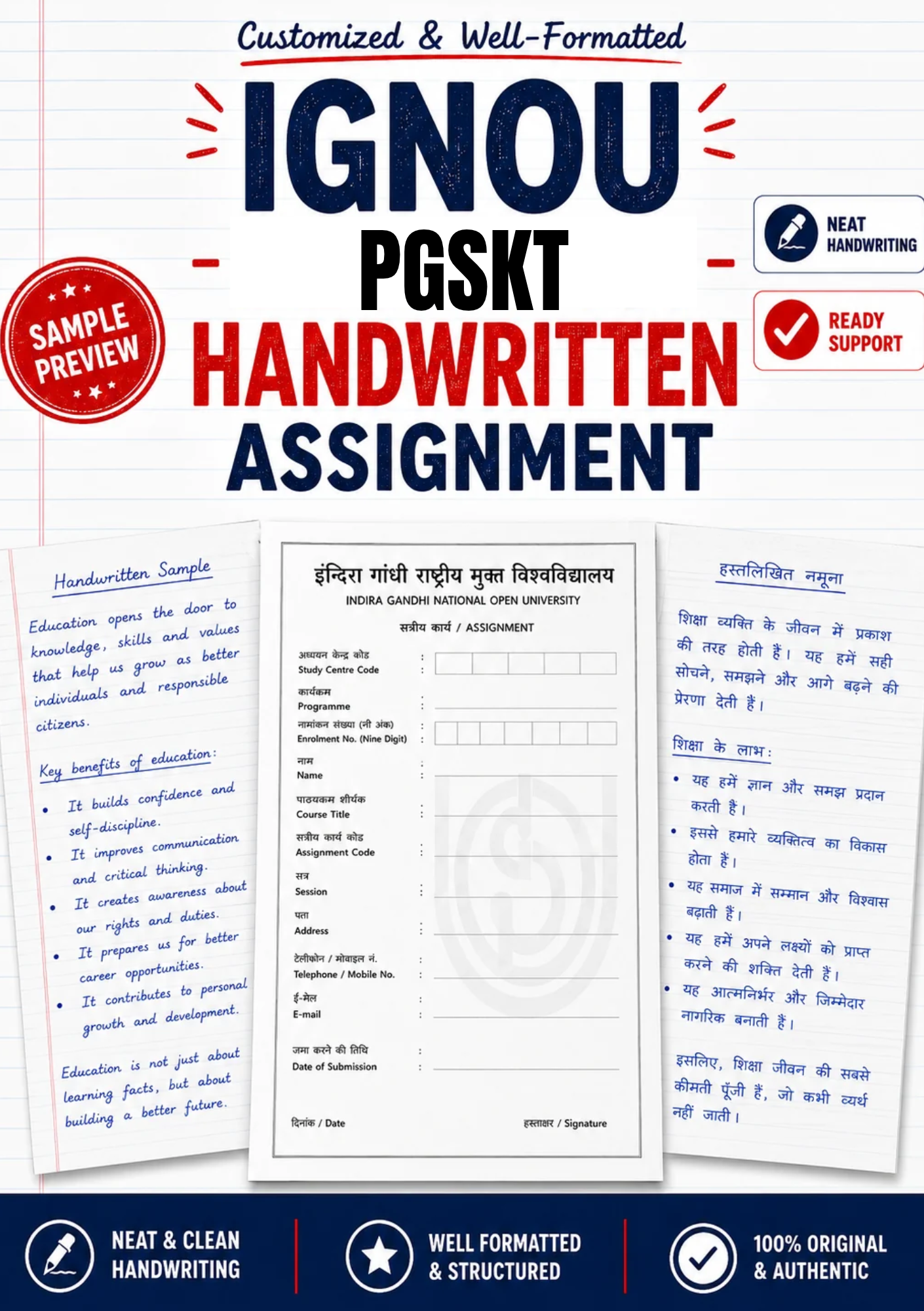


Description
In short. A PGSKT handwritten assignment is one MSK course of IGNOU’s Post Graduate Diploma in Sanskrit Sahitya mein Vigyan, a one-year School of Humanities diploma of five papers at eight credits each totalling 40 credits, answered in ink in Devanagari against the booklet IGNOU published for your cycle and delivered as a hard copy with the question paper and an IGNOU-format cover sheet; the rate is ₹320 per subject, hard copy only, with courier included in that price and no separate shipping charge, and the paper to write against is the July 2025 and January 2026 set, which is still the newest PGSKT assignment IGNOU has issued as of 14 November 2026, its own two printed cut-offs of 30 April 2026 and 31 October 2026 having both passed and no July 2026 and January 2027 file having appeared on IGNOU’s PG diploma assignment index.
What a PGSKT Parcel Holds When the Courier Hands It Over
A PGSKT order is physical, and it is worth knowing exactly what the packaging contains before the money moves. For each MSK code you name, the parcel carries the answer book itself, written through by one hand in Devanagari, with the question number copied above each answer in the sequence the booklet prints it rather than in whatever order the writer found convenient.
Beneath the answer book sits a photocopy of the official question paper for that code and cycle. It is the document that lets an evaluator match eight answers to the right twelve-question paper, and a learner who has only ever seen the booklet as a download on a phone is the one most likely to reach the counter without it. On top of both sits the IGNOU-format front page, filled in with the course code, course title, assignment code, enrolment number and study centre, included free with every order.
What the parcel does not contain is a file. No soft copy or PDF is sold. Nothing is emailed, nothing is dropped into a WhatsApp chat as a scan, and there is no download link waiting after payment. The whole deliverable is paper, because paper is what gets handed across the counter.
What ₹320 Buys on a Forty-Credit Sanskrit Diploma, and What It Leaves Out
PGSKT prices awkwardly against most IGNOU diplomas, and the reason is the credit weight. A great many PG diplomas are built from four-credit and six-credit courses, so a learner comparing quotes across programmes is usually comparing per-paper prices for lighter papers. Every PGSKT course is an eight-credit course. Five of them make the whole 40-credit award. One ₹320 subject here therefore buys the assignment for a fifth of an entire diploma.
Inside the rate sit the writing, the sheets, the ink, the free front page, the copied question paper and the courier. The rate is ₹320 per subject, hard copy only, with courier included in that price and no separate shipping charge. Handwriting matching is inside it too: send a photo of a page you have written yourself and the handwritten set is matched to your handwriting at no extra charge. There is no minimum order: one subject or fourteen, same rate.
Outside the rate sits everything that is not writing. Delivery depends on your pin code and is confirmed for your order before you pay. No figure is promised on this page. Submission at the study centre remains yours to do, as does the declaration on the cover sheet. And no claim is made about the marks any assignment will receive, about how an evaluator will assess it, or about whether it will be accepted. Assignment evaluation is entirely a matter for IGNOU.
A Sanskrit PDF You Read Against a Sanskrit Set You Hand In
Two different products circulate under similar names for MSK-021 to MSK-025, and learners regularly pay for one while needing the other. A solved assignment is a soft-copy reference file of model answers for a course code and session, read on a screen and used as material to draft from. A handwritten assignment is the booklet’s questions answered by hand on sheets, signed on the cover page and submitted in hard copy at the study centre. The first is study material. The second is the submission.
| What you are comparing | A solved MSK reference file | A handwritten PGSKT set |
|---|---|---|
| Form it arrives in | Soft copy, usually a typed PDF | Paper, written through in ink by one hand |
| What a learner does with it | Reads it, then writes the answers out | Reviews it, signs the cover page, submits it |
| Script it carries | Whatever the vendor typed it in | Devanagari, as the PGSKT booklet is printed |
| Suits a learner who | Wants to write the paper and needs the content | Has the content settled and no time to write |
| Price on this store | Carried on the PGSKT solved-assignment shelf | ₹320 per subject, courier included |
Scroll the table sideways on a narrow screen.
IGNOU’s own wording settles the question of what the counter takes. The MSK-022 booklet for July 2025 and January 2026 instructs learners to use foolscap-size paper for their answers, and the MSK-021 booklet for the previous cycle carries the same instruction in the same Hindi wording. An instruction about the size of the sheet is only meaningful if a sheet is being written on, which is why a printout of a typed file is not a PGSKT submission however complete its answers are. If a model-answer file is what you actually need, the PGSKT solved-assignment shelf carries the per-code reference files and this page is not the right purchase.
Name your MSK numbers and the quote comes back the same day you ask.
₹320 per subject · hard copy only · courier included · any cycle IGNOU has published a PGSKT paper for
The Five MSK Codes a PGSKT Record Actually Carries
PGSKT has no electives, no optional pool and no project course. Five codes, eight credits apiece, and the diploma is complete. That makes it one of the simpler IGNOU structures to quote against, provided the right five codes are being quoted. The titles below are the ones the July 2026 Common Prospectus prints in Devanagari, set beside the transliterated titles IGNOU publishes on the School of Humanities programme page for the same codes.
| MSK code | Prospectus title, as printed | Roman title on IGNOU’s SOH page | Credit weight |
|---|---|---|---|
| MSK-021 | संस्कृत वाङ्मय में विज्ञान परंपरा | Sanskrit Vaangmay mein Vigyan Parampara | 8 |
| MSK-022 | संस्कृत वाङ्मय प्रमुख वैज्ञानिक सिद्धांत | Sanskrit Vaangmay: Pramukh Vaigyanic Sidhaant | 8 |
| MSK-023 | संस्कृत में रसायन, धातु, चिकित्सा एवं वनस्पति विज्ञान का प्रायोगिक स्वरुप | Sanskrit mai Rasayan, Dhaatu, Chikitsa evam Vanaspati Vigyan ka Prayogik Swaroop | 8 |
| MSK-024 | संस्कृत: अभियांत्रिकी कृषि विज्ञान एवं पर्यावरण विज्ञान | Sanskrit: Abhiyantriki, Krishi Vigyan evam Paryavaran Vigyan | 8 |
| MSK-025 | लौकिक संस्कृत साहित्य में विज्ञान | Laukik Sanskrit Sahitya mein Vigyan | 8 |
| Total | Five courses, no elective, no project | 40 | |
Scroll the table sideways on a narrow screen.
Five papers at eight credits sum to the 40 credits the prospectus states for the award, and the arithmetic matching matters more than it looks: the prospectus entry for this diploma is printed in a legacy Devanagari font that renders as roman letters in several places, which is exactly the condition under which an extracted table silently borrows a row from the programme printed next to it. Here the sum holds. If you want the content behind the codes rather than the assignment, the five PGSKT course books sit together on one shelf, and a study guide for MSK-021 on its own is there for a learner carrying a single backlog.
One title worth noting before you copy it onto a cover sheet: the MSK-022 booklet prints the course title with a visarga and the older spelling of the final word, as संस्कृत वाङ्मयः प्रमुख वैज्ञानिक सिद्धान्त, while the prospectus prints it without the visarga as संस्कृत वाङ्मय प्रमुख वैज्ञानिक सिद्धांत. Copy whichever appears on the booklet in your hand, because that is the document the evaluator holds.
One Prefix, Three Programmes: Telling PGSKT Codes From MA Sanskrit and PGDBD
MSK is the single most overloaded prefix in IGNOU’s Sanskrit catalogue, and the overload is the commonest reason a PGSKT learner is quoted for the wrong paper. MSK is itself a programme code: it is the code for the MA in Sanskrit. It is also the course prefix for two unrelated postgraduate diplomas, each of 40 credits, sitting in different sections of the same prospectus. A learner who says only “my code is MSK” has not narrowed anything.
| Code block | Programme it belongs to | Credit weight stated | Where the booklets are filed |
|---|---|---|---|
| MSK-001 to MSK-008, MSK-011, MSK-012, plus the two marked MSKE-009 and MSKE-010 | MA Sanskrit, programme code MSK, with MSKOL as the online-mode variant | Twelve codes printed at eight credits each, two of them marked as elective papers | ignou.ac.in, under the School of Humanities assignment folder |
| MSK-021 to MSK-025 | PG Diploma in Sanskrit Sahitya mein Vigyan, programme code PGSKT | 40 credits | webservices.ignou.ac.in, in the PG diploma tree under a PGSKT folder |
| MSK-031 to MSK-035 | PG Diploma in Indian Philosophy, programme code PGDBD | 40 credits | No folder on the PG diploma assignment index at the time of writing |
Scroll the table sideways on a narrow screen.
Two things follow from that table. The first is that the two diplomas are not stored on the same server as the MA, so a learner who has bookmarked the MA Sanskrit assignment folder will never see a PGSKT paper appear in it. The second is that MSK-031 to MSK-035 currently have no published assignment folder at all, which means a PGDBD learner cannot yet be written against a current paper even though the prospectus prints the structure. If your codes are the MA Sanskrit set rather than the diploma set, the MA Sanskrit handwritten page covering MSK-001 to MSKE-010 is the one scoped for you, and the editorial page that maps the whole MSK prefix sets the three programmes side by side if you would rather read the breakdown before ordering anything.
Twenty-Three Places Where the PGSKT Paper Trail Contradicts Itself
The list below is what came out of reading the July 2026 Common Prospectus against four live PGSKT booklets, one MA Sanskrit booklet of the same session, IGNOU’s PG diploma assignment index, IGNOU’s School of Humanities programme page, three competitor listings and this store’s own category structure. Nothing in it is a guess. Sixteen of the twenty-three are disagreements inside IGNOU’s own documents, three come from other vendors, and four are defects on shrichakradhar.com that are named here because a learner is better served by knowing them than by being sold around them.
Read this before you copy a date, a code or a title onto a cover sheet.
1. The prospectus gives this diploma two different Hindi names. The programme table at entry 177 prints संस्कृत साहित्य में स्नातकोत्तर डिप्लोमा, with no mention of विज्ञान. The contents list and the section heading at 8.53 both print संस्कृत साहित्य में विज्ञान में स्नातकोत्तर डिप्लोमा. The second matches the English name IGNOU uses elsewhere; the first reads like a general Sanskrit literature diploma, which PGSKT is not.
2. The submission regime moved by a month between two consecutive cycles. The MSK-021 booklet for July 2024 and January 2025 prints 31 March 2025 and 30 September 2025. The MSK-021 booklet for July 2025 and January 2026 prints 30 April 2026 and 31 October 2026. Same code, same school, same programme, both dates shifted.
3. The MSK prefix carries two different cut-offs in the same session. The MA Sanskrit MSK-006 booklet for July 2025 and January 2026 gives 30 September 2026 for the January 2026 intake. The PGSKT MSK-021 booklet of the same session gives 31 October 2026 for the same intake. One month apart, one prefix, one School.
4. No PGSKT paper exists for the 2026-27 cycle. IGNOU’s PG diploma assignment index listed only July 2025 to January 2026, July 2024 to January 2025 and July 2023 to January 2024 when it was read on 14 November 2026, and both cut-offs printed on the newest of those had already expired.
5. PGSKT drops TMA from its assignment code and MA Sanskrit keeps it. The PGSKT booklets print MSK-021/2025-26. The MA Sanskrit booklet of the same session prints MSK – 006/TMA/2025-26. Two code grammars under one prefix.
6. The MSK-022 booklet prints its own assignment code two ways on one page, once closed up as MSK-022/2025-26 and once with a space inside it as MSK- 022/2025-26.
7. Every PGSKT booklet read for this page prints a two-digit code on the cover and a three-digit code inside. The cover says MSK-21 or MSK-25; the body says MSK-021 or MSK-025.
8. The paper-size instruction is not applied consistently. The MSK-022 booklet of the 2025-26 cycle instructs learners to use foolscap-size sheets. The MSK-021 and MSK-025 booklets of the same cycle print no paper-size instruction at all, although the MSK-021 booklet of the previous cycle did carry it. The instruction was there and then was dropped on that code.
9. The medium lines contradict each other. The prospectus gives the medium of instruction as Hindi. Immediately below it, in a legacy Devanagari font that renders as roman characters in extraction, sits an examination-medium line stating that the examination for this programme may be written in Sanskrit, Hindi or English, but that the medium must be one throughout. A reader who takes the Hindi line alone would not know the other two were permitted.
10. The fee is printed twice at two figures. The July 2026 Common Prospectus gives Rs 7,200 for PGSKT. IGNOU’s own School of Humanities programme page for the same programme code gives Rs 6,700.
11. The booklet file names follow five different patterns across three cycles. Within the 2025-26 folder alone, three files use a three-digit code and two use a two-digit one, and the MSK-025 file name omits the year 2025 altogether, reading as July and January 2026. Within the 2024-25 folder one file carries a stray space inside the code and another abbreviates the year to two digits. A path constructed by pattern rather than read off the index will fail.
12. The MSK-022 course title is spelled two ways. The booklet prints संस्कृत वाङ्मयः प्रमुख वैज्ञानिक सिद्धान्त; the prospectus prints संस्कृत वाङ्मय प्रमुख वैज्ञानिक सिद्धांत.
13. The December 2025 term-end question paper for MSK-021 is published at IGNOU’s question-paper path but carries no machine-readable text layer, so it cannot be searched or read by assistive software even though sibling MSK papers at the same path can be.
14. The December 2026 tentative date sheet has been reissued more than once, with versions dated in late September, early October and early November 2026. A date noted from one version is not safe to rely on.
15. PGSKT is scheduled for the December 2026 term-end examination while having no assignment paper for the 2026-27 cycle. A learner admitted in July 2026 is examinable but has nothing current to submit against.
16. MSK-031 to MSK-035, the PGDBD code block printed in the same prospectus, has no folder on the PG diploma assignment index at all. The structure is published; the papers are not.
17. A third-party assignment site publishes 30 April 2025 and 31 October 2025 as the two dates for the 2024-25 MSK-21 paper. IGNOU’s own booklet for that cycle prints 31 March 2025 and 30 September 2025. The site appears to have carried the newer regime back onto the older paper.
18. A vendor page dated 7 September 2026 offers PGSKT solved assignments for a July 2026 to January 2027 session. IGNOU had published no PGSKT paper for that cycle then and had still published none on 14 November 2026.
19. Three vendors state three different mediums for the same five codes. One sells them as Sanskrit medium, one as English and Hindi medium, one lists the language simply as Sanskrit. The prospectus names Hindi as the medium of instruction.
20. This store names one programme three ways across its own categories. The books category calls it PG Diploma in Sanskrit Sahitya mein Vigyan, the guess-paper category spells it out in full, and the solved-assignment category calls it Post Graduate Diploma in Sanskrit, a title IGNOU does not use for any programme.
21. One PGSKT guess-paper product on this store carries pgjmc inside its web address, a journalism programme code, while its title correctly reads PGSKT.
22. The PGSKT guess-paper category on this store holds ten products for a five-course programme, because two near-identical sets of MSK 21 to MSK 25 were published.
23. The handwritten assignment category page on this store still promises a 7 to 9 working day courier window and describes its sample as A4 ruled sheets. This product page promises no delivery figure, because delivery depends on pin code, and the PGSKT booklet that does name a paper size names foolscap rather than A4. The category page is wrong on both counts and is queued for correction.
Why Your PGSKT Cut-Off Moved by a Month Between Two Cycles
Every IGNOU booklet prints two last dates, one for each intake the paper serves, and a learner only ever needs one of them. For PGSKT the pairing is unusual in two respects: the dates run the opposite way round from the School of Management Studies pattern that circulates most widely online, and they changed between cycles.
| Paper cycle | July intake due | January intake due | Booklet this came off |
|---|---|---|---|
| July 2025 and January 2026 | 30 April 2026 | 31 October 2026 | MSK-021, MSK-022 and MSK-025, all three agreeing |
| July 2024 and January 2025 | 31 March 2025 | 30 September 2025 | MSK-021 of that cycle |
| July 2026 and January 2027 | No paper published | No paper published | PG diploma index, read 14 November 2026 |
Scroll the table sideways on a narrow screen.
The practical consequence is that any PGSKT date you find on a blog, a forum or a vendor listing is more likely wrong than right, because the figure that was correct for the 2024-25 paper stopped being correct for the 2025-26 one. The only dependable source is page one of the booklet for your own cycle, which you can download yourself from IGNOU’s own assignment download service or locate through the PG diploma assignment index where the PGSKT folders are listed cycle by cycle.
Both dates on the newest PGSKT paper have now gone by, which is the reason the backlog position on this page is stated plainly rather than softened. Any session is accepted, current cycle or older, including backlog courses, at the same ₹320 per subject. If you are sitting the December 2026 examination against an older PGSKT paper, that is the paper the set is written to, and nobody here will pretend a 2026-27 file exists in order to make the order look tidier.
Copying MSK-021/2025-26 With No TMA in the Middle
The assignment code is the short string the evaluator uses to match your answer book to a paper and a cycle, and it goes in its own box on the front page. PGSKT’s version of that string is shorter than most learners expect, because it omits the element nearly every other IGNOU programme includes.
Read left to right, MSK-021/2025-26 is the course code, then a forward slash, then the two-year span naming the cycle the paper belongs to. There is no TMA segment, no session name and no month. Compare it with the MA Sanskrit string of the same session, MSK – 006/TMA/2025-26, which carries TMA in the middle, or with the School of Management Studies pattern of MMPC-001/TMA/JULY/2026, which adds the session name as well. Three programmes, three grammars.
Two cautions follow. The first is not to add what is not printed: a learner who writes MSK-021/TMA/2025-26 on the cover sheet because every guide online shows a TMA has written a string that does not appear on the paper. The second is that the second half of the span is two digits on PGSKT, as 2025-26, not four as the MA prints it. Copy the characters off page one of your own booklet, spacing included, and the match is exact. If the booklet in your hand prints the odd spaced form, copy that.
Matching a Devanagari Hand From a Single Sample Photograph
A PGSKT set is written in Devanagari with Sanskrit passages quoted inside it, and Devanagari is less forgiving of a mismatch than roman script is. The headline stroke, the way the vowel signs attach, the height of the consonant bodies and the treatment of conjunct characters all vary between writers far more visibly than the loops of a roman hand do. A set written in a generic neat Devanagari next to a learner’s own earlier submissions does not look like continuity.
The matching step exists for that reason and it costs nothing. Send a photo of a page you have written yourself and the handwritten set is matched to your handwriting at no extra charge. The sample is read before any writing begins, and the sample photograph plus the agreed price reach you before any payment does, which puts the risk on the publisher rather than on you.
Choosing a sample page when your draft mixes Devanagari and roman transliteration
Many PGSKT learners keep notes in a mixed hand, writing the Sanskrit quotation in Devanagari and the surrounding analysis in transliterated roman. That is a poor sample. Photograph a page that is entirely Devanagari and that contains at least one Sanskrit verse or sutra written out in full, including a conjunct or two, in daylight, flat, with the whole sheet inside the frame. A page from your MSK-021 or MSK-022 notes is ideal because it will already carry the vocabulary the answer book needs. If every page you have is mixed, send two photographs rather than one and say which script each is.
Hindi on the Booklet, Three Mediums in the Exam Rule
The medium question on PGSKT has a narrow answer and a wider one, and they are easy to confuse. The narrow answer concerns the assignment: the booklets IGNOU publishes for MSK-021 to MSK-025 are printed in Hindi, with Sanskrit titles and Sanskrit quotation inside the questions, so the answer book is written in Hindi with the Sanskrit rendered in Devanagari. That is what the paper asks for and that is what gets written.
The wider answer concerns the examination. The prospectus names Hindi as the medium of instruction for PGSKT, and then adds a separate line, set in the legacy Devanagari font, stating that the examination for this programme may be answered in Sanskrit, Hindi or English, provided the medium stays the same throughout. That line is nearly invisible to anyone reading an extracted copy of the prospectus, because the font renders it as a string of roman characters that looks like corrupted text. It is also the reason three different vendors advertise three different mediums for the same five codes.
For ordering purposes none of this changes the price. The service covers all mediums IGNOU issues the TMA paper in, at the same price. What it changes is the instruction you give: say which medium your own paper is printed in and which you intend to write, and the set is prepared to match rather than to a default. Learners carrying Sanskrit-side papers elsewhere on the same record will find Sanskrit major papers at bachelor level and the twenty-two applied Sanskrit codes handled on their own pages, with their own cut-offs.
The Five Things That Turn a PGSKT Enquiry Into a Price
The quote is arithmetic once five facts are on the table, and the enquiries that take longest are the ones missing one of them. Nothing else is needed, and in particular no enrolment proof, no fee receipt and no identity document are asked for at the quoting stage.
- The MSK numbers you want written. Three digits is safer than two, because MSK-21 is ambiguous between the cover and the body of the same booklet. Say MSK-021, MSK-023 if those are the two.
- Your admission cycle. July 2025, January 2026, or an earlier intake you are clearing a backlog from. This decides which booklet the set is written against.
- The medium printed on your paper, and the medium you intend to write in if it differs from the Hindi the booklet is set in.
- One photograph of a page in your own Devanagari hand, chosen as described above.
- The delivery pin code, which is what the courier window is worked out from rather than guessed at.
Five numbers and a photograph. The reply carries the price, the sample and the confirmed courier position for your pin code, and nothing is prepaid before all three are in front of you.
Three digits, one cycle, one photo, and the writing can start today.
₹320 per subject · free IGNOU-format front page · official question paper copied in · handwriting matched at no extra cost
Opening the Parcel: What to Verify Against Your Own Record
Checking a set over takes a few minutes and it is worth doing before the parcel goes anywhere near a study centre, because a mismatch found at home is a correction and a mismatch found at the counter is a wasted trip.
Start with the code on each answer book and read it against your admission record rather than against your memory, which on a shared prefix like MSK is the thing most likely to be wrong. Then check the cycle: the two-year span in the assignment code should be the cycle you named, and the two last dates printed on the attached question paper should be the pair for that cycle rather than the pair from the one before it. Then count the answers against the booklet’s attempt rule, which on every PGSKT paper read for this page is four questions from the first section and four from the second, not all twelve.
Last, read some of it. You sign the declaration on the assignment cover page, so you should read and review the content before submitting it, and satisfy yourself that it represents your own understanding of the course. Anything that needs changing is easier to raise while the parcel is still at your address.
The Other Three PGSKT Shelves on This Store, and the Mislabelled One
PGSKT learners usually need more than one thing at once, and this store carries four PGSKT lanes, three of which are correctly named. The book shelf linked earlier holds one study guide per MSK code, for a learner working through the syllabus rather than outsourcing the assignment. The guess-paper lane carries PGSKT revision sets aimed at the December sitting, which are examination preparation and are never submitted to IGNOU. The solved-assignment lane carries the per-code reference files discussed earlier. The fourth lane is this page.
The mislabelling is worth stating rather than hiding. The solved-assignment category for this programme is currently titled Post Graduate Diploma in Sanskrit, a programme name IGNOU does not use, which means a learner searching for the full Sanskrit Sahitya mein Vigyan name may not recognise their own shelf. It is queued for correction and the category contents are correct even though its title is not.
Beyond PGSKT, the Sanskrit side of the School of Humanities runs wide. The eight-paper Vedic Studies set sits under the MVS prefix, and the Vastushastra diploma written on the same Hindi footing shares both that prefix and a programme coordinator with it, which is its own source of confusion. A learner holding codes from two programmes at once is better served by a one-off order built around a mixed code list than by placing two separate orders, and every programme set this store writes by hand is listed in one place if your codes are not PGSKT at all.
What PGSKT Learners Want Settled Before Any Money Moves
Which codes does a PGSKT handwritten assignment cover?
MSK-021, MSK-022, MSK-023, MSK-024 and MSK-025, which are the five courses of the diploma at eight credits each. There are no electives and no project course, so those five are the whole 40-credit structure. Order one of them or all five at the same ₹320 per subject.
My code starts with MSK but I am in MA Sanskrit, not the diploma. Is this my page?
No. MSK is the programme code for the MA in Sanskrit as well as the course prefix for two diplomas. MA Sanskrit codes run MSK-001 to MSK-012 with MSKE-009 and MSKE-010 marked as electives, and those are handled on the MA Sanskrit handwritten page, which also carries the MA’s own cut-off dates. MSK-021 to MSK-025 are PGSKT and belong here. MSK-031 to MSK-035 are PGDBD, the Indian Philosophy diploma, and IGNOU has published no assignment folder for those yet.
What is the last date for the PGSKT assignment?
It depends on your cycle, and the answer changed between the two most recent papers. The July 2025 and January 2026 booklets print 30 April 2026 for the July intake and 31 October 2026 for the January intake. The July 2024 and January 2025 booklets print 31 March 2025 and 30 September 2025. Read page one of your own booklet rather than trusting any date quoted on a blog, including a date quoted for the same course code a year earlier.
Why is there no PGSKT assignment for 2026-27?
IGNOU had not published one as of 14 November 2026. Its PG diploma assignment index lists PGSKT folders for July 2025 to January 2026, July 2024 to January 2025 and July 2023 to January 2024, and nothing newer. A July 2026 admission therefore has no current paper, even though PGSKT appears on the December 2026 examination schedule. Sets are written against the newest paper IGNOU has actually issued, and the backlog rate is the same ₹320 per subject.
Solved assignment aur handwritten assignment mein kya difference hai PGSKT ke liye?
Solved assignment ek soft copy reference file hai, usually a typed PDF of model answers for one MSK code and session, jise aap padhte hain. Handwritten assignment wahi questions hain jo haath se likhe gaye hain, sheets par, cover page sign karke study centre mein jama karne ke liye. Pehla study material hai, doosra submission hai. Dono ek hi cheez nahin hain.
Kya main PGSKT solved assignment PDF print karke jama kar sakta hoon?
Print karne se wo printout ban jaata hai, handwritten set nahin. MSK-022 ka July 2025 aur January 2026 booklet foolscap size paper par answer likhne ko kehta hai, aur paper size ka instruction tabhi matlab rakhta hai jab sheet par likha ja raha ho. Jo file aapne download ki hai wo likhne ke liye material hai, submit karne ke liye nahin.
Is a typed PGSKT assignment rejected at the study centre?
Acceptance is the study centre’s call and no claim is made about it here. What can be stated is what the paper itself asks for: the PGSKT booklets that name a paper size name foolscap, and IGNOU’s general submission guidance across programmes asks for handwritten work with the question paper attached. Writing by hand removes the question rather than arguing it.
Should a PGSKT set go on foolscap or A4?
Foolscap where your own booklet says so. The MSK-022 booklet of the 2025-26 cycle names foolscap, and so does the MSK-021 booklet of the cycle before it. The MSK-021 and MSK-025 booklets of the 2025-26 cycle print no paper-size instruction at all, so for those codes the sensible course is to follow the sibling paper in the same folder. Tell us which codes you hold and the sheets are chosen to match.
How many questions are on a PGSKT paper and how many must be answered?
Each paper carries twelve questions across two sections, six in each, for 100 marks in total. The instruction on every PGSKT booklet read for this page is to answer any four of the six in the first section at 15 marks each, giving 60, and any four of the six in the second at 10 marks each, giving 40. Eight answers, not twelve.
Can a PGSKT assignment be written in English?
The booklets are printed in Hindi with Sanskrit quotation, so the assignment is written in Hindi with the Sanskrit in Devanagari. The prospectus separately permits the examination for this programme to be answered in Sanskrit, Hindi or English, with one medium kept throughout, so the examination position is wider than the assignment position. Say which medium your own paper is printed in when you send the codes.
Why does my assignment code have no TMA in it?
Because PGSKT does not print one. The code on these papers is the course code, a slash and the two-year span, as in MSK-021/2025-26. The MA Sanskrit papers of the same session print MSK – 006/TMA/2025-26 with TMA in the middle, and management programmes add the session name as well. Copy what your own booklet prints and do not add a TMA segment that is not there.
The cover says MSK-21 and the inside says MSK-021. Which do I write?
Write the form that appears in the course-code and assignment-code lines inside the booklet, which on every PGSKT paper read for this page is the three-digit form. The two-digit form on the cover is the same course. If a study centre form asks you to match the cover exactly, match the cover for that form and keep the three-digit form on the answer book.
I am clearing an old PGSKT backlog from 2023-24. Can that still be written?
Yes, and at the same rate. Any session is accepted, current cycle or older, including backlog courses, at the same ₹320 per subject. The July 2023 and January 2024 PGSKT folder is still published on IGNOU’s index, so the paper for that cycle can be read and written against rather than reconstructed.
Do you sell a PGSKT solved assignment PDF on this page?
No. No soft copy or PDF is sold. This page is the handwritten hard copy only. The reference files for MSK-021 to MSK-025 sit on the store’s PGSKT solved-assignment shelf, which is a different product with a different purpose, and the link to it is in the comparison section above.
Will one writer handle all five of my PGSKT codes?
Yes where the order is placed as one order, because consistency across the five answer books is the point of matching the hand in the first place. Splitting five codes across five writers would defeat the sample photograph. If you add a code later, say that it belongs to an earlier PGSKT order and it is routed to the same writer.
When will my PGSKT parcel reach me?
Delivery depends on your pin code and is confirmed for your order before you pay. No figure is promised on this page. Send the pin code with the codes and the courier position for that address comes back with the price, rather than a general figure that may not hold for where you live.
Which Document Each PGSKT Fact Was Read Off
Three kinds of source sit behind this page and they do not carry equal weight. They are kept apart here so that a learner can tell which claims are IGNOU’s, which are read off a live document, and which are this publisher’s own commercial terms.
The prospectus. The IGNOU Common Prospectus July 2026 is the authority for the structure: five courses, MSK-021 to MSK-025, eight credits each, 40 credits in total, School of Humanities, one year minimum and three years maximum, Hindi medium of instruction, year-wise examination, January and July intakes, and the examination-medium line permitting Sanskrit, Hindi or English. The two Hindi programme names and the Rs 7,200 fee figure come from the same document. The transliterated course titles come from IGNOU’s School of Humanities programme page for PGSKT, which is also where the second fee figure of Rs 6,700 appears.
The live booklets. Four PGSKT assignment booklets were opened for this build: MSK-021, MSK-022 and MSK-025 of the July 2025 and January 2026 cycle, and MSK-021 of the July 2024 and January 2025 cycle, all from IGNOU’s PG diploma assignment index. The MA Sanskrit MSK-006 booklet of the July 2025 and January 2026 cycle was opened alongside them for the prefix comparison. The two cut-off dates, the assignment-code string, the twelve-question structure, the attempt rule, the mark split and the paper-size instruction are read off those files and from nowhere else. The index itself was read on 14 November 2026 and is the basis for the statement that no 2026-27 PGSKT paper exists.
This publisher’s own terms. The ₹320 rate, the hard-copy-only scope, the included courier, the free front page, the copied question paper, the handwriting match, the absence of a minimum order and the refusal to quote a delivery figure are Shri Chakradhar Publication’s commercial terms. They are not IGNOU rules and are not presented as such. Where this store’s own category pages contradict them, the conflict box above says so.
Important Notice
Shri Chakradhar Publication Pvt. Ltd. and shrichakradhar.com form an independent IGNOU study-support publisher. This is not the official website of Indira Gandhi National Open University, is not affiliated with, endorsed by or authorised by the university, and no page on this site should be treated as an official IGNOU communication.
Programme structures, course codes, submission dates and rules change, and only ignou.ac.in and your Regional Centre can confirm the current position for your enrolment.
You sign the declaration on the assignment cover page, so you should read and review the content before submitting it, and satisfy yourself that it represents your own understanding of the course.
No claim is made about the marks any assignment will receive, about how an evaluator will assess it, or about whether it will be accepted. Assignment evaluation is entirely a matter for IGNOU.
WhatsApp Your PGSKT Codes and the Writing Starts
₹320 per subject, hard copy only, courier included, front page and question paper in the same parcel, and your own Devanagari hand matched from one photograph at no extra charge.
Start a PGSKT order on WhatsApp at +91 93546 37830
Or ask which programme your MSK codes actually belong to first if the prefix has you unsure, and the codes get checked against the three structures before anything is priced.