

Description
In short. PGDWI, IGNOU’s Post Graduate Diploma in Writings from India, is four 8-credit English literature papers (MEG 05, MEG 07, MEG 10 and MEG 14, 32 credits in section 8.46 of the Common Prospectus July 2026), and each one carries a tutor marked assignment worth 30 per cent of that course’s result. Shri Chakradhar Publication writes those four assignments by hand at ₹320 per subject, hard copy only, with courier included, a free front page and a copy of the question paper, in a hand matched to a sample photo of your own writing. The point a PGDWI learner most needs to know is that the current papers are no longer printed as a PGDWI booklet: the 2025-26 and 2026-27 files on ignou.ac.in are MA English (Programme: MEG) papers, they ask for foolscap where the last two PGDWI booklets asked for A4, and they print three different styles of code line, one of which carries no assignment code at all. The cut-off for a July 2026 learner sitting the June 2027 examination is 31 March 2027.
Four MEG Answer Sets for a Writings From India Diploma, and What Travels With Them
A PGDWI order is counted paper by paper, not diploma by diploma. Each MEG code you name is written as its own bundle, so a learner who owes all four papers receives four bundles in one envelope, and a learner who owes only MEG 14 receives one. Nothing is assembled into a single booklet, because the study centre receives and records each course separately and your grade card shows each course separately.
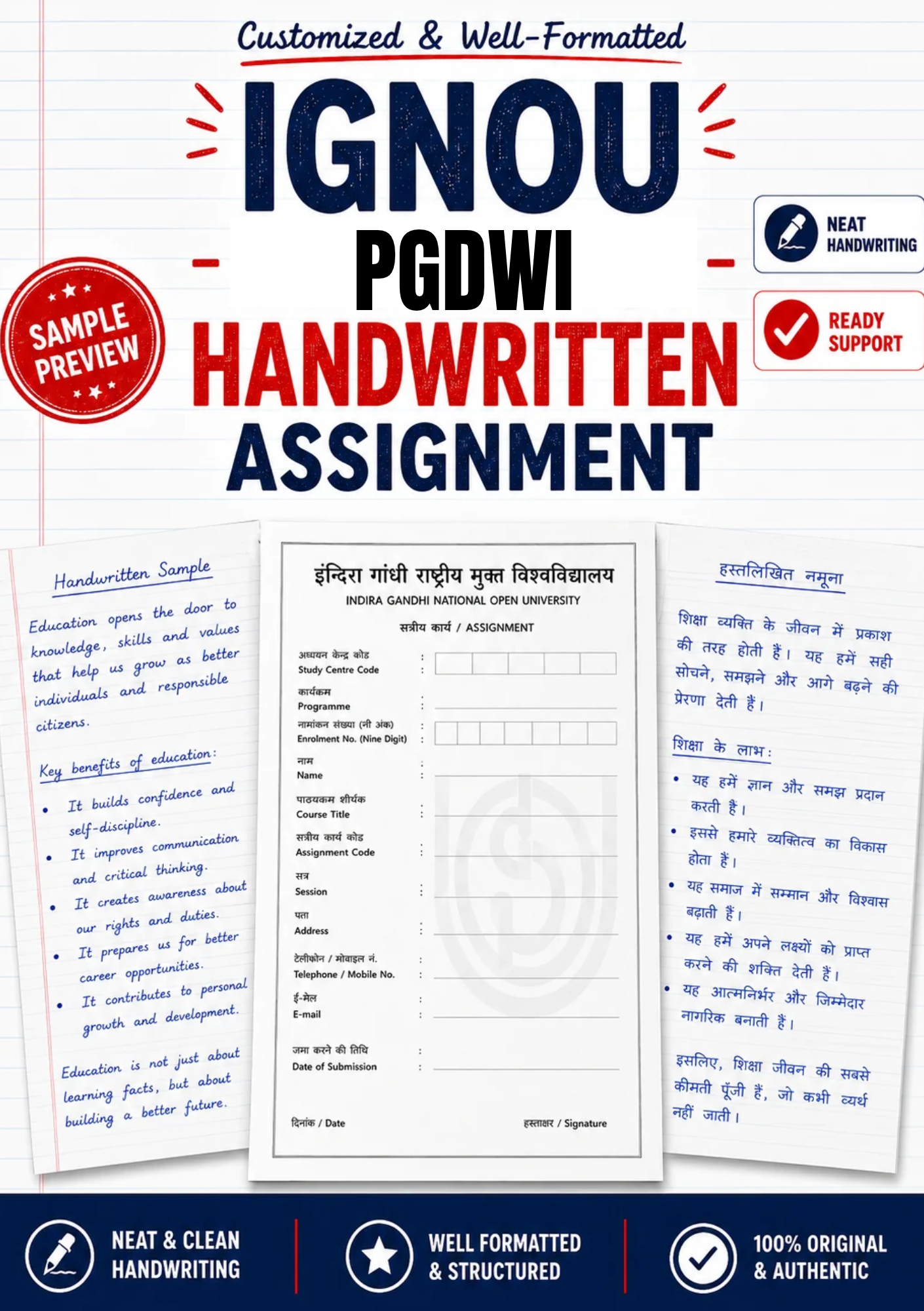
Inside each bundle there are four things. The first is the handwritten answer set itself, written in blue or black ink on the sheet size your question paper asks for, with every answer headed by the question number the booklet uses. The second is a front page in the format IGNOU asks for, carrying spaces for your enrolment number, name, address, course title, assignment number and study centre, free with every order. The third is a printed copy of the question paper the set answers, so the evaluator and you can see exactly which year’s questions were attempted. The fourth is nothing more than the folding and packing needed to keep the sheets flat in the courier bag.
What is not inside matters as much. No soft copy or PDF is sold. There is no scan of the answers for you to keep, no typed version and no file sent over WhatsApp after the parcel leaves. The set exists on paper only, because the purpose of the order is a submission in ink, and a digital copy of handwritten answers would serve no submission purpose IGNOU recognises.
On a Writings from India order the bundles are not the same size. The MEG 14 papers for 2024-25 and 2025-26 ask ten questions of 10 marks each, all compulsory, while the MEG 07 paper for 2025-26 asks you to attempt any five of eight questions at 20 marks each, and the MEG 10 papers ask five questions of 20 marks each, all compulsory. A MEG 14 bundle therefore carries ten shorter answers and a MEG 10 bundle five longer ones. The rate does not change with that difference.
₹1,280 for the Four PGDWI Papers: What That Figure Contains and What It Never Will
The rate is ₹320 per subject, hard copy only, with courier included in that price and no separate shipping charge. A complete PGDWI year, MEG 05, MEG 07, MEG 10 and MEG 14, is therefore four times ₹320, which is ₹1,280. That is the whole of the commercial arithmetic for a learner who owes all four papers and nothing else.
Several things sit inside the ₹320 and are never billed separately. Courier to your address is one. The IGNOU-format front page is another. The printed copy of the question paper is a third. Matching the writing to your own hand from the sample photo is a fourth, and the handwriting is matched at no extra charge however many papers you order. There is no packing fee, no medium surcharge and no extra amount for an older session.
There is no minimum order: one subject or fourteen, same rate. A learner who passed MEG 05 and MEG 07 in an earlier cycle and owes only MEG 10 and MEG 14 pays ₹640. A learner who owes only MEG 07 pays ₹320. Nothing is bundled to push the order size up.
Some PGDWI learners read the 2024-25 PGDWI booklet, see six codes on its course line, and assume six papers are due. That booklet also prints MEG 04 and MEG 15, and the reason is explained in the section on the two MA English years below. The figure of ₹1,280 assumes the four codes printed in section 8.46. If your admission record shows a different list, the quote follows your record, still at ₹320 a paper.
What the figure never covers is anything that happens after the parcel reaches you: the examination fee, the term-end examination itself, any re-registration fee, and the marks. No claim is made about the marks any assignment will receive, about how an evaluator will assess it, or about whether it will be accepted. Assignment evaluation is entirely a matter for IGNOU.
Model-Answer PDF or Ink on Foolscap: Which One the PGDWI Front Page Belongs To
Two products are sold to PGDWI learners under names that sound almost the same, and they do different jobs. A solved assignment is a soft-copy reference file of model answers prepared for a course code and session, such as MEG 07 for 2025-26, which you read and learn from. A handwritten assignment is the answer set written out by hand on the sheet size the booklet names and submitted as a hard copy at the study centre with your front page on top. One is something to study; the other is something to hand in.
The MEG booklets themselves settle which form the counter takes. The MEG 14 paper for July 2025 and January 2026 tells the learner, in its own words, “You should write in your own handwriting.” The MEG 10 papers for 2025-26 and 2026-27 carry the same instruction. A typed answer, a printed answer file or a photocopy does not meet that instruction, whichever site the file came from.
| What a PGDWI learner is choosing between | Solved MEG reference file (soft copy) | Handwritten PGDWI set (hard copy) |
|---|---|---|
| Form it takes | A digital document of model answers for one MEG code and one session | Ink on paper, one bundle per MEG code, with front page and question paper copy |
| What you do with it | Read it, take notes from it, then write your own answers | Read it, sign the declaration if it represents your understanding, and hand it in |
| Against the booklet instruction to write in your own handwriting | Cannot be submitted as it stands, printed or not | Written by hand on the sheet size your MEG file names |
| Suits a learner who | Has the time to write four literature papers and wants a starting point | Cannot find the writing time before the cut-off, or owes papers from an older cycle |
| Price line | Listed on the store’s solved-assignment shelf, not on this page | ₹320 per subject, courier included |
On a narrow screen, swipe the table sideways to see every column.
The honest scoping is short. A solved assignment is a reference to write from; it is not a submission, and nothing on this page suggests a downloaded file can be handed in. If a reference file is what you want, the MA English solved-assignment shelf, where MEG reference files are listed code by code is the place for it, because the store has no PGDWI-named solved shelf and every PGDWI paper is a MEG code. This page sells only the handwritten set.
You sign the declaration on the assignment cover page, so you should read and review the content before submitting it, and satisfy yourself that it represents your own understanding of the course.
Four MEG papers, one envelope, one rate.
₹320 per subject, hard copy, courier included. ₹1,280 for MEG 05, MEG 07, MEG 10 and MEG 14 together.
MEG 05, MEG 07, MEG 10 and MEG 14: The Thirty-Two Credits of Section 8.46
Section 8.46 of the Common Prospectus July 2026, on page 300, sets out the Post Graduate Diploma in Writings from India under the School of Humanities. It describes a programme built around Indian English writing and writers, the institutionalisation of English studies in India, Indian literature read in English translation from the Bhasha languages, and literary theory and criticism. Eligibility is a bachelor’s degree or a higher degree from a recognised university, and the medium of instruction is English. The section ends with the programme coordinator’s name, Prof. Pema Eden Samdup.
The course table under it has four rows and no choice. Every row is an 8-credit course, there is no project, no practical, no elective group and no viva. The table total is printed as 32, and four rows of 8 credits each come to 32, so the extracted table and the printed total agree. The annexure row for the programme (row 175) gives a minimum duration of one year, a maximum of three years, a fee of Rs 7,000, year-wise fee payment and admission in both the January and July cycles.
| MEG code in section 8.46 | Title exactly as section 8.46 prints it | Credits toward the 32 | Year the MAEG table assigns it | Latest file opened for this page |
|---|---|---|---|---|
| MEG 05 | Literary Theory & Criticism | 8 | I Year, compulsory | MEG-5 file for July 2024 and January 2025; PGDWI 2024-25 booklet |
| MEG 07 | Indian English Literature | 8 | I Year, elective | MEG-07 file for July 2025 and January 2026 |
| MEG 10 | English Studies in India | 8 | II Year, elective | MEG-10 file for July 2026 and January 2027 |
| MEG 14 | Contemporary Indian Literature in English Translation | 8 | II Year, elective | MEG-14 file for July 2025 and January 2026; a Hindi 2026-27 file issued for MATS |
| Total | Printed as 32 | 4 x 8 = 32 |
On a narrow screen, swipe the table sideways to see every column.
Three things about this table are worth reading slowly. First, the title of MEG 05 is printed here as “Literary Theory & Criticism”, while the booklets IGNOU issues for the same code call it “Literary Criticism & Theory”. It is one course, and the code is what matters on your front page. Second, all four codes are MA English (MEG) courses: PGDWI has no prefix of its own, which is why the papers you download say MEG. Third, the prospectus ends the section by saying that a learner who completes the diploma can take admission to the MA (English) programme under the lateral entry scheme, as per the university’s rules.
The IGNOU’s own listing of the Writings from India diploma lists the same four codes at 8 credits each, but labels every one of them Year 1, misspells two titles and does not print a total. Those differences are logged in the conflict box further down. They do not change what is written for you: the four codes and their questions come from the file you answer, not from the page title.
If you want the course books alongside the writing, the Writings from India diploma book shelf exists on the store, although at the time of writing it holds MEG 5 titles only.
Two MA English Years Folded Into One Diploma, and the MEG 04 and MEG 15 Papers on the 2024-25 Booklet
PGDWI looks like a one-year diploma, and the annexure gives it a one-year minimum. Its four papers, though, are not drawn from one year of the MA. The MAEG course table in the same prospectus places MEG 05 as the compulsory first-year paper and MEG 07 among the first-year electives, while MEG 10 and MEG 14 sit among the second-year electives. A PGDWI learner is therefore writing two first-year MA papers and two second-year MA papers in the same diploma, and the questions on MEG 10 and MEG 14 are set for MA second-year learners, not for a diploma audience.
This explains a line that unsettles many PGDWI learners. The 2024-25 PGDWI booklet prints its course line as “MEG – 04, 05, 07, 10, 14 & 15” and adds MEG 04 Aspects of Language and MEG 15 Comparative Literature to the four diploma papers. Its letter to the learner says that, depending on whether you are in the MA first or second year, you will also need to do MEG 05 and MEG 04 or MEG 15, and that this is why MEG 04 and MEG 15 are included. The MEG 15 header in the same booklet calls it a compulsory component for the second year, to be chosen between MEG 04 and MEG 15.
| Extra code on the 2024-25 booklet | Title of the course | In section 8.46? | How the 2024-25 PGDWI booklet presents it | MAEG table placing |
|---|---|---|---|---|
| MEG 04 | Aspects of Language | No | Printed in full with the code MEG-04/TMA/2024-2025 | II Year, elective |
| MEG 15 | Comparative Literature | No | Printed in full, headed as the second-year compulsory choice between MEG 04 and MEG 15 | II Year, elective |
On a narrow screen, swipe the table sideways to see every column.
The plain reading is that the 2024-25 PGDWI booklet was assembled for MA English learners who also hold the diploma route, and that a learner enrolled for PGDWI alone owes the four codes in section 8.46. That reading is consistent with the 2023-24 PGDWI booklet, whose course line is “MEG – 05, 07, 10 & 14” with no MEG 04 or MEG 15. It is still a reading, not a ruling. The only document that settles what you owe is your own admission record or fee receipt, and if it lists MEG 04 or MEG 15 those papers are written at the same ₹320 each.
The online-mode MA English programme information that IGNOU hosts on its Samarth portal frames the same codes as a module. It lists a “Writings from India” module made of MEG 7, MEG 10 and MEG 14, and says a learner may exit with a PG Diploma in English after 32 credits. That is a different exit award name from PGDWI, and it belongs to the online programme, but it confirms how closely the diploma is tied to the MA structure.
Twenty-Nine Points Where the PGDWI Paperwork Pulls in Different Directions, Eight of Them on This Store
Everything in the box below was found on 9 November 2026 by reading IGNOU’s own PGDWI and MEG documents against each other, and by reading this store’s own listings against those documents. None of it is offered as criticism of the university. It is listed because a learner who copies the wrong code, the wrong title or the wrong sheet size onto a front page is the one who has to sort it out at the counter.
Twenty-nine discrepancies were logged for this page: twenty in IGNOU’s own documents, one between IGNOU’s printed dates and press reports, and eight in this store’s own listings. Where IGNOU’s documents disagree, follow the file for your admission cycle and confirm with your Regional Centre.
1. MEG 05 is titled four ways. Section 8.46 prints “Literary Theory & Criticism”; the MAEG table in the same prospectus prints “Literary Theory and Criticism”; the PGDWI and MEG booklets print “Literary Criticism & Theory”; the PGDWI programme page prints “Literarcy Criticism and Theory”.
2. The PGDWI programme page spells MEG 07 as “Indian English Literarture”.
3. The programme page labels all four PGDWI papers Year 1, while the MAEG table in the prospectus places MEG 10 and MEG 14 among the second-year electives.
4. The MAEG table marks MEG 05 as compulsory, while the letter in the MEG-5 file for July 2024 and January 2025 calls it “the elective English course”.
5. The 2024-25 PGDWI booklet prints six codes on its course line (MEG 04, 05, 07, 10, 14 and 15) against the four in section 8.46.
6. The same booklet heads MEG 15 as the compulsory component for the second year, although PGDWI has no second year of its own.
7. The same booklet numbers the MEG 15 questions 1, 1, 3, 4 and 5, skipping 2 and repeating 1.
8. The PGDWI booklets for 2023-24 and 2024-25 ask for A4 paper, while the MEG-07 and MEG-10 files for 2025-26 and the MEG-10 file for 2026-27 ask for foolscap only.
9. The MEG-14 file for 2025-26 asks for “full scrape size paper”, which reads as a misprint of foolscap.
10. No PGDWI-headed booklet for 2025-26 or 2026-27 was located; the current MEG-07, MEG-10 and MEG-14 files name Programme: MEG and do not mention PGDWI at all.
11. The current files key their dates three different ways: MEG-10 to the admission session with the year printed, MEG-07 for 2025-26 to the session without a year, and MEG-14 for 2025-26 to the June or December examination.
12. The 2023-24 PGDWI booklet prints its four codes in four shapes: “MEG – 05/TMA/2023-2024”, “MEG-07/ TMA/2023-24”, “MEG – 10/ TMA / 2023 -24” and “MEG-14/TMA/2023-2024”.
13. The 2024-25 PGDWI booklet prints MEG 10 as “MEG 10/ TMA 01/ 2024 -25”, with a TMA number no other PGDWI code carries, and prints MEG 07 as “MEG-07/ 2024-25” with no TMA at all.
14. On the 2025-26 files, MEG 07 prints “MEG-07/2025-26” without TMA, MEG 14 prints “MEG-14/TMA/2025-26” with it, and MEG 10 prints no assignment code at all, only “Course Code: MEG – 10”.
15. The MEG-10 file for 2026-27 again prints no assignment code, only the course code line.
16. The MEG 07 question pattern changed between cycles: answer all five questions in 2023-24 and 2024-25, attempt any five of eight in 2025-26.
17. The MEG 14 question pattern changed as well: any five of seven at 20 marks in 2023-24, then ten questions at 10 marks each, all compulsory, in 2024-25 and 2025-26.
18. The cover of the MEG-10 file for 2025-26 prints the title as “EMGLISH STUDIES IN INDIA”.
19. The MEG-14 file for 2025-26 does not say where the assignment is to be submitted, while the MEG-07 and MEG-10 files name the coordinator of your study centre.
20. The only 2026-27 MEG-14 file located is a Hindi paper issued by the School of Translation Studies and Training for MATS and MATSOL, while section 8.46 gives PGDWI’s medium as English only.
21. Every MEG file read for this page prints 30 September as the January-cycle or December-examination cut-off, while press reports dated 28 to 29 October 2026 describe an extension for the December 2026 examination to 20 November 2026 through online submission. The extension is not printed on any MEG file.
22. In-house: the store’s Writings from India book shelf holds two products, and both are MEG 5 books; no MEG 07, MEG 10 or MEG 14 book is filed under PGDWI, although all three exist elsewhere on the store.
23. In-house: the two MEG 5 book listings filed under PGDWI carry a WhatsApp button to a different number from the +91 93546 37830 used on this page.
24. In-house: the MAEG handwritten product has a table of PG diplomas built from MEG papers that does not list PGDWI.
25. In-house: the MAEG handwritten product says every MEG booklet it checked asks for foolscap, while the PGDWI booklets for 2023-24 and 2024-25 ask for A4 for the same codes.
26. In-house: the MAEG handwritten product describes an examination-keyed MEG date pair of 30 April and 31 October, while the MEG-14 file for 2025-26 and the MEG-03 file for 2026-27 read for this build print 31 March for the June examination.
27. In-house: the MATS handwritten product describes its written set as being on A4, while the MEG-14 file it is built on asks for full-size (foolscap) paper.
28. In-house: the store’s general handwritten category page still prints a fixed working-day delivery window, first-person copy and A4 ruled sheets as the default, none of which this page repeats, and the last of which does not match the current MEG files.
29. In-house: before this product, the store had no PGDWI handwritten, solved or guess-paper shelf, and ignouproject.com had no PGDWI article, so PGDWI learners were routed to MA English pages without being told which four codes apply to them.
Disclosing the store’s own errors is deliberate. A page that lists eight of its own publisher’s mistakes is easier to trust on the other twenty-one, and every in-house item above is listed for correction at source.
31 March or 30 September, Keyed Three Different Ways Across the Four MEG Papers
Submission deadlines at IGNOU are set by school, and sometimes by programme or by course, so no date from another product should be carried onto a PGDWI set. The School of Humanities MEG files read for this page all land on the same pair of calendar dates, 31 March and 30 September. What differs is what those dates are keyed to, and that is where learners go wrong.
| File read on 9 November 2026 | July-cycle or June-examination line | January-cycle or December-examination line | The date is keyed to |
|---|---|---|---|
| PGDWI booklet, July 2023 and January 2024 | 31st March (July session) | 30th September (January session) | Admission session, no year printed |
| PGDWI booklet, July 2024 and January 2025 | 31st March 2025 (July 2024 session) | 30th Sept, 2025 (January 2025 session) | Admission session, year printed |
| MEG-07, July 2025 and January 2026 | 31 March (July session) | 30th September (January session) | Admission session, no year printed |
| MEG-10, July 2025 and January 2026 | 31st March 2026 (July 2025 session) | 30th Sept, 2026 (January 2026 session) | Admission session, year printed |
| MEG-14, July 2025 and January 2026 | 31st March (June examination) | 30th September (December examination) | Term-end examination |
| MEG-10, July 2026 and January 2027 | 31st March 2027 (July 2026 session) | 30th Sept, 2027 (January 2027 session) | Admission session, year printed |
On a narrow screen, swipe the table sideways to see every column.
Read together, the files give a PGDWI learner three working positions. If you were admitted in July 2026 and will sit the June 2027 examination, your papers are due by 31 March 2027, and every keying method agrees on that. If you were admitted in January 2027, the date is 30 September 2027. If you were admitted in January 2026 and are entered for the December 2026 examination, the printed date was 30 September 2026, and it has passed.
That last group is the one with a live question. Press reports dated 28 and 29 October 2026, including Careers360, describe IGNOU extending assignment submission for the December 2026 term-end examination to 20 November 2026 through an online submission window, after an earlier extension to 31 October. Those reports are third-party news, not text printed on any MEG file, so treat 20 November 2026 as a date to confirm on ignou.ac.in or with your Regional Centre before you rely on it. If it holds, it is a real deadline, and the only legitimate reason for urgency on this page.
Two habits keep the date straight. Read the cut-off off the file you are actually answering, not off a friend’s MEG paper from another cycle. And if your admission cycle and your examination sitting point to different dates, ask your study centre which one it is applying, because the two keying methods only diverge when a learner sits an examination out of sequence.
Programme structures, course codes, submission dates and rules change, and only ignou.ac.in and your Regional Centre can confirm the current position for your enrolment.
MEG-14/TMA/2025-26, MEG-07/2025-26 and a MEG 10 Paper With No Code at All
The front page asks for an assignment number, and on a PGDWI set it is easy to stall on that box, because the four papers do not print it the same way. The rule that keeps the evaluator and the study centre clerk on your side is simple: copy the string your own question paper prints, character for character, and do not tidy it into a pattern borrowed from another code.
| PGDWI paper | File and cycle | Code line as the file prints it | Contains TMA? |
|---|---|---|---|
| MEG 05 | PGDWI booklet, 2023-24 | MEG – 05/TMA/2023-2024 | Yes |
| MEG 07 | PGDWI booklet, 2024-25 | MEG-07/ 2024-25 | No |
| MEG 10 | PGDWI booklet, 2024-25 | MEG 10/ TMA 01/ 2024 -25 | Yes, with a number |
| MEG 14 | PGDWI booklet, 2024-25 | MEG-14/TMA/2024-25 | Yes |
| MEG 07 | MEG file, 2025-26 | MEG-07/2025-26 | No |
| MEG 10 | MEG file, 2025-26 | None printed; only “Course Code: MEG – 10” | No |
| MEG 14 | MEG file, 2025-26 | MEG-14/TMA/2025-26 | Yes |
| MEG 10 | MEG file, 2026-27 | None printed; only the course code line | No |
| MEG 14 | SOTST Hindi file for MATS, 2026-27 | MEG-14/TMA/2026-27 | Yes |
On a narrow screen, swipe the table sideways to see every column.
Where the file prints a full string with TMA in it, as MEG 14 does, that string goes on the front page as printed. Where it prints a course code and session but no TMA, as MEG 07 does for 2025-26, the course code line is the assignment number IGNOU has given you, and adding “TMA” yourself creates a string the university never issued. Where the file prints only “Course Code: MEG – 10” and the session heading, write the course code with the session shown at the top of the questions, which for the 2026-27 paper is “ASSIGNMENT 2026 – 2027”, and ask your study centre if it wants anything more.
The front page that comes with each bundle leaves the assignment number for you to fill in from your own paper for exactly this reason. A front page pre-filled with a guessed string would be quicker to hand in and wrong more often.
Four Literature Papers Copied in the Hand Shown in Your Sample Photo
Send a photo of a page you have written yourself and the handwritten set is matched to your handwriting at no extra charge. On a PGDWI order the match matters for an ordinary reason: the same study centre sees your MEG assignments and the same university sees your term-end scripts, and four papers in four visibly different hands invite a question nobody needs.
The order of events protects you. The photo comes first. A short sample written in the matched hand comes back to you on WhatsApp. Only when you have seen that sample and are satisfied does the order go ahead and payment fall due. If the match is not close enough, say so at that stage, and the sample is redone before anything is written for submission.
Matching covers the things a reader notices: letter shapes, slant, spacing between words, the size of the writing against the line, the way headings and question numbers are set out, and whether you underline. It does not extend to your signature: the declaration on the front page is yours to sign.
Choosing a sample page for essay-length English answers
MEG answers are continuous prose, so the most useful photo is a page of your own running sentences rather than a list or a form. A page of notes from a literature lecture, a letter or any paragraph you wrote in ink works well. Photograph it flat, in daylight, so the whole page is in the frame and the lines are sharp. If you write differently in English and in Hindi, send the English page, because PGDWI is answered in English. If your examination scripts are written in a particular ink colour, mention it.
English Medium on Record, a Hindi MEG 14 File Elsewhere, and PGDWI Papers Left From 2023-24
The service covers all mediums IGNOU issues the TMA paper in, at the same price. For PGDWI that is a short list. Section 8.46 gives the medium of instruction as English, and every MEG file read for this page is an English paper, except one: the 2026-27 MEG-14 file issued by the School of Translation Studies and Training for the MA in Translation Studies, which is printed in Hindi. That file belongs to the translation programme. A PGDWI learner is enrolled in an English-medium diploma and should answer the English MEG 14 paper, and the set is written in English unless your own record says otherwise.
Learners who also hold MATS papers and want the Hindi MEG 14 written are better served by the MA Translation Studies handwritten listing, which covers the borrowed MEG 14 paper, because the codes, medium and cut-off for that programme are set out there.
Any session is accepted, current cycle or older, including backlog courses, at the same ₹320 per subject. That matters on PGDWI because the diploma’s papers have changed more than most between cycles. A learner who joined in July 2023 and still owes MEG 14 may find that the 2023-24 PGDWI booklet asked for any five of seven questions, while the current MEG 14 file asks all ten. Which year’s questions you answer is a rule IGNOU and your study centre set, not a choice the publisher makes. Tell the desk which file your study centre has asked for, and the set answers that file.
The maximum duration printed for PGDWI is three years from admission. A backlog order is welcome at any point inside that window, but whether a paper written for an expired cycle is still accepted at your study centre is a question for the centre, and the honest advice is to ask before ordering an old cycle rather than after.
Code List, Admission Cycle, Exam Sitting, Photo, Pin Code: The Five-Line PGDWI Message
A PGDWI quote is built from five pieces of information, and nothing beyond them is asked for. A short WhatsApp message carrying all five gets a complete answer in one reply.
- The MEG codes you still owe, as your admission record or fee receipt shows them. For most PGDWI learners that is MEG 05, MEG 07, MEG 10 and MEG 14, or a subset of them.
- Your admission cycle, July or January, and the year, so the right file and cut-off are used.
- The examination you are entered for, June or December and the year, because the MEG 14 file keys its date to the examination rather than the session.
- A photo of a page in your own handwriting, taken as described above.
- Your delivery pin code, so the delivery position can be confirmed before you pay.
Your enrolment number, study centre and address go on the front page you fill in yourself, so they do not need to be sent for a quote. If you have already downloaded the question paper you want answered, sending a photo of its first page removes any doubt about which file is meant.
Delivery depends on your pin code and is confirmed for your order before you pay. No figure is promised on this page.
Not sure your cut-off still leaves room for a written set?
Ask first. Each paper is ₹320, hard copy, with courier included, and the delivery position for your pin code is confirmed before any payment.
Paper Size, Front Page and the Study Centre Counter Once the PGDWI Envelope Is Open
When the parcel reaches you, the remaining work is yours, and on PGDWI it is short but not optional. Begin by checking each bundle against your order: the MEG code on the question paper copy, the session printed on it, and the number of answers against the number of questions the paper asks you to attempt.
Then read the answers. You sign the declaration on the assignment cover page, so you should read and review the content before submitting it, and satisfy yourself that it represents your own understanding of the course. A MEG 07 answer on Kanthapura or a MEG 14 answer on Samskara is something an academic counsellor may ask you about, and the term-end examination will ask about the same texts without the assignment in front of you.
Fill in the front page yourself. Copy the assignment number from your question paper as the section on code lines explains, write your enrolment number exactly as it appears on your identity card, and name your study centre as IGNOU has allotted it. The MEG files read for this page ask for the enrolment number, name, address and date at the top right of the first page, and the course title, assignment number and study centre in the centre.
Tag the pages of each course separately, in order, and keep the courses apart; the files ask for the pages to be tagged carefully. Hand each set to the coordinator of your study centre, or submit it the way your Regional Centre has told you to, and take a receipt. If you are submitting through IGNOU’s online window rather than at the counter, follow the upload instructions IGNOU publishes for that window and keep the paper original. Keep a photocopy or scan in any case, as the MEG files read for this page advise, in case a set is lost in transit.
Assignments carry 30 per cent of the final course result and the term-end examination carries the remaining 70 per cent. The set covers the first share. The second share is the examination, and that is where the rest of this page’s links are aimed.
Indian English Literature Books, MEG Guess Papers and the MA English Bridge After PGDWI
A handwritten set answers the assignment half of each PGDWI course and nothing more, so most learners need something for the examination half as well. Because every PGDWI paper is a MEG code, most of what is useful sits on the MA English shelves rather than under a PGDWI label.
For course reading, the MEG-07 study guide on Indian English Literature is written for the paper of the same name, the English Studies in India guide for MEG-10 serves the English studies paper, and the guide to the translated Indian texts set for MEG-14 serves the translation paper. The wider MA English book shelf for every MEG code holds the remaining titles, including the literary theory volume for MEG 05.
For examination practice, the expected-question sets written against MEG term-end papers and the earlier MEG examination papers with worked answers are both filed under MA English. Pick the PGDWI codes from them; the other MEG codes on those shelves belong to MA learners.
If you plan to use the lateral entry route into the MA once the diploma is complete, the MAEG handwritten product for learners continuing into MA English covers the MEG papers you would meet next. And for any IGNOU programme other than PGDWI, the full handwritten section, arranged programme by programme lists every written set at the same rate.
If you would rather write the four papers yourself, the sister site’s walk-through of MEG assignment writing on ignouproject.com explains how the MA English papers are set out and answered, and applies to the PGDWI codes because they are the same papers.
Sixteen PGDWI Questions, Starting With Why Your Paper Says MEG and Not PGDWI
My MEG 07 paper says Programme: MEG. Is it really the paper a PGDWI learner answers?
Yes, on the evidence available. PGDWI has no course prefix of its own; its four courses in section 8.46 of the prospectus are MEG 05, MEG 07, MEG 10 and MEG 14. The last booklet headed PGDWI that was located is for July 2024 and January 2025. For 2025-26 and 2026-27, the only MEG 07, MEG 10 and MEG 14 papers found on ignou.ac.in are the MA English files, so those are the papers in circulation for the codes. If your study centre has issued anything different, follow the centre.
PGDWI mein kitne assignment likhne hote hain, chaar ya chhe?
Section 8.46 lists four courses, so a learner enrolled in PGDWI alone normally writes four: MEG 05, MEG 07, MEG 10 and MEG 14. The 2024-25 PGDWI booklet also prints MEG 04 and MEG 15, but its own letter ties those two to MA first- or second-year learners. Your admission record decides. If it shows six codes, all six are written at ₹320 each.
What does the full PGDWI set cost, and is courier charged on top?
The rate is ₹320 per subject, hard copy only, with courier included in that price and no separate shipping charge. All four PGDWI papers come to ₹1,280. The front page and the question paper copy are included in each ₹320.
PGDWI ke liye MEG ka solved assignment kaafi hai, ya handwritten set lena padega?
Solved assignment ek soft-copy reference file hoti hai jisse aap padhkar apne answers likhte hain. Handwritten set wahi answers haath se likhe hue hard copy mein hote hain jo study centre par jama hote hain. MEG 14 aur MEG 10 ki files khud kehti hain, “You should write in your own handwriting.” Isliye solved file padhne ke liye theek hai, jama karne ke liye nahi. No soft copy or PDF is sold.
Can a printed MEG 14 answer file be handed in at the study centre instead of a written one?
Not if the paper asks for your own handwriting, and the MEG 14 file for 2025-26 does. A printout of a downloaded answer file is a typed document whatever its source. It can help you write your own answers; it is not the submission the paper describes.
If a MEG 10 reference file is bought for study, is the handwritten set still needed?
Only if you are not going to write MEG 10 yourself. The two are not duplicates: one is reading material and the other is the submission. A learner who has the time to write uses the reference file and writes by hand; a learner who has not found the time orders the written set and still reads it closely before signing the declaration.
A4 ya foolscap: PGDWI assignment kis size ke paper par likhna hai?
Jis file ka answer aap likh rahe hain, wahi size. 2023-24 aur 2024-25 ki PGDWI booklets A4 kehti hain. 2025-26 ki MEG-07 aur MEG-10 files aur 2026-27 ki MEG-10 file foolscap kehti hain, aur MEG-14 2025-26 “full scrape size” likhti hai, jo foolscap ki printing galti lagti hai. Order karte waqt file ka naam bata dijiye, set usi size par likha jayega.
I was admitted in July 2026. What is my last date for the PGDWI papers?
31 March 2027, for the June 2027 term-end examination. The MEG-10 file for July 2026 and January 2027 prints that date for July 2026 learners, and the MEG-14 file’s examination-keyed line gives the same date for a June examination. Confirm on ignou.ac.in in case IGNOU extends it.
December 2026 ka exam hai aur 30 September nikal gaya. Kya MEG papers abhi bhi jama ho sakte hain?
Press reports dated late October 2026 describe IGNOU extending December 2026 assignment submission to 20 November 2026 through an online window. That date is not printed on any MEG file, so confirm it on ignou.ac.in or with your Regional Centre first. If it holds, a written set can still be useful, but ask for the delivery position for your pin code before ordering, because it decides whether the parcel arrives in time.
The MEG 10 paper prints no assignment code. What goes in that box on the front page?
Write the course code and the session exactly as the paper shows them, for example the course code line and the “ASSIGNMENT 2026 – 2027” heading above the questions. Do not invent a TMA string IGNOU never issued. If your study centre asks for a particular form, use that.
There is a Hindi MEG 14 paper on the portal. Can my PGDWI set be written in Hindi?
That Hindi file is issued for the MA in Translation Studies, not for PGDWI, and section 8.46 gives PGDWI’s medium as English. The service covers all mediums IGNOU issues the TMA paper in, at the same price, but for a PGDWI enrolment the paper to answer is the English one.
My 2024-25 booklet lists MEG 04 and MEG 15. Do I owe those papers?
Probably not, if you are enrolled in PGDWI alone. The booklet’s own letter says those two are included for MA English first- and second-year learners, and they are not in section 8.46. Check your admission record or fee receipt. If they are on it, they can be written at the same rate.
I still owe MEG 14 from my 2023-24 admission. Can that one paper be ordered on its own?
Yes. Any session is accepted, current cycle or older, including backlog courses, at the same ₹320 per subject. Ask your study centre which year’s MEG 14 questions it wants, because the 2023-24 paper and the current one ask different numbers of questions, and the set answers the file the centre names.
After PGDWI I want to join MA English through lateral entry. Should MAEG papers be ordered now?
No. Lateral entry is a matter for IGNOU’s admission rules, and the MA papers you will owe depend on what the university records after your diploma is complete. Finish the four PGDWI papers first. The MAEG listing linked above covers the next stage when you reach it.
Will a MEG 14 set be longer or shorter than a MEG 07 set?
Different in shape rather than simply longer. The current MEG 14 paper asks ten compulsory questions at 10 marks each, while the 2025-26 MEG 07 paper asks for any five of eight at 20 marks each, so a MEG 14 set carries more, shorter answers. Both are priced at ₹320.
Can anyone say what marks the PGDWI set will get?
No. No claim is made about the marks any assignment will receive, about how an evaluator will assess it, or about whether it will be accepted. Assignment evaluation is entirely a matter for IGNOU.
Section 8.46, Eight MEG and PGDWI Files and the Publisher’s Terms: Which Line Came From Where
This page draws on three kinds of source, and they carry different authority, so the claims taken from each are kept apart below.
From the IGNOU Common Prospectus July 2026. The programme description, eligibility, English medium, the four course codes, their titles and credits, the printed total of 32, the lateral entry sentence and the coordinator’s name come from section 8.46 on page 300. The duration, fee and admission cycles come from annexure row 175. The year placing of MEG 05, MEG 07, MEG 10 and MEG 14 comes from the MAEG course table in the same prospectus, and the Hindi-bracketed MEG 14 title from the MATS table. The prospectus is the authority for structure and credits, and the table’s credits were summed against the printed total before being used.
From IGNOU’s live files and pages, read on 9 November 2026. The PGDWI booklet for July 2024 and January 2025, with its six-code course line and the PGDWI booklet for July 2023 and January 2024; the MEG-07 paper for July 2025 and January 2026; the MEG-10 paper for the same sessions; the MEG-14 paper with its examination-keyed dates; the MEG-10 paper for July 2026 and January 2027; the MEG-5 paper for July 2024 and January 2025; and the School of Translation Studies and Training MEG-14 file for 2026-27, plus the indexed text of the MEG-03 file for 2026-27 cited in conflict item 26. Dates, code strings, question patterns, paper sizes and submission instructions on this page were read off those files and not carried from any other programme. The PGDWI programme page on ignou.ac.in supplied the Year 1 labels and the title spellings logged as conflicts. Current papers can be downloaded from IGNOU’s student service page for current assignment papers. The December 2026 extension to 20 November is press reporting, labelled as such wherever it appears.
From the publisher’s own commercial terms. The ₹320 rate, hard copy only, courier included, the free front page, the question paper copy, the handwriting match, the absence of a minimum order, the acceptance of any session, and the pin-code basis for delivery are Shri Chakradhar Publication’s own terms. They are not IGNOU rules and should not be read as IGNOU policy.
Important Notice
Shri Chakradhar Publication Pvt. Ltd. and shrichakradhar.com form an independent IGNOU study-support publisher. This is not the official website of Indira Gandhi National Open University, is not affiliated with, endorsed by or authorised by the university, and no page on this site should be treated as an official IGNOU communication.
Programme structures, course codes, submission dates and rules change, and only ignou.ac.in and your Regional Centre can confirm the current position for your enrolment.
You sign the declaration on the assignment cover page, so you should read and review the content before submitting it, and satisfy yourself that it represents your own understanding of the course.
No claim is made about the marks any assignment will receive, about how an evaluator will assess it, or about whether it will be accepted. Assignment evaluation is entirely a matter for IGNOU.
Send the MEG Numbers on Your PGDWI Record and Get a ₹320-a-Paper Quote
MEG 05, MEG 07, MEG 10 and MEG 14, or only the ones still open, each written by hand on the sheet size your file names, each with its own front page and question paper copy. The rate is ₹320 per subject, hard copy only, with courier included in that price and no separate shipping charge.
Delivery depends on your pin code and is confirmed for your order before you pay. No figure is promised on this page.
List the PGDWI papers you still owe on WhatsApp
Or send your handwriting photo first and the MEG codes after it, on +91 93546 37830.