

Description
In short. Shri Chakradhar Publication writes IGNOU PGDPPED (Post Graduate Diploma in Pre Primary Education) assignments by hand for the four theory papers that set them, MES 81 Introduction to Pre-School Education, MES 82 Human Development during Early Childhood, MES 83 Principles of Childhood Education and MES 84 Practices in Modern Pre-School Education, against the question sheet for your own cycle, including the January and July 2026 sheets IGNOU published under the School of Education. Each 2026 sheet carries three questions to be answered in about 500 words each, and none of them prints a submission date, an assignment code or a mark split. The 16-credit MESP 85 project sets no assignment, so it is not part of this order. The rate is ₹320 per subject, hard copy only, with courier included in that price and no separate shipping charge. No soft copy or PDF is sold.
What Comes Back for Each MES Paper: Three Long Answers, the Question Sheet and a Filled Cover
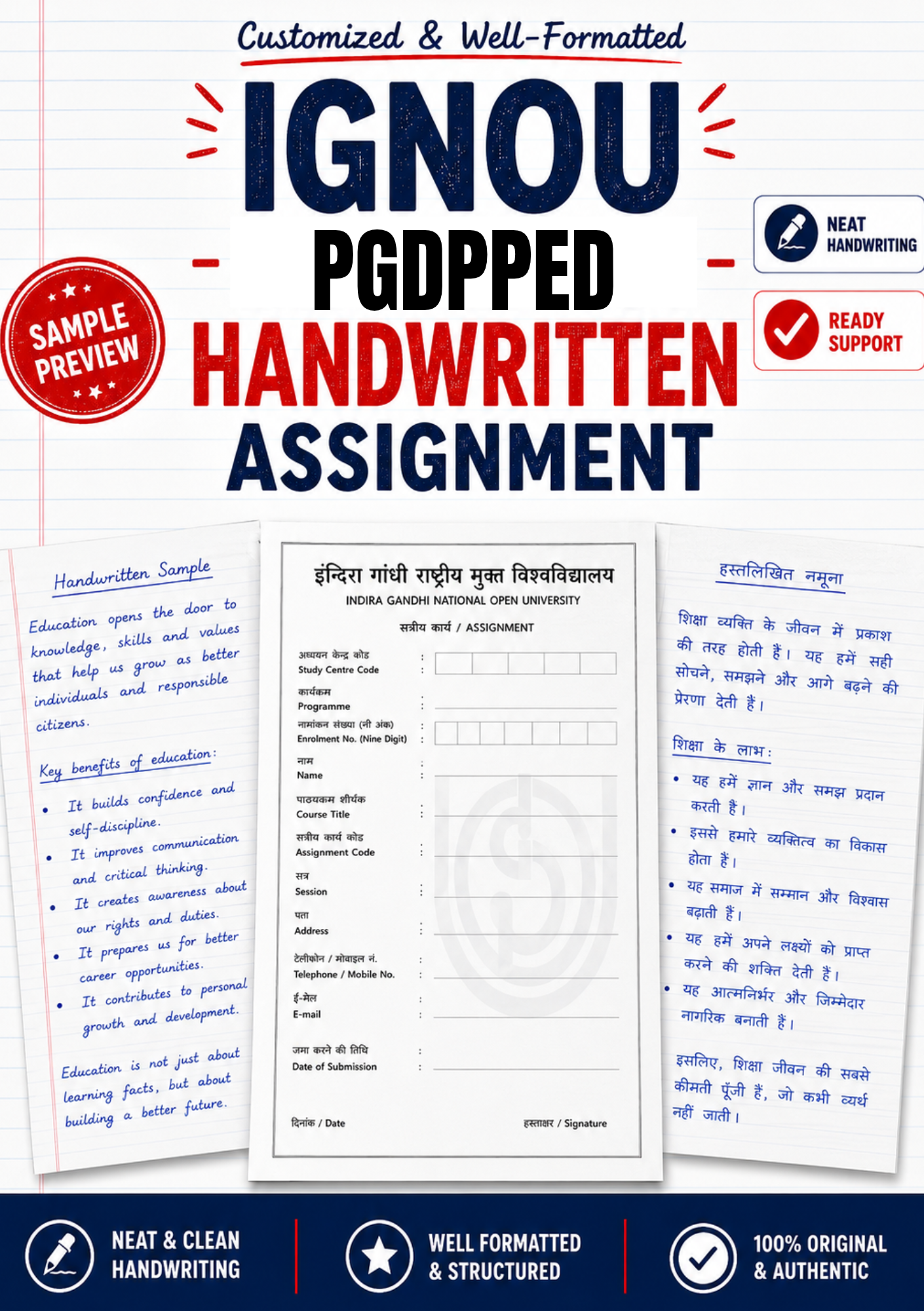
An order is counted in MES papers, because that is how IGNOU sets the work. For every PGDPPED course you name, the parcel holds the answers to that paper’s three questions written out by hand on ruled sheets, a printed copy of the IGNOU question sheet those answers respond to, and an IGNOU-format front page with your details filled in. The front page is free with every order. If you order all four theory papers, you receive four separate sets, each with its own cover, so that you can hand them in as four submissions.
The answers follow the instruction IGNOU prints under every PGDPPED course heading, which asks for answers of about 500 words each. On the 2026 sheets that means roughly fifteen hundred words of handwriting per paper, spread across three questions that each ask you to explain, discuss or describe a part of pre-school practice. The writers keep to that length rather than padding it, because an answer that runs to three times the asked length is not a stronger answer to an evaluator reading forty of them.
The copy of the question sheet is included for a practical reason. PGDPPED sheets change from one cycle to the next, and the 2026 questions for MES 81 have nothing in common with the 2025 questions for the same code. When the sheet travels with the answers, you can check in a minute that the questions on the page in front of you are the ones the answers address, before you sign anything.
Nothing digital travels with the parcel. No soft copy or PDF is sold. That is a deliberate part of the product rather than an omission: the set exists to be read, signed and handed in on paper at your study centre, and a file that could be forwarded would only invite the kind of copying that IGNOU’s declaration on the cover is written to prevent.
Half of PGDPPED’s 32 Credits Sit on Four Written Papers: What ₹320 a Paper Covers
The Common Prospectus for July 2026 gives PGDPPED a total of 32 credits. Four theory courses carry 4 credits each, which comes to 16, and the project, MESP 85, carries the other 16 by itself. That split is unusual. In most School of Education diplomas the project is a minority of the credit load; in PGDPPED it is exactly half. For an assignment order it means the arithmetic is simple, because only four codes can ever be on the list.
The rate is ₹320 per subject, hard copy only, with courier included in that price and no separate shipping charge. A complete set of the four theory papers therefore comes to ₹1,280, with nothing added for postage, packing or the cover page. There is no minimum order: one subject or fourteen, same rate. A learner who has already submitted MES 81 and MES 82 and owes only MES 83 and MES 84 pays for two papers and nothing more.
What the rate does not cover is just as specific. It does not cover MESP 85, because the project is a separate piece of work with its own report and its own route to the university; the store sells project material on a different shelf, described further down this page. It does not cover a soft copy of the answers. It does not cover a promise about the arrival date. Delivery depends on your pin code and is confirmed for your order before you pay. No figure is promised on this page.
The rate also does not change with the cycle or the medium. Any session is accepted, current cycle or older, including backlog courses, at the same ₹320 per subject. The 2021 sheet for MES 84 costs the same to have written as the 2026 sheet, and so does a paper you are re-submitting after re-registering for the course.
A Reference File of Model Answers or a Handwritten Set for MES 81 to MES 84: Choosing Between Them
Two different products get called an assignment, and they solve different problems. A solved assignment is a soft-copy reference file of model answers for a course code and session, which you read on a screen or print, and then use as a guide while you write your own answers. A handwritten assignment is the answers written out by hand on ruled sheets and submitted in hard copy at the study centre. The first is something to learn from; the second is a finished set ready for you to review, sign and hand in.
| Point of comparison | Solved assignment (soft-copy reference) | Handwritten assignment (this product) |
|---|---|---|
| Format | A file of typed model answers | Ruled sheets written by hand, plus the question sheet and a cover page |
| What you do with it | Read it, then write your own answers from it | Read it, satisfy yourself it reflects your understanding, sign the cover and submit it |
| Who it suits | A teacher with time to write four sets of 1,500 words by hand | A teacher who cannot find that writing time before the cut-off |
| Price on this store | Priced per code on the solved-assignment shelves; no PGDPPED code is listed there today | ₹320 per MES paper, courier included |
On a small screen, swipe the table sideways to see all three columns.
What the IGNOU sheet itself says about the form of the submission is very little. The only instruction printed under each 2026 PGDPPED course is “Answer the following questions in about 500 words each.” The sheets name no paper size, say nothing about handwriting and give no submission address. The PGDPPED programme guide that IGNOU hosts at its usual address returned no readable text when it was opened for this page on 15 October 2026, so the instruction on handwriting cannot be quoted from the guide either. Your study centre is the authority on what it accepts, and it is worth asking before you decide.
The honest scoping is this. A solved file is a reference to write from; it is not a submission. Printing a downloaded file and handing it in places a document you did not prepare under a declaration that says you did. If a model-answer file is what you want, the store keeps the diploma solved-assignment shelf, which holds the soft-copy model answers, though no file for MES 81 to MES 84 was listed on it when this page was checked. This page sells the handwritten set only.
Four MES papers, one price each, written for your cycle.
The rate is ₹320 per subject, hard copy only, with courier included in that price and no separate shipping charge.
MES 81 to MES 84: The Four Pre-School Papers That Carry an Assignment
PGDPPED has no electives and no choice of papers. Every learner takes the same four theory courses and the same project, so the code list on an order is never longer than four. The table below gives each course exactly as the Common Prospectus for July 2026 prints it, with the credits and a note on what IGNOU sets against it.
| Code (prospectus form) | Code on the 2026 sheet | Official title | Credits | Assignment set by IGNOU |
|---|---|---|---|---|
| MES 81 | MES‑081 | Introduction to Pre-School Education | 4 | Yes, three questions, about 500 words each |
| MES 82 | MES‑082 | Human Development during Early Childhood | 4 | Yes, three questions, about 500 words each |
| MES 83 | MES‑083 | Principles of Childhood Education | 4 | Yes, three questions, about 500 words each |
| MES 84 | MES‑084 | Practices in Modern Pre-School Education | 4 | Yes, three questions, about 500 words each |
| MESP 85 | No sheet | Project | 16 | No; settled by a project report |
| Total stated in the prospectus | 32 | 16 credits carry assignments | ||
Swipe sideways on a phone to read the last two columns.
The credits add up as the prospectus says they should: four papers at 4 credits each make 16, and the 16-credit project brings the total to 32. That check matters more than it sounds. The prospectus is a long extracted text in which adjacent programme tables sometimes run into each other, and the PGDPPED table sits directly after the PGDEMA table and directly before the PGDUPDL table. The sum confirms that nothing from either neighbour bled into it.
The prospectus prints the title of MES 83 as “Principles of ChildhoodEducation”, with the two words run together. The table above separates them, because the IGNOU assignment sheets for 2021, 2022, 2024, 2025 and 2026, and the June 2026 term-end paper, all print the words apart. The run-together form is a typesetting slip in one document, not a second title.
None of the MES 81 to MES 84 codes appears in any other programme table in the July 2026 prospectus. That is why the 2026 PGDPPED sheets are headed for PGDPPED alone. Several sibling School of Education diplomas share their papers with the MA in Education and receive question sheets under an MA cover; PGDPPED learners do not have that complication, because nobody else studies these four papers.
What each January and July 2026 sheet asks you to write about
The 2026 questions are summarised below in a few words each, so that you can match them against the sheet you hold. The full wording is on IGNOU’s own IGNOU’s MES-081 question file for the 2026 cycle and its three companions at the same address.
| Paper | Question 1 | Question 2 | Question 3 |
|---|---|---|---|
| MES‑081 | Pre-school education and the child’s holistic development | Why the play-way method matters | How pre-school eases the move into formal schooling |
| MES‑082 | Language development in early childhood | Parents and a child’s emotional development | Heredity and environment, explained with examples |
| MES‑083 | Learning through play | The teacher as a facilitator of learning | Positive reinforcement for desirable behaviour |
| MES‑084 | Principles of planning pre-school activities | Art and craft in pre-school education | A balanced daily schedule and effective learning |
On a narrow screen, swipe the table to see questions 2 and 3.
Set the 2026 list against the 2025 one and the change is complete. The 2025 MES 81 paper asked for a comparison of Froebel’s and Montessori’s views and an activity plan for democratic values; the 2026 paper asks about holistic development and the play-way method. A set written for one year cannot be handed in against the other, which is the main reason the cycle is the first thing the desk asks you to confirm.
MESP 85: Why the 16-Credit Project Is Never Part of a PGDPPED Assignment Order
MESP 85 is the largest single course in the programme and it sets no assignment. IGNOU’s assignment index for PGDPPED lists one combined sheet per year from 2021 to 2025, and every one of them covers MES 81 to MES 84 only; the 2026 sheets are four separate files for the same four codes. There is no MESP 85 sheet in any of them, because the project is assessed through a report of its own rather than through tutor-marked answers.
That has two consequences for an order. The first is that the price of a complete PGDPPED assignment set stops at four papers. The second is that a learner who needs project help is shopping for a different product. The store lists MESP 085 project and synopsis files in soft copy and, separately, printed and bound MESP 085 project copies; each shelf held one product when this page was written. Neither is priced at ₹320 and neither is covered by the commercial terms on this page.
For a learner who would rather plan the project alone, the sister editorial site has a MESP-085 project guide on ignouproject.com covering format, topics and the viva. That guide writes the code as “MESP-05” in two places, which is listed in the conflict box below as an error on the publisher’s own side.
Pre Primary, Pre-Primary, Pri primary: The PGDPPED Spellings, Codes and Listings That Contradict Each Other
Reading the prospectus, six years of assignment sheets, the June 2026 examination papers and IGNOU’s live programme page against each other turns up a series of small and not-so-small disagreements. Most of them will never affect a submission. A few will, if a learner copies a code or a title from the wrong document onto the cover. They are set out in full because a learner deciding what to write on a front page is better served by seeing every variant than by being shown one tidy version that hides the rest.
Sixteen disagreements found while building this page: twelve in IGNOU and third-party documents, four on this publisher’s own pages. Copy codes and titles onto your cover from the question sheet you are answering, not from any other source, including this page.
1. The course code is written at least four ways. The prospectus prints two digits with no leading zero (MES 81, MESP 85). The 2021, 2022 and 2024 sheets mix MES 081 with a space and MES-084 with a hyphen inside a single document; the 2025 and 2026 sheets use the hyphen throughout. The June 2026 term-end papers print the code line with a typographic dash and the title line with a hyphen, so the same paper carries two forms on one page.
2. The programme name is “Pre Primary”, with a space and no hyphen, in the prospectus and on the 2021, 2022 and 2026 sheets, but “Pre-Primary” with a hyphen on IGNOU’s live programme page and on all four June 2026 term-end papers.
3. The 2025 combined sheet calls the programme “Post Graduate Diploma in Pri primary Education (PGDPPEd)”, and the file itself is stored under the name “PGDEPPEd”. The 2021 file is stored as “PGDPPEd”. Neither spelling matches the official abbreviation.
4. MES 81 is “Introduction to Pre-School Education” in the prospectus and on the 2026 sheet, but “Introduction to Preschool Education” (one word, no hyphen) on the 2025 sheet and on the June 2026 term-end paper. MES 84 appears as “Preschool” on the 2021 sheet and “Pre-School” everywhere else.
5. The prospectus runs the title of MES 83 together as “Principles of ChildhoodEducation”. The 2024 sheet capitalises it as “Principles Of Childhood Education”. Every other document prints “Principles of Childhood Education”.
6. MES 82 is “Human Development during Early Childhood” in the prospectus and on the 2024 sheet, and “Human Development During Early Childhood” on the 2026 sheet.
7. The 2026 sheets are published without a year in the file name (MES-081.pdf to MES-084.pdf). The year-suffixed address used by several other School of Education papers (MES-081-2026.pdf) returns an empty document, the same response a deliberately invented address returned on the same day. IGNOU’s own PG Diploma assignment index still stops at January and July 2025 and does not link the 2026 files.
8. No PGDPPED sheet from 2021 to 2026 prints a submission date, an assignment code or a mark split, while the term-end papers print a weightage of 70 per cent. The cut-off has to come from a separate IGNOU notice.
9. The prospectus names two programme coordinators, Dr. Sutapa Bose and Dr. Vandana Singh. IGNOU’s live programme page shows a coordinator heading with no name under it, and labels its fee line “for null”.
10. The PGDPPED programme guide at IGNOU’s usual guide address returned no readable text on 15 October 2026, and the live programme page offers no guide link at all, so the university’s written rules on presentation could not be read for this page.
11. IGNOU’s tentative December 2026 date sheet, dated 21 September 2026, places MES 81 to MES 84 on 2, 3, 4 and 5 December 2026. A revised date sheet was reported on 6 October 2026 and was not read for this page, so those four dates may have moved.
12. A third-party assignment site still lists 30 September as the PGDPPED cut-off for a December examination. A news report of 2 October 2026 states that the December 2026 cut-off was extended to 31 October 2026. The IGNOU notice behind that report was not located.
13. In-house. The store’s PGDPPED books combo is titled “MES 81 MES 82 MES 83 MES 131”. MES 131 is a PGDET paper; the fourth PGDPPED paper is MES 84. The same listing promises same-day dispatch.
14. In-house. The store’s MESP 085 hard-copy project listing carries “100% Guaranteed Approval” and “10000+ PGDPPED Synopsis Approved”, and gives the WhatsApp number 9958947060 rather than the number used on this page. No approval claim of any kind is made here.
15. In-house. The sister site’s MESP-085 project guide writes the code as “MESP-05” and “MESP 05” in places.
16. In-house. The store’s handwritten category page states delivery windows in working days, describes ordering in first person, and calls the handwritten sets “study reference material, not for submission”. This page makes no delivery promise and sells the set for submission after your own review.
The in-house items are listed with the same weight as IGNOU’s because they are the same kind of problem. A learner who saw MES 131 on a combo and searched for it would find a paper from a different diploma. Saying so here is more useful than pretending the store’s other listings are clean, and each of the four is listed for correction.
No Date on Any PGDPPED Sheet Since 2021: Where Your MES Cut-Off Actually Comes From
Each 2026 PGDPPED sheet carries the session line “January & July 2026” in its heading and no date beyond that line. The same is true of every PGDPPED sheet on IGNOU’s index back to 2021. The School of Management Studies prints its own deadlines on its papers; the School of Education does not, for this programme, and a date read off another programme’s paper does not apply here.
In practice the cut-off for PGDPPED reaches you through the university’s general notice for each term-end examination. For the December 2026 examination, the usual cut-off of 30 September was reported on 2 October 2026 as extended to 31 October 2026. That report came from a news site rather than from an IGNOU notice located for this page, so treat 31 October 2026 as the working date and confirm it with your study centre or the university’s student-service pages. For a June examination, IGNOU issues a separate notice, and the date commonly circulated for that cycle should be checked against the notice itself rather than taken from an aggregator.
The examination dates frame the deadline from the other side. On the tentative December 2026 date sheet of 21 September, the four PGDPPED papers fall on consecutive days, MES 81 on Wednesday 2 December, MES 82 on Thursday 3 December, MES 83 on Friday 4 December and MES 84 on Saturday 5 December. Because a revised sheet was reported on 6 October, check IGNOU’s tentative December 2026 date sheet of 21 September against the revised version before planning around it.
Assignments carry 30 per cent of the final course result and the term-end examination carries the remaining 70 per cent. For PGDPPED the 70 per cent figure is printed on every June 2026 paper as the maximum weightage. The 30 per cent does not appear on the assignment sheets at all, which is one more reason a missed cut-off is easy to underestimate: the sheet gives no sign of how much of the course result it carries.
The sheets also expire. A January and July 2026 sheet belongs to the 2026 cycle, and IGNOU replaces it with a new sheet for the next cycle, as it has every year since 2021. Before writing, the desk checks which sheet your study centre will accept for the examination you are registered for, because that, and not the date of your order, decides which questions get answered.
The Sheet Prints Only MES-081 and a Session: Filling the Code Line on Your PGDPPED Cover
Many IGNOU papers print a full assignment code, such as a course code followed by TMA and a session. The PGDPPED sheets do not. Each 2026 sheet prints the programme name, the course code and title, and the session line “January & July 2026”, and nothing that looks like a TMA string. Earlier PGDPPED sheets are the same.
The front page supplied with each set is filled from what the sheet actually prints. The course code goes in exactly as the 2026 sheet writes it, with the hyphen and the leading zero, MES-081 rather than MES 81. The course title goes in as the sheet prints it. Where the cover form asks for an assignment code, the course code and the session line are entered together, because that is the only identifying string IGNOU gives, and no invented TMA number is added. If your study centre uses its own cover format or asks for a particular code line, tell the desk in the first message and the cover is filled to match.
Two fields on the cover are yours alone. Your enrolment number and your study centre code come from your admission record, and your signature on the declaration is something no publisher can supply. You sign the declaration on the assignment cover page, so you should read and review the content before submitting it, and satisfy yourself that it represents your own understanding of the course.
A Pre-School Teacher’s Own Letterforms, Copied From One Page You Photograph
Four sets of answers in one hand that is visibly not yours sit badly next to a signature that is. The handwriting on a PGDPPED order is therefore matched to your own before any writing starts. Send a photo of a page you have written yourself and the handwritten set is matched to your handwriting at no extra charge.
The writer studies the page for the features that make a hand recognisable: the slope, the spacing between words, how capitals are formed, whether letters join, and how numbered points and headings are set out. The sample is checked before you pay, so you can see that the match is being taken seriously before any money changes hands. For a four-paper order the same hand runs across all four sets, which keeps MES 81 and MES 84 looking like the work of one person.
Why a page from your own lesson or activity notes makes a useful sample
A teacher’s working notes often show more of a hand than a neat page does. A page with an activity plan, a short numbered list or a few headings shows the writer how you number points and set out a sequence, which matters for PGDPPED answers that ask you to describe a daily schedule or the principles of planning an activity. Photograph it in daylight, flat and square to the camera, with the whole page in the frame. Ruled or plain paper both work; what matters is that the page is in your ordinary writing rather than your most careful.
English Medium Only, the 2021 to 2026 Sheets, and an MES Paper You Still Owe
PGDPPED is an English-medium programme. The prospectus lists English as its only medium of instruction, and every sheet on IGNOU’s PGDPPED index from 2021 to 2025, together with the four 2026 sheets, is in English. No Hindi edition of a PGDPPED sheet was found for any of those years. The service covers all mediums IGNOU issues the TMA paper in, at the same price. For this programme that means English.
The cycle is a separate question from the medium. Any session is accepted, current cycle or older, including backlog courses, at the same ₹320 per subject. IGNOU’s index holds PGDPPED sheets for January and July of 2021, 2022, 2023, 2024 and 2025, and the 2026 sheets sit on the School of Education’s file server. The 2023 sheet is listed on the index and was not opened for this page; the others were. A learner re-submitting a 2024 paper, or one who enrolled in 2020 and is clearing the course years later, is asked which sheet the study centre has told them to answer, and the set is written to that sheet.
A learner whose current sheet has not yet appeared on IGNOU’s site sometimes asks whether to answer the previous year’s paper instead. The answer depends on the study centre, not on the publisher. Some centres accept the latest published sheet until the new one appears; others will not. The desk will write either, but it will ask you to confirm with the centre first, because a set answered against the wrong year is of no use to you at the counter. If you are working against an older cycle, ask about an older PGDPPED cycle on WhatsApp and name the year on the sheet you were given.
What the PGDPPED Desk Needs From You: MES Numbers, Sheet Year, Enrolment Details, Pin Code, Photo
A quote for PGDPPED needs very little. Five details let the desk confirm the price, the sheet and the delivery estimate for your pin code, and nothing beyond them is required to start.
- The MES papers you need. Any of MES 81, MES 82, MES 83 and MES 84, written however your admission record shows them.
- The cycle of the sheet. January and July 2026 for most current learners, or the year your study centre has told you to answer.
- The details for the cover. Your name as it appears on your identity card, your enrolment number and your study centre code.
- Your delivery pin code. This is how the delivery estimate is worked out for your order.
- One photographed page of your handwriting. Any page in your ordinary writing, sent as a clear photo.
There is no need to send the question sheet; a copy is included with the set. There is no need to send a payment before the sample has been checked. If you are not sure which sheet applies to you, say so, and the desk will tell you what to ask the study centre rather than guessing on your behalf.
One photo of your writing, and the quote for your MES papers follows.
The rate is ₹320 per subject, hard copy only, with courier included in that price and no separate shipping charge.
Delivery depends on your pin code and is confirmed for your order before you pay. No figure is promised on this page.
Reading, Signing and Handing In Your MES Sets Once the Courier Arrives
When the parcel arrives, open each set and lay it next to the question sheet that came with it. Check that the code and session on the cover match the sheet, that the three answers address the three questions on that sheet in order, and that your name, enrolment number and study centre code are spelled as they appear on your admission record. A mistake in any of those is far easier to correct before submission than after.
Then read the answers through, all of them. An evaluator at your study centre may ask about what you submitted, and the PGDPPED term-end papers draw on the same ideas, play-based learning, child development and the planning of a pre-school day among them, so reading the sets carefully is preparation for the examination as well. Where an answer says something you would put differently, it is your submission and your call. When you are satisfied, sign the declaration.
Submit each set at your study centre in the way it asks, keep a copy of your own, and ask for an acknowledgement or receipt. Learner comments on PGDPPED pages show the recurring problems: a sheet that was not yet uploaded, a learner unsure which year to answer, a learner moving from one regional centre to another. A receipt with the date and the codes on it is the simplest protection against each of them. No claim is made about the marks any assignment will receive, about how an evaluator will assess it, or about whether it will be accepted. Assignment evaluation is entirely a matter for IGNOU.
Other PGDPPED Shelves on This Store, and One Combo That Names the Wrong Fourth Paper
Most PGDPPED learners who order assignments also prepare for the four term-end papers, and the store has shelves for that. The PGDPPED study guides for MES 81 to MES 84 hold one book per course plus a combo. The combo’s title lists MES 131 as its fourth code; MES 131 is not a PGDPPED paper, and if you want the fourth PGDPPED book you should look for MES 84 by name on that shelf.
For revision against the examination pattern, which on the June 2026 papers means four questions with internal choice in the first two and short notes in the third, there is the PGDPPED guess-paper shelf with one product per course, and the single solved previous-year paper listed for PGDPPED, which covers MES 84 for June 2022.
Two neighbouring programmes are easy to confuse with this one. PGDECFE, the School of Continuing Education’s diploma in early childhood and foundational stage education, covers some of the same ground with MCD codes instead of MES codes, and has the separate PGDECFE handwritten product for MCD codes. MES 131, the code that appears on the books combo by mistake, is an educational technology paper, and anyone who genuinely needs it will find it on the PGDET handwritten product. For any programme other than PGDPPED, the handwritten category page lists each product separately.
What Nursery and Pre-School Teachers Ask Before Paying for an MES Set
Is there a second-year PGDPPED assignment?
No. PGDPPED has a minimum duration of one year and a single set of four theory papers, MES 81 to MES 84, with no year-wise split in the prospectus table. Every PGDPPED sheet from 2021 to 2026 covers all four papers for the cycle. A learner who is still studying in a second or third calendar year is answering the same four codes, against the sheet for the cycle they are submitting in.
The new PGDPPED sheet has not appeared yet. Can I answer last year’s paper instead?
Only if your study centre accepts it. PGDPPED sheets change completely between cycles, so the 2025 MES 81 questions are not the 2026 ones. Ask the centre which sheet it will accept for the examination you are registered for. The publisher writes against whichever sheet the centre names, and asks you to confirm that first.
I enrolled several years ago and never submitted. Which PGDPPED sheet do I answer now?
Usually the sheet current for the cycle in which you are submitting, but the centre decides. A long gap may also mean re-registration for the course, which changes the cycle. Bring the question to your study centre with your enrolment number; once it names the sheet, the set is written to that sheet at the same ₹320 per paper.
Is MESP 85 written as part of this order?
No. MESP 85 carries 16 credits but sets no assignment; IGNOU assesses it through a project report. The store sells MESP 085 project material on separate soft-copy and hard-copy project shelves, at their own prices and on their own terms, and neither is part of a ₹320 assignment order.
MES 81 to MES 84 are tentatively scheduled from 2 December 2026. What is the assignment cut-off before that?
The sheets print no date. A news report of 2 October 2026 states that IGNOU extended the December 2026 cut-off from 30 September to 31 October 2026; the IGNOU notice itself was not located for this page. Work to 31 October 2026 and confirm it with your study centre.
Can I submit a typed or printed PGDPPED assignment instead of a handwritten one?
The 2026 sheets say nothing on the point, and the PGDPPED programme guide on IGNOU’s server could not be read, so this page cannot quote IGNOU either way. Some other School of Education guides set out their own rules, which do not carry over to PGDPPED. Ask your study centre. The publisher sells handwritten hard copy only.
How does an MES 81 solved file differ from an MES 81 handwritten set?
They are different products. A solved assignment is a soft-copy file of model answers, meant to be read and then used as a guide while you write your own. A handwritten assignment is a finished set in hard copy, with the question sheet and a filled cover, which you review, sign and submit. No MES 81 to MES 84 solved file was listed on the store when this page was checked.
Can a downloaded PGDPPED answer file be printed out and handed in?
It should not be. The cover declaration states that the work is your own, and a downloaded file was prepared by someone else for anyone who downloads it. Use such a file as a reference while writing, or order a handwritten set written against your own sheet and review it before signing.
Can I order only MES 84?
Yes. There is no minimum order, and a single paper costs ₹320 with courier included. Learners often need one or two papers rather than all four, because they submitted the others in an earlier cycle.
Does IGNOU publish PGDPPED sheets in Hindi?
No Hindi edition was found. The prospectus lists English as the only medium, and every PGDPPED sheet on IGNOU’s index from 2021 to 2025, as well as the four 2026 sheets, is in English. The set is written in English accordingly.
What do I write as the assignment code on a PGDPPED front page?
The sheet prints no TMA code. Use the course code exactly as the sheet prints it, MES-081 on the 2026 sheet, together with the session line, January and July 2026. The supplied cover is filled that way unless your study centre asks for a different format.
How long are the answers in a PGDPPED set?
Each 2026 sheet asks for three answers of about 500 words each, so a set comes to roughly 1,500 words per paper. The writers keep close to that length rather than exceeding it.
Is the PGDECFE assignment the same as PGDPPED?
No. PGDECFE belongs to the School of Continuing Education and uses MCD codes, while PGDPPED belongs to the School of Education and uses MES 81 to MES 84. The two programmes cover related ground with different papers, and the store sells them as separate products.
The store’s PGDPPED books combo lists MES 131. Is MES 131 one of my papers?
No. MES 131 is a paper in the educational technology diploma, PGDET. The fourth PGDPPED paper is MES 84, Practices in Modern Pre-School Education. The combo title is a listing error on this store, listed for correction.
Does a PGDPPED handwritten set raise my course result?
No claim is made about that. Assignments carry 30 per cent of each course result and IGNOU alone evaluates them. What the set does is make sure a submission exists for each paper before the cut-off, written against the right sheet, which you have read and are ready to sign.
One Prospectus, Six Years of Sheets, Four June 2026 Papers and a Price List: How This PGDPPED Page Was Checked
This page rests on IGNOU paperwork of two sorts and on the publisher’s price list, and each is labelled separately below because the three do not carry equal authority. Only the first two are IGNOU’s; the third is the publisher’s own commercial terms and should be read as such.
From the IGNOU Common Prospectus, July 2026. The programme’s school (School of Education), its eligibility (a graduate in any discipline), its medium (English), its minimum and maximum duration (one year and three years), its fee as listed (Rs. 9,800, with the registration fee charged separately), its mode of examination (year wise) and its admission cycles (January and July). The course table: MES 81, MES 82, MES 83 and MES 84 at 4 credits each, and MESP 85 Project at 16 credits, totalling 32. The coordinators named there. The credit sum was checked against the stated total before the table was used.
From IGNOU’s live documents, read on 15 October 2026. The four 2026 sheets at the School of Education’s file server; the 2021, 2022, 2024 and 2025 combined sheets linked from IGNOU’s PG Diploma assignment index; the June 2026 term-end papers for MES 81 to MES 84 and the December 2024 paper for MES 84; the tentative December 2026 date sheet; and IGNOU’s PGDPPED programme page. Current sheets for other cycles are posted on the student-service page where IGNOU posts current question sheets. The December 2026 cut-off extension comes from a news report of 2 October 2026, not from an IGNOU notice, and is labelled that way wherever it appears.
From Shri Chakradhar Publication’s own terms. The ₹320 rate, the hard-copy-only format, the included courier and cover page, the copy of the question sheet, the handwriting match, the absence of a minimum order, the acceptance of any session and the pin-code-based delivery estimate. These are the publisher’s commercial terms and nothing on IGNOU’s side confirms or depends on them.
Important Notice
Shri Chakradhar Publication Pvt. Ltd. and shrichakradhar.com form an independent IGNOU study-support publisher. This is not the official website of Indira Gandhi National Open University, is not affiliated with, endorsed by or authorised by the university, and no page on this site should be treated as an official IGNOU communication.
Programme structures, course codes, submission dates and rules change, and only ignou.ac.in and your Regional Centre can confirm the current position for your enrolment.
You sign the declaration on the assignment cover page, so you should read and review the content before submitting it, and satisfy yourself that it represents your own understanding of the course.
No claim is made about the marks any assignment will receive, about how an evaluator will assess it, or about whether it will be accepted. Assignment evaluation is entirely a matter for IGNOU.
MES 81, 82, 83 or 84: Starting a PGDPPED Order With a Single Message
Name the papers you owe, the cycle your study centre has asked for and your pin code, attach one photographed page of your writing, and the quote comes back for your codes.
The rate is ₹320 per subject, hard copy only, with courier included in that price and no separate shipping charge.
Message the PGDPPED desk on WhatsApp, or if one paper is all you are missing, order just one MES paper. WhatsApp +91 93546 37830.