

Description
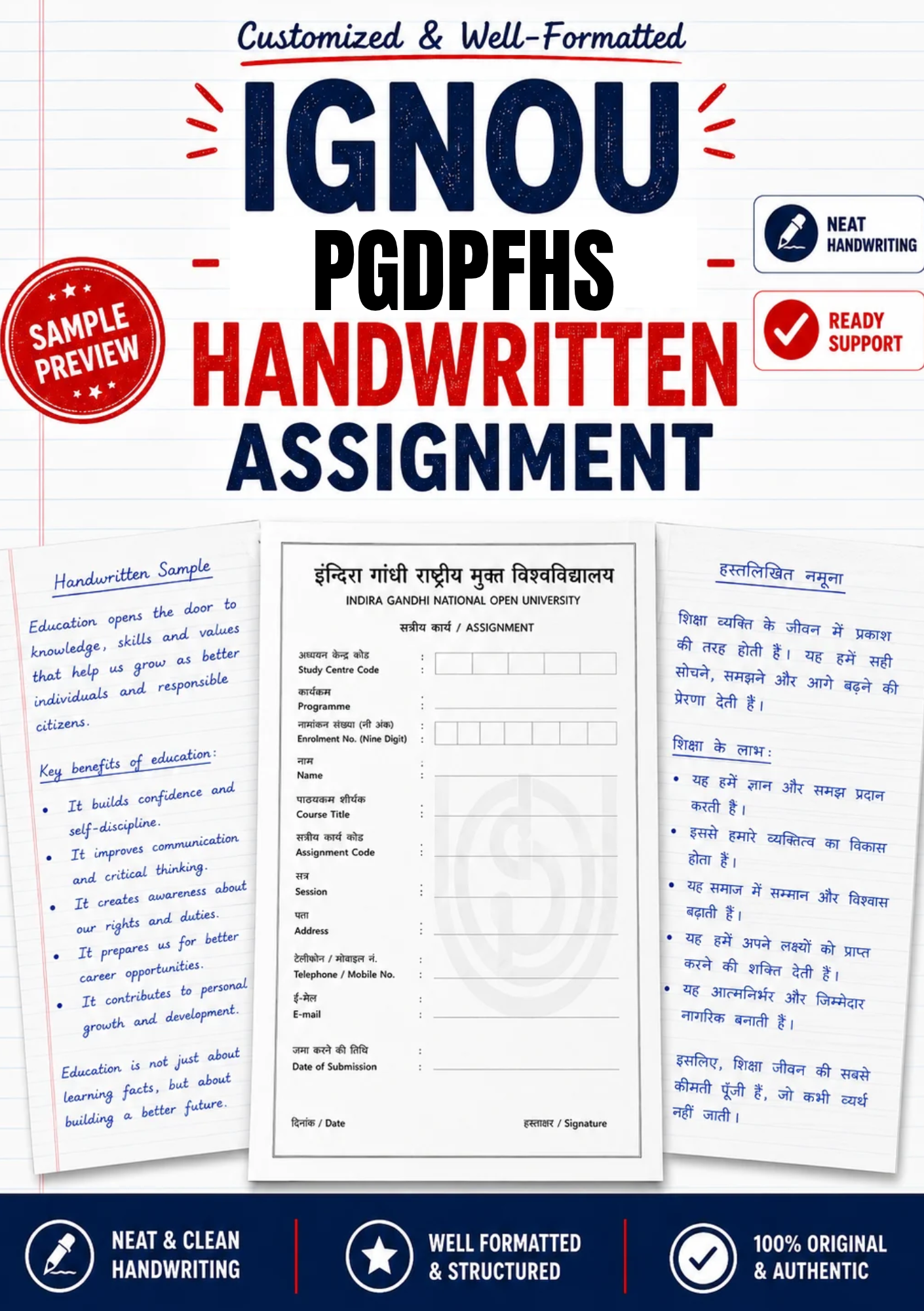
In short. The Post Graduate Diploma in Population and Family Health Studies is five courses, MEDS-071 to MEDS-075, eight credits each, forty credits in total, with no elective and no project to choose between, which means a PGDPFHS learner owes exactly five assignment sheets and not one more. Each sheet sets five questions at 20 marks apiece to a 600-word limit, so a complete year is twenty-five long-form answers written out by hand. Shri Chakradhar Publication writes those answers on A4 in a hand matched to a sample page the learner photographs first. The rate is ₹320 per subject, hard copy only, with courier included in that price and no separate shipping charge. Every set carries a free IGNOU-format front page and a copy of the MEDS question paper the answers were written against, because on this programme IGNOU currently keeps two generations of the same sheet live on its own website at the same time and the questions are not identical.
What Lands on Your Doorstep for Each MEDS Number
A PGDPFHS order is counted in papers, not in pages. For every MEDS number on the order, four physical things travel together in the same parcel, and they are easier to check on the doorstep than at the study centre counter two weeks later.
- The answer sheets. Five questions answered in full on A4, written on both sides with a left margin, numbered and tied, which is what the MEDS sheet itself asks for in its own instructions.
- The IGNOU-format front page. Filled in with the course code, the course title, the programme code, the enrolment number and the Regional Centre, with the signature line left blank because that signature has to be yours.
- A copy of the question paper. The exact MEDS sheet the answers were written against, printed and included, so that the questions in the parcel and the answers in the parcel provably match.
- Nothing digital. No soft copy or PDF is sold. There is no download link in the parcel and no file emailed afterwards, because the thing being sold is the physical set a counter clerk will accept.
That fourth line is not a limitation dressed up as a feature. It is the distinction the rest of this page turns on, and it is the single most common misunderstanding a learner arrives with.
Forty Credits, Five Papers, and the Arithmetic Behind ₹320
Priced per subject, a full PGDPFHS year is five subjects. The rate is ₹320 per subject, hard copy only, with courier included in that price and no separate shipping charge. There is no minimum order: one subject or fourteen, same rate. A learner who cleared four papers in an earlier cycle and owes only MEDS-073 pays for MEDS-073 and nothing else.
What the figure does not cover is worth stating as plainly as what it does. It does not cover your IGNOU programme fee, your re-registration, your examination form fee, or the ₹200 per theory course the university charges to sit the term-end examination. It does not cover a study centre’s own photocopying or binding charge, if one is levied where you submit. And it does not cover the one thing no publisher can sell: the reading. The assignment is a continuous-evaluation instrument and the course material behind it is yours to work through either way.
Delivery depends on your pin code and is confirmed for your order before you pay. No figure is promised on this page. That sentence is deliberate. A written set that arrives on time matters more than a number printed on a product page, and the honest answer varies by where you live.
A Population Studies Model File Versus Pages the Counter Will Take
Two different products get called an “assignment” in this market and a PGDPFHS learner usually needs to know which one is in front of them before anything else gets decided.
A solved assignment is a soft-copy reference file of model answers for a course code and session. You read it, check your own answer against it, and write from it. A handwritten assignment is the answers written out by hand on A4 and submitted in hard copy at the study centre. The first is study material. The second is a submission. They are not two grades of the same thing.
| What differs | Solved assignment (soft copy) | Handwritten assignment (hard copy) |
|---|---|---|
| Physical form | A PDF on a phone or laptop, or a printout of one | Ink on A4 sheets, written both sides, numbered and tied |
| What you do with it | Read it, compare it against your own draft, revise from it | Check it, sign the declaration on the front page, hand it in |
| What the MEDS sheet asks for | Not addressed; the sheet does not contemplate a file | “You should write in your own handwriting, with relevant references,” and the attachment list names the “Main Text of Assignments (Handwritten)” |
| Handwriting | Not applicable | Matched to a sample page the learner photographs first |
| Who it suits | A learner who will do the writing and wants a reference beside them | A learner who has read the course and needs the twenty-five answers on paper |
| Price on this store | Sold separately, per course code, as a download | ₹320 per subject, hard copy, courier included |
Scroll the table sideways on a narrow screen.
No soft copy or PDF is sold. The instruction on the MEDS sheet is not ambiguous and it is not borrowed from another school. It appears on every PGDPFHS sheet read for this page, in the same words, directly above the list of what has to be attached. A downloaded file is a reference to write from; it is not a submission, and nothing on this page should be read as suggesting a PDF can be handed across a counter.
If what you actually want is the model-answer file rather than the written set, the store sells that separately. Because the five MEDS codes are shared with the master’s programme, the model answers for MEDS-071 to MEDS-075 are filed on this store under the MAPFHS course-code assignment shelf, which is the right place to look for a reference PDF against any of the five codes. That is also one of this store’s own untidy edges, and it is listed with the other findings further down.
Five codes, or just the one you still owe.
₹320 per subject, hard copy, courier included in that price, free IGNOU-format front page and a copy of your MEDS question paper. Handwriting matched to your sample at no extra charge.
Five MEDS Numbers, Eight Credits Each, No Elective to Choose
Most IGNOU post graduate diplomas make a learner pick something: an elective out of three, a project instead of a paper, a specialisation stream. PGDPFHS does not. The Common Prospectus July 2026 prints five courses under section 8.23 and a total of 40 credits, and all five are compulsory theory courses at eight credits each. Five multiplied by eight is forty, which matches the stated total, so the table below has been checked against the figure the prospectus itself prints rather than assumed from the row count.
Eight credits per course is also heavier than the SOEDS norm. The sibling diplomas in the same school run on six-credit courses, which is why a PGDPFHS answer carries a 600-word limit where some other programmes set less, and why five papers rather than six still adds up to a full year.
| Course code | Title as the prospectus prints it | Credits | Assignment label on the sheet |
|---|---|---|---|
| MEDS-071 | Introduction to Population Studies | 8 | ASSIGNMENT – 1 |
| MEDS-072 | Population Theories, Policies and Programmes | 8 | ASSIGNMENT – 2 |
| MEDS-073 | Social Groups and Family Health | 8 | ASSIGNMENT – 3 |
| MEDS-074 | Population and Development: Issues and Challenges | 8 | ASSIGNMENT – 4 |
| MEDS-075 | Research Methodology in Population and Family Health Studies | 8 | ASSIGNMENT – 5 |
| Total | 40 | Five sheets, twenty-five answers | |
Scroll the table sideways on a narrow screen.
One structural point matters for anyone who intends to continue. These same five codes are the first year of the Master of Arts in Population and Family Health Studies, and the prospectus states that a learner who completes PGDPFHS may take lateral entry into the second year of MAPFHS. That is why the assignment sheets for these codes are shared between the two programmes, and why the MAPFHS shelves on this store are the ones stocked against MEDS numbers. Your admission record is still the authority on which codes you personally owe; read them off it rather than off any table, including this one.
Why MEDS-074 Exists Twice on ignou.ac.in Right Now
This is the part of the PGDPFHS paperwork most likely to cost a learner a cycle, and it is not mentioned anywhere else that this build could find.
IGNOU publishes the MEDS assignment sheets in the School of Extension and Development Studies folder on its own website. For these five codes there are currently two naming regimes sitting side by side, and both resolve. The older files are named by course code alone, with no session in the file name, and the sheet inside is headed SESSION: JANUARY 2025 and July 2025. The newer files carry the programme code, the course code and the cycle in the file name itself, and the sheet inside is headed SESSION: January 2026 and July 2026. The questions are not the same.
| Regime | File-name shape | Session printed inside | Session in the file name |
|---|---|---|---|
| Older, code-only | MEDS-071.pdf, MEDS-073.pdf, MEDS-074.pdf | JANUARY 2025 and July 2025 | None, so the name never changes when the paper does |
| Newer, programme-led | PGDPFHS-MEDS-074-Jan-July-2026.pdf | January 2026 and July 2026 | Printed in the file name |
Scroll the table sideways on a narrow screen.
The practical consequence is simple. A learner who searches for a course code and clicks the first result can land on the 2025 sheet in October 2026 and answer five questions that belong to a closed cycle. Compare them yourself: the 2025 MEDS-074 sheet and the January and July 2026 MEDS-074 sheet set different questions under the same course code and the same assignment number. Because of that, every PGDPFHS order placed here asks for the file you downloaded, and the parcel comes back with that paper printed inside it. The set is written against the sheet in your hand, not against whichever file a search engine surfaced first.
Sixteen Things the PGDPFHS Documents Get Wrong About Each Other
Everything below was found by reading IGNOU’s own documents against each other during this build, not taken from another website. Three of the sixteen are this store’s own untidiness, and they are named here rather than left for a learner to trip over.
Read this before you take any date, title or medium on this page as settled.
1. The Common Prospectus July 2026 gives PGDPFHS two different mediums. Its summary annexure, at row 190, prints the medium as Hindi. Its own programme section 8.23, nineteen pages later, prints “Medium of Instruction: English“. IGNOU’s live programme page agrees with the second. Two documents out of three say English and the annexure is the outlier, but the annexure is what most aggregator sites copy.
2. MEDS-072 is titled two ways inside one prospectus. Section 8.23 prints “Population Theories, Policies and Programmes“. Section 3.49, the master’s table using the identical code, prints “Population Theories, Policies and Programme“. The assignment booklet uses the singular.
3. IGNOU’s live programme page prints MEDS-075 as “Research Methodology in Population and Family Heath Studies”. The prospectus prints “Health”.
4. The same live page renders MEDS-074 as “Population and Development – Issues and Challenges” where the prospectus and the booklets use a colon.
5. The live programme page lists the five courses out of code order: 071, 072, 073, then 075, then 074.
6. Two generations of assignment sheet for the same codes are reachable on ignou.ac.in at once, one labelled January 2025 and July 2025 and one labelled January 2026 and July 2026, with different questions. Neither is marked as superseded.
7. The cover applicability has changed without announcement. The combined PGDPFHS booklet for July 2024 and January 2025 names PGDPFHS alone. Every current per-course sheet is headed PGDPFHS/MAPFHS 1st Year and names both programmes.
8. The deadline sentence on every current sheet is truncated. It reads “Last date for submitting the assignments for July Session is 30th March … for January Session is 30th September in the respective.” and then stops. There is no noun after “the respective”.
9. No year is printed with either date on the current sheets. The older combined booklet did print years, as “30th March 2025” and “30th September 2025”.
10. The PGDPFHS sheets print 30th March. Other School of Extension and Development Studies programmes print 31st March on their 2026-27 sheets. One school, two March dates, one day apart.
11. On the January and July 2026 MEDS-074 sheet the date is set as “30thMarch”, with no space between the numeral and the month.
12. No TMA code string is printed anywhere on a PGDPFHS sheet. Where other schools print a string such as MMPC-001/TMA/JULY/2026, these sheets carry only “ASSIGNMENT – 1” through “ASSIGNMENT – 5”, and the cover page leaves the “Assignment No.” field blank for you to fill.
13. The course coordinators named on the sheets are not the programme coordinators named in the prospectus. The prospectus names Dr. Sarda Prasad and Grace Don Nemching for PGDPFHS; the sheets name Prof. Nehal A. Farooquee on MEDS-074 and Prof. B.K. Pattanaik on MEDS-075. The prospectus itself calls Grace Don Nemching “Dr.” in the diploma section and “Prof.” in the master’s section.
14. Several question texts carry printing errors that a learner has to answer around rather than correct: MEDS-071 asks you to “Discuss fecundity is determinants of fertility”, and the 2026 MEDS-074 sheet asks about “factors affecting of poverty in India” and to “Explains factors of mal-nutrition”.
15. This store’s own gap. shrichakradhar.com carries MAPFHS categories for solved assignments, books and guess papers, but no PGDPFHS solved-assignment or books category, even though the five MEDS codes are identical across the two programmes. A PGDPFHS learner therefore has to look under the master’s name to find material for their own codes.
16. This store’s own gap. Two separate MAPFHS books categories exist with near-identical names and different product counts, so the same shelf is split in two places.
None of this makes the programme harder than it is. It makes the paperwork less reliable than it looks, which is a different problem and a solvable one: take your codes off your admission record, take your questions off the sheet with the current session printed inside it, and treat anything a third-party site tells you about PGDPFHS dates or medium as a claim to check.
30th March and 30th September, Printed Without a Year
A PGDPFHS learner has two cut-off dates, and they belong to the session they registered in rather than to the month they took admission.
- July session: the sheets print 30th March.
- January session: the sheets print 30th September.
Both dates fall in the calendar year after the session opens. A July 2026 learner is working to 30th March 2027; a January 2027 learner is working to 30th September 2027. The current sheets do not print those years, so the year has to be inferred from the session label at the top of the sheet, which is exactly the kind of inference that goes wrong when two sheet generations are live at once.
Two further points are worth holding on to. First, the 30th March figure is specific to these MEDS sheets; other programmes in the same school print 31st March, so a date read off a sibling programme’s booklet is not transferable. Second, assignments expire. The question paper is replaced each cycle, a lapsed paper is not revived, and a learner who misses a window answers the next cycle’s questions rather than the ones they prepared for. Only ignou.ac.in and your Regional Centre can confirm the current position for your enrolment, and a date read off this page in a later year should be re-checked there.
Assignments carry 30 per cent of the final course result and the term-end examination carries the remaining 70 per cent. On a forty-credit diploma made of five eight-credit papers, that 30 per cent is not a rounding error.
ASSIGNMENT – 1 to ASSIGNMENT – 5 Is the Only Label Your Paper Carries
Learners arriving from a management or humanities programme often expect a code string to copy onto the first sheet, and then cannot find one. On PGDPFHS there is nothing to copy, and that is the correct answer rather than a missing file.
What the sheet actually prints, at the head of each paper, is the course code on one line and an assignment number on another: “Course Code: MEDS-071” above “ASSIGNMENT – 1”. The numbering follows the order of the courses in the prospectus table, so MEDS-071 is always Assignment 1 and MEDS-075 is always Assignment 5. The number is not yours to pick and it does not change with your session.
The cover page is a separate matter. It is a blank template with no programme name printed on it at all, and the fields you have to complete yourself are: Assignment No., Name of learner, Enrolment No., Father’s or Mother’s Name, Name of the Programme, Programme Code, Regional Centre and Code, Course Title, Course Code, Email, Mobile number, Course Coordinator, Date of Submission, Address and Signature. The front page supplied with a Shri Chakradhar set is filled in against the codes you send, with the signature and date left for you.
Twenty-Five Answers in One Hand, Set by a Single Photograph
Five sheets at five questions each is twenty-five answers of up to 600 words. Across that much paper, consistency of hand is more noticeable than on a single short paper, which is why the sample photograph comes before anything is written rather than after.
Send a photo of a page you have written yourself and the handwritten set is matched to your handwriting at no extra charge. The sequence matters: you see what the hand looks like before any money moves, so the risk sits on this side of the transaction rather than yours.
A sample page with a demographic table on it is more useful than a plain one
Population Studies answers are not pure prose. A MEDS-071 answer on measures of morbidity, or a MEDS-075 answer on sampling, will carry figures, a small table, sometimes a sketched curve. A sample page that already contains your numerals, your column alignment and the way you rule a line gives the writer more to work from than a page of unbroken sentences, because numerals and table edges are where a mismatched hand shows first. One clear, well-lit page is enough; several pages of the same handwriting add nothing.
Medium on Paper, Medium in Practice, and Cycles You Still Owe
The medium question on PGDPFHS is genuinely unsettled on the university’s own documents, as the conflict box above sets out, and the honest position is that the prospectus annexure says Hindi while the prospectus programme section and the live programme page both say English. The sheets read for this page were in English and printed no language instruction of any kind.
From an ordering point of view that argument does not have to be resolved before you can place an order. The service covers all mediums IGNOU issues the TMA paper in, at the same price. Send the sheet you were actually issued and the answers come back in the language that sheet is written in.
Sessions work the same way. Any session is accepted, current cycle or older, including backlog courses, at the same ₹320 per subject. A learner who registered in an earlier cycle, never submitted, and now finds their grade card short of assignment marks is an ordinary case on this programme rather than an awkward one. The only thing that changes is which question paper gets answered, and that is settled by the file you send.
Codes, Session, Medium, Centre, Pin Code: the Whole Brief
A PGDPFHS quote needs five things and nothing else. Everything beyond this list slows the order down rather than speeding it up.
- Your MEDS numbers. Any of MEDS-071 to MEDS-075, read off your admission record, not off a table online.
- Your session. January 2026, July 2026, or an older cycle you still owe. This decides which question paper is answered.
- The sheet itself, if you have it. The PDF you downloaded, or its file name. This is the single most useful thing you can send on this programme, for the reason set out above.
- Your Regional Centre or study centre. Needed for the front page, which carries the centre name and code.
- Your pin code. Delivery depends on your pin code and is confirmed for your order before you pay. No figure is promised on this page.
A photograph of one page of your own handwriting goes with the five, and it is the step that happens before payment rather than after.
Have your file name ready and the quote is quicker.
₹320 per subject on every MEDS code, any session including backlogs, courier included, question paper enclosed. One subject or all five.
The Last Two Signatures Are Yours, Not the Writer’s
The parcel is not the end of the process, and the two steps that remain cannot be done for you.
The first is reading. You sign the declaration on the assignment cover page, so you should read and review the content before submitting it, and satisfy yourself that it represents your own understanding of the course. On a programme where the question text itself contains printing errors, this is also a practical check: read the answer against the question on the sheet in the parcel and confirm it addresses what was actually asked.
The second is submission. The MEDS sheets name two routes: hand the set in or post it to the Director, SOEDS at Maidan Garhi, or submit it at your Regional Centre. Keep whatever acknowledgement you are given. Assignment marks appear on the grade card some weeks later, on IGNOU’s own schedule, and the acknowledgement is what you hold if the entry does not appear.
No claim is made about the marks any assignment will receive, about how an evaluator will assess it, or about whether it will be accepted. Assignment evaluation is entirely a matter for IGNOU.
What Else the Store Stocks Under Population and Family Health
Because MEDS-071 to MEDS-075 are shared with the master’s programme, most of the related material on this store is filed under the MAPFHS name even when a PGDPFHS learner is the one who needs it. That is awkward, it is listed in the conflict box as one of this store’s own gaps, and in the meantime here is where things actually are.
For reading rather than submitting, the help books written against the MEDS course codes cover the same syllabus a PGDPFHS learner is sitting, and they are the right starting point for someone who intends to write their own answers. Closer to the examination, the guess papers filed under the diploma’s own name are one of the few shelves on this store that does carry the PGDPFHS label, and there is a parallel set under the master’s name for anyone who has taken lateral entry into the second year.
Learners who do continue into MAPFHS reach a project course in the second year, and that is stocked two ways: as a project file to work from and as a bound hard copy, which are different products for different stages of the same task.
For written sets outside this programme, the handwritten assignment section lists the programmes already built out, including sibling diplomas from the same school such as the Animal Welfare diploma set and the Corporate Social Responsibility diploma set, both of which print 31st March where PGDPFHS prints 30th. If your programme has no page of its own yet, the open customised order takes any code from any session. And the whole downloadable solved-assignment library sits apart from all of this, for learners who want a reference file rather than a parcel.
If you would rather do the writing yourself, the editorial side of the same publishing house keeps a step-by-step guide to preparing an IGNOU handwritten assignment on ignouproject.com, which costs nothing and covers the format rules this page assumes you already know.
What a Population and Family Health Learner Wants Settled First
How many assignments does PGDPFHS have in total?
Five. MEDS-071 to MEDS-075, one sheet per course, labelled ASSIGNMENT – 1 to ASSIGNMENT – 5. There is no elective and no project course on this diploma, so there is no sixth paper to choose and nothing optional to drop.
I downloaded MEDS-074.pdf and it says January 2025. Is that my paper?
Probably not, if you are in the 2026 cycle. That file is the older code-only sheet and is headed SESSION: JANUARY 2025 and July 2025. The current sheet is named with the programme code and cycle in the file name and is headed January 2026 and July 2026. Both are live on ignou.ac.in at the same time and they set different questions. Check the session line printed inside the sheet rather than the file name.
Is PGDPFHS a Hindi medium programme or an English medium one?
IGNOU’s own documents disagree. The Common Prospectus July 2026 annexure prints Hindi; the prospectus programme section and IGNOU’s live programme page both print English. The sheets read for this page were in English with no language instruction. Your Regional Centre is the authority for your enrolment. Either way the rate is the same here, because the service covers all mediums IGNOU issues the TMA paper in, at the same price.
What is the last date for a PGDPFHS assignment?
The sheets print 30th March for the July session and 30th September for the January session, with no year printed. Both fall in the year after the session opens, so a July 2026 learner is working to 30th March 2027. Note that this is a day earlier than the 31st March other programmes in the same school print.
Where do I write the TMA code on a MEDS sheet?
There is no TMA code string on a PGDPFHS sheet. The paper carries the course code and an assignment number, and the cover page leaves the “Assignment No.” field blank for you to fill with that number. Writing an invented code string in it does more harm than leaving it as the sheet intends.
MEDS ka typed ya printout answer study centre par chalega kya?
Nahi. The MEDS sheet instructs you to write in your own handwriting and its attachment list names the handwritten main text. A model-answer file is something to study from and is sold separately on this store; printing one out does not turn it into a submission.
My sheet says PGDPFHS/MAPFHS across the top. Have I downloaded the wrong programme’s paper?
No. The current sheets are shared between the diploma and the first year of the master’s programme, because the five MEDS codes are the same in both. An older combined booklet named PGDPFHS alone, which is why some learners remember a cover that looked different. Fill your own programme code on the cover page.
How long should one PGDPFHS answer be?
The sheet sets five questions at 20 marks each with a word limit of 600, and the guidance inside an older booklet says around 500 to 600 words per answer. Across five papers that is twenty-five answers, which is the scale of writing this product is priced against.
Can I order just MEDS-073 rather than all five?
Yes. There is no minimum order: one subject or fourteen, same rate. Learners who cleared part of the year earlier and owe one or two papers are a normal case.
Why does this store have MAPFHS shelves but no PGDPFHS ones?
Because the catalogue was built around the master’s programme name and the five shared course codes were filed under it. It is a real gap, it is listed in the conflict box above as one of this store’s own, and until it is fixed a PGDPFHS learner should look under MAPFHS for material against MEDS-071 to MEDS-075.
I am taking lateral entry into MAPFHS second year. Do I reorder these five?
No. The prospectus provides lateral entry into the second year of MAPFHS for learners who have completed PGDPFHS, which means the first-year MEDS papers are behind you. The second year is a different set of courses plus a project.
The question on my sheet has a grammatical error in it. Should the answer correct it?
Answer the question as it is printed, and answer what it evidently asks. Several PGDPFHS questions carry printing errors, including one on MEDS-071 about fecundity and determinants of fertility. The safest approach is to address the recognisable topic in full rather than to comment on the wording.
Is the question paper included or do I print it myself?
It is included. A copy of the sheet the answers were written against travels in the parcel, which on this programme matters more than usual because two generations of sheet are live for the same codes.
Can I see the handwriting before I pay anything?
Yes, and that is the intended order of events. Send a photo of a page you have written yourself and the handwritten set is matched to your handwriting at no extra charge.
Is there a soft copy of the handwritten set?
No soft copy or PDF is sold. The product is the physical set, couriered to your address, with the front page and the question paper inside it.
How soon will the parcel reach me?
Delivery depends on your pin code and is confirmed for your order before you pay. No figure is promised on this page.
The Paper Trail Behind This Page, Kept in Three Piles
Three kinds of claim appear above and they do not carry the same weight. They are separated here so that a reader can check each one at its own source.
The prospectus. The course codes, official titles, credits, the forty-credit total, the eligibility, the lateral-entry provision and the two printed mediums come from the IGNOU Common Prospectus July 2026, section 8.23 for the diploma and section 3.49 for the master’s, plus the summary annexure row for PGDPFHS. The credit arithmetic was checked against the stated total before the table above was written: five courses at eight credits is forty, matching the figure the prospectus prints.
The live sheets. The submission dates, the truncated deadline sentence, the assignment numbering, the five-question and 20-mark structure, the 600-word limit, the handwriting and A4 instructions, the attachment list, the cover-page fields, the coordinator names and the question-text errors were read off five assignment documents opened on IGNOU’s own site for this build: the code-only sheets for MEDS-071, MEDS-073 and MEDS-074 headed January 2025 and July 2025, the programme-led MEDS-074 sheet headed January 2026 and July 2026, and the combined PGDPFHS booklet for July 2024 and January 2025 on IGNOU’s webservices host. The course list, the medium line and the “Heath” spelling were read off IGNOU’s live PGDPFHS programme page. All six were read on 28 October 2026.
The publisher’s own commercial terms. The ₹320 rate, the inclusion of courier, the free front page, the enclosed question paper, the absence of a minimum order, the sample-photo-before-payment sequence and the acceptance of backlog sessions are Shri Chakradhar Publication’s own terms. They are not IGNOU rules and nothing above should be read as the university’s position on price or service.
Important Notice
Shri Chakradhar Publication Pvt. Ltd. and shrichakradhar.com form an independent IGNOU study-support publisher. This is not the official website of Indira Gandhi National Open University, is not affiliated with, endorsed by or authorised by the university, and no page on this site should be treated as an official IGNOU communication.
Programme structures, course codes, submission dates and rules change, and only ignou.ac.in and your Regional Centre can confirm the current position for your enrolment.
You sign the declaration on the assignment cover page, so you should read and review the content before submitting it, and satisfy yourself that it represents your own understanding of the course.
No claim is made about the marks any assignment will receive, about how an evaluator will assess it, or about whether it will be accepted. Assignment evaluation is entirely a matter for IGNOU.
Your MEDS Numbers Are the Whole Order Form
The rate is ₹320 per subject, hard copy only, with courier included in that price and no separate shipping charge. Every set carries a free IGNOU-format front page and a copy of the MEDS question paper your answers were written against. Any session is accepted, current cycle or older, including backlog courses, at the same ₹320 per subject.
Two ways to open an order. Send the codes and the session: message the MEDS list straight through. Or send the sheet itself if you already have it, which settles the question paper in one step: send your downloaded MEDS file.
Not sure which of the five you still owe? Ask before ordering and work it out against your grade card first.