

Description
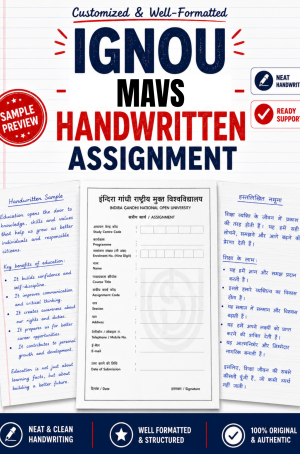
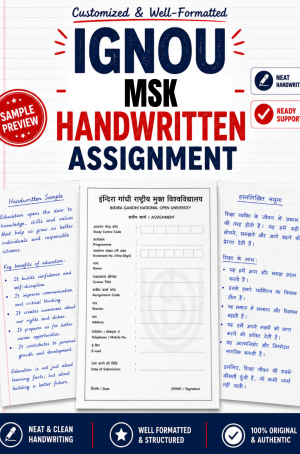
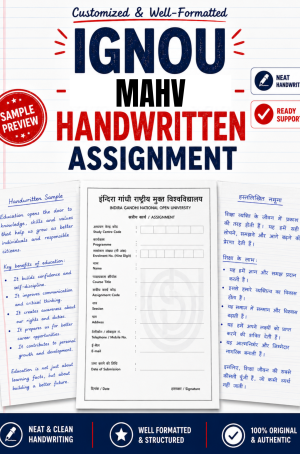
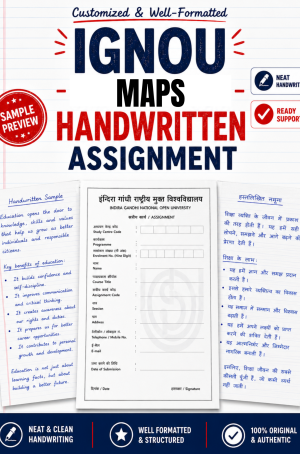
In short. PGDLAN is a 32-credit Post Graduate Diploma in Library Automation and Networking run by the Faculty of Library and Information Science at the School of Social Sciences, and it sets more assignment papers than almost any diploma of its size: seven MLI theory papers numbered MLI-001 to MLI-007 and seven matching MLIL practical papers numbered MLIL-001 to MLIL-007, each carrying its own 50-mark Tutor Marked Assignment, with only the MLIP-008 project excluded. Shri Chakradhar Publication writes those papers out by hand on foolscap at ₹320 per subject, hard copy only, with courier included in that price and no separate shipping charge, matched to a sample of your own handwriting, with the IGNOU-format front page and a copy of the official question paper in the same parcel. The PGDLAN booklet prints that assignments carry 20% weightage and the term-end examination 80%, not the 30 and 70 that circulate for most IGNOU programmes, and it prints two cut-off dates that sit a long way from the admission month: 30 September for a January session and 31 March of the following year for a July session.
Every MLI Order Lands as Four Separate Things
A PGDLAN parcel is not a single bound item. For each course number ordered it holds four separate things, and each of them exists because of something the IGNOU paperwork asks for rather than because it looks generous on a product page.
The first is the written answer set itself, on foolscap sheets, in a hand matched to the sample page you send before anything is written. The PGDLAN booklet is unusually specific here: it asks for foolscap, for a three-inch margin down the left side, for at least four blank lines between one answer and the next, and for the question number to be written against every answer. A set produced to a generic A4 house style quietly fails the instruction the booklet actually prints, and the learner is the one standing at the counter when that is noticed.
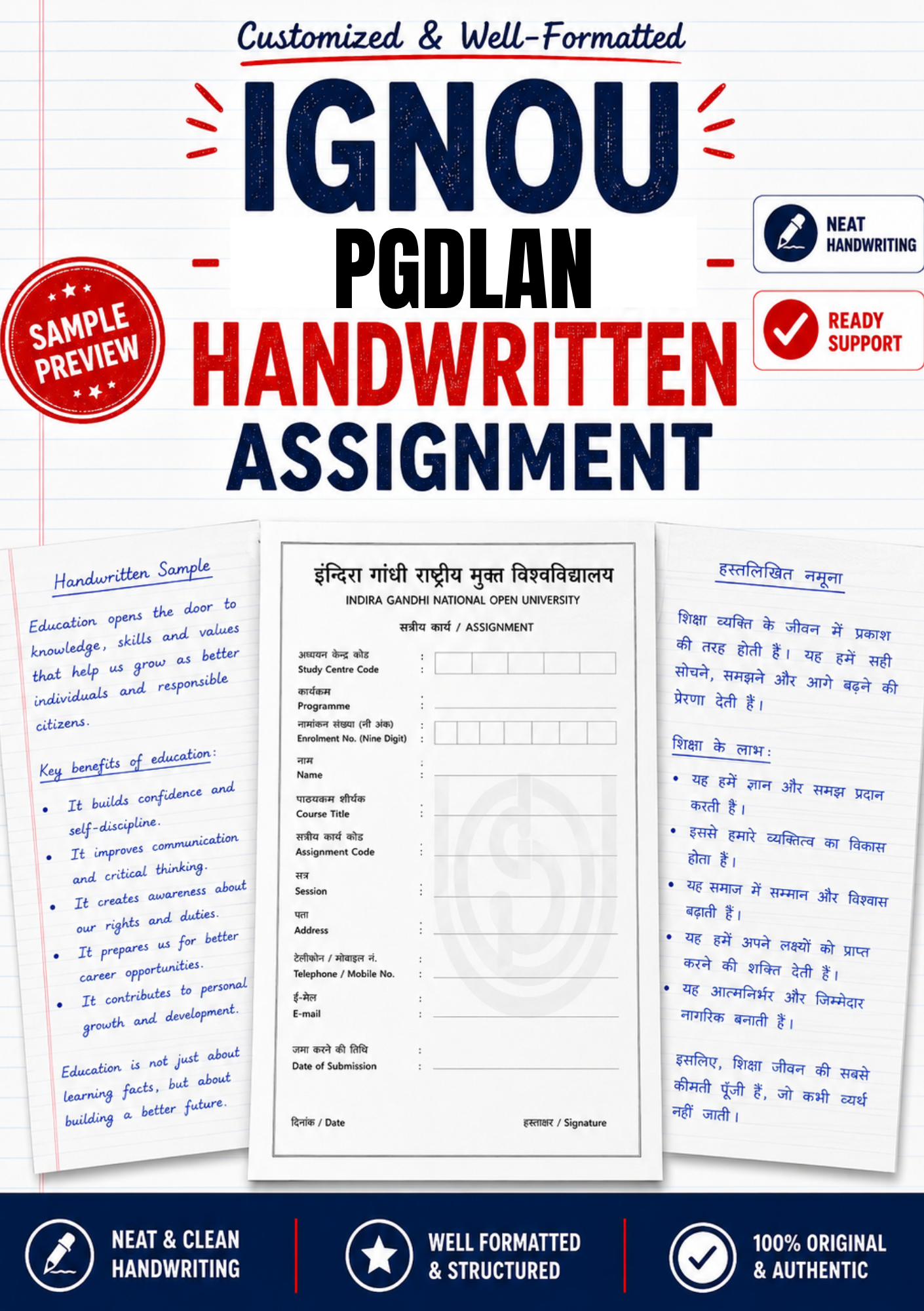
The second is the IGNOU-format front page, which arrives filled in and free with every order. The PGDLAN assignment format document lists exactly what that sheet has to carry: Programme Title, Enrolment No., Course Code & Title, Name, Assignment Number, Address, Study Centre/TLC (Code), Study Centre/TLC, Place and Date, with the date of despatch written at the top right of the first page alongside the enrolment number, name and full address. Two of those fields catch PGDLAN learners out, and both are covered further down this page.
The third is a printed copy of the official question paper the answers were written against. For PGDLAN this matters more than it does elsewhere, because from the 2026 cycle the university stopped publishing one consolidated booklet for the whole diploma and began publishing a separate file for each course number. A learner holding a 2024 consolidated booklet and a learner holding a 2026 per-course file are not necessarily looking at the same questions, and the paper in the parcel is the one the set answers.
The fourth is the courier itself, which is already inside the price. There is no packing charge, no separate shipping line and no delivery fee added at the end. No soft copy or PDF is sold, so nothing arrives by email and nothing needs printing at your end.
₹320 a Paper on a Diploma That Sets Fourteen Papers
The rate is ₹320 per subject, hard copy only, with courier included in that price and no separate shipping charge. The arithmetic on PGDLAN is different from every other post graduate diploma on this store, and a learner who budgets from the course count rather than the paper count gets it wrong by half. Seven course numbers are registered. Fourteen Tutor Marked Assignments are owed, because MLI-001 carries a theory paper and MLIL-001 carries a practical paper, and the same doubling runs all the way to MLI-007 and MLIL-007. Each is marked out of 50.
The ₹320 covers the writing of a paper, the foolscap it is written on, the front page, the question-paper copy and the courier to your address. There is no minimum order: one subject or fourteen, same rate. A learner clearing a single backlog theory paper pays the same per-paper rate as a learner ordering the full set in one message.
Four things sit outside it, and they sit outside it permanently rather than as an upsell. The first is anything IGNOU charges for: the programme fee, the registration fee and the university development fee are matters between you and the university. The second is the MLIP-008 project, which the PGDLAN booklet explicitly excludes from the Tutor Marked Assignment requirement and the programme guide describes as a typed, double-spaced, bound report on A4 with a supervisor’s certificate. That is a different kind of document from a handwritten assignment and is not what this product makes. The third is the practical work itself: the booklet requires the practical sessions to be performed at the Study Centre or Tele Learning Centre and the screen captures to be saved and shown to the counsellor, which is work only the enrolled learner can do. The written-up portion of a practical paper can be prepared at the same ₹320 per code once you supply your own captures and session record, but the sitting at the machine cannot be handed to anyone. The fourth is any claim about outcome. No claim is made about the marks any assignment will receive, about how an evaluator will assess it, or about whether it will be accepted. Assignment evaluation is entirely a matter for IGNOU.
Delivery depends on your pin code and is confirmed for your order before you pay. No figure is promised on this page.
A Model-Answer PDF Cannot Be Shown to a Counsellor
Two different products answer two different needs, and the difference is sharper on PGDLAN than on most programmes because of how the practical half is marked.
A solved assignment is a soft-copy reference file of model answers for a course code and a session. You read it, you learn from it, and you write your own answers out from it. A handwritten assignment is those answers written out by hand on the paper the booklet asks for, submitted as hard copy at the Study Centre or Tele Learning Centre.
The PGDLAN booklet settles the argument about printed submissions in its own words rather than leaving it to inference. It instructs the learner to use only foolscap size paper, ordinary writing paper neither too thick nor too thin, with a three-inch margin and four blank lines between answers. A PDF printed on A4 satisfies none of that. The practical half goes further still: the booklet directs practical assignments to be submitted or shown to the concerned counsellors, with evaluation of the practical assignment done by the counsellor or practical supervisor on the spot. A file on a phone screen is not a thing a counsellor marks on the spot.
| Question asked | PGDLAN solved assignment | PGDLAN handwritten set |
|---|---|---|
| What form does it take | Soft copy file of model answers for one MLI code and session | Foolscap sheets in a hand matched to your own, posted to you |
| What you do with it | Read it, then write your own sheets from it | Check it, sign the declaration, hand it in at the centre |
| Does it meet the booklet instruction | No, it is reference material and was never meant to be the submission | Written to the foolscap, margin and spacing the booklet prints |
| Who it suits | A learner with time who wants to write the fourteen papers personally | A learner short of weeks before 30 September or 31 March |
| What it costs here | Priced per code on its own shelf | ₹320 per subject, courier included |
Scroll the table sideways on a narrow screen.
If what you actually want is the reference file rather than the submission, it is already stocked: the PGDLAN solved assignment shelf carries it code by code, and that is the right page for a model-answer search rather than this one. This product does not sell one and does not pretend to.
Start by listing the MLI numbers you still owe.
The rate is ₹320 per subject, hard copy only, with courier included in that price and no separate shipping charge. There is no minimum order: one subject or fourteen, same rate. Theory papers, practical write-ups and backlog codes from a lapsed cycle are quoted at the same rate.
MLI-001 to MLI-007: the Theory Half of a 32-Credit Diploma
The Common Prospectus July 2026 prints the PGDLAN table with three columns and no type-of-course column at all, which is unusual: the diplomas on the facing pages carry one, and MLIS carries explicit compulsory and elective group headings. PGDLAN carries neither. Nothing in the table is marked core, compulsory or elective, and nothing needs to be, because there are no electives in this programme. Every learner takes the same seven course numbers and the same project.
The prospectus also numbers them differently from every other PGDLAN document. It prints MLI 1 through MLI 7, MLIL 1 through MLIL 7 and MLIP 8, spaced and single-digit. The assignment booklets and the programme guide print MLI-001 through MLI-007, MLIL-001 through MLIL-007 and MLIP-008, hyphenated and three-digit. They are the same courses. The table below gives both, because a learner reading an admission record and a learner reading a booklet are reading two different strings for one paper.
| Booklet code | Prospectus code | Title of the course | Credits | Theory TMA marks |
|---|---|---|---|---|
| MLI-001 | MLI 1 | Introduction to Computers | 4 | 50 |
| MLI-002 | MLI 2 | Library Automation | 4 | 50 |
| MLI-003 | MLI 3 | Information Systems | 4 | 50 |
| MLI-004 | MLI 4 | Networking and Internet Technology | 4 | 50 |
| MLI-005 | MLI 5 | Internet Resources | 4, displaced in the prospectus layout | 50 |
| MLI-006 | MLI 6 | Content Development | 4 | 50 |
| MLI-007 | MLI 7 | Programming | 4 | 50 |
Scroll the table sideways on a narrow screen.
The credit arithmetic is worth doing in the open, because the prospectus page does not survive a careful reading. Seven theory courses at 4 credits plus the MLIP-008 project at 4 credits comes to 32, which is exactly the Total Credits figure the prospectus prints. The difficulty is that the credit figure belonging to MLI 5 Internet Resources has slipped out of its row in the layout and sits on a line of its own, so a reader who takes the table strictly as printed sees only 28 credits accounted for. The missing 4 belongs to Internet Resources. The programme guide confirms it independently by stating that the weightage is uniformly distributed and each such course is therefore of 4 credits.
The theory papers share one structure across the whole diploma, which is itself unusual. Each is marked out of 50 and splits into two parts: a first part of three questions of which any two are answered at 15 marks each, in not more than 1000 words each, and a second part of six questions of which any four are answered at 5 marks each, in not more than 500 words each. That structure held on MLI-001 and MLI-004 in the 2026 files and on the consolidated booklets of earlier cycles. It is one of the few things about PGDLAN that does not vary.
MLIL-001 to MLIL-007: Practical Papers That Are Marked on the Spot
This is the section that separates PGDLAN from the other post graduate diplomas on this store, and it is worth reading before ordering rather than after. On most IGNOU diplomas with a laboratory component, the laboratory courses carry no Tutor Marked Assignment at all. PGDLAN is the opposite case. Every one of its seven practical courses carries a full 50-mark assignment of its own, printed in the same booklet as its theory partner.
What those practical papers ask for is not essay writing. MLIL-001 works through DOS, Windows and UNIX or office tasks. MLIL-004 asks for searches run in a browser against IndCat, a Gmail folder set up, Indian library network websites examined, ERNET services described and Boolean searches performed, with the screen captures saved in one file for evaluation. MLIL-007 offers three groups, C++, Visual Basic and Java, with the learner choosing one language and working through its questions. The booklet is explicit that this work happens at the Study Centre or Tele Learning Centre and is evaluated by the counsellor or practical supervisor on the spot.
The honest position on a commercial page is that the sitting at the machine, the searches and the screen captures belong to the enrolled learner and cannot be bought. What a written set does for the practical half is the write-up: the answers, the procedure descriptions and the explanatory text, written out in your hand on the paper the booklet asks for, around the captures you supply. That is quoted at the same ₹320 per code. Anyone promising the practicals themselves is promising something the booklet does not allow.
| Booklet code | Prospectus code | Paired with | Practical hours | Carries a TMA |
|---|---|---|---|---|
| MLIL-001 | MLIL 1 | MLI-001 Introduction to Computers | 40 | Yes, 50 marks |
| MLIL-002 | MLIL 2 | MLI-002 Library Automation | 40 | Yes, 50 marks |
| MLIL-003 | MLIL 3 | MLI-003 Information Systems | 40 | Yes, 50 marks |
| MLIL-004 | MLIL 4 | MLI-004 Networking and Internet Technology | 60 | Yes, 50 marks |
| MLIL-005 | MLIL 5 | MLI-005 Internet Resources | 60 | Yes, 50 marks |
| MLIL-006 | MLIL 6 | MLI-006 Content Development | 80 | Yes, 50 marks |
| MLIL-007 | MLIL 7 | MLI-007 Programming | 60 | Yes, 50 marks |
| MLIP-008 | MLIP 8 | Project, 4 credits | Not applicable | No, excluded by the booklet |
Scroll the table sideways on a narrow screen.
The counselling hours in that table come from the programme guide and are worth noticing, because they do not match the credits. Every MLI and MLIL pair is rated at 4 credits, yet the practical hours run from 40 for the first three courses to 60 for networking, internet resources and programming, and 80 for content development. A learner planning centre visits around a deadline should plan from the hours, not from the credits.
The project is a separate matter again. MLIP-008 is worth 4 credits, is excluded from the Tutor Marked Assignment requirement, needs a supervisor who may guide a maximum of six candidates at a time, and is submitted as a typed, double-spaced, bound report on A4 with the supervisor’s certificate. If that is what you are looking for rather than an assignment set, the store keeps PGDLAN project samples as soft copies and a bound hard copy project report separately, and the sister site goes through the MLIP-008 requirement in detail in its PGDLAN project guidance for MLIP-008.
Twenty-Nine Points Where the PGDLAN Record Contradicts Itself
Everything below was found by reading IGNOU’s own documents against each other: the Common Prospectus July 2026, the PGDLAN programme guide, the 2026 per-course assignment files for MLI-001, MLI-004 and MLI-007, the 2025 PGDLAN assignment format document, the consolidated 2024 booklet and the consolidated 2021 booklet. Three of the twenty-nine are faults on this store rather than IGNOU’s, and they are listed with the rest because hiding your own errors is a worse position than publishing them.
Disagreements found in the PGDLAN record, and what to do about each.
1. Every PGDLAN booklet from 2021 to 2026 prints that assignments carry 20% weightage and the term-end examination carries 80%. Almost every aggregator, and most IGNOU programmes, print 30 and 70. Work from the booklet.
2. The prospectus prints MLI 1 to MLI 7 and MLIL 1 to MLIL 7. The booklets and the programme guide print MLI-001 to MLI-007 and MLIL-001 to MLIL-007. Write the booklet form on the sheet.
3. In the prospectus table the credit figure for MLI 5 Internet Resources has slipped out of its row, leaving a visible total of 28 against a stated Total Credits of 32. The missing 4 credits belong to Internet Resources.
4. The prospectus prints no credit value against any MLIL practical row. The programme guide resolves it by stating the weightage is uniformly distributed and each course is of 4 credits.
5. The 2026 per-course files print the practical assignment code as AST/TMA-T, with the T that marks a theory paper. The 2021 and 2024 consolidated booklets print AST/TMA-P for the same practical papers. The 2026 files carry the theory marker in error.
6. The PGDLAN assignment code names no course at all. AST/TMA-T/Jan. & July 2026 is identical on every paper in the programme, so the course code has to be written separately in the Course Code & Title field.
7. In the consolidated 2024 booklet the MLI-002 paper prints Course: Introduction to Computers in its header, which is the title of MLI-001, not Library Automation.
8. The programme guide prints MUP-008 for MLIP-008 inside its project guidelines.
9. The programme coordinator is Prof. Archna Shukla on the PGDLAN page of the prospectus and Prof. Archana Shukla on the MLIS page, with an identical email address and telephone number on both.
10. The PGDLAN prospectus table has no type-of-course column, while PGDGI and PGDDRRM on the facing pages and MLIS earlier in the document all carry grouping of some kind.
11. In the prospectus summary list the row immediately above PGDLAN reads Post Graduation Diploma where the section heading for that same programme reads Post Graduate Diploma.
12. The prospectus prints no exit award, lateral entry or credit transfer for PGDLAN, while PGDGI gets an explicit lateral entry into MSCGI and PGDRD gets an explicit credit transfer into MARD on nearby pages. Ask your Regional Centre before assuming a PGDLAN to MLIS route exists.
13. The MLIP prefix is used by two programmes: MLIP 2 Project in MLIS and MLIP 8 Project in PGDLAN, both at 4 credits, both under the same coordinator.
14. The bare MLI stem is also shared: MLIS uses MLI 101 and MLI 102, PGDLAN uses MLI 1 to MLI 7. MLI 1 and MLI 101 are easy to confuse on a handwritten front page.
15. Practical counselling hours run 40, 40, 40, 60, 60, 80 and 60 across seven courses that are all rated at the same 4 credits.
16. The MLI-007 practical paper offers three language groups and asks the learner to choose one, then states that all questions are compulsory.
17. In the same MLI-007 practical paper, a question inside the C++ group asks for a Java program.
18. From 2026 the university replaced the single consolidated PGDLAN booklet with separate files per course number. Two learners in the same year may be working from differently organised papers.
19. The 2026 covers name PGDLAN and nothing else, so unlike several other diplomas there is no shared applicability list to check.
20. The prospectus programme section states no duration for PGDLAN. The one year minimum and three year maximum appear only in the summary list.
21. The prospectus prints no practical counselling instruction or centre list for PGDLAN despite seven practical courses, while PGDGI gets a full set of special instructions for only two laboratory courses.
22. The programme guide gives two destinations for the project report, one copy at the Regional Centre where the learner is enrolled and the final report sent to Registrar (SED), IGNOU.
23. The January submission date is printed as 30thSeptember with no space, on the 2021, 2024, 2025 and 2026 editions alike.
24. The assignment code string itself is typeset inconsistently between papers, with AST/TMA-T/Jan. & July 2024 on one paper and AST/TMA–T/ Jan. & Jul.2024 on the next.
25. PGDLAN is English medium only. MLIS, BLIS and CLIS, in the same faculty, all carry an explicit note that students may write assignments and the term-end examination in Hindi. PGDLAN carries no such note.
26. The PGDLAN margin instruction is printed in inches, a 3″ left margin, where most IGNOU schools print a 4 cm margin.
27. This store’s own handwritten assignment category page still carries delivery times in working days and a Rs 350 list price line. Both contradict this product page and are in the correction queue.
28. This store’s five PGDLAN shelves print the programme name three different ways, as PG Diploma in Library Automation and Networking, as Post Graduate Diploma in Library Automation and Networking Assignments, and in title case as PG Diploma In Library Automation And Networking Previous Year Solved Paper.
29. Two MLIS handwritten assignment products are live on this store at the same time. One of them should be redirected to the other.
Twenty Per Cent: the Weightage Figure PGDLAN Prints and Nobody Quotes
The single most repeated sentence about IGNOU assignments is that they carry 30 per cent of the course result. For PGDLAN that sentence is wrong, and it has been wrong for at least five cycles. The instruction block at the front of every PGDLAN assignment booklet read for this page, from the consolidated January and July 2021 edition through to the per-course files for January and July 2026, states that assignments carry 20% weightage in the continuous evaluation process of a course and that the term-end examinations carry 80% weightage. The programme guide says the same thing in its own words, giving continuous evaluation 20% for theory and practical and the term-end examination 80% for theory and practical.
Two things follow from that, and they pull in opposite directions. A PGDLAN learner who skips an assignment loses less than a learner on a 30 per cent programme would, which is the comfortable half of the fact. The uncomfortable half is that the fourteen papers are still compulsory, that a 40 per cent minimum applies in practicals for clearing a course, that a candidate has to average 40 per cent across continuous evaluation and the term-end examination, and that anyone below 40 per cent is recorded as having failed. The programme guide sets the divisions at 60 per cent and above for first, 50 and above for second and 40 and above for third. Twenty per cent of fourteen papers is not a rounding error on a diploma where the pass floor sits at 40.
If a site quotes 30 and 70 at you for PGDLAN, it has not opened the booklet. The booklet is the document the counsellor marks against.
A January Deadline in September and a July Deadline in March
The two cut-off dates printed on the PGDLAN booklet are further from the admission month than most learners expect, and they do not move with the course number.
For a January session the last date is 30 September of the same year. For a July session the last date is 31 March of the following year. The 2026 edition prints 30 September 2026 for the January 2026 session and 31 March 2027 for the July 2026 session, and the 2025, 2024 and 2021 editions print the same pattern against their own years. Alongside the dates the booklet states that the validity of the assignment is one year, which is why a paper downloaded for one cycle cannot be submitted against the next.
Three practical consequences follow. A January admission has nine months, which is generous until it is August. A July admission has its deadline in a different calendar year from its admission, which is the single most common source of confused questions on this programme. And every learner is working to a date printed on the booklet they themselves downloaded, not to a date circulated for IGNOU generally, because the deadlines are set per school and the School of Social Sciences does not share the management school’s 31 October and 30 April.
The questions are replaced each cycle. Last year’s paper is not this year’s paper, the set written against it cannot be reused, and the only safe copy is the one downloaded from IGNOU’s own assignment download service for the cycle named on your booklet.
AST/TMA-T Is the Whole Code, and It Names No Course
Most IGNOU programmes print an assignment code that contains the course number, so the string on the paper identifies the paper. PGDLAN does not. The code printed on the 2026 files is AST/TMA-T/Jan. & July 2026, and that same string appears on every theory paper and every practical paper in the programme. Nothing in it says MLI-004 rather than MLI-001.
This is why the Course Code & Title field on the front page carries more weight here than on other programmes. The assignment code tells the counsellor what kind of document it is and which pair of sessions it belongs to. The course code field is the only thing that tells them which paper it is. Both go on the sheet.
The letter after TMA is supposed to separate the two halves, T for theory and P for practical. In the 2021 and 2024 consolidated booklets it does: the MLIL papers print AST/TMA-P. In the 2025 format document and the 2026 per-course files the practical papers print AST/TMA-T as well, carrying the theory marker onto a practical paper. That is IGNOU’s typesetting rather than a format change, and the sensible response is to copy whatever your own booklet prints, character for character, including the full stop after Jan and the ampersand, rather than correcting it to what looks right.
One Photographed Page Decides How All Fourteen Look
You sign the declaration on the assignment cover page, so you should read and review the content before submitting it, and satisfy yourself that it represents your own understanding of the course. A set in a hand that looks nothing like the signature above it is a problem a learner does not need at a counter. Send a photo of a page you have written yourself and the handwritten set is matched to your handwriting at no extra charge.
On PGDLAN the match matters across an unusually wide range of content, because the fourteen papers are not all prose. A theory answer on information systems is continuous writing. A practical write-up may carry command lines, a search string, a field label or a fragment of C++, Visual Basic or Java. Letterforms that look natural in a paragraph can look copied in a code listing if the sample never showed how you write a bracket, a semicolon or a capital letter standing alone.
Photographing a page that already has your own notes on it
A page from your own PGDLAN notebook is a better sample than a page written specially, because a page written to be photographed is always written more carefully than you really write. Daylight, the page flat, the phone directly above it rather than at an angle, and the whole sheet in frame. If a page of your own with a few technical terms, a URL or a command on it exists, send that one: it shows the writer how your hand behaves when it stops writing sentences, which is exactly where the practical papers live. The sample settles the hand before any money moves, so the risk sits with the writer rather than with you.
English Only, Foolscap Only, Any Cycle Still Open
The service covers all mediums IGNOU issues the TMA paper in, at the same price. For PGDLAN that resolves to one medium, and the restriction is the programme’s own rather than this publisher’s. The Common Prospectus records the medium of instruction for PGDLAN as English, and the programme guide puts it more bluntly still by stating that the medium of instruction of the PGDLAN programme is English only. The contrast is sharp inside the same faculty: MLIS, BLIS and CLIS all carry an explicit note that students may write assignments and the term-end examination in Hindi. PGDLAN carries no such note anywhere in the prospectus. A learner who has seen Hindi PGDLAN material advertised has seen something the university does not publish.
The paper is equally fixed. Foolscap, ordinary writing paper neither too thick nor too thin, a three-inch left margin and at least four blank lines between answers. That instruction has not changed across any edition read for this page.
The cycle is the flexible part. Any session is accepted, current cycle or older, including backlog courses, at the same ₹320 per subject. A learner who registered in an earlier year, let a cycle lapse and now owes four theory papers and two practical write-ups is an ordinary order, not a special case. What is needed is the booklet year printed on the paper you downloaded, because the questions changed.
Four Lines to Send Before Any Writing Starts
A PGDLAN quote needs four things, and sending more than four slows it down rather than speeding it up.
- The course numbers. Write them as the booklet writes them, MLI-004 or MLIL-004, and say whether you need the theory paper, the practical write-up, or both.
- The cycle on your booklet. Not your admission month. The line printed on the cover, for example January 2026 and July 2026 Sessions.
- Your pin code. This settles the courier, which is already inside the ₹320.
- One photograph of a page in your own handwriting. This settles the hand before anything is written, and it costs nothing.
Enrolment number, name, address and Study Centre or TLC code are needed for the front page, and they are asked for once the order is confirmed rather than in the first message. Nothing else is required, and nothing is paid before the sample has been seen and the hand agreed.
If you would rather write the fourteen papers yourself, the sister site’s step by step guide to writing an IGNOU handwritten assignment covers the front page, the paper and the submission routine without selling anything, and the sample photo can be sent to the desk whenever you decide otherwise.
Theory papers, practical write-ups or a single lapsed code.
₹320 per subject, foolscap, courier included in the price. Any session is accepted, current cycle or older, including backlog courses, at the same ₹320 per subject. The handwriting is agreed from your own sample before payment.
The Counsellor Marks the Practical in Front of You
Two different submission routines run on this programme, and a learner who treats them as one routine loses marks on the half that is handed over differently.
The theory papers go the familiar way. The booklet directs Tutor Marked Assignments to the Coordinator or Programme In-charge of the Study Centre or Tele Learning Centre allotted to you, within the due dates printed on the cover. Before they go, check the front page against the sheets: Programme Title, Enrolment No., Course Code & Title, Name, Assignment Number, Address, Study Centre/TLC Code, Study Centre/TLC, Place and Date, with the date of despatch at the top right of the first page. Keep the receipt or the acknowledgement you are given.
The practical papers do not go that way. The booklet says practical assignments have to be submitted or shown to the concerned counsellors, and that evaluation of the practical assignment is done by the counsellor or practical supervisor on the spot. That means being present with the written-up sheets and the screen captures the questions asked you to save, in the session the centre schedules, rather than leaving a bundle at a counter. Plan the centre visit around the practical hours in the table above, not around the postal date.
You sign the declaration on the assignment cover page, so you should read and review the content before submitting it, and satisfy yourself that it represents your own understanding of the course. After that the status page eventually catches up, and the result weighting is the 20 and 80 described earlier rather than the 30 and 70 most sites print.
Five Other PGDLAN Shelves, and When Each One Earns Its Place
A written set is one purchase out of several a PGDLAN learner makes in a year, and most of them are not substitutes for each other.
For reading rather than submitting, the PGDLAN study guides shelved under the diploma books cover the course content behind the questions, which matters more on a programme where 80 per cent of the result sits in the term-end examination. Closer to the examination, PGDLAN solved guess papers and previous year solved papers for the diploma show how MLI questions have actually been set rather than how a syllabus describes them.
Learners who hold a Bachelor’s in Library and Information Science often arrive here from, or move on to, the two neighbouring programmes in the same faculty, and both have their own written sets with their own deadlines and their own code families: the MLIS written set for the master’s programme and the BLIS equivalent for the bachelor’s. Nothing from one transfers to another, because the codes and the question papers differ. If you have landed here while looking for a different programme entirely, the full handwritten assignment catalogue lists what is written for every other programme at the same rate.
Seventeen Things PGDLAN Learners Ask Before Paying
How many PGDLAN assignments do I actually owe in one year?
Fourteen, if you are registered for all seven courses. Each MLI theory code and each MLIL practical code carries its own Tutor Marked Assignment of 50 marks. Only MLIP-008, the project, is excluded. Learners who budget for seven papers are budgeting for half the programme.
Is the PGDLAN weightage really 20 per cent and not 30?
Yes. Every PGDLAN assignment booklet from 2021 onwards prints that assignments carry 20% weightage in continuous evaluation and the term-end examinations carry 80%. The programme guide repeats it. The 30 and 70 figure quoted across most IGNOU coverage does not apply to this diploma.
My admission was in July. When is my last date?
31 March of the following year. A January session is due on 30 September of the same year. Those two dates are printed on the PGDLAN booklet cover and have been stable across the 2021, 2024, 2025 and 2026 editions.
Why does my assignment code not contain MLI-004 anywhere?
Because the PGDLAN code does not carry a course number. AST/TMA-T/Jan. & July 2026 is printed identically on every paper in the programme. Your course code goes in the Course Code & Title field on the front page instead.
My practical paper prints TMA-T instead of TMA-P. Is the file wrong?
The 2026 per-course files do print the theory marker on practical papers, where the 2021 and 2024 consolidated booklets printed TMA-P. It is IGNOU’s own typesetting. Copy what your booklet prints rather than correcting it.
Can a downloaded PGDLAN PDF be printed and handed in?
The booklet asks for foolscap, a three-inch margin and four blank lines between answers, and sends practical work to a counsellor who marks it on the spot. A printed A4 file meets none of that. A solved file is reference material you write from.
PGDLAN mein solved aur handwritten set ka farak kya hai?
Solved assignment ek soft copy reference file hai, jisse aap padh kar apne answers likhte hain. Handwritten set wahi answers foolscap par aapki apni writing mein likhe hue hote hain, hard copy mein, study centre par jama karne ke liye tayyar.
Typed MLI paper study centre par chalega ya nahi?
Booklet sirf foolscap par likhe gaye answers maangti hai, 3 inch margin ke saath. Typed ya printed copy ke baare mein booklet kuch nahi kehti, aur practical paper to counsellor ke saamne hi check hota hai. Likha hua set hi safe raasta hai.
Is PGDLAN available in Hindi medium?
No. The prospectus records the medium as English and the programme guide states it is English only. MLIS, BLIS and CLIS all permit Hindi answer scripts, but PGDLAN carries no such provision anywhere in the prospectus.
What paper size does the PGDLAN booklet ask for?
Foolscap, described as ordinary writing paper neither too thick nor too thin, with a 3″ margin on the left and at least four blank lines between answers, and the question number written against each answer.
Can the MLIL practical assignments be written for me as well?
The write-up can be, at the same ₹320 per code. The practical sessions themselves cannot. The booklet requires the work to be done at the Study Centre or Tele Learning Centre with the screen captures saved for the counsellor, and that part belongs to the enrolled learner.
Do you write the MLIP-008 project too?
No. The project is excluded from the assignment requirement, needs an approved supervisor, and is submitted as a typed double-spaced bound report on A4. It sits on the PGDLAN project shelves rather than here.
My prospectus says MLI 5 but my booklet says MLI-005. Which do I write?
Write MLI-005, the form your booklet and the programme guide use. The spaced single-digit form is the prospectus layout only. They are the same course.
I only need one backlog MLI paper. Is that order too small?
No. There is no minimum order: one subject or fourteen, same rate. Any session is accepted, current cycle or older, including backlog courses, at the same ₹320 per subject.
Does a scanned copy come with the set?
No soft copy or PDF is sold. What arrives is the written sheets, the IGNOU-format front page and a copy of the official question paper, couriered to your address.
How soon will the parcel reach me?
Delivery depends on your pin code and is confirmed for your order before you pay. No figure is promised on this page.
Will this get my PGDLAN assignment accepted or get me good marks?
No claim is made about the marks any assignment will receive, about how an evaluator will assess it, or about whether it will be accepted. Assignment evaluation is entirely a matter for IGNOU.
Seven Documents Were Read, and Only One of Them Sets the Price
Important Notice
Shri Chakradhar Publication Pvt. Ltd. and shrichakradhar.com form an independent IGNOU study-support publisher. This is not the official website of Indira Gandhi National Open University, is not affiliated with, endorsed by or authorised by the university, and no page on this site should be treated as an official IGNOU communication.
Programme structures, course codes, submission dates and rules change, and only ignou.ac.in and your Regional Centre can confirm the current position for your enrolment.
You sign the declaration on the assignment cover page, so you should read and review the content before submitting it, and satisfy yourself that it represents your own understanding of the course.
No claim is made about the marks any assignment will receive, about how an evaluator will assess it, or about whether it will be accepted. Assignment evaluation is entirely a matter for IGNOU.
Your Code List Is the Only Thing the Desk Needs First
₹320 per subject, hard copy only, with courier included in that price and no separate shipping charge. Foolscap sheets, the IGNOU-format front page and a copy of the official question paper travel together. Theory papers, practical write-ups and codes from a lapsed cycle are all quoted at the same rate, and there is no minimum order: one subject or fourteen, same rate.
Confirm your pin code and paper count on WhatsApp
Delivery depends on your pin code and is confirmed for your order before you pay. No figure is promised on this page.