

Description
In short. Shri Chakradhar Publication writes IGNOU PGDISM assignments by hand, one set per course code, at ₹320 per subject, hard copy only, with courier included in that price and no separate shipping charge; the Post Graduate Diploma in Services Management is a 36-credit School of Management Studies diploma whose Common Prospectus table lists nine four-credit courses, the compulsory MMPC 006 and MMPC 001 plus MMPM 005, MMPF 006, MMPO 005, MMPH 002, MMPM 009, MMPF 011 and MMPB 005, while IGNOU’s own SOMS programme guide lists a tenth, MMPM 008 Rural Marketing, that the prospectus never mentions and moves MMPH 002 from the second semester into the first, so the codes you owe depend on which IGNOU document your study centre works from; seven of those nine papers carry 31 October 2026 for the July 2026 semester and 30 April 2027 for the January 2027 semester, MMPM 009 and MMPF 011 still carry the January 2026 and July 2026 window, every paper is a five-question “Coverage: All Blocks” sheet with no per-question mark split printed, assignments carry 30 per cent of the final course result and the term-end examination carries the remaining 70 per cent, any session is accepted including backlogs at the same rate, and the handwriting is matched to a photograph of a page you have written yourself before you pay anything.
Nine Sets in One Courier Bag: What a PGDISM Order Puts in Your Hands
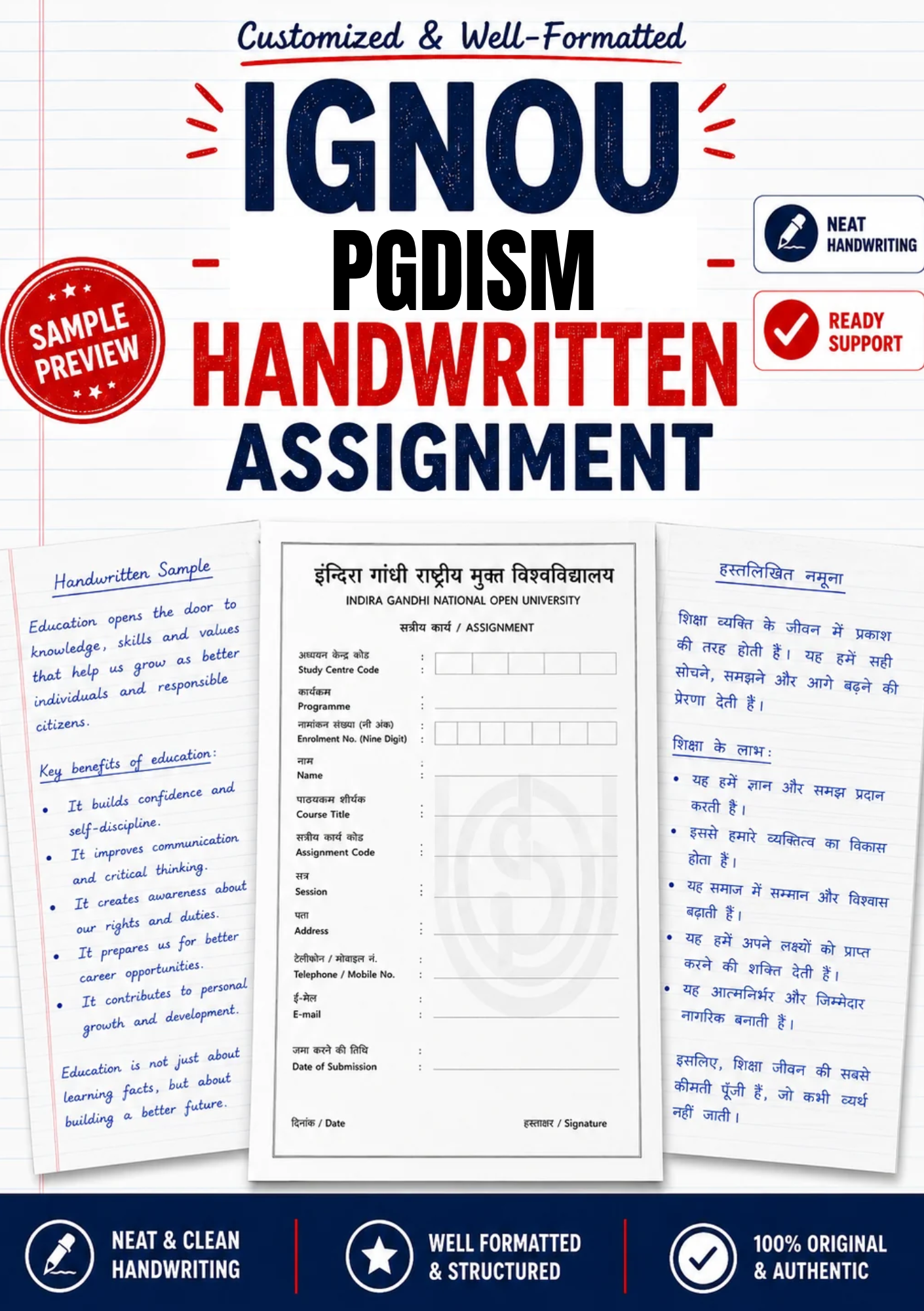
A PGDISM order arrives as paper, not as a download. For each course code you name, the bag holds the answers written out by hand on A4 sheets against the five questions IGNOU prints on that code’s current booklet, an IGNOU-format front page already laid out with the course code, course title and assignment code fields for you to sign, and a copy of the official question paper for that code so the sheet you staple to the set is the sheet the evaluator expects to see with it. The rate is ₹320 per subject, hard copy only, with courier included in that price and no separate shipping charge.
Nine codes means nine physically separate sets, each with its own front page and its own question-paper copy, because IGNOU’s instruction on every PGDISM booklet is to submit the assignment to the coordinator of your study centre code by code, not programme by programme. Nothing is combined into one bundled notebook. No soft copy or PDF is sold.
What does not travel in the bag is worth stating as plainly. There is no scanned archive, no emailed duplicate, and no model-answer file sitting behind a password. If a reference file is what you are after, that is a different product on this store and the section below explains which one and why they are not interchangeable.
What ₹320 Buys on a 36-Credit Services Diploma, and What It Leaves Out
Every PGDISM course is worth exactly four credits. There is no project paper, no laboratory code, no dissertation and no eight-credit outlier anywhere in the structure, which is unusual for a one-year postgraduate diploma and makes the arithmetic on this page simpler than on most: nine courses multiplied by four credits is 36, and 36 is the figure the Common Prospectus July 2026 prints as the programme total. Because every code weighs the same, every code costs the same.
Inside the ₹320: the writing itself, the IGNOU-format front page, the question-paper copy, the handwriting match, and the courier. Outside it: nothing that is charged to you later. There is no packing fee, no medium surcharge, no rush tier and no per-page rate. There is no minimum order: one subject or fourteen, same rate. Delivery depends on your pin code and is confirmed for your order before you pay. No figure is promised on this page.
Two things are outside the service rather than outside the price. The first is the declaration on the cover page, which carries your signature and nobody else’s. The second is the submission itself, which happens at your study centre counter or through whatever upload route your Regional Centre operates. Those stay with you by design.
A Downloaded MMPM 005 Answer File Is Not the Thing You Hand Over
These two products get confused constantly, so here is the distinction in one line each. A solved assignment is a soft-copy reference file of model answers for one course code and one session, meant to be read and written from. A handwritten assignment is the answers written out by hand on A4 and submitted in hard copy at the study centre. One is study material. The other is the submission.
| PGDISM solved assignment | PGDISM handwritten assignment | |
|---|---|---|
| Format | Soft copy, read on a screen or printed out for yourself | Hard copy, written by hand on A4 sheets |
| What you do with it | Read it, understand the model answer, then write your own version | Check it, sign the declaration, submit it at the counter |
| Who it suits | A learner who has the weeks to write nine papers and wants a reference while doing it | A learner who is out of weeks, or writing nine papers alongside a job |
| Price on this store | Priced per code in the PGDISM solved-assignment category | ₹320 per subject, courier included |
| Can it be submitted as it stands | No. A printout is a typed or printed submission | Yes, once you have read it and signed the declaration |
Scroll the table sideways on a narrow screen to see both columns.
The reason the last row matters is printed on the PGDISM booklets themselves. The MMPB 005 paper for July 2026 and January 2027 instructs the learner to “Attempt all the questions and submit this assignment to the Coordinator of your study centre”, and IGNOU’s assignment rules circulated by its own Regional Centres and study centres state that assignments are to be handwritten and that typed submissions are not accepted. A downloaded answer file printed on a laser printer is a typed submission whatever its content is. That is the whole of the difference, and it is not a sales point, it is a formatting rule.
If what you actually want is the reference file, the honest route is the store’s own PGDISM solved-assignment listings for the diploma’s course codes, not this page. This page sells the written set, and it does not include a model-answer file with it.
Have the nine codes in front of you? Start with the codes, not the semester.
₹320 per subject, hard copy only, courier included, any session including backlogs. Send the codes exactly as your admission record spells them and the quote comes back against that list.
MMPC 006 and MMPC 001: The Two Papers No PGDISM Learner Can Skip
Only two of the nine courses are marked Compulsory in the Common Prospectus July 2026, and both sit in the first semester. They are also the two codes PGDISM shares with the widest set of other SOMS programmes, which is why their booklets carry the longest cover-page programme lists in the school.
| Code | Official title | Type | Credits | Assignment code on the live booklet |
|---|---|---|---|---|
| MMPC 006 | Marketing Management | Compulsory | 4 | MMPC-006/TMA/JULY/2026 |
| MMPC 001 | Management Functions and Organizational Processes | Compulsory | 4 | MMPC-001/TMA/JULY/2026 |
Scroll the table sideways on a narrow screen to see the assignment-code column.
The title in that table is the prospectus spelling. IGNOU’s own MMPC 001 booklet prints “Management Functions and Organisational Processes” with an s, and so does the SOMS programme guide, which leaves the Common Prospectus as the single document using the z. Copy whichever spelling appears on the booklet you downloaded onto your front page, because that is the document the evaluator is holding.
Both codes also exist in Hindi editions that name PGDISM on the cover, and both Hindi editions print a different assignment-code string from their English twins. That is covered in the medium section below rather than here, because it changes what you write at the top of the sheet rather than which paper you owe.
Seven Papers Marked Elective That Nobody Actually Elects
This is the part of PGDISM that reads wrongly the first time. The Common Prospectus July 2026 lists seven courses under PGDISM with “Elective” in the Type column, and the programme total it prints is 36 credits. Seven electives plus two compulsory courses at four credits each is exactly 36. There is no eighth elective to choose between, which means that under the prospectus table, all seven papers marked Elective are in practice compulsory.
That is not how the four sibling SOMS diplomas are built. PGDIHRM, PGDIMM and PGDIOM each list ten courses, two compulsory and eight elective, and each table is followed by the footnote “*Choose any seven courses from the electives.” PGDIFM lists nine and carries the same footnote. PGDISM is the only one of the five whose table carries no footnote at all, and it is also the only one where the number of electives listed equals the number required. Whether that is deliberate or a dropped line is not something this page can settle, and the conflict section below does not pretend otherwise.
| Code | Official title | Credits | Semester, Common Prospectus July 2026 | Semester, SOMS programme guide | Live assignment code |
|---|---|---|---|---|---|
| MMPM 005 | Marketing of Services | 4 | I | I | MMPM-005/TMA/ JULY/2026 |
| MMPF 006 | Management of Financial Services | 4 | I | I | MMPF-006/TMA/JULY/2026 |
| MMPH 002 | Human Resource Development | 4 | II | I | MMPH-002/TMA/JULY/2026 |
| MMPO 005 | Logistics and Supply Chain Management | 4 | II | II | MMPO-005/TMA/ JULY/2026 |
| MMPM 009 | Retail Management | 4 | II | II | MMPM-009/TMA/Jan/2026 |
| MMPF 011 | Management of Insurance Services | 4 | II | II | MMPF-011/TMA/JAN/2026 |
| MMPB 005 | Marketing of Financial Services | 4 | II | II | MMPB – 005/TMA/JULY/2026 |
Scroll the table sideways on a narrow screen to compare the two semester columns.
Two rows in that table deserve a second look. MMPF 006 is titled Management of Financial Services and MMPB 005 is titled Marketing of Financial Services; the two papers are one word apart, come from different sub-prefixes, and PGDISM is the only IGNOU programme that carries both. Learners order one and mean the other often enough that it is worth checking the prefix letter before paying. MMPB is also the rarest prefix in the diploma: the string appears exactly once in the whole Common Prospectus July 2026, in the PGDISM table, even though the MMPB 005 booklet names MBA, MBA (Online) and MBF alongside PGDISM on its cover.
Then there is the tenth code. The SOMS PG Diploma programme guide lists MMPM 008 Rural Marketing as a PGDISM second-semester elective. The string MMPM 008 does not appear anywhere in the Common Prospectus July 2026, and the live MMPM-008 booklet for January 2026 and July 2026 names Master of Business Administration, MBA (Online) and MBAMM on its cover without naming PGDISM at all. Three IGNOU documents, three different answers about whether this code is yours.
| Code | Official title | In the SOMS programme guide | In the Common Prospectus July 2026 | Named on its own live booklet cover |
|---|---|---|---|---|
| MMPM 008 | Rural Marketing | Listed as a PGDISM second-semester elective | Absent; zero occurrences of the string | MBA, MBA (Online), MBAMM. PGDISM not named |
Scroll the table sideways on a narrow screen to see all three document columns.
The practical consequence is simple. If MMPM 008 is printed on your admission record or your study centre has asked for it, it is written at ₹320 like any other code and the writing is done against the live MMPM-008 booklet. If it is not on your record, it is not yours, whatever the programme guide says. The one thing worth not doing is assuming either way from a list on a website, including this one. Guide books for the whole PGDISM code set are stocked in the store’s Services Management diploma book shelf if you want the reading matter alongside.
Two IGNOU Documents, One Diploma, Twenty Points of Difference
Everything below was found by reading IGNOU’s Common Prospectus July 2026 against IGNOU’s SOMS PG Diploma programme guide and against nine live assignment booklets on ignou.ac.in, in November 2026. Three of the twenty are this store’s own problems and are listed with the rest rather than quietly left out.
1. MMPM 008 Rural Marketing is listed as a PGDISM elective in the SOMS programme guide. The string MMPM 008 occurs zero times in the Common Prospectus July 2026.
2. The live MMPM-008 booklet for January 2026 and July 2026 names MBA, MBA (Online) and MBAMM on its cover and does not name PGDISM.
3. MMPH 002 Human Resource Development sits in Semester I in the programme guide and in Semester II in the Common Prospectus.
4. The programme guide requires two compulsory and three elective courses in Semester I. The Common Prospectus Semester I block offers only two electives, so that rule cannot be satisfied against the prospectus table at all.
5. The Common Prospectus prints “*Choose any seven courses from the electives.” under PGDIHRM, PGDIFM, PGDIMM and PGDIOM, and prints no equivalent line under PGDISM.
6. Under the Common Prospectus table all nine courses are needed to reach the stated 36 credits, so the seven courses labelled Elective leave nothing to elect.
7. The programme name is spelled “Service Management” on the MMPB 005, MMPM 005 and MMPF 006 covers and “Services Management” on the MMPH 002, MMPO 005, MMPM 009 and MMPF 011 covers, in the same school and the same publishing cycle.
8. The MMPF 006 cover closes its programme list with two brackets: “Post Graduate Diploma in Service Management (PGDISM))”.
9. Seven of the nine codes carry “July 2026 and January 2027 Semesters”. MMPM 009 and MMPF 011 still carry “January 2026 and July 2026 Sessions”.
10. Because of that split, MMPM 009 and MMPF 011 print JAN in the assignment code where the other seven print JULY, for learners sitting the same semester.
11. The same two booklets print the word “Sessions” where the other seven print “Semesters”, which is not interchangeable on a semester-pattern diploma.
12. The MMPF 011 cover prints “for July 2026 sessions is 31st October, 2026”, pluralising a single session.
13. Both the prospectus and the programme guide state the medium of instruction is English, yet IGNOU publishes Hindi editions of MMPC 001 and MMPC 006 whose covers name PGDISM.
14. Those Hindi editions print a two-year assignment code span, जुलाई /2026-27, where the English editions of the same two papers print a single year, JULY/2026.
15. The two Hindi covers disagree with each other on the name: MMPC 001 in Hindi prints सर्विसेज़ (Services) and MMPC 006 in Hindi prints सर्विस (Service).
16. MMPC 001’s title is spelled “Organizational” in the Common Prospectus and “Organisational” on its own booklet and in the programme guide.
17. The prospectus at-a-glance table prints the PGDISM fee twice and two ways inside one cell, “Rs. 10,000/- per semester and Rs. 20,000/- Total”, where the four sibling SOMS diplomas print only “Rs. 20,000/- Total”.
18. In-house: this store’s PGDISM combo products are built on the nine-code prospectus set and carry no MMPM 008, and the first-semester combo is a set of four where the programme guide’s Semester I holds five courses.
19. In-house: the PGDISM solved-assignment category holds one product while the PGDISM book shelf holds fifteen and the guess-paper shelf holds three, which under-serves a nine-code diploma.
20. In-house: legacy pages elsewhere on this store still carry a marks assurance, a no-rejection line and a working-days delivery figure, and one legacy page quotes handwritten work at a price that is not ₹320. Those lines are wrong, they are being removed, and none of them is repeated on this page.
Publishing that list is a deliberate choice. A page that prints nine course codes and a price is indistinguishable from forty other pages printing the same nine codes. A page that has read the two IGNOU documents against each other and says where they part company is telling you something you cannot get by searching, and it is also the only honest way to answer the question a PGDISM learner actually arrives with, which is not “what are the codes” but “which codes do I owe”.
31 October 2026, 30 April 2027, and the Two Codes Still on an Older Cycle
PGDISM belongs to the School of Management Studies, and SOMS prints its own pair of submission dates that no other IGNOU school uses in the same form. Read off the live booklets rather than from any aggregator: MMPC 001, MMPC 006, MMPM 005, MMPF 006, MMPO 005, MMPH 002 and MMPB 005 all print, in the same sentence, that the last date of submission for the July 2026 semester is 31 October 2026 and for the January 2027 semester is 30 April 2027.
MMPM 009 and MMPF 011 print something else. Their current files are the January 2026 and July 2026 editions, which give 30 April 2026 for the January 2026 session and 31 October 2026 for the July 2026 session. For a learner submitting in the July 2026 semester the October date happens to coincide, which is why the split goes unnoticed; for a learner in the January 2027 semester it does not, because those two booklets print no January 2027 date at all. If your study centre has not issued replacements by then, the sensible move is to ask the coordinator which edition they are accepting rather than to assume the 2026-27 window applies to papers that do not mention it.
One more date fact worth having straight: the SOMS PG Diploma programme guide prints the submission dates as a bare pair, 30 April and 31 October, with no year attached and no session label. That is a validity rule rather than a deadline, and it is the reason the booklets and not the guide are the document to work from. Assignments carry 30 per cent of the final course result and the term-end examination carries the remaining 70 per cent, so the date is not a formality.
Papers also expire. Each cycle IGNOU withdraws the previous year’s PGDISM booklet and publishes a replacement with new questions, and submitting against a withdrawn paper is one of the commonest reasons a set comes back. Any session is accepted, current cycle or older, including backlog courses, at the same ₹320 per subject, and the writing is always done against the paper you actually hold rather than against the newest one on the portal. The current files sit on the IGNOU assignment download service, and the live MMPB 005 booklet is a reasonable one to open first, because it is the PGDISM code with the fewest other programmes competing for it.
Copying MMPB 005/TMA/JULY/2026 Exactly as the Cover Prints It
The assignment code is the line IGNOU uses to route your set to the right evaluator, and on PGDISM papers it is not consistent enough to type from memory. The pattern is the course code, then TMA for Tutor Marked Assignment, then the session name, then the year. What varies is everything else.
MMPB 005 prints it with spaces around the dash in the course code and none in the session: MMPB – 005/TMA/JULY/2026. MMPM 005 and MMPO 005 print a space before the session instead: MMPM-005/TMA/ JULY/2026. MMPM 009 prints the session in title case rather than capitals: MMPM-009/TMA/Jan/2026. MMPF 011 prints it in capitals: MMPF-011/TMA/JAN/2026. The Hindi MMPC 001 and MMPC 006 editions print the whole string in Devanagari with a two-year span, एमएमपीसी-001/टी. एम. ए./ जुलाई /2026-27, where their English twins print a single year.
The rule that follows is boring and reliable. Open the booklet you downloaded, find the “Assignment Code” line on the first page of the assignment itself rather than on the decorative cover, and copy it character for character onto your front page, spacing and capitalisation included. Do not normalise it, do not reconcile it against another code’s formatting, and do not substitute the English string for the Devanagari one if you are writing in Hindi. Each PGDISM set prepared here is labelled from the code on the paper supplied with it, which is one of the reasons the question-paper copy travels in the bag.
The Hand on Your Sample Page Becomes the Hand on All Nine Sets
A nine-paper diploma submitted in nine visibly different hands is a problem that no amount of content quality fixes, and it is the usual failure of ordering a set from a volume seller. The method here starts from your writing rather than from a house style. Send a photo of a page you have written yourself and the handwritten set is matched to your handwriting at no extra charge.
The sample is also the risk-removal step. It comes before payment, so you see the matched writing against your own before any money moves rather than after the courier has left. If the match is not close enough to be yours, that is the point at which to say so.
What a usable sample photograph has to show
One full page, not a few words. Daylight or even indoor light, with no flash shadow across the middle. The page flat on a table rather than held up, so the baseline is straight. Ordinary content, a page of your own notes is ideal, because a carefully copied specimen shows a hand you do not actually write in. Blue or black ink on ruled or plain A4, matching whatever your study centre accepts. One page like that is enough to set the hand for all nine PGDISM sets, and the same sample stays on file for a later backlog order.
English on the Prospectus, Hindi on the Shelf, Sessions You Let Slip
Both the Common Prospectus July 2026 and the SOMS programme guide state the PGDISM medium of instruction is English, with no second medium offered. The assignment shelf does not quite agree: IGNOU publishes MMPC-001-HINDI and MMPC-006-HINDI editions whose covers list PGDISM among the programmes the paper applies to, and those Hindi papers carry the Devanagari assignment codes described above. Whether a Hindi submission is acceptable for a declared English-medium diploma is a question for your Regional Centre and not for a publisher, and this page does not pretend to answer it.
What this page can settle is the commercial side. The service covers all mediums IGNOU issues the TMA paper in, at the same price. If you hold the Hindi MMPC 001 paper, the set is written in Hindi against that paper, with the Devanagari code string copied as printed, and the rate does not move. If you hold the English edition, the same.
Session coverage works the same way. Any session is accepted, current cycle or older, including backlog courses, at the same ₹320 per subject. A PGDISM learner who completed the first semester in an earlier cycle and is now clearing MMPO 005, MMPH 002, MMPM 009, MMPF 011 and MMPB 005 is a normal order, not an exception, and so is a single paper left over from a lapsed year. The maximum duration for PGDISM is three years against a minimum of one, so partially finished diplomas are common by design.
Five Lines in the First Message, and Nothing Further Is Needed
A quote needs five things and no documents.
- Your programme code as the record spells it, PGDISM, and the semester or semesters you are clearing.
- The course codes you need written, exactly as they appear on your admission record. MMPM 008 included if it is there.
- The session printed on the booklets you hold, which may not be the session on the portal today.
- The medium of the paper, English or Hindi, per code if they differ.
- One photograph of a page in your own handwriting.
What is not needed at this stage: your enrolment number, your identity card, your fee receipt, your address or any payment. The address is taken once the set is confirmed and the writing has been matched. Nothing is asked for that a quote does not require.
Second semester only, or one lapsed elective? Both are quoted the same way.
₹320 per subject, hard copy only, courier included, no minimum order, and the handwriting sample seen before payment. Send the code list and the session printed on your booklets.
The Last Mile: From Your Doorstep to the Coordinator’s Desk
When the bag arrives, three checks take about ten minutes and prevent most of the problems that follow. Count the sets against the codes you ordered and confirm each front page carries the right course code and the right assignment code, because a correct answer filed under the wrong code is marked against the wrong course. Read the answers. You sign the declaration on the assignment cover page, so you should read and review the content before submitting it, and satisfy yourself that it represents your own understanding of the course. Then sign, date, and add your enrolment number to each front page in your own hand.
Submission is yours. IGNOU’s instruction on every PGDISM paper is to submit the assignment to the coordinator of your study centre, and some Regional Centres additionally operate an upload route for scanned copies of the handwritten pages. Take a receipt at the counter, or keep the upload confirmation, and photograph each set before it leaves your hands; sets do go missing in transit and the photograph is the only reconstruction you will have.
After that comes the wait. Assignment marks reach the grade card on IGNOU’s own timetable, not the study centre’s, and the status page lags submission by weeks rather than days. No claim is made about the marks any assignment will receive, about how an evaluator will assess it, or about whether it will be accepted. Assignment evaluation is entirely a matter for IGNOU.
Where a Services Management Learner Goes Next on This Store
PGDISM sits in the middle of a cluster of SOMS programmes that share its codes, which means a learner on this page is often shopping for one of the neighbours too. The first-semester study material combo for MMPC 006, MMPC 001, MMPM 005 and MMPF 006 is the usual companion purchase, and the PGDISM guess-paper shelf covers the other 70 per cent of the result, the term-end examination this page does not touch.
On the handwritten side, the codes fan out across four other products. MMPM 005 and MMPM 009 are marketing papers, so a learner who switched specialisations may want the marketing-specialisation MBA set. MMPB 005 is the banking paper, covered on the Banking and Finance MBA set. MMPF 006 and MMPF 011 belong to finance, handled on the finance-specialisation MBA set, and MMPH 002 is the human-resource paper on the human-resource MBA set. A learner who wants the services subject at bachelor’s level rather than diploma level should look at the BBA Services Management set, which runs on BSM codes and not MMP ones, and the nearest cognate one-year SOMS diploma is the International Business Operations diploma set. Everything else written by hand on this store sits under the handwritten assignment catalogue.
If you would rather write the nine papers yourself, the editorial side of the same business publishes a free walkthrough of the format rules, the front page and the submission routes at ignouproject.com’s handwritten assignment guide. It sells nothing, and it is the better starting point if time is the one thing you do have.
Doubts a PGDISM Learner Raises Before Paying
PGDISM mein kitne subject hain, nine ya ten?
It depends which IGNOU document you read, which is why this page prints both. The Common Prospectus July 2026 lists nine four-credit courses totalling 36 credits. The SOMS PG Diploma programme guide lists ten courses and says nine of them must be completed, two compulsory and seven electives. The nine both documents agree on are MMPC 006, MMPC 001, MMPM 005, MMPF 006, MMPO 005, MMPH 002, MMPM 009, MMPF 011 and MMPB 005. The tenth, MMPM 008, appears only in the programme guide. Your admission record is the document that decides it for you.
Is MMPM 008 Rural Marketing part of my PGDISM, or not?
If it is printed on your admission record or your study centre has asked for it, yes, and it is written at ₹320 like any other code. On the documents, the evidence is split three ways: the SOMS programme guide lists it as a PGDISM second-semester elective, the Common Prospectus July 2026 does not contain the string MMPM 008 anywhere, and the live MMPM-008 booklet names MBA, MBA (Online) and MBAMM on its cover without naming PGDISM. Ask your coordinator before writing it, and do not add it on the strength of a website list.
My MMPH 002 shows in Semester I on one list and Semester II on another. Which semester do I submit it for?
The Common Prospectus July 2026 places MMPH 002 Human Resource Development in Semester II and the SOMS programme guide places it in Semester I. The submission dates are identical either way, 31 October for a July semester and 30 April for a January one, so the practical question is only which semester’s fee and examination form it attaches to. That is settled by your admission record and your Regional Centre, not by either document. The writing itself is unaffected, because the MMPH-002 booklet is the same paper in both readings.
Seven of my nine papers say July 2026 and two say January 2026. Which paper is the current one for me?
Both are current, which is the odd part. MMPC 001, MMPC 006, MMPM 005, MMPF 006, MMPO 005, MMPH 002 and MMPB 005 have 2026-27 editions carrying “July 2026 and January 2027 Semesters”. MMPM 009 and MMPF 011 have not been replaced and still carry “January 2026 and July 2026 Sessions”. Write each set against the booklet that exists for that code, and copy that booklet’s own assignment code, which is why two of your nine sets will say JAN where the rest say JULY.
What is the last date for a PGDISM assignment?
Read off the live booklets: 31 October 2026 for the July 2026 semester and 30 April 2027 for the January 2027 semester, printed on seven of the nine PGDISM papers. MMPM 009 and MMPF 011 print 30 April 2026 and 31 October 2026 instead, because they are still on the previous cycle. The SOMS programme guide prints the pair as a bare 30 April and 31 October with no year. Programme structures, course codes, submission dates and rules change, and only ignou.ac.in and your Regional Centre can confirm the current position for your enrolment.
The electives are marked Elective. Can I skip two and still reach 36 credits?
Not under the Common Prospectus table, no. It lists exactly seven electives and two compulsory courses, nine courses at four credits each, which is the 36 credits it states as the total. Dropping any of them leaves you short. The programme guide’s ten-course table is the only version of PGDISM where a genuine choice exists, because it offers five second-semester electives against a requirement of four. Which version applies to you is a question for your Regional Centre.
PGDISM ka solved assignment PDF download kar liya, to handwritten kyun lena?
Because the two things do different jobs. A solved assignment is a soft-copy reference file of model answers for a code and session, meant to be read and written from. A handwritten assignment is the answers written out by hand on A4 and handed in at the study centre. Having the PDF solves the content problem and leaves the nine-papers-in-your-own-hand problem exactly where it was. If the PDF is all you want, the store’s PGDISM solved-assignment listings are the right page rather than this one.
Can a printed PGDISM solved assignment be handed in at the counter as it is?
No. IGNOU’s assignment rules as circulated by its study centres and Regional Centres state that assignments must be handwritten and that typed or printed submissions are not accepted, and the PGDISM booklets themselves instruct the learner to submit the assignment to the coordinator of the study centre. A laser-printed answer file is a printed submission regardless of how good the answers are. Nothing on this page should be read as suggesting a downloaded PDF can be submitted.
What is the price difference between the solved assignment and the handwritten set on this store?
The handwritten set is ₹320 per subject, hard copy only, with courier included in that price and no separate shipping charge. The solved assignment is a separate soft-copy product priced per course code in the PGDISM solved-assignment category, and it is cheaper because it is a reference file rather than a prepared submission. The comparison is not like for like: one saves you the understanding, the other saves you the writing.
Is a PDF of the handwritten set sent along with the courier?
No soft copy or PDF is sold. The order is hard copy only, which is why the courier is inside the ₹320 rather than an add-on. If your Regional Centre runs an upload route and wants a scanned PDF of handwritten pages, you can photograph or scan the sets after they reach you, which is good practice in any case as your own record of what was submitted.
PGDISM is an English-medium programme. Why does a Hindi MMPC 001 paper exist?
That is one of the twenty contradictions listed above rather than something this page can resolve. Both the Common Prospectus July 2026 and the SOMS programme guide give the medium of instruction as English. IGNOU nevertheless publishes MMPC-001-HINDI and MMPC-006-HINDI editions whose covers name PGDISM among the applicable programmes. Commercially it changes nothing here: the service covers all mediums IGNOU issues the TMA paper in, at the same price. Whether a Hindi submission is accepted against your enrolment is a Regional Centre question.
Do I copy MMPB 005/TMA/JULY/2026 with the spaces and the dash exactly as printed?
Yes. Copy the “Assignment Code” line from the first page of the assignment itself, character for character, including the spaces around the dash that the MMPB 005 paper prints and the space before the session that MMPM 005 and MMPO 005 print. Do not tidy them into a single house format. If your paper is the Hindi edition, copy the Devanagari string with its two-year span rather than substituting the English one.
Can one or two papers be ordered, or does it have to be all nine?
There is no minimum order: one subject or fourteen, same rate. A single second-semester elective, two backlog papers from a lapsed year, or the full nine are priced identically at ₹320 per subject with courier included. Ordering the whole diploma at once gets you one courier bag instead of several, and that is the only difference.
I left PGDISM after the first semester two years ago. Can the second-semester papers still be written?
Yes. Any session is accepted, current cycle or older, including backlog courses, at the same ₹320 per subject, and PGDISM carries a maximum duration of three years against a minimum of one, so a gap of that size is ordinary. The practical step is to confirm which booklet edition your study centre will accept for the gap papers, since MMPM 009 and MMPF 011 have not been reissued for 2026-27 while the rest have.
Who writes the nine sets, and will the handwriting match across all of them?
Shri Chakradhar Publication runs its own writing team and its own printing press, and the whole PGDISM set is matched to the single sample page you send rather than distributed across whoever is free. Send a photo of a page you have written yourself and the handwritten set is matched to your handwriting at no extra charge. The sample is seen and agreed before payment, which is the point at which to object if the match is not close enough to be yours.
Will the set be accepted, and what marks will it get?
No claim is made about the marks any assignment will receive, about how an evaluator will assess it, or about whether it will be accepted. Assignment evaluation is entirely a matter for IGNOU. Anyone quoting you a grade figure for an externally evaluated assignment is quoting something they cannot control. What is in anyone’s control is the writing, the correct code on the front page, the right booklet edition and the submission before the cut-off, and those are what this order covers.
Which of the Four Documents Behind This Page Said What
Important Notice
Shri Chakradhar Publication Pvt. Ltd. and shrichakradhar.com form an independent IGNOU study-support publisher. This is not the official website of Indira Gandhi National Open University, is not affiliated with, endorsed by or authorised by the university, and no page on this site should be treated as an official IGNOU communication.
Programme structures, course codes, submission dates and rules change, and only ignou.ac.in and your Regional Centre can confirm the current position for your enrolment.
You sign the declaration on the assignment cover page, so you should read and review the content before submitting it, and satisfy yourself that it represents your own understanding of the course.
No claim is made about the marks any assignment will receive, about how an evaluator will assess it, or about whether it will be accepted. Assignment evaluation is entirely a matter for IGNOU.
Send the PGDISM Codes You Are Registered For
₹320 per subject, hard copy only, with courier included in that price and no separate shipping charge. Free IGNOU-format front page, a copy of the official question paper, every medium at the same rate, and any session including backlogs. No soft copy or PDF is sold.
Two ways in. Either list the PGDISM codes from your admission record and the session printed on your booklets, or send a photograph of the first page of one booklet and the codes can be read off it.
Open WhatsApp with your PGDISM code list or send the booklet photograph instead.