

Description
In short. This product is a handwritten, submission-format set for each IGNOU PGDIS assignment paper: MSEI-021, MSEI-022, MSEI-023 and MSE-024 in Semester I, and MSEI-025, MSEI-026 and MSEI-027 in Semester II, written on foolscap with a 4 cm left margin, at ₹320 per subject with courier included. All seven papers together come to ₹2,240, because the eighth course, MSEP-028, is a project and has no assignment. Each PGDIS booklet prints a single last date for every paper inside it: 31 March on the January 2026 booklet, and 31 October on the July 2023, July 2024 and July 2025 booklets. No PGDIS page prints a TMA code; the only identifier is the booklet reference, such as PGDIS/ASSIGN/2026.
What the Courier Brings for Each PGDIS Paper You Order
Every PGDIS code you name becomes its own set, because the booklet asks for each assignment to be answered separately rather than run together with the next course. A learner ordering the whole of Semester I therefore receives four separate sets, one each for MSEI-021, MSEI-022, MSEI-023 and MSE-024, and a learner ordering one backlog paper receives exactly one.
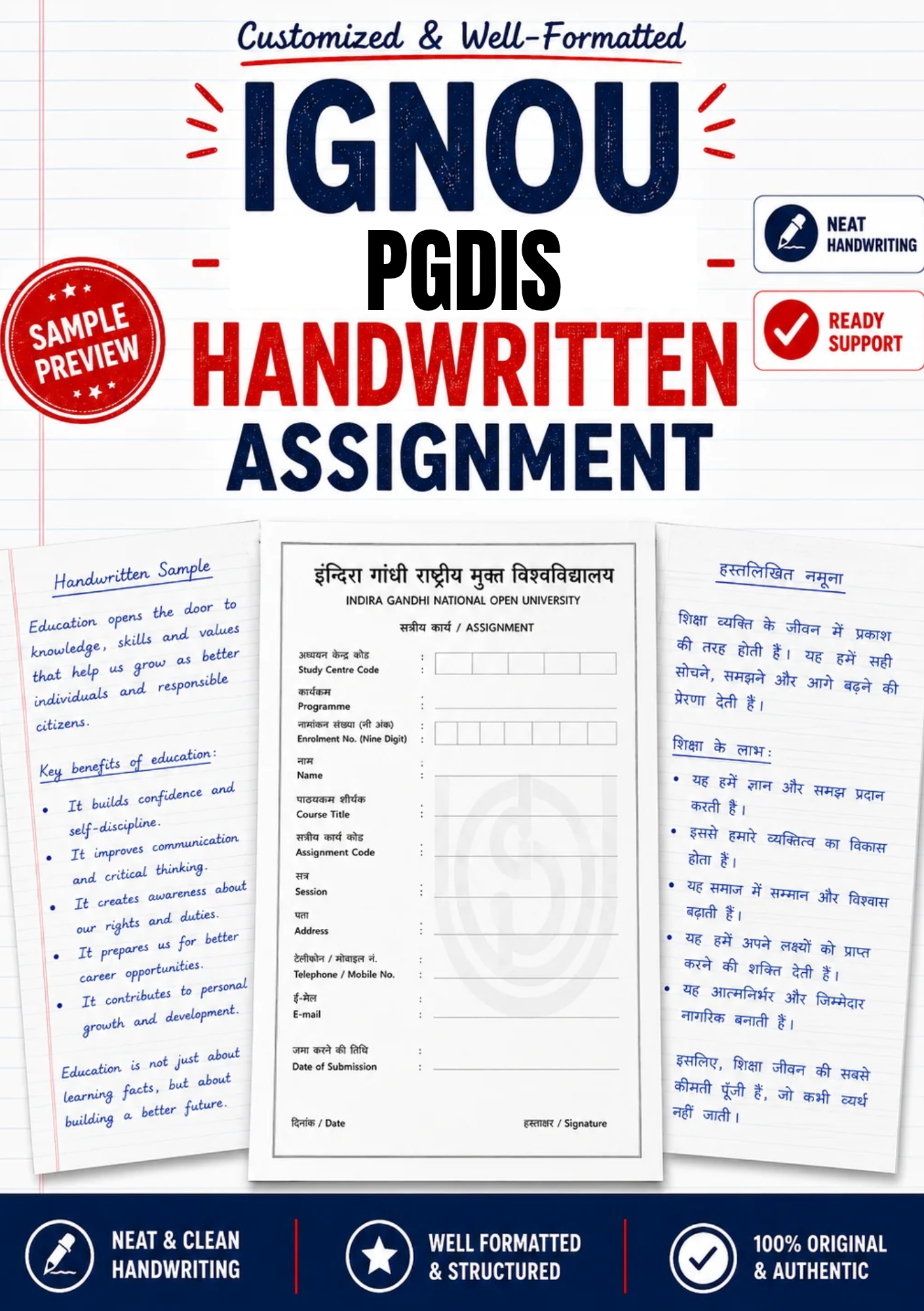
Inside each set there are four things. The first is the answer pages, written by hand on foolscap in a hand matched to the sample photo you sent, with the 4 cm left margin and the gap of at least four lines between answers that the PGDIS response instructions ask for. The second is an IGNOU-format front page, free with every order, laid out in the two positions the booklet describes: enrolment number, name, address, signature and date at the top right, and programme title, course code and course title at the top left. The third is a copy of the official PGDIS question paper for the cycle you named, so the evaluator can see which questions the pages answer. The fourth is the course code exactly as IGNOU prints it on that paper, which matters on this programme more than most, because the fourth Semester I course is printed as MSE-024 and not MSEI-024.
Where a PGDIS question invites a diagram, as the January 2026 MSEI-022 paper does for IPSec and the handshake protocol, the booklet permits illustrations, and any diagram in the set is drawn on the same foolscap sheets by hand rather than printed and pasted in. Nothing arrives as a file. No soft copy or PDF is sold.
The rate is ₹320 per subject, hard copy only, with courier included in that price and no separate shipping charge.
The ₹320 Figure on an MSEI Paper: Included Items and Excluded Ones
The figure is per code, not per semester and not per booklet. Four Semester I papers come to ₹1,280, the three Semester II papers come to ₹960, and the full set of seven comes to ₹2,240. Those totals are simple multiplication, and they are the only arithmetic a PGDIS order involves, because every paper costs the same whether IGNOU marks it out of 20 or out of 30.
Inside the ₹320 sit the handwriting, the matching of that handwriting to your sample, the free front page, the copy of the question paper and the courier to your address. There is no minimum order: one subject or fourteen, same rate.
Outside it sit five things that belong to you or to IGNOU. The first is IGNOU’s own programme fee, which the July 2026 Common Prospectus sets for PGDIS at Rs. 11,000 per semester, Rs. 22,000 in total, paid to the university and not to this store. The second is the act of submission: the PGDIS booklet sends assignments to your Regional Centre or Study Centre, and says they must never be sent to the Student Evaluation Division. The third is any scanning, if your Regional Centre takes the scanned route the booklet also allows. The fourth is the practical component that the prospectus prints beside six of the codes, and the fifth is MSEP-028, the project, which has its own shelves on this store and no assignment at all.
Delivery depends on your pin code and is confirmed for your order before you pay. No figure is promised on this page.
A PGDIS Answer File to Study, or Foolscap Pages to Hand In
Two different things are sold under similar names, and PGDIS learners searching for one often land on the other. A solved assignment is a soft-copy reference file of model answers for a PGDIS course code and session, meant to be read and written from. A handwritten assignment is the answers written out by hand on paper and submitted in hard copy at the Regional Centre or Study Centre. For PGDIS the paper is foolscap, because that is what the booklet asks for.
| Point to settle | PGDIS answer file (soft copy) | PGDIS foolscap set (hard copy) |
|---|---|---|
| What it physically is | A digital document of model answers | Pages written by hand, with front page and question paper |
| What you do with it | Read it, then write your own pages | Read and review it, sign the cover, then submit it |
| Matches the booklet’s handwriting rule | No, a typed or printed copy does not | Yes, it is handwritten as the booklet requires |
| Suits a learner who | Has time to write seven papers on foolscap | Needs the written pages themselves |
| Where it is sold on this store | The PGDIS solved-assignment shelf | This product, ₹320 per subject |
On a narrow screen, swipe the table sideways to see every column.
The PGDIS booklet settles the question for itself. Its instructions for responses ask that answers be written in your own hand, not typed or printed, and not copied from the study units. A downloaded file, however good, is therefore a reference to write from and not a submission. Printing it out does not change that, and neither does stapling a printed file behind a handwritten front page.
The scanned route the booklet allows is sometimes read as a loophole. It is not one. What the booklet permits is a scanned copy of handwritten assignments sent by email or uploaded to the link your Regional Centre provides. A scan of handwritten foolscap pages meets that description; a typed PDF does not.
If a reference file is what you actually want, the PGDIS solved-assignment files, listed code by code sit on their own shelf, and this page does not sell them. No soft copy or PDF is sold.
Name the MSEI and MSE papers you still owe.
The rate is ₹320 per subject, hard copy only, with courier included in that price and no separate shipping charge. All seven PGDIS papers: ₹2,240.
MSEI-021 to MSEI-027 and MSE-024: The Seven Papers That Carry an Assignment
Section 8.32 of the IGNOU Common Prospectus July 2026 lists eight PGDIS courses of 4 credits each, in two semesters, for a total of 32 credits. Seven of them are theory courses with a written assignment. The eighth, MSEP 28, is the project. The prospectus prints the codes with two digits (MSEI 21, MSE 24); every PGDIS booklet read for this page prints them with three (MSEI-021, MSE-024), and the three-digit form is the one to write on the front page.
| Paper as the booklet prints it | Name in prospectus section 8.32 | Term in the diploma | Credits per section 8.32 | Marks on the booklet page read |
|---|---|---|---|---|
| MSEI-021 | Introduction to Information Security | I | 4 | 20 (July 2024) |
| MSEI-022 | Network Security | I | 4 | 20 (January 2026) |
| MSEI-023 | Cyber Security | I | 4 | 20 (July 2025) |
| MSE-024 | Policy, Standards and Laws | I | 4 | 30 (January 2026) |
| MSEI-025 | Application and Business Security Developments | II | 4 | 20 (January 2026) |
| MSEI-026 | BCP, DR Planning and Audit | II | 4 | 20 (July 2024) |
| MSEI-027 | Digital Forensics | II | 4 | 20 (July 2024) |
Swipe sideways on a phone to reach the marks column.
The seven papers add up to 28 credits. With MSEP 28 at 4 credits, the total is 32, which matches the figure section 8.32 prints, so the table was not disturbed by the column bleed that affects some other prospectus tables.
The question pattern is unusually short and unusually uneven. Six of the seven papers carry two questions of 10 marks each, out of 20, with the instruction to answer all the questions and the note that illustrations and diagrams may be used. MSE-024 alone carries three questions of 10 marks each, out of 30. The July 2024 booklet shows that split across all seven papers, and the January 2026 pages for MSEI-022, MSE-024 and MSEI-025 repeat it. No PGDIS page read for this product prints a weightage line; the 30 per cent figure comes from IGNOU’s general assessment rule, not from the PGDIS paper itself.
A short paper is not a light one. The January 2026 MSE-024 paper asks for the objectives of cryptography, the role of digital signatures and authentication protocols in one question, a recommended information security policy for a company in the second, and in the third, whether the Internet has become a breeding ground for cybercrime and how a cyber cell inspector would respond. The January 2026 MSEI-022 paper asks for cryptography’s place in authenticating digital information and then five short notes, on the handshake protocol, Pretty Good Privacy, Secure Shell, symmetric ciphers and IPSec. The January 2026 MSEI-025 paper asks about coding standards and whether vulnerability assessment belongs inside an information security risk management programme. The July 2025 MSEI-023 paper asks for the stages of reverse engineering and, separately, why database failures are hard to recover from and how fault tolerance and transaction processing work.
Those questions change every cycle while the codes stay fixed, so the code alone never tells anyone which questions to answer. The cycle printed on the cover does.
MSEP-028, the (P) Lines and the PGCIS Exit After Semester I
Three parts of the PGDIS structure sit outside the seven written papers, and each of them changes what a sensible order looks like.
| PGDIS block | Course codes in it | Credit share of the 32 | Written assignment in the booklet |
|---|---|---|---|
| Semester I theory | MSEI-021, MSEI-022, MSEI-023, MSE-024 | 16 | Yes, four papers |
| Semester II theory | MSEI-025, MSEI-026, MSEI-027 | 12 | Yes, three papers |
| Semester II project | MSEP-028 | 4 | None; assessed as a project |
| Whole PGDIS | Eight courses | 32 | Seven papers |
The table scrolls sideways on smaller screens.
The project. MSEP 28 appears in the Semester II list of section 8.32 under the plain title Project. No PGDIS booklet’s contents page lists it, and no booklet read for this page carries a question for it. A full handwritten order is therefore seven sets, never eight. The project report and synopsis are separate work, and this store keeps them on a PGDIS project shelf for MSEP-28 reports and synopses and on a bound, printed edition of the same project.
The (P) lines. Section 8.32 prints six codes twice, once plain and once with a (P) suffix: MSEI 21 and MSEI 21 (P), and the same for 22, 23, 25, 26 and 27. MSE 24 has no (P) line, and MSEP 28 has none either. One credit figure of 4 sits against each pair. The (P) form is the practical component of the course, and it has no written assignment in any PGDIS booklet. A handwritten set covers the theory assignment only.
The exit point. The prospectus describes PGDIS as carrying an exit option of a PG Certificate in Information Security (PGCIS) after successful completion of the first semester. A learner who intends to leave with PGCIS needs only the four Semester I papers, ₹1,280 in all. A learner who completes the diploma can, under section 3.68, enter the second year of the Master of Science (Information Security) by lateral entry, with credits transferred as per university norms.
That lateral route is why two products on this store share the same seven codes. The MSCIS handwritten order covering all nineteen master’s codes is the right page once you are registered on the master’s programme, especially for its Semester III and IV papers. This page is the right one while your enrolment and your booklet say PGDIS. Two of the same codes also travel further: the BCA_NEW course grid in the prospectus lists MSEI 023 Cyber Security in Semester V and MSEI 027 Digital Forensics in Semester VI, and BCA learners holding those papers are served by the BCA_NEW handwritten product, where MSEI-023 and MSEI-027 sit among undergraduate codes.
Where the Prospectus, the Booklets and This Store Disagree on PGDIS
Reading the PGDIS prospectus entry against three PGDIS booklets opened in full, the contents pages of six older PGDIS booklets, one MSCIS booklet and this store’s own pages turned up nineteen disagreements. They are listed in full, including the three that belong to this store, because a learner deciding what to write on a front page is better served by knowing where the paperwork is unreliable than by a page that pretends it is not.
Nineteen PGDIS points to check against your own booklet and admission record before you submit anything.
1. One course, two spellings. The prospectus prints MSE 24 and every booklet prints MSE-024, yet IGNOU’s own file for the January 2026 PGDIS booklet is named PGDIS-MSEI-024-Jan-26.pdf. Write the code as the paper prints it: MSE-024.
2. Two digits or three. Section 8.32 prints MSEI 21 to MSEI 27, the booklets print MSEI-021 to MSEI-027, and the BCA_NEW grid in the same prospectus prints MSEI 023 and MSEI 027. All three refer to the same courses.
3. (P) in one table, absent in the other. Section 8.32 pairs six PGDIS codes with a (P) form; section 3.68 lists the same courses for MSCIS without any (P) line.
4. Project or Project-1. MSEP 28 is titled Project in the PGDIS table and Project-1 in the MSCIS table of the same document.
5. Uneven marks. MSE-024 is out of 30 with three questions; the other six papers are out of 20 with two. The booklet gives no reason, and no PGDIS page prints a weightage line.
6. No assignment code at all. No PGDIS course page prints a TMA string. The only identifier is the booklet reference on the cover, such as PGDIS/ASSIGN/2026.
7. One reference year for two cycles. The January 2024 and July 2024 booklets both carry the reference PGDIS/ASSIGN/2024, so the reference alone does not tell you which cycle a paper belongs to. The cover line, such as ASSIGNMENTS JAN 2026, does.
8. One date for both semesters. Each booklet prints the same last date against Semester I papers for fresh learners and Semester II papers for re-registered learners, although the two groups are at different points in the diploma.
9. Same codes, separate booklets. IGNOU issues an MSCIS Semester I booklet (reference MSCIS/ASSIGN/2025, file MSEI-021-July-25.pdf) for the same four Semester I codes, and that booklet does not mention PGDIS. The PGDIS booklet for the same cycle carries the reference PGDIS/ASSIGN/2025.
10. File names that mislead. IGNOU names PGDIS files in at least two styles, PGDIS_MSEI-023-July-25.pdf and PGDIS-MSEI-022-Jan-26.pdf, while MSCIS files for the same codes carry no programme prefix at all. A learner downloading by code can open the wrong programme’s booklet without noticing.
11. Joint examination, separate assignments. The December 2023 term-end paper for MSEI-021 is headed MSCIS/PGDIS together, out of 50 marks in 2 hours, while the assignment booklets are kept apart by programme.
12. 31th. The July 2023, July 2024, July 2025 and January 2025 booklets print the date as 31th; the January 2026 booklet prints 31st. The day is the same; the spelling is IGNOU’s.
13. Dates that used to be absent. The July 2021 and January 2022 PGDIS booklets printed no date at all, only “As per SED Notification on IGNOU’s website”. From 2023 onwards a date is printed, still with a line pointing to SED notifications for updates.
14. No July 2026 booklet found. Searches of ignou.ac.in run on 3 November 2026 surfaced PGDIS booklets up to January 2026 only, and IGNOU’s programme-wise assignment index lists PGDIS only up to January 2025. A July 2026 learner should read the cycle and date off the paper actually issued, not off this page.
15. Same acronym, different programme. Some third-party listings attach the label PGDIS to an industrial safety programme. In IGNOU’s own prospectus PGDIS is only the PG Diploma in Information Security; the industrial safety programmes carry the codes PGDINDS and PGCINDS.
16. Eligibility restated more narrowly. Some third-party listings say PGDIS needs a science or computing degree. Section 8.32 and the prospectus annexure both state a Bachelor Degree in any discipline or its equivalent.
17. This store’s MSCIS page. The store’s MSCIS handwritten product says PGDIS learners use a booklet that does not mention them. That holds for the MSCIS booklet, but IGNOU also issues PGDIS’s own booklets, read for this page under PGDIS/ASSIGN/2024, 2025 and 2026. Until now the store had no PGDIS handwritten product at all, and that page sent diploma learners only to the solved-assignment shelf.
18. This store’s handwritten category page and paper size. The category page describes the sets as written on A4 ruled sheets. Every PGDIS booklet read for this page asks for foolscap. PGDIS sets are written on foolscap.
19. This store’s handwritten category page and timing. The category page states a working-day delivery window and describes the sets as study reference material not for submission as your own work. This page promises no delivery figure, and the learner-responsibility lines in the Important Notice below set out what you must do before submitting anything.
31 March on a January Booklet, 31 October on a July One
PGDIS does not print a pair of dates on one booklet, the way programmes that issue one booklet for two cycles do. SOVET issues a separate PGDIS booklet for each cycle and prints one date on it, against all seven papers. The January booklets read for this page print 31 March of the same year. The July booklets print 31 October of the same year.
| PGDIS cycle on the cover | Reference printed | Date against all seven papers |
|---|---|---|
| January 2023 | PGDIS/ASSIGN/2023 | 31st March, 2023 |
| July 2023 | PGDIS/ASSIGN/2023 | 31th October, 2023 |
| January 2024 | PGDIS/ASSIGN/2024 | 31st March, 2024 |
| July 2024 | PGDIS/ASSIGN/2024 | 31th October, 2024 |
| January 2025 | PGDIS/ASSIGN/2025 | 31th March, 2025 |
| July 2025 | PGDIS/ASSIGN/2025 | 31th October, 2025 |
| January 2026 | PGDIS/ASSIGN/2026 | 31st March, 2026 |
Dates are copied as IGNOU prints them, including the 31th spelling. Swipe sideways if the last column is hidden.
Read against each other, the booklets show a stable pattern for this programme: a January cohort is given until 31 March, and a July cohort until 31 October. That pattern belongs to these SOVET booklets. It is not the School of Management Studies pattern and should never be borrowed from an MBA or MCOM page, or lent to one.
Every booklet adds that the latest position comes from SED notifications on IGNOU’s website, and IGNOU does extend submission dates by notification from time to time. Treat the printed date as the date unless a notification on ignou.ac.in or your Regional Centre says otherwise.
The July 2026 PGDIS booklet had not surfaced in searches of ignou.ac.in when this page was written. The pattern above would point to 31 October 2026, but no PGDIS booklet read for this page prints that date, so it is not stated here as a fact. If you joined in July 2026, the paper your Regional Centre or the assignment portal gives you is the authority.
Papers expire. Each booklet’s questions apply to the cycle printed on its cover, and the booklet’s own guideline says that a learner who fails to submit, or does not reach the minimum qualifying marks, must wait for the fresh assignments meant for the current batch. Questions written against an expired cycle are written against the wrong paper.
No TMA String on Any PGDIS Page: What Goes on the Cover Instead
Many IGNOU programmes print an assignment code such as a course code followed by TMA and a session. PGDIS prints nothing of the kind. Each PGDIS course page shows the course code, the course title, the maximum marks and the last date of submission, and stops there. The only reference string anywhere in the booklet is the one on the cover, in the form PGDIS/ASSIGN/ followed by a year.
So the front page carries what the booklet actually asks for. At the top left go the programme title, PG Diploma in Information Security (PGDIS), the course code as printed, such as MSEI-022, and the course title, Network Security. At the top right go your enrolment number, name, address, signature and date. Inventing a TMA code to fill a blank that some generic cover templates carry only adds an identifier IGNOU never printed for this programme.
The reference year on the cover does not identify the cycle on its own, because the January and July booklets of 2024 both read PGDIS/ASSIGN/2024. The words under the programme name, such as ASSIGNMENTS JAN 2026 or ASSIGNMENTS JULY 2025, are what identify the cycle, together with the date printed in the contents table.
One more check belongs here. If the cover of your booklet says MASTER OF SCIENCE (INFORMATION SECURITY) and carries MSCIS/ASSIGN, it is the master’s booklet for the same codes, not the diploma one. A PGDIS learner should be answering from the booklet whose cover says PG DIPLOMA IN INFORMATION SECURITY and whose applicability lines name fresh Semester I students and re-registered Semester II students. Whether the questions in the two booklets of one cycle match was not established for this page, so the safe course is the one IGNOU issued to your programme.
One Photographed Page Sets the Hand, Then Foolscap Carries It
Send a photo of a page you have written yourself and the handwritten set is matched to your handwriting at no extra charge. On PGDIS this matters for a practical reason as well as an obvious one. Six of the seven papers are only two questions long, so a set may run to a handful of foolscap sheets, and a short set is one you will read in full before you sign it.
The matching covers the features an eye picks up first: letter size and slant, the way capitals and lower case sit together, the spacing between words, how numbers and code strings such as MSEI-025 are formed, and whether you underline headings. It is done before the set is written, not after.
The paper follows the booklet. Instruction 6 of the PGDIS response guidelines asks for foolscap only, warns against very thin paper, and asks for a 4 cm margin on the left and at least four lines between one answer and the next. Each set is written to that layout, with the question numbers marked against each answer as the booklet’s instruction 5 requires.
Choosing the page to photograph for an MSEI order
Pick a page of continuous writing, not a form you filled in block capitals. A page of notes from one of your MSEI blocks is ideal, because it shows how you write technical terms. Photograph it flat, in daylight or under a white lamp, with the whole page in the frame and no shadow from the phone. Blue or black ink, whichever you normally use, tells the writer which pen to pick up.
English Medium, Either Semester, and MSEI Papers From Earlier Cycles
Section 8.32 lists English as the only medium of instruction for PGDIS, and every PGDIS booklet read for this page is in English. The service covers all mediums IGNOU issues the TMA paper in, at the same price. For this programme that means English.
Any session is accepted, current cycle or older, including backlog courses, at the same ₹320 per subject. On PGDIS, backlogs come in two usual shapes. The first is a Semester I learner who submitted three papers and left one, for example MSE-024, the only PGDIS paper with three questions. The second is a learner who re-registered for Semester II while a Semester I paper was still outstanding, and so holds papers from two semesters at once. Both are ordinary orders; you list the codes and the cycle each one belongs to.
Which paper a backlog should be written against is a question for the booklet, not for this store. The PGDIS guidelines say a learner who did not submit, or did not reach the minimum qualifying marks, has to wait for the fresh assignments meant for the current batch. In practice that usually means answering the current cycle’s questions for the outstanding code. If your Regional Centre tells you otherwise for your case, name the cycle it gives you and that is the paper the set is written against.
The guidelines also close two doors that learners sometimes ask about. A paper that has already received pass marks cannot be re-submitted to improve them, and assignments are not re-evaluated.
The Short List a PGDIS WhatsApp Message Should Carry
Five details are enough to quote and start a PGDIS order, and none of them is a document upload.
- Your MSEI or MSE codes. As the booklet prints them, for example MSEI-021, MSEI-023 and MSE-024.
- The cycle on your booklet cover. January 2026, July 2025 and so on, with the semester if you are re-registered for Semester II.
- The details for the front page. Your name, enrolment number and address exactly as you want them at the top right.
- A photo of your own handwriting. One full page, as described above.
- Your pin code. So that delivery can be confirmed for your order before you pay.
The medium does not need to be stated, because PGDIS is English only. The question paper does not need to be sent either; a copy of the official paper for the cycle you name is included with the set.
Four Semester I papers, three Semester II papers, or just the one you missed.
₹320 per code, handwritten on foolscap, IGNOU-format front page and question paper included, courier inside the price. Delivery depends on your pin code and is confirmed for your order before you pay. No figure is promised on this page.
Between Unpacking the Sets and the Regional Centre Counter
When the parcel arrives, check each set against your list before anything else: the code at the top left, the course title, the cycle of the question paper enclosed, and your details at the top right. A set written for MSEI-025 with the January 2026 paper behind it should say exactly that.
Then read the answers. You sign the declaration on the assignment cover page, so you should read and review the content before submitting it, and satisfy yourself that it represents your own understanding of the course. PGDIS makes that easier than most programmes because the papers are short; reading the two answers of a 20-mark paper alongside the matching block of your course material takes an evening.
Submission is yours. The PGDIS booklet offers two routes: hard copy to your Regional Centre or Study Centre, or a scanned copy of the handwritten pages sent by email to the Regional Centre or uploaded through the link on its website. Follow whichever route your Regional Centre uses, and do it before the term-end examination, since the booklet warns that hall tickets will not be issued otherwise. Never send the sets to the Student Evaluation Division; the booklet says so in terms.
Keep a copy. Instruction 7 of the PGDIS guidelines asks learners to retain a copy of every assignment response they submit, and a photocopy or a clear phone scan of each set before you hand it in does that. Ask the Study Centre or Regional Centre for a receipt if it issues one. Assignments carry 30 per cent of the final course result and the term-end examination carries the remaining 70 per cent.
Other PGDIS Shelves on the Store, and Where MSCIS Takes Over
A PGDIS order rarely stops at the assignments, because the same seven codes come back in the term-end examination. For the reading itself, the PGDIS study guides and help books for all seven codes sit together, and for the one paper that is longest on the assignment side there is a separate MSE-24 Policy, Standards and Laws study guide.
For examination preparation, the store keeps likely-question sets for the PGDIS term-end papers and, separately, earlier PGDIS examination papers worked through with answers. Learners whose other programme has its own product rather than this one can start from the category page listing every programme-wise handwritten product, and a code that belongs to no listed programme, or a session no product describes, can be ordered through the open-ended order for any IGNOU code and session.
If you would rather write the seven papers yourself, ignouproject.com, the editorial side of the same publisher, explains the shared first-year codes in its walkthrough of the MSEI and MSE assignments as the MSCIS booklets set them. It is written for the master’s programme, so read the PGDIS cover points on this page alongside it.
Questions Information Security Diploma Learners Raise Before Paying
Is MSE-024 the same paper as MSEI-024?
Yes. The course is Policy, Standards and Laws, and IGNOU prints it as MSE-024 on every PGDIS booklet and as MSE 24 in the prospectus. The MSEI-024 spelling comes from the name of IGNOU’s January 2026 PDF file, not from the paper. Write MSE-024 on the front page, because that is the code printed above the questions.
MSEI papers ke liye kaunsa kagaz chahiye, foolscap ya A4?
Foolscap. Instruction 6 of every PGDIS booklet read for this page says to use only foolscap size paper, to avoid very thin paper, and to leave a 4 cm margin on the left with at least four lines between answers. The A4 advice found on many general IGNOU pages, including this store’s own handwritten category page, does not match the PGDIS booklet.
My PGDIS booklet shows no assignment code. What do I write on the cover?
Write what the booklet asks for and nothing more: programme title, course code and course title at the top left, and enrolment number, name, address, signature and date at the top right. PGDIS course pages carry no TMA string, so there is none to copy. The free front page with each set is laid out this way.
Why is MSE-024 out of 30 when the other PGDIS papers are out of 20?
IGNOU sets MSE-024 as three questions of 10 marks and the other six papers as two questions of 10 marks, and the July 2024 and January 2026 booklets both show that split. The booklet gives no reason. The price is the same ₹320 for each paper regardless of its maximum marks. Assignments carry 30 per cent of the final course result and the term-end examination carries the remaining 70 per cent.
I re-registered for Semester II in January. Is my last date different from the Semester I learners?
Not on the booklets read for this page. The January 2026 PGDIS booklet prints 31 March 2026 against MSEI-025, MSEI-026 and MSEI-027 for re-registered learners and against the four Semester I papers for fresh learners. Check SED notifications on ignou.ac.in for any extension. Programme structures, course codes, submission dates and rules change, and only ignou.ac.in and your Regional Centre can confirm the current position for your enrolment.
Can I answer MSEI-021 from the MSCIS booklet if that is the one I downloaded?
Use the booklet IGNOU issued to your programme. For a PGDIS enrolment, that is the one whose cover reads PG DIPLOMA IN INFORMATION SECURITY with a PGDIS/ASSIGN reference. The MSCIS booklet for the same cycle carries the same codes under MSCIS/ASSIGN and does not mention PGDIS, and whether its questions are identical was not established for this page.
Is there a written assignment for the MSEP-028 project?
No. MSEP 28 appears in the prospectus as the Semester II project, but no PGDIS booklet lists it or sets a question for it. A complete PGDIS handwritten order is seven papers. Project reports and synopses are on the store’s separate PGDIS project shelves.
Is IGNOU PGDIS the information security diploma or an industrial safety one?
Information security. In IGNOU’s July 2026 Common Prospectus, PGDIS is only the PG Diploma in Information Security, offered by SOVET. The industrial safety programmes are coded PGDINDS and PGCINDS. Some third-party listings mix the two labels.
I joined PGDIS in July 2026. Where is my booklet, and what is the date?
The July 2026 PGDIS booklet had not surfaced in searches of ignou.ac.in on 3 November 2026, so neither its questions nor its date are stated here. Earlier July booklets printed 31 October. Take the paper and the date from IGNOU’s assignment portal or your Regional Centre, and name that cycle in your order.
Can I print a PGDIS solved assignment and submit that instead?
No. The PGDIS booklet asks for answers written in your own hand, not typed or printed. A solved assignment is a reference to write from, not a submission, and printing it does not change that. With a handwritten set the duty moves to the checking stage instead: you sign the declaration on the assignment cover page, so you should read and review the content before submitting it, and satisfy yourself that it represents your own understanding of the course.
PGDIS ka solved file khareedun ya likha hua set, dono mein asli antar kya hai?
A solved assignment is a soft-copy file of model answers that you read and then write out yourself. A handwritten assignment is the finished foolscap pages, written by hand, which you review, sign and submit. This product is the second; the store’s PGDIS solved-assignment shelf sells the first.
My Regional Centre accepts scanned PGDIS assignments by email. Is a hard copy still useful?
Yes, because the scanned route the booklet allows is a scan of handwritten pages. You scan the foolscap set yourself and send it as your Regional Centre directs, and you keep the paper set as the copy the booklet asks you to retain. A typed or downloaded PDF is not the same thing.
I only want the PGCIS certificate after Semester I. Which papers should I order?
The four Semester I papers: MSEI-021, MSEI-022, MSEI-023 and MSE-024, at ₹1,280 in all. The prospectus places the PGCIS exit after successful completion of the first semester, so the Semester II papers and MSEP-028 do not arise for that route.
I finished PGDIS and moved to MSCIS Year 2. Does this page still apply?
Not for your new papers. Once you are on the master’s programme by lateral entry, your Semester III and IV codes, such as MSE-029 to MSE-036 and MCS-226, are covered by the store’s MSCIS handwritten product. This page remains the right one for any PGDIS paper still outstanding from your diploma enrolment.
Does the order cover the (P) practical components shown in the prospectus?
No. The (P) lines in section 8.32 are the practical side of six courses and carry no written assignment in any PGDIS booklet. A handwritten set covers the theory assignment only.
Which PGDIS Document Each Statement on This Page Came From
Three kinds of source were used, and they are kept apart here because they carry different authority.
Prospectus source, July 2026 edition. Section 8.32 (pages 289 to 290): SOVET as the school; the PGCIS exit after the first semester; 32 credits; one year minimum and three years maximum; eligibility of a Bachelor Degree in any discipline or its equivalent; English as the medium; the eight course codes, their titles and 4 credits each, with the (P) lines; and the programme coordinators. Annexure row 157: the fee of Rs. 11,000 per semester, Rs. 22,000 in total, and January and July admission. Section 3.68 (page 127): MSCIS lateral entry for PGDIS pass-outs and the title Project-1 for MSEP 28. Section 6.3: MSEI 023 and MSEI 027 in the BCA_NEW grid. The credit total was checked: seven papers at 4 credits plus MSEP 28 at 4 gives 32, the stated figure.
From IGNOU’s PGDIS booklets. Read on 3 November 2026 on ignou.ac.in: the January 2026 PGDIS booklet (reference PGDIS/ASSIGN/2026) through its MSEI-022, MSE-024 and MSEI-025 files, including the January 2026 PGDIS booklet file for MSE-024; the July 2025 PGDIS booklet (PGDIS/ASSIGN/2025) through its MSEI-023 file; and the July 2024 PGDIS booklet (PGDIS/ASSIGN/2024) in full. Contents-page dates for January 2023, July 2023, January 2024 and January 2025 come from the same booklets as listed on IGNOU’s webservices archive. For comparison, the July 2025 MSCIS Semester I booklet (MSCIS/ASSIGN/2025) was read, and the header of the December 2023 MSEI-021 term-end paper was consulted. Current papers are downloaded from the university’s page for downloading assignment papers.
From Shri Chakradhar Publication’s own commercial terms. The ₹320 rate, hard copy only, courier inside the price, the free front page, the copy of the question paper, the handwriting match from a sample photo, no minimum order, any session including backlogs, and delivery confirmed per pin code. None of these come from IGNOU, and none of them say anything about how IGNOU will assess a set.
Important Notice
Shri Chakradhar Publication Pvt. Ltd. and shrichakradhar.com form an independent IGNOU study-support publisher. This is not the official website of Indira Gandhi National Open University, is not affiliated with, endorsed by or authorised by the university, and no page on this site should be treated as an official IGNOU communication.
Programme structures, course codes, submission dates and rules change, and only ignou.ac.in and your Regional Centre can confirm the current position for your enrolment.
You sign the declaration on the assignment cover page, so you should read and review the content before submitting it, and satisfy yourself that it represents your own understanding of the course.
No claim is made about the marks any assignment will receive, about how an evaluator will assess it, or about whether it will be accepted. Assignment evaluation is entirely a matter for IGNOU.
Send the MSEI Codes You Owe and the Quote Comes Straight Back
The rate is ₹320 per subject, hard copy only, with courier included in that price and no separate shipping charge. Seven PGDIS papers in all, written on foolscap, each with its front page and question paper.
Ask for a PGDIS quote on WhatsApp, or write to +91 93546 37830 with the codes, your booklet cycle and a photo of your handwriting, and start a full seven-paper PGDIS order if the whole diploma is still to be written.