

Description
In short. Shri Chakradhar Publication writes the IGNOU PGDIPR handwritten assignment by hand for any of the eight School of Law papers, MIP 101 to MIP 108, each worth 4 of the programme’s 32 credits, at ₹320 per paper with courier included, so a full eight-paper set costs ₹2,560. As of 4 November 2026 the newest PGDIPR assignment file IGNOU publishes is the Jan/July-2025 set, split into Booklet 1 for MIP-101 to MIP-104 and Booklet 2 for MIP-105 to MIP-108, and the two booklets set opposite cut-offs for the same intake: a January 2025 learner was due on 30 April 2025 for Booklet 1 and on 31 October 2025 for Booklet 2. All eight 2025 papers also print the same assignment code, MIP-101/TMA/2025, which the set reproduces as printed after the mismatch is raised with you. The packet carries one written answer book per paper, a free IGNOU-format front page and a copy of the question paper; no soft copy or PDF is sold, and no claim is made about marks or acceptance.
Eight MIP Answer Books in One Envelope: A PGDIPR Order, Item by Item
A PGDIPR order is built paper by paper, so the envelope that reaches you holds exactly the MIP codes you named and nothing you did not ask for. A learner who has already handed in the four Booklet 1 papers and still owes MIP-105 to MIP-108 receives four answer books, not eight. A learner starting from nothing receives all eight. The count follows your admission record, not a bundle someone else designed.
Each answer book is written by hand on loose sheets, with the question number and the part being answered marked against every response, because the PGDIPR booklet asks for exactly that in its formatting instructions. The 2025 papers each carry twelve questions under a 10X10= 100 marks line, and how many of those twelve are written out is confirmed with you before work begins, for the reason set out in the conflicts section further down this page.
Four physical things travel together for every paper:
- One MIP answer book in ink for that course code, in a hand matched to the sample you send.
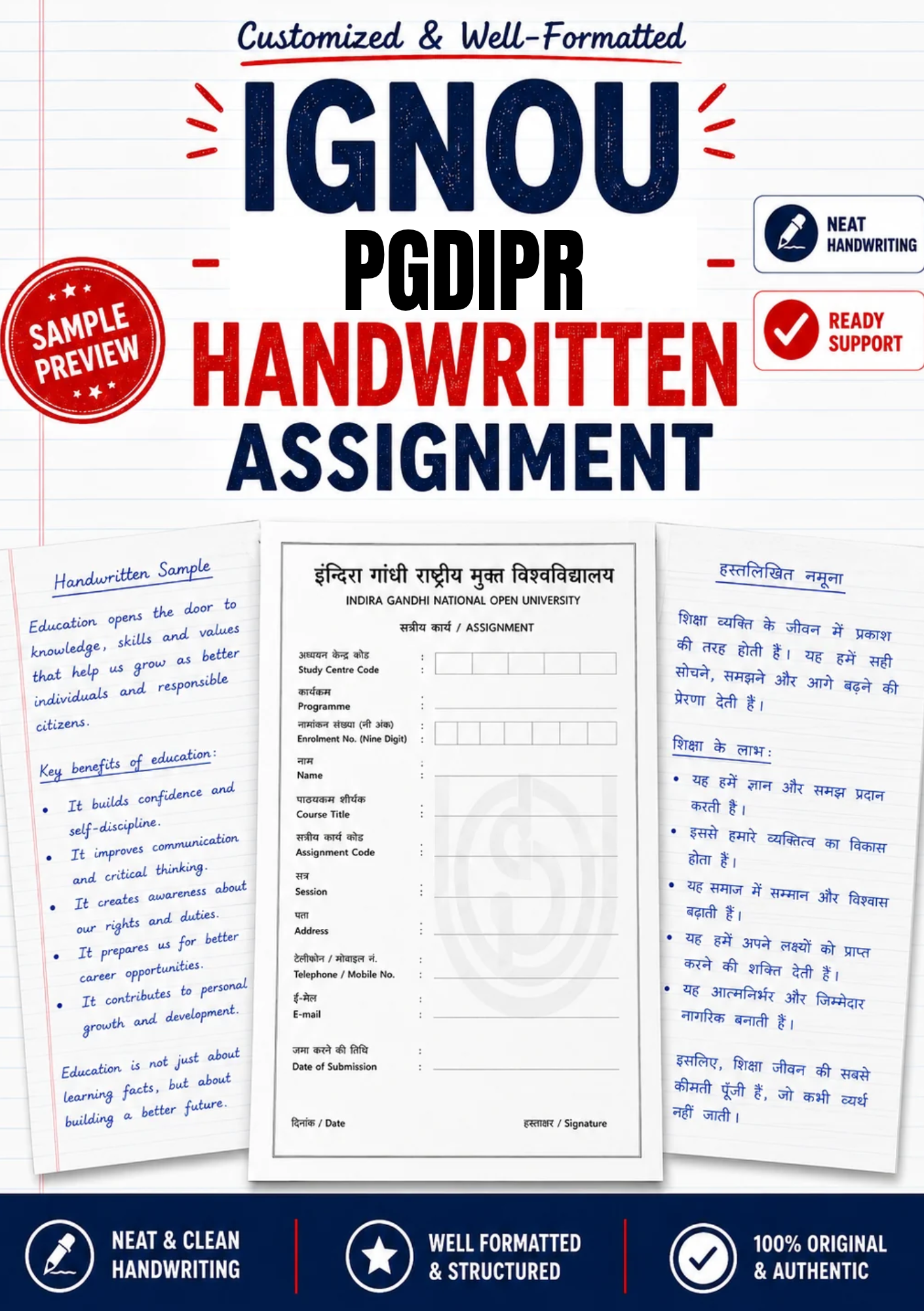
- A filled IGNOU-format front page carrying the nine fields the PGDIPR booklet lists: enrolment number, name, address, course code, course title, assignment code, Regional Centre code, study centre code and date. It is free with every order.
- A copy of the official TMA question paper for that course, so the evaluator sees the questions the answers respond to.
- The courier packaging and dispatch, which is paid for inside the per-paper rate.
What does not travel is any digital file. No soft copy or PDF is sold. A PGDIPR learner who wants a typed file of model answers to study from is looking for a different product, described in the comparison section below, and the store keeps that on a separate shelf.
Reading the ₹320 Line Against an Eight-Paper Law Diploma
The rate is ₹320 per subject, hard copy only, with courier included in that price and no separate shipping charge. On PGDIPR that arithmetic is unusually tidy, because the programme has no project, no practical, no elective and no paper of a different credit weight. Every MIP course is a 4-credit theory paper, so every MIP course costs the same to order.
The figures a PGDIPR learner most often needs are these. One paper is ₹320. Booklet 1 on its own, MIP-101 to MIP-104, is ₹1,280. Booklet 2 on its own, MIP-105 to MIP-108, is another ₹1,280. The full diploma, all eight papers, is ₹2,560. There is no minimum order: one subject or fourteen, same rate.
Three things sit inside that number and do not appear as extra lines on the bill: the free IGNOU-format front page, the copy of the question paper and the courier. Handwriting matching sits inside it too. Send a photo of a page you have written yourself and the handwritten set is matched to your handwriting at no extra charge.
Two things sit outside it. The first is any IGNOU fee: the Common Prospectus July 2026 lists the PGDIPR programme fee as Rs. 10,400 for the year, and that is paid to the university, not to a publisher. The second is any delivery-time commitment. Delivery depends on your pin code and is confirmed for your order before you pay. No figure is promised on this page.
MIP Model Answers on a Screen, or MIP Answers in Ink for the Counter
Two different products share the word assignment, and PGDIPR learners mix them up often enough that the difference deserves a plain statement. A solved assignment is a soft-copy reference file of model answers prepared for one course code and one session, meant to be read and studied. A handwritten assignment is the set of answers written out by hand on paper and submitted in hard copy at the study centre as the learner’s own response to the TMA.
The PGDIPR booklet itself settles which of the two the university asks for. Its formatting instructions state that the assignment response should be hand-written on A-4 or foolscap size paper that is not of a very thin variety, ask for answers in the learner’s own words rather than copied from the course material, and warn that copying another student’s response will draw serious action. A downloaded file of model answers is therefore a reference to write from. It is not a submission, and nothing on this page suggests that a printed or downloaded file can be handed in.
| What a PGDIPR learner weighs | Downloaded MIP reference file | Written MIP answer book |
|---|---|---|
| Form it takes | A digital document you read on a phone or print to study | Loose sheets written in ink, one book per MIP code |
| What you do with it | Study it, then write your own answers from it | Read it, sign the front page and hand it in |
| Who it suits | A learner with time to write eight papers personally | A working learner who cannot find the writing hours |
| Where the store keeps it | The PGDIPR model-answer shelf, sorted by MIP code and year | This product, priced at ₹320 per paper |
On a narrow screen, swipe the table sideways to read the third column.
If a reference file is what you came for, the store lists PGDIPR model-answer files arranged under each MIP code, and that shelf currently runs to the 2024 and 2025 sessions. This page does not sell a solved assignment and is not the place to compare solved-assignment titles. It sells the written hard copy, and it exists for the learner who has already decided that the answers have to arrive on paper.
A practical note for the learner who buys both: some PGDIPR learners order the model-answer file to study for the term-end examination and the written set for submission. That works, but the written set is not a copy of any file you hold. It is written against the question paper you name, in the hand you send, and you read it before you sign. You sign the declaration on the assignment cover page, so you should read and review the content before submitting it, and satisfy yourself that it represents your own understanding of the course.
Owe only Booklet 2? Order the four papers that are still open.
₹320 per MIP paper, courier included, front page free, question paper copy included. Booklet 2 alone, MIP-105 to MIP-108, comes to ₹1,280.
MIP 101 to MIP 108: Eight Four-Credit Papers and Nothing to Choose Between
Section 8.34 of the Common Prospectus July 2026 sets out PGDIPR as a School of Law programme, revised and launched in 2013, open to a graduate in any discipline, taught in English, with a minimum duration of one year and a maximum of three, examined year-wise, with admission in both the January and July cycles. Its course table lists eight codes and nothing else. Every code is compulsory. There are no electives to pick, no project code and no practical component.
| MIP paper | Title in prospectus section 8.34 | Credit weight of 32 | Booklet it sits in |
|---|---|---|---|
| MIP 101 | General Introduction to IP Rights | 4 | Booklet 1 |
| MIP 102 | Patents | 4 | Booklet 1 |
| MIP 103 | Industrial Design and Layout Designs of Integrated Circuits and Utility Models | 4 | Booklet 1 |
| MIP 104 | Trademarks, Domain Names, Geographical Indications | 4 | Booklet 1 |
| MIP 105 | Copyright and Related Rights | 4 | Booklet 2 |
| MIP 106 | Plant Varieties Protection, Biotechnology and Traditional Knowledge | 4 | Booklet 2 |
| MIP 107 | Trade Secrets, Competition Law and Protection of TCE | 4 | Booklet 2 |
| MIP 108 | Management of IPRs | 4 | Booklet 2 |
Swipe sideways on a phone to see the booklet column.
The credits add to 8 papers of 4 each, which is 32, and the prospectus prints Total Credits 32 beneath the table, so the extraction reconciles exactly. The same eight codes, titles and credits appear in the programme guide IGNOU publishes for PGDIPR on its e-VBAB portal.
Two features of this table matter to an order. First, because every paper is compulsory, every PGDIPR learner eventually needs the same eight codes; the only thing that varies between two learners is which of them are still outstanding. Second, the prefix MIP is unique to this programme. It occurs only eight times in the whole Common Prospectus, all eight in this one table. The neighbouring School of Law certificates use a different prefix: the Post Graduate Certificate in Patent Practice lists MIR 21, Overview of Intellectual Property Rights, and the Post Graduate Certificate in Cyber Law lists MIR 111 to MIR 114. An MIR paper is not a PGDIPR paper, however close its title sounds, and an order message that mixes the two prefixes is checked against your admission record before anything is written.
The booklet column is not in the prospectus. It comes from the assignment files themselves: IGNOU issues PGDIPR assignments as two booklets, the first holding MIP-101 to MIP-104 and the second MIP-105 to MIP-108, and that division drives the two different sets of cut-off dates described below.
MIP-101/TMA/2025 Printed Eight Times, and Other Places the PGDIPR Record Disagrees
Reading the 2025 PGDIPR booklets against the prospectus, against the 2024 booklets, and against the store’s own listings turns up a long list of disagreements. None of them is hidden here. Some are small spelling variations; two of them change what a learner writes on the front page or when the set must reach the study centre.
Every disagreement found while preparing this page, numbered so you can quote it to your study centre.
1. All eight 2025 PGDIPR papers, MIP-101 through MIP-108, print the same line: Assignment Code: MIP-101/TMA/2025. The repetition appears in each per-course file IGNOU publishes under ignou.ac.in/viewFile/SOL/assignments/ and again in the combined 2025 file on webservices.ignou.ac.in.
2. The 2024 PGDIPR booklets printed a separate code for each paper, MIP-101/TMA/2024 through MIP-108/TMA/2024, except that MIP-106 appeared as MIP-106/TMA/20124. The 2025 single-code printing is therefore new, not the long-standing format.
3. Booklet 1 and Booklet 2 set opposite cut-offs for the same intake. For a January 2025 learner, Booklet 1 gives 30 April 2025 and Booklet 2 gives 31 October 2025. For a July 2025 learner, Booklet 1 gives 31 October 2025 and Booklet 2 gives 30 April.
4. That Booklet 2 date for the July 2025 intake is printed as 30th April, 2025, which falls before the July 2025 session began. The 2024 Booklet 2 had given the July 2024 intake 30th April, 2025, the following year, so the 2025 printing reads as a year left unchanged.
5. Each 2025 paper prints, under the same heading, both “All questions are compulsory” and “Answer any Ten questions” with 10X10= 100, above a list of twelve questions. The two instructions cannot both be followed.
6. MIP-101 is “General Introduction to IP Rights” in the prospectus and “General Introduction to Intellectual Property Rights” on the 2025 paper. The July 2013 booklet called it “General Introductions to IP Rights”.
7. MIP-103 is “Industrial Design and Layout Designs of Integrated Circuits and Utility Models” in the prospectus and begins “Industrial Designs” on the 2025 paper.
8. MIP-104 is “Trademarks, Domain Names, Geographical Indications” in the prospectus and “Trademarks, Domain Names and Geographical Indications” on the 2025 paper. MIP-106 is printed on the 2025 paper with irregular capitals, “Plant Varieties protection, Biotechnology And traditional Knowledge”.
9. IGNOU’s PGDIPR assignment index on webservices.ignou.ac.in lists January/July files for 2025, 2024 and 2023 only, as read on 4 November 2026. No 2026 PGDIPR file is listed there, although the 2025 papers say they remain valid for one year.
10. The PGDIPR programme page on IGNOU’s own e-VBAB portal opens with objectives about sustainable development and environmental capacity building, wording that belongs to an environment programme rather than to intellectual property rights.
11. The July 2013 booklet asked for MIP-101 to MIP-104 to be sent before September 31, 2013, a date that does not exist.
12. The combined 2025 PGDIPR file on webservices.ignou.ac.in does not end with the 2025 papers. Its closing pages carry a Jan/July-2019 PGDIPR Booklet 1 cover and a Jan/July 2019 cover for the Post Graduate Certificate in Patent Practice assignments, MIR-021 and MIR-022, which belong to a different programme and an expired cycle.
13. Third-party sellers advertise PGDIPR solved assignments for a Jan-July 2026 session, while IGNOU’s own PGDIPR index shows no 2026 file.
14. Third-party admission pages quote the PGDIPR fee as ₹10,200 against the prospectus figure of Rs. 10,400, one states a maximum duration of one year against the prospectus maximum of three years, and another names a programme coordinator whom the prospectus lists against PGDCJ, while also renaming several MIP courses.
15. In-house: the store’s MIP-101 solved-assignment listing for 2025 offers a handwritten MIP-101 at ₹350 rather than ₹320, states a delivery window in working days, and titles the course “General Introductions to IP Rights”.
16. In-house: the description on the store’s PGDIPR solved-assignment shelf promotes guide books, says they are limited to a page count, and presents a share of examination questions as a guarantee. That shelf holds sixteen solved-assignment listings and no books, and the store has no PGDIPR books shelf at all.
17. In-house: the store’s handwritten hub category still states three different delivery windows in working days, describes its sets as study reference material not for submission, and specifies A4 ruled sheets, while the PGDIPR booklet allows A-4 or foolscap paper.
Items 1, 3 and 5 are the ones that reach into an order. The assignment code question is handled in the code section below. The date question is handled in the next section. The any-ten-or-all-twelve question is settled per order: the set follows whichever instruction your study centre confirms, and if you have no confirmation, the choice is put to you on WhatsApp before writing starts rather than decided silently. The in-house items, 15 to 17, are this store’s own errors and are listed for correction at source rather than repeated on this page.
Booklet 1 Shuts in April, Booklet 2 in October: The PGDIPR Cut-Offs Read Off the 2025 Files
Most IGNOU programmes print one pair of submission dates that applies to every paper. PGDIPR does not. The School of Law issues the eight papers as two booklets, and each booklet’s Dear Student letter carries its own pair of dates. Read side by side, the 2025 letters stagger the work across the year: a learner admitted in January hands in the first four papers in spring and the second four in autumn, and a learner admitted in July does the reverse.
| PGDIPR booklet | Papers inside | Cut-off for a January 2025 learner | Cut-off for a July 2025 learner |
|---|---|---|---|
| Booklet 1 | MIP-101, MIP-102, MIP-103, MIP-104 | April 30, 2025 | 31st October, 2025 |
| Booklet 2 | MIP-105, MIP-106, MIP-107, MIP-108 | October 31, 2025 | 30th April, 2025, as printed |
Swipe left on a phone for the July intake column.
The dates in that table are copied exactly as printed, odd ordinals included. The last cell is the one to treat with care. A cut-off of 30 April 2025 for a session that began in July 2025 cannot have been meant, and the 2024 booklet for the same papers gave the July 2024 intake 30 April 2025, a year after admission. If you are a July learner working from the 2025 Booklet 2, confirm the real cut-off with your study centre or Regional Centre before relying on the printed year.
Both letters attach the same consequence to a missed date: a learner will not be allowed to appear in the term-end examination for a course whose assignment was not submitted before the due date. The booklets also say each assignment remains valid for one year, advise submission within eight weeks of receiving it, require at least 40 per cent in each course’s assignment to clear the continuous evaluation component, and recommend keeping a copy of what you hand in. Assignments carry 30 per cent of the final course result and the term-end examination carries the remaining 70 per cent.
These dates belong to PGDIPR and to the School of Law’s two-booklet arrangement. They are not a template for other programmes, and other programmes’ dates are not a template for PGDIPR. They also belong to one cycle: the 2025 papers expire, and IGNOU replaces them with a new set when it publishes one. As of 4 November 2026 its PGDIPR index lists no 2026 file, so a learner admitted in 2026 should check the university’s assignment download portal, and ask the study centre which year’s paper it will accept, before any writing is ordered. The set is written against whichever paper you name; it is never quietly swapped for a different year.
Which Code Goes Under Your Name When One Code Is Printed on Eight Papers
The assignment code is the line the study centre uses to match a script to a course and a cycle, which is why the front page asks for it separately from the course code. On the 2024 PGDIPR papers the two lined up neatly: course code MIP-104, assignment code MIP-104/TMA/2024. The pattern reads as course code, then TMA for tutor marked assignment, then the year.
On the 2025 papers the two lines no longer agree. Course code MIP-104 sits directly above Assignment Code: MIP-101/TMA/2025, and the same assignment code appears beneath MIP-102, MIP-103, MIP-105, MIP-106, MIP-107 and MIP-108. A learner copying the front page faithfully would therefore write the same assignment code on eight different scripts.
Shri Chakradhar Publication does not decide this for you, because the decision belongs to the university, not to a publisher. The default is to copy the code exactly as your paper prints it, since the front page is meant to mirror the question paper attached behind it. Before writing, the mismatch is pointed out to you on WhatsApp, and if your study centre tells you to use the per-course form, MIP-104/TMA/2025 for example, the front page is written that way instead. Whichever form is used, the course code and course title fields carry the correct MIP number and title for that script, so the paper can still be identified.
The same care applies to older papers. A backlog MIP-106 written against the 2024 set carries the code as the 2024 paper prints it, which for that one course means checking whether your study centre wants the printed MIP-106/TMA/20124 or the evident intention, MIP-106/TMA/2024. The question is raised, not guessed.
Your Own Pen Strokes Carried Onto a Law Paper
A PGDIPR answer book is read by a School of Law evaluator alongside your term-end script in the same hand, so a written set that looks nothing like your handwriting is an obvious problem. Send a photo of a page you have written yourself and the handwritten set is matched to your handwriting at no extra charge.
Matching here means the things a reader notices first: the slant, the size of the letters, how capitals and numerals are formed, how far apart words sit and how the lines run across the sheet. It is a practical copy of your writing style for an answer book, done by people who write by hand every working day, not a forensic reproduction.
Law papers raise one particular point. MIP answers lean heavily on statute names, section numbers and treaty titles, such as the Patents Act, 1970, the Patent Co-operation Treaty or the Protection of Plant Varieties and Farmers’ Rights Act, and those are written out in full where the answer needs them, in the same hand as the rest of the page.
The page to photograph before a PGDIPR order
Photograph one full page of ordinary running writing in blue or black ink, on lined or plain paper, in good light, held flat. A page of class notes or an old answer is ideal. A signature alone, a single line or a page of capital letters gives too little to match. If your English writing changes when you are rushed, send the rushed page, because that is the hand an evaluator will compare against.
English Only, Either Intake, and MIP Papers Still Owed From an Earlier Year
The service covers all mediums IGNOU issues the TMA paper in, at the same price. For PGDIPR that resolves to one medium. The prospectus lists English as the medium of instruction, and every 2025 PGDIPR file on ignou.ac.in is tagged (E) in its name. A request for a Hindi PGDIPR set cannot be met against a paper IGNOU does not issue, and the order message will say so rather than producing a translation the university never set.
Both intakes are covered. PGDIPR admits learners in January and in July, and the order follows the dates and the paper that belong to your intake, as set out in the dates section above. Any session is accepted, current cycle or older, including backlog courses, at the same ₹320 per subject.
Backlogs are common on PGDIPR for a structural reason: the programme can be completed in one year but may run to three, so a learner who cleared Booklet 1 in the first year often returns for Booklet 2 later, or re-attempts a single course such as MIP-102 or MIP-108. Whichever year’s paper your study centre asks for, 2023, 2024 or 2025, the set is written against that paper, with that paper’s code and that paper’s questions.
Five Lines That Start a PGDIPR Quote on WhatsApp
An order needs five pieces of information, and nothing beyond them:
- The MIP codes you need, for example MIP-105, MIP-107 and MIP-108.
- The session or year of the paper your study centre will accept, such as Jan/July-2025.
- The intake you joined, January or July, because the two booklets set different cut-offs for each.
- One photographed page of your writing, a full page as described above.
- The delivery address with pin code, which is what the delivery estimate depends on.
Your enrolment number, study centre code and Regional Centre code are needed for the front page, and they can be sent in the same message or after the order is confirmed. There is no form to fill in on this page and no account to create.
Starting PGDIPR from the beginning? Price all eight papers in one message.
Eight MIP papers at ₹320 each is ₹2,560, with the courier, the front pages and the question-paper copies already inside that figure.
From the Courier Packet to the Study Centre Receipt for MIP Papers
When the packet arrives, open it straight away and check it against your order: one answer book per MIP code, each with its front page and its question paper copy. Read every answer book through. This is not a formality. You sign the declaration on the assignment cover page, so you should read and review the content before submitting it, and satisfy yourself that it represents your own understanding of the course.
Before handing in, complete any front-page field that was left for you, sign where your signature is needed, and assemble each script in the order the study centre expects: front page, question paper, answers. Keep a photocopy or clear photographs of every script, which the PGDIPR booklet itself recommends.
Submit at your allotted study centre before the cut-off for that booklet, and ask for an acknowledgement. Some centres accept scanned uploads instead of paper in particular cycles; if yours does, the written set can be scanned by you exactly as it is. After evaluation, assignment marks appear on IGNOU’s own status and grade card services, which this store does not operate or influence. No claim is made about the marks any assignment will receive, about how an evaluator will assess it, or about whether it will be accepted. Assignment evaluation is entirely a matter for IGNOU.
Other Shelves a PGDIPR Learner Tends to Open
The written set covers the 30 per cent. For the term-end examination, many PGDIPR learners also look at the eight MIP guess-paper titles kept for term-end revision, one per course. The paper that worries learners most is often the management course, and the store keeps a separate guess paper for Management of IPRs, a three-hour, 100-mark paper in its recent term-end sittings.
A learner who wants to study from a model answer before writing personally can start with the MIP-101 reference file dated 2025 and find the remaining seven codes on the same PGDIPR shelf. Learners juggling more than one programme sometimes prefer the multi-programme solved assignment book instead.
For a learner enrolled in a second IGNOU diploma alongside PGDIPR, the parent shelf of solved files for every IGNOU diploma and guess papers for the other IGNOU diplomas sit one level above the PGDIPR shelves, and the solved-assignment catalogue as a whole sits above those.
A written set for a programme without its own product page, or for an unusual mix of courses from different programmes, can be placed through the any-session customised order page, and every programme that does have its own page is listed on the store’s full shelf of programme-wise written sets.
The store has no PGDIPR books shelf at present, so no study-guide link is offered here. If you would rather write the eight papers yourself, the PGDIPR programme guide on ignouproject.com covers the programme, its courses and its School of Law context without selling anything.
Fifteen Questions Asked About PGDIPR Written Sets
IGNOU has not put up a 2026 PGDIPR assignment. Which year should my MIP papers be written for?
As of 4 November 2026, IGNOU’s PGDIPR assignment index lists only the 2025, 2024 and 2023 January/July files. Which year counts for your intake is the study centre’s decision, so ask it first, then name that year in your order. The set is written against the year you name and is never switched to another year without your instruction.
Why does my MIP-104 question paper show MIP-101/TMA/2025 as the assignment code?
Because all eight 2025 PGDIPR papers print that same code, which looks like a carry-over from the first paper in IGNOU’s template. By default the front page copies the code as printed; if your study centre asks for the per-course form, MIP-104/TMA/2025, the front page is written that way instead. Either way the course code field carries MIP-104.
MIP papers ke liye downloaded answer file aur haath se likhe set mein farq kya hai?
A solved assignment is a soft-copy file of model answers for one MIP code and one session, meant for study. A handwritten assignment is the answer book written by hand on paper and handed in at the study centre. This product is the second. Model-answer files sit on the separate PGDIPR solved-assignment shelf.
Can I print out a downloaded MIP-105 answer file and submit it?
The PGDIPR booklet asks for a hand-written response in your own words on A-4 or foolscap paper, so a printed file does not match the instruction IGNOU gives for this programme. Treat a downloaded file as material to write from, not as something to hand in.
Typed ya printed PGDIPR assignment study centre par chalega?
The PGDIPR booklet’s formatting instruction is that the response should be hand-written. That is why this product exists as a written hard copy and why no soft copy or PDF is sold with it. If your centre runs a scan-upload route in a given cycle, what is scanned is still a handwritten script.
The paper says answer any ten but also says all questions are compulsory. How many does the set answer?
The 2025 papers print both instructions above twelve questions. The set follows whichever one your study centre confirms. If you have no answer from the centre, the choice is put to you on WhatsApp before writing begins, so the decision stays with you.
I joined in January. When are MIP-105 to MIP-108 due?
On the 2025 Booklet 2, the January 2025 intake was given October 31, 2025 for MIP-105 to MIP-108, while Booklet 1 gave the same learners April 30, 2025 for MIP-101 to MIP-104. For any other year, read the Dear Student letter in that year’s booklet, because PGDIPR’s two booklets carry different dates.
What will all eight PGDIPR papers cost, and is shipping extra?
Eight papers at ₹320 each is ₹2,560. Courier, a free IGNOU-format front page for each paper and a copy of each question paper are already inside that figure, so no separate shipping or packing line is added.
Is a Hindi-medium PGDIPR set possible?
The prospectus offers PGDIPR in English only, and the 2025 files on ignou.ac.in are all English editions. A set is written in the medium of the paper IGNOU actually issues, so for PGDIPR that is English.
I passed Booklet 1 in 2024 and still owe MIP-102 from that year. Can that one paper be ordered alone?
Yes. A single backlog paper from an older PGDIPR set is ordered at the same ₹320, written against the year your study centre asks for, with that year’s code and questions. There is no minimum order.
Should a PGDIPR answer book be on A4 or foolscap?
The PGDIPR booklet allows either, asking only that the paper is not of a very thin variety and that a margin of at least 4 cm is left on the left, top and bottom of each sheet for the evaluator’s comments. If your study centre prefers one size, mention it in your order message.
How many marks do I need in each MIP assignment?
The PGDIPR booklet states that a learner needs 40 per cent in the assignment for each course to clear the continuous evaluation component, and that assignments carry 30 per cent of the final grade. Those figures are IGNOU’s; no claim is made about what any written set will score.
How do I get my handwriting copied for the MIP set?
Photograph one full page of your normal running writing in blue or black ink, in good light, and send it on WhatsApp with your codes. The answer books are then written to match that page, at no extra charge.
Mera PGDIPR course MIR code wala hai ya MIP code wala?
PGDIPR uses MIP 101 to MIP 108 only. MIR codes belong to other School of Law certificates, such as MIR 21 in the patent practice certificate and MIR 111 to MIR 114 in the cyber law certificate. Your admission record shows which programme you are in, and the order is checked against it.
Can the publisher say how an evaluator will mark my MIP answer books?
No. No claim is made about the marks any assignment will receive, about how an evaluator will assess it, or about whether it will be accepted. Assignment evaluation is entirely a matter for IGNOU.
Prospectus, Booklet and Publisher Terms: Where Each PGDIPR Claim Comes From
Three kinds of source were used for this page, and they are kept apart here because they carry different authority.
From the Common Prospectus July 2026, section 8.34 and annexure row 159. School of Law; revised and launched in 2013; eligibility a graduate in any discipline; English medium; minimum one year, maximum three years; fee Rs. 10,400; year-wise examination; January and July cycles; the eight MIP codes, their titles and 4 credits each, totalling 32. The prospectus is available as the Common Prospectus July 2026 file IGNOU publishes. The same table is reproduced in IGNOU’s PGDIPR programme guide on the e-VBAB portal.
From the live 2025 PGDIPR assignment files. The per-course files PGDIPR_MIP-101(E)(2025) to PGDIPR_MIP-108(E)(2025) under ignou.ac.in/viewFile/SOL/assignments/, read on 4 November 2026, and the combined Jan/July-2025 file on IGNOU’s PGDIPR assignment index on webservices.ignou.ac.in, which also lists the 2024 and 2023 sets. The 2024 combined file was read for comparison. From these come the two-booklet split, every submission date, the single printed assignment code, the twelve-question any-ten pattern, the paper size and margin instruction, the 40 per cent requirement, the one-year validity line and the front-page fields. Papers for every IGNOU programme are reachable through the university’s assignment download portal.
Taken from the publisher’s own PGDIPR sales terms. The ₹320 rate, courier inside it, the free front page, the question paper copy, handwriting matching, no minimum order, sessions and backlogs accepted, no soft copy or PDF, and delivery confirmed per pin code rather than promised. These are the publisher’s terms, not IGNOU’s.
Programme structures, course codes, submission dates and rules change, and only ignou.ac.in and your Regional Centre can confirm the current position for your enrolment.
Important Notice
Shri Chakradhar Publication Pvt. Ltd. and shrichakradhar.com form an independent IGNOU study-support publisher. This is not the official website of Indira Gandhi National Open University, is not affiliated with, endorsed by or authorised by the university, and no page on this site should be treated as an official IGNOU communication.
Programme structures, course codes, submission dates and rules change, and only ignou.ac.in and your Regional Centre can confirm the current position for your enrolment.
You sign the declaration on the assignment cover page, so you should read and review the content before submitting it, and satisfy yourself that it represents your own understanding of the course.
No claim is made about the marks any assignment will receive, about how an evaluator will assess it, or about whether it will be accepted. Assignment evaluation is entirely a matter for IGNOU.
List the MIP Papers Still Open and the Quote Arrives at ₹320 Each
The rate is ₹320 per subject, hard copy only, with courier included in that price and no separate shipping charge. No soft copy or PDF is sold. Delivery depends on your pin code and is confirmed for your order before you pay. No figure is promised on this page.
WhatsApp +91 93546 37830 with the MIP codes you owe, or choose the number of papers and use the Add to cart button at the top of this page.