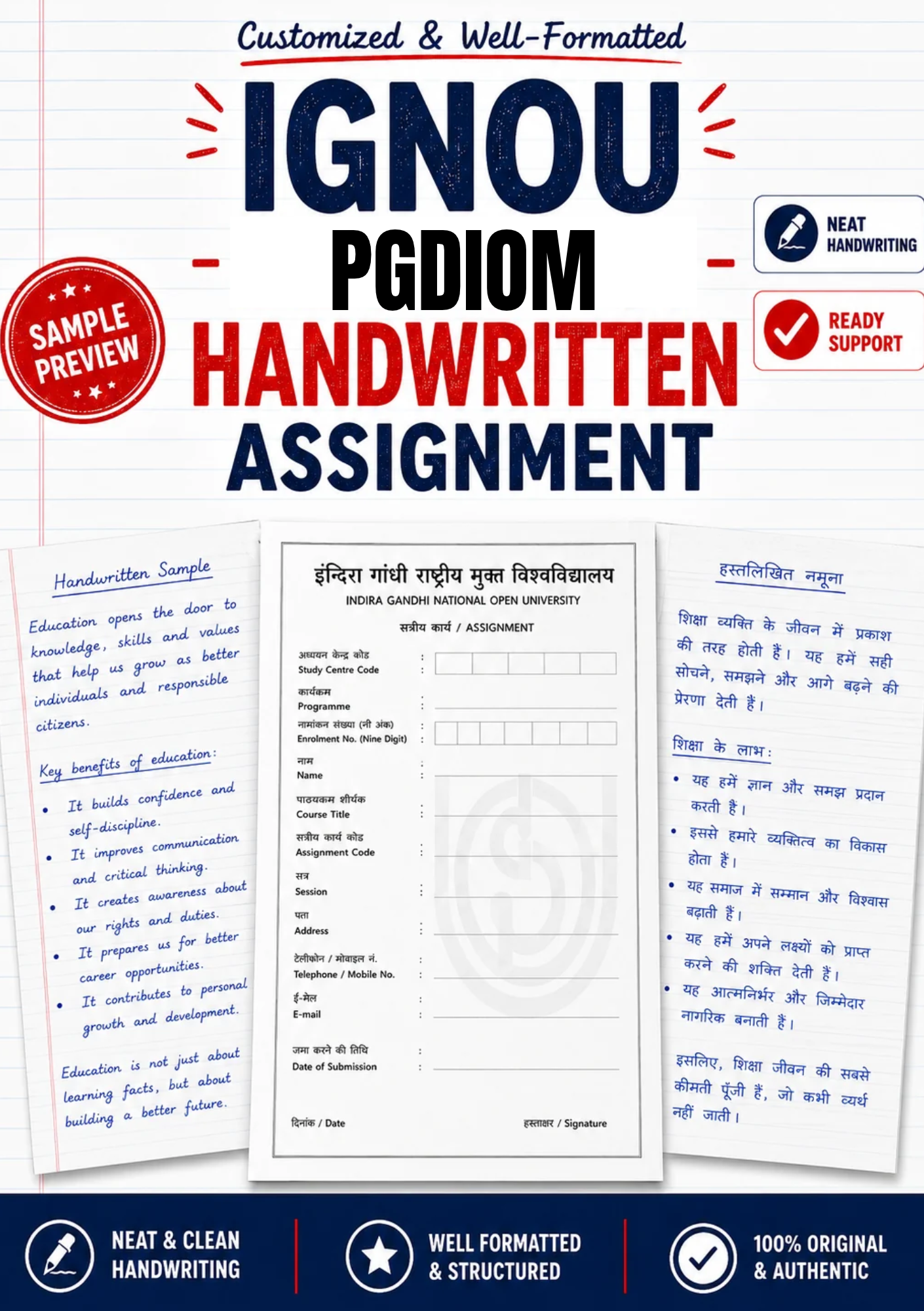


Description
In short. A complete IGNOU PGDIOM handwritten order is nine papers, not the ten the Common Prospectus July 2026 prints: MMPC 005 Quantitative Analysis for Managerial Applications, MMPC 008 Information Systems for Managers, and seven of the eight MMPO electives, since the printed total is 36 credits and ten rows at four credits would be 40. The rate is ₹320 per subject, hard copy only, with courier included in that price and no separate shipping charge. Seven of those papers sit on the July 2026 and January 2027 cycle and print 31 October 2026 and 30 April 2027 on their covers, while MMPC 008, MMPO 004 and MMPO 008 are still printed for January 2026 and July 2026 and give 30 April 2026 and 31 October 2026, so a July 2026 submission lands on 31 October 2026 whichever cycle your particular code is on. Shri Chakradhar Publication writes each set against the booklet that is actually live for that code, in English or in Hindi, for the current cycle or for a backlog, and the handwriting is matched from a page you photograph yourself before any payment is made.
The Operations Parcel, Item by Item, Before You Open It
A PGDIOM order does not arrive as a link. It arrives as paper, in a courier bag, with one bundle per course code you named. Opening it, you should be able to lay out four things for every single code and account for them separately.
- The answer sheets. Every question on that code’s live booklet answered by hand on plain A4, in the hand that matches your sample page, with headings and sub-headings marked so an evaluator can find the question numbers without hunting.
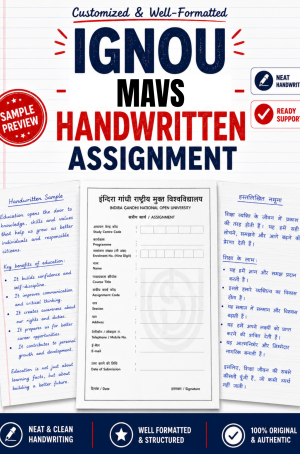
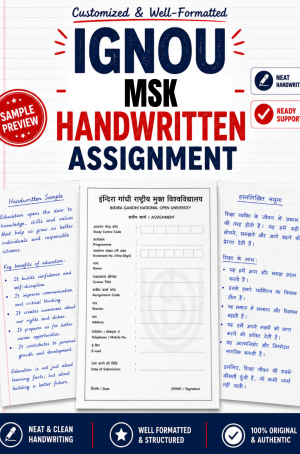
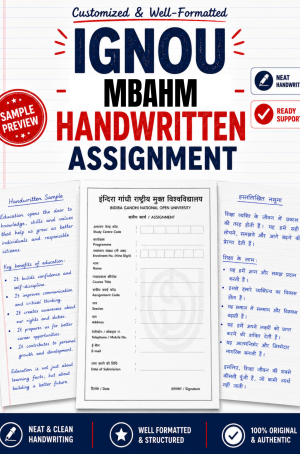
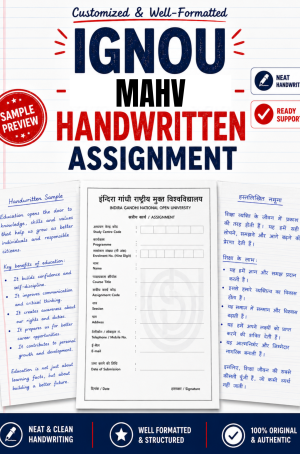
- The IGNOU-format front page. One per code, carrying the course code, the course title as the booklet prints it, the assignment code string, your enrolment number, your name and address, the study centre and the submission date. It is included free with every order.
- A copy of the official question paper. The actual booklet downloaded for your code and your session, printed and clipped to the set, because study centres routinely refuse a bundle that has no question paper attached and because a handwritten copy of the questions is not accepted in its place.
- A tracking message. The courier reference reaches you on WhatsApp on the number the order was placed from.
What does not arrive is a file. No soft copy or PDF is sold. If your study centre has moved to online submission, you scan the sheets that reach you and upload your own scan, which is a different thing from buying a model-answer document and treating it as a submission.
What the Rate Settles, and the Two Things It Leaves to You
The rate is ₹320 per subject, hard copy only, with courier included in that price and no separate shipping charge. On a nine-paper diploma that is nine units of ₹320, and nothing is added for the parts a learner usually expects to be charged for.
Inside the rate: the writing itself, the free IGNOU-format front page for each code, the printed question paper for each code, the handwriting match taken from your own sample page, the courier, and the WhatsApp tracking. Send a photo of a page you have written yourself and the handwritten set is matched to your handwriting at no extra charge. The service covers all mediums IGNOU issues the TMA paper in, at the same price, which matters here because MMPC 005, MMPO 001 and MMPO 003 have live Hindi editions. There is no minimum order: one subject or fourteen, same rate.
Outside the rate, and genuinely outside it, are two things. The first is the walk to the counter: you submit your own set, you sign the declaration on the front page, and the study centre receipt is issued in your name. The second is the result. No claim is made about the marks any assignment will receive, about how an evaluator will assess it, or about whether it will be accepted. Assignment evaluation is entirely a matter for IGNOU. Assignments carry 30 per cent of the final course result and the term-end examination carries the remaining 70 per cent, and that 30 per cent is awarded by your evaluator and by nobody else.
Delivery depends on your pin code and is confirmed for your order before you pay. No figure is promised on this page.
Why an MMPO PDF Cannot Sign Your Declaration
Two different purchases get called the same thing in operations-management searches, and the difference is not quality but function. A solved assignment is a soft-copy reference file: model answers for one course code and one session, delivered as a PDF, which you read and write from. A handwritten assignment is the answers written out by hand on A4 and submitted in hard copy at the study centre, which is the physical object the counter accepts.
The instruction on your own paper settles which one crosses the counter. MMPO-003 for the July 2026 and January 2027 semesters tells the learner to “submit this assignment to the Coordinator of your study centre”, and the submission that reaches that coordinator is a written set with a signed declaration on its front page. A downloaded file cannot sign that declaration and a printout of model answers is not a handwritten submission, whatever the file is titled.
| Point of difference | Solved assignment, soft copy | Handwritten assignment, this product |
|---|---|---|
| What it physically is | A PDF of model answers for one code and session | Hand-written A4 sheets plus the front page and question paper |
| What you do with it | Read it, then write your own answers from it | Check it, sign the declaration, submit it |
| Who it suits | A learner who intends to write the nine sets personally and wants a reference | A learner whose time has gone and who needs the written sets to exist |
| Rate on this store | Per PDF, priced on the solved-assignment shelves | ₹320 per subject, courier included |
| Medium coverage | Usually the English paper only | All mediums IGNOU issues the TMA paper in |
Scroll the table sideways on a narrow screen to see the handwritten column.
If the reference file is what you actually want, the operations-diploma soft-copy shelf on this store is the operations-diploma solved assignment shelf, and one warning is owed about it: that shelf is built on the MS series, which belongs to the other IGNOU diploma of the same name, so an MMPO learner will find MS 55 and MS 56 there rather than MMPO 005 and MMPO 006. For MMPO-coded soft copies the right route is the wider MBA assignment catalogue, because the same MMPO codes are examined on MBAOM. The twin-diploma problem is set out below, and it is the single most expensive mistake a PGDIOM learner can make when buying study support.
Nine papers, one message, one rate of ₹320 per subject.
Type out the MMPC and MMPO code numbers printed on your re-registration record, say which session your booklets are dated for, and add your pin code. A per-code quote comes back against your own list, and the handwriting sample is taken before any payment is made.
Both Compulsory Papers Are Also Somebody Else’s Core Course
PGDIOM has exactly two courses nobody on the diploma can avoid, and both of them are the most widely shared codes in the School of Management Studies catalogue. MMPC 005 Quantitative Analysis for Managerial Applications and MMPC 008 Information Systems for Managers appear in five separate programme tables in the Common Prospectus July 2026, and the five tables do not agree with each other about what those courses are called or how they are classified.
| Compulsory code | Credits on PGDIOM | Title as the PGDIOM table prints it | Other titles and types the same prospectus prints |
|---|---|---|---|
| MMPC 005 | 4 | Quantitative Analysis for Managerial Applications | Title identical in all five tables. Typed Compulsory on PGDIOM, Theory,Compulsory in the MBACN and MBALS tables, Theory in the MBAABM and MBAHCHM tables |
| MMPC 008 | 4 | Information Systems for Managers | Information System Managers in the MBACN and MBALS tables. Typed Compulsory on PGDIOM, Theory,Compulsory in MBACN and MBALS, Theory in MBAABM and MBAHCHM |
The right-hand column is wide, so scroll it sideways on a phone.
Three of those four other programmes are not even run by the same school. MBACN and MBALS sit with the School of Engineering and Technology, MBAABM with the School of Agriculture and MBAHCHM with the School of Health Sciences, while PGDIOM sits with the School of Management Studies. Since IGNOU sets its submission dates per school rather than per course, a code that lives in four schools is a code that can carry more than one date regime, and that is exactly what MMPC 008 does: its own current booklet is printed for the January 2026 and July 2026 sessions, while MMPC 005, the other compulsory paper, is printed for the July 2026 and January 2027 semesters.
The practical consequence is narrow and worth stating plainly. When you download MMPC 008 you are downloading a paper written for seven MBA programmes with PGDIOM added at the end of the list, and the dates on it will not match the dates on MMPO 003 that you downloaded the same afternoon. Neither file is wrong. They are on different cycles.
Semester I Is Where You Drop a Paper; Semester II Is Not
Eight MMPO electives are printed and seven are required, so there is one choice to make in the whole diploma and it is narrower than the arithmetic suggests. The SOMS PG Diploma programme guide states the split: two compulsory papers plus three electives in Semester I, then four electives in Semester II. Semester I prints four electives for three places, so one of MMPO 001, MMPO 002, MMPO 003 and MMPO 004 comes off your list. Semester II prints four electives for four places, so MMPO 005, MMPO 006, MMPO 007 and MMPO 008 are all compulsory in practice despite being labelled Elective in the table.
| Elective code | Course title on the prospectus table | Semester | Cycle on the current live booklet | Assignment code string as printed |
|---|---|---|---|---|
| MMPO 001 | Operations Research | I | July 2026 and January 2027 Semesters | MMPO-001/TMA/JULY/2026 |
| MMPO 002 | Project Management | I | July 2026 and January 2027 Semesters | MMPO-002/TMA/JULY/2026 |
| MMPO 003 | Operations Management | I | July 2026 and January 2027 Semesters | MMPO-003/TMA/JULY/2026 |
| MMPO 004 | Management Information Systems | I | January 2026 and July 2026 Sessions | MMPO-004/TMA/JAN/2026 |
| MMPO 005 | Logistics and Supply Chain Management | II | July 2026 and January 2027 Semesters | MMPO-005/TMA/ JULY/2026 |
| MMPO 006 | Materials Management | II | July 2026 and January 2027 Semesters | MMPO-006/TMA/JULY/2026 |
| MMPO 007 | Maintenance Management | II | July 2026 and January 2027 Semesters | MMPO-007/TMA/JULY/2026 |
| MMPO 008 | International Logistics and Supply Chain Management | II | January 2026 and July 2026 Sessions | MMPO-008/TMA/JAN/2026 |
Five columns, so scroll sideways on a phone to reach the code string.
Two of those eight codes are worth a second look. MMPO 001 Operations Research, MMPO 006 Materials Management and MMPO 007 Maintenance Management occur exactly once each in the whole 1.15 MB Common Prospectus July 2026, and all three occurrences are inside the PGDIOM table. No other programme in that document carries them. If you are registered for Materials Management or Maintenance Management, the PGDIOM table is the only place the prospectus describes your paper at all, which is why the title on the table and the title on the booklet are worth comparing before you write anything.
Five of the eight go the other way. MMPO 002, MMPO 003, MMPO 004, MMPO 005 and MMPO 008 reappear in the MBALS table, where they are not electives at all but are typed Theory,Compulsory on an MBA run by the School of Engineering and Technology. Among them MMPO 005 also appears in the PGDISM table, so Logistics and Supply Chain Management is simultaneously a PGDIOM elective, a PGDISM elective and an MBALS core course. Its booklet cover names PGDIOM and PGDISM and leaves MBALS out.
One Code Set, Four Schools and Two Diplomas of the Same Name
IGNOU runs two post graduate diplomas in operations management at the same time. They share an English name, they share no course codes, and only one of them is in the Common Prospectus July 2026. Before the contradictions are listed, the code map is worth seeing on its own, because getting this wrong means buying the right subject in the wrong code family.
| Subject as both diplomas name it | PGDIOM code, 4 credits | PGDOM code, 6 credits | Titles identical? |
|---|---|---|---|
| Operations Research | MMPO 001 | MS-51 | Yes, word for word |
| Project Management | MMPO 002 | MS-52 | Yes, word for word |
| Operations management as a subject | MMPO 003 Operations Management | MS-53 Production/Operations Management | No, MS-53 adds Production |
| Logistics and Supply Chain Management | MMPO 005 | MS-55 | Yes, word for word |
| Information systems for managers | MMPC 008 Information Systems for Managers | MS-7 Information System for Managers | No, one letter apart |
| Materials and maintenance | MMPO 006, MMPO 007 | MS-56, MS-57 | Compare the covers before ordering |
Four columns, scrollable sideways on a phone.
Both diplomas are live for the current cycles. PGDIOM is in the prospectus at section 8.63 and its MMPO booklets are published under the School of Management Studies assignment directory. PGDOM is absent from that prospectus entirely, yet its MS-51, MS-52, MS-53 and MS-55 booklets are published in the same directory and IGNOU’s own current-assignments index for management lists it by name with its MS code set. Neither document mentions the other.
Twenty-four findings are set out below. The first twenty-two are IGNOU’s own documents disagreeing with each other across the Common Prospectus, the SOMS programme guide, the live programme page and admission portal, the assignment booklets and the management current-assignments index. The last two are this publisher’s own faults, and the second of those bundles several. All of them are printed here rather than quietly resolved.
1. The PGDIOM table prints ten course rows at four credits each, which is 40 credits, under a printed Total Credits figure of 36. The resolving footnote, which reads that any seven courses are to be chosen from the electives, sits beneath the table and is the only thing in the prospectus that reconciles the two numbers.
2. The elective footnote appears under PGDIHRM, PGDIFM, PGDIMM and PGDIOM but not under PGDISM, so four of the five School of Management Studies post graduate diplomas offer a choice and one does not.
3. MMPC 008 is titled Information Systems for Managers in the PGDIOM, MBAABM and MBAHCHM tables and Information System Managers in the MBACN and MBALS tables, inside one document.
4. Both PGDIOM compulsory papers are typed three different ways in that same document: Compulsory in the PGDIOM table, Theory,Compulsory in two School of Engineering and Technology tables, and Theory in the School of Agriculture and School of Health Sciences tables.
5. MMPO 003 is Operations Management in the PGDIOM table and Operation Management, singular, in the MBALS table. The singular form occurs exactly once in the whole prospectus.
6. MMPO 004 is Management Information Systems in the prospectus, on IGNOU’s live programme page and on the university’s own video-resources listing, but its live booklet prints the course title as Management Information System, singular.
7. Seven of the ten PGDIOM rows are on one assignment cycle and three are on another. MMPC 005, MMPO 001, 002, 003, 005, 006 and 007 are printed for the July 2026 and January 2027 semesters, while MMPC 008, MMPO 004 and MMPO 008 are printed for the January 2026 and July 2026 sessions. The diploma’s two compulsory papers are on opposite cycles.
8. The assignment code string is not spaced consistently inside one programme. MMPO 003 prints the string tight, while MMPC 005 and MMPO 005 both print a space between the second slash and the session name.
9. The month inside the code string is rendered two ways across one learner’s own ten papers, as JULY on six of them and as JAN on three.
10. PGDOM, the diploma that shares PGDIOM’s English name, occurs zero times in the Common Prospectus July 2026, while its MS-series booklets are live for both current cycles and IGNOU’s management current-assignments index lists it.
11. That index spells the genus Post Graduation Diploma, the MS-55 cover spells it Post Graduate Diploma, an older MS-51 file spells it Post-Graduate Diploma with a hyphen, and IGNOU’s admission portal prints Post Graduate Diploma followed by the specialisation in brackets. Four spellings of one programme name.
12. PGDOM runs two cycles too. MS-51 and MS-53 are printed for January 2026 and July 2026, while MS-55 is printed for July 2026 and January 2027.
13. A marketing code prints on an operations compulsory paper. The current MMPC 008 cover carries a stray MS-65 above its programme list, and MS-65 is a live course code on the marketing diploma, not on either operations diploma.
14. Three IGNOU documents name three different PGDIOM programme coordinators: the prospectus section 8.63 names one, with no email and no telephone number; the SOMS post graduate diploma programme guide names a second, with an email address and a direct line; and IGNOU’s own distance-mode admission portal names a third, who is the coordinator of the operations MBA.
15. The medium is stated two ways by the university. The prospectus and the live programme page both print English as the medium of instruction, while the admission portal entry for PGDIOM lists English and Hindi. Hindi editions of MMPC 005, MMPO 001 and MMPO 003 are published and all three name PGDIOM on the cover.
16. Those Hindi covers print the assignment code in Devanagari with a two-year span ending in 2026-27, where the English twins print a single year, 2026. The 2025 edition of MMPC 005 also capitalised For in the middle of its own course title.
17. Availability is stated both ways. The prospectus salient features say the programme is offered across pan India and in selected countries outside India; the live programme page says it is not offered for international students. The live page also states AICTE recognition, which the prospectus entry does not mention.
18. Eligibility is spelled two ways. Section 8.63 prints the company-secretary qualification as one word; the at-a-glance annexure at serial 186 splits it into two.
19. Ten superseded MMPO editions remain live in the same directory as the current ones, carrying 2025 dates, so a learner who guesses a filename instead of using the download service can reach last year’s questions. MMPO 003 alone has two older files still readable.
20. The June 2026 term-end paper for MMPO 005 prints Management Programme as its programme line rather than PGDIOM or MBAOM, attributing the code to a programme that predates both.
21. The programme guide contradicts itself on how long an assignment stays valid, stating one year in one section and two semesters in its assignment instructions, and reconciling neither.
22. Third-party education sites have circulated 30 September 2026, then 31 October 2026, and then an extension to 20 November 2026 for the December 2026 examination. No MMPO booklet prints 20 November. Only ignou.ac.in and your Regional Centre can confirm whether an extension applies to you.
23. This store’s own fault: there is no PGDIOM solved-assignment shelf. The only operations-diploma solved-assignment shelf is built on MS codes and belongs to PGDOM, so an MMPO learner following the obvious category path reaches the wrong code family. That shelf also carries a books description on an assignment page, the operations books shelf is displayed under two different names in two parts of the catalogue, and the operations MBA guess-paper shelf exists twice with one copy rendering its own dash as a question mark.
24. This store’s own fault, and the more serious one: three prices for one handwritten service are live at the same time. New products such as this one state ₹320 per subject. Older handwritten product pages still say 350 in their body text. A marketplace listing published by this publisher says 300. The correct figure is the ₹320 on this page, and the older wordings are being corrected.
Your Nine Papers Do Not All Sit on the Same Assignment Cycle
Two dates are printed on each of your covers, and which pair you get depends on which cycle that individual code was last republished for. This is read off the booklets themselves, not carried across from another programme, because submission dates at IGNOU are set per school and the School of Management Studies pair is not the pair that other schools print.
Seven papers, MMPC 005, MMPO 001, MMPO 002, MMPO 003, MMPO 005, MMPO 006 and MMPO 007, are printed for the July 2026 and January 2027 semesters. Their covers give 31 October 2026 as the last date for the July 2026 semester and 30 April 2027 for the January 2027 semester.
Three papers, MMPC 008, MMPO 004 and MMPO 008, are printed for the January 2026 and July 2026 sessions. Their covers give 30 April 2026 as the last date for the January 2026 session and 31 October 2026 for the July 2026 session.
Read those two paragraphs together and the useful conclusion falls out: if you are submitting against July 2026, the date is 31 October 2026 on every one of your nine papers, whichever cycle the individual cover belongs to. The cycles only diverge on the other end, where one group points at 30 April 2026 that has already gone and the other at 30 April 2027 that has not. A learner reading only MMPO 004 and assuming 30 April applies to the whole diploma has misread the set.
Papers also expire. Each cycle IGNOU replaces the booklet for a code and the previous edition stops being valid, even though it often stays downloadable at a slightly different filename. Pull your set from the IGNOU assignment download service rather than from a saved link, and if you want the work done against a cycle that has already closed, that is a backlog order and is accepted at the same rate.
The Code Line Above Your First Answer, Character for Character
Three lines sit at the top of each booklet and all three get copied onto your front page exactly as printed. The course code, as MMPO-003. The course title, as the cover spells it and not as the prospectus spells it, which is why MMPO 004 goes down as Management Information System when that is what its own paper says. And the assignment code, which encodes the cycle.
Read MMPO-003/TMA/JULY/2026 left to right. MMPO-003 is the course. TMA is tutor-marked assignment, which is the only assignment type these papers carry. JULY/2026 is the cycle the paper was issued for, and it is the part that decides whether your submission is current. MMPC-008/TMA/JAN/2026 is the same structure with the other cycle in it, and MMPC-005/TMA/ JULY/2026 and MMPO-005/TMA/ JULY/2026 are the same string with an extra space IGNOU’s own typesetting introduced. Copy whichever of those your cover shows, space included, because a mismatch between the string on your sheets and the string on the paper you attached is the kind of clerical gap that sends a bundle back.
The Hindi editions carry the whole string in Devanagari and end in a two-year span rather than a single year. If your paper is the Hindi one, the Devanagari string is the one to copy, and the handwritten set is prepared in that script.
The Sample Comes First, the Quote Second, the Payment Third
Send a photo of a page you have written yourself and the handwritten set is matched to your handwriting at no extra charge. The sample goes first and the quote goes second, so you see how close the match is before any payment is made. One writer takes all the codes in one learner’s order, which is the point: nine sets in nine different hands would be more conspicuous at a counter than nine sets in one.
What makes a sample page usable
A full page of ordinary continuous writing works better than a neat specimen. Photograph something you wrote without thinking about it being photographed: lecture notes, a page of rough work, an old assignment. Shoot it flat in daylight, whole page in frame, no flash and no shadow across the middle. What the writer is reading off the page is letter slant, how your loops close, where you break words, how heavy the pen sits and how you handle numerals, which matters more than usual on an operations diploma where MMPO 001 and MMPC 005 answers are full of figures and tabulated working.
Two Mediums IGNOU Admits To, and Any Cycle You Still Owe
The prospectus prints English as PGDIOM’s medium of instruction and the live programme page agrees. IGNOU’s own distance-mode admission portal does not: its PGDIOM entry lists English and Hindi. The booklets side with the portal, because MMPC 005, MMPO 001 and MMPO 003 all have published Hindi editions that name PGDIOM on the cover. The service covers all mediums IGNOU issues the TMA paper in, at the same price, so if the Hindi paper is the one you were issued, the Hindi paper is the one that gets answered, in Devanagari, at ₹320 per subject.
Session coverage is wider still. Any session is accepted, current cycle or older, including backlog courses, at the same ₹320 per subject. On a one-year diploma with a three-year maximum duration, a learner who registered two January intakes ago and let Semester II slide is common rather than unusual, and the paper that was live for that closed cycle is the paper the set is written against. Mixing cycles inside one order is also normal here: three Semester I papers on the July 2026 cycle and one old MMPO 008 on a 2024 cycle is a single order at the same rate per subject.
What to Type First, and What Nobody Needs From You
Five things start an order and there is no form to fill in.
- The code numbers. Copy them off your re-registration record, not from a syllabus page. MMPC 005, MMPC 008 and your seven chosen MMPO codes, written out individually.
- The session on your booklet. July 2026 and January 2027, or January 2026 and July 2026, or whichever closed cycle you are clearing. If your papers split across both, say so.
- The medium. English or Hindi, per code if they differ.
- Your pin code. This is what the delivery window is worked out from before you pay.
- The sample photo. One page in your own hand, sent before the quote is confirmed.
Nothing else is needed. Not your enrolment password, not your Samarth login, not a payment before the handwriting match has been shown to you, and not the question paper itself, because that is downloaded and printed on this side and clipped into the bundle.
₹320 per subject, hard copy, courier included, any cycle including a closed one.
Operations learners usually order in two waves, the Semester I papers first and the four Semester II papers when re-registration comes through. Either shape is fine, and there is no minimum order: one subject or fourteen, same rate.
Start with my Semester I codes or ask about a closed-cycle MMPO paper.
The Nine Bundles Are Yours to Check Before a Counter Sees Them
The work that remains after the courier leaves is yours, and it is short. Lay out the bundles and count them against your own list of codes. Open each one and read it, because you sign the declaration on the assignment cover page, so you should read and review the content before submitting it, and satisfy yourself that it represents your own understanding of the course. On an operations diploma that reading is worth doing properly: the MMPO 001 answers contain worked linear-programming and assignment-method solutions and the MMPO 005 and MMPO 008 answers run on supply-chain terminology, so you want to recognise the arguments you are about to put your enrolment number on.
Then check the clerical layer, which is where sets actually get sent back. The course code and title match the booklet. The assignment code string matches the paper you attached, including the space if your cover has one. The enrolment number is yours. The question paper is clipped in. Once that is done you submit at the study centre, or scan and upload if your centre takes uploads, and you keep the receipt.
After that it is IGNOU’s process. The evaluated marks appear against each course code on your grade card when the study centre has entered them, and no claim is made about the marks any assignment will receive, about how an evaluator will assess it, or about whether it will be accepted. Assignment evaluation is entirely a matter for IGNOU.
Where to Go Next if Your Codes Start With MS Instead
The catalogue splits along the same twin-diploma line that the university’s own documents do, so the right shelf depends on which code family your record shows. If your codes are MMPO and MMPC, the soft-copy material sits with the MBA catalogue because the operations MBA examines the same codes, and the guess-paper combinations for the operations area are built on MMPO 001 through MMPO 008 by semester. If your codes are MS-51 to MS-58, the older MS-series guess papers are the ones that match, and buying across the two families is the error this page keeps warning about.
Printed study support for both families sits in the master-degree help-book catalogue, where the operations shelf is filed under its MS-series name even though it is reached from the diploma tree, and the wider post graduate guess-paper index lists every management programme in one place. The full soft-copy library across all programmes is the solved assignment catalogue, and the handwritten products for every other programme are grouped in the handwritten assignment category.
Two edge cases have their own products. A learner carrying MMPO papers alongside MBAOM codes, which happens on a credit transfer into the operations MBA, is better served by the MBA handwritten product, and a load that mixes codes from more than one programme or school goes through the customised handwritten order, which takes any combination of codes and sessions. If you would rather write the nine sets yourself, the sister site’s step-by-step guide to writing IGNOU handwritten assignments covers the format, the front page and the submission mechanics without selling anything.
Questions That Arrive With Half-Finished MMPO Orders
Is my diploma PGDIOM or PGDOM, and how do I tell?
Look at the course codes on your re-registration record rather than at the programme name, because the two diplomas share the name. Codes beginning MMPO and MMPC, at four credits each, are PGDIOM. Codes beginning MS at six credits each, in the range MS-51 to MS-58 plus MS-7, are PGDOM. If your record shows MMPO 001 you are on PGDIOM even if a letter or a shelf calls it something else.
Ten rows are printed but only 36 credits are required. How many sets do I order?
Nine. The Common Prospectus July 2026 prints ten rows for PGDIOM but a printed total of 36 credits, and ten rows at four credits would be 40. The footnote beneath the table resolves it: two compulsory papers plus seven of the eight electives. Only the codes you actually name are written and charged for.
Which elective do I drop, and can I choose freely?
The choice is in Semester I only. The SOMS programme guide allocates two compulsory papers plus three electives to Semester I and four electives to Semester II, so one of MMPO 001, MMPO 002, MMPO 003 and MMPO 004 comes off your list and all four Semester II papers stay on it. Which one you drop is settled by your own re-registration, so read it off that record rather than deciding here.
Two of my covers name different session pairs. Has one of them expired?
Because they are on different cycles and both are current. MMPC 008, MMPO 004 and MMPO 008 were last republished for the January 2026 and July 2026 sessions; the other six were republished for the July 2026 and January 2027 semesters. For a July 2026 submission both groups give the same last date, 31 October 2026.
Can a printout of model answers be handed in at the study centre?
No. A solved assignment is a soft-copy reference file of model answers, meant to be read and written from. The study centre accepts handwritten answer sheets with a signed declaration on the front page, and a printout of model answers is not that, however it is titled. This product supplies the written sheets; the reference file is a different purchase.
Where are the MMPO soft copies here, given that the operations shelf shows MS codes?
None, and that is a gap being corrected. The only operations-diploma solved-assignment shelf here is built on the MS series and belongs to the other diploma, so it will show you MS 55 and MS 56 rather than MMPO 005 and MMPO 006. For MMPO-coded soft copies the MBA assignment catalogue is the right route, because the operations MBA examines the same codes.
My MMPO 004 booklet says Management Information System but the prospectus says Systems. Which do I write?
Write what your own booklet prints, singular, because the front page is checked against the paper attached to it and not against the prospectus. The plural form appears in the prospectus, on the live programme page and in the university’s video-resources listing. Both refer to the same course; only the booklet governs the paperwork.
The diploma is listed as English medium. Are the Devanagari papers covered too?
Yes. The prospectus and the live programme page print English as the medium, but IGNOU’s own admission portal lists PGDIOM as English and Hindi, and published Hindi editions of MMPO 001 and MMPO 003 name PGDIOM on the cover. The service covers all mediums IGNOU issues the TMA paper in, at the same price.
An MS-65 sits above the programme list on my compulsory paper. What is it doing there?
A template carry-over, not a course you are registered for. MS-65 is a live code on the marketing diploma and it appears above the programme list on several of the School of Management Studies files produced in the same batch. Ignore it and work from the course code printed in the body of the paper.
The MMPO file I opened carries 2025 dates. Did I reach the wrong edition?
No, that is a superseded edition left live in the same directory as the current one. Ten older MMPO files are still readable that way. Use the IGNOU assignment download service rather than guessing filenames, and if the cycle you need has already closed, order it as a backlog at the same rate.
Is the PGDIOM submission date 31 October 2026 or has it been extended?
Every current MMPO booklet prints 31 October 2026 for a July 2026 submission. Third-party education sites have separately circulated 30 September 2026, then 31 October, then an extension to 20 November 2026 for the December 2026 examination, and no MMPO booklet prints 20 November. Only ignou.ac.in and your Regional Centre can confirm whether an extension applies to your enrolment.
My study centre takes uploads. Can I have the set as a scan instead of by courier?
No soft copy or PDF is sold. The hard copy is couriered to you and you scan the sheets yourself for upload, which also leaves you holding the physical set if the centre later asks for it. The rate is ₹320 per subject, hard copy only, with courier included in that price and no separate shipping charge.
At what point in the order is money actually taken?
No. The sample page you photograph goes first and the handwriting match is shown to you before payment. Send a photo of a page you have written yourself and the handwritten set is matched to your handwriting at no extra charge.
Does the cover sheet arrive completed, or is that left to me?
Yes to both. One IGNOU-format front page per course code is included free with every order, carrying the course code, the course title as your booklet prints it, the assignment code string, your enrolment number, name, address, study centre and submission date. The declaration stays unsigned, because that signature is yours.
Only two MMPO codes are left on my record. Is there a minimum order?
There is no minimum order: one subject or fourteen, same rate. Two codes is a normal order and so is one, and operations learners frequently order in two waves as re-registration comes through for Semester II.
Will anyone tell me what marks the set will get?
No claim is made about the marks any assignment will receive, about how an evaluator will assess it, or about whether it will be accepted. Assignment evaluation is entirely a matter for IGNOU. What is measurable is the weightage: assignments carry 30 per cent of the final course result and the term-end examination carries the remaining 70 per cent.
Three Kinds of Source, Kept Apart on Purpose
Three kinds of source sit behind everything above and they are not interchangeable, so they are labelled separately.
From IGNOU’s prospectus and programme documents. Course codes, official titles, credits, the semester split, the 36-credit total, the elective footnote, eligibility, medium and the coordinator entry come from the Common Prospectus July 2026 at section 8.63 and from the annexure at serial 186. The elective-selection rule and the second coordinator name come from the SOMS post graduate diploma programme guide. The course list, the AICTE line, the international-student line and the third coordinator name come from IGNOU’s live PGDIOM programme page and from its distance-mode admission portal. Where those documents disagree, the disagreement is printed above rather than resolved.
From live assignment booklets. The two submission dates, the assignment code strings, the question pattern, the cover-page programme lists, the title spellings and the stray MS-65 were read off the current files themselves, including the MMPO 003 paper for the July 2026 and January 2027 semesters and the MMPC 008 paper for the January 2026 and July 2026 sessions. None of it is carried over from another programme, because submission dates at IGNOU are set per school and the code-cycle split here is specific to these ten codes.
From this publisher’s own commercial terms. The ₹320 rate, hard-copy-only format, courier inclusion, free front page, question-paper copy, medium and session coverage, handwriting matching and the absence of a minimum order are Shri Chakradhar Publication’s own terms and are not IGNOU policy. Programme structures, course codes, submission dates and rules change, and only ignou.ac.in and your Regional Centre can confirm the current position for your enrolment.
Important Notice
Shri Chakradhar Publication Pvt. Ltd. and shrichakradhar.com form an independent IGNOU study-support publisher. This is not the official website of Indira Gandhi National Open University, is not affiliated with, endorsed by or authorised by the university, and no page on this site should be treated as an official IGNOU communication.
Programme structures, course codes, submission dates and rules change, and only ignou.ac.in and your Regional Centre can confirm the current position for your enrolment.
You sign the declaration on the assignment cover page, so you should read and review the content before submitting it, and satisfy yourself that it represents your own understanding of the course.
No claim is made about the marks any assignment will receive, about how an evaluator will assess it, or about whether it will be accepted. Assignment evaluation is entirely a matter for IGNOU.
Send the Ten Rows You Were Registered Against
The quote is built from your own record, not from the prospectus table, because the table prints ten rows and you are writing nine. List the MMPC and MMPO codes, name the session your covers are dated for, and say which medium each paper came in.
₹320 per subject, hard copy only, with courier included in that price and no separate shipping charge. Any session is accepted, current cycle or older, including backlog courses, at the same ₹320 per subject.
Two ways in: send the code list for pricing at ₹320 a paper, or send the handwriting sample first and price it afterwards.