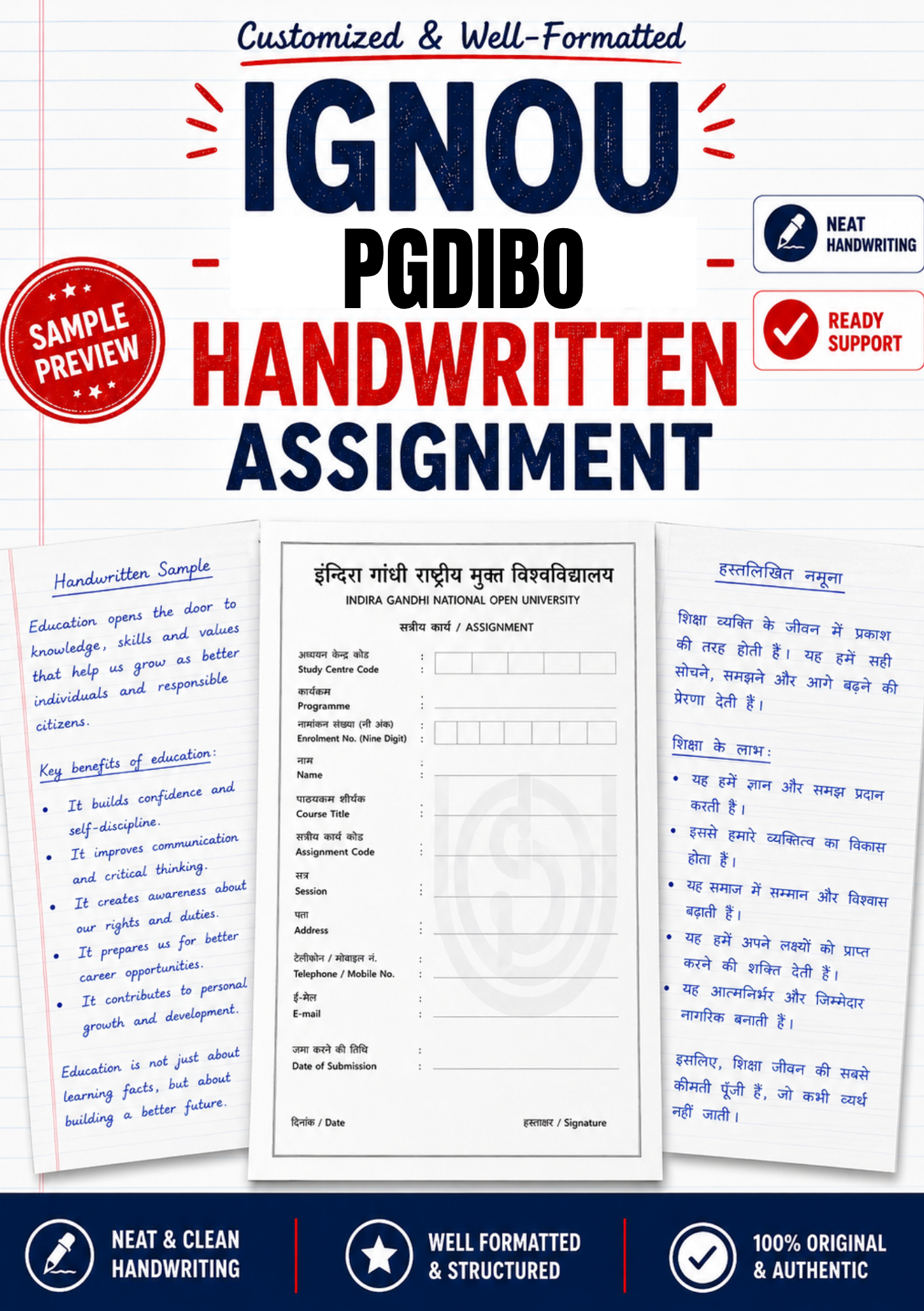


Description
In short. This listing covers handwritten assignment sets for IGNOU PGDIBO, the Post Graduate Diploma in International Business Operations run by the School of Management Studies, and it reaches every code the diploma has: IBO 1 International Business Environment, IBO 2 International Marketing Management, IBO 3 India’s Foreign Trade, IBO 4 Export Import Procedures and Documentation, IBO 5 International Marketing Logistics and IBO 6 International Business Finance, six papers of six credits each adding to the 36 credits the Common Prospectus July 2026 states for the programme. The rate is ₹320 per subject, hard copy only, with courier included in that price and no separate shipping charge. Every set is written against the booklet IGNOU has issued for the code and cycle you name, and arrives with a free IGNOU-format front page and a copy of that official question paper. Four live 2026 booklets were read for this page, and they do not agree on the December cut-off: the English IBO-04 and IBO-05 papers print 15 October 2026 while the Hindi IBO-03 and IBO-06 papers print 15 September, against a 15 March 2026 date that all four print for the June term-end examination. Half the diploma, IBO 1, IBO 2 and IBO 6, is also carried inside M.Com, and half, IBO 3, IBO 4 and IBO 5, is not.
Six Papers, One Cover Sheet Design, and What Reaches Your Address
A PGDIBO order arrives as paper in a courier bag, and it is worth knowing exactly what that bag holds before the first sheet is written, because three of the four items in it are things learners commonly assume they will have to assemble themselves.
The first item is the answer set: full-length responses to every question printed on the Tutor Marked Assignment paper for each IBO code ordered, written out by hand. The length follows the paper rather than a house template. An IBO-04 set answers a first question split 4+8+8 and a second split 10+10 before it reaches the three short-answer blocks; an IBO-03 set opens with three straight twenty-mark questions instead. Nobody can quote a page count for a PGDIBO order honestly without first seeing which codes are on it.
The second is the IGNOU-format front page, one per course, supplied free with every order and filled in with the programme code, the course code, the assignment code and the session. The fields left deliberately empty are the ones only you can complete: your name, your signature and your study-centre code, written in on the day you hand the bundle over.
The third is a printed copy of the question paper the set was answered from. On this diploma that copy earns its place twice over. IGNOU scopes each IBO booklet to two admission cycles and then withdraws it, so a coordinator checking your bundle against the current file wants the two to agree; and because the same IBO codes are issued to M.Com learners as well, the copy in the bag settles which programme’s paper you actually answered.
The fourth is the courier itself, which is inside the rate rather than beside it. What is not in the bag is a file. No soft copy or PDF is sold. There is no download link, no password and nothing to collect from an email afterwards.
₹320 a Paper on a Diploma Where Every Code Weighs the Same
PGDIBO is unusual among IGNOU diplomas in having no light papers. All six courses carry six credits, so the question that reaches WhatsApp on most programmes, whether a heavier paper costs more, does not arise here: there is nothing lighter to compare it against.
The rate is ₹320 per subject, hard copy only, with courier included in that price and no separate shipping charge. Per subject means per course code. Inside the figure sit the writing, the IGNOU-format cover sheet, the printed question paper, the packing and the courier to your address. There is no minimum order: one subject or fourteen, same rate. A learner clearing a single pending IBO 5 pays the same per-paper rate as a learner commissioning the whole diploma in one message.
Three things sit outside the figure and are named here rather than discovered later. The programme fee is IGNOU’s: the Common Prospectus July 2026 records it as Rs. 8,500 per year for PGDIBO, and the university’s own programme page adds that the examination fee is not part of it. The submission is yours, because carrying the bundle to the study centre and collecting the receipt is a step nobody can take on your behalf. And the outcome is nobody’s to sell. No claim is made about the marks any assignment will receive, about how an evaluator will assess it, or about whether it will be accepted. Assignment evaluation is entirely a matter for IGNOU.
One further thing is absent rather than excluded. Delivery depends on your pin code and is confirmed for your order before you pay. No figure is promised on this page. The store’s regular price on this product is ₹350 against a selling price of ₹320, which is where the gap between the two figures you may see comes from.
A Reference File on Export Documentation Is Not a Submission
Two products are sold against the same IBO codes and the difference between them decides whether a cycle is cleared or lost, so it is worth stating once, plainly, before either is bought.
A solved assignment is a soft-copy reference file of model answers for one course code and one session, downloaded and read. A handwritten assignment is those answers written out by hand and submitted in hard copy at the study centre. The first is study material. The second is the object the counter logs against your enrolment number.
| Where they differ | PGDIBO solved assignment | PGDIBO handwritten assignment |
|---|---|---|
| Form it takes | A file for one IBO code and session, read on screen or printed | Written sheets for a named IBO code and cycle, couriered to you |
| What you then do | Read it, understand the argument, write your own answer from it | Check it against your booklet, sign the declaration, hand it in |
| Handwriting | None, it is typed | Matched to the sample page you send first |
| Who tends to buy it | A learner with writing time who wants the reading compressed | A learner carrying several IBO papers into one cut-off |
| How it is priced here | Per code and session on the solved-assignment shelf | ₹320 per subject, courier included |
Scroll the table sideways on a narrow screen.
On the honest scoping, the four 2026 IBO booklets read for this page are quieter on this question than booklets for some other programmes. Each instructs the learner to submit the assignments to the Coordinator of the Study Centre by the stated date, prints a coverage line reading ALL BLOCKS, and stops there: none of the four prints a handwriting rule, and none prints a paper size. That matters because a great many pages assert the opposite and attribute it to the booklet. Where a handwriting requirement applies to you it comes from the Programme Guide, your Regional Centre and your own study centre’s instruction, and those are the places to check. What does not change is the arithmetic of the two products: printing a model-answer file does not turn a reference into a submission. If a reference file is what you actually want, it is sold on the PGDIBO solved-assignment shelf, which lists model answers code by code, and not on this page, which sells nothing of the kind.
Know your IBO numbers? The rate is fixed before a sheet is written.
₹320 per subject · hard copy · courier included · no minimum order
IBO 1 to IBO 6: the Whole Diploma Is Six Codes
Most IGNOU programme pages have to explain an elective pool, a skill slot and a generic pool before a learner knows what they owe. PGDIBO has none of that. The Common Prospectus July 2026 prints six courses, no electives, no project and no laboratory work, and every one of the six is compulsory for every learner on the programme. The titles below are reproduced as that document prints them, including its unpadded code style.
| Code as the prospectus prints it | Official title | Credits | Also issued inside M.Com |
|---|---|---|---|
| IBO 1 | International Business Environment | 6 | Yes, as IBO-01 |
| IBO 2 | International Marketing Management | 6 | Yes, as IBO- 02 |
| IBO 3 | India’s Foreign Trade | 6 | No |
| IBO 4 | Export Import Procedures and Documentation | 6 | No |
| IBO 5 | International Marketing Logistics | 6 | No |
| IBO 6 | International Business Finance | 6 | Yes, as IBO-06 |
Scroll the table sideways on a narrow screen.
The credit arithmetic is worth doing rather than assuming, because extracted tables bleed into one another and a wrong total is the easiest way to spot it. Six courses at six credits give 36, which is the figure the prospectus itself states as the programme total on the same page. A list of PGDIBO codes that does not reconcile to 36 is a wrong list rather than a newer one. Eligibility is a Bachelor’s Degree in any discipline or equivalent, the minimum duration is one year, and the prospectus programme table gives the maximum as three years, a figure IGNOU’s own live page contradicts in the conflict list below. If the reading rather than the writing is what you are short of, the PGDIBO help-book shelf covering all six IBO papers carries the chapter-wise guides, and a single combo that takes all six titles together is the version learners starting the diploma usually pick up.
Three Codes M.Com Also Issues, and Three It Has Never Heard Of
This is the structural fact that makes a PGDIBO order different from a commerce order, and the reason a page written for M.Com cannot cover one properly.
IBO 1, IBO 2 and IBO 6 appear twice in the Common Prospectus July 2026: once in the PGDIBO table above and once inside the M.Com semester structure, where they sit in Semesters III and IV. That is 18 of this diploma’s 36 credits living inside a different programme. IBO 3, IBO 4 and IBO 5 appear in no M.Com table at all. The practical consequence is that half of a PGDIBO learner’s workload is shared with thousands of commerce learners writing the same questions in the same cycle, and half is written by PGDIBO learners alone.
| Document read | How the code appears | What it tells you |
|---|---|---|
| Common Prospectus July 2026, PGDIBO table | IBO 1, IBO 2, IBO 3, IBO 4, IBO 5, IBO 6 | Unpadded, space, no hyphen |
| Common Prospectus July 2026, M.Com table | IBO-01, IBO- 02, IBO-06 | Zero-padded and hyphenated, with a stray space in one row |
| 2026 assignment booklets | IBO-04/TMA/2026, IBO-05/TMA/2026 | Zero-padded, hyphenated, single year, no session word |
| June 2026 term-end question paper | IBO–004 | Three digits with an en dash, on a paper headed PGDIBO/M. COM. |
Scroll the table sideways on a narrow screen.
None of those four renderings is wrong, and no one of them governs the others. What matters at the counter is the code as your own admission record and your own booklet print it, which is the string to send when ordering. If your record shows MCOM rather than PGDIBO and you are looking at IBO codes because they fall in your Semesters III and IV, the M.Com written-set listing is built around the fifteen-course commerce structure instead and is the correct page for that enrolment. Learners still clearing the pre-semester M.Com, whose entire first year was IBO 1 to IBO 6, sit in an odd position: their code list is this diploma’s code list, and the older commerce reference listing built on those annual codes is where their model answers are shelved.
Twenty Places the PGDIBO Paperwork Argues With Itself
Every item below was found by reading one IGNOU document against another rather than by copying either. None of it is a criticism of the university: documents this large drift, and four separate booklets issued for one diploma in one year will drift apart. It is collected here because a PGDIBO learner who has noticed one of these and cannot get a straight answer deserves one. Where the disagreement is this store’s own, it is numbered with the rest rather than quietly left out.
Twenty disagreements found while preparing this page, three of them this store’s own. Check every one against your own booklet and your Regional Centre before acting on it.
1. The two Hindi 2026 IBO booklets print 15 September as the last date for the December term-end examination. The two English 2026 IBO booklets, same programme and same year, print 15 October for the same examination. The gap is a full month and it falls along the medium line.
2. Neither of those pairs matches the 31 October and 30 April that the management programmes in the same School of Management Studies run on. One school is running at least three different assignment calendars.
3. The prospectus PGDIBO table prints the codes unpadded, as IBO 1 to IBO 6. The M.Com table in the same document prints the three shared codes zero-padded, as IBO-01 and IBO-06, and prints the second of them as IBO- 02, with a space after the hyphen.
4. The English booklet cover heads the set ASSIGNMENTS (IBO & 01 to IBO – 06), with an ampersand standing where a hyphen belongs and an en dash before 06, while the assignment code lower on the same page is plainly hyphenated as IBO-04/TMA/2026.
5. The June 2026 term-end question paper prints the course code as IBO–004, three digits with an en dash, against IBO-04 on the assignment booklet and IBO 4 in the prospectus. Three renderings of one course on three live IGNOU documents.
6. That question paper titles the course EXPORT-IMPORT PROCEDURE AND DOCUMENTATION, singular and hyphenated. The prospectus prints Export Import Procedures and Documentation, plural and unhyphenated.
7. The same question paper heads itself POST GRADUATE DIPLOMA IN INTERNATIONAL BUSINESS OPERATIONS / MASTER OF COMMERCE (PGDIBO/M. COM.). One examination paper serves two programmes, which is the clearest statement anywhere in IGNOU’s documents that these codes are genuinely shared rather than merely similar.
8. IGNOU’s live PGDIBO programme page gives the maximum duration as 24 months. The prospectus programme table gives three years. The minimum, one year, agrees on both.
9. The live page gives the medium of instruction as English alone. The prospectus gives English and Hindi, and IGNOU itself publishes Hindi IBO booklets for 2026, two of which were read for this page.
10. The live page displays a credit value for IBO-01, IBO-02 and IBO-06 and leaves the credit field empty for IBO-03, IBO-04 and IBO-05. The three with credits shown are exactly the three that also appear in M.Com, which suggests the page is populated from commerce data rather than from the diploma’s own.
11. The live page zero-pads all six codes where the prospectus PGDIBO table pads none of them.
12. The four booklets read do not share a question pattern. IBO-04 opens 4+8+8 then 10+10; IBO-05 and IBO-06 open 10+10 then 10+10; IBO-03 sets three straight twenty-mark questions before its split blocks. All four reach 100 marks across five questions by different routes.
13. Not one of the four booklets prints a paper size, and not one prints a handwriting instruction. On this diploma both requirements come from outside the assignment paper.
14. The prospectus mentions PGDIBO outside its own section exactly once, inside the M.Com exit paragraph, where it records that the existing PGDIBO shall continue to be on offer as a stand-alone programme. A diploma’s continued existence is confirmed in another programme’s paragraph.
15. The PGDIBO section of the prospectus carries a typesetting fault in its own feature list, printing the phrase about interacting with leading experts through teleconferencing as throught eleconferencing, with the t transposed.
16. IBO 3 is titled India’s Foreign Trade at six credits in this diploma, while M.Com carries MCO-015 India’s Foreign Trade and Investment at four credits. Two near-identical titles, two codes, two credit weights, one prospectus.
17. Aggregator pages are currently circulating 30 April and 31 March as though they were a single national IGNOU assignment deadline. Neither date appears on any of the four PGDIBO booklets read for this page.
18. In-house: until this listing went up, no PGDIBO handwritten product existed on this store at all, while the M.Com handwritten listing already described IBO-01, IBO-02 and IBO-06 coverage. Diploma learners looking for the three codes M.Com does not carry had nowhere on this store to land.
19. In-house: the handwritten-assignment category page on this store still prints courier times in working days and a ₹350 line. This page promises no delivery figure and sells at ₹320. The category text is queued for correction.
20. In-house: this store files the same diploma under International Business Operation on its previous-year-paper category and International Business Operations on the other three category shelves. One programme, two spellings, inside one catalogue.
15 March for June, Then 15 October or 15 September Depending on Your Booklet
This is the most expensive thing on the page to get wrong, and it is the finding that four booklets were opened to establish rather than one.
All four 2026 PGDIBO booklets agree on the first date. If you intend to appear in the June term-end examination, the assignments go to the Coordinator of your Study Centre by 15 March 2026. They also agree on validity: a January 2026 enrolment holds until December 2026, and a July 2026 enrolment holds until June 2027, with the same six-course paper serving both admission cycles.
They part company on the second date. The English IBO-04 and IBO-05 papers print 15 October 2026 as the last date for the December term-end examination. The Hindi IBO-03 and IBO-06 papers print 15 September for the same examination. Two booklets each way is enough to show this is not a slip on a single file, and the split follows the medium rather than the course number. A PGDIBO learner holding a Hindi booklet and a classmate holding the English one have been given December deadlines a month apart for the same diploma in the same year.
| Booklet opened | Medium | For the June examination | For the December examination | Assignment code printed |
|---|---|---|---|---|
| IBO-04-2026 | English | 15th March, 2026 | 15th October, 2026 | IBO-04/TMA/2026 |
| IBO-05-2026 | English | 15th March, 2026 | 15th October, 2026 | IBO-05/TMA/2026 |
| IBO-03-Hindi-2026 | Hindi | 15 March | 15 September | Printed in Devanagari, reading IBO-03/TMA/2026 |
| IBO-06-Hindi-2026 | Hindi | 15 March | 15 September | Printed in Devanagari, reading IBO-06/TMA/2026 |
Scroll the table sideways on a narrow screen.
The safe reading, and the one this page works to, is the earlier of the two: treat 15 September as your December date unless the booklet in your own hand says otherwise, because submitting early against a 15 October paper costs nothing while submitting on 10 October against a 15 September paper costs a cycle. Note also what these dates are keyed to. They follow the examination you intend to sit, not the session you were admitted in, which is a different rule from the one several other IGNOU schools run on. Work back from your date, allow for the courier, allow for reading the set through, and start the order before the month the date falls in rather than inside it. Assignments carry 30 per cent of the final course result and the term-end examination carries the remaining 70 per cent, and submission is also what makes you eligible to sit the paper that carries the other seventy.
Copying IBO-05/TMA/2026 When the Examination Paper Says IBO–004
The assignment code is the string a coordinator matches against their list, and PGDIBO’s is simple in itself and confusing only because of what sits around it.
Read left to right, the English form is the course code, a slash, TMA for Tutor Marked Assignment, a slash, and a single four-digit year. IBO-05/TMA/2026 is the whole of it. There is no session word inside the string, which means January and July learners of the same year copy an identical code, and no two-year span, which several other IGNOU schools use. On the Hindi papers the same string is set in Devanagari rather than roman letters, so what a Hindi-medium learner copies from the booklet does not look like what every portal listing and every shop, this one included, writes when it refers to the code.
Three traps sit around that simple string. The first is the booklet’s own cover, which heads the set with an ampersand, as ASSIGNMENTS (IBO & 01 to IBO – 06); that ampersand belongs to the set title and not to your assignment code, and copying it into the code produces a string that does not exist. The second is the term-end question paper, which codes the same course with three digits as IBO–004; that is the examination’s numbering, not the assignment’s. The third is the M.Com habit of a nearby programme: commerce papers of the same year print the ampersand inside the assignment code itself, so a PGDIBO learner copying a commerce friend’s format onto a front page will produce something neither programme uses.
Copy what your own paper prints, character for character, and take it from the university’s own assignment download page rather than from a forwarded screenshot, because papers are replaced each cycle and withdrawn files circulate on messaging apps long after they have expired.
The Hand That Signs the Front Page Should Be the Hand on the Sheets
You sign the declaration on the assignment cover page, so you should read and review the content before submitting it, and satisfy yourself that it represents your own understanding of the course. That signature is the whole reason the matching step exists: a bundle written in one hand and signed in another is obvious to anyone who glances at both.
Send a photo of a page you have written yourself and the handwritten set is matched to your handwriting at no extra charge. The writer works from slope, letter size, spacing and the general density of the script. The sequence is the protection here: the sample goes over first, a matched specimen comes back, and payment follows only once you have seen it. Nothing is written against your IBO codes before you have seen what your own hand is going to look like coming back, which means a mismatch costs nothing at the only point where it could.
What one photographed page has to show
Half a page of ordinary continuous writing, in the pen you normally use, photographed straight down in daylight with the whole sheet in frame. Continuous sentences are more useful than a list, because the spacing between words carries more of your signature than the letters do. Do not print, do not write in capitals and do not send a signature, which says almost nothing about how you form ordinary text. If your booklet is the Hindi edition, send the sample in Devanagari: letterforms in one script cannot be inferred from a sample in the other, and on this diploma the medium is a live question rather than a formality.
An English Booklet, a Hindi Booklet, and a Year You Let Lapse
Medium is not a side issue on PGDIBO. The Common Prospectus July 2026 records the medium of instruction as English and Hindi; IGNOU’s own live programme page records English only; and IGNOU publishes Hindi IBO booklets for 2026 that carry a different December deadline from the English ones. Those three statements cannot all be complete, and the one that governs your order is the booklet actually issued against your enrolment.
The service covers all mediums IGNOU issues the TMA paper in, at the same price. Ordering the Hindi edition is a line in your message rather than an upgrade, and it is not billed as one. What it does change is the date you should be working to and the script your handwriting sample needs to be in, which is why the medium is asked for at the same time as the codes.
On sessions, any session is accepted, current cycle or older, including backlog courses, at the same ₹320 per subject. A PGDIBO learner who stopped after the first two papers and came back two cycles later is an ordinary order rather than a complicated one: each code is written against the booklet that applied to its own cycle, not retrofitted to the current paper. Because IGNOU scopes each IBO booklet to two admission cycles and then withdraws it, the one thing an older order needs that a current one does not is the paper itself, or at minimum the year printed on it.
What a PGDIBO Quote Needs From You, and What It Does Not
Five lines are enough to price and start an order. Anything beyond them slows the reply rather than speeding it up.
- The IBO numbers. Copied off your admission record, in whatever padding your record uses, from one code to all six.
- The cycle and the examination. January or July, the year on your booklet, and which term-end examination you intend to sit, because that is what fixes your date.
- The medium of your booklet. English or Hindi, which on this diploma also settles whether you are working to 15 October or 15 September.
- A sample page. Half a page in your own hand, in the script the set will be written in.
- Your delivery pin code. So the courier position can be confirmed to you before payment rather than estimated after it.
What is not needed: your IGNOU password, a scan of your identity card, or any payment before the sample has been looked at. Your enrolment number and study-centre code are used only to complete the front page and are asked for separately once the order is confirmed. If you have the question-paper PDF, send it; if not, the code, the year and the medium are enough to find the right one.
Hindi booklet, an older cycle, or only the three codes M.Com does not cover?
₹320 per subject · every session including backlogs · English and Hindi at the same rate
Between the Courier Bag and the Counter Receipt
Delivery is the middle of the process rather than the end of it, and the steps after it belong to you.
Open the bag and read the set before anything else happens to it. Check three things against your own booklet: that the course code and the assignment code on each front page match the paper you were issued, including the year; that the cycle is the one you are submitting for; and that every question on your paper has an answer against it, in the order your paper prints them. Then read the answers themselves. That is not a formality, because the declaration you are about to sign says the work represents your own understanding, and reading it is what makes that true rather than merely stated.
Your name, your signature and your study-centre code go in by hand on the morning you submit. Submit at whichever study centre your record names, and do not leave the counter without an acknowledgement. Keep that receipt and photograph it: if the marks do not appear against the course later, the receipt is the only evidence that exists that the bundle was ever received, and on a programme whose codes are shared with M.Com a misfiled submission is easier than it should be.
After that the timetable is IGNOU’s. The status page lags, often by weeks, and a blank entry in the first month means very little on its own. If something in the packet is wrong, a code mismatch, a missing page, a set written against the wrong cycle, say so on the same WhatsApp thread the order was placed on, before you submit rather than after.
What an International Business Learner Picks Up Next
A written set clears the thirty per cent. It does nothing for the three-hour paper that carries the rest, and most PGDIBO orders are placed alongside something aimed at that.
Closer to the examination, guess papers written for the IBO term-end sitting are the shelf that gets opened most, and previous years’ IBO question papers with worked answers are the better guide to how an export-documentation or logistics paper actually behaves across sessions, since the question shapes repeat even when the cases change.
Learners on other programmes who have arrived here because of a shared code will find their own listing on the written-set shelf that covers every programme, and a code belonging to neither this diploma nor commerce is handled by the open customised order that takes any programme and any session. Reference files across the whole catalogue sit on the soft-copy reference hub, which is a different product from this one in the way the comparison section above sets out. And if you would rather write the six papers yourself and only want the method, the sister site carries a step-by-step guide to writing an IGNOU assignment by hand, which sells nothing and covers the front page, the margins and the submission in order.
Questions That Reach WhatsApp Before a PGDIBO Order
Is my PGDIBO December deadline 15 September or 15 October?
It depends on which booklet you are holding, which is the single oddest thing about this diploma. The two English 2026 IBO booklets read for this page print 15 October 2026 and the two Hindi ones print 15 September, for the same December term-end examination. Both print 15 March 2026 for the June examination. Work to the date on your own paper, and if you have not downloaded it yet, working to 15 September costs you nothing and protects you either way.
Is the PGDIBO date 31 October like the IGNOU MBA one?
No. The 31 October and 30 April pair belongs to the management programmes in the same School of Management Studies. No PGDIBO booklet read for this page carries either date. The School of Management Studies runs more than one assignment calendar, and the diploma is on a different one from the MBA.
How many subjects does PGDIBO have, and is any of them optional?
Six, and none of them is optional. The Common Prospectus July 2026 lists IBO 1 to IBO 6 at six credits each, totalling the 36 credits it states for the programme, with no electives, no project and no laboratory course. Every PGDIBO learner owes the same six papers.
I am doing M.Com and my record shows IBO-01. Is this the right page?
Not quite. IBO-01, IBO-02 and IBO-06 are issued inside M.Com as well, so those three codes are written either way, but the M.Com structure carries fifteen courses and eleven of them are MCO codes this page does not cover. The M.Com written-set listing is built for that enrolment. If your record says PGDIBO, this is the page.
Why does my examination paper say IBO-004 when my assignment says IBO-04?
Because IGNOU numbers them differently. The June 2026 term-end question paper prints the course as IBO-004 with three digits, the 2026 assignment booklet prints IBO-04, and the prospectus prints IBO 4. All three refer to Export Import Procedures and Documentation. Use the form your own booklet and admission record print when you fill in the front page.
The cover says IBO & 01. Does the ampersand go into my assignment code?
No. The ampersand belongs to the set title printed across the top of the English booklet, which heads the whole six-course set. The assignment code further down the same page is hyphenated, in the form IBO-04/TMA/2026. Commerce papers of the same year do put an ampersand inside the code itself, which is where the confusion usually comes from.
PGDIBO ka solved PDF le liya hai, to handwritten kyun chahiye?
Solved file padhne ke liye hai, jama karne ke liye nahin. Study centre par hard copy jaati hai aur uspar declaration aap khud sign karte ho. Solved PDF se aap khud likh sakte ho; agar chhe IBO paper aur waqt kam hai, to likha hua set mangwaya ja sakta hai. Dono alag cheezein hain aur yeh page sirf likha hua set bechta hai.
Can a printed IBO answer file be handed in at the study centre as it is?
A downloaded file is a reference to write from, not a submission. Worth being precise about what the papers themselves say: none of the four 2026 IBO booklets read for this page prints a handwriting rule or a paper size, so the requirement, where it applies to you, comes from your Programme Guide, your Regional Centre and your study centre rather than from the assignment paper. Confirm with your own centre before relying on either answer.
Does the Hindi medium cost more than English?
No. The service covers all mediums IGNOU issues the TMA paper in, at the same price. What the Hindi edition changes is your December date, which those booklets print as 15 September, and the script your handwriting sample should be in.
Can I order one IBO paper, or does it have to be all six?
There is no minimum order: one subject or fourteen, same rate. A single carried-forward IBO 5 is a normal order and is not priced differently from the full diploma.
IGNOU’s website shows no credits against IBO-03, IBO-04 and IBO-05. Are they still six credits?
The Common Prospectus July 2026 gives all six IBO courses six credits each, and the 36-credit total it states for the programme only closes if every one of the six is counted at six. The blank fields on the live page are a display gap rather than a change, and they happen to fall on exactly the three codes that are not shared with M.Com. Your admission record governs.
Is PGDIBO still running, or has M.Com replaced it?
Still running as its own programme. The Common Prospectus July 2026 states, inside the M.Com exit paragraph, that the existing PGDIBO shall continue to be on offer as a stand-alone programme. That single sentence is the only place in the document where the diploma is mentioned outside its own section, so anything further should be confirmed with your Regional Centre.
I stopped after two papers in an older cycle. Can the rest still be written?
Yes. Any session is accepted, current cycle or older, including backlog courses, at the same ₹320 per subject. Each paper is written against the booklet that applied to its own cycle rather than the current one, so send the year printed on the paper you still owe, or the paper itself if you kept it.
Do I get a PDF of the set as well as the hard copy?
No soft copy or PDF is sold. This product is the physical set only, couriered to your address. If a scanned file is what your study centre has asked for, this is not the right product for that requirement.
How many days will the packet take to reach me?
Delivery depends on your pin code and is confirmed for your order before you pay. No figure is promised on this page. Message your pin code and the position for that address comes back, rather than a figure averaged across the country.
Will you tell me what marks the set will get?
No claim is made about the marks any assignment will receive, about how an evaluator will assess it, or about whether it will be accepted. Assignment evaluation is entirely a matter for IGNOU. Any figure quoted to you by any supplier is a figure that supplier cannot control.
Nothing Above Came From a Second-Hand List
From the Common Prospectus July 2026. The six IBO codes and their official titles, the six credits on each, the 36-credit total, the School of Management Studies attachment, the eligibility of a Bachelor’s Degree in any discipline or equivalent, the English and Hindi medium, the one-year minimum and three-year maximum duration, the Rs. 8,500 per year fee, the M.Com exit paragraph naming PGDIBO as a continuing stand-alone programme, and the M.Com table that carries IBO-01, IBO- 02 and IBO-06. The credits were added and checked against the 36 the document itself states before the table above was used. Items 3, 14, 15 and 16 of the conflict list come from reading this document against itself.
From live IGNOU booklets and the live programme page, read on 12 October 2026. The submission dates, the registration validity, the assignment-code format, the coverage line, the mark splits and the absence of any paper-size or handwriting instruction were read directly off the English IBO-04 booklet for 2026, the English IBO-05 booklet, the Hindi IBO-03 booklet and the Hindi IBO-06 booklet. Four were opened rather than two precisely so that a one-month difference between two files could be told apart from a slip on one. The three-digit course code and the dual-programme heading come from the June 2026 term-end question paper for the same course, and the duration, medium and blank credit fields from IGNOU’s own PGDIBO programme page.
From Shri Chakradhar Publication’s own commercial terms. The ₹320 per subject rate, the hard-copy-only format, the included courier, the free IGNOU-format front page, the included copy of the question paper, the handwriting match from a learner-supplied sample at no extra charge, the absence of a minimum order, and the acceptance of older and backlog cycles. These are the publisher’s terms. They are not IGNOU rules and are not presented as any. Items 18, 19 and 20 of the conflict list are this store’s own errors, disclosed here and queued for correction.
Important Notice
Shri Chakradhar Publication Pvt. Ltd. and shrichakradhar.com form an independent IGNOU study-support publisher. This is not the official website of Indira Gandhi National Open University, is not affiliated with, endorsed by or authorised by the university, and no page on this site should be treated as an official IGNOU communication.
Programme structures, course codes, submission dates and rules change, and only ignou.ac.in and your Regional Centre can confirm the current position for your enrolment.
You sign the declaration on the assignment cover page, so you should read and review the content before submitting it, and satisfy yourself that it represents your own understanding of the course.
No claim is made about the marks any assignment will receive, about how an evaluator will assess it, or about whether it will be accepted. Assignment evaluation is entirely a matter for IGNOU.
Send Six Codes or One, and the Quote Comes Back
The rate is ₹320 per subject, hard copy only, with courier included in that price and no separate shipping charge.
Two ways to begin. Send the IBO numbers, the cycle and the medium and have the rate confirmed, or send a page of your handwriting first and see the match before deciding anything.