

Description
In short. A PGDGPS handwritten assignment set is the tutor marked assignment written out by hand for the IGNOU Post Graduate Diploma in Gandhi and Peace Studies, and this one covers all eight codes that make up the diploma’s 32 credits: MGP 1 Gandhi: The Man and His Times, MGP 2 Philosophy of Gandhi, MGP 3 Gandhi’s Social Thought, MGP 4 Gandhi’s Political Thought, MGPE 6 Gandhi’s Economic Thought, MGPE 7 Non-violent Movements after Gandhi, MGPE 9 Gandhi in the 21st Century and MGPE 14 Gandhi, Ecology and Sustainable Development, each of them a 4-credit course. The rate is ₹320 per subject, hard copy only, with courier included in that price and no separate shipping charge. Every code ordered arrives as written answer sheets plus a free IGNOU-format front page and a copy of the official question paper the answers were written against. The 2025-26 Gandhi and Peace Studies papers read for this page print 100 marks per assignment and a five-question pattern, and the one file among them that carries a cover page gives March 31, 2026 for the July 2025 session and September 30, 2026 for the January 2026 session; four other files for the same diploma print no date at all, which is why your own download, not this page, is the document that sets your deadline. Any session is accepted, current cycle or older, including backlog courses, at the same ₹320 per subject.
What a PGDGPS Packet Holds When It Reaches Your Door
A PGDGPS order is counted in codes, not in semesters, because the diploma has no semesters to count. Eight courses, each worth 4 credits, each setting one tutor marked assignment, and each priced on its own. Whatever number of those eight is ordered, the packet that arrives is built the same way, code by code, so that nothing has to be sorted out after it lands.
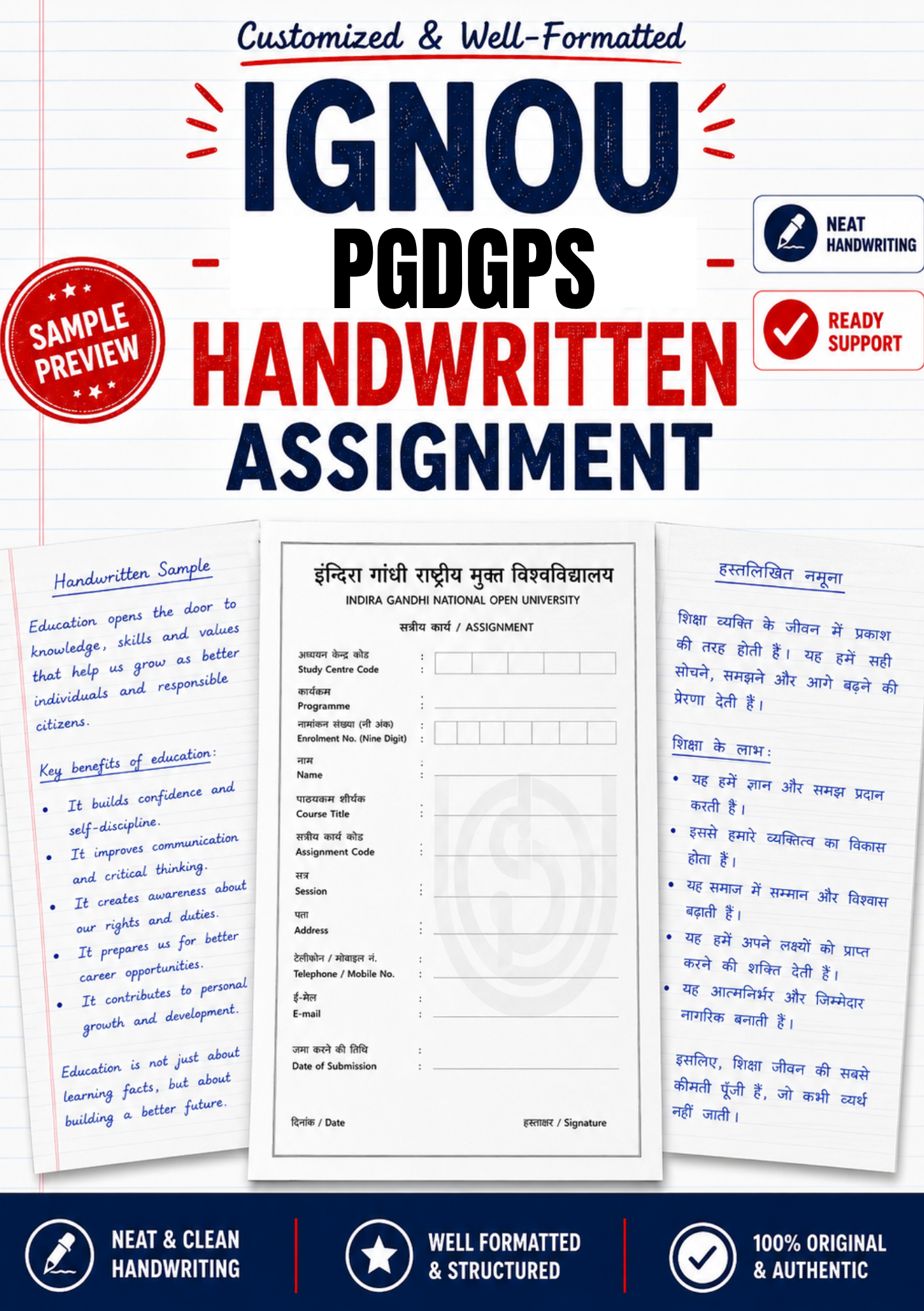
For every code there are the written answer sheets, prepared on A4 in a single consistent hand from the first question to the last. There is an IGNOU-format front page, filled in with the course code, the assignment code, the session and the spaces your enrolment number and signature go into, supplied free with the order rather than charged as an extra. There is a printed copy of the official question paper the answers were written against, which matters more on this diploma than on most, because the Gandhi and Peace Studies papers are reissued each cycle and because one of the eight codes is distributed inside a file headed for an entirely different programme. Having the source paper in the same envelope as the answers is how you check, at the counter, that the two belong together.
No soft copy or PDF is sold. There is no download link waiting in an email afterwards, no drive folder, and no typed version of the same answers. What is sold is the physical set, and the physical set is what IGNOU’s study centres take in.
Eight Codes at ₹320 Each, and What Sits Outside That Figure
The arithmetic on this diploma is unusually clean. Every PGDGPS course carries 4 credits, every one of them sets a single assignment, and the prospectus total of 32 credits is simply eight times four. There is no laboratory component to price separately, no project course, no dissertation, and no specialisation stream that changes the count. A learner ordering the complete diploma is ordering eight written papers; a learner ordering one is ordering one. There is no minimum order: one subject or fourteen, same rate.
Inside the figure sit the writing itself, the front page, the question-paper copy and the courier. Outside it sit everything that belongs to the university rather than to a publisher: the programme fee of ₹7,500 that the Common Prospectus July 2026 records against PGDGPS, the re-registration you file yourself, the term-end examination form, and the counter submission at the study centre allotted to you, which is where the MGPE-007 file tells you to hand the set in. Also outside it sits the examination itself. Assignments carry 30 per cent of the final course result and the term-end examination carries the remaining 70 per cent.
Delivery depends on your pin code and is confirmed for your order before you pay. No figure is promised on this page. That is a deliberate omission rather than an oversight: a working-day count printed on a product page is a promise made before the address is known, and this page does not make it.
Which One a Gandhi Studies Learner Actually Needs: Reference PDF or Written Set
Two different products get called an assignment on IGNOU study-support sites, and a PGDGPS learner looking at a search results page will see both. They are not substitutes, and confusing them costs a submission.
A solved assignment is a soft-copy reference file of model answers for a course code and session. It is read on a screen or printed out, and it exists so that a learner has something to write from. A handwritten assignment is the answers written out by hand on A4 and submitted in hard copy at the study centre. It is the object the university takes in. The first is study material; the second is the submission.
| Point of difference | Solved assignment for a PGDGPS code | Handwritten set for a PGDGPS code |
|---|---|---|
| Format | Soft copy, read or printed from a file | A4 sheets written by hand, delivered as hard copy |
| What you do with it | Read it, compare it against your study material, then write your own answers | Check it, sign the declaration on the front page, hand it in at the study centre |
| Who it suits | A learner who intends to write the eight papers personally and wants a worked reference for MGP and MGPE questions | A learner who cannot get eight sets of 500-word and 250-word answers onto paper before the cut-off |
| Rate on this store | Priced on its own shelf, per code and session | ₹320 per subject, hard copy only, courier included |
Scroll the table sideways on a narrow screen.
IGNOU’s own wording settles the point that gets argued about most. The 2025-26 Gandhi and Peace Studies file read for this page carries the instruction that it is important you write the answers in your own words, and it directs the completed work to the Coordinator of the study centre allotted to you. A reference file is not addressed to anybody and is not handed to anybody. It is a thing to write from, never a thing to submit, and no page on this store should be read as suggesting a downloaded PDF can be walked into a counter.
If a worked reference is what the situation calls for rather than a written set, the diploma has its own shelf: the store keeps fourteen solved files filed against the PGDGPS codes, which is the right place for that question and not this one.
Eight codes, one message, one rate. ₹320 per subject, hard copy only, courier included, IGNOU-format front page free, and a copy of the question paper your answers were written against.
Send the code numbers you owe and the session printed on your download: ask for a PGDGPS quote on WhatsApp.
The Eight MGP and MGPE Codes That Make Up 32 Credits
The table below is taken from section 8.11 of the IGNOU Common Prospectus July 2026, which prints the PGDGPS structure as a single eight-row list with no electives, no optional group and no choice of any kind. Every PGDGPS learner is registered for the same eight courses. The credits sum to 32, which matches the total the prospectus itself states at the foot of that table, so the extraction has been checked rather than trusted.
The second column is not decoration. The prospectus spaces and un-pads these codes as MGP 1 and MGPE 6; every live assignment file hyphenates and zero-pads them, and on one of them the pad is applied to the wrong stem. Where a file was actually opened for this build the column records what that file printed. Where one was not, it says so rather than guessing.
| Prospectus code | Official title, as the prospectus prints it | Credits | Code form on the 2025-26 file read for this build |
|---|---|---|---|
| MGP 1 | Gandhi: The Man and His Times | 4 | MGP-001, assignment code MGP-001/ASST/TMA/2025-26 |
| MGP 2 | Philosophy of Gandhi | 4 | Not read for this build |
| MGP 3 | Gandhi’s Social Thought | 4 | Not read for this build |
| MGP 4 | Gandhi’s Political Thought | 4 | MGP-004, assignment code MGP-004/ASST/TMA/2025-26 |
| MGPE 6 | Gandhi’s Economic Thought | 4 | MGPE-006, assignment code MGPE-006/ASST/TMA/2024-25 on a file whose cover reads 2025-26 |
| MGPE 7 | Non-violent Movements after Gandhi | 4 | MGPE-007, assignment code MGPE-007/ASST/TMA/2025-26 |
| MGPE 9 | Gandhi in the 21st Century | 4 | Not read for this build |
| MGPE 14 | Gandhi, Ecology and Sustainable Development | 4 | Headed MGPE-014 but labelled MGP-014, assignment code MGP-014/ASST/TMA/2025-26 |
| Total credits | 32 | Matches the prospectus total | |
Scroll the table sideways on a narrow screen.
Several commercial sites list PGDGPS as an eleven-course programme by adding MGPE 8, MGPE 10 and MGPE 11 to the list. Those three codes exist, they are genuine Gandhi and Peace Studies courses, and they appear in the same downloadable files as MGPE 7, which is almost certainly how the error spread. They belong to the two-year master’s degree, not to the diploma. The prospectus table for PGDGPS runs to eight rows and stops.
Why Your Diploma Is the First Year of the MGPS Degree
PGDGPS has no elective papers at all, which is rare enough among IGNOU post graduate diplomas to be worth explaining rather than noting. The reason is visible once the three Gandhi and Peace Studies programmes are set beside each other: the eight PGDGPS courses are, code for code, the first year of the Master of Arts in Gandhi and Peace Studies. The choice that other diplomas offer inside themselves is offered here in the second year of a longer programme instead.
| Programme | Total credits | Codes the prospectus lists | Overlap with the eight PGDGPS codes |
|---|---|---|---|
| PGDGPS, the diploma | 32 | MGP 1, MGP 2, MGP 3, MGP 4, MGPE 6, MGPE 7, MGPE 9, MGPE 14 | This is the set |
| MGPS, the master’s degree | 64 | Year 1 is the identical eight. Year 2 adds MGP 5 as compulsory and 28 credits chosen from MGPE 8, 10, 11, 12, 13, 15, 16 and the 8-credit MGPE 17 Project Work | All eight |
| PGCGPS, the certificate | 16 | MGP 1, MGP 5, MGPE 7, MGPE 8 | MGP 1 and MGPE 7 only |
Scroll the table sideways on a narrow screen.
Two practical things follow. The first is that a learner who later moves up to the master’s degree is moving into a second year whose compulsory course, MGP 5 Introduction to Peace and Conflict Resolution, is a course the diploma never set them. The prospectus prints no exit award, lateral entry route or credit transfer note against PGDGPS, so nothing on this page should be read as describing one; only your Regional Centre can tell you what carries across. The second is more immediate. Because the same code family serves three programmes, assignment files for the family are distributed together, and a search for a PGDGPS paper will keep returning master’s material. That is also why the written set built for the two-year MGPS degree sits on this store as a separate product rather than as a variation of this one, and why the master’s shelf holds eighty files against the same code family while the diploma’s own holds fourteen. If you are on the six-month certificate rather than the diploma, the PGCGPS shelf of eight files is the one that matches your four codes.
Reading Five Gandhi Papers Against the Prospectus: Sixteen Findings
The five live 2025-26 files opened for this page do not agree with each other, and they do not entirely agree with the prospectus. None of what follows is an accusation; IGNOU reissues hundreds of assignment files every cycle and carry-over errors are the predictable result. It is listed because a PGDGPS learner holding two downloads that contradict each other needs to know which is which before writing, and because three of the sixteen are this store’s own.
Sixteen disagreements found in the PGDGPS record, including three on this store.
1. MGPE 6 is a core PGDGPS course, yet its live 2025-26 assignment file is headed MASTER OF ARTS (ECONOMICS) with Fourth Semester Courses beneath it. PGDGPS is named nowhere on that file.
2. The same file prints its assignment code as MGPE-006/ASST/TMA/2024-25 while its own cover reads ASSIGNMENTS 2025-26. The code and the cover disagree about the cycle by a full year.
3. MGPE 6 keys its dates to the examination: by 31st March 2026 for students willing to appear in the June 2026 term-end examination, and by 30th September 2026 for the December 2026 term-end examination. MGPE 7 keys the same two calendar dates to the session instead: March 31, 2026 for the July 2025 session and September 30, 2026 for the January 2026 session. One diploma, two ways of explaining the same pair of dates.
4. MGPE 6 instructs you to answer all the questions, with Section A at 20 marks and about 700 words and Section B at 12 marks and about 500 words. Every other PGDGPS paper read prints answer five questions in all, selecting at least two questions from each section, at 20 marks and about 500 words, with 250-word short notes. The question architecture changes inside one diploma.
5. The MGPE 14 file heads the course GANDHI: ECOLOGY AND SUSTAINABLE DEVELOPMENT (MGPE-014) and then labels the course code MGP-014, printing the assignment code as MGP-014/ASST/TMA/2025-26. The E is dropped between the heading and the code line on the same page.
6. The prospectus prints that course as Gandhi, Ecology and Sustainable Development with a comma; the booklet prints it with a colon.
7. Only one of the five files read carries a cover page naming any programme. The MGP-001, MGP-004 and MGPE-014 files name none, so nothing on them tells you they are PGDGPS papers.
8. The one file that does carry a cover bundles four assignments, MGPE-007, MGPE-008, MGPE-010 and MGPE-011, under a shared heading naming MAGPS, PGDGPS and PGCGPS. Only MGPE-007 is a PGDGPS course, so your diploma is named on the cover of three papers it does not set you.
9. Four of the five files read print no submission date anywhere on them.
10. The Common Prospectus July 2026 prints MGP 4 in the PGDGPS table and MGP 004, for the identical course and title, inside the MA History table on an earlier page.
11. The same prospectus prints Gandhi’s Economic Thought against MGPE 6 in the PGDGPS table and Gandhi’s Economic Thoughts, plural, against the same code in the MA Economics specialisation table.
12. It prints Non-violent Movements after Gandhi against MGPE 7 in the PGDGPS table and Non-violence Movements after Gandhi against the same code in the PGCGPS table.
13. The prospectus spaces every code as MGP 1 and MGPE 6. No live file uses that form; all of them hyphenate and zero-pad to MGP-001 and MGPE-006. Neither document acknowledges the other’s convention.
14. The master’s degree is MGPS in the prospectus contents and in its programme table, MAGPSOL in the list of online-mode programmes, and MAGPS on the booklet cover. Three names for one degree in two documents.
15. PGDGPS is a diploma in Gandhi and Peace Studies that contains no peace studies course. MGP 5 Introduction to Peace and Conflict Resolution sits in the 16-credit PGCGPS certificate, in the second year of the master’s degree, and in the MA Philosophy elective pool, but not in the 32-credit diploma.
16. On this store: a Gandhi’s Political Thought study guide is stocked twice, once as MGP 4 and once as MGP 004, mirroring IGNOU’s own split; an MGP 5 guide is tagged for PGDGPS although MGP 5 is not in the PGDGPS table; and the handwritten category page still prints delivery times in working days and a ₹350 list price, both of which this product’s terms contradict. All three are being corrected at source.
Two Dates on One Paper, and Four Papers With No Date at All
The honest statement of the PGDGPS deadline is that it is printed on one of your eight downloads and missing from the others, and that this page is not the document that sets it.
What the live 2025-26 Gandhi and Peace Studies file prints, on the only cover page among the five read, is a pair: March 31, 2026 for the July 2025 session, and September 30, 2026 for the January 2026 session. Both of those dates have already passed, which is exactly what a 2025-26 cycle looks like when it is read in late 2026. IGNOU replaces the assignment file each cycle and the dates move with it, so a learner on a current registration reads the pair off their own download and a learner clearing an older code works to the pair that was printed when that code was set.
Note what the pattern is not. It is not the 31 October and 30 April that the School of Management Studies prints and that half the aggregator sites repeat as though it were a university-wide rule. It is not the single June date that one large education portal gives as the IGNOU assignment last date. Submission dates belong to the school and sometimes to the individual paper, and the Gandhi and Peace Studies papers are issued by the Centre for Gandhi and Peace Studies inside the School of Social Sciences. Carrying a management deadline onto a Gandhi studies paper is the single most common thing a PGDGPS learner is told incorrectly.
For the four files that print no date at all, the practical route is the one IGNOU itself offers: the current paper and its instructions come from the university’s own assignment download service, and your Regional Centre confirms what applies to your enrolment. Programme structures, course codes, submission dates and rules change, and only ignou.ac.in and your Regional Centre can confirm the current position for your enrolment.
MGPE-007/ASST/TMA/2025-26, and the Line Where the E Goes Missing
The assignment code is the string that tells an evaluator which paper, which programme family and which cycle a set of answers belongs to, and on this diploma it has to be copied with some care.
The shape is consistent: course code, then ASST, then TMA, then the two-year cycle span. MGP-001/ASST/TMA/2025-26 on the first core paper. MGP-004/ASST/TMA/2025-26 on Gandhi’s Political Thought. MGPE-007/ASST/TMA/2025-26 on Non-violent Movements after Gandhi. ASST and TMA both stand for the same thing said twice, assignment and tutor marked assignment, and neither segment changes from one PGDGPS course to another. The only part that varies is the code at the front and the cycle at the back.
Two traps sit inside that simplicity. The first is MGPE 14, whose file heads the course MGPE-014 and then prints the code line as MGP-014/ASST/TMA/2025-26. A learner copying the heading and a learner copying the code line will write two different strings for one paper. The set prepared here follows the string the file actually prints on its code line, and the question-paper copy travels in the envelope so you can see for yourself which is which before you sign anything. The second is MGPE 6, whose file prints 2024-25 in the code while its cover says 2025-26. Neither of those is a mistake you can resolve by reasoning about it; both are resolved by looking at your own download.
The cycle span is also the reason an old paper cannot be answered from a new one. A 2025-26 MGPE-009 paper and a 2022-23 MGPE-009 paper carry different questions under the same course title, and a set written against the wrong one is a set of correct answers to questions nobody asked.
The Declaration Is Yours, So the Letterforms Should Be Too
The assignment front page carries a declaration in your name, and the sheets behind it should look like they came from the person who signed it. That is the whole logic of matching the handwriting rather than simply writing neatly.
Send a photo of a page you have written yourself and the handwritten set is matched to your handwriting at no extra charge. The photo comes first, the match is shown to you, and the decision to go ahead is made after that rather than before it. On a diploma where a complete order runs to eight papers of 500-word answers and 250-word short notes, consistency across the whole set matters more than on a programme with two or three codes: eight papers in eight visibly different hands is the thing most likely to be noticed at a counter.
Which page to photograph when your medium is Hindi
For an English-medium set, any page of your own continuous writing works better than a signature or a form: a page of class notes, a rough draft, anything with joined-up sentences in it. For a Hindi-medium set, send a Devanagari page rather than a roman one. Devanagari carries its matras and conjuncts as part of the letterform, and a hand sampled in roman cannot be reproduced in Devanagari from it. If your course work is a mix, as it often is on this diploma, send one page of each and say which medium each paper is going in.
English Sheets, Devanagari Sheets and Cycles That Already Closed
The Common Prospectus July 2026 records the medium of instruction for PGDGPS as English and Hindi, which puts it in a minority among post graduate diplomas, many of which are English only. The live files bear that out: the Gandhi and Peace Studies papers are issued in both, and the Hindi edition is not a translation sitting beside the English one but a separate file with its own typesetting. The Hindi MGP-001 paper prints its assignment code in Devanagari transliteration rather than in roman, so the string on a Hindi learner’s front page looks nothing like the string on an English learner’s, although both decode to MGP-001/ASST/TMA/2025-26.
The service covers all mediums IGNOU issues the TMA paper in, at the same price. A Hindi set and an English set are the same ₹320 per subject, and a mixed order of some papers in each is ordinary rather than exceptional on this diploma.
Session coverage works the same way. Any session is accepted, current cycle or older, including backlog courses, at the same ₹320 per subject. A single MGPE 9 paper left over from a cycle that closed three years ago is written against the paper set in that cycle, not against this year’s, which is why the session on your download is one of the few things the desk genuinely needs from you.
A Hindi set, an English set, or one of each. Same ₹320 per subject either way, hard copy only, courier included, with the front page and the question-paper copy in the same envelope.
Say which medium your papers came in and the desk will confirm the cycle it holds: check medium and cycle availability.
Four Details Decide the Quote, and a Fifth Decides the Hand
Quoting a PGDGPS order takes very little information, and sending more than is needed slows it down rather than speeding it up.
- Your code numbers. Which of the eight you want written, in whatever form your admission record prints them. MGPE 14 and MGPE-014 and even the file’s own MGP-014 are all understood as the same paper.
- The session on your download. The cycle span at the end of the assignment code, such as 2025-26, or the session you registered in if the paper prints no code.
- Your medium. English or Hindi, per paper if it differs between them.
- Your delivery pin code. Which is what the delivery window is confirmed against before anything is paid.
- One photographed page in your own hand. This is the one that decides the writing rather than the price.
What is not needed: your password, your login, your fee receipt, your grade card, your identity documents or your date of birth. A quote for written sheets does not require access to your university account, and nothing on this store asks for it.
From Your Address to the Study Centre Register
The packet arrives at the address given, and from that point the work is yours, which is the part worth reading slowly.
Check the question-paper copy against your own download first, code by code, because that is the check this diploma genuinely needs after what the five files showed. Confirm the course code on each set, confirm the assignment code string, and confirm the cycle span. Then read the answers. You sign the declaration on the assignment cover page, so you should read and review the content before submitting it, and satisfy yourself that it represents your own understanding of the course.
Fill in your enrolment number, your name, your programme code and your study centre on the front page, sign it, and submit the set to the Coordinator of the study centre allotted to you, which is the instruction the MGPE-007 file itself carries. Keep the receipt or the register entry. The assignment status on IGNOU’s own portal updates on the university’s timetable and not on anybody else’s, and a receipt in hand is the only thing that settles a dispute about whether a set was handed in.
Four Other Gandhi Studies Shelves, and Who Each One Suits
A written set is one part of what a PGDGPS learner buys across a year, and the rest of it sits on separate shelves of this store rather than inside this product.
If the study material has not reached you or has gone missing, the diploma’s thirty-three PGDGPS titles already stocked cover the eight codes individually, and a combo that bundles all eight study guides together exists for learners starting the diploma from scratch. Nearer the examination, the guess-paper shelf for this diploma and the past term-end papers filed against these codes are the two that address the other seventy per cent. Learners who are reading ahead into the master’s degree will find fifty-one MGPS titles on a shelf of their own. Written sets for other programmes, if you are registered on more than one, are collected on the store’s handwritten assignment hub.
And if the honest answer is that you would rather write the eight papers yourself and simply need the method, the editorial side of the same publisher keeps a step-by-step walk-through of writing and submitting an IGNOU assignment that costs nothing to read.
Sixteen Answers Before You Send the First Message
Does a PGDGPS learner write eight assignments or eleven?
Eight. The Common Prospectus July 2026 lists PGDGPS as MGP 1, MGP 2, MGP 3, MGP 4, MGPE 6, MGPE 7, MGPE 9 and MGPE 14, at 4 credits each, totalling 32. Several commercial sites add MGPE 8, MGPE 10 and MGPE 11 and call it eleven courses. Those three are real Gandhi and Peace Studies courses, but they belong to the master’s degree, and they appear in the same download file as MGPE 7, which is almost certainly how the error spread.
My MGPE-006 download is headed Master of Arts (Economics). Have I got the wrong file?
Probably not. The live 2025-26 MGPE-006 assignment file genuinely is headed MASTER OF ARTS (ECONOMICS) with Fourth Semester Courses beneath it, because that code is also issued to an MA Economics specialisation. PGDGPS is named nowhere on it. The course code, the course title Gandhi’s Economic Thought and the assignment code are the things to check; the programme name on the cover is not reliable for this paper.
The MGPE 14 paper calls the code MGP-014. Which one goes on my front page?
The file heads the course GANDHI: ECOLOGY AND SUSTAINABLE DEVELOPMENT (MGPE-014) and then prints its code line as MGP-014/ASST/TMA/2025-26, dropping the E. The set prepared here follows the code line the file actually prints, and the question-paper copy is sent with the answers so you can see the discrepancy yourself before signing. If your study centre asks for the heading form instead, the front page is a single sheet and is easily refilled.
The MGPE-007 file has four assignments in it. Do I write all four?
No. That file bundles MGPE-007, MGPE-008, MGPE-010 and MGPE-011 under one cover naming MAGPS, PGDGPS and PGCGPS. Of those four, only MGPE-007 is a PGDGPS course. The cover names your diploma because the file serves three programmes, not because the diploma sets you all four papers.
My MGP-001 download has no last date printed on it. What do I go by?
Four of the five Gandhi and Peace Studies files read for this page print no submission date at all, and MGP-001 is one of them. The dated file in the same family gives March 31, 2026 for the July 2025 session and September 30, 2026 for the January 2026 session. For an undated paper, the Regional Centre and the university’s own assignment download service are the authorities, not a product page and not an aggregator site.
Is the PGDGPS cut-off 31 October, like the dates I keep seeing quoted?
No. 31 October and 30 April are School of Management Studies dates and get repeated as though they applied everywhere. The Gandhi and Peace Studies papers are issued through the Centre for Gandhi and Peace Studies inside the School of Social Sciences, and the dated 2025-26 file prints 31 March and 30 September. One large education portal states a single June date for all IGNOU assignments, which matches none of the Gandhi papers read here.
Can a PGDGPS set be written in Hindi when the questions came from an English PDF?
The medium recorded for PGDGPS in the prospectus is English and Hindi, and IGNOU issues the papers in both, so a Hindi set is written against the Hindi edition of the same paper rather than translated out of the English one. Send the Hindi download if you have it, or say which medium you registered in and the desk will match the file. The rate does not change with the medium.
Does the Hindi paper really print the assignment code in Devanagari?
Yes. The Hindi edition of MGP-001 prints its code line in Devanagari transliteration rather than in roman letters, although it decodes to the same MGP-001/ASST/TMA/2025-26 string as the English file. A Hindi-medium learner copying the code onto the front page should copy what their own paper prints rather than the roman form seen on an English download.
MGPE-006 says answer all; MGPE-007 says answer five. Which pattern does the written set follow?
Whichever one the paper being answered prints. MGPE-006’s 2025-26 file instructs you to answer all the questions, with Section A at 20 marks and about 700 words and Section B at 12 marks and about 500 words. The other PGDGPS papers read print answer five questions in all, selecting at least two from each section, at 20 marks and about 500 words, with 250-word short notes. The set is written to the paper, not to a house pattern.
How many sheets does one PGDGPS code run to?
It depends on the paper and on the hand. A five-question paper at about 500 words an answer plus short notes of about 250 words is a substantially shorter piece of writing than MGPE-006’s answer-all pattern with 700-word Section A responses. That is one of the reasons the price is set per subject rather than per page: a learner ordering eight codes pays eight times ₹320 whether a particular paper runs long or short.
I moved up from PGCGPS to PGDGPS. Does MGP 1 get written again?
MGP 1 and MGPE 7 appear in both programmes, so the question of whether an earlier submission counts is a Regional Centre question and not one this page can answer; the prospectus prints no credit-transfer note against PGDGPS. What can be said is that the papers are reissued each cycle, so a current PGDGPS registration is being set a different MGP 1 paper from the one a PGCGPS learner answered two cycles ago.
Is PGDGPSOL, the online mode, written the same way?
The prospectus lists a Post Graduate Diploma in Gandhi and Peace Studies in online mode as PGDGPSOL alongside the regular PGDGPS, and the store stocks study material under both codes against the same eight course numbers. Send the programme code as it appears on your own record along with the paper you downloaded, because the paper is what the answers are written against in either case.
Should MGP 5 be in a PGDGPS order?
Not according to the prospectus. MGP 5 Introduction to Peace and Conflict Resolution sits in the PGCGPS certificate, in the second year of the MGPS master’s degree and in the MA Philosophy elective pool, but it is absent from the 32-credit PGDGPS table. This store does stock an MGP 5 guide labelled for PGDGPS, which is one of the in-house errors listed above and is being corrected. If MGP 5 appears on your own admission record, send that record and it will be written.
I have one MGPE 9 backlog from an older cycle. Is that still written?
Yes, and at the same rate. Any session is accepted, current cycle or older, including backlog courses, at the same ₹320 per subject. The important detail is the cycle span on the paper you were set, because an MGPE 9 paper from a closed cycle carries different questions from this year’s under the same course title.
Do the answers need to quote Hind Swaraj and Gandhi’s own writings?
The Gandhi and Peace Studies papers set questions that expect engagement with Gandhi’s texts and with the scholarship around them, and answers are written accordingly, with references drawn from the IGNOU study material for the code concerned. What the file asks for in its own words is that you write the answers in your own words, which is why the set is sent for you to read and review before you sign the declaration.
What does ASST mean in MGP-004/ASST/TMA/2025-26, and does it change per course?
It does not change. ASST and TMA both mark the same thing, an assignment and a tutor marked assignment, and every Gandhi and Peace Studies code read for this page uses the identical middle segment. Only the course code at the front and the cycle span at the end vary, which makes a mis-transcribed code easy to spot: if the middle of the string is not ASST/TMA, it has been copied from a different programme’s paper.
Where Each Line on This Page Came From
The prospectus. The eight course codes, the official titles, the 4 credits apiece, the 32-credit total, the medium of English and Hindi, the ₹7,500 programme fee, the School of Social Sciences attribution, the MGPS and PGCGPS comparison and the PGDGPSOL online listing are taken from the IGNOU Common Prospectus July 2026, sections 3.25, 8.11, 10.9 and 13 and the consolidated programme table. The credit sum was checked against the printed total before the table was used.
The live assignment files. The assignment code format, the marks, the question patterns, the word limits, the submission dates, the cover-page applicability list, the Centre for Gandhi and Peace Studies attribution and the instruction to submit to the Coordinator of the study centre allotted to you were read off five files on ignou.ac.in during this build: the bundled Gandhi and Peace Studies file containing MGPE-007 and three master’s papers, the separate MGPE-011 edition of the same bundle, the MGPE-006 file headed for MA Economics, the MGP-004 and MGP-001 English files, and the MGP-001 Hindi file. Three of the eight codes, MGP 2, MGP 3 and MGPE 9, were not opened for this build, and the table above says so rather than extending a pattern over them.
The publisher’s own commercial terms. The ₹320 per subject rate, the hard-copy-only format, the courier inclusion, the free front page, the question-paper copy, the handwriting matching, the absence of a minimum order and the refusal to print a delivery figure are Shri Chakradhar Publication’s own terms. They come from no IGNOU document and are not represented as university policy.
Important Notice
Shri Chakradhar Publication Pvt. Ltd. and shrichakradhar.com form an independent IGNOU study-support publisher. This is not the official website of Indira Gandhi National Open University, is not affiliated with, endorsed by or authorised by the university, and no page on this site should be treated as an official IGNOU communication.
No claim is made about the marks any assignment will receive, about how an evaluator will assess it, or about whether it will be accepted. Assignment evaluation is entirely a matter for IGNOU.
One Message Is Enough to Open a PGDGPS Order
₹320 per subject, hard copy only, courier included, front page and question-paper copy in the envelope, your own handwriting matched from a sample before anything is paid.
The quickest route is the code numbers themselves: confirm the rate and the sample-photo step. If the paper you are clearing is from a cycle that has already closed, say so in the first line instead: start a backlog order with your enrolment number.