

Description
In short. IGNOU’s Post Graduate Diploma in Geoinformatics is a 40-credit, two-semester programme run by the School of Sciences in English only, and exactly six of its eight courses carry a tutor marked assignment: MGY 101, MGY 102 and MGY 103 in Semester I, and MGY 005, MGY 006 and MGY 007 in Semester II. The two laboratory courses, MGYL 104 and MGYL 008, hold 12 of the 40 credits and the official PGDGI programme guide states that no assignment exists for either, which is why a written order never covers them. Shri Chakradhar Publication writes the six theory papers out by hand on A4 paper, in a hand matched to a sample the learner photographs first, at ₹320 per subject with courier included, a free IGNOU-format cover sheet and a copy of the MGY question paper the answers belong to. The 2026 booklets print a validity window of 1 January to 31 December 2026 with two submission dates inside it, 31 March for the January cycle and 30 September for the July cycle, and they print the assignment code in the shortened form MGY-101/TMA/2026 rather than the MGY-101/PGDGI/TMA/2025 form the 2025 booklet used. Any cycle is accepted, including papers whose validity year has already closed.
A4 Sheets, a Cover Page and the MGY Question Paper You Were Set
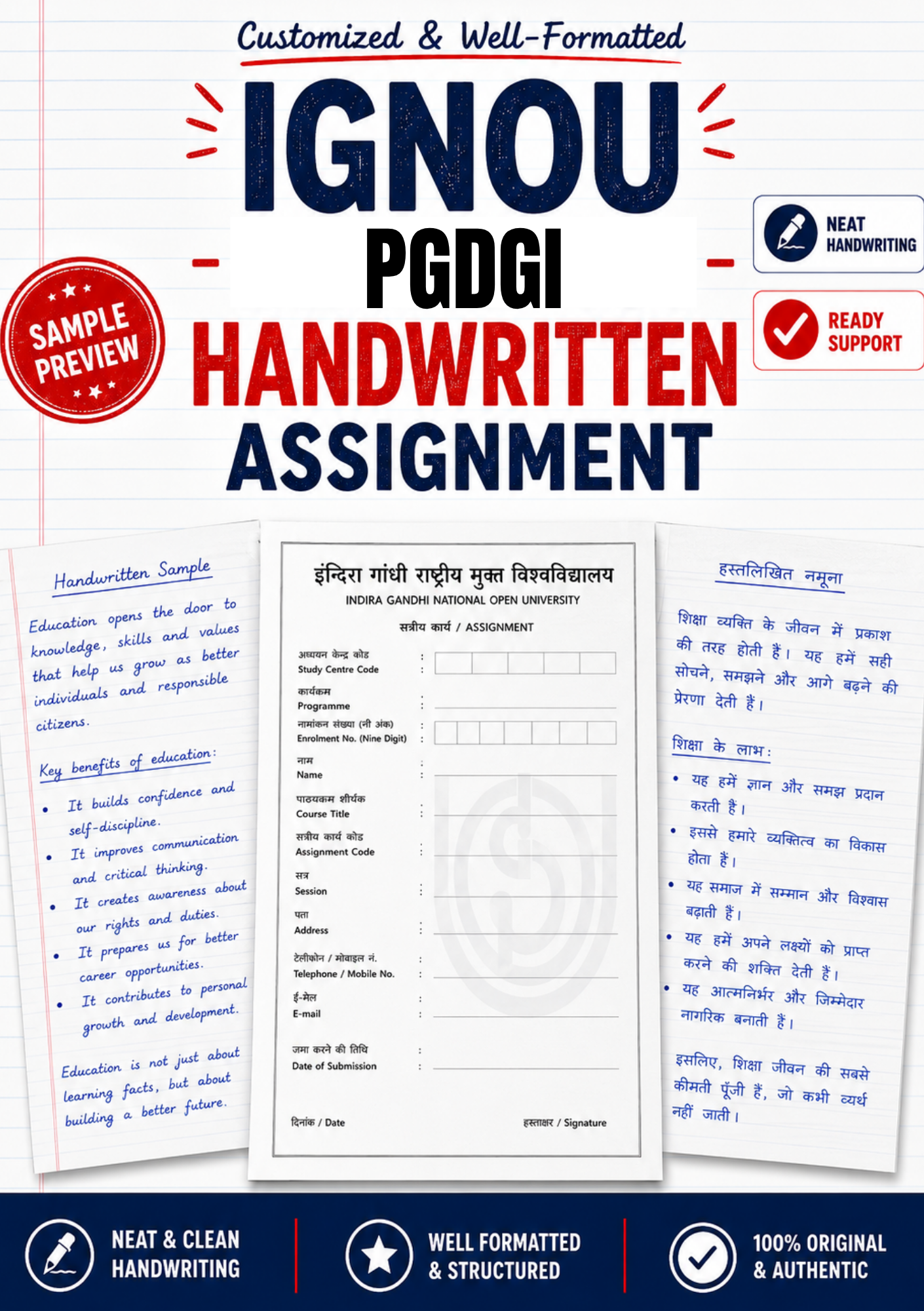
A geoinformatics order arrives as paper, not as a download, and it is worth knowing exactly what the parcel holds before the first message is sent. Four things travel for each code ordered. The first is the answer set itself, written out in ink on A4 sheets, numbered and tied, with each answer labelled by its question number the way the MGY booklets instruct. The second is an IGNOU-format front page carrying the fields a study centre expects to see filled, supplied free with every subject. The third is a printed copy of the official MGY question paper the answers respond to, so the counter clerk and the evaluator can see the paper and the response as one object. The fourth is the courier itself, which is already inside the price.
The rate is ₹320 per subject, hard copy only, with courier included in that price and no separate shipping charge. Nothing is held back as a digital version to be emailed afterwards. No soft copy or PDF is sold. That is a deliberate scope decision rather than a limitation, because the 2026 MGY booklets state in their own instruction block that only handwritten assignments will be accepted and that typed or printed copies are not evaluated, so a PDF would be a file the learner could not hand in.
One practical point specific to geoinformatics: three of the six orderable papers set questions that invite sketches, labelled diagrams, band-combination tables and small worked calculations rather than continuous prose. Those are written and drawn on the same A4 sheets rather than pasted in, which is why the sample photograph described further down matters more on this diploma than on a purely discursive one.
Pricing Six Theory Papers When the Diploma Has Eight Courses
The gap between eight courses and six papers is the single most useful thing a PGDGI learner can understand about this order, because it decides what is payable. The diploma is built as four courses per semester, three of them theory and one a laboratory course. The theory courses carry 28 of the 40 credits between them and each one carries a single tutor marked assignment. The laboratory courses carry the remaining 12 credits and carry none.
So a learner registered for the full year owes six assignments, not eight, and a full-year written order is six multiples of ₹320. There is no minimum order: one subject or fourteen, same rate. A learner who finished the Post Graduate Certificate in Geoinformatics first and used the credit-transfer route the prospectus describes to enter the diploma at Semester II owes three papers rather than six, and that is an ordinary order rather than an exception.
What the figure does not reach is as important. It does not touch the laboratory courses, because there is nothing to write for them. It does not touch the practical record book, which the programme guide requires to be signed exercise by exercise by a counsellor and then submitted, and which is by definition the learner’s own bench work. It does not touch the Term-End Practical Examination, the 70 per cent practical attendance requirement, the registration fee or the examination form fee. And it buys preparation, not an outcome. No claim is made about the marks any assignment will receive, about how an evaluator will assess it, or about whether it will be accepted. Assignment evaluation is entirely a matter for IGNOU.
Two weightings run inside this one diploma, and confusing them costs learners real marks. On the six theory courses the continuous component is the smaller half. Assignments carry 30 per cent of the final course result and the term-end examination carries the remaining 70 per cent. On the two laboratory courses the proportion inverts: the programme guide puts 70 per cent on continuous evaluation of tutor-guided practicals and the practical record, and 30 per cent on the Term-End Practical Examination. A learner who assumes the familiar 30/70 applies everywhere will under-invest in exactly the component that carries most of the lab marks. Alongside both, the guide sets a 40 per cent minimum in each component separately, so a theory assignment below that floor is not rescued by a strong examination paper.
Why the PGDGI Booklet Settles the Typed-Copy Argument for You
Two different products are sold under names that sound alike, and the distinction is worth stating once, cleanly. A solved assignment is a soft-copy reference file of model answers for a course code and a session, read on a screen or printed out and used as study material while writing. A handwritten assignment is the answers written out by hand on paper and submitted in hard copy at the study centre. The first is something to learn from. The second is the thing that is actually handed in.
On most IGNOU programmes that boundary has to be argued from the declaration a learner signs. On this one it does not, because the School of Sciences wrote it into the paper. The instruction block printed on the 2026 MGY-101, MGY-103, MGY-005 and MGY-006 booklets states that responses are to be written on A-4 size paper only, that only handwritten assignments will be accepted, and that typed or printed copies will not be evaluated. The same instruction appears on the consolidated PGDGI booklets for 2024 and 2025. Four separate files across three cycles say the same thing, so this is the programme’s settled position rather than one editor’s preference.
| What differs | Solved assignment (soft copy) | Handwritten assignment (hard copy) |
|---|---|---|
| Physical form | A file on a screen or a printout | Ink on A4 sheets, numbered and tied |
| What it is for | Reading, revision, checking your own answer against a model | Submission at the study centre counter |
| What the MGY booklet says about it | Typed or printed copies are not evaluated | Only handwritten assignments will be accepted |
| Who it suits | A learner who will write the six papers personally and wants a reference | A learner who cannot free the hours before 31 March or 30 September |
| Handwriting | Not applicable | Matched to a sample page the learner photographs first |
| Price on this page | Not sold here. No soft copy or PDF is sold. | ₹320 per subject, courier included |
Scroll the table sideways on a narrow screen.
If a model-answer file is what is wanted rather than a written set, it belongs on a different shelf of this store, and there is an honest complication worth naming. the store’s own PGDGI solved-assignment category exists but is empty at the time of writing, holding zero products. Because MGY 005, MGY 006 and MGY 007 are shared with the first year of M.Sc. Geoinformatics, the reference files for the Semester II codes are filed on the MSCGI assignment listing where the shared codes actually sit instead. That is a shelving fault on this store rather than a gap in the catalogue, and it is recorded in the correction queue for this build.
Six codes, priced one at a time. Every PGDGI theory paper is ₹320, whether one is ordered or all six. Courier is already inside that figure and there is no packing charge on top.
Six Theory Codes, Two Numbering Generations, One Diploma
Read the PGDGI course table once and something looks wrong. Semester I runs MGY 101, MGY 102, MGY 103 and MGYL 104. Semester II then drops back to MGY 005, MGY 006, MGY 007 and MGYL 008. Eight rows of one table, and the numbers run in two different series. Learners regularly assume a misprint, or that courses 004 and 008 have gone missing, or that the 100 series belongs to the master’s programme.
None of that is the case, and the explanation is traceable inside the Common Prospectus itself. The Post Graduate Certificate in Geoinformatics, which feeds this diploma, is described there as a 16-credit programme on offer from 2014 to 2023 that was revised to 20 credits to make it modular with the diploma and the master’s, with the revised version on offer from the January 2024 admission cycle. That revision renumbered the first-semester courses into the 100 series and reweighted them. The second semester was never reissued, so it still carries its original unit numbering. The result is one diploma whose eight course numbers belong to two different generations of the same scheme. The older numbering has not vanished either: MGY 001, titled Introduction to Geoinformatics at 4 credits, is still live in the second-year table of a programme in a different school altogether, while MGY 101 carries the same title at 6 credits here.
| Code | Title of the course | Semester | Credits | Assignment |
|---|---|---|---|---|
| MGY 101 | Introduction to Geoinformatics | I | 6 | One TMA |
| MGY 102 | Remote Sensing and Image Interpretation | I | 4 | One TMA |
| MGY 103 | Global Navigation Satellite System and Geographic Information System | I | 4 | One TMA |
| MGY 005 | Techniques in Remote Sensing and Digital Image Processing | II | 6 | One TMA |
| MGY 006 | Spatial Analysis and Modeling | II | 4 | One TMA |
| MGY 007 | Applications of Geoinformatics | II | 4 | One TMA |
Scroll the table sideways on a narrow screen. Titles are reproduced from the PGDGI table of the Common Prospectus July 2026, including its spelling of MGY 006.
Those six add to 28 credits. Add the two laboratory courses at 6 credits each and the diploma totals 40, which is the figure the prospectus prints and the figure the university’s own PGDGI page prints. The arithmetic was checked rather than assumed, because the semester split in the prospectus table is 20 and 20 and a column that bled from a neighbouring programme would not balance. A learner should still read the exact codes off an admission record rather than off any table on any website, because re-registration gaps and credit transfer mean two learners admitted in the same year can owe different papers.
The paper the store sells for each of these codes is the written response, not the course material. The Semester I book combo covering MGY 101, 102 and 103 is where the reading sits, and the store files the MGY 006 reading as a study guide under the double-l spelling of Modelling, which is the spelling the booklet and the university’s live page both use.
MGYL 104 and MGYL 008: Why No Assignment Exists for Either
The two laboratory courses are the reason a full-year PGDGI order is six papers and not eight, and the reason deserves to be stated with its source rather than asserted. The School of Sciences PGDGI programme guide states that there are no assignments for the laboratory courses. That is confirmed by the booklets themselves: the consolidated PGDGI Semester I booklet for 2025 contains assignments for MGY-101, MGY-102 and MGY-103 and nothing for MGYL-104, and the consolidated Semester II booklet for the January 2024 cycle contains MGY-005, MGY-006 and MGY-007 and nothing for MGYL-008. A file does sit at the expected address for MGYL-104, but it returns no machine-readable text, which is the same signature the laboratory codes of other School of Sciences programmes show.
| Code | Title of the course | Semester | Credits | How it is assessed |
|---|---|---|---|---|
| MGYL 104 | Geoinformatics Laboratory | I | 6 | Continuous evaluation of tutor-guided practicals and the practical record at 70 per cent, Term-End Practical Examination with viva at 30 per cent. No TMA. |
| MGYL 008 | Digital Image Processing and Spatial Analysis Laboratory | II | 6 | Same split: 70 per cent continuous, 30 per cent practical examination. No TMA. |
Scroll the table sideways on a narrow screen. Credits and titles from the Common Prospectus July 2026; the assessment split from the School of Sciences PGDGI programme guide.
Three consequences follow for anyone planning a year. Twelve of the forty credits are decided at a computer rather than on paper, so a learner who writes six excellent assignments and skips practical counselling has secured a minority of the available marks. The guide requires at least 70 per cent attendance at practical counselling to qualify for the practical examination at all. And the self-learning material for both laboratory courses is issued only in digital form, which the prospectus states twice, so the printed-book expectation that holds for the theory courses does not hold for these two.
Twenty-Six Points Where the Geoinformatics Paperwork Does Not Line Up
The sections above were built by reading the Common Prospectus July 2026, five live assignment booklets across three cycles, the School of Sciences programme guide and the university’s own PGDGI page against one another. They do not all say the same thing. Everything found is set out below rather than quietly reconciled, because a learner who meets one of these halfway through a semester is better served by having seen it here first.
Disagreements found while building this page. Numbers 1 to 20 are inside IGNOU’s own documents. Numbers 21 to 26 are this store’s own faults, listed for the same reason.
1. The eight course numbers in one PGDGI table belong to two numbering generations, the 100 series in Semester I and the unit series in Semester II.
2. MGY 006 is titled Spatial Analysis and Modeling in the PGDGI table of the Common Prospectus July 2026 and Spatial Analysis and Modelling in the MSCGI table of the same document. Each spelling occurs exactly once.
3. The booklet cover, the university’s live PGDGI page and this store’s own book product all use the double-l spelling, leaving the PGDGI prospectus table as the only source using the single-l form.
4. Annexure row 137 of the prospectus names the programme Post Graduation Diploma in Geoinformatics. Section 8.9 and the contents page name it Post Graduate Diploma in Geoinformatics.
5. All four 2026 per-course booklets read for this page print PG DIPLOMA IN GEOIFORMATICS on the cover, dropping a letter, while the welcome letter inside the same file spells Geoinformatics correctly.
6. The consolidated PGDGI booklets for 2024 and 2025 spell the programme name correctly on the cover, so the misspelling arrived with the 2026 per-course template.
7. The assignment code format changed between cycles. The 2025 Semester I booklet prints MGY-101/PGDGI/TMA/2025 with the programme code inside it. The 2026 booklet prints MGY-101/TMA/2026 without it.
8. Cover-page applicability differs by semester within the same 2026 set. The MGY-101 and MGY-103 covers name PGCGI, PGDGI and MSCGI. The MGY-005 and MGY-006 covers name PGDGI and MSCGI only.
9. The validity regime has changed three times in three cycles: the Semester II booklet for the January 2024 cycle is valid 1 January to 30 June 2024, a later Semester II booklet runs July 2024 to June 2025, and the 2025 and 2026 booklets run a full calendar year.
10. The number of submission dates printed changed with it. The January 2024 Semester II booklet prints one date, 31 March 2024. The 2025 and 2026 booklets print two.
11. The marks architecture of one code is re-set between cycles. MGY-006 in the January 2024 booklet runs 10, 15 and five short notes per part. The same code in 2026 runs 10, 10 and six short notes.
12. Question counts differ across one 2026 set: MGY-101 sets nine questions in three parts, MGY-005 sets nine in three parts, MGY-103 sets ten in two parts and MGY-006 sets six in two parts. There is no single PGDGI question pattern.
13. The weighting inverts inside the diploma. Theory courses are 30 per cent assignment and 70 per cent examination. Laboratory courses are 70 per cent continuous and 30 per cent practical examination.
14. Paper size is not uniform across the School of Sciences. Every PGDGI and MSCGI booklet read here specifies A-4 only, while booklets of other School of Sciences programmes specify foolscap.
15. The PGDGI entry in the prospectus prints the exit note as “may opt to receive & Post Graduate Certificate in Geoinformatics”, with a stray ampersand.
16. Two different routes award the same qualification. The prospectus describes a stand-alone Post Graduate Diploma in Geoinformatics and, separately, an MSCGI exit after two semesters and 40 credits that it writes as Post-Graduate Diploma, hyphenated.
17. The course description for MGY-101 on the university’s live PGDGI page calls the course part of a certificate programme, on a page that is about the diploma.
18. The live page prints the MGY-102 title as Remote sensing and Image Interpretation, with a lower-case s, where the prospectus and the booklet capitalise it.
19. The programme coordinator is Dr. Kakoli Gogoi in the prospectus and Prof. Kakoli Gogoi on the live page, where the entry also appears twice.
20. Blanket submission dates circulated by third-party education portals for the 2026 cycle do not match the dates printed on the PGDGI booklets. Only the booklet and your Regional Centre settle this.
21. This store spells the programme Geo-informatics, with a hyphen, on all three of its PGDGI category shelves. IGNOU spells it Geoinformatics.
22. This store’s PGDGI solved-assignment category exists and holds zero products, while the MSCGI assignment shelf holds the files for the shared Semester II codes.
23. This store runs two separate MSCGI book shelves under slightly different names, one holding three products and one holding sixteen. They should be one shelf.
24. This store’s Post Graduate Certificate in Geoinformatics book shelf holds zero products although PGCGI-labelled items are live elsewhere in the catalogue.
25. This store still files some geoinformatics guess papers under the retired MGY 1, MGY 2 and MGY 3 numbering while filing the books under the current MGY 101, 102 and 103 numbering.
26. This store’s handwritten-assignment category page still carries delivery-time figures in working days and a ₹350 line that contradict the ₹320 and the no-promised-figure position stated on this product page. Correcting the category page is the first item in this build’s correction queue.
Programme structures, course codes, submission dates and rules change, and only ignou.ac.in and your Regional Centre can confirm the current position for your enrolment. The point of listing the twenty-six is not to suggest the university’s records are unusable. It is that a learner copying a code or a date off a third-party summary has no way of knowing which of these variants they are copying.
Two Dates That Do Not Move With Your Admission Month
Submission deadlines at IGNOU are set school by school and often programme by programme, so a date read on a management or humanities page is of no use to a geoinformatics learner. The dates below were read off the PGDGI booklets themselves rather than carried across from another programme.
Every 2026 MGY booklet read for this page prints the same three-part arrangement. The paper is valid from 1 January to 31 December 2026. Inside that window, a learner on the January 2026 cycle submits by 31 March 2026, and a learner on the July 2026 cycle submits by 30 September 2026. The 2025 Semester I booklet prints the identical structure one year earlier, with 31 March 2025 and 30 September 2025. The programme guide gives the same pair in general terms, adding that the University may notify otherwise.
Two things follow that catch people out. The first is that the deadline is tied to the admission cycle, not to the month a learner happens to download the paper, so someone admitted in July who downloads in February is still on the September date. The second is what the validity line does when it closes. The programme guide states that an assignment carries validity dates and that a learner who misses them submits again in the next year, which means against the next year’s paper. A 2025 paper does not stay submittable into 2026 simply because it was never handed in. That is why an older cycle is ordered by naming the booklet year rather than only the course code.
Blanket assignment deadlines circulate widely on education-news sites each year, and they are usually written about the university as a whole rather than about a School of Sciences diploma. The authoritative copy is the one printed on the paper downloaded from IGNOU’s own assignment download service, and the position for a particular enrolment is settled by the Regional Centre.
The Year IGNOU Dropped PGDGI From the Middle of Your Assignment Code
The assignment code is the string copied onto the top of the first sheet, and getting it wrong is one of the quieter reasons a set is queried at the counter. On this programme the string changed shape between cycles, which is worth knowing before copying one from an older paper or an older friend’s set.
The 2025 consolidated PGDGI Semester I booklet prints the code with four segments and the programme code inside it, in the form MGY-101/PGDGI/TMA/2025. The 2026 per-course booklets print three segments and drop the programme, in the form MGY-101/TMA/2026, MGY-103/TMA/2026, MGY-005/TMA/2026 and MGY-006/TMA/2026. The change is consistent with what else happened to those files: in 2026 the Semester I paper became a shared booklet serving the certificate, the diploma and the master’s at once, and a programme segment naming only PGDGI would have been wrong on a paper three programmes download.
Reading the current form left to right gives the course code with a hyphen, then TMA for tutor marked assignment, then a single four-digit year. There is no session word such as JULY or JAN, no TMA number, and no two-year span. Programmes in other schools use all three of those, which is why a code pattern learned elsewhere should not be applied here. The rule for an order is simple: copy the string exactly as printed on the booklet that was downloaded, including its year, and send that year with the code list so the correct paper is written against.
Map Sketches, Band Tables and a Hand That Matches the Declaration
A geoinformatics answer set does not look like an essay set. Across the papers read for this page, the questions ask for labelled diagrams of sensor geometry, sketches of satellite orbits and swath, tables comparing spectral bands, short worked calculations on resolution and scale, and definitions of terms that have to be written precisely rather than paraphrased. A writer who produces neat continuous prose and ignores the diagrams has answered a different paper.
Two things therefore govern how a PGDGI set is prepared. The answers are written to the marks allocated, which the booklets state as roughly 300 words for a short note and roughly 600 for a long answer, and the diagrams are drawn on the same A4 sheets in the same ink rather than pasted in from elsewhere. And the hand itself is matched to the learner, because the cover page carries a declaration with the learner’s signature on it. Send a photo of a page you have written yourself and the handwritten set is matched to your handwriting at no extra charge.
That sequencing is the point rather than a courtesy. The sample goes first, the match is shown, and payment follows. You sign the declaration on the assignment cover page, so you should read and review the content before submitting it, and satisfy yourself that it represents your own understanding of the course.
The sample page, and why diagrams on it help rather than hinder
One page is enough, photographed flat in daylight with the whole sheet in frame and nothing cropped. A page from an existing notebook works better than a page written specially, because the writing is unselfconscious. For this diploma in particular, a page that happens to contain a sketch, a labelled axis or a few figures is more useful than a page of pure prose, because it shows how the numerals, the capitals and the pencil-to-ink habits actually look. If the only available page is in another subject entirely, that is fine; the hand is what is being read, not the content.
Sample first, quote second, payment last. A photograph of one page of your own writing is all that is needed to start. Pricing stays at ₹320 per subject whichever codes are on the list.
One Medium, One Calendar Year per Paper, and the Cycles Behind You
Medium is settled quickly on this diploma. The Common Prospectus names English as the medium of instruction for PGDGI, the university’s live programme page names English, and none of the five booklets read for this page exists in another edition. The service covers all mediums IGNOU issues the TMA paper in, at the same price, and on PGDGI that set has one member. A learner who has seen a Hindi edition of a geoinformatics paper should send it, because that would be new information rather than a routine request.
Session coverage is wider than medium. Any session is accepted, current cycle or older, including backlog courses, at the same ₹320 per subject. A backlog order on this programme is slightly different from one on a year-wise programme, because PGDGI papers are tied to a calendar year of validity rather than to a two-year span. A learner returning to clear MGY 007 after two idle years is not writing the old paper; they are writing the paper currently valid, which may well be a different set of questions under the same code. Naming the booklet year alongside the code is what keeps that straight.
Lateral entry adds a third pattern. The prospectus allows a learner holding the Post Graduate Certificate in Geoinformatics to enter the diploma at the second semester under the credit-transfer policy, and it allows a PGDGI holder to enter the second year of M.Sc. Geoinformatics the same way. So a perfectly normal PGDGI order can be three codes rather than six, and a learner who has moved on may need the M.Sc. Geoinformatics written set instead of this one for the codes above MGY 007.
Before the Writing Starts: Codes, Cycle, Centre and a Sample
An order opens with one message and closes with one confirmation. Five pieces of information decide everything, and nothing else is needed at the start.
- The MGY codes. Written as they appear on the admission record, for example MGY 005, MGY 006 and MGY 007. Laboratory codes should not be listed, because there is no paper to write for them.
- The booklet year printed on the paper. 2026 for a current set, an earlier year for a lapsed one. This is what decides which questions are answered.
- The admission cycle. January or July, because that is what selects between the 31 March and 30 September dates.
- A photograph of one page in your own handwriting. Described in the section above.
- The delivery pin code. Delivery depends on your pin code and is confirmed for your order before you pay. No figure is promised on this page.
Things that are deliberately not asked for: enrolment number and study centre code are needed only for the front page and can follow once the order is confirmed, and no payment is requested before the handwriting match has been shown. There is no minimum order: one subject or fourteen, same rate.
Still checking an older MGY booklet year? Papers from closed validity years are written at the same ₹320 per subject, and the first thing worth confirming is which year’s questions you are actually required to answer.
Signing for the Parcel, and Then Signing the Declaration
What happens after the courier hands the parcel over is the learner’s part, and it is short but not optional. Open the packet and check it code by code against the booklet downloaded from the university: the course code on the sheets, the assignment code string, the year, and that every question in every part has been answered, because the booklets state that all questions are compulsory and that incomplete answer sheets attract poor grades.
Then the cover page. Fill in the enrolment number, name, address, course code and title, study centre and the date, and sign the declaration. That signature is the reason the whole order is built around a handwriting sample rather than a house style. Keep a photocopy of the complete set before it leaves, which is an instruction the booklets give in their own words and which costs nothing to follow.
Submission is to the Coordinator of the study centre, and the programme guide notes that assignments received after the due date may be rejected and that missing the date also closes the term-end examination for that course. After submission the status appears on the university’s own assignment status service in its own time, and evaluated scripts can be collected from the study centre. No claim is made about the marks any assignment will receive, about how an evaluator will assess it, or about whether it will be accepted. Assignment evaluation is entirely a matter for IGNOU.
Where a PGDGI Learner Goes Next, Including One Empty Shelf
A written set is one item in a year of study, and the rest of the geoinformatics material on this store sits in a few predictable places. It is worth saying plainly that the shelving is imperfect, because sending a learner to an empty category helps nobody.
Reading first. The diploma’s own book shelf carries the guide material filed against the PGDGI codes, and because Semester II is shared with the master’s programme, the wider geoinformatics book range is where the MGY 005 to MGY 007 titles are stocked in depth. For the term-end examination rather than the assignment, the PGDGI guess-paper shelf is built around the question patterns that recur in June and December, which is a different job from the assignment entirely.
Two shelves come with warnings. The PGDGI solved-assignment category, linked earlier in the comparison section, is currently empty. And the Post Graduate Certificate shelf for geoinformatics also holds nothing at present, although certificate-labelled items exist elsewhere in the catalogue. Both are listed in the correction queue rather than hidden.
Sideways from geoinformatics, two neighbours matter. A learner who has already moved up finds the master’s codes on the M.Sc. Geoinformatics written set linked above, and a learner who met MGY 001 rather than MGY 101 will find it carried inside the environmental and occupational health set that still issues the four-credit MGY 001, which is a different course at a different weight despite the shared title. Beyond geoinformatics altogether, every other programme written to order is listed on one page.
If writing the six papers personally is the preferred route, that is a reasonable choice and the sister site covers it: a step-by-step guide to preparing and submitting an IGNOU assignment yourself walks through the cover page, the numbering and the counter process without selling anything.
Sixteen Questions Asked About MGY Papers, Answered
Can a downloaded PGDGI solved assignment PDF be submitted at the study centre?
No. The instruction block on the 2026 MGY booklets states that only handwritten assignments will be accepted and that typed or printed copies will not be evaluated. A solved assignment is a soft-copy reference file of model answers for a course code and session; it is material to write from, not a submission. The thing that is handed in has to be written out by hand on A4.
PGDGI mein solved assignment aur handwritten set ka farak kya hai?
A solved assignment is a PDF of model answers that you read on a screen or print out and study. A handwritten assignment is those answers written out in ink on A4 sheets, with a cover page, ready to be handed in at the counter. On PGDGI the booklet itself closes the gap between the two: typed or printed copies are not evaluated, so only the second one can actually be submitted.
Typed MGY paper study centre par chalega ya nahi?
The booklet does not use the word reject, but it does say that typed or printed copies will not be evaluated, which comes to the same thing for a learner. This instruction appears on the 2026 MGY-101, MGY-103, MGY-005 and MGY-006 booklets and on the consolidated PGDGI booklets for 2024 and 2025, so it is the settled position of the School of Sciences on this programme rather than a one-file note.
How many PGDGI assignments do I actually owe in a full year?
Six. The diploma has eight courses, but the two laboratory courses carry no tutor marked assignment, which the programme guide states directly and which both consolidated booklets confirm by containing only the theory codes. A full-year order is therefore MGY 101, 102 and 103 plus MGY 005, 006 and 007.
Why does the course list jump from MGYL 104 back to MGY 005?
Because the two semesters were renumbered at different times. The Post Graduate Certificate in Geoinformatics was revised from 16 credits to 20 credits with effect from the January 2024 admission cycle, and that revision moved the first-semester courses into the 100 series. Semester II was not reissued, so it still carries the original unit numbering. Nothing is missing from the list.
Are MGYL 104 and MGYL 008 charged for?
No, because there is nothing to write. They are assessed as practical work: continuous evaluation of tutor-guided practicals and the practical record carries 70 per cent, and the Term-End Practical Examination with its viva carries 30 per cent. The programme guide also requires at least 70 per cent attendance at practical counselling to sit that examination.
What is the last date for a PGDGI assignment?
The 2026 booklets print 31 March 2026 for the January 2026 cycle and 30 September 2026 for the July 2026 cycle, inside a validity window running from 1 January to 31 December 2026. The 2025 booklet prints the same pattern a year earlier. Dates circulated as a single university-wide figure on education-news sites are not PGDGI dates, and the booklet you downloaded plus your Regional Centre settle the question for your enrolment.
My friend’s paper says MGY-101/PGDGI/TMA/2025 and mine says MGY-101/TMA/2026. Which is correct?
Both, for their own year. The 2025 consolidated booklet printed the programme code inside the string. The 2026 booklet dropped it, because in 2026 the Semester I paper became a shared booklet covering the certificate, the diploma and the master’s at once. Copy the string exactly as printed on the booklet you downloaded, year included.
Why does my MGY-101 cover list three programmes and my MGY-006 cover list two?
Because the certificate programme only has a first semester. The 2026 MGY-101 and MGY-103 covers name PGCGI, PGDGI and MSCGI. The 2026 MGY-005 and MGY-006 covers name PGDGI and MSCGI only. A shared cover does not mean a shared paper for you: order against the codes on your own admission record.
Is the MGY 006 title Modeling or Modelling?
Both spellings are in print. The PGDGI table of the Common Prospectus July 2026 uses Modeling with one l. The MSCGI table of the same document, the assignment booklet cover and the university’s live programme page all use Modelling with two. Each spelling occurs exactly once in the prospectus. It is the same course either way, and the code is what identifies it.
I entered the diploma after finishing PGCGI. Can I order only the Semester II papers?
Yes. The prospectus allows a PGCGI holder to take lateral entry into the second semester of PGDGI under the credit-transfer policy, so an order of MGY 005, MGY 006 and MGY 007 alone is ordinary rather than a special case. There is no minimum order: one subject or fourteen, same rate.
Can you write a PGDGI paper from a year that has already lapsed?
Any session is accepted, current cycle or older, including backlog courses, at the same ₹320 per subject. One thing to be clear about on this programme: each MGY paper is valid for a stated calendar year, and the programme guide says a learner who misses that window submits again in the next year, which means against the next year’s questions. Send the booklet year you have been told to answer along with the codes.
Is there a Hindi medium PGDGI assignment?
None was located. The Common Prospectus and the university’s live PGDGI page both give English as the medium of instruction, and no Hindi edition of any of the five booklets read for this page exists at the School of Sciences address. The service covers all mediums IGNOU issues the TMA paper in, at the same price, so if a Hindi edition appears it is covered without a price change.
How much of my PGDGI result do these six papers decide?
Assignments carry 30 per cent of the final course result and the term-end examination carries the remaining 70 per cent. That applies to the six theory courses. On the two laboratory courses the proportion is the other way round, 70 per cent continuous and 30 per cent practical examination. The programme guide also sets a 40 per cent minimum in each component separately, so a theory assignment below that floor is not carried by a strong examination mark.
What paper size should a geoinformatics assignment be written on?
A-4, and only A-4. Every PGDGI and MSCGI booklet read for this page says so in its instruction block. This is worth checking against advice from elsewhere, because booklets of some other School of Sciences programmes specify foolscap, and a study centre used to foolscap submissions may say so informally. The instruction printed on your own MGY booklet is the one that governs.
How many questions will my MGY paper have?
It varies by code, so no single answer is honest. In the 2026 set, MGY-101 and MGY-005 each set nine questions across three parts, MGY-103 sets ten across two parts, and MGY-006 sets six across two parts. All of them total 100 marks and all questions are compulsory. The same code can also change between cycles: MGY-006 in the January 2024 booklet carried a different split from the 2026 version.
Eight Documents Were Read for This Page, and They Do Not Agree
Important Notice
Shri Chakradhar Publication Pvt. Ltd. and shrichakradhar.com form an independent IGNOU study-support publisher. This is not the official website of Indira Gandhi National Open University, is not affiliated with, endorsed by or authorised by the university, and no page on this site should be treated as an official IGNOU communication.
Programme structures, course codes, submission dates and rules change, and only ignou.ac.in and your Regional Centre can confirm the current position for your enrolment.
You sign the declaration on the assignment cover page, so you should read and review the content before submitting it, and satisfy yourself that it represents your own understanding of the course.
No claim is made about the marks any assignment will receive, about how an evaluator will assess it, or about whether it will be accepted. Assignment evaluation is entirely a matter for IGNOU.
The Order Opens With Your Semester and Your Code List
The rate is ₹320 per subject, hard copy only, with courier included in that price and no separate shipping charge. A free IGNOU-format front page and a copy of the official MGY question paper go into the packet with the written sheets, and no soft copy or PDF is sold.
Two ways to start. Send the MGY codes, the booklet year and your admission cycle and a quote comes back per paper: Confirm a PGDGI order. Or, if something above needs settling first, such as which semester your codes belong to or which booklet year you should be answering: Ask one question before ordering.
Delivery depends on your pin code and is confirmed for your order before you pay. No figure is promised on this page.