

Description
In short. The Post Graduate Diploma in Food Safety and Quality Management runs eight courses worth 36 credits, and IGNOU publishes an assignment paper for five of them: MVP-001 Food Fundamentals and Chemistry, MVPI-001 Food Microbiology, MVP-002 Food Laws and Standards, MVP-003 Principles of Food Safety and Quality Management and MVP-004 Food Safety and Quality Management Systems. Shri Chakradhar Publication writes those five by hand on foolscap sheets with a 4 cm margin on the top, bottom and left, which is what the School of Agriculture booklet asks for rather than the A4 layout most guidance repeats, and ships the bundle with a copy of the official MVP paper and a free IGNOU-format front page. Four of the papers are marked out of 50 and MVPI-001 out of 25, each with five questions and the instruction to attempt all of them. The rate is ₹320 per subject, hard copy only, with courier included in that price and no separate shipping charge. The two dates the 2026 papers print, 30 September 2026 for the January 2026 session and 31 March 2027 for the July 2026 session, are both marked “Before submission of TEE Form”, and the remaining three courses, MVPL-001, MVPL-002 and MVPP-003, carry 16 credits between them with no assignment paper to write at all.
What a Five-Paper Food Safety Bundle Contains
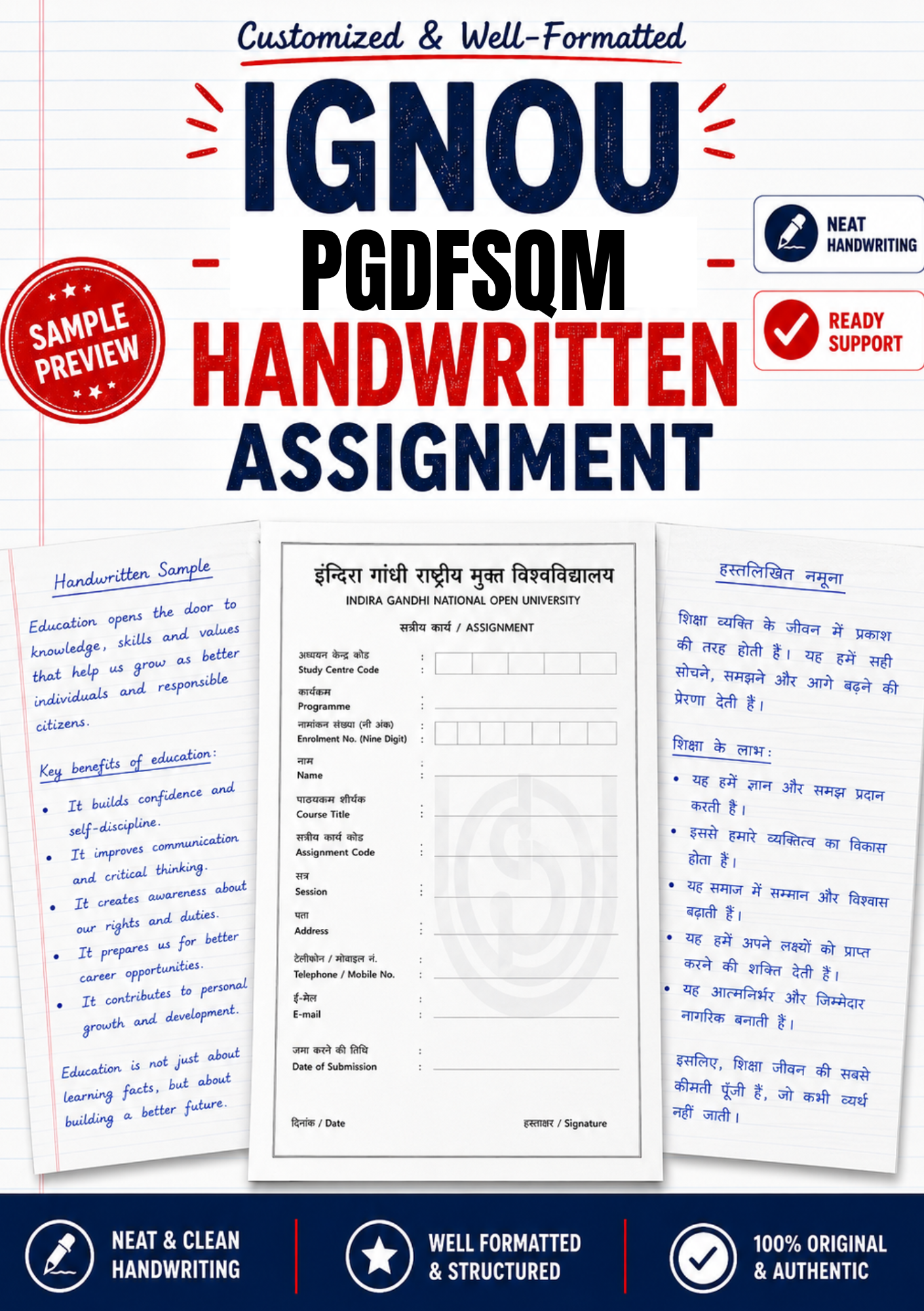
A PGDFSQM order arrives as paper, in one courier packet, and the contents are fixed rather than assembled to taste. For each MVP code you name, the packet holds a complete handwritten answer set on foolscap sheets, written on one side, numbered, and left with the 4 cm margin the booklet specifies on three edges of the sheet so that the study centre can tag and bind it without losing text into the fold.
Travelling with the written sheets is a printed copy of the official assignment paper for that code and that cycle, taken from the file IGNOU publishes under the School of Agriculture, and an IGNOU-format front page carrying the enrolment number, name, address, course code, course title, study centre name and code, and date fields exactly as the booklet lays them out at the top of its first page. The front page is included at no charge and is not an optional add-on.
No soft copy or PDF is sold. The written sheets are the product, which is also why they are the only thing a counter can accept. Nothing is emailed, nothing is uploaded to a drive, and there is no file to lose when a phone is replaced. Delivery depends on your pin code and is confirmed for your order before you pay. No figure is promised on this page.
What does not travel in the packet is anything belonging to the practical or project side of the diploma. MVPL-001 and MVPL-002 are assessed in a laboratory session against performance, reporting, viva voce and record, and MVPP-003 is a supervised project report. Those three are the subject of a separate section below, because the commonest source of a wasted PGDFSQM order is a learner paying for eight papers when five exist.
Itemising ₹320 for a Food Safety Diploma Order
The rate is ₹320 per subject, hard copy only, with courier included in that price and no separate shipping charge. Inside that figure sit the writing of the complete answer set for one MVP code, the foolscap paper it is written on, the printed question paper, the IGNOU-format front page, the handwriting match against your own sample, and the courier to your address. There is no packing charge, no per-page charge and no charge for the front page.
Outside the figure sits everything the university controls. The diploma fee itself is IGNOU’s, and the Common Prospectus annexure prints it as Rs.14,200 year-wise against the Programme Guide’s Rs. 14,400 and a third figure on IGNOU’s own live programme page, which is one of the disagreements catalogued further down. The term-end examination fee, the laboratory sessions for MVPL-001 and MVPL-002, the project supervision for MVPP-003 and the act of handing the bundle in at your study centre are all yours and the university’s, not this store’s.
There is no minimum order: one subject or fourteen, same rate. A learner who has written four of the five papers and left MVP-004 alone pays ₹320, not a five-paper package price. The service covers all mediums IGNOU issues the TMA paper in, at the same price. For PGDFSQM that currently means the English paper the School of Agriculture publishes, since English is the only medium of instruction the prospectus and the Programme Guide record for this diploma.
Assignments carry 30 per cent of the final course result and the term-end examination carries the remaining 70 per cent. On a five-paper diploma that is 30 per cent of each of five course results, and the 2026 papers tie their dates to the moment the examination form goes in, so the component is not only worth marks, it gates the sitting.
Have the five codes in front of you before messaging.
Your admission record and grade card will show which of MVP-001, MVPI-001, MVP-002, MVP-003 and MVP-004 are still open. Send that list and the session you are submitting against.
₹320 per subject, hard copy, courier included. Start a PGDFSQM order on WhatsApp
A File You Copy From Against a Bundle You Hand Over
Two different things are sold under names that look similar, and PGDFSQM learners are more exposed to the confusion than most because the MVP codes are shared with the M.Sc and the solved-assignment listings on this store are filed under the master’s shelf.
A solved assignment is a soft-copy reference file of model answers for a course code and session. You read it, check your own understanding against it, and write your own answers from it. A handwritten assignment is the answers written out by hand and submitted in hard copy at the study centre, which for this diploma means written on foolscap rather than A4. The first is a study aid. The second is the submission itself. No soft copy or PDF is sold.
| Aspect on a PGDFSQM order | Model answer file you download | Written bundle for the counter |
|---|---|---|
| Form it reaches you in | A PDF you open on a phone or laptop | Foolscap sheets in a courier packet |
| What you do with it | Read it, then write your own answers by hand | Check it, sign the declaration, hand it in |
| Who it suits on PGDFSQM | A learner with time who wants reference material for all five MVP papers | A working food industry learner whose cut-off is close |
| Where it is sold here | Per course code, under the food safety assignment shelf | This page, at ₹320 per subject |
Scroll the table sideways on a narrow screen.
The instruction on the paper itself settles which one a counter will take. Every 2026 PGDFSQM booklet carries the line that assignments “have to be sent to the Programme Coordinator of your study centre within the due date”, and the Programme Guide is blunter still: responses must be written in the learner’s own handwriting, and typed assignment responses are not to be sent. A printed model answer file is therefore a thing to write from and not a thing to submit, whatever the file is called when it is downloaded.
If a reference file is what you actually need, the model answers for the MVP codes sit on the store’s own food safety solved assignment shelf, where the MVP course codes are filed, and that is the right place to send a solved-assignment query rather than this page. Note while you are there that the shelf is labelled for the master’s programme even though MVP-001 to MVP-004 and MVPI-001 are shared with this diploma, which is on the correction list at the end of this page.
The Five MVP Papers an Assignment Exists For
These are the codes with a published paper, with the titles as the Common Prospectus July 2026 prints them in the PGDFSQM table at section 8.30, and the marks and question counts read off the 2026 files rather than carried over from an earlier cycle.
| MVP code | Title printed in the prospectus table | Credits, theory plus practical | Marks on the 2026 paper | Question split on the paper |
|---|---|---|---|---|
| MVP-001 | Food Fundamentals and Chemistry | 4 + 0 = 4 | 50 | Five, 10 marks each |
| MVPI-001 | Food Microbiology | 2 + 2 = 4 | 25 | Five, 5 marks each |
| MVP-002 | Food Laws and Standards | 4 + 0 = 4 | 50 | Five, 10 marks each |
| MVP-003 | Principles of Food Safety and Quality Management | 4 + 0 = 4 | 50 | Five, 10 marks each |
| MVP-004 | Food Safety and Quality Management Systems | 4 + 0 = 4 | 50 | Five, 10 marks each |
Scroll the table sideways on a narrow screen.
Four of the five are pure theory and read as such. MVP-001 asks for terms defined and processes explained, with the 2026 paper opening on mutarotation, inversion of sugar, gelatinization, retrogradation and modified starch, and closing on sampling techniques for food products. MVP-002 sends the learner to the Food Safety and Standards Authority of India website to list the regulations and then describe the organic food regulation, before moving through export quality control agencies, export promotion schemes, the World Trade Organization agreement with notes on the sanitary and phytosanitary and technical barriers to trade agreements, and the Codex Alimentarius Commission. MVP-004 runs on audit principles, auditor competence, quality management system fundamentals, management responsibility under ISO 22000, laboratory assurance under ISO 17025, and India GAP and BRC food standards.
MVPI-001 is the structural oddity and the one worth checking against your own paper before ordering. It is the only course in the diploma that is neither pure theory nor pure practical: the prospectus section 8.30 gives it 2 theory credits and 2 practical credits, the Programme Guide calls it an integrated course, and IGNOU’s live programme page types it as a skill course. Its assignment is marked out of 25 where the other four are marked out of 50, so a learner ordering all five receives one noticeably shorter bundle, by design and not by shortcut. Answer length on every bundle is set from the marks printed beside each question on the paper that was fetched, which is why a 5 mark question in MVPI-001 does not receive the same treatment as a 10 mark question in MVP-003.
MVPL-001, MVPL-002 and MVPP-003: Sixteen Credits With No Paper Attached
This is the section that saves money. Three of the eight PGDFSQM courses hold 16 of the 36 credits and none of them has a tutor marked assignment to write.
| Course with no assignment | Title as the Programme Guide prints it | Course type in the Guide | Credits it holds | How it is assessed instead |
|---|---|---|---|---|
| MVPL-001 | Food Safety and Quality Auditing | Practical | 0 + 4 = 4 | Laboratory work split between guided and unguided experiments, scored on performance, reporting, viva voce and record |
| MVPL-002 | Chemical Analysis and Quality Assurance | Practical | 0 + 4 = 4 | The same practical scheme, with its own evaluation forms and a practical attendance requirement |
| MVPP-003 | Project Work-1 | Project Work | 0 + 8 = 8 | A supervised project report submitted to the School of Agriculture with an approved proposal and supervisor bio-data |
Scroll the table sideways on a narrow screen.
The evidence for the split is in IGNOU’s own documents and it is not entirely consistent, which is the point. Section 6.0 of the Programme Guide states that each course will have one assignment. Section 7.1.1 of the same guide then lists the assignments and names only MVP-001, MVP-002, MVP-003, MVP-004 and MVPI-001. The 2026 booklets resolve it in favour of five: every one of them opens with the sentence that there is one assignment for each course and a total of five assignments for the programme, in a single breath, for a diploma with eight courses. The published files agree with the number rather than the phrasing, and so does the practice at study centres.
Practically, that means a PGDFSQM learner’s complete handwritten requirement is five bundles and ₹1,600 at ₹320 per subject, not eight bundles. If you are carrying MVPP-003 as an open component, the project side is a different product altogether and lives on the store’s food safety project samples in soft copy shelf, or as a bound report on the printed and bound project shelf for this diploma. The laboratory courses cannot be bought from anyone, because they are scored on attendance and performance in a room.
Where the Food Safety Paperwork Stops Agreeing With Itself
Everything above was read off the documents rather than copied from another listing, and reading them against each other turned up thirty-one disagreements. Twenty-four sit inside IGNOU’s own material or in the aggregator tables that circulate it. Seven are this store’s or its sister site’s, and they are printed here with the rest because a page that hides its own errors is not more trustworthy for hiding them.
Thirty-one findings on the PGDFSQM record, as of 31 October 2026. Confirm anything that affects your own submission with ignou.ac.in or your Regional Centre.
1. The Common Prospectus July 2026 gives this diploma two credit totals. Section 8.30 prints a course table footed “Total Credits 18 18 36”, and the rows do sum to 36. Section 3.78, describing the M.Sc, twice refers to PGDFSQM holders “who have completed 32 credits”.
2. The 32 is traceable rather than random. Older PGDFSQM structure tables still circulating give the project course 4 credits instead of 8, and those tables sum to exactly 32. The current Programme Guide gives the project 8 credits and sums to 36. The prospectus appears to be carrying a figure from the pre-revision structure alongside the revised table.
3. Every 2026 booklet states that “There is one assignment for each course i.e. total five assignments for the programme.” The diploma has eight courses. The sentence contradicts itself in its own clause.
4. Programme Guide section 6.0 says each course will have one assignment. Section 7.1.1 of the same guide lists five.
5. Programme Guide section 8.2 refers to the diploma’s “seven courses” where section 4.2 of the same document lists eight.
6. The project course is printed four ways. The current Programme Guide puts MVPP-003 on its own cover and in its structure table, the prospectus section 8.30 agrees, and IGNOU’s live page agrees. The School of Agriculture’s own project guidelines, still in circulation, name the project course MVPP-001 throughout.
7. The project title is punctuated three ways across three IGNOU documents: “Project Work -1” in prospectus section 3.78, “Project Work 1” in section 8.30, and “Project Work-1” on the live programme page and in the Programme Guide.
8. MVP-002 is capitalised two ways inside one document. Prospectus section 3.78 prints “Food laws and Standards”; section 8.30 prints “Food Laws and Standards”.
9. MVPI-001 is given a flat 4 credits with no split in prospectus section 3.78, 2 theory plus 2 practical in section 8.30, “Integrated” in the Programme Guide and “Skill” on the live page. Four descriptions of one course.
10. No PGDFSQM paper prints an assignment code or a TMA string anywhere. “Course Code: MVP-001” and “Assignment – 1” are the only identifiers on the sheet, which is unusual for an IGNOU paper and leaves learners filling in a field that has no source.
11. Inside a single booklet the microbiology code is written both “MVPI001” without a hyphen, in the marks note, and “MVPI-001” with one, in the date table.
12. The booklets say to send assignments to “the Programme Coordinator of your study centre”. Programme Guide section 6.3 says to submit only at the Study Centre or Programme Study Centre, to its Coordinator or Programme In-charge, and not elsewhere. The actual Programme Coordinator named in the prospectus and on the live page is a professor at the School of Agriculture in New Delhi, who is not at any study centre.
13. The 2026 M.Sc booklet reproduces this diploma’s letter word for word. The file prints the master’s name on its cover, then the same “total five assignments for the programme” sentence and the same five-code date table, although the master’s programme publishes papers up to MVP-009.
14. IGNOU’s own filename for those master’s files transposes the programme code, publishing MSCSFQM in the file path against MSCFSQM printed inside the document.
15. Undated duplicates of the PGDFSQM papers are still live. Files at paths carrying no year print the January 2025 and July 2025 dates and a different set of questions from the 2026 files. A learner who reaches the undated path writes last cycle’s paper.
16. The deadline structure has changed shape three times. The 2012 and 2016 booklets staggered three separate dates across the five assignments. The July 2021 booklet gave three dates again, in January, February and March 2022. The 2024 and 2026 booklets give one pair of dates covering all five.
17. The 2026 dates are tied to a form rather than a month. Both are printed “Before submission of TEE Form”, which makes the operative deadline the examination form window rather than the calendar date alone.
18. The diploma fee is printed four ways: Rs.14,200 year-wise in the prospectus annexure, Rs. 14,400 in the Programme Guide, a per-year figure on IGNOU’s live page, and Rs. 14,000 on at least one widely read aggregator.
19. Every PGDFSQM booklet instructs foolscap paper and a 4 cm margin on the top, bottom and left. Most IGNOU assignment guidance in circulation, including some Regional Centre notices, specifies A4 and a single left margin. The two layouts are not interchangeable, because the sheet proportions differ.
20. The Programme Guide gives the unguided practical component 30 per cent in section 7.1.2 and 70 per cent in section 7.3.
21. ISO versions disagree inside the syllabus. The MVPL-001 material cites ISO 22000:2005 while MVP-004 cites ISO 22000:2018, and the 2026 MVP-004 paper asks about ISO 9000:2005, a revision long superseded.
22. The Programme Guide is dated November 2024 and carries a 2023 copyright line.
23. The programme name is rendered three ways: spelled out with “and” in the prospectus, set in capitals on every booklet cover, and written with an ampersand on the live page, where the mode tag also runs into the title without a space.
24. IGNOU’s live programme page states no credit total at all, leaves the coordinator field blank on all eight course cards, and carries several typographical errors in the course introductions.
25. Aggregator tables are unreliable on this diploma in three separate ways. One circulates a single 31 March 2026 date for all IGNOU courses, which matches neither PGDFSQM date. One prints MVP-003 at 8 credits, adds a 4 credit MVPP-001 and omits MVPL-002 entirely. One keys the two dates to the June and December examinations rather than to the admission session the booklet names.
26. The Programme Guide sets a 40 per cent minimum separately in the assignments and in the term-end examination, and in the aggregate, for all eight courses. No booklet mentions it.
27. In house: the ten PGDFSQM project products on this store name the project course MVPP 001, against MVPP-003 in both the current Programme Guide and the Common Prospectus. The listings are being renamed.
28. In house: the sister site ignouproject.com spells the project code three ways across its PGDFSQM project articles, and one of those articles has a web address ending in one code while its own headline prints another.
29. In house: this store’s handwritten assignment category page states A4 ruled sheets, which is wrong for every School of Agriculture programme including this one, and still prints a courier window in working days. No such window is promised on this page, and the category text is being corrected.
30. In house: two separate book categories exist on this store for the master’s food safety programme, splitting one shelf in two and leaving a learner uncertain which holds the MVP titles.
31. In house: no PGDFSQM solved assignment category and no PGDFSQM guess paper category exist on this store, although the MVP solved assignment listings are live and filed under the master’s shelf. Learners searching the diploma code find nothing where they expect it.
Two Cut-Offs Pegged to the TEE Form Rather Than the Month
The 2026 PGDFSQM papers print one date table, and it covers all five assignments at once. For the January 2026 session the date is 30 September 2026. For the July 2026 session it is 31 March 2027. Both carry the parenthetical “Before submission of TEE Form”, and the booklet adds the standing instruction to check ignou.ac.in for any change in due date. Assignments carry 30 per cent of the final course result and the term-end examination carries the remaining 70 per cent.
That parenthetical is the part worth reading twice. A plain calendar deadline is a date you either meet or miss. A deadline expressed as “before submission of the TEE form” ties the assignment to the examination form window for your session, so a learner who has not yet filled the examination form is still inside the mechanism the booklet describes even after the printed date, and a learner who has filled it is outside the mechanism regardless. The printed dates remain what the paper says; the booklet’s own framing is what makes the practical position worth confirming with your Regional Centre rather than guessing from an aggregator table.
Both 2026 figures sit in a cycle that has already moved on in part. As of the last review of this page, 30 September 2026 has passed while the January 2026 files remain the published papers on ignou.ac.in and the July 2026 column still runs to 31 March 2027. Any session is accepted, current cycle or older, including backlog courses, at the same ₹320 per subject, so a missed September date is an ordering question rather than a closed door, but the submission position itself is the university’s to state and not this store’s.
Two further things follow from the School of Agriculture’s pattern and are easy to get wrong by analogy. The 30 September and 31 March pair is not the 31 October and 30 April pair that the School of Management Studies prints, and it is not the staggered three-date structure that PGDFSQM itself used up to the 2021 cycle. Deadlines on this diploma have to be read off the paper for the cycle being submitted, which is one reason a copy of that paper travels in the packet.
An MVP Paper Prints No Assignment Code, So What Goes on Page One
Most IGNOU programmes give the learner a code string to copy. The School of Social Sciences prints things like MPA-016/Asst/TMA/July-2026 and January-2027. The School of Vocational Education and Training prints an assignment code on its pharmaceutical sales diploma papers, and transposes the course code while doing it. PGDFSQM prints nothing of the kind.
What a 2026 MVP paper prints is a section label, “Assignment – 1” through “Assignment – 5”, and a course line, “Course Code: MVP-001”, with the course title on the master’s edition of the same file and not always on the diploma edition. There is no TMA element, no session element and no slash-separated string anywhere on the sheet.
So the front page is built from the fields the booklet itself lists at the top of its first page, and nothing is invented to fill a gap. Those fields are the enrolment number, name, address, course code, course title, study centre name and code, and date. The booklet’s instruction is to follow that format strictly “to facilitate evaluation and to avoid delay”, and the free front page supplied with every bundle reproduces those fields and leaves the assignment-code line out, because the paper does not give one. If your study centre asks for a code string on its own cover sheet, the course code plus the session you are submitting against is the honest answer, and it is worth asking the centre rather than copying a format from another school.
Foolscap in a Hand That Matches the One Signing Below
Send a photo of a page you have written yourself and the handwritten set is matched to your handwriting at no extra charge. On this diploma the match has to carry across an unusual sheet. Foolscap runs longer than A4, roughly eight and a half inches by thirteen and a half, so line spacing, how far a sentence travels before it wraps, and how a 10 mark answer sits on the page all change relative to the A4 habit. A hand matched on A4 proportions and then transferred to foolscap reads differently, which is why the sample is matched on the sheet the bundle will actually be written on.
The 4 cm margin on the top, bottom and left is part of the same discipline. Three margins rather than one is a real constraint on a long sheet: it narrows the writing block, and a writer who ignores it produces pages that look full but lose their first centimetre to the tag. Sets are ruled to the booklet’s three margins before a word goes down.
Choosing the page you photograph first
One clear photograph of a full page of your own continuous writing is enough. Continuous prose is more useful than a list, because the match is being taken from how your letters join and how your line slopes over a paragraph, not from individual characters. A page of notes from one of the MVP blocks is ideal, since food safety writing carries the chemistry and standards vocabulary that will recur across the bundle. Daylight, the page flat, the whole sheet in frame, no filter. The match comes back before payment, so the risk of ordering a hand that does not look like yours sits with the publisher rather than with you.
You sign the declaration on the assignment cover page, so you should read and review the content before submitting it, and satisfy yourself that it represents your own understanding of the course.
English on the Prospectus, and Every Closed Cycle Still Open
PGDFSQM records one medium of instruction in every document that states one. Prospectus section 8.30 gives English. The Programme Guide gives English. IGNOU’s live programme page gives English. There is no Hindi edition of the MVP papers published under the School of Agriculture for this diploma, which separates it from most of the diplomas on this store, where a Hindi paper usually exists alongside the English one. The service covers all mediums IGNOU issues the TMA paper in, at the same price. On PGDFSQM that resolves to the English paper, and a learner asking for Hindi is told plainly that IGNOU does not issue one here rather than being sold a translation of a paper that does not exist.
Sessions are a different matter and much more open. Any session is accepted, current cycle or older, including backlog courses, at the same ₹320 per subject. The diploma has a maximum duration of three years from registration, and the gaps that reach this store are usually one or two MVP codes left from an earlier cycle while the rest of the grade card has completed. The older papers are genuinely different documents: the 2012 and 2016 booklets staggered three deadlines and asked different questions, the July 2021 booklet asked about processed meat products and lipid constants where the 2026 paper asks about mutarotation and modified starch, and the undated files still on ignou.ac.in carry the 2025 questions. A bundle is written against the paper for the cycle you are submitting, so name the cycle along with the code.
If the backlog is spread across more than one programme, or across codes this diploma does not own, the store’s open order for any session and any code combination handles the mixed cases without forcing them onto a programme page.
Five Lines in the First Message Settle the Order
A PGDFSQM order needs five facts and nothing more. Everything else is either already fixed by the rate or will be confirmed back to you.
- The MVP codes you want written, from MVP-001, MVPI-001, MVP-002, MVP-003 and MVP-004. Copy them off your admission record or grade card rather than from a syllabus table, because the aggregator tables for this diploma are demonstrably wrong about which codes exist.
- The session you are submitting against, which is the admission session the booklet names, January or July of a given year, and not the examination month.
- One photograph of a full page in your own handwriting.
- The delivery address with the pin code, since the courier window is confirmed from the pin code rather than promised in advance.
- Your enrolment number and study centre name and code, which the free front page needs filling in.
What is not needed: no advance payment before the handwriting match comes back, no scan of your identity card at the ordering stage, no minimum number of codes, and no soft copy request, because none is sold.
Already know which papers are open? The message is one line.
Codes, session, address, enrolment number, and a photo of your own writing. The match and the total come back before anything is paid.
₹320 per subject, courier included, no minimum. Send the MVP list and get the total
The Counter, the Register and the Status Page Afterwards
When the packet reaches you, the sequence is yours and it is short. Read the answers through. The declaration on the cover page is signed by you and nobody else, and reading the content first is the reason that signature means anything.
Then the bundle goes to the study centre or Programme Study Centre you are attached to. The Programme Guide is explicit that it goes nowhere else: not to another study centre, not to an institution, and not to New Delhi. Ask for an acknowledgement when you hand it over, and keep it. The Programme Guide also advises retaining a copy of your own responses, which on a hard-copy submission means photographing the sheets before they leave your hands.
Marks appear later and through IGNOU’s own channel. The assignment status and marks transmission pages at ignou.ac.in take an enrolment number and a programme code, and the School of Agriculture’s updates land there well after submission, typically some months into the cycle. Those pages are the university’s record and this store has no view into them.
No claim is made about the marks any assignment will receive, about how an evaluator will assess it, or about whether it will be accepted. Assignment evaluation is entirely a matter for IGNOU. What this page can be specific about is what was written, on what paper, against which published question set, and at what price.
Other Shelves a PGDFSQM Enrolment Usually Needs
A food safety diploma learner rarely buys only one thing. The block material for the five theory and integrated courses sits on the store’s diploma-level food safety guide books shelf, and the broader master’s set, which overlaps on MVP-001 to MVP-004 and MVPI-001, is on the larger food safety study material collection. For term-end preparation on the same codes there are guess papers built around the recurring MVP questions and the previous year MVP question papers with worked answers.
Two neighbouring programmes matter here more than usual, because the MVP codes travel. If you are enrolled on the master’s rather than the diploma, the ten-paper set including MVP-005 to MVP-009 is covered by the written set for the master’s food safety programme, not this page. If you are on the four-year bachelor’s food safety programme, which runs on BPVC codes and not MVP codes at all, that is the bachelor’s food safety written set. Ordering across the three by code alone is the commonest mistake, because MVP-001 appears on two of them and the papers are published as separate files.
Written sets for every other programme on the store are indexed on the every programme-wise written set this store stocks. If you would rather write the five papers yourself, the editorial side of the same business publishes a programme-level account of this diploma, its courses and its School of Agriculture context at the PGDFSQM programme guide on ignouproject.com, and the papers themselves download free from download the MVP papers free from IGNOU.
Questions That Come Before Payment on a PGDFSQM Order
PGDFSQM mein kitne assignment likhne padte hain, aath ya paanch?
Paanch. The diploma has eight courses but IGNOU publishes an assignment paper for five only: MVP-001, MVPI-001, MVP-002, MVP-003 and MVP-004. The booklet itself says “total five assignments for the programme” in the same sentence where it says one per course, which is where the confusion starts. MVPL-001, MVPL-002 and MVPP-003 have no paper.
Will a handwritten assignment be written for MVPL-001 and MVPL-002?
No, because there is nothing to write from. Both are pure practical courses of 4 credits each, assessed in a laboratory session on performance, reporting, viva voce and record, with an attendance requirement attached. No assignment paper is published for either code, so neither can honestly be sold as a written bundle.
Is the MVPP-003 project report part of this order?
No. MVPP-003 Project Work-1 carries 8 credits and is a supervised project with an approved proposal, not an assignment. It is a separate product on this store, in soft copy and as a bound hard copy. Note also that the project code is printed as MVPP-003 in the current Programme Guide and prospectus but as MVPP-001 in the older School of Agriculture project guidelines, so check which code your own record carries.
Foolscap paper par likhna zaroori hai ya A4 chalega?
Every PGDFSQM booklet says foolscap, with a 4 cm margin on the top, bottom and left. A4 with a single left margin is what most general IGNOU guidance repeats, and this store’s own category page still repeats it too, which is on the correction list. Sets for this diploma are written on foolscap to the three-margin layout the booklet prints. If your Regional Centre has issued a notice preferring A4, follow the notice and say so when ordering.
Why does MVPI-001 carry 25 marks when the other four carry 50?
Because it is an integrated course rather than a theory course. The prospectus gives it 2 theory credits and 2 practical credits, so only half of it is examined through the written paper. Its assignment prints five questions of 5 marks each against five questions of 10 marks each on the other four papers. The bundle for MVPI-001 is correspondingly shorter.
My paper prints no assignment code. What goes in that field on the front page?
Nothing is invented. A PGDFSQM paper prints only “Assignment – 1” and “Course Code: MVP-001” with no TMA string anywhere, unlike papers from several other schools. The free front page supplied with the bundle fills the fields the booklet actually lists, which are enrolment number, name, address, course code, course title, study centre name and code, and date. If your centre insists on a code string, give the course code plus your submission session and ask the centre what format it wants.
PGDFSQM ka solved assignment PDF print karke study centre mein jama kar sakte hain?
Nahi. A solved assignment is a soft-copy reference file of model answers for a course code and session, meant to be read and written from. The Programme Guide requires responses in the learner’s own handwriting and says not to send typed responses. A printout of a model answer file is not a submission in any form. It is a study aid, and a useful one if you have the time to write from it.
Typed ya computer se nikala PGDFSQM assignment study centre lega ya nahi?
The Programme Guide for this diploma states directly that responses must be written in your own handwriting and that typed assignment responses should not be sent. That is the programme’s own document rather than a study centre notice, which makes the position unusually clear on PGDFSQM. Whether an individual counter accepts a typed set anyway is not something this page can promise either way.
I downloaded one MVP-001 file and a classmate downloaded another, and the questions differ. Which one counts?
Both are live on ignou.ac.in and they are different cycles. The files at paths carrying 2026 are the January 2026 and July 2026 papers; files at paths with no year in them are still serving the 2025 questions. Check the academic session line on the cover of your own download before you write a word. A copy of the paper the bundle was written against travels in the packet for exactly this reason.
Mera January 2026 session hai aur 30 September 2026 nikal gayi. Ab kya hoga?
The printed date has passed while the January 2026 files remain the published papers. The booklet frames both dates as falling before submission of the TEE form, so the practical position depends on your examination form window, and only your Regional Centre can state it for your enrolment. On the ordering side nothing changes: any session is accepted, current cycle or older, including backlog courses, at the same rate.
Is this the same bundle as the master’s food safety written set on this store?
No, and the overlap is worth understanding. The master’s programme shares MVP-001 to MVP-004 and MVPI-001 with this diploma but adds MVP-005 to MVP-009, and IGNOU publishes separate booklet files for each programme. The master’s file even reproduces this diploma’s five-assignment letter on its cover pages, which is one of the documented errors above. Order against the programme on your admission record, not against the code alone.
My grade card still shows MVP-002 from an older cycle. Can that paper still be written?
Yes, at the same ₹320. The older PGDFSQM papers are genuinely different documents, and the earlier booklets even used a staggered three-deadline structure instead of today’s single pair of dates. Name the cycle along with the code and the bundle is written against that cycle’s published questions rather than the current ones.
Assignment Hindi mein likhwa sakte hain?
IGNOU does not publish a Hindi MVP paper for this diploma. English is the medium of instruction recorded in the prospectus, in the Programme Guide and on IGNOU’s live programme page, and the School of Agriculture publishes the PGDFSQM papers in English only. Where a programme does have a Hindi paper the same rate applies, but on PGDFSQM there is no Hindi paper to write against.
Do the sheets go to my study centre or to the School of Agriculture in New Delhi?
To the study centre. The Programme Guide says to submit only at the Study Centre or Programme Study Centre you are attached to, to its Coordinator or Programme In-charge, and not to any other centre or institution. The booklets phrase it as “the Programme Coordinator of your study centre”, which reads ambiguously because the diploma’s actual Programme Coordinator is a professor at the School of Agriculture. The Programme Guide is the clearer of the two.
Kitne page ka hota hai ek MVP paper ka set?
Length follows the marks printed beside each question rather than a page target. Four of the five papers are 50 marks across five 10 mark questions; MVPI-001 is 25 marks across five 5 mark questions. On foolscap, which runs longer than A4, that produces a noticeably thinner bundle for MVPI-001 and comparable bundles for the other four. No page count is quoted in advance because padding an answer to a page number is the opposite of answering it.
Does the order include the question paper and the front page, or do I arrange those?
Both are included and neither is charged for. A printed copy of the official MVP paper for your code and cycle travels with the written sheets, and the IGNOU-format front page reproducing the fields the booklet lists is supplied free with every order. What you supply is the enrolment number, study centre name and code, and your signature on the declaration.
Separating the Prospectus, the Papers and the Store’s Own Terms
Three kinds of source sit behind this page and they are not interchangeable. Keeping them apart is the only way a reader can tell which lines are IGNOU’s, which are read off a live document, and which are commercial terms this publisher sets and can therefore be held to.
From the IGNOU Common Prospectus July 2026. The programme structure, all eight course codes, the official course titles, the theory and practical credit split, the 36 credit total, the English medium, the eligibility list, the one-year minimum and three-year maximum duration, the year-wise fee in the annexure, and the School of Agriculture attribution. Section 8.30 is the diploma’s own entry; section 3.78 is the master’s entry, and it is the source of the competing 32 credit figure. The credit arithmetic was summed rather than trusted: 4 plus 4 plus 4 plus 4 plus 4 plus 4 plus 4 plus 8 gives 36, and the theory and practical columns give 18 and 18, matching the footer the table prints.
From live IGNOU documents fetched on 31 October 2026. The PGDFSQM Programme Guide and Project Guidelines, dated November 2024, supplied the eight-course structure table, the assignment list naming five courses, the handwriting requirement, the submission rule, the practical assessment scheme, the 40 per cent minimums and the internal inconsistencies recorded above. Three 2026 PGDFSQM assignment booklets published under the School of Agriculture supplied the two submission dates, the “Before submission of TEE Form” qualification, the foolscap instruction, the three margins, the marks per paper, the question counts and the exact 2026 questions quoted in the course section. A 2026 master’s booklet and an undated 2025 file supplied the cross-programme and stale-cycle findings. IGNOU’s live programme page supplied the course card typing and the blank coordinator fields. Earlier PGDFSQM booklets from the 2012, 2016, 2021 and 2024 cycles supplied the deadline history.
From Shri Chakradhar Publication’s own commercial terms. The ₹320 per subject rate, hard copy only with no soft copy or PDF sold, courier included with no separate shipping charge, the free IGNOU-format front page, the included question paper copy, the handwriting match from a sample photo at no extra charge, no minimum order, and the position that delivery depends on pin code and is never promised as a figure. These are the publisher’s terms, not the university’s, and they are the only claims on this page that this business controls.
Important Notice
Shri Chakradhar Publication Pvt. Ltd. and shrichakradhar.com form an independent IGNOU study-support publisher. This is not the official website of Indira Gandhi National Open University, is not affiliated with, endorsed by or authorised by the university, and no page on this site should be treated as an official IGNOU communication.
Programme structures, course codes, submission dates and rules change, and only ignou.ac.in and your Regional Centre can confirm the current position for your enrolment.
You sign the declaration on the assignment cover page, so you should read and review the content before submitting it, and satisfy yourself that it represents your own understanding of the course.
No claim is made about the marks any assignment will receive, about how an evaluator will assess it, or about whether it will be accepted. Assignment evaluation is entirely a matter for IGNOU.
List the MVP Codes and the Writing Begins
Five papers exist on this diploma and the open ones are on your grade card. Send that list with the session, and a quote comes back against it rather than against a package.
The rate is ₹320 per subject, hard copy only, with courier included in that price and no separate shipping charge. There is no minimum order: one subject or fourteen, same rate. Delivery depends on your pin code and is confirmed for your order before you pay. No figure is promised on this page.
Two routes: message WhatsApp for a PGDFSQM quote at ₹320 a paper, or if you would rather compare programmes first, open the code-check conversation before ordering.