

Description
In short. An IGNOU PGDFCS handwritten assignment from Shri Chakradhar Publication covers the four folklore theory papers that carry a Tutor Marked Assignment, MFC-001 to MFC-004, at ₹320 per paper, so a complete first attempt comes to ₹1,280 with courier already inside that figure, a filled IGNOU-format front page and a copy of the question paper in each bundle, and the hand matched to a photo of your own writing before anything is paid. The Project Manual, printed as MFCI 5 in one prospectus table and MFCP 005 in another, has no assignment and sits outside this order. PGDFCS is taught in English only, and IGNOU’s own PGDFCS documents disagree with one another on the credit total, on which programme each paper is written for and on the December 2026 cut-off, so every disagreement found on 6 November 2026 is listed further down this page before you put pen to paper.
Four MFC Bundles and a Front Page Each: What a PGDFCS Parcel Holds
A PGDFCS order is assembled one course code at a time. Name MFC-002 and MFC-004 and the parcel carries two bundles; name all four folklore papers and it carries four. Nothing is grouped by year or by semester, because the diploma has neither split in practice: section 8.37 of the Common Prospectus July 2026 prints the programme as one flat list of five courses, and only four of those produce an assignment.
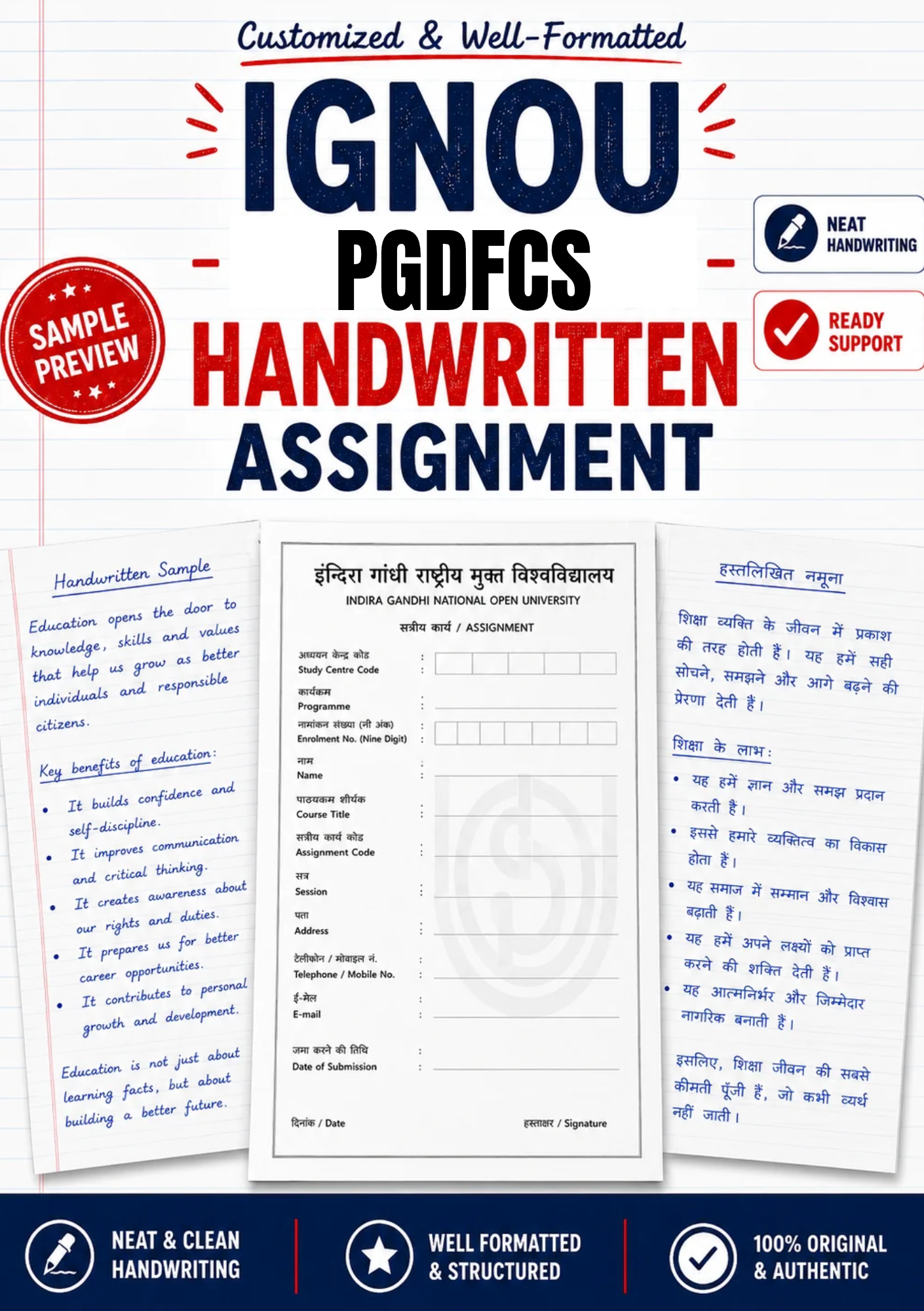
Each bundle is a complete submission kit for one paper. It holds the written answers, set down by hand on A4 sheets in a hand matched to the sample you send. It holds an IGNOU-format front page, filled in with the programme name, the course code, the course title and the assignment code exactly as the paper you are answering prints them, so the fields left for you are your name, enrolment number, address, study centre, date and signature. It holds a copy of the official question paper for that code and session, which most study centres expect to see placed between the front page and the first answer. And it travels inside courier packaging that is already paid for.
No soft copy or PDF is sold. The written sheets are the product, and there is no digital twin of them sitting on a server. That matters on a folklore paper more than on most, because the answers lean on named examples (proverbs, tribal communities, festival forms, ballad traditions) and a learner who intends to read the set before signing it needs the paper in hand, not a file to scroll.
The answer count is fixed by IGNOU, not by the publisher. Every MFC paper read for this page, from the 2023-24 combined booklet to the 2026-27 MFC-001 file, sets five questions and tells you to attempt all of them, each worth 20 marks out of 100. The last question, and on some papers the last two, is broken into four short notes of five marks each. A PGDFCS bundle therefore carries five answered questions, with the short-note items written as four separate notes rather than merged into one essay, because that is how the paper is laid out and how an evaluator reads it.
₹1,280 for the Whole Folklore Diploma, and What Sits Outside That Figure
The rate is ₹320 per subject, hard copy only, with courier included in that price and no separate shipping charge. On PGDFCS that arithmetic is short. Four theory papers carry an assignment, so the most a first-attempt learner can owe is four subjects, and four subjects at ₹320 come to ₹1,280. There is no programme fee on top, no packing line, no surcharge for a 6-credit paper as against an 8-credit one, and no charge for the handwriting match.
There is no minimum order: one subject or fourteen, same rate. A learner who cleared MFC-001 and MFC-002 last cycle and still owes MFC-003 and MFC-004 pays for those two and nothing else. A learner whose admission record unexpectedly lists one of the two second-year folklore codes that IGNOU’s live PGDFCS page now prints, covered in the course section below, pays the same ₹320 for that paper too.
Delivery depends on your pin code and is confirmed for your order before you pay. No figure is promised on this page.
Four things are deliberately outside the rate, and it is better to know them now than to discover them at the counter. The first is anything IGNOU charges: the programme fee, the examination form fee and any late fee are paid to the university, never through this store. The second is the Project Manual course, which carries no Tutor Marked Assignment at all; project material is sold on a separate shelf and priced separately. The third is the act of submission itself, which stays with you, because the front page carries your signature and the study centre receipt is issued in your name. The fourth is any statement about marks, which this page does not make in any form.
A Solved MFC File You Study From, or a Handwritten PGDFCS Set You Sign
Two products are searched for with almost the same words, and folklore learners regularly buy the one they did not need. A solved assignment is a soft-copy reference file of model answers for a course code and session: something you read on a screen, take notes from and then write your own answers out of. A handwritten assignment is the answers written out by hand on A4 and submitted in hard copy at the study centre: the thing that actually goes into the envelope with your front page on top. This page sells only the second. No soft copy or PDF is sold.
| Point being weighed for an MFC paper | Solved MFC reference file | Handwritten PGDFCS set |
|---|---|---|
| Physical form | Soft copy, read on a phone or laptop | Hard copy on A4, written by hand |
| What a learner does with it | Reads it, then writes the paper out personally | Reads it, signs the front page, submits it |
| Who it suits | A learner with the time to write five long answers per paper by hand | A learner who does not have that time across four papers |
| Front page and question paper | Not part of a reference file | Both inside every bundle |
| Price line on this store | Listed per code on the PGDFCS solved shelf | ₹320 per paper, courier included |
Scroll sideways on a small screen to see every column.
The deciding point is what IGNOU itself prints. The 2026-27 MFC-001 paper and the 2025-26 MFC-003 paper both carry the same instruction: “You should write the answer in your own handwriting.” The 2025-26 MFC-004 paper repeats it in its own words: “You should submit the assignment in your own handwriting.” Neither the prospectus nor any MFC paper read for this page offers a typed or printed route. So a downloaded answer file, printed out and stapled behind a front page, is not a PGDFCS submission under the paper’s own terms. A solved file is a reference to write from, and it is honestly useful as one; it is simply not the thing that gets handed in.
If a reference file is what you want, the store keeps one per MFC code on its PGDFCS solved-assignment shelf, listed code by code for the four folklore papers, and that shelf is the right place for anyone searching for model answers rather than for a submission set. Some learners buy both for the same paper, reading the reference file first and then checking the handwritten set against it before signing. That is a reasonable way to work, though it is not required, and it costs more than either on its own.
Owe all four folklore papers, or only the two that slipped last cycle? The arithmetic is the same ₹320 for each one.
₹320 per MFC paper · courier inside the rate · IGNOU-format front page and question paper in every bundle · hand matched from your photo
Message the MFC papers you still need and get the PGDFCS total back
MFC-001 to MFC-004: The Four Folklore Papers That Carry a Tutor Marked Assignment
Section 8.37 of the Common Prospectus July 2026, on pages 293 and 294, sets out the Post Graduate Diploma in Folklore and Culture Studies under the School of Intra-Disciplinary and Trans-Disciplinary Studies, as that section spells it. It names a graduate in any discipline as the eligibility, English as the medium of instruction and five courses of 6 credits each. The table prints the codes without hyphens or leading zeros (MFC 1, MFC 2 and so on), while every assignment paper prints them hyphenated with three digits (MFC-001). They are the same courses. The table below uses the paper form, because that is the form you copy onto a front page.
| MFC code on the paper | Title as section 8.37 prints it | Credits, section 8.37 | Credits, section 3.39 year one | Tutor Marked Assignment |
|---|---|---|---|---|
| MFC-001 | Folklore and Culture: Conceptual Perspectives | 6 | 6 | Yes, MFC-001/TMA-01/2026-27 read for this page |
| MFC-002 | Tradition, Identity and Cultural Production | 6 | 6 | Yes, 2026-27 file posted without a text layer |
| MFC-003 | Cultural and Societal Transformation | 6 | 6 | Yes, MFC-003/TMA-01/2025-26 read for this page |
| MFC-004 | Tribes of India: Identity, Culture and Folklore | 6 | 6 | Yes, MFC-004/TMA-01/2025-26 read for this page |
| MFCI 5 / MFCP 005 | Project Manual | 6 | 8 | No, assessed as a project |
| Total | Five courses | 30 | 32 | Four papers |
Scroll sideways on a small screen to see every column.
The credit arithmetic was checked rather than trusted. Section 8.37 prints five rows at 6 credits each and a footer of 30, and 5 x 6 = 30, so that table is internally consistent. Section 3.39, which sets out the MA in Folklore and Culture Studies on page 93, describes its own first year as “the first year programme being PGDFCS: 32 credits” and prints that year as MFC 001 to MFC 004 at 6 each plus MFCP 005 Project Manual at 8. Four times 6 plus 8 is 32, so that table is internally consistent too. Its second year, MFC 006 to MFC 009 at 8 each, adds another 32, and the stated MAFCS total of 64 checks out. Both tables add up; they simply describe two different diplomas, and the difference is entirely in the project.
That matters for the order in only one way. Whichever table your enrolment followed, the four theory papers are the same four codes at the same 6 credits, and each of them needs one handwritten assignment. The 2 credits that separate 30 from 32 sit inside the Project Manual, which carries no assignment either way. A PGDFCS learner on either structure owes the same four papers.
The titles are worth copying carefully. Three of the four read identically everywhere. The fourth does not: section 8.37 ends MFC 4 with the word “Folklore”, while section 3.39, IGNOU’s live programme page and every MFC-004 paper and examination paper read for this page end it with “Lore”. The paper you are answering is the safer source for the title line on your front page, so a PGDFCS set from this publisher prints “Tribes of India: Identity, Culture and Lore” on the MFC-004 cover, matching the paper in the bundle.
Assignments carry 30 per cent of the final course result and the term-end examination carries the remaining 70 per cent. On a four-paper diploma that weighting is unforgiving, because a missing assignment cannot be recovered by a strong examination script, and every MFC term-end paper seen for this page is set for the full 100 marks with its own choice of questions.
Course 5, MFC-007 and MFC-009: The Three Lines Outside the Four-Paper Order
Three course lines can appear on a PGDFCS learner’s paperwork without belonging in a handwritten assignment order. Each needs a short explanation, because each has caused a wasted message at some point.
| Line outside the four MFC papers | Where it is printed | Credits it carries there | Position on a written order |
|---|---|---|---|
| Project Manual (MFCI 5, MFCP 005, MFC-005, Course 5) | Prospectus 8.37 and 3.39, live page, every MFC booklet letter | 6 or 8 | No assignment exists; project shelf instead |
| MFC-007 Theories and Pedagogy of Folklore | IGNOU live PGDFCS page, labelled Yearly 1; assignment portal row tagged MAFCS, PGDFCS | 8 | Written at ₹320 only if your admission record lists it |
| MFC-009 Approaches to Folklore | IGNOU live PGDFCS page, labelled Yearly 1 | 8 | Written at ₹320 only if your admission record lists it |
Scroll sideways on a small screen to see every column.
The project is the easiest of the three. Every PGDFCS booklet letter read for this page opens the same way: one assignment for each course, “Courses 1-4, Course 5 being a project paper”. The project is assessed as a project, through a synopsis and a report, and it has no Tutor Marked Assignment to write. What is unusual about it is how many names it carries, which the conflict section below sets out in full. For an order, the practical point is simple: do not list it, and if you need project material, the store keeps hard-copy samples on a separate project shelf linked further down.
The two second-year codes are the unusual part of this diploma. IGNOU’s live programme page at ignou.ac.in/schools/programme/PGDFCS, read on 6 November 2026, lists seven course rows for PGDFCS, every one marked “Yearly 1”: the four MFC theory papers, the project as MFCP-005 at 8 credits, and then MFC-007 and MFC-009 at 8 credits each. Neither of those two codes appears in either prospectus table for the diploma. Both are second-year papers of the MA in the prospectus. The listed credits on that live page add up to 48, a figure that matches nothing else IGNOU prints for PGDFCS.
The page cannot settle which of those documents is right for your enrolment, and it does not pretend to. The admission record is the only document that does. If yours lists four MFC papers and a project, the order is four papers. If it also lists MFC-007 or MFC-009, those can be written at the same ₹320 each, against the MAFCS paper that IGNOU issues for them. Shri Chakradhar Publication will not add either code to a quote unless you name it from your own record.
Send the codes on your admission record and ask which ones need a PGDFCS set
One more line belongs here because it explains the 30-credit figure. Section 3.39 adds a note that a 2-credit “Translation of Folklore Coursework” is allotted to students “who completed PGDFCS (with only 30 credits, between 2009 and 2020)” and then join the MA’s second year. Read plainly, that describes the 30-credit diploma as a structure that ran from 2009 to 2020, while section 8.37 of the same prospectus still prints 30 as the current total. Learners who finished under the older structure and now hold a translation requirement are covered in the session section further down.
Twenty-Three Contradictions in the PGDFCS Record, Six of Them In-House
Everything in the box below was found on 6 November 2026 by reading IGNOU’s own PGDFCS documents against one another, then reading this store and its sister site against the same documents. Where a document is quoted, the words are the document’s own. None of the points is resolved here by picking a winner; each is set out so that you can check it against the paper you have actually downloaded and the record you actually hold.
Twenty-three disagreements in the folklore diploma’s paperwork, sixteen inside IGNOU’s own documents, one from a third party and six on this store or its sister site. Read your own paper before relying on any of them, this page included.
1. Three credit totals. Section 8.37 prints 30. Section 3.39 calls PGDFCS the first year of the MA at 32. The seven rows on IGNOU’s live PGDFCS page add up to 48.
2. Two second-year codes on a one-year page. The live page lists MFC-007 and MFC-009 as “Yearly 1” PGDFCS courses. Neither appears in either prospectus table for the diploma; both sit in the MA’s second year.
3. The portal tags two of the wrong papers. On IGNOU’s assignment download service, read earlier on 6 November, the MFC-003 and MFC-007 rows carry the tag “MAFCS, PGDFCS”, while MFC-002 and MFC-004, both core PGDFCS papers, are tagged MAFCS alone. No MFC-001 row appeared in the table as fetched, although the MFC-001 2026-27 file itself is live.
4. Two covers in one session. In 2025-26 the MFC-003 paper is headed “Programme: PGDFCS”, while the MFC-001 and MFC-004 papers of the same session are headed MAFCS. The 2026-27 MFC-001 paper names the MA only. The 2023-24 combined booklet named both.
5. Dates printed on one paper and absent from its neighbours. The 2025-26 MFC-004 paper prints “For the December TEE: 30th September” and “For the June TEE: 31st March”. The 2025-26 MFC-003 paper and the 2026-27 MFC-001 paper print no date and point to the university website.
6. Four December 2026 dates. The booklets’ 30 September, the portal’s 30-10-2026, the extension to 31 October 2026 listed on IGNOU’s notifications page, and a 20 November 2026 date reported by several news sites for online submission that could not be traced to an IGNOU text.
7. Two validity statements on one paper. The 2026-27 MFC-001 cover says “July 2026 & January 2027”; its instructions say the questions “are valid for 2026 and 2027”.
8. Five names for the project. MFCI 5 at 6 credits (section 8.37), MFCP 005 at 8 credits (section 3.39 and the live page), MFC-005 (the 2022-23 MA booklet), “Course 5” with no code (every PGDFCS booklet), and MFCI-005 on this store’s project shelf and the sister site’s project guide.
9. Two durations. The prospectus annexure gives 1 to 3 years; the live page gives 12 to 24 months.
10. Two titles for MFC-004. “Tribes of India: Identity, Culture and Folklore” in section 8.37, against “…Culture and Lore” in section 3.39, on the live page, on every MFC-004 assignment and on the June and December 2025 examination papers.
11. One coordinator, two titles and two numbers. Section 8.37 names Dr. Nandini Sahu on 011-29572780; section 3.39 names Prof. Nandini Sahu on 011-29572785.
12. The school spelled four ways. “Intra-Disciplinary& Trans-Disciplinary” (8.37), “Interdisciplinary and Trans-disciplinary” (3.39), “Inter-Disciplinary and Trans-Disciplinary” (live page) and “Inter-disciplinary and Transdisciplinary” (booklet covers). The 2025-26 MFC-009 file prints “School of Humanities” instead.
13. Diploma papers filed under another degree. The 2024-25 PGDFCS papers, headed “Programme: PGDFCS”, sit in the MA English (MEG) folder on webservices.ignou.ac.in.
14. Two paper sizes. The 2026-27 MFC-001, 2025-26 MFC-003 and 2024-25 MFC-004 papers say “Use only A4 paper size”. The 2025-26 MFC-004 paper says “Use foolscap/A4 size paper”.
15. A misspelt programme line. The inside page of the 2024-25 MFC-004 and 2025-26 MFC-003 papers reads “POST GRADUATE DIPLOMA IN FOLKLORE AND CULTURE STUDES”.
16. A 30-credit total the same prospectus calls historic. Section 3.39 describes the 30-credit PGDFCS as the structure completed “between 2009 and 2020”, while section 8.37 prints 30 as the current total.
17. Third party: a different fee and a different total. A widely indexed college-listing site gives PGDFCS a programme fee of ₹6,500 and 32 credits; the prospectus annexure gives Rs. 7,500 and section 8.37 gives 30.
18. In-house: the MAFCS product says there is no 2026-27 booklet. This store’s MAFCS handwritten page states that no 2026-27 MAFCS paper is posted, but MFC-001/TMA-01/2026-27 is live on ignou.ac.in under the MA’s name.
19. In-house: an expired review date and older dates. The same MAFCS page schedules its next review before 30 September 2026, which has passed, and gives the booklet pair (30 September, 31 March) rather than the portal’s 30-10-2026 and 31-03-2027.
20. In-house: two MFC-004 titles on one store. The MFC-004 book listing uses “Culture and Folklore”; the 2022-23 MFC-004 solved listing uses “Culture and Lore”.
21. In-house: a project code IGNOU’s live page no longer prints. The PGDFCS project shelf files every sample under MFCI-005, while the live page prints MFCP-005.
22. In-house: an empty shelf. The PGDFCS previous-year solved-paper category is live on this store with no products in it.
23. In-house, sister site: no PGDFCS handwritten article. ignouproject.com carries a PGDFCS programme page and two project articles, but no handwritten-assignment article for the diploma, so the link out from this page goes to its MAFCS article, which covers the same four papers.
Three of those points change what you should actually do, and the rest are context. Point 4 means a MAFCS heading on your MFC-001 or MFC-004 paper does not mean you downloaded the wrong file: for PGDFCS learners in 2025-26 and 2026-27, IGNOU is issuing the four theory papers under the MA’s name, and the paper is the same paper. Point 6 decides whether a December 2026 attempt is still open, which the next section works through. Point 14 decides the paper size, and the answer is simpler than it looks: A4 is permitted by every one of the four MFC papers read, including the one that also allows foolscap, so a PGDFCS set from this publisher is written on A4.
30 September, 31 October or 20 November: Fixing the PGDFCS Cut-Off for December 2026 and June 2027
PGDFCS is an awkward diploma to date, because its own papers do not agree on whether to print a date at all. The School’s practice varies paper by paper, which is the opposite of the School of Management Studies, where every booklet carries the same printed pair. Where a date is printed at all, the papers and IGNOU’s own portal do not match. Learners should not borrow 31 October and 30 April from an MBA page, or 31 March and 30 September from a humanities one, and assume it applies here.
| Source read for the PGDFCS date | December 2026 TEE | June 2027 TEE |
|---|---|---|
| 2025-26 MFC-004 paper | 30 September | 31 March |
| 2023-24 PGDFCS and MAFCS combined booklet | 30 September | 31 March |
| 2026-27 MFC-001 and 2025-26 MFC-003 papers | None printed; refers to the university website | None printed |
| IGNOU assignment download service, MFC rows | 30-10-2026 | 31-03-2027 |
| IGNOU notifications page, extension notice | 31 October 2026 | Not covered |
| News sites reporting online submission | 20 November 2026, not traced to an IGNOU text | Not covered |
Scroll sideways on a small screen to see every column.
For the June 2027 term-end examination the sources line up: the portal gives 31-03-2027 and the papers that print a date give 31 March. That is the cut-off a July 2026 entrant, writing the MFC-00N/TMA-01/2026-27 papers, should plan around. It sits close enough to the start of the calendar year that a four-paper order is worth placing well before March, when study centres are at their busiest.
For the December 2026 examination the honest position, on 6 November 2026, is that the date IGNOU itself extended to, 31 October 2026, has passed. Several news sites reported a further window to 20 November 2026 for online submission, but no IGNOU notice carrying that date could be opened for this page, and one outlet flagged it as unverified. A learner hoping to sit MFC papers in December should confirm with the study centre or the Regional Centre, in writing if possible, whether a submission made now will be counted for December 2026 before ordering on that basis. If it will not, the same set can be written for the June 2027 cycle instead, provided it answers the paper valid for that cycle.
Assignments carry 30 per cent of the final course result and the term-end examination carries the remaining 70 per cent. The assignment also has to be in before the examination form for that paper is processed, which is why a missed cut-off usually moves the whole course, not just the assignment, into the next cycle.
One date-related caution applies to everyone. The papers are replaced each cycle. A set written to the 2025-26 MFC-003 questions answers the 2025-26 paper and no other, so a learner who has moved into the 2026-27 cycle needs the 2026-27 paper answered. When you message, name the session printed on the paper you downloaded, not the year you enrolled, and the set is written to that paper.
MFC-003/TMA-01/2025-26, and the Shorter Course Code Line Printed Above It
Every MFC paper read for this page prints two code strings, and learners mix them up. Near the top, under the programme line, sits a course code with a session: “Course Code: MFC-003/2025-26” on the 2025-26 paper, “MFC-001/2026-27” on the 2026-27 one. Further down, in the block that opens the actual questions, sits the assignment code: “Assignment Code : MFC-003/TMA-01/2025-26”. The second string is the one the front page asks for when it says assignment number, and it is the one the study centre uses to file your sheets against the right course and cycle.
Read left to right, the assignment code has four parts. MFC-003 is the course. TMA marks it as a Tutor Marked Assignment, and 01 says it is the first and only one for that course; no MFC paper read for this page carries a TMA-02. The last part is a two-year span, 2025-26 or 2026-27, which is how this School labels a paper that serves the July and January intakes of one cycle. It is not a year of admission and it is not the examination year.
That format is distinct, and worth knowing if you hold papers from more than one programme. SOMS papers print a single year with the session name. Some School of Journalism papers carry no TMA element at all. MFC papers carry a hyphenated course code, TMA-01 and a hyphenated span, every cycle from the 2022-23 MA booklet to the 2026-27 MFC-001 file. A PGDFCS front page from this publisher copies the string exactly as the bundled paper prints it, including the spaces around the colon, which are on the paper and are harmless.
The 2026-27 MFC-001 paper is the most recent text-readable PGDFCS file, and its assignment code is MFC-001/TMA-01/2026-27. The 2026-27 files for MFC-002, MFC-003 and MFC-004 were posted as image-only PDFs that a text reader cannot open, so their codes were not read off the page for this build; on the pattern of every cycle since 2022-23 they would read MFC-002/TMA-01/2026-27 and so on, but that is inference, and the set is written to whatever the file you send actually shows.
Matching a Folklore Learner’s Own Hand, on the A4 Sheet Every MFC Paper Allows
Send a photo of a page you have written yourself and the handwritten set is matched to your handwriting at no extra charge. On PGDFCS the match matters for a practical reason: four papers of five long answers each make a thick stack, and you have to read every page of it before you sign the declaration. A set in a hand that reads as naturally as your own notes is far easier to work through, check and own than one in a stranger’s script.
The writer studies how you form letters, how far apart you space words and lines, how you start a paragraph, how heavily you press, and how you set out a numbered list. Folklore answers lean on lists more than many subjects: functions of folklore, stages of Sanskritization, types of nomads, features of a tribal economy. So the way you number and indent is copied as carefully as the letter shapes.
Paper size follows the MFC papers themselves. Three of the four papers read for this page say “Use only A4 paper size for your assignment and tag all the pages carefully”; the 2025-26 MFC-004 paper allows “foolscap/A4”. A4 satisfies all four, so every PGDFCS set is written on A4 sheets and nothing else. The tagging the papers ask for is done by you when you assemble the front page, question paper and answers in order, which also lets you check every sheet before it is fastened.
Which handwritten page to photograph for an MFC order
Pick a page of continuous prose rather than a form or a few scattered words, ideally one with a heading and a short numbered list on it, because that shows both your running hand and your layout. Photograph it in daylight, flat, from directly above, with the whole page in frame. A page from a college notebook is fine; it does not need to be about folklore. The first matched sample comes back to you before any payment is made, and if it does not look like your writing, say so and it is redone before the order goes further.
English Only, Either Admission Cycle, and MFC Papers Left Over From Earlier Years
The service covers all mediums IGNOU issues the TMA paper in, at the same price. For PGDFCS that is a short list. Section 8.37 gives English as the medium of instruction, section 3.39 gives English for the MA, and every MFC paper read for this page, back to 2022-23, is in English. No Hindi MFC paper surfaced on ignou.ac.in or webservices.ignou.ac.in. A Hindi folklore set is therefore not offered here, because there is no Hindi paper for it to answer, and the page does not invent one.
Any session is accepted, current cycle or older, including backlog courses, at the same ₹320 per subject. Both admission cycles are covered: the prospectus annexure lists PGDFCS for January and July entry, and one MFC paper serves both intakes of a cycle. Older papers are covered too. A learner who enrolled in 2023 and never submitted MFC-004 needs the paper valid for the cycle in which the submission will now be made, which is normally the current one rather than the one from the year of entry; the study centre can confirm which, and the set is written to that paper.
Two groups of earlier learners have particular situations. Learners who completed the 30-credit PGDFCS between 2009 and 2020 and then joined the MA’s second year carry the 2-credit Translation of Folklore Coursework described in section 3.39; that is coursework approved by the Programme Coordinator by email, not a Tutor Marked Assignment, and it is not written here. Learners who completed PGDFCS and moved straight into the MA’s second year owe MFC-006 to MFC-009, which are covered by the MAFCS product linked in the shelves section rather than by this one.
The PGDFCS Order Message: Codes, Cycle, Photo, Address, Medium
A PGDFCS quote needs very little, because there are only four likely papers and no electives to choose between. Five items cover it, and anything beyond them tends to slow the reply.
- The MFC codes still open on your record. MFC-001 to MFC-004, or whichever of them you still owe, plus MFC-007 or MFC-009 only if your admission record lists them.
- The session printed on the paper. 2025-26 or 2026-27, read off the assignment code line, not the year you joined.
- The examination you are aiming at. June 2027 for most learners messaging now; December 2026 only if your study centre has confirmed a late submission will count.
- One photographed page of your own writing. As described in the handwriting section above.
- Where the parcel goes, pin code first. The pin code is what the delivery estimate for your order is based on.
Your enrolment number and study centre code are written onto the front page by you, not sent, so neither needs to go into the message. Medium needs no line of its own on PGDFCS, since English is the only one, but if you are enrolled in the MA and are ordering MFC papers for its first year, say so, because the MA covers are the ones currently in circulation and the front page is filled to match.
Four MFC papers, one photographed page and a pin code: that is a complete PGDFCS order.
₹320 per subject · courier included · one IGNOU-format front page per paper · sample returned before payment
Send a photo of a page you have written yourself and the handwritten set is matched to your handwriting at no extra charge.
Start the folklore diploma order with your codes, cycle and pin code
From Unpacking the Folklore Set to the Study Centre Acknowledgement
The parcel is where your part begins. Open it as soon as it arrives rather than in submission week, because anything that needs correcting is far easier to correct with weeks in hand.
First, count the bundles against your order: one per MFC code, each with a front page on top and the matching question paper behind it. Check that the assignment code on each front page matches the code on the question paper in the same bundle, and that the session on both is the session you named.
Second, read every answer against its question. This is not a formality. You sign the declaration on the assignment cover page, so you should read and review the content before submitting it, and satisfy yourself that it represents your own understanding of the course. On a folklore paper that reading is also good examination preparation: the four MFC term-end papers seen for this page return again and again to the same ground (etiological tales, forest laws and tribal livelihoods, Sanskritization and Westernization, the ethics of folklore preservation, migration and nomadism), and the assignment answers cover much of it.
Third, complete the front page. Add your enrolment number, your name and address, your study centre and the date, and sign it. Then assemble the bundle in the order your study centre asks for. Many centres want the front page first, then a copy of your IGNOU identity card, then the question paper, then the answers; some publish their own checklist, and theirs takes precedence.
Fourth, keep a copy. Every MFC paper read for this page asks for that in its own words, “just in case the one you submitted is lost in transit”, and a phone photograph of each page is enough.
Fifth, submit at your own study centre, not at the Regional Centre unless your study centre tells you to, and ask for an acknowledgement. The 2025-26 MFC-004 paper puts it plainly: take a receipt from your Study Centre when you submit. The submission later shows on IGNOU’s assignment status service, and the marks follow on the grade card once evaluation is complete.
No claim is made about the marks any assignment will receive, about how an evaluator will assess it, or about whether it will be accepted. Assignment evaluation is entirely a matter for IGNOU.
Folklore Shelves on This Store, and the Route Into MAFCS Year Two
A handwritten set covers the 30 per cent, and most PGDFCS learners need help with the 70 per cent as well. The store keeps separate folklore shelves for that, and they do different jobs.
For reading the course itself, the PGDFCS help books condense the four MFC blocks into examination-length guides, and the store also gathers every folklore title in one place on its combined folklore and culture studies book shelf, which is the quicker route if you are comparing the diploma’s books with the MA’s. For examination practice, the diploma-level folklore guess papers for the MFC term-end sittings collect the question themes that keep returning.
For the Project Manual course, which this order does not touch, the store’s hard-copy PGDFCS project samples, filed under the MFCI-005 code are the place to look; note the code difference set out in the conflict box before you copy anything from a sample onto your own synopsis.
For learners continuing into the MA, the store’s MAFCS handwritten listing for the second-year MFC-006 to MFC-009 papers is the companion to this page, priced the same way. The MA’s own book shelf, Master of Arts folklore books for the year after the diploma, covers the second-year blocks, and the MA folklore reference files for MFC-007 and MFC-009 are where those two codes sit if your PGDFCS record lists them.
If you hold papers from a programme other than PGDFCS as well, the full handwritten section covering every IGNOU programme at the same rate lists the other programme products, and the single listing for any course code and any session takes an odd code that has no programme product of its own.
If you would rather write the MFC papers yourself, the sister site’s walk-through of the MFC assignment papers on ignouproject.com covers how each paper is set out and how to approach it. It is written for the MA, but its first-year material concerns the same four papers.
Sixteen Things PGDFCS Learners Ask Before the First Payment
PGDFCS mein kitne assignment jama karne hote hain, chaar ya chhe?
Chaar, for nearly every learner: one each for MFC-001, MFC-002, MFC-003 and MFC-004. The Project Manual has no assignment. IGNOU’s live PGDFCS page also lists MFC-007 and MFC-009, but neither prospectus table for the diploma does, so they are written only if your own admission record shows them.
My 2026-27 MFC-001 paper says MAFCS on the cover. Is it the right paper for PGDFCS?
Very likely yes. The 2026-27 MFC-001 paper names only the MA, and two of the three 2025-26 papers did the same, while the 2025-26 MFC-003 paper was headed PGDFCS. The questions are the same for both programmes. Check the session in the assignment code against the cycle you are submitting for; the programme heading is not the test.
Solved assignment aur handwritten assignment mein PGDFCS ke liye kya farq hai?
A solved assignment is a soft-copy reference file of model answers that you read and then write from. A handwritten assignment is the set written out by hand on A4, with a front page and question paper, ready for you to sign and submit. This page sells only the handwritten set; the solved files sit on the separate PGDFCS solved shelf.
Can a printed copy of a downloaded MFC answer file be handed in?
Not under the paper’s own terms. The 2026-27 MFC-001 and 2025-26 MFC-003 papers say “You should write the answer in your own handwriting”, and no MFC paper read for this page offers a typed or printed option. A printed file can be a reference for writing, not a submission.
Typed PGDFCS assignment chalega ya haath se hi likhna padega?
Haath se. Every MFC paper read for this page asks for your own handwriting, and the 2025-26 MFC-004 paper repeats it as “You should submit the assignment in your own handwriting.” If writing four long papers by hand is the difficulty, that is exactly what the handwritten set is for.
Is it sensible to buy the MFC solved file and the handwritten set for the same paper?
Some learners do, reading the reference file first and checking the written set against it before signing. It is not necessary, because the handwritten set already answers the full paper, and it costs more than either alone. Buy both only if you want a second version to revise from.
What is the last date for the PGDFCS assignment for the June 2027 examination?
31 March 2027 on IGNOU’s assignment download service, and 31 March on the MFC papers that print a June date. Extensions are announced on ignou.ac.in, so check there close to the date, but plan around 31 March.
December 2026 exam ke liye abhi bhi jama kar sakte hain kya?
Only if your study centre confirms it. IGNOU’s own extension for December 2026 ran to 31 October 2026, which has passed. News sites reported online submission open to 20 November 2026, but that date could not be traced to an IGNOU notice for this page. Ask the study centre first; if the answer is no, the set can be written for June 2027 instead.
Does the Project Manual (MFCI 5 or MFCP 005) need an assignment?
No. Every PGDFCS booklet letter says one assignment is due for each of Courses 1 to 4, “Course 5 being a project paper”. The project is assessed through its synopsis and report, and project samples are on a separate shelf.
My admission record shows MFC-007 or MFC-009. Can those be written too?
Yes, at ₹320 each, written to the MA paper IGNOU issues for that code. Those two codes appear on IGNOU’s live PGDFCS page but not in the prospectus tables, so name them only if they are on your own record; they are never added to a PGDFCS quote by default.
Is PGDFCS 30 credits or 32 credits, and does it change what I order?
Section 8.37 prints 30 and section 3.39 prints 32, and both add up correctly; the 2-credit gap is entirely in the Project Manual (6 against 8). The four theory papers are 6 credits each in both, so the order is the same four papers either way.
Is there a Hindi-medium PGDFCS handwritten set?
No, because there is no Hindi PGDFCS paper to answer. The service covers all mediums IGNOU issues the TMA paper in, at the same price. The prospectus gives English as the only medium for the diploma and for the MA, and every MFC paper found was in English.
Should MFC answers go on A4 or foolscap?
A4. Three of the four MFC papers read say “Use only A4 paper size”, and the 2025-26 MFC-004 paper allows “foolscap/A4”. A4 meets all four, so that is what every PGDFCS set is written on.
I finished the 30-credit PGDFCS before 2020 and joined the MA. What do I still owe?
Section 3.39 allots a 2-credit Translation of Folklore Coursework to that group, approved by the Programme Coordinator by email; it is not a Tutor Marked Assignment and is not written here. The MA’s second-year papers, MFC-006 to MFC-009, are covered by the MAFCS handwritten listing.
Purana MFC-004 paper 2024-25 ka bacha hai. Akela order ho sakta hai?
Haan, ek paper bhi chalega. Any session is accepted, current cycle or older, including backlog courses, at the same ₹320 per subject. There is no minimum order: one subject or fourteen, same rate. Check with your study centre whether the submission now has to answer the current cycle’s paper rather than the 2024-25 one, because papers are replaced each cycle, and send the session the study centre names.
Can the publisher say how many marks the PGDFCS set will get?
No. The set is written to answer the paper fully, in a hand matched to your sample, but evaluation is IGNOU’s alone, and no figure, grade or outcome is suggested anywhere on this page.
The Prospectus, Six MFC Booklets and the Publisher’s Terms, Read One at a Time
Three kinds of source sit behind this page, and they carry different authority, so they are kept separate rather than blended into one voice.
Read from the IGNOU Common Prospectus July 2026. The programme entry in section 8.37 (pages 293 and 294): school, eligibility, English medium, the five course codes, titles and credits, the 30-credit total and the coordinator line. The MA entry in section 3.39 (page 93): the description of PGDFCS as a 32-credit first year, the year-one and year-two tables summing to 32 and 32 for a 64-credit MA, the MFCP 005 project at 8 credits, the “Culture and Lore” title and the 2-credit translation note. Annexure row 162: 1 to 3 years, Rs. 7,500, year-wise, January and July. Every credit figure was summed before it was used.
Read from IGNOU’s live files on ignou.ac.in and webservices.ignou.ac.in. The 2026-27 MFC-001 assignment paper, the 2025-26 MFC-003 paper headed PGDFCS and the 2025-26 MFC-004 paper with its printed TEE dates, each opened in full for this page, plus the 2024-25 MFC-004 paper in the MEG folder, the 2023-24 combined booklet and the 2022-23 MA booklet, read in part. The PGDFCS programme page on ignou.ac.in, IGNOU’s assignment download service and its notifications page were read earlier on 6 November 2026; the download service could not be reopened in the final pass, so its dates and tags are as read earlier that day. The 2026-27 MFC-002, MFC-003 and MFC-004 files were posted without a text layer and could not be read.
Fixed by the publisher for every folklore order, and not by the university. The ₹320 rate, the courier inclusion, the contents of each bundle, the handwriting match from a photo, the A4 choice, the absence of any minimum order and the refusal to promise a delivery time or an outcome. These are the publisher’s own commercial terms and nothing on this page attributes them to the university.
Important Notice
Shri Chakradhar Publication Pvt. Ltd. and shrichakradhar.com form an independent IGNOU study-support publisher. This is not the official website of Indira Gandhi National Open University, is not affiliated with, endorsed by or authorised by the university, and no page on this site should be treated as an official IGNOU communication.
Programme structures, course codes, submission dates and rules change, and only ignou.ac.in and your Regional Centre can confirm the current position for your enrolment.
You sign the declaration on the assignment cover page, so you should read and review the content before submitting it, and satisfy yourself that it represents your own understanding of the course.
No claim is made about the marks any assignment will receive, about how an evaluator will assess it, or about whether it will be accepted. Assignment evaluation is entirely a matter for IGNOU.
Tell the Desk Which MFC Papers Are Still Pending
The rate is ₹320 per subject, hard copy only, with courier included in that price and no separate shipping charge. Four folklore papers come to ₹1,280; one paper comes to ₹320.
Ask for a price on the PGDFCS papers still pending
Or send your handwriting photo first and the MFC details after it
WhatsApp +91 93546 37830