

Description
In short. Shri Chakradhar Publication prepares IGNOU PGDET Tutor Marked Assignment answers by hand on A4 sheets for MES 131 Educational Technology: An Overview, MES 132 Computer in Education, MES 133 Selection and Integration of Technology in Educational Processes and MES 134 Design, Development and Delivery of Courseware, the four theory courses of the 32-credit Post Graduate Diploma in Educational Technology, each of which sets three questions to be answered in about 500 words apiece. The rate is ₹320 per subject, hard copy only, with courier included in that price and no separate shipping charge. Learners who enrolled before the January 2021 session and still owe MES-031 to MES-034 are written for at the same rate, the MESP-135 project is not part of this product, and because no 2026 PGDET paper prints a submission date or an assignment code, the cut-off for your term-end examination has to be read from IGNOU’s notice for that cycle rather than from the sheet itself.
Opening a PGDET Parcel: Answer Sheets, a Cover Page and the MES Question Sheet
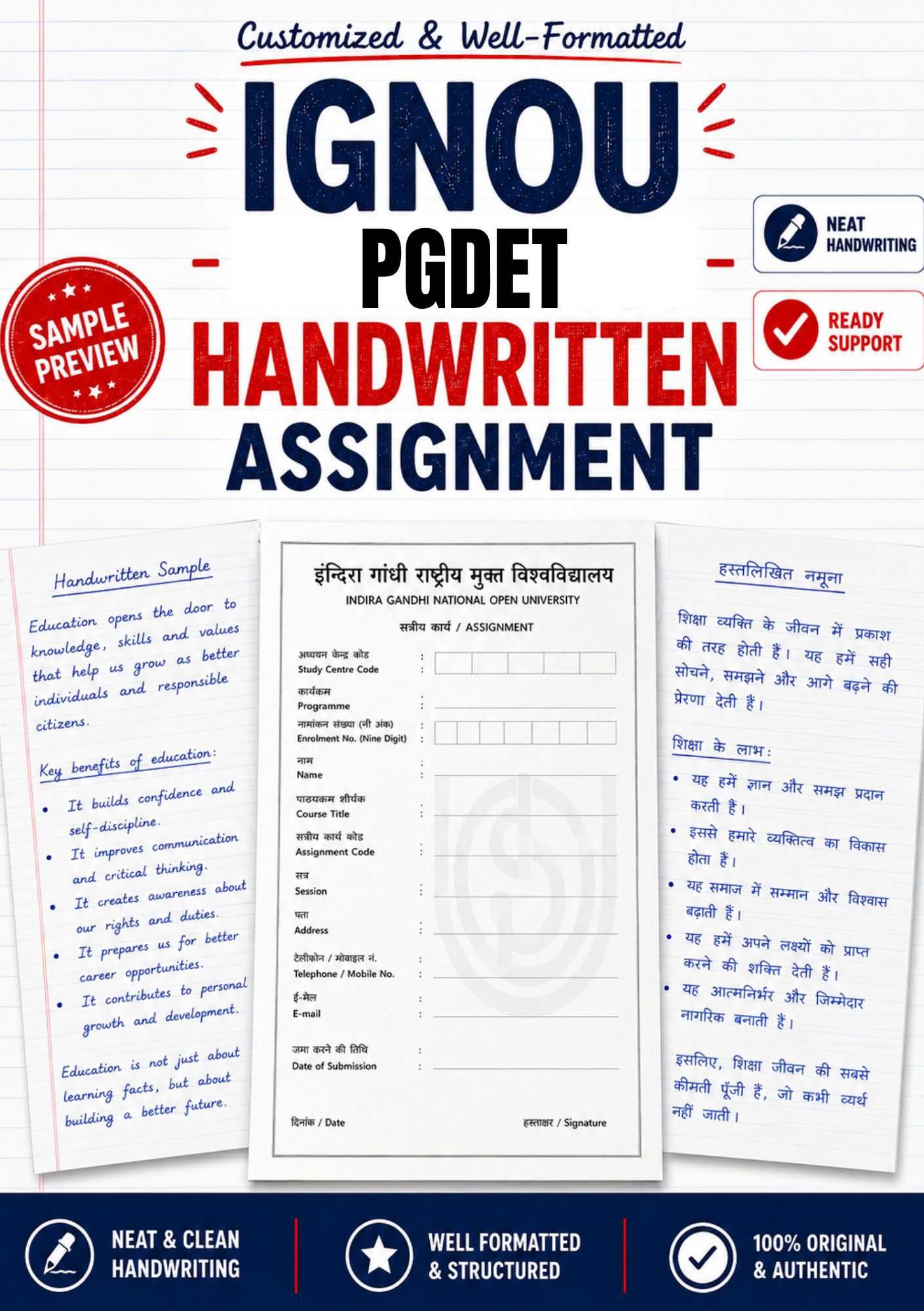
A PGDET order is delivered as paper. For every MES course number you order, the envelope carries the three answers written out by hand on A4 sheets, an IGNOU-format front page filled in with your details at no charge, and a printed copy of the official question sheet for that course, so that you can lay each answer beside the question it responds to before you sign anything. No soft copy or PDF is sold. Nothing is emailed or shared on WhatsApp as a file, and no download link follows the parcel.
The question sheet that travels with a PGDET order is the one IGNOU files under the PGDET cover, not one of the sister editions. That distinction matters more on this diploma than on most. In the January and July 2026 cycle the School of Education published the same MES 131 questions three times: once under a cover reading Post Graduate Diploma in Educational Technology (PGDET), once under a cover reading Master of Arts (Education), Second Year, and once under a cover reading Master of Arts in Adult Education (MAAE), 2nd Year. The questions are word for word the same across all three, but a PGDET learner who hands in a front page that copies the programme name off a MAEDU or MAAE download is creating a mismatch the study centre may query. The copy in the packet therefore carries the PGDET heading.
Each 2026 PGDET paper asks for three answers of about 500 words, so a full set of four courses is twelve long answers and roughly 6,000 words of handwriting. The answers are laid out the way the PGDET programme guide asks a response to be laid out: A4 paper, a clear left margin, and visible space between one answer and the next. The front page sits on top of each course, and the courses are kept separate so that MES 131 can be handed over without disturbing MES 133 if you submit in two visits.
What ₹320 Pays For on MES 131 to MES 134, and Why MESP-135 Sits Outside It
One PGDET course number, answered in full, is one subject. The rate is ₹320 per subject, hard copy only, with courier included in that price and no separate shipping charge. There is no minimum order: one subject or fourteen, same rate. A PGDET learner on the current scheme owes at most four written assignments, so ordering MES 131, MES 132, MES 133 and MES 134 together comes to four times ₹320, which is ₹1,280, and ordering only the one paper still outstanding is charged at the single rate. All four MES theory courses carry six credits, so there is no question of a heavier course costing more.
The figure covers the writing of the three answers, the free front page, the copy of the question sheet, packing and courier to your pin code. Delivery depends on your pin code and is confirmed for your order before you pay. No figure is promised on this page.
Three things remain outside it. The first is MESP-135, the eight-credit project. According to the PGDET programme guide, the project report is submitted at the Regional Centre where admission was taken and is followed by a viva-voce held at the same Regional Centre, which makes it a different kind of task from a three-question assignment and a different product entirely. The second is anything paid to IGNOU: the programme fee, the term-end examination form and any re-registration fee are matters between you and the university. The third is the act of submission itself. The study centre counter, the acknowledgement and the declaration on the cover are yours, and the set is written for you to read, check and hand in, not handed in on your behalf.
The arithmetic shows why the project matters. PGDET totals 32 credits in the Common Prospectus July 2026: four MES courses of six credits each, which is 24, plus MESP-135 at 8. Exactly three quarters of the diploma is carried by courses that set a written assignment. The remaining quarter is settled by the project report and the viva, and no assignment set from any publisher can stand in for either.
Typed Printout, Reference File or Your Own Hand: Three PGDET Routes Compared
PGDET learners searching for help usually meet two products with similar names and do not always meet a third possibility that their own programme guide opens. Each one is defined here on first mention so that the comparison is clear.
A solved assignment is a soft-copy reference file of model answers for a course code and session, sold or shared as a PDF, meant to be read and learned from. A handwritten assignment is the answers written out by hand on A4 and submitted in hard copy at the study centre, which is what this product is. And on PGDET specifically there is a third route: a typed printout of your own answers. The PGDET programme guide, dated January 2020 and still the guide IGNOU publishes for the diploma, says in its list of assignment instructions that you “may write /word process assignments and submit the print out”. That sentence is unusual in the School of Education. Most learners assume handwriting is mandatory on every IGNOU programme, and on several programmes it is, but the PGDET guide does not say so, and none of the four 2026 PGDET question sheets states a format at all.
| Aspect a PGDET learner checks | Reference file of model answers | Printout of answers you typed yourself | Handwritten set from this desk |
|---|---|---|---|
| Physical form | Soft copy on a phone or laptop | A4 printout you produce at home or a shop | A4 sheets written by hand, couriered to you |
| What you do with it | Read it, learn from it, then write your own response | Submit it to the programme in-charge, as the 2020 guide allows | Read it, review it, sign the declaration and submit it |
| Whose words appear on the page | The file’s author | Yours | Written for you to review and adopt before signing |
| Who it suits | Learners writing their own answers who want a model to compare against | Learners with time to draft 6,000 words and a study centre that accepts printouts | Learners who prefer a handwritten submission or whose study centre asks for one |
| Price line on this store | Sold separately on the solved shelf, where stocked | No cost from this store | ₹320 per subject, courier included |
On a narrow screen, swipe the table sideways to see all four columns.
The honest scoping follows from the definitions. A solved assignment is a reference to write from; it is not a submission, and a downloaded PDF should never be printed and handed in as if it were your response, because the declaration you sign on the cover says the work represents your own understanding. The PGDET guide’s own instruction points the same way, asking that answers be in your own words rather than reproduced from the study material or other sources.
For a handwritten set the position on PGDET is equally plain: it is a preference, not a requirement imposed by the 2020 guide. Some learners choose it because they want their submission to look like the rest of their written coursework, some because their study centre has asked for handwritten responses, and some because they would rather review and sign a finished set than draft one. If your study centre accepts printouts and you have the time to type twelve answers, the third column costs nothing. Ask the programme in-charge before you decide, since practice at the counter can differ from the wording of a guide printed in 2020. If what you want is the reference file rather than a written set, the PGDET solved-assignment shelf, which at present holds only older Hindi files is the place that query belongs, and its current contents are described honestly in the conflict list further down.
Ready to hand over the writing on your MES papers?
The rate is ₹320 per subject, hard copy only, with courier included in that price and no separate shipping charge.
MES 131 to MES 134: Every Theory Code in the Revised PGDET Scheme
The Common Prospectus July 2026 prints PGDET in section 8.15, under the School of Education, as five courses and 32 credits. The four MES courses are compulsory, there are no electives, and there is no laboratory course. The table below reproduces each code and title exactly as the prospectus prints them, alongside the title the 2026 PGDET question sheet carries, because the two do not always agree.
| Course number in the prospectus | Title as the PGDET table prints it | Title on the 2026 PGDET cover | Credit value | Three-question paper in 2026 |
|---|---|---|---|---|
| MES 131 | Educational Technology: An Overview | Educational Technology: An Overview | 6 | Yes |
| MES 132 | Computer in Education | Computer in Education | 6 | Yes |
| MES 133 | Selection and Intergration of Technology in Educational Processes | Selection and Integration of Technology in Educational Processes | 6 | Yes |
| MES 134 | Design, Development and Delivery of Courseware | Design, Development and Delivery of Courseware | 6 | Yes |
| MESP135 | Project | No question sheet issued | 8 | No |
Swipe sideways on a phone. The credit column sums to 6 + 6 + 6 + 6 + 8 = 32, which matches the total the prospectus states.
The credit check was run before the table was trusted, because extraction from the prospectus can bleed one programme’s rows into another’s. Here the PGDET block is short and self-contained, the MAEDU Educational Technology stream on page 87 prints the same four MES titles at the same six credits, and the PGDET programme guide repeats the five-course, 32-credit framework with three blocks per theory course and one for the project.
Knowing what each 2026 paper actually asks is more useful than knowing its title, so the questions are summarised here in plain words. The MES 131 paper asks you to discuss the ethical and health side of technology use in education, to explain what cognitivism implies for technology-mediated learning, and to describe how ICT can support the professional development of teachers, naming a few tools and platforms. The MES 132 paper asks how ICT is used in inclusive classrooms, how software installed on a computer can be protected, and what you would put into a presentation for secondary school students on securing digital data and protecting their privacy online. The MES 133 paper asks what interactivity means in educational communication and what its levels are, what Open Educational Resources are and how they are created and shared, and how you would use ICT in teaching and assessment for a topic you choose. The MES 134 paper asks you to define learning design with an example, to discuss the teaching potential of audio and video programmes, and to write a short piece of self-learning material with a marked introduction, main body and conclusion.
Two of those twelve questions are not essays in the ordinary sense. The MES 132 presentation outline and the MES 134 self-learning material are production tasks, and they read more clearly when the handwriting carries headings, numbered points and white space rather than continuous paragraphs. They are written that way in the set, which is one reason the sample photo described further down asks for a page with some structure on it.
The questions change from cycle to cycle, so a set written to one year’s paper is not a set for another year. The 2024 Second Year MAEDU booklet, which carried the same four courses, asked MES 133 learners about the SECTIONS model of technology selection, the Technology Integration Matrix and five technology plans, and asked MES 134 learners to compare blended and flipped learning and to script an audio programme. None of those questions survives into 2026. An order is written to the question sheet of the cycle you name, which is why the cycle is one of the details asked for at the start.
The Pre-2021 MES-031 Series and the MESP-135 Project
PGDET has been taught under two sets of course numbers, and both are still visible on IGNOU’s own servers. The older set uses MES-031 to MES-034. IGNOU’s 2022 PGDET booklet for it is headed for those enrolled before the January 2021 session, which places the switch to MES 131 to MES 134 at that intake. The older titles are not simply renumbered versions of the new ones, as the table shows.
| Earlier course number | Title as the 2022 PGDET booklet prints it | Closest revised course by subject | Still visible on IGNOU servers |
|---|---|---|---|
| MES-031 | ET: An Overview | MES 131 | 2022 booklet; June 2025 term-end paper listed |
| MES-032 | Communication and Information Technology | No direct equivalent title | 2022 booklet; December 2025 term-end paper listed |
| MES-033 | Computer Technology | MES 132 Computer in Education | June 2026 term-end paper headed MAEDU/PGDET |
| MES-034 | Designing Courseware | MES 134 | 2022 booklet; 2024 MAEDU Second Year booklet |
| MESP-135 | Project (revised scheme) | Not an assignment course | Programme guide; project manual route |
Swipe sideways on a phone to read the last column.
The older codes are not historical curiosities. IGNOU’s June 2026 term-end paper for MES-033 is still printed under the heading Master of Arts (Education)/P.G. Diploma in Educational Technology, and the consolidated MAEDU Second Year booklet for January and July 2024 carried the MES-031 to MES-034 assignments alongside the revised MES 131 to MES 134 set. A learner who enrolled in 2019 or 2020 and paused can therefore still hold an MES-033 assignment that has to be submitted before the related examination. Those papers are written at the same rate as the current ones, to the question sheet IGNOU issued for the cycle in which you are submitting, and the order needs to say which scheme your admission record follows.
Two cautions apply. A matching title is not a matching paper: MES-031 and MES 131 share a subject, but the questions set under each number are different documents and the front page has to carry the number on your record, not the one that looks more recent. And the store’s own older listings use both series loosely, which is covered in the conflict list below.
The project course works on a different footing altogether. The prospectus notes against MESP135 that a guide for the project and the synopsis submission are not required and that the instructions in the project manual should be followed. The programme guide adds that the report goes to the Regional Centre where you were admitted and that a viva-voce is held there. Help with that report sits on the bound MESP-135 project shelf, prepared as a hard copy rather than in this product, and the editorial side of the business keeps a longer walk-through in its ignouproject.com article on the PGDET project for MESP 135.
Where the PGDET Programme Guide, Prospectus and 2026 Papers Part Company
The facts on this page come from reading IGNOU’s PGDET documents against one another rather than from any list already circulating online. Read that way, they disagree in a number of places, and some of the disagreements change what you should do. The store’s own pages are included, because a publisher that lists only other people’s errors is not giving you the whole picture.
Nineteen points where the PGDET paperwork does not line up, fourteen of them in IGNOU’s own documents and five on this store or its sister site.
1. The PGDET programme guide allows a word-processed printout of your assignment. The four 2026 PGDET question sheets say nothing about format, and this store’s handwritten hub page writes as if handwriting were the norm. Ask your study centre which it accepts before you choose.
2. One MES 131 paper, three covers. The January and July 2026 MES 131 questions appear under a PGDET cover, under a Master of Arts (Education) Second Year cover and under a Master of Arts in Adult Education 2nd Year cover. The questions are identical. Only the PGDET edition names your programme.
3. The same pattern holds for MES 132, MES 133 and MES 134. IGNOU publishes each course twice for 2026: a file with no year in its name under the PGDET cover and a file ending in 2026 under the MAEDU Second Year cover.
4. Where the response is handed in is worded three ways. The PGDET guide sends it to the programme in-charge of the concerned study centre, the MAAE edition of the same MES 131 paper sends it to the allotted Learner Support Centre by hand, registered post or speed post, and the 2024 MAEDU booklet allows hand delivery or registered post to the Programme-in-Charge of the Programme Study Centre.
5. The fee is printed two ways. The PGDET programme guide states Rs. 6,600, noting that it can be revised. The prospectus annexure lists Rs. 6,800 for the same programme.
6. Eligibility is worded two ways inside one prospectus. Section 8.15 asks for graduation in any discipline; the annexure row asks for graduation from a recognized university.
7. MES 133 is spelt two ways. The prospectus prints “Intergration” in both the PGDET table and the MAEDU Educational Technology stream; the programme guide and the 2026 question sheet print Integration.
8. The course numbers are punctuated three ways. The prospectus spaces the theory codes (MES 131) but closes up the project (MESP135); the programme guide hyphenates both (MES-131, MESP-135); the 2026 covers print MES 131 followed by a colon.
9. Annexure I(a) of the prospectus, which lists the MAEDU specialisation streams, still prints the Educational Technology stream as MES31 to MES34, while the MAEDU programme table on page 87 prints MES 131 to MES 134. An applicant reading the annexure sees the retired numbering.
10. The changeover date sits awkwardly with the guide’s date. The 2022 booklet for MES-031 to MES-034 applies to learners enrolled before the January 2021 session, yet the programme guide that already lists MES-131 to MES-134 is dated January 2020.
11. Retired codes are still examined. The June 2026 term-end paper for MES-033 Computer Technology is printed under a Master of Arts (Education)/P.G. Diploma in Educational Technology heading.
12. The guide asks you to submit “by the specified date”, but none of the four 2026 PGDET question sheets specifies one, and neither does the guide.
13. No 2026 PGDET sheet prints an assignment code or a mark split. The MAAE edition of MES 131 labels itself Assignment: 01, and the 2022 MAEDU Educational Technology booklet printed MES 131 / ASSIGNMENT 01, but the PGDET edition carries only the course number, title and session line.
14. The project is described two ways. The prospectus says no guide and no synopsis submission are required for MESP135; the programme guide says the report is submitted at the Regional Centre of admission and is followed by a viva-voce there.
15. In-house: this store’s PGDET solved-assignment shelf holds eight products, all of them 2023 Hindi files, four of them for MES 31 to MES 34 from the earlier scheme and four for MES 41 to MES 44, which are Educational Management codes and not PGDET courses at all. It holds nothing for MES 131 to MES 134, and PGDET itself is an English-medium programme.
16. In-house: Hindi guess papers and books for MES 131 to MES 134 are listed with PGDET in their titles, although the prospectus and the programme guide both record English as the only medium of instruction. No Hindi PGDET question sheet was found on ignou.ac.in on 15 October 2026.
17. In-house: PGDET books are split across two shelves, one under the diplomas books section with 14 products and a second, smaller one under a near-identical diploma books section with 4.
18. Sister site: the ignouproject.com article on the PGDET project carries MES 035, the project number of the earlier scheme, in its URL and tags, while its text correctly uses MESP-135, and a reply in its comment thread gives a contact number that is not this store’s WhatsApp line. The store’s handwritten hub also describes its sets as study reference material not for submission, which contradicts the product pages, including this one, that are written for submission after your review.
19. In-house: the MA Education handwritten product on this store pairs the title Computer Technology with MES 032. IGNOU’s 2022 PGDET booklet and its June 2026 term-end paper both give Computer Technology as MES-033; MES-032 is Communication and Information Technology.
Point 1 is the one that changes a decision, and it has been placed first for that reason. Points 2 and 3 change what goes on your front page. Points 9 to 11 matter only if your enrolment predates January 2021, but for those learners they decide which question sheet applies. The in-house points have been passed to the store’s owner for correction; until they are fixed, this page is the reliable statement of what the PGDET shelf does and does not hold.
Your PGDET Due Date Comes From the Term-End Cycle, Not From the Paper
Many IGNOU schools print two cut-off dates on the front of an assignment booklet, one for each admission intake. The School of Education does not do that for PGDET. The 2026 MES 131, MES 132, MES 133 and MES 134 sheets carry a single session line, “Assignments- January & July 2026”, and no date anywhere. The 2022 booklet for the earlier codes is the same. The programme guide is no more specific: it tells you to submit by the specified date, says a deadline falling on a holiday moves to the next working day, and gives no calendar date of its own.
In practice the due date is set by the term-end examination you intend to sit, and IGNOU announces it for each examination cycle. Three rules from the programme guide make that announcement important to a PGDET learner. Submitting assignments within the due date is a pre-requisite for appearing in the term-end examination. Assignments received after the due date are rejected. And a learner who misses the date has to submit the assignment of the current academic year rather than the one originally set, which is why a late order has to be written to the newer question sheet.
For the December 2026 term-end examination, news reports published on 2 October 2026 state that IGNOU extended assignment submission to 31 October 2026, citing a university notice without identifying it. Treat that date as reported, not confirmed by this page, and check it on ignou.ac.in or with your study centre before relying on it. The date is real and it is close, which is the only kind of urgency this page will mention. Whether a handwritten set can reach you before it depends on your pin code, and that is confirmed for your order before you pay rather than estimated here.
The same 2026 paper serves both intakes. A learner admitted in January 2026 and one admitted in July 2026 answer identical questions; what differs is which examination each is preparing for and therefore which announced date applies. When the next cycle’s sheets are released, they replace these, and an order placed after that point is written to the new questions.
The weighting behind all this is IGNOU’s usual one, and the PGDET guide states it directly. Assignments carry 30 per cent of the final course result and the term-end examination carries the remaining 70 per cent. The guide also requires at least a D grade in the assignment and in the examination separately, with an overall average of at least C, so a missing assignment cannot be made up by a strong examination script.
Identifying an MES Paper When IGNOU Prints Course Number and Session Only
Learners from other schools expect a reference such as a course code followed by TMA and a year, and they look for it on the PGDET sheet before filling in the front page. On the 2026 PGDET papers it is not there. The heading block gives the university, the School of Education, the programme name, the session line and the course number with its title, and then goes straight to the instruction to answer in about 500 words each.
That leaves the front page to do the identifying. On a PGDET cover the useful entries are the programme name exactly as the PGDET edition prints it, the course number as it appears on your admission record, the course title as printed on the question sheet, the session you were set (January 2026 or July 2026), your enrolment number, your study centre code and your address. If your study centre’s own cover format asks for an assignment number, the programme guide says each theory course has one assignment, and IGNOU’s sister editions of the same paper label it 01. Do not construct a TMA code that IGNOU has not printed, such as adding a year and the letters TMA after the course number. A reference invented to fill a box is harder to defend than an honest blank, and the free front page in the packet is completed from the details you supply rather than from a guess.
Two small points prevent most mistakes. Copy MES 133’s title with the correct spelling, Integration, because the misspelling in the prospectus has spread to some third-party lists. And if your download is headed Master of Arts (Education) or Master of Arts in Adult Education, keep the questions but take the programme name from your own admission record, which for this diploma reads PGDET.
Lesson Plans, Outlines and Your Own Letterforms in One PGDET Set
Send a photo of a page you have written yourself and the handwritten set is matched to your handwriting at no extra charge. The writer works from that photo for every course in the order, so MES 131 and MES 134 come back in the same hand rather than in two styles that would stand out side by side on the counter.
Matching is a practical matter of slant, letter size, spacing, the way you form a few distinctive letters, and the way you number and underline. It is not forgery of a signature, and the declaration on each cover is signed by you. The aim is that the pages you submit look like the rest of your own written work, which matters to a learner who is choosing handwriting over the printout the PGDET guide would allow.
PGDET answers lean on structure more than many diplomas do. Teachers and trainers writing about OERs, learning design or a data-privacy presentation naturally reach for numbered steps, short headings and the occasional boxed list, and the MES 134 self-learning material task asks for labelled sections by design. The set reproduces those features in your style, so a sample that shows how you number points is worth more than a page of unbroken prose.
Choosing a notebook page that shows your numbering and underlining
One page is enough. Choose one written in the pen you normally use, on lined or plain paper, photographed flat in daylight so that the whole page is in focus and nothing is cut off at the edges. A page from a lesson plan, class notes or a filled form works well because it usually shows headings, numbered points and underlining together. Avoid a page written specially for the photo, which tends to be neater than your everyday hand, and avoid a page crowded with someone else’s corrections. The sample is shared before payment, so you can see how the writing will look before you commit to anything. Share one photographed page with the PGDET desk and see the matched hand first.
English Only, Revised or Earlier Codes, Any Cycle Since Enrolment
The service covers all mediums IGNOU issues the TMA paper in, at the same price. For PGDET that means English. The prospectus records English as the medium of instruction, the programme guide says the same, and no Hindi PGDET question sheet could be located on ignou.ac.in on 15 October 2026. Hindi study material for the same MES numbers exists in the wider MAEDU catalogue, but that is a different programme’s arrangement, and a PGDET order is written in English unless IGNOU has issued you a Hindi sheet you can show.
Any session is accepted, current cycle or older, including backlog courses, at the same ₹320 per subject. On this diploma, backlog work falls into two groups. The first is a revised-scheme learner who did not submit MES 131 to MES 134 in time and must now answer the current year’s paper, as the programme guide requires. The second is a learner who enrolled before January 2021 and still owes MES-031, MES-032, MES-033 or MES-034, for whom the question sheet IGNOU issued for those codes in the cycle you are submitting for is the right one. In both cases the order is written to the sheet you will actually hand in, and the packet includes a copy of it.
The maximum duration of PGDET is three years in the prospectus and in the guide, so a learner admitted in July 2024 still has time to clear outstanding courses, and the guide notes that courses already passed need not be repeated. Courses close; the price does not change with them.
Course Numbers, Cycle, Cover Details, Pin Code, Photo: The PGDET Checklist
An order needs no form, account or upload beyond a WhatsApp message. Five details are enough to quote and begin.
- The course numbers you owe, as they appear on your admission record: MES 131 to MES 134 under the revised scheme, or MES-031 to MES-034 if you enrolled before January 2021.
- The cycle, meaning your admission session and the term-end examination you are submitting for, so the right question sheet is used.
- The cover details: your name, enrolment number, study centre code and address, which go on the free front page.
- Your pin code, so the courier route can be confirmed for your order before you pay.
- One photo of a page in your own hand, chosen as described above.
Nothing else is needed. You do not have to send the question sheet, since the PGDET edition is already on file and a copy travels with the set. You do not have to send your study material. If you are unsure whether your record shows the revised or the earlier course numbers, a photo of the relevant line of your admission or fee receipt settles it.
Five details, one message, and the PGDET quote comes back.
The rate is ₹320 per subject, hard copy only, with courier included in that price and no separate shipping charge. There is no minimum order: one subject or fourteen, same rate.
Between the Courier Envelope and the Study Centre’s Acknowledgement
When the envelope arrives, check it course by course before anything else. Each MES number should have its front page, its question sheet and three answers in the order the questions are set. Read each answer against its question. You sign the declaration on the assignment cover page, so you should read and review the content before submitting it, and satisfy yourself that it represents your own understanding of the course. If anything needs correcting, say so on WhatsApp before you submit.
Then follow the route your study centre uses. The PGDET guide sends responses to the programme in-charge of the study centre assigned to you, by the specified date, and asks you to keep a copy of everything you submit. A photocopy or clear photographs of each set, together with whatever acknowledgement the counter gives you, is the record that resolves any later query about whether a paper was received. If you submit by post, as IGNOU’s sister booklets for the same courses allow, keep the postal receipt with the copies.
After submission, the marks for the assignment component appear on IGNOU’s own records in due course and are combined with the term-end result under the 30 and 70 weighting described above. No claim is made about the marks any assignment will receive, about how an evaluator will assess it, or about whether it will be accepted. Assignment evaluation is entirely a matter for IGNOU. The project, if you are completing it in the same cycle, goes separately to your Regional Centre as described in the programme guide.
Other PGDET Shelves on the Store, Including One That Holds the Wrong Codes
A PGDET learner rarely needs only a written set, so the related shelves on this store are listed here with an honest note on each. The broadest is the PGDET study guides arranged by MES number, which carries the help books for MES 131 to MES 134 and some of the earlier-scheme titles, and is the right starting point for examination preparation.
For revision against the term-end paper there are educational technology guess papers built around likely MES questions and a small set of worked PGDET term-end papers from earlier sittings. The PGDET solved-assignment shelf mentioned above is the one this heading refers to: as of 15 October 2026 it holds 2023 Hindi files for the earlier MES 31 to MES 34 series and four Educational Management codes that are not part of PGDET, so it should not be relied on for MES 131 to MES 134 until it is restocked.
Learners who move on from PGDET often do so into a master’s degree in the same school. Because the prospectus bars a PGDET holder from choosing Educational Technology again as the MAEDU specialisation, the written-set product for the MA Education degree and its other four streams is the relevant next page for that route. MES 131 also sits in the second year of the MA in Adult Education as a compulsory course, and the MAAE handwritten product, which carries the same MES 131 paper under an adult-education cover serves those learners. A learner on the sister diploma in educational management will find the PGDEMA written set for MES-041 to MES-044 and its electives on its own page.
If your code list mixes programmes, or your cycle is unusual enough that no programme page fits, the open order for any IGNOU code and any session takes it at the same rate. Every programme the desk writes for is gathered on the store’s main handwritten assignment listing. And if you decide to write your own answers after all, whether by hand or as the printout the PGDET guide allows, the publisher’s editorial site has a walk-through for preparing an IGNOU assignment yourself.
What Educational Technology Learners Want Settled Before Paying
PGDET assignment typed karke print nikal kar jama kar sakte hain kya?
The PGDET programme guide, dated January 2020, says you may write or word-process your assignments and submit the printout, and the four 2026 PGDET question sheets set no format rule. So on the wording of IGNOU’s own guide, a printout of answers you typed yourself is permitted. Practice at individual study centres can differ, so confirm with your programme in-charge before choosing. A handwritten set is for learners who prefer handwriting or whose centre asks for it.
If the guide allows a printout, why would a PGDET learner order a handwritten set at all?
Because the question is not only about format. Typing twelve answers of about 500 words each still means drafting about 6,000 words across MES 131 to MES 134, and some learners would rather review and sign a finished set in their own style than draft from scratch. Others have been told by their study centre to submit handwritten responses. If neither applies and you have the time, writing and printing your own answers costs nothing, and this page says so plainly.
Can an MES 131 solved assignment file be printed and handed in as my PGDET response?
No. A solved assignment is a reference file of model answers, not your response, and the PGDET guide asks that answers be in your own words rather than reproduced from other sources. Printing someone else’s file and signing the declaration on top of it is the one route this page advises against without qualification. Use a reference file to learn from, then write or review your own response.
MES 132 ki solved file aur likha hua set: in dono mein se study centre par kya jata hai?
Only the response you sign goes to the study centre. The solved file stays with you as reading material. The written set, once you have read it, checked it against the question sheet and satisfied yourself that it represents your understanding, is what you hand to the programme in-charge with its front page. The difference is not paper versus screen but reference versus submission.
One MES 131 download is headed MAEDU and another MAAE. Which cover belongs to a PGDET learner?
Neither. IGNOU published the 2026 MES 131 questions under three covers: PGDET, MA (Education) Second Year and MA in Adult Education 2nd Year. The questions are the same in all three, so your answers do not change, but your front page should carry PGDET, the programme on your admission record. The question sheet included with this order is the PGDET edition.
When is the PGDET assignment due for the December 2026 term-end examination?
No PGDET paper prints a date, so the due date comes from IGNOU’s announcement for the examination. News reports dated 2 October 2026 say submission for the December 2026 term-end examination was extended to 31 October 2026. Treat that as reported until you have checked it on ignou.ac.in or with your study centre, and remember that late submissions have to be made against the current year’s paper.
There is no TMA code anywhere on my MES 133 sheet. What goes on the front page?
Use what IGNOU does print: the programme name PGDET, the course number MES 133, the title Selection and Integration of Technology in Educational Processes, and the session January 2026 or July 2026. If your centre’s format asks for an assignment number, the guide sets one assignment per course and IGNOU’s sister editions label it 01. Do not invent a TMA code IGNOU has not printed.
I enrolled in 2020 and my record still shows MES-033. Is that covered by this order?
Yes. MES-031 to MES-034 belong to the scheme for learners enrolled before the January 2021 session, and IGNOU still sets examination papers for MES-033 under the MAEDU/PGDET heading in June 2026. The set is written to the question sheet issued for that code in the cycle you are submitting for, at the same ₹320 per subject. State on the order that your record follows the earlier scheme.
Does this order include the MESP-135 project report?
No. MESP-135 carries eight credits but no question sheet. The programme guide sends the report to the Regional Centre where you were admitted and follows it with a viva-voce there, which is a different task from a three-question assignment. Project help is on the separate MESP-135 hard-copy shelf linked from this page.
How much writing is one MES paper, and how does that grow for all four?
Each 2026 PGDET paper sets three questions at about 500 words each, so one course is roughly 1,500 words and the four revised courses together come to about 6,000. The MES 132 presentation outline and the MES 134 self-learning material are laid out with headings and numbered points, so they take more space on the page than their word count suggests.
The store sells Hindi MES 131 books. Is there a Hindi PGDET question sheet?
None was found. The prospectus and the PGDET guide both give English as the medium of instruction, and no Hindi PGDET sheet was located on ignou.ac.in on 15 October 2026. The Hindi titles on the store belong to the wider MAEDU catalogue and are labelled loosely, which is listed among the in-house corrections on this page. If IGNOU has issued you a Hindi sheet, send a photo and it can be written in Hindi at the same price.
If I finish PGDET and join MAEDU later, can MES 131 to MES 134 count again?
The prospectus says the opposite about specialisation choice: a learner who already holds the PG Diploma in Educational Technology must choose one of the other four MAEDU specialised areas, which are Higher Education, Distance Education, Educational Management and Adult Education. It prints no credit-transfer note for PGDET into MAEDU, and this page does not assert one. Ask the School of Education before relying on any transfer.
Does the PGDET guide’s A4 rule say anything about margins and spacing?
Yes. It asks for A4 paper of good quality, a left margin of 2 to 3 inches and at least four lines left between answers. The set is laid out on A4 to that instruction. The guide does not specify ruled or plain sheets or an ink colour, and none of the 2026 question sheets adds anything on presentation.
Does anything have to be paid before the PGDET handwriting sample is shown?
No. The sample, written from the photo you send, is shown on WhatsApp first, and payment follows only once you are content with it and the courier route to your pin code has been confirmed. Nothing on this page asks for an advance.
Will the study centre accept a PGDET set ordered here, and what will it score?
That is not something any publisher can know, and this page does not claim it. Acceptance and evaluation are decided by IGNOU and your study centre. What can be stated is narrower: the set is written to the PGDET question sheet for your cycle, laid out to the programme guide’s instructions, and sent for you to read and sign as your own response.
One Guide, One Prospectus and Fourteen IGNOU Question Files, Read Apart From the Price List
Three kinds of source sit behind this page, and they are kept apart here because they carry different authority.
The IGNOU Common Prospectus, July 2026. Section 8.15 for the PGDET programme description, eligibility, medium and the five-course, 32-credit table; the annexure row for fee, duration and the January and July cycles; section 3.33 for the MAEDU Educational Technology stream, the rule barring PGDET holders from that stream and the MAAE second-year table carrying MES 131; and Annexure I(a) for the MES31 to MES34 stream listing. The credits were summed against the stated total before the table on this page was trusted.
Live IGNOU files, read on 15 October 2026. The PGDET programme guide dated January 2020, at IGNOU’s PGDET programme guide on the School of Education path, for assignment instructions, weighting, grading, the project route and the fee. The 2026 PGDET-cover question sheets for MES 131, MES 132, MES 133 and MES 134, beginning with the January and July 2026 MES 131 sheet under the PGDET heading; the MAEDU Second Year editions of all four courses, the files ending in 2026; the MAAE 2nd Year edition of MES 131; the 2022 PGDET booklet for MES-031 to MES-034; the 2024 MAEDU Second Year booklet; the 2022 MAEDU Educational Technology booklet; and the term-end papers for MES-132 (June 2025) and MES-033 (June 2026). Current question sheets for other programmes are on question sheets on the university’s student-service download page.
This publisher’s own commercial terms. The price, what it includes, the handwriting match, the session and medium coverage, the minimum order and the delivery position are Shri Chakradhar Publication’s own terms and nobody else’s. The rate is ₹320 per subject, hard copy only, with courier included in that price and no separate shipping charge. Any session is accepted, current cycle or older, including backlog courses, at the same ₹320 per subject.
Important Notice
Shri Chakradhar Publication Pvt. Ltd. and shrichakradhar.com form an independent IGNOU study-support publisher. This is not the official website of Indira Gandhi National Open University, is not affiliated with, endorsed by or authorised by the university, and no page on this site should be treated as an official IGNOU communication.
Programme structures, course codes, submission dates and rules change, and only ignou.ac.in and your Regional Centre can confirm the current position for your enrolment.
You sign the declaration on the assignment cover page, so you should read and review the content before submitting it, and satisfy yourself that it represents your own understanding of the course.
No claim is made about the marks any assignment will receive, about how an evaluator will assess it, or about whether it will be accepted. Assignment evaluation is entirely a matter for IGNOU.
Send MES 131 to MES 134, or Just One, and the PGDET Order Begins
Revised or earlier course numbers, January or July cycle, a current paper or one carried over from a closed year: the rate does not move. The rate is ₹320 per subject, hard copy only, with courier included in that price and no separate shipping charge. Send a photo of a page you have written yourself and the handwritten set is matched to your handwriting at no extra charge.
Open a PGDET order with your MES numbers and cycle
Prefer to ask first? Put one PGDET question to the desk before ordering, or save +91 93546 37830 and message it directly.