

Description
In short. Shri Chakradhar Publication prepares IGNOU PGDDE handwritten assignments for MDE-411, MDE-412, MDE-413 and MDE-414 at ₹320 per subject, written by hand on A4 and sent to you as a hard copy with courier included, an IGNOU-format front page and a copy of the official PGDDE paper. PGDDE is a 32-credit diploma of five courses from the Staff Training and Research Institute of Distance Education, and only four of those five carry a written assignment a handwritten set can answer: the fifth, MDE-518, is a Block-5 learning portfolio that IGNOU asks you to submit on its own platform, so it is quoted only when the booklet you hold shows a written paper against that code. Any session is accepted, current cycle or older, including backlog courses, at the same ₹320 per subject, and your handwriting is matched from a sample page you photograph before you pay anything.
Opening the Envelope on a PGDDE Order
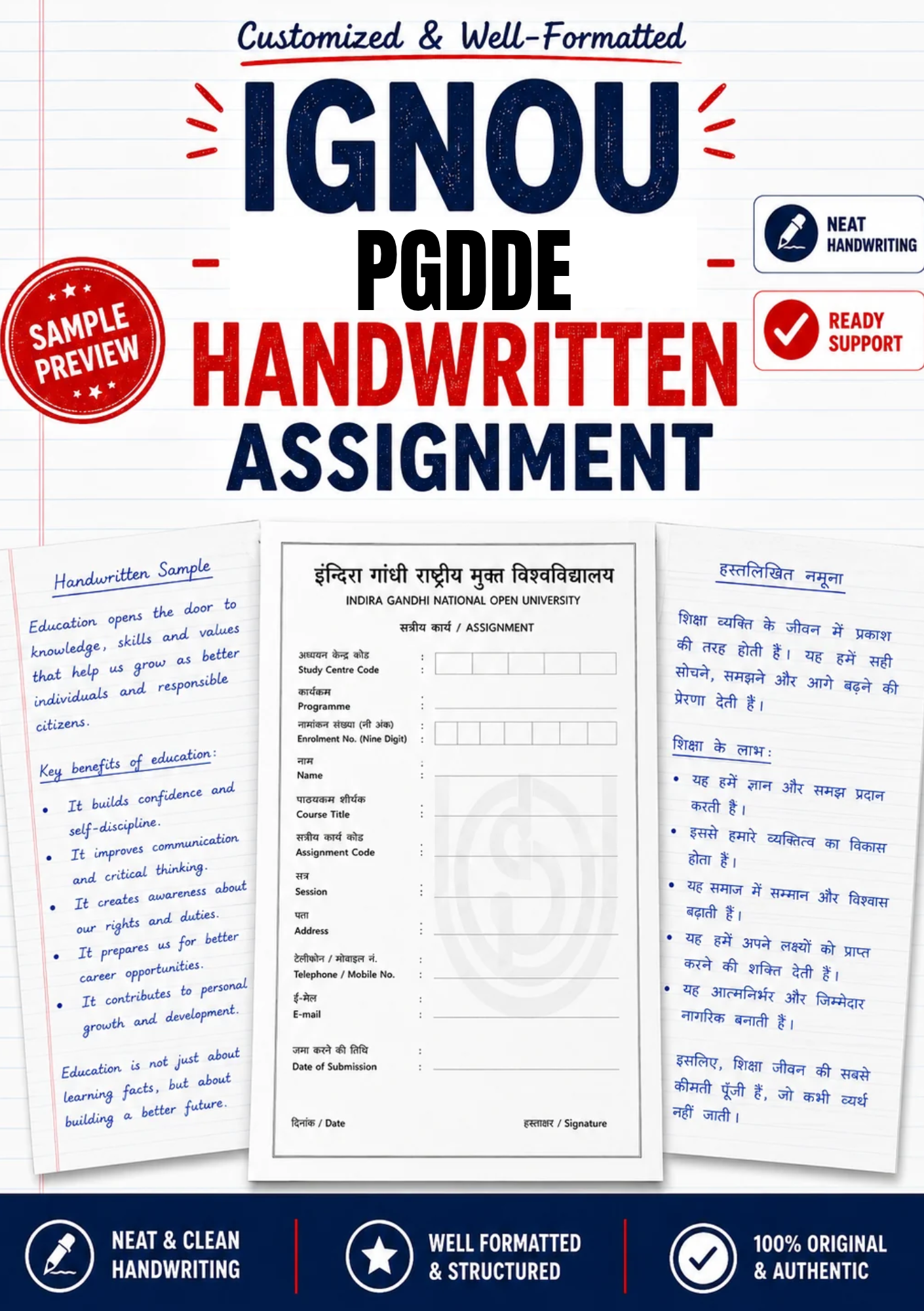
A PGDDE order arrives as paper, because paper is what the counter at your study centre accepts. Inside the courier bag sits one set of handwritten answer sheets for each MDE code you named, written on A4 in a single consistent hand, with the question written out before each answer in the sequence the STRIDE paper numbers them. The 2026 PGDDE papers ask for exactly that, and they ask for continuous numbered pages rather than loose sheets, so the sets come collated in reading order and ready to be tagged.
Travelling with the sheets is an IGNOU-format front page for every code, free with every order, carrying the fields the paper asks you to fill in capital letters on page one: programme code, course code, name, address, mobile number, email identifier and study centre code. A photocopy of the official PGDDE question paper for the session you named comes in the same envelope, which matters more on this diploma than on most, because STRIDE publishes the 2026 papers as one PDF per course rather than one combined booklet, and a learner who downloaded only the MDE-411 file can easily believe it is the whole set.
What does not arrive is a file. No soft copy or PDF is sold. Nothing is emailed, nothing is sent as a scan, and there is no download link behind this product, because the thing being sold is the physical writing rather than the answers in the abstract.
The ₹320 Line for a Thirty-Two-Credit Diploma
The rate is ₹320 per subject, hard copy only, with courier included in that price and no separate shipping charge. On a four-paper PGDDE order the arithmetic is plain: four codes at ₹320. There is no minimum order: one subject or fourteen, same rate, which is why a learner clearing one outstanding MDE paper pays the same per-paper rate as a learner ordering the whole first year at once.
Three things sit inside that figure which other sellers itemise separately. The courier is inside it. The IGNOU-format front page for each code is inside it. Matching the writing to your own hand is inside it, and not an upgrade: send a photo of a page you have written yourself and the handwritten set is matched to your handwriting at no extra charge.
Two things sit outside it. The first is evaluation, which is not for sale by anyone. No claim is made about the marks any assignment will receive, about how an evaluator will assess it, or about whether it will be accepted. Assignment evaluation is entirely a matter for IGNOU. The second is the act of submission itself: the sheets reach you, and carrying them to the counter or posting them to STRIDE remains yours to do, because the declaration on the cover page carries your signature and nobody else’s.
Delivery depends on your pin code and is confirmed for your order before you pay. No figure is promised on this page. Any seller who prints a working-day count without first asking where you live is guessing.
A Model-Answer PDF Against a Written PGDDE Set
Two different products get searched for with nearly the same words, and PGDDE learners ask the difference more often than most, because the MDE papers are long enough that the temptation to hand in something printed is real. A solved assignment is a soft-copy reference file of model answers for a course code and session, read on a screen and used as raw material. A handwritten assignment is those answers written out by hand on A4 and submitted in hard copy at the study centre. The first is something to write from. The second is something to hand in. They are not substitutes for one another.
IGNOU settles the question on the paper itself rather than leaving it to interpretation. General instruction nine on the 2026 PGDDE papers reads: “Assignments should be handwritten.” The same papers add that answers must be specific and written in your own words rather than copied directly from the printed self-learning material, and that you should prepare a draft, read it, correct it and only then write the final version for submission. A downloaded PDF printed and tagged is not a submission under that instruction, however good the answers inside it are.
| Question | Solved assignment file | Handwritten PGDDE set |
|---|---|---|
| What it is | Soft-copy reference answers for one code and session | Those answers written by hand on A4 sheets |
| What you do with it | Read it, then write the paper yourself in your hand | Check it, sign the declaration, hand it in |
| Format delivered | A file on a screen | Hard copy in a courier bag |
| Who it suits | A learner with time to write but short of material | A learner with the material but no writing time |
| Price on this store | Priced per code on the solved-assignment pages | ₹320 per subject, courier included |
Scroll the table sideways on a narrow screen.
If what you actually want is the reference file rather than the writing, the honest answer is that this is the wrong page and the store keeps those elsewhere: the model-answer files are catalogued by programme and code and that is where a PGDDE learner looking for something to write from should start. This page sells the writing.
Four codes, one message, a quote back against the current paper.
₹320 per subject, hard copy, courier included. Name the MDE codes you still owe and the session printed on your paper.
MDE-411 to MDE-414: The Four Papers a Written Set Covers
PGDDE is built from five courses and nothing else. There is no elective pool, no semester split, no project course and no laboratory component, which makes it one of the simplest IGNOU structures to quote against and one of the easiest to misread, because the five courses do not all behave the same way. The Common Prospectus July 2026 gives the structure as follows, and the credits sum to the 32 the same table states.
| Code | Title in the Common Prospectus, July 2026 | Credits | Written assignment a handwritten set can answer |
|---|---|---|---|
| MDE 411 | Growth and Philosophy of Distance Education | 6 | Yes. Two 800-word answers and three of five shorter ones |
| MDE 412 | Instructional Design | 6 | Yes. Printed as “within 800 words” rather than “about” |
| MDE 413 | Learner Support Systems and Services | 6 | Yes. Same three-question shape as MDE-411 |
| MDE 414 | Management of Distance Education | 6 | Yes, but question two offers three of four, not three of five |
| MDE 518 | Educational Communication Technologies | 8 | No. The live booklet names it Learning Portfolio and routes it to a platform |
Scroll the table sideways on a narrow screen.
Read the right-hand column before ordering, because it is the column that decides what you pay for. Four of the five PGDDE courses carry a conventional written paper: one long answer of about 800 words, a middle question where you choose a subset of short answers at 250 to 300 words each, and a second long answer of about 800 words. That is roughly 2,100 words of finished writing per code, so a full first-year order is somewhere near 8,400 words in one consistent hand. Those four papers are what a ₹320 per subject quote covers.
The titles in that table are the prospectus titles, and IGNOU’s own live PGDDE programme page repeats four of the five exactly, listing each of MDE-411 to MDE-414 as a six-credit theory course and MDE-518 as an eight-credit theory course. The fifth title is where the documents part company, which is the next section.
Why MDE-518 Holds Eight Credits and No Written Paper
MDE-518 is the largest single course in PGDDE. Eight credits of a 32-credit diploma, a full quarter of the programme, sit against that one code, and the Common Prospectus July 2026 and IGNOU’s live programme page both title it Educational Communication Technologies. Open the assignment file STRIDE actually publishes for it and the header reads differently: “Course Code: MDE-518 Course Name: Learning Portfolio”. The same file does not set three questions. It asks the learner to work through the learning activities in block five of the course and submit them, and it names a course coordinator to contact if the platform cannot be reached.
The January 2023 PGDDE booklet explains how the two titles came about, because that one document still carried both codes side by side on its cover, printed as “(MDE-411,412,413,414, 418/518)”. Inside, it directed learners registered up to January 2020 to attempt assignment five against MDE-418, and learners who registered from July 2020 onwards to attempt the Learning Portfolio against MDE-518 instead. MDE-418 was the older Educational Communication Technologies paper and did carry a written assignment with a due date of 30 September 2023. MDE-518 replaced it with a portfolio. The structure documents kept the retiring course’s title and attached it to the replacement code, which is why a prospectus table and a live assignment file can both be accurate and still disagree.
The practical consequence for an order is simple and worth stating plainly rather than quietly charging for. If your registration is from July 2020 onwards, MDE-518 is a portfolio of learning activities routed through IGNOU’s platform and it is not part of a handwritten set, so your order is four codes. If you registered earlier and your booklet still shows a written MDE-418 paper, that fifth paper can be written by hand at the same ₹320 per subject. The only way to be certain which applies is the file in your own hand, and the quote is made against that file rather than against an assumption.
Not sure whether your fifth paper is written or a portfolio?
Send a photograph of the cover and the fifth-paper page. The reply says which codes can be written and what the four or five papers come to at ₹320 per subject.
Reading Five PGDDE Papers Side by Side: Twelve Mismatches
Five STRIDE assignment PDFs, two prospectus editions and IGNOU’s live programme page were opened for this product. They do not agree with one another, and the disagreements are listed rather than smoothed over, because a learner who knows where the record is contradictory can check the one document that governs their own enrolment instead of trusting a summary. Two of the twelve are this publisher’s own errors.
Twelve places the PGDDE record contradicts itself, including two of ours.
1. Three different PGDDE credit totals appear in one prospectus. The PGDDE section of the Common Prospectus July 2026 offers lateral entry to those who completed “PGDDE of 24 credits”. Its own programme-list table gives PGDDE as 32 credits. Its MADE section refers to learners who completed PGDDE “having 30 credits” before July 2020. The PGDDE course table in that same document sums to 32, and IGNOU’s live PGDDE page also says 32, so 24 looks like the outlier.
2. MDE-518 carries two titles. Educational Communication Technologies in the Common Prospectus July 2026 and on the live PGDDE programme page; Learning Portfolio in the STRIDE assignment file and in the 2023 and 2024 PGDDE booklets.
3. The 2026 PGDDE papers ask for the wrong programme code. The cover reads Post Graduate Diploma in Distance Education (PGDDE), the salutation reads “Dear PGDDE Learner” and the sign-off reads “Programme Coordinators, PGDDE”, but general instruction one asks you to write “your Programme code (MADE)” on page one, and general instruction fifteen describes the minimum standards for completion of “the MADE programme”.
4. That instruction reversed between editions. The January and July 2024 PGDDE paper asked in the same numbered instruction for “your Programme Code (PGDDE)” and referred to “the PGDDE programme”. The wording changed to MADE on the 2026 files.
5. Due dates vanished. The January 2023 PGDDE booklet printed a separate due date against every course: 30 May, 30 June, 30 July, 30 August and 30 September 2023. The 2024 and 2026 PGDDE papers print no date anywhere and refer the learner to ignou.ac.in instead.
6. They did not vanish everywhere. STRIDE’s 2026 second-year file for MDE-417 does print a due date, 30 September 2026, in the same publishing cycle in which the first-year PGDDE files print none.
7. Assignment weightage is stated two ways. The STRIDE PGDDE and MADE papers state that assignments carry 25 per cent of the overall grade for each course, and the MADE term-end papers print a maximum weightage of 75 per cent, which is consistent with that. The weighting that applies across most IGNOU programmes, and that this publisher states in its own terms below, is 30 per cent assignment and 70 per cent examination. Check the figure on your own paper.
8. The fifth code was listed twice over. The January 2023 PGDDE cover printed “418/518”, carrying both the retiring and the replacement code. The 2024 and 2026 covers list MDE-518 alone, and the string MDE 418 appears nowhere in the Common Prospectus July 2026.
9. One booklet drops a hyphen. The January 2023 PGDDE booklet prints “MDE413” where every other code on the same page is hyphenated, which matters only because you are copying these strings onto a cover sheet by hand.
10. Word-limit wording is inconsistent across one session’s papers. MDE-412 asks for answers “within 800 words” and for short answers “within 300 words each”, where MDE-411, MDE-413 and MDE-414 ask for “about 800 words” and “about 250-300 words”.
11. This store’s own MADE handwritten product is titled for all nine MDE codes and names the five first-year codes as papers STRIDE issues. MDE-518 is a Block-5 portfolio submitted on IGNOU’s platform and MDEP-520 is a project course, so neither is a written paper a handwritten order can cover. That listing is being corrected.
12. This store also carries two separate MADE book categories covering the same nine courses, and an MA Distance Education assignment category with no products in it. Both are being consolidated.
A Due-Date Ladder in 2023, and No Date at All on the 2026 Paper
Most IGNOU programmes give a learner two cut-offs to plan around, one for each intake, printed on the assignment paper. PGDDE does not, and has not for several cycles, so the usual advice does not transfer here.
| Edition opened | Cover reads | Programme code it asks for | Timing printed on the paper |
|---|---|---|---|
| January 2023 | PGDDE, codes 411 to 414 and 418/518 | “your programme code”, unspecified | A separate due date per course, 30 May to 30 September 2023 |
| January and July 2024 | PGDDE, codes 411 to 414 and 518 | PGDDE | None. Points to ignou.ac.in |
| January and July 2026 | PGDDE, for December 2026 and June 2027 examinations | MADE | None. Points to ignou.ac.in |
| January and July 2025, first year | MADE, first year, same five codes | MADE | None. Points to ignou.ac.in |
| 2026, second year, MDE-417 | MADE, second year | MADE | Due date 30 September 2026 |
Scroll the table sideways on a narrow screen.
What the current paper gives you instead of a date is an examination window. The January 2026 and July 2026 PGDDE files are headed “For Students Going to Appear in December 2026 and June 2027 Term End Examination”, and general instruction thirteen makes the real deadline a dependency rather than a calendar entry: submitting your assignments is mandatory before you fill the term-end examination form. Instruction fourteen then sends you to ignou.ac.in for the last date. That is the whole of what STRIDE commits to in writing.
This is worth saying clearly because aggregator sites circulate a confident single figure for “the IGNOU assignment last date” every cycle, and in 2026 they have variously carried 30 September, 31 October, 20 November, 30 April and 31 May. Some of those are genuine university extensions for particular submission modes and sessions. None of them is printed on a PGDDE paper. Treat the examination-form dependency as your real constraint, read the current notice on ignou.ac.in, and confirm with your regional centre, because programme structures, course codes, submission dates and rules change, and only ignou.ac.in and your Regional Centre can confirm the current position for your enrolment.
What follows for an order is that the session on the paper matters more than the month on a calendar. A PGDDE set is written against the paper IGNOU currently has published for your codes, and papers are replaced each cycle, so the 2026 questions differ from the 2024 and 2023 questions on the same five codes. Naming the session printed on your own file is how the right questions get answered.
Assignments carry 30 per cent of the final course result and the term-end examination carries the remaining 70 per cent. On this diploma that figure is itself contested, as mismatch seven above records, which is one more reason to read your own paper rather than any page about it. Ask which published PGDDE paper fits your session if the heading on your file is unclear.
Copying the Code Line Off a Paper That Names Two Programmes
Page one of every submitted PGDDE assignment carries an identifying block, and the 2026 paper is specific about it: programme code, course code in the form MDE-xxx, name, address, mobile number, email identifier and study centre code or name, all in capital letters. Four of those seven fields are yours alone and are never written for you, because an assignment pre-filled with somebody else’s enrolment details is worthless.
The programme code field is the one that causes trouble on this diploma. The file is headed PGDDE, welcomes you as a PGDDE learner and is signed by the PGDDE programme coordinators, and then instruction one asks for the programme code MADE. PGDDE and MADE share these five courses exactly, PGDDE being the 32-credit exit award and MADE the 64-credit degree that continues into a second year, so the instruction is a template inherited from the master’s booklet rather than a statement about your enrolment. Your enrolment record, not the booklet, is the authority on which code you are registered under, and that is the code to write. If your admission letter says PGDDE, write PGDDE and keep the file you downloaded as evidence of why the question arose.
There is no TMA string to copy on this diploma. Many IGNOU programmes print an assignment code of the form CODE/TMA/SESSION on the paper, and a learner is expected to copy it onto the cover sheet. The PGDDE papers print no such string at any edition examined. The identifying information is the course code and the session on the cover, which is why the question paper copy travels with every order: it is the document that evidences which paper the answers were written against.
Why the Handwriting Question Is Settled Before Payment
You sign the declaration on the assignment cover page, so you should read and review the content before submitting it, and satisfy yourself that it represents your own understanding of the course. That sentence is the reason the handwriting question is settled before payment rather than after delivery. A set that does not look like your writing is a set you cannot comfortably sign, and on a four-paper order it is roughly 8,400 words of a hand that has to stay consistent from the first page of MDE-411 to the last page of MDE-414.
Send a photo of a page you have written yourself and the handwritten set is matched to your handwriting at no extra charge. Matching happens first, and the quote and the writing follow it, so the risk of paying for something unusable sits here rather than with you.
Which page to photograph, and how
Any page of your ordinary English handwriting works, and an older evaluated assignment returned by your study centre is ideal because it shows the hand an evaluator has already seen. Fill most of a sheet rather than writing three lines, photograph it flat in daylight with the whole page in frame, and avoid a page written unusually carefully for the purpose, because a set matched to handwriting you cannot reproduce is worse than no match at all. One page is enough for all four codes.
English Only, PGDDE or PGDDEOL, Any Intake Still Owed
The service covers all mediums IGNOU issues the TMA paper in, at the same price. On this diploma that resolves to one medium: the Common Prospectus July 2026 gives PGDDE’s medium of instruction as English, and IGNOU’s live programme page repeats it. Every STRIDE assignment file opened for this page is in English and no Hindi PGDDE paper was found, so a Hindi-medium request on these codes is a question for STRIDE rather than for a publisher.
Two programme codes are served identically. PGDDE is the open and distance learning version and PGDDEOL the online-mode variant, which the prospectus lists among its online programmes and which this store already catalogues separately: the printed material for the distance-mode diploma and the equivalent shelf for the online-mode intake sit in different categories. The handwritten rate does not change between them.
Any session is accepted, current cycle or older, including backlog courses, at the same ₹320 per subject. A learner clearing MDE-414 three cycles after first registering for it pays what a January 2026 intake pays, and the set is written against whichever paper applies to that learner rather than against the newest one. Where the backlog reaches far enough back to involve MDE-418 rather than MDE-518, that is handled as the fifth written paper described above.
If your second year has already begun, these four codes are only half your writing. The second-year MDE papers and the MDEP-520 project course belong to the master’s programme, and the store keeps a separate written-set listing for learners continuing into MADE rather than folding them into this diploma page.
Before a Price Exists, Five Details Have to Land
Quoting a PGDDE order needs five things and nothing else, and none of them is a payment detail.
- The MDE codes you want written, from MDE-411, MDE-412, MDE-413 and MDE-414, plus the fifth code only if your booklet shows a written paper against it.
- Whether you are registered under PGDDE or PGDDEOL, taken from your admission record rather than from the booklet heading.
- The session printed on the paper you downloaded, which on the current file reads January 2026 and July 2026 with December 2026 and June 2027 examinations.
- One photograph of a page in your own handwriting.
- Your delivery pin code, which is what makes a delivery estimate possible instead of a guess.
Your enrolment number helps and your study centre code helps, because both belong on page one of every sheet. Nothing else is asked for, and nothing is paid before the handwriting sample has been seen and the codes confirmed against the published paper.
The sample photo comes before the money, not after it.
₹320 per subject, hard copy, courier included, handwriting matched free. Send the page photo and the four codes together and the whole order is settled in one exchange.
Two Submission Routes, One of Them Unusual for IGNOU
When the envelope reaches you, read the sheets before anything else. You are the person signing the declaration, so the review is not a formality: check that each set answers the questions on the paper you hold, that the course code on page one matches the sheets behind it, and that the programme code reads as your enrolment record has it.
PGDDE submission then has two routes, and the paper names both. Assignments can be deposited at your study centre, which is what most learners do and which gives you a counter receipt worth keeping. Or they can be posted to The Director, STRIDE, Block16, IGNOU, Maidan Garhi, New Delhi-110068. That direct route to a school is unusual: on most IGNOU programmes assignments go only to the study centre’s programme in-charge, whereas STRIDE accepts PGDDE and MADE work at its own address. Keep a photocopy or a scan of every sheet before it leaves your hands, which the paper asks you to do and which is the only protection if a set goes missing in transit.
Where MDE-518 is a learning portfolio, it does not travel with the rest. It goes through the platform the STRIDE file names, and the file gives a coordinator contact for learners who cannot reach that platform. Submitting four papers at the counter and forgetting the fifth on the platform is the most common way a PGDDE learner ends a cycle with one course incomplete.
After that, the timeline is the university’s. Evaluated assignment marks surface on the grade card in their own time, and the status page is where that gets checked rather than anywhere on this store. Minimum standards for completing a PGDDE course are printed on the paper: a minimum D grade in continuous evaluation for each assignment in each course, a minimum C grade in the term-end examination in each course, and a final grade in the course of at least C.
The Shelves a Distance Education Diploma Draws On
PGDDE learners rarely buy one thing. The written sets are most often ordered alongside the reading that produced them, and the store carries the five-course study material combo covering MDE-411 to MDE-518 in one order for learners starting the diploma from nothing. Where only the heaviest course is missing, the eight-credit communication technologies volume is sold on its own, which is the book behind the block-five portfolio work.
For examination preparation rather than assignment writing, the MDE codes are shared with the master’s programme, so the material is catalogued there: worked guess papers across the MDE codes and previous-year papers solved for the same courses both cover the four PGDDE theory papers, and the full distance-education book list runs across both years. Learners ordering written sets for other programmes at the same time can work from the complete handwritten catalogue, programme by programme.
If you would rather write the four papers yourself, that is a legitimate choice and the editorial side of this publisher documents it in detail: a step-by-step account of writing and submitting an IGNOU handwritten assignment covers the cover sheet, the paper and the counter, and the MDE paper-pattern study that reads all nine codes including the PGDDE year sets out what the questions on these four papers tend to repeat. The current papers themselves are free from IGNOU’s own assignment download service, and the programme structure is on the university’s live PGDDE page.
Doubts a PGDDE Order Raises Before Payment
How many PGDDE papers can actually be handwritten, four or five?
Four, for most current learners. MDE-411, MDE-412, MDE-413 and MDE-414 each set a written assignment of two long answers and a choice of short ones, and those are written by hand at ₹320 per subject. MDE-518 is published by STRIDE as a learning portfolio built from the activities in block five of the course and routed through IGNOU’s platform, so it is not a written paper. Learners registered before July 2020 whose booklet still shows MDE-418 do have a fifth written paper, and it is quoted at the same rate.
Nothing on my downloaded PGDDE file says when it is due. Is my copy incomplete?
It is not on the paper, and that is not an error in your download. The 2024 and 2026 PGDDE files both say to visit ignou.ac.in for the last date of submission, and both make submission mandatory before you fill the term-end examination form. The January 2023 booklet did print per-course due dates, but that practice stopped. Treat the examination-form dependency as the real constraint and confirm the current date against IGNOU’s own notice.
The paper says to write MADE as my programme code but I am enrolled in PGDDE. Which do I write?
Write what your enrolment record says. The 2026 file is headed PGDDE, addresses you as a PGDDE learner and is signed by the PGDDE coordinators, and only general instruction one and instruction fifteen say MADE, inherited from the master’s template because the two programmes share these five courses. The 2024 edition of the same paper asked for PGDDE in that same instruction. Your admission record is the authority, not the booklet.
Can I print a solved assignment PDF and submit that for MDE-411?
No. General instruction nine on the 2026 PGDDE papers states that assignments should be handwritten, and the same instructions ask for answers in your own words rather than copied from the printed course material. A model-answer file is something to write from, not something to hand in. If the reference file is what you want, the store catalogues those separately from this page.
In one line, how does a model-answer file differ from what this page sells?
The solved assignment is a soft-copy reference file of model answers for a code and session, delivered as a file and used as raw material. The handwritten set is those answers written out by hand on A4, delivered as a hard copy with courier included at ₹320 per subject, ready for the counter once you have read and signed it. One saves you research. The other saves you writing.
Is a typed PGDDE assignment rejected?
The instruction on the paper is that assignments should be handwritten, and across IGNOU programmes typed submissions are generally returned rather than evaluated. No claim is made here about how any particular evaluator or study centre will act, because that is not a publisher’s call. What can be said is that the paper asks for handwriting, which is what this product supplies.
Why does MDE-518 have two different names in IGNOU’s own documents?
Because the code replaced an earlier one and the structure documents kept the earlier title. MDE-418 Educational Communication Technologies applied to registrations up to January 2020 and carried a written assignment. MDE-518 replaced it from July 2020 with a learning portfolio. The Common Prospectus July 2026 and the live programme page still print Educational Communication Technologies against MDE-518, while the STRIDE assignment file prints Learning Portfolio.
Which weightage applies to MDE papers, the 25 per cent on the booklet or the 30 per cent everywhere else?
The STRIDE papers say 25 per cent of the overall grade for each course, and the MADE term-end papers print a maximum weightage of 75 per cent, which fits. The 30 per cent assignment and 70 per cent examination split applies across most IGNOU programmes and is what this publisher states in its own standing terms. The two do not agree on this diploma, so read the figure printed on your own paper and ask STRIDE if it matters to your calculation.
How many credits is PGDDE, since I have seen 24, 30 and 32?
All three figures appear in the Common Prospectus July 2026, which is why the question keeps coming up. Its PGDDE section mentions lateral entry for a PGDDE of 24 credits, its programme-list table says 32, and its MADE section mentions 30 credits for pre-July-2020 completions. The PGDDE course table itself sums to 32, six credits each for MDE-411 to MDE-414 and eight for MDE-518, and IGNOU’s live PGDDE page also states 32.
I finished PGDDE and am entering MADE year two. Do I order from this page?
Not for the second year. These four codes are the first-year papers you have already completed. The second-year MDE papers and the MDEP-520 project course sit under the master’s programme, and the store keeps a separate written-set listing for those. This page is for learners still owing first-year papers, whether they intend to exit with the diploma or continue.
How much writing is a full PGDDE order?
Each of the four papers sets two answers of about 800 words and a middle question where you write three shorter answers of 250 to 300 words each, so roughly 2,100 words per code and somewhere near 8,400 words across the four. The 2026 papers also ask for continuous numbered pages with the question written out before each answer, which adds to the page count without adding to the thinking.
Where do PGDDE assignments get submitted?
The paper names two routes. You can deposit them at your study centre, or post them to The Director, STRIDE, Block16, IGNOU, Maidan Garhi, New Delhi-110068. Direct submission to a school is unusual across IGNOU and specific to how STRIDE runs this diploma. Keep a copy of every sheet before it leaves you, as the paper asks.
Can I order a PGDDE set for a backlog from an older session?
Yes, at the same rate. Any session is accepted, current cycle or older, including backlog courses, at the same ₹320 per subject. The set is written against the paper that applies to the session you name rather than the newest one, because the questions on these five codes changed between 2023, 2024 and 2026. Name the session printed on your own file.
Can these four papers be written in Hindi?
None was found. The Common Prospectus July 2026 gives PGDDE’s medium of instruction as English, IGNOU’s live programme page repeats it, and every STRIDE assignment file opened for this product is in English. The service covers all mediums IGNOU issues the TMA paper in, at the same price, which on this diploma means English. If STRIDE issues a Hindi paper for your session, it is written at the same rate.
Will all four papers look like one person’s handwriting?
That is the point of matching from a sample before writing starts. One photographed page sets the hand for the whole order, and the four sets are written to stay consistent across roughly 8,400 words so that nothing reads as though it came from four different people. The matching happens first and costs nothing extra.
Are the cover sheet and a copy of the paper charged separately?
Both, at no extra charge. An IGNOU-format front page comes for every code you order, carrying the fields the paper asks you to complete in capital letters on page one. A copy of the official PGDDE question paper for your session travels in the same envelope, which also evidences which published paper the answers were written against.
The Four Sources Behind Every Figure on This Page
Four kinds of document were read for this product and they are not interchangeable. Where they disagree, the disagreement is printed in the warning box above rather than resolved silently.
Common Prospectus, July 2026 edition
IGNOU’s live PGDDE programme page
Five STRIDE assignment PDFs opened for this page
Terms set by this publisher, not by the university
Important Notice
Shri Chakradhar Publication Pvt. Ltd. and shrichakradhar.com form an independent IGNOU study-support publisher. This is not the official website of Indira Gandhi National Open University, is not affiliated with, endorsed by or authorised by the university, and no page on this site should be treated as an official IGNOU communication.
Programme structures, course codes, submission dates and rules change, and only ignou.ac.in and your Regional Centre can confirm the current position for your enrolment.
You sign the declaration on the assignment cover page, so you should read and review the content before submitting it, and satisfy yourself that it represents your own understanding of the course.
No claim is made about the marks any assignment will receive, about how an evaluator will assess it, or about whether it will be accepted. Assignment evaluation is entirely a matter for IGNOU.
Send the Four Codes You Still Owe
₹320 per subject, hard copy only, courier included, IGNOU-format front page and question-paper copy with every set, handwriting matched from your own sample at no extra charge. No minimum order, and any session accepted including backlogs.
Two ways to start. Message the codes and a handwriting photo together for a quote in one exchange, or ask the single question you are stuck on first.