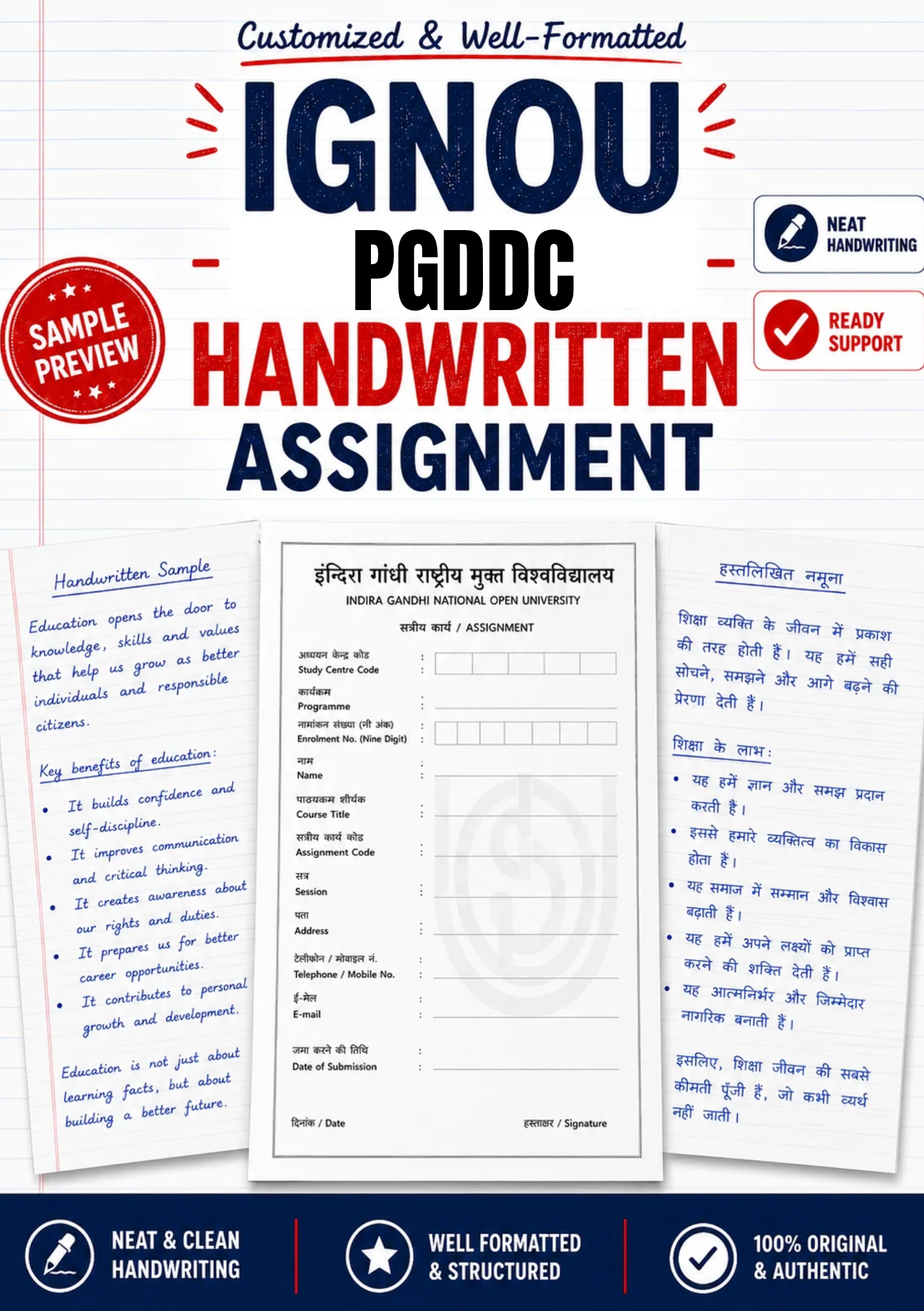


Description
In short. Shri Chakradhar Publication prepares handwritten Tutor Marked Assignment sets for the IGNOU Post Graduate Diploma in Development Communication, covering MDC-001 Fundamentals of Development and Communication, MDC-002 Human Development and Communication, MDC-003 Media in Development Communication, MDC-004 Development Journalism for Social Change, MDC-005 Development: Information and Communication Technologies and MDC-006 Media and Communication Theories, which are the six theory papers out of the seven codes on this 40-credit diploma; the seventh, MDCP-006, is project work and carries no assignment at all. The rate is ₹320 per subject, hard copy only, with courier included in that price and no separate shipping charge. Each of the six papers is a 100-mark instrument worth 30 per cent of that course, with five compulsory questions of roughly 500 words, and the 2026 booklets print a submission date of 31 March or 30 September depending on whether the admission was January or July. Backlog learners are covered too, which matters on PGDDC more than on most diplomas because the sixth paper appeared as MDCE-006 on booklets up to 2023 and as MDC-006 from 2024 onward, and both codes still have live 2026 papers. Any session is accepted, current cycle or older, including backlog courses, at the same ₹320 per subject. No soft copy or PDF is sold. Orders are placed on WhatsApp at +91 93546 37830, and a sample photograph of your own handwriting is matched before any payment is taken.
Opening a PGDDC Parcel: The Four Things Inside
A development communication order does not arrive as a link. Four physical items travel together in one courier packet, and each of them has a job at the study centre counter.
The first is the written answer set itself, one bundle per course code, with the question copied out above each answer in the order the booklet prints them. The 2026 MDC papers set five questions carrying equal marks and ask for roughly 500 words per answer, so a single PGDDC paper runs to a substantial number of sides rather than a few pages. The second is the IGNOU-format front page, filled in with the enrolment number, name, address, assignment code and study centre code that the booklet instruction asks for, free with every order. The third is a copy of the official Tutor Marked Assignment paper for that code and cycle, which several regional centres ask to see stapled behind the front page. The fourth is the physical delivery itself, booked and tracked, with courier already inside the rate.
What does not arrive is a file. That is a deliberate boundary rather than a limitation: the thing IGNOU accepts at the counter is paper carrying one person’s handwriting, and a download cannot be that.
Counting What ₹320 Buys on a Six-Paper PGDDC Order
The rate is ₹320 per subject, hard copy only, with courier included in that price and no separate shipping charge. Priced that way, a full first-cycle PGDDC set of six written papers is a single arithmetic line rather than a quotation exercise, and a learner who owes only the sixth paper pays for the sixth paper.
Inside the figure: the writing of all five answers for that code, the matching of the hand to your own sample, the IGNOU-format front page, the copy of the question paper, packing, and the courier leg to your pin code. There is no minimum order: one subject or fourteen, same rate. The service covers all mediums IGNOU issues the TMA paper in, at the same price, which on PGDDC means English, because the Common Prospectus July 2026 records the medium of instruction for this diploma as English and the School of Journalism and New Media Studies has published no Hindi MDC booklet for the 2026 cycle.
Outside the figure, and stated plainly rather than buried: the university’s own fees, which the prospectus annexure records as ₹10,000 for the full PGDDC programme plus examination fees decided separately, and the MDCP-006 project, which is a typed and hardbound submission of 10,000 to 12,000 words under its own manual and is not a handwritten assignment at any price. Delivery depends on your pin code and is confirmed for your order before you pay. No figure is promised on this page.
Reference File or Submission Set: The MDC Choice Learners Get Wrong
Two different products share the words “MDC assignment” and they are not substitutes. A solved assignment is a soft-copy reference file of model answers for a course code and a session, read on a phone or a laptop and used as raw material while you write. A handwritten assignment is the set of answers written out by hand on A4 sheets and submitted in hard copy at the study centre, which is the artefact IGNOU evaluates.
| What separates them | The soft-copy model answers | The written set in the packet |
|---|---|---|
| Form it takes | Soft copy for reading on a screen | Paper bundle in a courier packet |
| What a learner does with it | Reads it, then writes the answers out | Checks it, signs the declaration, submits it |
| Handwriting | None; there is nothing written | Matched to the learner’s own sample page |
| Who it suits | A learner with time to write six papers | A learner short of writing time, not of understanding |
| Rate on this store | Priced per code on the solved-assignment shelf | ₹320 per subject, courier included |
Scroll the table sideways on a narrow screen.
The instruction printed on IGNOU’s own 2026 MDC-006 paper settles what the submission has to be. It tells the learner to obtain a receipt from the study centre for the assignments submitted and to retain it, to insist that evaluated assignments are returned, and to mention the enrolment number, name, address, assignment code and study centre code on the assignment’s first page. Those are instructions about a physical object passing across a counter. A downloaded model-answer file is a reference to write from and never a submission in itself, and nothing on this page should be read as suggesting a PDF can be handed in.
If the honest answer for your situation is the soft-copy route, the store’s own PGDDC solved-assignment files sold code by code are the shelf to open instead of this one, and the comparison above exists so the choice is made once rather than twice.
Six codes, one figure, no bundle to join.
One figure covers the writing, the front page, the question-paper copy and the courier leg to your address. There is no minimum order: one subject or fourteen, same rate.
Which of the Seven PGDDC Codes Actually Needs Writing
The Common Prospectus July 2026 sets out PGDDC at section 8.27 as a 40-credit programme under the School of Journalism and New Media Studies, with six theory courses of six credits each and one project course of four. Six times six is thirty-six, plus four is forty, and that total matches the figure the prospectus itself prints, so the table below has been checked rather than copied.
| PGDDC code | Title printed in the July 2026 prospectus | Credits on the structure | Written assignment due? |
|---|---|---|---|
| MDC 001 | Fundamentals of Development and Communication | 06 | Yes |
| MDC 002 | Human Development and Communication | 06 | Yes |
| MDC 003 | Media in Development Communication | 06 | Yes |
| MDC 004 | Development Journalism for Social Change | 06 | Yes |
| MDC 005 | Development: Information and Communication Technologies | 06 | Yes |
| MDC 006 | Media and Communication Theories | 06 | Yes |
| MDCP 006 | Internship or Development based Research Project | 04 | No, project only |
| Total credits | 40 | Six written papers | |
Scroll the table sideways on a narrow screen.
The 2026 instruction letter bound into every MDC booklet is explicit about the split. It lists MDC-001 through MDC-006 as the first-year theory courses whose assignments must be submitted, then lists MDCP-006, MADJP-004 and MADJP-005 under a heading saying those courses are project-only and no assignments are required, with assessment based on project work alone. So the written order for a PGDDC learner tops out at six papers, and a learner who has been quoted for seven has been quoted for one too many.
One structural fact behind all of this is worth stating because it changes what a learner should buy. Section 3.65 of the same prospectus sets out the MA in Development Journalism as an 80-credit programme of 40 credits a year and records that on completing the first year of MADJ a student is issued with PGDDC. The PGDDC table and the MADJ Year One table carry the same seven codes. A PGDDC learner therefore owes exactly half of what a MADJ learner owes, which is why the MADJ written set spanning both years of the master’s lists twelve codes rather than six, and why ordering from this page rather than that one keeps six papers off the invoice.
MDCE-006, MDC-006 and the Sixth-Paper Switch of 2024
Most diplomas have one code per paper. PGDDC’s sixth paper has had two, and both still have live 2026 booklets on ignou.ac.in, so the single most expensive mistake available on this programme is writing the wrong one.
| Cycle on the booklet | Code published for the sixth paper | Programme code line | Title printed above the questions |
|---|---|---|---|
| July 2021 and January 2022 | MDCE-006 | PGDDC | Research Methods in Development Communication |
| January 2023 and July 2023 | MDCE-006 | PGDDC | Research Methods in Development Communication |
| January 2024 and July 2024 | MDC-006 | MADJ/PGDDC | Research Methods in Development Communication |
| January 2024 and July 2024 | MDCE-006 (separate block) | MADJ | Research Methods in Development Communication |
| January 2026 and July 2026 | MDC-006 | MADJ/PGDDC | Research Methods in Development Communication |
| January 2026 and July 2026 | MDCE-006 (separate file) | MADJ | Research Methods in Development Communication |
Scroll the table sideways on a narrow screen.
Read the right-hand column again. Every one of those six blocks prints the same course title, including the three that belong to MDC-006, whose prospectus title is Media and Communication Theories. The questions underneath tell the truth where the heading does not: the 2026 MDC-006 paper asks about cultivation theory, agenda setting, uses and gratification and dependency, about psychological perspectives on media effects, about Marxist and cultural studies approaches, about technological determinism and the public sphere, and about feminist media theories. That is Media and Communication Theories under a heading borrowed from the other paper. The 2026 MDCE-006 paper, by contrast, asks about research classifications, sampling, quantitative and qualitative methods, data interpretation and monitoring and evaluation, which is genuinely research methods.
Practically, the test is the programme-code line, not the title. If the line reads MADJ/PGDDC, the paper is yours as a PGDDC learner. If it reads MADJ alone, it is not, and MDCE-006 has read MADJ alone since the 2024 cycle. The exception is a learner carrying a genuine backlog from the 2021 to 2023 cycles, whose grade card still shows MDCE-006 against a PGDDC registration, because in those years MDCE-006 was published under Programme Code: PGDDC and no MDC-006 block existed at all. For that learner the correct paper is the archived MDCE-006 booklet for the cycle in which the course was registered, not the current one. Both routes are written at the same rate, so working out which code applies costs nothing but a check.
There is one more wrinkle for a learner reading the project paperwork. The School of Journalism and New Media Studies has published a PGDDC project handbook built around the code MDCP-007 at six credits, which tells learners to refer to MDCE-006 for research methods, while the current prospectus prints MDCP 006 at four credits and files MDCE 006 in MADJ Year Two. Two project codes, two credit values, and a research-methods course that belongs to a different year of a different programme.
Twenty-Five Contradictions Worth Knowing Before You Write a Word
The research behind this page meant reading the Common Prospectus July 2026, seven PGDDC assignment booklets from four cycles, two project manuals, two programme guides, the live programme page and a June 2026 question paper against each other. They do not agree. Everything below was found by comparing documents rather than by restating one of them, and three of the twenty-five are this publisher’s own.
Disagreements found in IGNOU’s own PGDDC documents, and in this store’s own pages.
1. The sixth paper changed code. MDCE-006 carried Programme Code: PGDDC on the 2021-22 and 2023 booklets; from the 2024 cycle MDC-006 carries MADJ/PGDDC and MDCE-006 carries MADJ alone.
2. The 2026 MDC-006 booklet prints the title Research Methods in Development Communication above five questions on media and communication theory, which is the subject the prospectus assigns to MDC 006.
3. Two different 2026 booklets, MDC-006 and MDCE-006, print an identical course title and are distinguishable only by the programme-code line.
4. The July 2021 and January 2022 booklet prints the due date as March 31 or September 31, 2022 against all six courses. September has thirty days.
5. The due-date line changed from a dated one to a perpetual one. The 2023 booklet prints September 30, 2023; the 2024, 2025 and 2026 booklets print September 30 every year.
6. The School of Journalism and New Media Studies is not one date regime. PGDDC’s 2026 papers print a calendar due date, while that school’s 2026 PGJMC and PGDIDM papers print no date and substitute an instruction to check the university website.
7. MDC 005’s title is spelled two ways inside one prospectus. Section 8.27 prints Communication Technologies; section 3.65 prints Communicaion Technologies.
8. The MDCP-006 project manual prints MDC-005 without the colon, as Development Information and Communication Technologies, against the prospectus form Development: Information and Communication Technologies.
9. The programme title is misspelled differently by year. The 2021-22 and 2023 covers print DEVELOPMENT COMMUNICTAION; the 2025 cover prints DEVELOPMNET COMMUNICATION; the 2024 and 2026 covers print POST GRADUATE IN DIPLOMA IN DEVELOPMNET COMMUNICATION.
10. The prospectus body text at section 8.27 prints Development Communiation in its opening paragraph.
11. The 2024 cover’s own list of codes prints MDCE-0006 with four digits, while the block inside the same file prints MDCE-006.
12. The programme-code line reverses order between cycles: PGDDC alone up to 2023, MADJ/PGDDC in 2024, PGDDC / MADJ in 2025, MADJ/PGDDC again in 2026.
13. Two project codes exist for one four-credit slot. The prospectus and the 2025 manual print MDCP-006 at four credits; the school’s PGDDC project handbook prints MDCP-007 at six credits.
14. That same handbook treats MDCE-006 as a PGDDC course to be referred to for research methods, while the prospectus files MDCE 006 in MADJ Year Two.
15. The MDCP-006 manual names the course two ways: Project Work on its cover and in its headings, Internship or Development based Research Project in its own structure table.
16. The project codes for the master’s year differ between documents. The prospectus prints MDJP 004 and MDJP 005; the 2026 booklet instruction prints MADJP-004 and MADJP-005.
17. One coordinator, four contact addresses. Section 8.27 prints pgddc2021@ignou.ac.in, section 3.65 prints madj@ignou.ac.in, the booklets print rameshyadav@ignou.ac.in, and the MDCP-006 manual prints pgddc2021@gmail.co.
18. The same coordinator is Prof. Ramesh Yadav in the prospectus and Dr. Ramesh Yadav on every booklet and project manual.
19. PGDDCOL, the online-mode version, appears exactly once in the whole Common Prospectus, in the list of online programmes, with no course table, no credits, no fee and no annexure row, while the ODL PGDDC has all four.
20. The MDCP-006 manual’s sample cover page in Annexure A names the master’s programme MA in Development Communication, dropping the word Journalism.
21. No PGDDC booklet specifies a paper size, an ink colour, or even uses the word handwritten, although the submission is a written one. A4 is this publisher’s own default and is stated as such rather than attributed to IGNOU.
22. The assignment and the examination use opposite question rules. The 2026 MDC-002 assignment sets five compulsory questions at about 500 words each; the June 2026 MDC-002 term-end paper is three hours for 100 marks and asks for any five of ten.
23. This store’s own fault: the handwritten category page carries three incompatible delivery figures, two of them saying seven to nine working days and one saying five to seven. No delivery figure belongs on any page here, and all three are queued for removal.
24. This store’s own fault: the PGDDC solved-assignment shelf holds files for MDC 1, MDC 2, MDC 3 and MDC 5 only. MDC 4 and MDC 6 are missing, so two of the six examinable papers have no reference file on the shelf this page points at.
25. This store’s own fault: the PGDDC books shelf lists the MDC 6 guide under the label MADJ even though MDC 006 is a PGDDC core paper, and the PGDDC book combo covers MDC 1 to MDC 5 only, leaving a buyer one core paper short.
Disclosing the last three is a deliberate choice. A page that lists the university’s inconsistencies while hiding its own is not making a trustworthiness argument, it is making a marketing one.
Why the MDC Papers Print a Date When Their Neighbours Print None
Every 2026 MDC booklet prints the same line under the assignment code: a due date of March 31 or September 30, every year. March 31 is the cut-off for the January admission cycle and 30 September for the July cycle, and because the line carries no year it does not expire the way a dated line does.
That is unusual inside this school. The sibling diplomas from the School of Journalism and New Media Studies dropped calendar dates from their 2026 papers entirely and print an instruction to check the university website instead. PGDDC did not. A PGDDC learner therefore has a date to work back from, and a learner comparing notes with a PGJMC or PGDIDM classmate will find the classmate has none.
The history behind the line is worth one paragraph because it explains why aggregator sites circulate three different answers. The 2021-22 booklet printed an impossible September 31. The 2023 booklet printed September 30, 2023, tied to that year alone. From 2024 the year was removed and the perpetual form appeared. All three strings are still findable in indexed PDFs, which is why the only reliable reading is the one on the booklet matching your own admission cycle, downloaded from the download service IGNOU runs for assignment papers.
What the dates are worth is not in dispute. Assignments carry 30 per cent of the final course result and the term-end examination carries the remaining 70 per cent. Six PGDDC papers at 100 marks each put 600 marks of continuous assessment behind that one line of text, and the booklet instruction adds that submission has to happen within the stipulated time to be eligible to appear in the term-end examination at all.
The Assignment Code String, and the Four Ways It Has Been Written
The assignment code is not the course code. It is the course code plus the cycle, and it goes on the first page of the written set along with the enrolment number, name, address and study centre code, because that is what the booklet instruction asks for. Copy it exactly as the paper you downloaded prints it, not as a neighbour’s paper prints it.
| Booklet cycle | Code string as printed | What moved |
|---|---|---|
| July 2021 and January 2022 | MDC-001/July 21-Jan 2022 | Earlier session first, four-digit year second |
| January 2023 and July 2023 | MDC-001/ Jan 2023-July 23 | Order flips, a space creeps in after the stroke |
| January 2024 and July 2024 | MDC-001/Jan 2024- July 24 | Hyphen separator retained |
| January 2026 and July 2026 | MDC-001/Jan 2026 & July 26 | Hyphen replaced by an ampersand |
Scroll the table sideways on a narrow screen.
Two details follow from that table. First, the separator between the two sessions has been a hyphen, a spaced hyphen and now an ampersand, so a learner transcribing from an older PDF will write a string the current paper does not use. Second, the string carries a two-digit year for the second session and a four-digit year for the first, in every cycle, which looks like a typographical slip but is consistent enough across four years to be copied rather than corrected. PGDDC papers also print no TMA suffix of the kind many schools use, so there is no slash-TMA-slash-year element to add.
Each written set from this publisher carries the code string transcribed off the booklet supplied with the order, which is why the admission cycle is asked for at quotation stage rather than assumed.
The Sample Photograph Comes Before Any Payment
Send a photo of a page you have written yourself and the handwritten set is matched to your handwriting at no extra charge. On PGDDC the match carries a particular weight, because six papers of five long answers each arrive as one large body of writing, and a hand that drifts between paper one and paper six is more noticeable than a hand that drifts across two.
The sequence is deliberately ordered so that nothing is paid on trust. The photograph is sent on WhatsApp, the writer matches it, a sample of the matched hand comes back, and only then does the order proceed. A learner who is not satisfied with the match has spent nothing.
What a usable sample page looks like
One full side of ordinary writing is enough, photographed flat in daylight with the whole sheet in frame and no shadow across the middle. Content does not matter, so old class notes or a copied paragraph work as well as anything. What matters is that the page shows your natural letter spacing, your slant and the way you form capitals and numerals, which a few words on a slip cannot. If you write differently with a gel pen than with a ballpoint, say which one you use for assignments.
One Medium, Both Intakes, and Papers From Closed Cycles
The Common Prospectus July 2026 records the PGDDC medium of instruction as English, and the 2026 booklets published for MDC-001 to MDC-006 are English files. The service covers all mediums IGNOU issues the TMA paper in, at the same price, so if the school ever publishes a Hindi MDC paper the rate does not move; today, for this diploma, English is what exists.
Session coverage is wider than the current cycle and is where PGDDC’s code history starts to matter in money terms. Older cycles cost no more than the current one, which is what makes the code history manageable rather than expensive. In practice four kinds of order are routine on this programme: a fresh January 2026 or July 2026 set of six papers; a single outstanding paper from the current cycle; a 2024 or 2025 backlog where MDC-006 was the sixth paper; and a 2021 to 2023 backlog where MDCE-006 was the sixth paper under a PGDDC programme code. The fourth kind is the one other sellers tend to get wrong, because it requires writing against an archived booklet rather than the one currently on the portal.
The admission mode is a separate question from the medium. The online-mode variant of this diploma, PGDDCOL, is listed by IGNOU as an online programme but has no course table, credits or fee anywhere in the Common Prospectus July 2026, so a PGDDCOL learner should confirm against their own admission record which codes and which submission route apply before ordering. The store keeps a separate PGDDCOL book shelf for exactly that reason.
Ordering in One Message: What to Type and What to Attach
A PGDDC quote needs five things and nothing else. Anything beyond this list slows the reply rather than speeding it.
- Your enrolment number, exactly as it appears on your admission record.
- The course codes you want written, for example MDC-003 and MDC-006, or all six.
- Your admission cycle, January or July, and the year, which is what decides which booklet is used.
- Your full postal address with the pin code, since the courier leg is already inside the rate.
- One photograph of a page in your own handwriting.
What not to send: scans of your identity card at the enquiry stage, your study centre’s phone number, a list of topics you would prefer, or payment. None of those is needed to produce a quote, and payment is not asked for until the handwriting match has been shown to you.
If you are unsure whether your sixth paper is MDC-006 or MDCE-006, send a photograph of the relevant line on your grade card or admission letter instead of guessing. That single check is faster than rewriting a paper.
The quote comes back the same way the question goes out.
Any session is accepted, current cycle or older, including backlog courses, at the same ₹320 per subject. A quotation names the papers, the cycle and the courier destination before anything is written.
From Delivery to Receipt: The Steps That Remain Yours
The courier packet ends the publisher’s part of the work and begins yours. Three things are worth doing in order.
Check the set against the paper first. Confirm that the course code and the assignment code string on the front page match the booklet for your own cycle, that all five questions appear with their answers, and that the question paper copy in the packet is the one for that code. Catching a cycle mismatch at this stage costs a message; catching it at the counter costs a submission window.
Then read it. You sign the declaration on the assignment cover page, so you should read and review the content before submitting it, and satisfy yourself that it represents your own understanding of the course. On PGDDC that reading is not a formality, because the term-end paper covers the same ground from a different angle: the June 2026 MDC-002 paper ran three hours for 100 marks with any five of ten questions, and the five answers in your assignment set are the ones you will have already thought through.
Then submit and keep the paperwork. The booklet instruction tells PGDDC learners to submit to the coordinator of their study centre within the stipulated time to stay eligible for the term-end examination, to obtain a receipt and retain it, to keep a photocopy of what was submitted, and to insist that evaluated assignments are returned with the counsellor’s marks. The study centre then sends the marks to the Student Evaluation Division, and what happens to the file after that is outside anyone’s control but the evaluator’s.
Books, Solved Files, Guess Papers and the MDCP-006 Project
A written set is rarely the only thing on a development communication learner’s list, and the rest of the store is organised by the same programme code. For reading rather than copying, the shelf of chapter-wise PGDDC study guides with previous-year papers covers the MDC codes individually and as a combo. Closer to the examination, the PGDDC guess-paper listing is the thinner shelf on this store and is queued for expansion rather than presented as complete.
The seventh code is its own project, not an assignment, and is handled separately. Bound copies for the project component sit under the PGDDC project hard-copy category, with the online-mode listing kept apart from it because the two admission routes do not always share paperwork. For reference, the MDCP-006 manual asks for 10,000 to 12,000 words across roughly 60 to 70 pages, typed and hardbound in English, with a proposal of four to five pages sent to the programme coordinator before the work itself goes to the Project Section, so it is a different kind of job from a handwritten TMA in every respect except the programme it belongs to.
Two more routes exist for learners whose situation does not fit a standard six-paper order. If your enrolment is on the master’s and PGDDC is only the exit award, the twelve-code set is the one to look at. If your cycle is an unusual one, the customised written order for any named session exists for that. And for learners on other programmes entirely, every programme on the written-assignment shelf is organised the same way. If you would rather write the papers yourself and only want the method, there is a free walkthrough of the format rules on the sister site, which sells nothing.
Sixteen Answers a PGDDC Learner Usually Wants First
How many PGDDC papers do I actually have to write by hand?
Six. MDC-001, MDC-002, MDC-003, MDC-004, MDC-005 and MDC-006 each carry one Tutor Marked Assignment of 100 marks. The seventh code on the structure, MDCP-006, is listed in the 2026 booklet instruction among the courses that are project-only and require no assignment, so it is never part of a written order.
My grade card shows MDCE-006 but the portal only has MDC-006. Which one do I write?
Write the one your registration points at. MDCE-006 was published under Programme Code: PGDDC on the 2021-22 and 2023 booklets, so a backlog from those cycles is an MDCE-006 backlog and is written against the archived booklet for that cycle. From the 2024 cycle onward MDCE-006 carries Programme Code: MADJ alone and belongs to the master’s second year, while MDC-006 is the PGDDC sixth paper. Send a photograph of the line on your grade card if you are not sure.
Why does the MDC-006 paper say Research Methods when the prospectus says Media and Communication Theories?
Because the 2026 and 2024 MDC-006 booklets print the other paper’s title above their own questions. The questions themselves are the reliable guide: MDC-006 asks about cultivation theory, agenda setting, Marxist and cultural approaches, technological determinism and feminist media theory. Shri Chakradhar Publication writes to the questions printed on the paper, not to the heading above them.
What is the price for all six papers?
The rate is ₹320 per subject, hard copy only, with courier included in that price and no separate shipping charge. Six papers is therefore six times that figure and nothing else, with no packing charge, no courier charge and no bundle premium.
Is there a cheaper rate if I order the whole first year at once?
No, and the reason is worth stating. A flat per-subject rate means a learner who owes one paper is not subsidising a learner who owes six, and it means no discount pressure exists to push anyone into ordering papers they have already cleared. Any session is accepted, current cycle or older, including backlog courses, at the same ₹320 per subject.
Can I get the PGDDC set as a PDF so I can print it?
No soft copy or PDF is sold. A printed copy of someone else’s handwriting is not what the study centre counter accepts, and selling a file would invite exactly that. What is sold is paper, written by hand, in a courier packet.
When is the PGDDC submission date?
Every 2026 MDC booklet prints the same line: a due date of March 31 or September 30, every year, with March 31 applying to the January admission cycle and 30 September to the July cycle. The line carries no year, unlike the 2023 booklet which printed September 30, 2023. Check the date against the booklet for your own admission cycle rather than against a date circulated on an aggregator site.
My classmate on PGJMC says there is no date on her paper. Is mine wrong?
Neither is wrong. The School of Journalism and New Media Studies removed calendar dates from its 2026 PGJMC and PGDIDM papers and substituted an instruction to check the university website, while the PGDDC papers kept the 31 March and 30 September line. Dates are set per programme on this school’s booklets, not per school, so comparing papers across diplomas is not a useful check.
How soon should I expect the courier?
Delivery depends on your pin code and is confirmed for your order before you pay. No figure is promised on this page. A figure quoted for a metro address would be wrong for a district address, and a wrong figure is worse than no figure when a submission window is involved.
How close is the match to my own hand?
Matching is the whole point of the sample step, and it carries no extra charge. One full side of your own writing, photographed flat in daylight, is enough. A sample of the matched hand is sent back before payment, so the match is something you approve rather than something you hope for.
What paper size and ink will be used?
A4 sheets, written on one side, in blue or black ink unless you ask otherwise. That is this publisher’s own standard and is stated as such, because no PGDDC booklet specifies a paper size or an ink colour anywhere, and attributing a format rule to IGNOU that IGNOU has not printed would be an invention.
Is PGDDC the same as the first year of the MA in Development Journalism?
In course terms, yes. Section 3.65 of the Common Prospectus July 2026 records that on completing the first year of MADJ a student is issued with PGDDC, and the two tables carry the same seven codes. The written consequence is that a PGDDC order is six papers while a MADJ order spans twelve, so ordering from the right page keeps six papers off the bill.
How many marks is each assignment worth, and does it count?
Each 2026 MDC assignment is a 100-mark paper carrying a printed weightage of 30 per cent. Assignments carry 30 per cent of the final course result and the term-end examination carries the remaining 70 per cent. The booklet also makes submission within the stipulated time a condition of eligibility for the term-end examination.
Do I have to attempt all five questions, or can I choose?
All five. The 2026 MDC papers print a note saying to answer all the questions, that all questions carry equal marks, and to answer each in about 500 words. That is the opposite of the term-end paper: the June 2026 MDC-002 examination offered any five of ten questions over three hours. A set written to the examination’s rules would be an incomplete assignment.
I am enrolled in PGDDCOL, the online version. Does this apply to me?
Partly, and the gap should be checked rather than assumed. PGDDCOL appears exactly once in the Common Prospectus July 2026, in the list of online programmes, with no course table, credits or fee printed anywhere. Confirm against your own admission record which codes apply and whether your submission route is the study centre counter or a learning-management upload before ordering.
Will the set guarantee a pass or a particular grade?
No claim is made about the marks any assignment will receive, about how an evaluator will assess it, or about whether it will be accepted. Assignment evaluation is entirely a matter for IGNOU. A seller who promises otherwise is promising something that is not theirs to give.
Prospectus, Seven Booklets and Two Project Manuals: What Each Supplied
Three kinds of document sit behind this page and they are not interchangeable. Keeping them labelled is how a reader can tell which claims are the university’s and which are this publisher’s.
From the IGNOU Common Prospectus July 2026. Section 8.27 supplied the programme structure: six theory courses at six credits and MDCP 006 at four, totalling 40 credits, a figure confirmed by adding the column rather than trusting the printed total. The same section supplied the official course titles, the eligibility of a bachelor’s degree in any discipline, and the medium of instruction as English. Annexure row 152 supplied the duration of one year minimum and three years maximum, the programme fee of ₹10,000, year-wise structure and January and July intakes. Section 3.65 supplied the MADJ relationship and the statement that PGDDC is issued on completing the first year of that master’s.
From live IGNOU booklets and manuals. The January 2026 and July 2026 papers for MDC-001, MDC-003, MDC-004, MDC-006 and MDCE-006 supplied the assignment code strings, the due-date line, the 100-mark total, the 30 per cent weightage, the five-compulsory-question pattern with its 500-word guidance, the instruction letter listing which courses carry assignments and which do not, and the printed course titles that disagree with the prospectus. The archived July 2021 to January 2022, January 2023 and January 2024 booklets supplied the code history and the impossible September 31 date. The MDCP-006 project manual of 2025 and the school’s MDCP-007 project handbook supplied the project requirements and the two conflicting project codes and credit values. The June 2026 MDC-002 term-end paper supplied the examination pattern.
From Shri Chakradhar Publication’s own commercial terms. The rate of ₹320 per subject, courier inclusion, the free IGNOU-format front page, the included question-paper copy, the A4 and ink standard, the handwriting-match process and the absence of a minimum order are this publisher’s terms and are not IGNOU rules. Where this page states a format detail IGNOU has not printed, it says so in the same sentence.
Important Notice
Shri Chakradhar Publication Pvt. Ltd. and shrichakradhar.com form an independent IGNOU study-support publisher. This is not the official website of Indira Gandhi National Open University, is not affiliated with, endorsed by or authorised by the university, and no page on this site should be treated as an official IGNOU communication.
Programme structures, course codes, submission dates and rules change, and only ignou.ac.in and your Regional Centre can confirm the current position for your enrolment.
You sign the declaration on the assignment cover page, so you should read and review the content before submitting it, and satisfy yourself that it represents your own understanding of the course.
No claim is made about the marks any assignment will receive, about how an evaluator will assess it, or about whether it will be accepted. Assignment evaluation is entirely a matter for IGNOU.
Which MDC Papers Are Still Outstanding on Your Record?
That question decides the whole order, because the sixth paper has two possible codes and the booklet used has to match the cycle your registration sits in. Send the codes and the cycle and the rest follows.
Pricing on this diploma does not move with the number of papers or the age of the cycle, and what ships is paper rather than a download. The service covers all mediums IGNOU issues the TMA paper in, at the same price.
List your outstanding PGDDC papers on WhatsApp
Or, if the sixth paper is the only question, ask which sixth paper applies to your cycle before anything is written.