

Description
In short. Shri Chakradhar Publication writes IGNOU PGDCCC handwritten assignment sets for the Post Graduate Diploma in Climate Change, the forty-credit SOITS diploma built from MEV-021 to MEV-029 and MSD-019, at ₹320 per subject in hard copy with courier included. IGNOU has not issued an assignment booklet under the PGDCCC name: on 7 November 2026 the PG Diploma list on the university’s assignment server carried no PGDCCC row, so six of the ten codes are answered from papers printed for other programmes (the PGCCC certificate booklet for MEV-021 to MEV-025 and the PGDEVS environmental studies booklet for MSD-019), while no live paper of any kind was found for MEV-026, MEV-027, MEV-028 or MEV-029. Every set is written against the paper you name, in a hand matched to your own sample photo, for the assignment component that carries 30 per cent of each course result.
What Comes Out of the Envelope on a PGDCCC Order
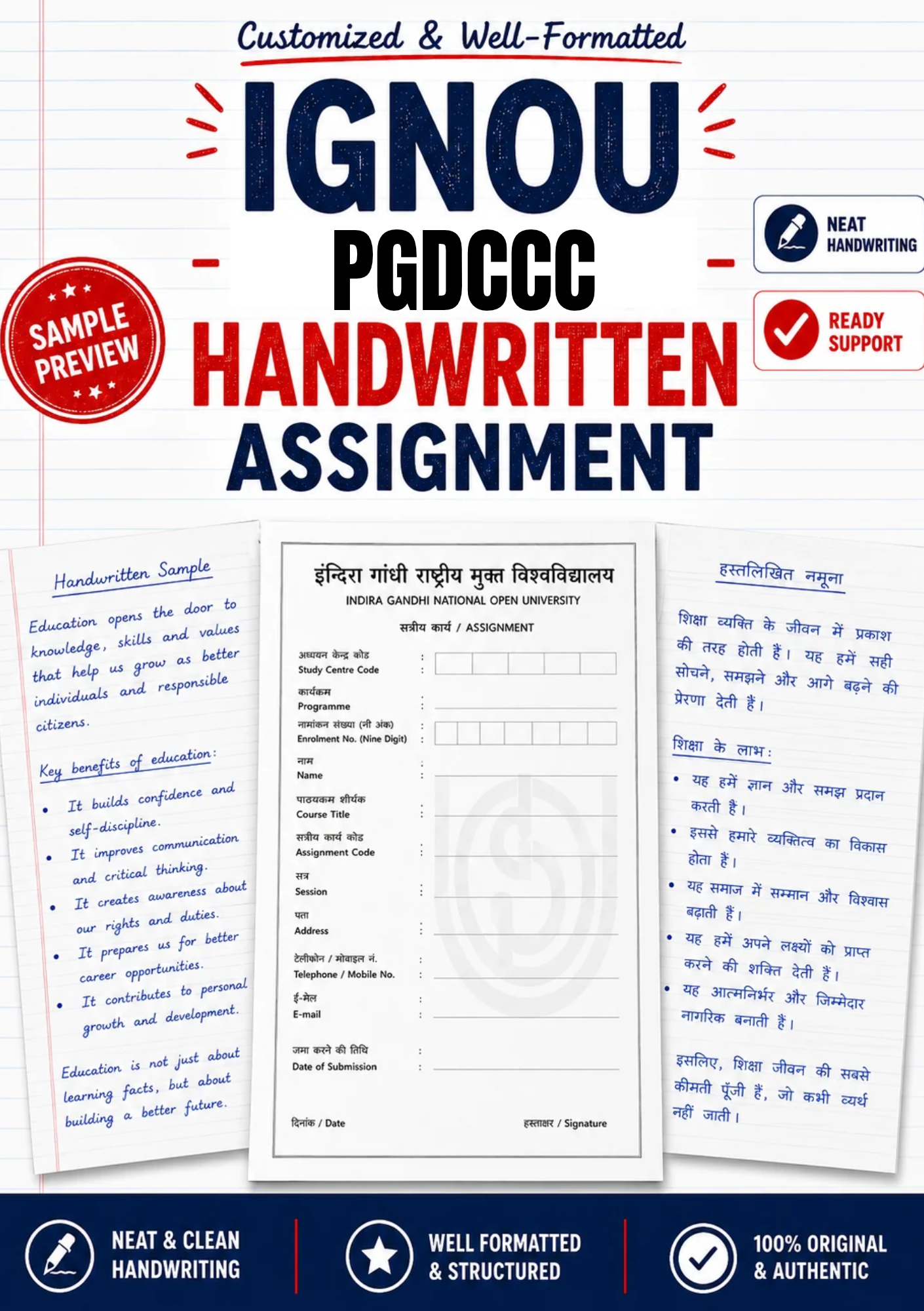
A PGDCCC order is built one course code at a time, and each code you pay for arrives as its own bundle inside one courier envelope. Opening it, you should be able to lay four things on the table for every code: the answer sheets written by hand, a front page in the IGNOU format with your details filled in, a copy of the question paper the answers were written against, and the courier packaging that brought it, which is already paid for.
The third item needs a word of explanation on this programme. Because no paper has been printed for PGDCCC itself, the question paper copy in your MEV-021 bundle will carry the heading of the Post Graduate Certificate in Climate Change, and the copy in your MSD-019 bundle will carry the heading of the Post Graduate Diploma in Environmental Studies. That is not a packing mistake. It is the paper IGNOU published for that course code, and the copy is included so that you, your study centre and the evaluator can see exactly which questions were answered.
The answer sheets follow the instruction line on that paper. On the PGCCC booklet each course has six questions, of which five are answered at twenty marks each, so a MEV-021 bundle carries five answers rather than six. The MSD-019 paper in the PGDEVS booklet has four questions at twenty-five marks, all compulsory, so that bundle carries four. Nothing is padded to look longer, and nothing is skipped to save time.
What does not arrive is anything electronic. No soft copy or PDF is sold. There is no scan sent ahead by email, no editable file and no download link, because the product is the written paper itself and a digital copy would only invite the confusion described in the comparison section below.
Pricing a PGDCCC Order Code by Code, and What the Rate Leaves Out
The rate is ₹320 per subject, hard copy only, with courier included in that price and no separate shipping charge. On PGDCCC that turns into simple arithmetic, provided you count only the codes that currently have a question paper.
Six codes have one as of 7 November 2026: MEV-021, MEV-022, MEV-023, MEV-024, MEV-025 and MSD-019. Writing all six comes to ₹1,920. The other four, MEV-026 Climate Change and Water, MEV-027 Climate Change and Energy, MEV-028 Climate Change and Agriculture and MEV-029 Climate Change and Disaster Risk Reduction, had no live assignment file anywhere this build could find on 7 November 2026. A set cannot honestly be written against questions that do not exist yet, so those four are not quoted, not pre-sold and not charged. When IGNOU publishes their papers, the full diploma at ten codes comes to ₹3,200, and you can add the four then without the earlier six being repriced.
There is no minimum order: one subject or fourteen, same rate. A learner who has already written MEV-021 and MEV-022 personally and wants help only with MEV-024 pays ₹320 for one bundle. A learner carrying MEV-023 from an earlier PGCCC attempt and now enrolled on PGDCCC pays the same per code as everyone else.
Several costs sit outside the rate because they are owed to IGNOU or arise after the parcel reaches you. The programme fee printed in the prospectus annexure for PGDCCC is Rs. 8,000, and any term-end examination fee is paid to the university, not to the publisher. If the paper you answer tells you to post your responses, the postage from your town to that address is yours. Photocopies you keep for your own record are yours too.
Delivery depends on your pin code and is confirmed for your order before you pay. No figure is promised on this page. That is deliberate: a delivery estimate printed on a product page would be wrong for most of the country on any given day, and the only number worth relying on is the one given for your address when you order.
A Climate Change Answer File Versus a PGDCCC Set You Sign: Which One the Counter Takes
Two things are sold in this space under names that sound alike, and climate change learners asking “solved assignment aur handwritten mein kya difference hai” are asking a fair question. A solved assignment is a soft-copy reference file of model answers for a course code and session, meant to be read while you prepare your own answers. A handwritten assignment is the answers written out by hand on A4 and submitted in hard copy at the point your paper names, which for most IGNOU papers is the study centre. One is something to learn from. The other is the thing you hand over.
| Question a PGDCCC learner asks | Solved assignment (soft copy) | Handwritten assignment (hard copy) |
|---|---|---|
| What form does it take? | A typed file you read on a screen or print | Pages written in ink, matched to your own hand |
| What do you do with it? | Study from it, then write your own answers | Read it, sign the declaration, attach the front page and submit it |
| Which climate change paper is it set against? | Whatever session and paper version the seller states on the file | The specific paper you name, with a copy of that paper enclosed |
| Who it suits | A learner who has time to write ten papers personally | A learner who cannot find that time before the cut-off |
| Price line | Priced per file on the solved-assignment shelf | ₹320 per subject, courier included |
Scroll sideways on a narrow screen to see every column.
IGNOU’s own papers settle which of the two can be submitted. The PGCCC 2024-25 booklet and the MAEVS second-year MEV-025 file both print the same instruction line, “Answer any five questions. All question carries equal marks.” The MAEVS file then asks for the answers in your own words, written by hand, on A4 sheets with the pages tagged, and handed to the coordinator of your study centre. A downloaded file, printed out, satisfies none of that, and an evaluator who receives typed pages has every reason to treat them as not submitted.
So the honest scope is this. A solved file is a reference to write from. It is not a submission, and this page does not sell one. If a reference file is what you are after for the five MEV codes you share with the certificate, the store keeps MEV 021 to MEV 025 reference files on the PGCCC solved-assignment shelf; no separate PGDCCC solved shelf exists. Whichever route you take, the responsibility for what is handed in stays with you. You sign the declaration on the assignment cover page, so you should read and review the content before submitting it, and satisfy yourself that it represents your own understanding of the course.
Assignments carry 30 per cent of the final course result and the term-end examination carries the remaining 70 per cent. That split is the reason the comparison matters: a reference file can help with the 70, but only a submitted set counts towards the 30.
Six PGDCCC codes can be written now, four are waiting on IGNOU. Tell the writing desk which of MEV-021 to MEV-025 and MSD-019 you owe, and which paper version your study centre or Regional Centre gave you.
₹320 per subject, hard copy, courier included, front page and question paper copy enclosed.
MEV-021 to MEV-029 Plus MSD-019: The Ten Papers in Section 8.43
The Common Prospectus July 2026 sets out PGDCCC in section 8.43, on pages 297 and 298, under the School of Interdisciplinary and Transdisciplinary Studies. Eligibility is graduation in any discipline from a recognised university, and the medium of instruction is English. The annexure row for the programme gives a minimum duration of one year, a maximum of three years, a fee of Rs. 8,000, year-wise structure, and admission in the January and July cycles.
The course table prints ten theory courses of four credits each and a stated total of forty. Ten times four is forty, so the extracted table checks out against the printed total before anything else on this page relies on it. There is no elective group, no optional course and no project: every PGDCCC learner holds the same ten codes.
| Code in section 8.43 | Title as section 8.43 prints it | Type | Credits | Same code also listed under |
|---|---|---|---|---|
| MEV-021 | Introduction to Climate Change | Theory | 4 | PGCCC (compulsory), MSCCC year one, MSCRWEE (elective) |
| MEV-022 | Impacts of Climate Change | Theory | 4 | PGCCC (compulsory), MSCCC year one |
| MEV-023 | Mitigation and adaptation to Climate Change | Theory | 4 | PGCCC (compulsory), MSCCC year one |
| MEV-024 | Climate Change Assessment Tools | Theory | 4 | PGCCC (optional), MSCCC year one, MAEVS (Semester III choice) |
| MSD-019 | Global Strategies to Sustainable Development | Theory | 4 | MSCCC year one, PGDEVS, MAEVS (Semester I), MASS (as MSD 19) |
| MEV-025 | Climate Change and Society | Theory | 4 | PGCCC (optional), MSCCC year one, MAEVS (Semester III choice), MASS (as MEV 25) |
| MEV-026 | Climate Change and Water | Theory | 4 | MSCCC year one |
| MEV-027 | Climate Change and Energy | Theory | 4 | MSCCC year one |
| MEV-028 | Climate Change and Agriculture | Theory | 4 | MSCCC year one |
| MEV-029 | Climate Change and Disaster Risk Reduction | Theory | 4 | MSCCC year one |
| Total printed in section 8.43 | 40 | Arithmetic check: 10 x 4 = 40 | ||
Scroll sideways on a narrow screen to see the last column.
Three features of this table shape everything that follows. First, the ten codes are exactly the first year of the M.Sc. in Climate Change in section 3.45, in the same order, and that section says learners leaving after the first forty credits may opt to receive the Post-Graduate Diploma in Climate Change. The same section then calls PGDCCC an existing programme also on offer on its own. So there are two ways to hold these ten codes: as a PGDCCC learner from the start, or as an MSCCC learner who exits after year one.
Second, the first five MEV codes are the whole content of the older Post Graduate Certificate in Climate Change in section 10.3. The certificate makes MEV-021, MEV-022 and MEV-023 compulsory and asks for one of MEV-024 or MEV-025, for sixteen credits. PGDCCC asks for all five and adds five more. That difference matters later, because the only booklet that sets the five MEV codes together was written for the certificate and carries the certificate’s rule.
Third, MSD-019 is the odd one out. It is a sustainable development code, not a climate code, and it belongs to an environmental studies and sustainability family that runs through PGDEVS, MAEVS and MASS. A PGDCCC learner therefore holds one paper whose questions are set by a different teaching team, on a different booklet, under a different code style.
The code style itself is printed two ways. Section 8.43 writes MEV-021 with a hyphen. Section 3.45 writes MEV 021 with a space, and the PGCCC booklet uses the space form on its course lines but the hyphen form inside the assignment code. None of these is wrong, and none needs correcting on your cover page. What matters is that you copy the assignment code line from the paper you answer, exactly as it is printed there, which the code-reading section below walks through.
Where Each PGDCCC Code Is Borrowed From: PGCCC, PGDEVS, MAEVS and MASS Papers
This is the section that makes PGDCCC unlike almost every other programme on the store. For most IGNOU diplomas, a learner opens the assignment server, finds the programme by name and downloads one booklet. For PGDCCC that route ends in an empty list. What follows is the map of where each code’s questions actually live, read off the files on 7 November 2026.
| PGDCCC code | Paper found | Programme on its cover | Assignment code as printed | Questions | Cut-off printed |
|---|---|---|---|---|---|
| MEV-021 | PGCCC assignment booklet, July 2025 and January 2026 sessions | PGCCC only | MEV-021/TMA/2025-26 | Six, answer any five, 20 marks each | 30 September 2025 (July 2025 cycle), 31 March 2026 (January 2026 cycle) |
| MEV-022 | Same PGCCC booklet | PGCCC only | MEV-022/TMA/2025-26 | Six, any five, 20 each | Same two dates |
| MEV-023 | Same PGCCC booklet | PGCCC only | MEV-023/TMA/2025-26 | Six, any five, 20 each | Same two dates |
| MEV-024 | Same PGCCC booklet | PGCCC only | MEV-024/TMA/2025-26 | Six, any five, 20 each | Same two dates |
| MEV-025 (version 1) | Same PGCCC booklet | PGCCC only | MEV-025/TMA/2025-26 | Six, any five, 20 each | Same two dates |
| MEV-025 (version 2) | MAEVS second-year file, January 2025 to July 2026 sessions | MAEVS only | MEV-025/TMA/ | Six, any five, 20 each | None; valid January 2025 to December 2026 |
| MEV-025 (version 3) | MASS-2/2026 file for the June and December 2026 term-ends | MASS only | MASS-2/2026 | Four, 25 marks each | 30 March (June), 30 September (December) |
| MSD-019 | PGDEVS assignment booklet, January 2025 to July 2026 sessions | PGDEVS only | MSD-019//TMA-01/January 2025 to July 2026 session | Four, answer all, 25 each | None; valid to December 2026 |
| MEV-026 to MEV-029 | No file found | Not applicable | Not printed anywhere read | Not published | Not published |
Scroll sideways on a narrow screen to see the cut-off column.
Read across the rows and the practical problem is plain. Not one of these covers names PGDCCC. The newest PGCCC booklet found is the 2025-26 edition for the July 2025 and January 2026 sessions, which predates the first PGDCCC intake. No 2026-27 climate change booklet of any kind was located. So a PGDCCC learner admitted in July 2026 has, strictly, no paper issued for their own cycle, and is relying on the instruction of their Regional Centre or the programme coordinators about which existing paper to answer.
MEV-025 is the sharpest case. Three different papers for the same code were live at once, each valid for a period that overlaps the others. The PGCCC 2025-26 version opens with the synergies and trade-offs between SDG 13 and the other goals. The MAEVS second-year version opens with the impacts of climate change on human society, which is word for word the opening question of the earlier PGCCC 2024-25 booklet, so the MAEVS file appears to be carrying the older certificate paper forward. The MASS-2/2026 version has only four questions, at twenty-five marks each, and opens with the relationship between vulnerability, exposure and risk. A learner who writes the wrong one has answered questions nobody set for them.
MSD-019 sits in a similar position. The PGDEVS booklet carries a full paper for it, with the doubled slash in its assignment code. The MASS-2/2026 file, by contrast, names MSD 019 only in a list of additional courses for lateral entry and sets no questions for it. If your study centre has told you to answer the environmental studies version, that is the one written. The same MSD-019 paper is also covered by the PGDEVS written set, which carries the same MSD-019 paper, and the second-year MEV-024 and MEV-025 files sit behind the MAEVS written set built on the second-year MEV-024 and MEV-025 files. The price is the same on all three pages; what differs is which paper your record needs.
The practical rule Shri Chakradhar Publication follows is short. Each PGDCCC set is written against a paper you name or send. If you do not know which version applies, the writing desk will ask before starting rather than guess, because a guessed MEV-025 has a two-in-three chance of being the wrong paper.
Twenty-Three Contradictions Around a Diploma With No Booklet, Four of Them on This Store
Everything in the box below was found by reading IGNOU’s documents against one another, and by reading this store’s own pages against this one. Eighteen items come from IGNOU’s files or from IGNOU’s files set against press coverage of the launch, one comes from a third-party site, and four are this publisher’s own. They are listed so you can check your paperwork against them, not to argue with the university.
Read these before you pick which paper to answer. Where two IGNOU documents disagree, the instruction of your Regional Centre or the programme coordinators decides.
1. No PGDCCC booklet. The PG Diploma list on webservices.ignou.ac.in carried PGDEVS and PGDSS rows on 7 November 2026, but no PGDCCC row and no link containing the word climate.
2. The university’s own programme page, ignou.ac.in/schools/programme/PGDCCC, returned “Programme details not found for code PGDCCC” when read on 7 November 2026, while the copy held in Google’s index lists course cards such as MEV-026 and MEV-027 at four credits with the label “Yearly 1”.
3. The PGCCC booklet’s opening letter asks for assignments for three compulsory courses and one optional course, yet prints five papers without saying which is optional. Section 8.43 gives PGDCCC no optional course at all, so a PGDCCC learner owes all five.
4. Three different MEV-025 papers were live at once: the PGCCC 2025-26 paper, the MAEVS second-year paper valid to December 2026, and the MASS-2/2026 paper for the June and December 2026 term-ends.
5. The MAEVS MEV-025 paper opens with the same question as the PGCCC 2024-25 paper, not the PGCCC 2025-26 paper, so two cycles’ questions circulate under one code.
6. The question count for MEV-025 changes by file: six with five answered on the PGCCC and MAEVS papers, four at twenty-five marks on the MASS-2 paper.
7. Three submission points apply to codes on one PGDCCC record. The PGCCC booklet sends responses to the programme coordinator at Block 15, Ground Floor, Maidan Garhi; the MAEVS and PGDEVS files send them to the coordinator of your study centre; the MASS-2 file sends them to the Regional Centre.
8. The PGDEVS booklet prints a full MSD-019 paper with the code MSD-019//TMA-01, doubled slash included, while the MASS-2/2026 file lists MSD 019 only as an additional course for lateral entry and sets no questions.
9. Three date regimes apply: the PGCCC booklets tie 30 September and 31 March to admission cycles, the MASS-2 file ties 30 March and 30 September to term-end sittings, and the MAEVS and PGDEVS files print no date at all, only a validity window.
10. The PGCCC booklet’s March date is the 31st; the MASS-2 file’s March date is the 30th. Both are SOITS documents.
11. The June 2026 term-end papers for MEV-022 and MEV-024 are headed Post Graduate Certificate in Climate Change, so a PGDCCC learner sits an examination printed under another programme’s name.
12. The newest PGCCC booklet found is the 2025-26 edition; no 2026-27 climate change booklet was located, although the first PGDCCC intake is July 2026.
13. No live assignment file was found for MEV-026, MEV-027, MEV-028 or MEV-029.
14. The minutes of IGNOU’s 67th Academic Planning and Coordination meeting, held on 1 June 2023, approved the M.Sc. in Climate Change proposal with a proposed launch of January 2024 and recommended a standalone PG Diploma. Press reports in June 2026 describe both as launched for the July 2026 session.
15. Section 3.45 calls PGDCCC an existing programme, while a June 2026 report from the Andaman and Nicobar Islands describes IGNOU as having introduced it for the July 2026 session.
16. The lateral-entry footnote under section 8.43 names PGCCC, the sixteen-credit certificate, not the forty-credit diploma it sits under.
17. The header row of the section 8.43 table prints “Title of the Course” twice, where section 3.45 prints a Type of Course column.
18. Titles change case between documents: MEV-023 is “Mitigation and adaptation” in sections 8.43 and 10.3 but “Mitigation and Adaptation” in section 3.45 and on the booklet, and the M.Sc. Renewable Energy elective list prints MEV 021 as “Introduction to climate change”. The programme coordinator is printed as Dr. V. Venkatramanan in sections 8.43 and 3.45, Prof. V. Venkat Ramanan in section 10.3, and Dr. V. Venkat Ramanan on the PGCCC booklets.
19. Third party. One education news site reporting the M.Sc. launch abbreviates the exit diploma as PGDCC, which is the abbreviation of IGNOU’s earlier Post Graduate Diploma in Clinical Cardiology, an unrelated medical programme. Searching that abbreviation returns cardiology results.
20. In-house. This store has no PGDCCC shelf for books, solved assignments, guess papers or projects. The nearest shelves are PGCCC ones, and those are duplicated: two PGCCC book categories (one filed under diploma books with one product, one under certificate books with three), two PGCCC guess-paper categories (one and three products), and a PGCCC previous-year category with no products.
21. In-house. The store’s handwritten hub category still states two working-day delivery windows, speaks in the first person, and describes handwritten sets as study reference material not for submission as your own work. This page states no delivery figure and describes the set as a submission you review and sign; the hub is the page that needs correcting.
22. In-house. The store’s MSCCC product title counts sixteen codes that carry a paper, while its own body notes that several codes in the MEV 026 to MEV 031 range had no published file. This build found no file for MEV-026 to MEV-029.
23. In-house. The sister site ignouproject.com has no PGDCCC article, and its MSCCC article title counts sixteen codes where the MSCCC product counts eighteen.
Two of these matter more than the rest for a learner about to order. Items 3 and 4 decide how many papers you owe and which MEV-025 you write. Items 7 and 9 decide where and by when you hand them in. If your Regional Centre has already answered those four points for you, the remaining items are background.
No PGDCCC Date Exists Yet: The Three Cut-Off Regimes Your Borrowed Papers Carry
Most product pages on this store can name two submission dates read off the programme’s own booklet. PGDCCC cannot, because there is no programme booklet to read them from. What can be said is which dates the borrowed papers print, and how they differ.
| Which file | Cut-off tied to the June term-end | Cut-off tied to the December term-end | Hand it to |
|---|---|---|---|
| PGCCC booklets 2024-25 and 2025-26 (MEV-021 to MEV-025) | 31 March, for the January cycle | 30 September, for the July cycle | Programme coordinator, Block 15, Maidan Garhi |
| MASS-2/2026 (MEV-025 version 3) | 30 March | 30 September | Regional Centre |
| MAEVS second-year and PGDEVS files (MEV-025 version 2, MSD-019) | No date printed | No date printed | Coordinator of your study centre |
Scroll sideways on a narrow screen to see the last column.
The PGCCC dates are printed against cycles rather than sittings. The 2025-26 booklet gives 30 September 2025 for the July 2025 cycle, linked to the December 2025 term-end, and 31 March 2026 for the January 2026 cycle, linked to the June 2026 term-end. The 2024-25 booklet repeats the pattern a year earlier. Both of those dates have passed, which is why item 12 in the box above matters: the dated papers in circulation belong to cycles before PGDCCC existed.
The MAEVS and PGDEVS files print a validity window instead of a date, running from January 2025 to December 2026, and say only that responses must reach the study centre within the stipulated time to keep you eligible for the term-end examination. That window closes at the end of December 2026, so a PGDCCC learner relying on either file should expect it to be replaced for 2027.
On top of the printed dates sit the university-wide notices. For the December 2026 term-end, press reports at the end of October 2026 described an extension of the assignment window first to 31 October and then, through an online assignment management system on Samarth, to 20 November 2026, with the term-end examination starting on 25 November 2026. Those reports are about IGNOU as a whole; none of them mentions PGDCCC by name.
The question that none of the documents read answers is which term-end sitting a July 2026 PGDCCC admission first sits. PGDCCC is year-wise, and the documents read do not say whether that first sitting is December 2026 or June 2027. Check your admission record and ask your Regional Centre; once you know the sitting, the cut-off follows from the paper you have been told to answer.
Assignments carry 30 per cent of the final course result and the term-end examination carries the remaining 70 per cent. A paper that misses its cut-off does not carry over silently: question papers expire with their cycle and are replaced, and a late learner is normally told to answer the next cycle’s questions instead. If your Regional Centre gives you a date, that date is the real deadline and the only urgency worth acting on.
MEV-021/TMA/2025-26, MEV-025/TMA/ and MASS-2/2026: Copying the Right String Onto Your Cover
The front page asks for an assignment code, and on PGDCCC there is no single format to give you, because each borrowed paper writes it differently. The rule is to copy the string from the paper you actually answer, character for character, and not to tidy it.
On the PGCCC booklet the string is the course code with a hyphen, then TMA, then the session span: MEV-021/TMA/2025-26, MEV-022/TMA/2025-26 and so on to MEV-025. The earlier 2024-25 booklet used MEV-021/TMA/2024-25. The course line on the same page writes the code with a space, MEV 021, which is why learners sometimes write both forms on one cover. The course code field takes the course code; the assignment code field takes the full string.
On the MAEVS second-year MEV-025 file the string is printed as MEV-025/TMA/ with a trailing slash and nothing after it. That is how the file prints it, and it is safer to copy it as printed than to invent a session suffix the paper does not carry.
On the MASS-2/2026 file there is no course-level assignment code at all. The page carries an assignment number for the whole year’s papers, MASS-2/2026, and the course is identified separately as MEV-025. If that is the version you have been told to answer, those are the two fields to fill.
On the PGDEVS booklet the MSD-019 string is MSD-019//TMA-01/January 2025 to July 2026 session. The doubled slash is IGNOU’s typing, not a code variant, and it can be copied as printed; writing a single slash is not an error either, since the course and session are unambiguous.
Shri Chakradhar Publication fills the front page from the paper your set is written against, so the code on your cover will match the question paper copy in the same bundle. If the string you were given by your study centre differs from the one on the paper, say so in your order message and the front page will follow your centre’s instruction.
One Photographed Page, Ten Climate Papers in the Same Hand
Send a photo of a page you have written yourself and the handwritten set is matched to your handwriting at no extra charge. On PGDCCC that matters more than usual, because your ten papers will eventually come from four or five different files and may reach two different counters. A single consistent hand across every bundle is what makes the set read as one learner’s work, whichever office receives it.
The match works from letter shapes, slant, spacing and the way you break a line, so the writing desk needs to see a page of continuous writing, not a signature or a single line. The sample page written back to you on WhatsApp is the check: if it does not look like your hand, say so and it is redone before anything else is written.
The page worth photographing before a climate change order
Photograph a page of ordinary notes written in the pen you normally use, in daylight, with the whole page in frame and the phone held flat above it. A page of answers from a past assignment or notes from a climate change unit works well because it shows how you write technical terms, abbreviations such as GHG and SDG, and numbers. Avoid a page written slowly for the photo; the hand you write in under time pressure is the hand an evaluator would recognise.
English Medium Only, Papers From the PGCCC Cycles, and Codes You Still Owe
The service covers all mediums IGNOU issues the TMA paper in, at the same price. For PGDCCC that means English alone. Section 8.43 gives English as the medium of instruction, the annexure row repeats it, and every climate change paper read for this page was printed in English. No Hindi edition of any PGDCCC code turned up among the files read.
Any session is accepted, current cycle or older, including backlog courses, at the same ₹320 per subject. On this programme the older-session question has an unusual shape. Because the only dated papers for MEV-021 to MEV-025 belong to the PGCCC cycles of 2024-25 and 2025-26, a learner told by their Regional Centre to answer one of those papers is, in effect, answering an older-session paper even if they enrolled in July 2026. That is accepted in exactly the same way, and the set is written against the edition you name.
Learners who began on the certificate and later joined the diploma sometimes ask whether old PGCCC work carries across. Whether earlier credits transfer is a decision for the university under its credit transfer rules, not something a publisher can confirm. What can be said is practical: if the university asks you for a fresh MEV-024 or MEV-025 under PGDCCC, it is priced like any other code, and if it does not, you do not need to order it.
The same applies to learners exiting the M.Sc. after year one. Their ten codes are identical to PGDCCC’s, and a set for any of them is written in the same way. Those staying on for the second year will find the full eighteen-code picture on the MSCCC handwritten product for learners staying on for the second year, which covers the second-year compulsory and optional codes this page does not.
What the First WhatsApp Message for a PGDCCC Quote Should Carry
A PGDCCC quote needs five things, and only five. Sending them together in one message saves a round of questions.
- The codes you owe. List them as they appear on your admission record, for example MEV-021, MEV-022, MEV-023, MEV-024, MEV-025 and MSD-019. Leave out any you have already submitted.
- The paper version for each code. Say whether your study centre or Regional Centre gave you the PGCCC booklet, the MAEVS file, the MASS-2 file or the PGDEVS booklet, or send a photo of the first page of the paper you were given. For MEV-025 this is essential.
- Your medium. English, which is the only medium PGDCCC is printed in.
- A photo of your handwriting. One full page of your ordinary writing, as described in the handwriting section above.
- Your pin code. The courier estimate is worked out from it and confirmed to you before payment.
Your enrolment number, name and study centre code go on the front page, so include them if you have them to hand, but a quote can be given without them. Nothing else is needed: no copy of your fee receipt, no identity document, no password for any IGNOU portal.
Send the five PGDCCC details in one message for a ₹320-per-subject quote
Not sure which of your ten climate codes has a paper yet? Ask before you order. The writing desk will tell you which codes can be written now, which version of MEV-025 your record points to, and which codes are still waiting on IGNOU.
₹320 per subject, hard copy, courier included, no minimum number of codes.
Block 15, the Study Centre or the Regional Centre: After the PGDCCC Parcel Arrives
When the envelope is open, the remaining steps are yours, and on PGDCCC the most important one is deciding where each bundle goes. Do this calmly, a few days before the cut-off rather than on the day.
Start by checking each bundle against your list. The code on the front page should match the code on the question paper copy, and both should match the code on your admission record. If anything differs, say so on WhatsApp before you submit, not after.
Then read every answer. You sign the declaration on the assignment cover page, so you should read and review the content before submitting it, and satisfy yourself that it represents your own understanding of the course. Reading the set is also the cheapest revision you will get for the term-end paper, which carries the other 70 per cent.
Next, sign the declaration, attach the front page, and tie or tag the pages if the paper asks for it; the PGCCC booklet asks for numbered and tied pages, and the MAEVS and PGDEVS files ask for tagged A4 sheets. Keep a photocopy of every bundle, as the booklets advise.
Then hand each bundle to the point its paper names, unless your Regional Centre has told you otherwise. Papers from the PGCCC booklet name the programme coordinator at Block 15, Ground Floor, IGNOU, Maidan Garhi, New Delhi, which in practice means posting them. Papers from the MAEVS and PGDEVS files name the coordinator of your study centre. The MASS-2 paper names the Regional Centre. Ask for a receipt wherever you submit by hand, and keep the postal receipt if you post.
Finally, watch the assignment status page on the IGNOU site in the weeks after submission. For the December 2026 term-end, press reports also describe an online upload route through the university’s online assignment management system on Samarth; whether your centre wants a scanned copy uploaded in addition to the paper is a question for your centre. Delivery depends on your pin code and is confirmed for your order before you pay. No figure is promised on this page.
Climate Change Shelves on This Store That a PGDCCC Learner Can Use
Because the store has no shelf named PGDCCC yet, the useful material for this diploma sits under the certificate and under the environmental programmes that share its codes. For revision of the five MEV codes, there are PGCCC help books for MEV 021, MEV 022 and MEV 023, and for term-end practice there are PGCCC guess papers drawn from earlier MEV sittings, which is useful because the June 2026 MEV-022 and MEV-024 papers were set under the certificate’s heading.
MEV-025 also appears in the sustainability degree, and if your Regional Centre has pointed you to the MASS-2 version of that paper, the MASS handwritten listing where MEV 025 sits in year two describes that file in detail. MEV-021 is also taken as an elective in the renewable energy degree, and the renewable energy degree set that takes MEV 021 as an elective covers that programme’s paper and its separate physical rules.
If your record mixes PGDCCC codes with papers from another programme, or carries an older code this page does not list, an open written order for any code and any session takes the whole list in one go. For every other programme the university runs, the store keeps handwritten listings for the rest of IGNOU’s programmes in one place.
Learners who would rather write the set themselves can start from the sister site’s MSCCC write-up, which covers the same ten first-year codes for learners doing their own writing. There is no PGDCCC article there yet, and the MSCCC one is the nearest match because the first year of the degree and the whole diploma are the same ten courses.
Fifteen PGDCCC Questions, Most of Them About Missing Paperwork
Does IGNOU publish an assignment booklet for PGDCCC?
Not under that name, as of 7 November 2026. The PG Diploma list on the university’s assignment server had no PGDCCC row, and no climate change booklet for 2026-27 was found. The five MEV codes PGDCCC shares with the certificate are set in the PGCCC booklet, MSD-019 is set in the PGDEVS booklet, and MEV-026 to MEV-029 had no paper at all.
Teen alag MEV 025 paper mil rahe hain, PGDCCC wale learner ko kaunsa likhna hai?
Three versions were live together: the PGCCC 2025-26 paper, the MAEVS second-year paper and the MASS-2/2026 paper. None of them names PGDCCC, so no document read for this page can choose for you. Ask your Regional Centre or the programme coordinators which version applies to your cycle, and send that answer with your order; the set is written against the version you name.
My PGCCC booklet says three compulsory papers and one optional. Can a PGDCCC learner leave one out?
No. That rule belongs to the sixteen-credit certificate, which asks for MEV-021, MEV-022 and MEV-023 plus one of MEV-024 or MEV-025. Section 8.43 lists all ten PGDCCC courses with no optional group, so a diploma learner owes MEV-024 and MEV-025 both.
If I exit the M.Sc. Climate Change after year one, do I order from this page or the MSCCC page?
Either works for the ten first-year codes, because they are identical and priced identically. Order here if the diploma is your goal. Order from the MSCCC product if you are continuing into the second year, so that the second-year codes can be quoted in the same message.
PGDCCC assignment ki last date kya hai?
No PGDCCC date has been printed, because there is no PGDCCC booklet. The PGCCC booklets print 31 March and 30 September by admission cycle, the MASS-2 file prints 30 March and 30 September by term-end, and the MAEVS and PGDEVS files print no date. For the December 2026 term-end, press reports describe a university-wide window to 20 November 2026. Confirm your own sitting with your Regional Centre.
Why does my MEV-022 exam paper say Post Graduate Certificate in Climate Change at the top?
Because IGNOU printed it that way. The June 2026 term-end papers for MEV-022 and MEV-024 both carry the certificate’s heading. The course code is what identifies the paper, and PGDCCC learners sit the same MEV papers as certificate learners.
Is there any assignment yet for MEV-026, MEV-027, MEV-028 and MEV-029?
None was found on 7 November 2026, on the university’s assignment server or in its course-wise files. Those four are therefore not quoted on this page. When IGNOU publishes their papers, they can be added to an existing order at ₹320 each.
Which MSD-019 paper does a climate change diploma learner answer?
The only full MSD-019 paper read for this page is in the PGDEVS booklet, with four questions at twenty-five marks, all compulsory, valid to December 2026. The MASS-2/2026 file names MSD 019 without setting questions for it. Unless your centre names a different paper, the PGDEVS version is the one written.
Can I print a solved PGDCCC answer file and hand that in instead?
That is not what the papers ask for. The climate change papers read for this page ask for answers in your own words, and the MAEVS file asks for them handwritten on A4. A printed solved file is a reference to write from, not a submission, and this page does not sell one.
Solved assignment se kaam chal jayega, ya climate change ke papers haath se hi likh kar jama karne padenge?
For submission, by hand. A solved file helps you understand the answers; the set you hand over has to be handwritten, and in the hand of the person signing the declaration. That is why the handwritten set is matched to your own sample page.
Does the handwritten set come with a PDF I can keep for revision?
No soft copy or PDF is sold. What you can keep for revision is the photocopy you make of each bundle before submitting it, along with the question paper copy that comes inside every bundle.
Is PGDCCC offered in Hindi medium?
No. Section 8.43 and the annexure both give English, and every climate change paper read for this page was printed in English only. The sets are written in English.
Do I post my set to Block 15 at Maidan Garhi, or take it to my study centre?
It depends on the paper you answer. The PGCCC booklet names the programme coordinator at Block 15, the MAEVS and PGDEVS files name your study centre coordinator, and the MASS-2 file names the Regional Centre. If your Regional Centre has given you one instruction for all ten codes, follow that instruction.
Can I order MEV-021 alone now and add the other codes later?
Yes. Each code is priced on its own at ₹320, and later codes are added at the same rate. Ordering one first is also a sensible way to see the matched handwriting before committing to the rest.
Can the publisher promise the set will be accepted or score well?
No claim is made about the marks any assignment will receive, about how an evaluator will assess it, or about whether it will be accepted. Assignment evaluation is entirely a matter for IGNOU.
Section 8.43, Three PGCCC-Era Booklets, Two June 2026 Exam Papers and the Store’s Terms, Labelled Apart
Three kinds of source sit behind this page, and they do not carry the same authority, so each is labelled.
Source one: the IGNOU Common Prospectus July 2026. Section 8.43 (pages 297 and 298) for the PGDCCC course table, eligibility, medium and coordinators; section 3.45 for the M.Sc. Climate Change structure and the exit to PGDCCC; section 10.3 for the PGCCC certificate; sections 3.42, 8.41 and 3.41 for MAEVS, PGDEVS and MASS, the other programmes carrying MEV-024, MEV-025 and MSD-019; the M.Sc. Renewable Energy elective list for MEV 021; and the annexure rows for PGDCCC and PGCCC. Course titles and credits on this page are as the prospectus prints them, including its spelling.
Source two: IGNOU’s live papers and pages, read on 7 November 2026. The PGCCC assignment booklets for 2024-25 and 2025-26 on the university’s assignment server, including the 2025-26 PGCCC booklet that sets MEV-021 to MEV-025; the PGDEVS booklet for January 2025 to July 2026 for MSD-019; the SOITS MAEVS second-year MEV-025 file; the SOITS MASS-2/2026 file; the PG Diploma assignment list; the June 2026 term-end papers for MEV-022 and MEV-024; the programme page for PGDCCC; and the minutes of the 67th Academic Planning and Coordination meeting. Current papers can be downloaded from IGNOU’s student-service page for assignment downloads, and the university’s main site is ignou.ac.in. Press reports of June and October 2026 were read for the launch and the December 2026 extension and are identified as press wherever used.
Source three: the publisher’s own commercial terms. The rate, the hard-copy-only format, courier inclusion, the free front page, the question paper copy, the handwriting match, the absence of a minimum order and the delivery policy are Shri Chakradhar Publication’s terms, not IGNOU’s, and are stated as such.
Written and reviewed by BK Sahni, Founder, Shri Chakradhar Publication Pvt. Ltd. and ignouproject.com, who has guided 5,00,000 students till date. ORCID 0009-0005-8092-459X.
Important Notice
Shri Chakradhar Publication Pvt. Ltd. and shrichakradhar.com form an independent IGNOU study-support publisher. This is not the official website of Indira Gandhi National Open University, is not affiliated with, endorsed by or authorised by the university, and no page on this site should be treated as an official IGNOU communication.
Programme structures, course codes, submission dates and rules change, and only ignou.ac.in and your Regional Centre can confirm the current position for your enrolment.
You sign the declaration on the assignment cover page, so you should read and review the content before submitting it, and satisfy yourself that it represents your own understanding of the course.
No claim is made about the marks any assignment will receive, about how an evaluator will assess it, or about whether it will be accepted. Assignment evaluation is entirely a matter for IGNOU.
Send Your Ten PGDCCC Codes, or Just the Ones Still Pending
The rate is ₹320 per subject, hard copy only, with courier included in that price and no separate shipping charge. Six climate change codes can be written against the papers IGNOU had live on 7 November 2026, and the other four are added when the university publishes them.
Message your pending PGDCCC papers for writing at ₹320 per subject
Prefer to call or type the number yourself? WhatsApp +91 93546 37830 with your codes, paper version, a handwriting photo and your pin code.