

Description
In short. This product supplies handwritten answer sets for the four papers of the IGNOU Post Graduate Diploma in Animal Welfare, MAW-001 Animal Welfare Science and Ethics, MAW-002 Animal Welfare Issues, MAW-003 Animal Welfare Laws, Policies and Organizations and MAW-004 Animal Welfare Practices, Economics and Livelihood, each of them an eight-credit course and together the whole thirty-two-credit diploma. The rate is ₹320 per subject, hard copy only, with courier included in that price and no separate shipping charge. Every set is written out by hand on A-4 sheets from the current PGDAW sheet published by the School of Extension and Development Studies, and it arrives with a free IGNOU-format front page and a copy of the official question paper it answers. The 2026-27 PGDAW sheets print 31 March 2027 as the last date for the July 2026 session and 30 September 2027 for the January 2027 session, and they instruct a PGDAW learner to speed post the completed set to the Programme Coordinator at the School of Extension and Development Studies rather than to hand it in at a study centre counter. Any session is accepted, current cycle or older, including backlog courses, at the same ₹320 per subject.
Four MAW Bundles, and What Travels Inside Each One
A PGDAW order is counted in papers, not in years, because the diploma has only one year and only four courses in it. Whether a learner orders one MAW number or all four, each paper is prepared and packed as its own bundle, with its own front page and its own copy of the question sheet clipped to the answers. That matters more on this programme than on most, because the booklet asks for the pages of each course to be tied or stapled together course wise, so the packet arrives already sorted the way the instruction page asks for it.
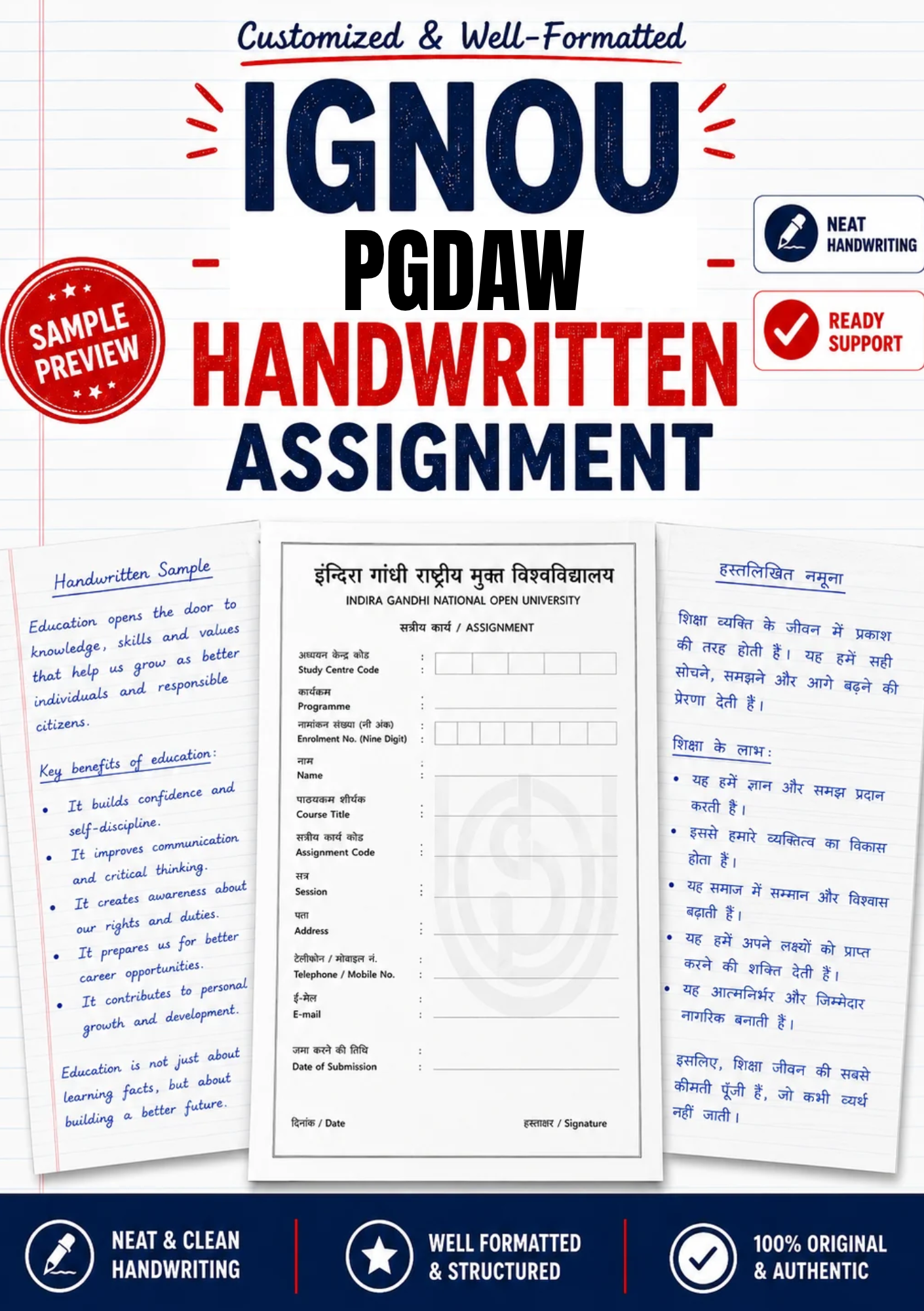
Inside a single MAW bundle there are four physical things. The first is the answer set itself, five answers to the five questions printed on that course’s sheet, written by hand in ink on A-4 paper. The second is the IGNOU-format front page, left ready for the learner’s own enrolment number, admission session and Regional Centre, since those are the fields the PGDAW sheet asks to see on the first page of each course. The third is a printed copy of the official question paper that the answers were written against, so the two can be checked side by side before anything is signed. The fourth is nothing more exotic than packing, because courier is included in that price and no separate shipping charge.
No soft copy or PDF is sold. There is no file to download after payment, no emailed copy of the answers and no scanned version held back for later, and that is a deliberate scope decision rather than an oversight. The thing being bought is paper with handwriting on it.
Pricing a Thirty-Two-Credit Diploma One Paper at a Time
PGDAW is unusual among IGNOU post graduate diplomas in how few, and how heavy, its courses are. The Common Prospectus July 2026 gives it four courses of eight credits each, thirty-two credits in total, where the development studies and corporate social responsibility diplomas run by the same school are built from six-credit courses and reach thirty-six. Eight credits is a master’s-sized course, and the answer sheet reflects it: five questions, twenty marks each, a maximum of one hundred, and about eight hundred words asked for each answer on the current sheet.
Pricing follows the paper, not the credit. The rate is ₹320 per subject, hard copy only, with courier included in that price and no separate shipping charge. An eight-credit MAW paper and a six-credit paper on another diploma are billed identically, which on this programme works in the learner’s favour, because a PGDAW answer is roughly a third longer than the six-hundred-word answers the older sheets asked for. There is no minimum order: one subject or fourteen, same rate.
Two things sit outside the ₹320. The first is the posting of the finished set, which on PGDAW is the learner’s own act and is described further down this page. The second is anything to do with evaluation. No claim is made about the marks any assignment will receive, about how an evaluator will assess it, or about whether it will be accepted. Assignment evaluation is entirely a matter for IGNOU.
Delivery depends on your pin code and is confirmed for your order before you pay. No figure is promised on this page.
A Downloaded MAW Answer File Is Not the Thing You Post to Maidan Garhi
Two different products answer the same four MAW question papers, and learners searching for help on this diploma meet both without always being told how they differ. A solved assignment is a soft-copy reference file of model answers for a course code and a session, read on a phone or printed for study. A handwritten assignment is the answers written out by hand on A-4 sheets and submitted as a hard copy, which on PGDAW means a parcel sent to the Programme Coordinator rather than a bundle handed across a study centre counter. The first is something to write from. The second is something to sign.
IGNOU settles the question itself on the sheet. The general instructions on the 2026-27 MAW-003 paper tell the learner to write in their own handwriting, and state that only handwritten assignments are evaluated
. The same instruction page asks for A-4 plain or ruled paper, for writing on both sides of the sheet with a margin, for the question number to be written beside each answer, and for the pages of each course to be tied or stapled together separately. A printout of a model-answer PDF satisfies none of that, whatever the file is called when it is downloaded.
| Compared on | MAW solved assignment | MAW handwritten set |
|---|---|---|
| Physical form | Soft-copy file, read or printed by the learner | Ink on A-4 sheets, written by hand |
| What a learner does with it | Reads it, takes points from it, writes their own answers | Reads it, checks it against the question paper, signs the front page and posts it |
| Who it suits | A learner who intends to write the four papers personally and wants model answers to work from | A learner who is short of writing time across thirty-two credits of eight-credit courses |
| What IGNOU’s PGDAW sheet says about it | Nothing: the sheet makes no provision for a printed answer file | The instruction page asks for the learner’s own handwriting and says handwritten work alone is evaluated |
| Price on this store | Priced per code on the diploma solved-assignment shelf | ₹320 per subject, courier included |
Scroll sideways on a phone to read the full table.
Both have a legitimate place, and a learner who wants model answers rather than a written set should go to the diploma solved-assignment shelf, where soft-copy model answers for diploma codes are listed, rather than ordering here. This page sells the written set and nothing else. It does not sell a PGDAW solved assignment, and it should not be read as offering one.
Four papers, thirty-two credits, one rate. MAW-001 to MAW-004 at ₹320 per subject, hard copy, courier included, any session including backlogs.
MAW-001 to MAW-004: The Whole of the PGDAW Code List
There is no elective on this diploma, no project course and no laboratory paper. Every learner admitted to PGDAW owes the same four codes, in the same order, with the same weight attached to each, which makes it one of the very few IGNOU programmes where two classmates can compare order lists and find them identical. The table below is taken from section 8.21 of the Common Prospectus July 2026, with the assignment numbers added from the PGDAW sheet itself, where each course is published as one numbered assignment.
| MAW number | Prospectus wording for the title | Credit weight | Printed on the sheet as |
|---|---|---|---|
| MAW-001 | Animal Welfare Science and Ethics | 8 | ASSIGNMENT – 1 |
| MAW-002 | Animal Welfare Issues | 8 | ASSIGNMENT – 2 |
| MAW-003 | Animal Welfare Laws, Policies and Organizations | 8 | ASSIGNMENT – 3 |
| MAW-004 | Animal Welfare Practices, Economics and Livelihood | 8 | ASSIGNMENT – 4 |
| Total | Four courses, no elective, no project | 32 | Four numbered assignments |
Scroll sideways on a phone to read the full table.
The arithmetic is worth doing rather than trusting, because an extracted table can pick up a neighbouring programme’s rows. Four courses at eight credits each come to thirty-two, and thirty-two is the total the prospectus prints at the foot of the same table. The MAW prefix appears nowhere else in the Common Prospectus July 2026 other than in these four rows, so there is no second programme quietly issuing the same codes and no shared pool to check against.
The prospectus also records what the diploma does not have. It states that a PGDDVS holder may take lateral entry into the second year of the development studies master’s, and that a PGDCSR holder may transfer credits into the corporate social responsibility master’s. It records nothing of the kind for PGDAW. There is no animal welfare master’s at IGNOU for the four MAW papers to feed into, which is why a PGDAW order is a single closed list rather than the first half of a longer one.
The Fifth Code on IGNOU’s Own Programme Page, and Why Nobody Writes It
IGNOU’s live PGDAW programme page lists the four MAW courses correctly, at eight credits each, all marked Year 1. It then adds a fifth row. The row reads BRLP-103, Internship, workbook and viva-voce, twelve credits, Semester 6. PGDAW has no sixth semester. It has no semesters at all, being a year-wise programme with a minimum duration of twelve months, and it has no internship, workbook or viva-voce component anywhere in its prospectus entry.
BRLP is the retail code family. In the Common Prospectus July 2026 the BRLP codes belong to the retail bachelor’s structure, where BRLP 101 is worth sixteen credits and BRLP 102 and BRLP 103 are worth twelve each. So the live page has not only attached a code from another programme to a four-paper diploma, it has also attached the wrong title to it: the prospectus prints BRLP 103 as On the Job Training, Workbook and Viva-Voce, and gives the Internship wording to BRLP 101 instead.
None of this changes what a PGDAW learner owes. The prospectus closes the programme at thirty-two credits across four courses, the School of Extension and Development Studies publishes exactly four numbered assignments for it, and no BRLP sheet is issued under the PGDAW name. A written set is prepared for MAW-001 to MAW-004 and for nothing else. The row is worth knowing about only so that a learner who has seen it on the university’s own site does not go looking for a fifth paper that was never set.
Twenty Places the PGDAW Record Argues With Itself
Everything below was found by reading IGNOU’s own documents against each other, and by reading this store’s own listings against both. Four of the twenty are this publisher’s own errors, and they are printed here with the rest rather than quietly fixed and forgotten.
Conflicts found while this page was being prepared, 22 October 2026.
1. IGNOU’s live PGDAW programme page adds BRLP-103 at twelve credits in a Semester 6 to a programme the Common Prospectus closes at thirty-two credits across four year-one courses.
2. That same row carries the title Internship, workbook and viva-voce, which the prospectus assigns to BRLP 101; the prospectus title for BRLP 103 is On the Job Training, Workbook and Viva-Voce.
3. The live page marks the four MAW papers Year 1 and the BRLP row Semester 6, putting a year-wise structure and a semester-wise structure on one screen.
4. One course code is published in at least four renderings: MAW-001 on the 2026-27 sheet, MAW -001 with a space before the hyphen on the July 2023 and January 2024 booklet, MAW-01 inside the file name MAW-01(E)(2025).pdf, and MAW 1 on this store’s own guess-paper listings.
5. Within the July 2023 and January 2024 booklet, assignments one and two print the code with that extra space while assignments three and four print it closed.
6. The July 2024 and January 2025 paper is published twice, as a consolidated PGDAW booklet on the webservices server and as MAW-01(E)(2025).pdf on the main site, with the same sessions and the same dates inside both.
7. That second file name carries the year 2025, while the sessions printed inside it are July 2024 and January 2025.
8. Its (E) marker is the convention IGNOU uses where a Hindi counterpart exists, on a programme the prospectus and the live programme page both record as English only.
9. The naming convention has changed three times in four cycles: one consolidated PDF per cycle up to 2024-25, then MAW-002-25-26.pdf, then PGDAW-MAW-001-26-27.pdf. Finding one pattern does not surface the others.
10. Length guidance changed between cycles. The 2023-24 and 2024-25 sheets ask for around six hundred to eight hundred words an answer; the 2025-26 and 2026-27 sheets ask for around eight hundred.
11. No TMA string is printed anywhere on a PGDAW sheet. The identifier is the word ASSIGNMENT with a number beside it, plus a separate course-code line.
12. The sheets do not send a PGDAW learner to a study centre. They instruct a speed post to the Programme Coordinator at Block 15-F, School of Extension and Development Studies, IGNOU, Maidan Garhi, New Delhi 110068.
13. The same first page nevertheless asks the learner to write in their Regional Centre, which is not where the parcel goes.
14. The instruction page asks for writing on both sides of the sheet with a margin, where many study centre notices and this store’s own handwritten hub describe single-sided A-4 ruled sets.
15. The sheet tells a learner to answer the most recent paper on the website whatever year or session they registered in, which cuts directly against the common belief that a backlog learner answers the paper of their own admission year.
16. A widely circulated aggregator article on IGNOU assignment deadlines presents one general cut-off of 15 June 2026 and distinguishes no school and no programme, where the PGDAW sheets print 31 March 2027 and 30 September 2027.
17. Study centre notices commonly attach 31 March and 30 September to the June and December term-end examinations, while the PGDAW sheet attaches the same two dates to the July and January sessions.
18. This store lists its PGDAW guess papers as MAW 1 to MAW 4, where IGNOU prints MAW-001 to MAW-004.
19. This store has no PGDAW solved-assignment shelf and no PGDAW books shelf, so a learner searching either term on this site reaches an empty result rather than a page.
20. This store’s handwritten hub category still prints two different written-and-couriered windows and describes the sets as study reference material not for submission, neither of which matches what is said on this page.
One methodological caution belongs with the list. The viewFile route on ignou.ac.in cannot be used to prove that a PGDAW file is absent. A deliberately invented code was requested during this build and returned exactly the same empty response as a real one, so a download that comes back blank is evidence of a wrong file name and nothing more. Papers were located here by searching for the file name first and opening it second.
A July 2026 PGDAW Paper Is Due on 31 March 2027
The two dates on a PGDAW sheet fall in the calendar year after the session that the learner registered in, which is the single most common source of panic on this programme. A learner admitted in the July 2026 cycle is not working to a 2026 deadline at all. The 2026-27 sheets print 31 March 2027 for the July 2026 session and 30 September 2027 for the January 2027 session, and both carry the usual note to check the university website in case of an extension.
| Sheet opened | Cycle printed on it | July session last date | January session last date |
|---|---|---|---|
| PGDAW consolidated booklet | July 2023 and January 2024 | 31 March 2024 | 30 September 2024 |
| PGDAW consolidated booklet | July 2024 and January 2025 | 31 March 2025 | 30 September 2025 |
| MAW-002-25-26.pdf | July 2025 and January 2026 | 31 March 2026 | 30 September 2026 |
| PGDAW-MAW-001-26-27.pdf and PGDAW-MAW-003-26-27.pdf | July 2026 and January 2027 | 31 March 2027 | 30 September 2027 |
Scroll sideways on a phone to read the full table.
Four cycles printing the same two calendar dates is a stable pattern rather than a coincidence, and it is the pattern the School of Extension and Development Studies uses across its diplomas. It is not the pattern the management school uses, and it is not the pattern a general deadline article will quote. A date read off somebody else’s programme is worth nothing here, and the date to work to is the one printed at the foot of the instruction page on the sheet actually downloaded.
Papers expire. Each cycle replaces the previous one, the old file stops being the current file, and the sheet itself instructs a learner to submit the most recent assignments available on the website regardless of the year or session they registered in. A learner clearing a backlog therefore writes against today’s questions and today’s dates, not against the questions printed in the year the backlog was created, and a written set is prepared the same way.
No TMA String on a MAW Sheet, Only an Assignment Number
On many IGNOU programmes the learner copies a composite code onto the top sheet, something of the shape course code, then TMA, then the session, then the year. PGDAW does not work like that. Nothing of that shape is printed on any of the four cycles opened for this page. What the sheet prints instead is a programme header, the words ASSIGNMENT and a number from one to four, and a separate line reading Course Code with the MAW number beside it.
That leaves the learner building the top line from parts rather than copying a ready-made string. The sheet asks for six things on the first page of each course: name and full address, enrolment number, admission session, course code, course title, and Regional Centre. The course code is MAW-001 to MAW-004 as printed on the sheet, not MAW 1 or MAW-01, and the course title is the title at the head of that assignment rather than a shortened version of it.
The free IGNOU-format front page supplied with each order is laid out for exactly those six fields. It is left for the learner to complete, because the enrolment number, admission session and Regional Centre are the learner’s own facts, and because the declaration underneath them is the learner’s own signature.
| Which cycle | Where it is published | File naming pattern observed |
|---|---|---|
| Up to July 2024 and January 2025 | webservices.ignou.ac.in, PG-Diploma folder | One consolidated PDF per cycle, named for the programme and both sessions |
| July 2024 and January 2025, duplicate | www.ignou.ac.in, SOEDS assignments folder | MAW-01(E)(2025).pdf, two-digit code, English marker, mismatched year |
| July 2025 and January 2026 | www.ignou.ac.in, SOEDS assignments folder | MAW-002-25-26.pdf, three-digit code, no programme prefix |
| July 2026 and January 2027 | www.ignou.ac.in, SOEDS assignments folder | PGDAW-MAW-001-26-27.pdf, programme prefix first |
Scroll sideways on a phone to read the full table.
The Hand on the Sheet Should Be the Hand That Signs the Declaration
Send a photo of a page you have written yourself and the handwritten set is matched to your handwriting at no extra charge. On PGDAW that step is done before any money is discussed, and it is done for a plain reason: the instruction page asks the learner to write in their own handwriting, so a set that does not look like the learner’s own writing is not worth posting to Maidan Garhi.
Choosing the page you photograph for a MAW order
A page of ordinary continuous writing works far better than a neat specimen. Half a page of notes copied out of the study material, written at normal speed with a normal pen, shows the slant, the letter spacing, the way the ascenders are formed and the way the line sags or climbs across the sheet. A carefully drawn alphabet shows none of that. Daylight, flat on a table, whole page in frame, no filter. Writing on ruled paper helps, because the four MAW sets will be written on ruled or plain A-4 and the line spacing is part of what is being matched.
The matched sample comes back before payment, which is the point of doing it in this order. A learner who looks at it and decides the match is not close enough has lost nothing but the time it took to photograph a page.
English on the Record, Any Cycle Still Owed
The Common Prospectus July 2026 records the medium of instruction for PGDAW as English, and IGNOU’s live programme page records the same. Every PGDAW sheet opened for this page is in English, and no Hindi edition of a MAW paper was found on either server. The service covers all mediums IGNOU issues the TMA paper in, at the same price. On this programme that means English, because English is what the university issues.
One curiosity sits against that. The duplicate 2024-25 file is named MAW-01(E)(2025).pdf, and the (E) marker is the convention the university uses where an English file needs distinguishing from a Hindi one. No Hindi counterpart was located. A learner who does find a Hindi MAW sheet on their own login should send it across, because a set is written against the sheet the learner actually holds rather than against an assumption about which sheet exists.
Session coverage is wider than the current cycle. Any session is accepted, current cycle or older, including backlog courses, at the same ₹320 per subject. The practical caveat is the one the sheet itself raises: the questions written against will be the current ones, because that is what the instruction page asks a backlog learner to submit.
Five Lines in the First Message, and the MAW Numbers Do the Rest
Quoting a PGDAW order takes five facts and no form. The course codes wanted, written as MAW-001 to MAW-004 or as whichever subset is actually outstanding. The session the learner is registered in, July or January, and the year. The enrolment number, so the front pages can be prepared correctly. The delivery address with its pin code, because delivery depends on your pin code and is confirmed for your order before you pay. And the photograph of a handwritten page, for the match described above.
Nothing else is needed at that stage. There is no need to send scanned study material, no need to send the question paper, since the current sheet is downloaded here, and no need to send payment before the sample has come back. A learner who has only two of the four codes left to clear should say so rather than rounding up, because there is no minimum order: one subject or fourteen, same rate.
Thirty-two credits, four sheets, five questions on each. ₹320 per subject including courier, free IGNOU-format front page, and a copy of the question paper with every set.
Posting the Set Yourself: What the PGDAW Sheet Asks of You
This is where PGDAW parts company with almost every other IGNOU programme, and it is the part most worth reading before the parcel arrives. The instruction page on the current MAW sheets does not point the learner at a study centre counter. It asks for the completed assignments to be speed posted to the Programme Coordinator for PGDAW at Block 15-F, School of Extension and Development Studies, IGNOU, Maidan Garhi, New Delhi 110068. The address is printed on the sheet, with the coordinator named.
Three steps between the courier bag and that post office are the learner’s alone. The first is reading the set. You sign the declaration on the assignment cover page, so you should read and review the content before submitting it, and satisfy yourself that it represents your own understanding of the course. The second is completing the front pages, since the enrolment number, admission session and Regional Centre cannot be filled in by anyone else. The third is keeping a record: the sheet asks a learner to retain a scan of the assignments until the marks appear on the grade card, which is sensible advice for any parcel that leaves the house and travels across the country.
Assignments carry 30 per cent of the final course result and the term-end examination carries the remaining 70 per cent. On a thirty-two-credit diploma made of four eight-credit courses, that share is carried by only four pieces of paper, which is why a missed cut-off on this programme costs more per sheet than it does on a programme with fourteen of them.
Which Shelf an Animal Welfare Learner Opens Next
PGDAW is a small catalogue on this store, and it is worth saying plainly which shelves exist and which do not. The four guess papers prepared for this diploma sit on the PGDAW guess-paper shelf, one for each MAW course, and they are aimed at the term-end examination rather than the assignment. Printed help books for diploma programmes are listed under the diploma help-book catalogue, though no animal welfare title is stocked there yet. There is no PGDAW solved-assignment category and no PGDAW books category on this site at present, which is recorded in the conflict list above rather than hidden.
Learners on the other diplomas run by the same school often arrive here first, because the sheets and the cut-off dates behave the same way across them. The development studies diploma has its own order page at the six-paper PGDDVS written sets, the urban planning diploma at the MEDS papers for urban planning, and the two master’s programmes those diplomas feed into at the MDV and MEDS master’s sets and the corporate social responsibility equivalent. Population and family health learners will find their eleven papers at the MAPFHS order page.
A learner who needs codes from more than one programme in a single parcel, which happens often enough with re-registration gaps, should use a mixed order built from whatever codes are actually outstanding instead of ordering programme by programme. Everything in this range sits under the full range of written sets stocked by programme. For a learner who would rather write the four MAW papers personally, the sister site walks through the whole process at a step-by-step guide to doing it yourself, and nothing on it is for sale.
What Animal Welfare Learners Check Before Paying
How many assignments does PGDAW actually have?
Four. MAW-001, MAW-002, MAW-003 and MAW-004, published as ASSIGNMENT – 1 to ASSIGNMENT – 4. There is no elective, no project course and no laboratory paper, so every PGDAW learner owes the same four and nobody owes a fifth.
IGNOU’s programme page shows a BRLP-103 course. Do I have to write that too?
No. BRLP-103 is a retail programme code worth twelve credits, and it has been attached to the PGDAW listing in error, in a Semester 6 that this one-year diploma does not have. The prospectus closes PGDAW at thirty-two credits across the four MAW courses, and no BRLP sheet is published under the PGDAW name.
What is the last date for a PGDAW assignment?
For the July 2026 session it is 31 March 2027, and for the January 2027 session it is 30 September 2027, both printed on the 2026-27 sheets. The deadline falls in the calendar year after the session begins, so a July 2026 learner is not working to any 2026 date.
Where do I submit a PGDAW assignment, at my study centre or somewhere else?
The sheet asks for a speed post to the Programme Coordinator for PGDAW at Block 15-F, School of Extension and Development Studies, IGNOU, Maidan Garhi, New Delhi 110068. It does not direct a PGDAW learner to a study centre counter, which is unusual and catches most people out. Confirm the current instruction on your own downloaded sheet before posting.
Why does the front page ask for my Regional Centre if the parcel goes to Delhi?
Both things are printed on the same sheet. The first-page field list asks for name and address, enrolment number, admission session, course code, course title and Regional Centre, while the posting instruction names the Programme Coordinator at the school. Fill in the Regional Centre as asked and post to the address printed on your sheet.
Is the code MAW-001, MAW-01 or MAW 1?
MAW-001 is what the current sheet prints, and that is the form to copy onto the front page. MAW-01 appears only inside an IGNOU file name, MAW -001 with a space appears on an older booklet, and MAW 1 is how this store has labelled its own guess papers, which is this publisher’s inconsistency rather than the university’s.
Can I print a solved MAW PDF and post that instead?
The instruction page on the current sheet tells the learner to write in their own handwriting and says handwritten assignments alone are evaluated. A printed answer file is a study reference. It is not a submission, and nothing on this page should be read as suggesting otherwise.
MAW ka solved PDF aur handwritten set mein farq kya hai?
Solved PDF ek soft copy reference hai, usse padhkar apne answers likhe jaate hain. Handwritten set A-4 sheets par haath se likha hua hota hai, front page aur question paper ke saath aata hai, aur wahi post kiya jaata hai. Rate ₹320 per subject hai, courier included.
How long should one MAW answer be?
The 2025-26 and 2026-27 sheets ask for around eight hundred words for each of the five questions. The older 2023-24 and 2024-25 sheets asked for around six hundred to eight hundred. If a backlog set is being written against an older paper, that difference is worth confirming before the writing starts.
Is there a Hindi edition of the MAW papers?
None was found. The prospectus and IGNOU’s live programme page both record PGDAW as an English-medium programme, and every sheet opened for this page is in English. One file name carries an English marker that usually implies a Hindi twin, but no Hindi twin was located.
My registration is from an older year. Which paper gets written?
The current one. The instruction page tells a learner to submit the most recent assignments on the website whatever year or session they registered in, so a backlog set is written against today’s questions and today’s cut-off dates. Any session is accepted, current cycle or older, including backlog courses, at the same ₹320 per subject.
Can I order only one MAW code rather than all four?
Yes. There is no minimum order: one subject or fourteen, same rate. A learner clearing a single outstanding paper pays ₹320 for that paper, with courier included, exactly as a learner ordering the full set of four does.
Does the MAW sheet come with the set, or do I fetch it?
A copy of the official question paper comes with the set, printed and packed with the answers for that course. The current sheet is downloaded here before writing begins, and the copy is included so that the answers and the questions can be checked against each other before the front page is signed.
At what point in a PGDAW order does money change hands?
After the handwriting has been matched, not before. Send a photo of a page you have written yourself and the handwritten set is matched to your handwriting at no extra charge. The matched sample is returned first, and a learner who is not satisfied with it has spent nothing.
PGDAW ka parcel kitne din mein aayega?
Delivery depends on your pin code and is confirmed for your order before you pay. No figure is promised on this page. PGDAW par ek baat aur dhyan rakhein: set aapke paas aane ke baad aapko khud Maidan Garhi speed post karna hota hai, isliye dono journeys ka time jod kar hi order kijiye.
Will a written set get me better marks?
No claim is made about the marks any assignment will receive, about how an evaluator will assess it, or about whether it will be accepted. Assignment evaluation is entirely a matter for IGNOU. What is being sold is the writing, on paper, against the current sheet.
Three Kinds of Source Sit Behind the Claims Above
From the IGNOU Common Prospectus July 2026. The programme name, the School of Extension and Development Studies as the issuing school, the four MAW course codes with their official titles, the eight credits attached to each, the thirty-two-credit total, English as the medium of instruction, graduation in any discipline as the eligibility, the twelve-month minimum and thirty-six-month maximum duration, and the recorded fee of ₹6,200 payable year wise. The BRLP titles quoted in the fifth-code section come from the retail programme tables in the same document. The absence of any lateral-entry provision for PGDAW is also read from this document, by contrast with the provisions it prints for the development studies and corporate social responsibility diplomas.
From live IGNOU assignment sheets, opened on 22 October 2026. Six files were downloaded and read: the consolidated PGDAW booklets for July 2023 with January 2024 and for July 2024 with January 2025 on the webservices server, and MAW-01(E)(2025).pdf, MAW-002-25-26.pdf, PGDAW-MAW-001-26-27.pdf and PGDAW-MAW-003-26-27.pdf in the SOEDS assignments folder on the main site. From these come both cut-off dates in each cycle, the ASSIGNMENT numbering, the five-question hundred-mark pattern, the word-count guidance and its change between cycles, the A-4 paper instruction, the both-sides-with-margin instruction, the tie-or-staple-course-wise instruction, the six fields asked for on the first page, the own-handwriting rule, the instruction to answer the most recent paper regardless of registration year, the instruction to keep a scan until the grade card updates, and the speed-post address with the named Programme Coordinator. IGNOU’s live PGDAW programme page supplied the BRLP-103 row, the per-year fee wording and the duration figures.
From this publisher’s own commercial terms. The rate of ₹320 per subject, hard copy only, with courier included and no separate shipping charge; the free IGNOU-format front page; the included copy of the question paper; the absence of any minimum order; the handwriting match from a learner’s sample photo at no extra charge; acceptance of any session including backlogs; and the refusal to promise a delivery figure, a mark or an outcome. These are commercial undertakings by Shri Chakradhar Publication Pvt. Ltd. They are not IGNOU rules, and they are not represented as such anywhere above.
Important Notice
Shri Chakradhar Publication Pvt. Ltd. and shrichakradhar.com form an independent IGNOU study-support publisher. This is not the official website of Indira Gandhi National Open University, is not affiliated with, endorsed by or authorised by the university, and no page on this site should be treated as an official IGNOU communication.
Programme structures, course codes, submission dates and rules change, and only ignou.ac.in and your Regional Centre can confirm the current position for your enrolment.
You sign the declaration on the assignment cover page, so you should read and review the content before submitting it, and satisfy yourself that it represents your own understanding of the course.
No claim is made about the marks any assignment will receive, about how an evaluator will assess it, or about whether it will be accepted. Assignment evaluation is entirely a matter for IGNOU.
Name the MAW Numbers and the Writing Starts
₹320 per subject, hard copy, courier included, free IGNOU-format front page and a copy of the official question paper with every MAW set. Any session, current or older, backlogs included.