

Description
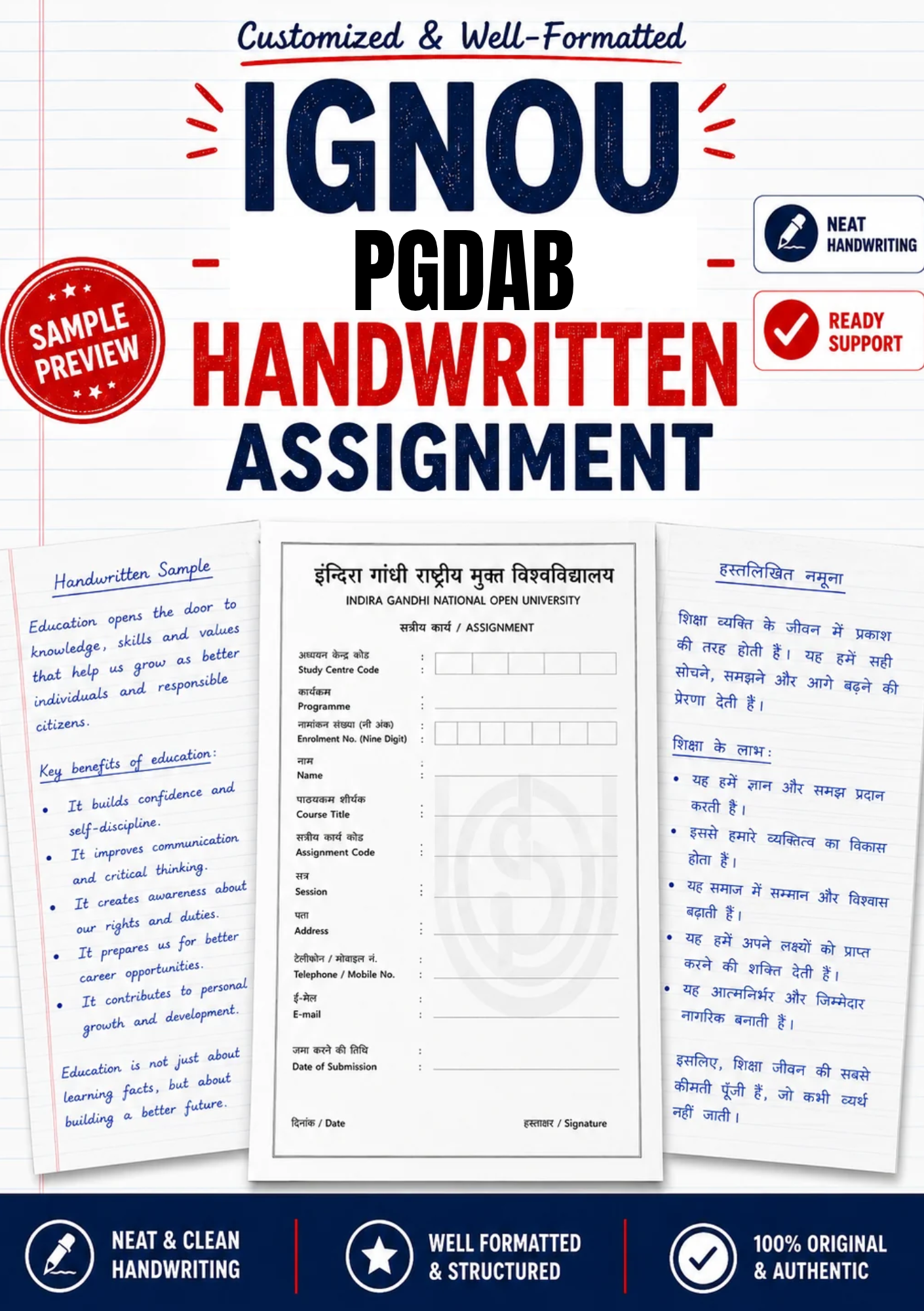
In short. The IGNOU Post Graduate Diploma in Agribusiness (PGDAB) is a 32-credit, one-year School of Agriculture programme of eight courses, but only the seven theory papers MAM-051 to MAM-057 carry an assignment; MAMP-058 Project Work has none. Shri Chakradhar Publication writes those seven papers by hand, in a hand matched to a sample page you photograph, at ₹320 per subject with courier included, a free IGNOU-format front page and a copy of the question paper inside, so all seven come to ₹2,240. The 2026 papers print the code as MAM-053/2026, ask for any five of eight questions at about 500 words each and print no submission date at all; the date sits on IGNOU’s assignment listing instead, and third-party copies of that listing give 31 March 2027 for the June 2027 term-end examination, the December 2026 cut-off having already passed.
Inside the Envelope When a PGDAB Order Arrives
A PGDAB order is built paper by paper, so the envelope holds one bundle for each MAM code you named and nothing for the codes you did not. Each bundle is a self-contained unit that can be carried to the study centre counter on its own, which matters because PGDAB learners frequently clear their papers in two or three rounds rather than all at once.
Every bundle carries four things. The first is the free IGNOU-format front page, filled in with your name, enrolment number, programme, the course code and title, your study centre and the assignment code exactly as your paper prints it. For a 2026 paper that code is short, for example MAM-055/2026, and the front page reproduces it without adding a TMA marker or a month that the School of Agriculture never printed. The second is a copy of the official question paper for that code and cycle, so the evaluator can see which eight questions you were set and which five you chose. The third is the answer set itself, written by hand in ink on loose sheets, with each answer headed by its question number, as the older PGDAB booklets ask. The fourth is the page order: front page, question paper, then answers, tied so the bundle does not come apart in a bag.
What is not in the envelope is just as specific. There is no typed copy, no printout and no file on a pen drive. No soft copy or PDF is sold. There is no project report for MAMP-058, because the project is a different kind of course with its own guidelines and its own shelf on the store. And there is no promise attached about the result, because the evaluator works for IGNOU and not for the publisher.
The rate is ₹320 per subject, hard copy only, with courier included in that price and no separate shipping charge. Delivery depends on your pin code and is confirmed for your order before you pay. No figure is promised on this page.
What ₹320 Pays For on One MAM Paper, and What Stays Outside It
The ₹320 is a per-code figure, and it is the whole figure. It pays for the writing of one MAM paper by hand, the matching of that hand to your sample, the IGNOU-format front page, the copy of the question paper, the binding and the courier to your address. There is no packing line, no shipping line and no surcharge for a remote pin code added afterwards.
Because PGDAB has exactly seven papers that carry an assignment, the arithmetic is short. One paper is ₹320, three papers are ₹960, five are ₹1,600 and all seven are ₹2,240. There is no minimum order: one subject or fourteen, same rate. On PGDAB the practical ceiling is seven, since the eighth course, MAMP-058, never had a paper to write.
Several things sit outside the ₹320 by design. The project report is one of them. The IGNOU examination fee for the term-end examination is another, and it is paid to the university, not to the publisher. A soft copy is a third. No soft copy or PDF is sold. A learner who wants something to read on a phone should look at the books and guess papers rather than ask for a file of the handwritten set.
Price is the same whichever cycle the paper comes from. Any session is accepted, current cycle or older, including backlog courses, at the same ₹320 per subject. A 2024 MAM-054 paper costs what a 2026 MAM-054 paper costs, even though the 2024 paper asked different questions.
A Solved File You Read From, or a Written Set You Hand In: Settling It for MAM Papers
Two different products travel under similar names, and PGDAB learners searching for help with a MAM paper meet both. A solved assignment is a soft-copy reference file of model answers for a course code and session, meant to be read on a screen or printed for study. A handwritten assignment is the answers written out by hand and handed in as hard copy at the study centre, the form the university actually collects.
The PGDAB Programme Guide issued by the School of Agriculture in November 2024 is direct about which of the two the study centre expects. It tells learners in its assignment instructions to “do not send a typed assignment response”, and it asks for the response to go only to the study centre or programme study centre. A downloaded solved file, printed as it comes, is a typed response. It is a reference to write from and nothing more; it is not a submission, and nothing on this page suggests that a printed file can be handed in for a MAM code.
| Question on a MAM order | MAM answer file to read from | Handwritten set for the counter |
|---|---|---|
| Form it takes | A soft-copy file of model answers | Ink on paper, bound with the front page and question paper |
| What you do with it | Read it, then write your own answers by hand | Review it, sign the cover declaration, hand it in |
| Fits the Programme Guide’s handwritten rule | No, not if printed and submitted as it stands | Yes, it is written by hand |
| Who it suits | A learner with time to write all five answers personally | A learner who needs the written set itself and will review it before signing |
| Price line for PGDAB | No MAM-coded solved file is listed on the store at present | ₹320 per subject, courier included |
Scroll sideways on a phone to see all three columns.
The last row needs a plain explanation. A check of the store’s catalogue on 3 November 2026 found PGDAB guess papers for all seven MAM codes and a hard-copy PGDAB project shelf, but no solved-assignment file coded to any MAM paper. A learner who wants a reference file to write from will find the solved reference files the store groups under IGNOU diplomas, and should check there for a MAM code before assuming one exists. This page sells only the handwritten set, and it does not claim to sell anything else.
Whichever route you take, the signature on the cover is yours. You sign the declaration on the assignment cover page, so you should read and review the content before submitting it, and satisfy yourself that it represents your own understanding of the course.
Seven MAM papers carry an assignment, and you can start with one. Name the codes you still owe, from MAM-051 to MAM-057, and the per-paper quote comes back on WhatsApp with the courier already inside it.
₹320 per subject, hard copy, IGNOU-format front page and question paper copy included.
The Seven MAM Theory Papers That Each Carry an Assignment
The Common Prospectus July 2026 lists PGDAB in section 8.31, under the School of Agriculture, with eight courses. Seven are theory courses of four credits each, numbered MAM 51 to MAM 57 in that table, and the eighth is MAMP 58 Project Work at four credits. The prospectus prints the total as 32 credits, and the eight entries add up to exactly that: seven times four is 28, plus four for the project, makes 32.
The 2026 assignment papers, the PGDAB Programme Guide and the programme page on ignou.ac.in all write the same codes with three digits, MAM-051 to MAM-057 and MAMP-058. They are the same courses. Use the three-digit form on your front page, because that is what the paper you are answering prints.
| Code on the 2026 paper | Prospectus spelling | Title IGNOU prints for the course | Credits toward the 32 | Second programme on the 2026 cover |
|---|---|---|---|---|
| MAM-051 | MAM 51 | Fundamentals of Agriculture | 4 | MBAABM |
| MAM-052 | MAM 52 | Agribusiness Management and Policies | 4 | MBAABM |
| MAM-053 | MAM 53 | Managerial Economics and Finance in Agribusiness | 4 | None, PGDAB only |
| MAM-054 | MAM 54 | Marketing Management for Agribusiness | 4 | None, PGDAB only |
| MAM-055 | MAM 55 | Principles of Agribusiness Management | 4 | None, PGDAB only |
| MAM-056 | MAM 56 | Qualitative and Quantitative Analysis for Agribusiness | 4 | None, PGDAB only |
| MAM-057 | MAM 57 | Project Management in Agribusiness | 4 | MBAABM |
Scroll sideways on a phone to see the cover column.
All seven titles above are copied from the prospectus table and match the titles printed on the 2026 papers and in the Programme Guide. None had to be taken from a third-party source. The last column comes from opening each of the seven 2026 papers: three covers name the MBA in Agribusiness Management as well as PGDAB, and four name PGDAB alone.
Each of the seven papers is a separate order line. A learner who passed MAM-051 and MAM-052 in a previous attempt and still owes the other five orders five; a learner starting fresh orders all seven. The code you write on the front page is the code printed on the paper, not a code inferred from a timetable or a friend’s file.
MAMP-058 and the Three Codes PGDAB Shares With the MBA in Agribusiness
MAMP-058 is the course most often mistaken for an assignment line. The 2025 PGDAB booklets state in their opening letter that there is one assignment for each theory course, a total of seven for the programme. The project is not a theory course. The School of Agriculture’s MAMP-058 project guidelines describe it as a practical, activity-based course built around a field study, market survey or industry visit, with a synopsis, a guide and a final report. None of that is written as a TMA, so this order does not include it.
| Part of the diploma | Codes | Credits held | Papers to write | Assessed through |
|---|---|---|---|---|
| Theory courses | MAM-051 to MAM-057 | 28 | 7, one per course | Assignment 30 per cent, term-end examination 70 per cent |
| Project Work | MAMP-058 | 4 | 0 | Synopsis and project report under the MAMP-058 guidelines |
| Whole programme | 8 courses | 32 | 7 | Prospectus footer reads 32, matching the sum |
Scroll sideways on a phone to see every column.
The second reason this section exists is the overlap with the Master of Business Administration (Agribusiness Management), MBAABM. Both programmes belong to the School of Agriculture, Prof. Praveen Kumar Jain is named as coordinator on both, and three MAM codes appear in both: MAM-051, MAM-052 and MAM-057. The MBAABM table in the same prospectus lists those three among its third-semester courses, alongside MAM-061 to MAM-070 that PGDAB never uses. The MBAABM project is a different course entirely, MAMP-060 at eight credits, where the PGDAB project is MAMP-058 at four.
For a shared code the paper is the same paper. The 2026 MAM-051, MAM-052 and MAM-057 files each name both programmes on the cover, so a PGDAB learner and an MBAABM learner holding MAM-052 answer identical questions. What differs is the front page, which must name the programme on your own admission record. A learner enrolled in the MBA programme rather than the diploma should use the handwritten set listing for MBAABM’s MMPC and MAM codes, which also covers the fourteen management papers that PGDAB does not have.
Eighteen Places the PGDAB Paperwork Contradicts Itself
Every statement on this page was checked against IGNOU’s own documents: the July 2026 Common Prospectus, the PGDAB Programme Guide dated November 2024, the programme page on ignou.ac.in, all seven 2026 MAM papers and the January 2025 and July 2025 booklets. Read side by side, they do not always agree, and the store’s own pages add a few disagreements of their own. Each one is listed here because a learner meeting it at the counter deserves to know it was already known.
Where the PGDAB record disagrees, and how this page handles each point. Fourteen findings come from IGNOU’s documents and four from this store. Where a point affects what goes on your front page, follow the paper you are answering and confirm with your study centre.
1. Two-digit and three-digit codes in one prospectus. The PGDAB table in the July 2026 Common Prospectus prints MAM 51 to MAM 57 and MAMP 58. The MBAABM table in the same document prints the shared codes as MAM 051, MAM 052 and MAM 057. The papers, the Programme Guide and ignou.ac.in all use three digits. This page uses the three-digit form throughout.
2. The project code is written four ways. MAMP 58 in the prospectus, MAMP-058 in the Programme Guide table, MAMP058 without a hyphen in the Guide’s own course heading, and MAMP-58 on the sister site’s project article. It is one course.
3. Three fee figures. The prospectus annexure gives Rs. 7,300 year-wise, the programme page on ignou.ac.in gives Rs 7,300 for the full programme, and the November 2024 Programme Guide gives Rs. 7100. The admission portal is the authority on the fee at the time you pay.
4. Seven assignments or eight. The 2025 booklets say a total of seven assignments, one per theory course. The Programme Guide’s section 5 says each course will have one assignment, which read literally would include the project. No MAMP-058 assignment paper exists on the university’s server, so seven is the working figure.
5. Foolscap or A-4. The January and July 2025 PGDAB booklets ask for foolscap paper with a 4 cm margin at the top, the bottom and the left. The Programme Guide asks for A-4 paper with a left margin of about two and a half inches. The 2026 papers say nothing about paper at all.
6. A diploma paper that points to another programme’s guide. All seven 2026 MAM papers, including MAM-053, MAM-054, MAM-055 and MAM-056 that belong to PGDAB alone, send learners to “the MBAABM programme guide” for grading details. PGDAB has its own Programme Guide.
7. Marks out of 50, or a letter grade. The 2025 booklets print Maximum Marks: 50 on every paper. The 2026 papers print no maximum marks and describe a letter scale from A to E instead. The Programme Guide sets the maximum for each course at 50 and also carries an A to E grade table.
8. A code string that appeared only in 2026. The 2025 booklets print no assignment code at all, only “Assignment -5” and the course code. The 2026 papers print MAM-055/2026, with no TMA element and no session month, which is a different shape from the MMPC-001/TMA/JULY/2026 style that MBAABM learners see on their management papers.
9. Three wordings for where the set goes. The 2025 booklets say the Programme Coordinator of your study centre, the 2026 papers say the Coordinator of your study centre, and the Programme Guide says only to your study centre or programme study centre. In practice all three point to the study centre counter.
10. No date on any PGDAB paper. None of the 2025 or 2026 papers prints a submission date, and the Programme Guide refers only to “the schedule of assignments”. The dates exist on the university’s assignment listing, not on the paper the learner holds.
11. Covers disagree on who the paper is for. The 2026 MAM-051, MAM-052 and MAM-057 covers name PGDAB and MBAABM. The 2026 MAM-053, MAM-054, MAM-055 and MAM-056 covers name PGDAB only, in the same school and the same cycle.
12. A programme name carried over from another diploma. Section 6.0 of the PGDAB Programme Guide refers to six theory courses in the Diploma in Agricultural Cost Management, a different School of Agriculture programme under the same coordinator, and asks learners to pass all six courses. PGDAB has seven theory courses.
13. Three units or five. Section 4.1 of the Programme Guide says each block contains three units, while the MAM-051 course outline in the same Guide lists five units in Block 1 and five in Block 3.
14. A coordinator address that will bounce. The programme page on ignou.ac.in prints the coordinator’s address with a doubled dot before “in”. The prospectus prints it correctly as pkjain@ignou.ac.in.
15. In-house: A4 against foolscap. The store’s handwritten category page says its sets are written on A4 ruled sheets. The 2025 PGDAB booklets ask for foolscap. This page asks you to state the sheet size your study centre expects before writing begins.
16. In-house: a delivery figure this page refuses to give. The same category page still states delivery in working days. This product promises no delivery figure, because delivery depends on your pin code and is confirmed per order.
17. In-house: how the category page describes the sets. The category page calls the handwritten sets study reference material and not for submission as your own work. Read this product in that light: the declaration on the cover is yours, and the Important Notice below asks you to review every page before you sign it.
18. In-house: books for three codes out of seven. The store carries guess papers for all seven MAM codes, but study guides only for MAM-051, MAM-052 and MAM-057, filed under MBAABM. MAM-053 to MAM-056 have no book listing at present.
None of these points changes what you write for a MAM paper. They change what you check before handing it in. The two that matter most at the counter are point 5, the sheet size, and point 10, the missing date. Both are covered in the sections that follow.
No Date on the Paper: Where the PGDAB Cut-Off Actually Comes From
Learners used to IGNOU booklets from other schools look for a line such as “last date of submission” near the top of the paper. On PGDAB they will not find one. The 2026 MAM papers print the session, January 2026 and July 2026, and nothing more. The 2025 booklets printed the same silence. The Programme Guide only says to submit by the last date in the schedule of assignments.
The schedule lives on the university’s current-assignment listing, which carries a December and a June due date against each course code. Third-party copies of that listing taken in 2026 show 30 September 2026 against the December 2026 term-end examination and 31 March 2027 against the June 2027 term-end examination for all seven PGDAB codes. The listing itself could not be opened directly while this page was prepared, so read those two dates as reported rather than as copied from IGNOU, and confirm them on ignou.ac.in.
The December 2026 date then moved. Education news outlets reported in October 2026 that IGNOU had extended assignment submission for the December 2026 term-end examination to 31 October 2026, for learners in open and distance learning and in online programmes. That extended date has now passed. For a PGDAB learner writing today for the June 2027 examination, the date to work back from is 31 March 2027, unless the university announces a change.
The pattern is the School of Agriculture’s own. Its PGDFSQM papers print the same pair, 30 September and 31 March, while the School of Management Studies papers that MBAABM learners also hold run to 31 October and 30 April. A learner who carries both kinds of code should never assume one school’s date applies to the other’s paper.
Papers also expire. The 2026 MAM papers are marked for the January 2026 and July 2026 sessions, and IGNOU replaces them each cycle with new questions. An answer set written to a 2025 question paper and handed in against a 2026 enrolment answers questions you were never set, so the cycle printed on your paper must match the cycle on the set you order.
MAM-053/2026 on the First Page, and Why the 2025 Papers Carried No Code
The 2026 PGDAB papers print an assignment code in the simplest shape IGNOU uses anywhere: the course code, a slash and the year. MAM-051/2026, MAM-052/2026 and so on up to MAM-057/2026. There is no TMA marker and no month, so a learner who writes MAM-053/TMA/JULY/2026 because that is what a friend’s MBA paper looked like has written a code that does not exist.
The 2025 booklets were different again. They printed an assignment number and a course code, “Assignment -3” and “Course Code: MAM-053”, and no combined code string at all. A learner submitting a 2025 paper in a backlog round copies those two lines as printed rather than inventing a 2025 version of the 2026 format.
The free front page in every bundle follows whichever paper you name. It carries your name, enrolment number, the programme as PGDAB, the course code and title, your study centre, and the assignment code or assignment number in the form your paper prints. If the paper prints the title in capitals on the cover and in title case inside, as several 2026 MAM papers do, the title case form is used.
The question pattern also comes from the paper. Each 2026 MAM paper prints eight questions and asks you to attempt any five, with a note that each answer may contain about 500 words. Five answers at that length make a substantial set, and it is written to that shape rather than to a fixed page count. The 2025 booklets also asked for any five of eight, with all questions carrying equal marks out of 50.
Your Own Hand on the Sheet Size Your Study Centre Expects
A MAM set is written to look like the person whose name is on the front page wrote it. Send a photo of a page you have written yourself and the handwritten set is matched to your handwriting at no extra charge. The match covers the slant, the size of the letters, the spacing between words and the way you form figures, which matters on MAM-053 and MAM-056 where answers carry numbers, ratios and simple calculations.
A sample of the matched writing is photographed and sent back on WhatsApp before any payment is requested. If the slant or size looks wrong to you, say so at that stage and it is adjusted before the full set is written. Nothing is paid until you have seen that sample.
Sheet size is the other decision to settle first, and on PGDAB it is a real decision rather than a formality. The 2025 booklets asked for foolscap with 4 cm margins at the top, bottom and left. The Programme Guide asks for A-4 with a wide left margin. The 2026 papers say nothing. Ask your study centre which it accepts, and put the answer in your first message, so the set is written on the size and with the margins you will be handing in.
Which page of your own writing to photograph
The most useful sample is a page you wrote at normal speed with the pen you would use for an assignment, not a page of careful practice. Class notes, an old answer sheet or a letter all work. Photograph it flat, in daylight, with the whole page in frame and no shadow across the lines. One clear page is enough; three blurred pages are not. Avoid a page written in capitals or at speed, because the match copies what it sees.
English Only, Both 2026 Intakes, and MAM Papers From Earlier Years
The service covers all mediums IGNOU issues the TMA paper in, at the same price. For PGDAB that means English. The prospectus, the Programme Guide and the programme page on ignou.ac.in all give English as the only medium of instruction, and every PGDAB paper found on the university’s server for 2022 to 2026 is in English. There is no Hindi PGDAB paper to write against, so a request for one cannot be met however it is phrased.
PGDAB admits learners in both the January and the July sessions, and the 2026 papers are marked for both, which is why a January 2026 learner and a July 2026 learner answer the same 2026 questions. The programme began in the January 2022 session, and the School of Agriculture has posted PGDAB papers for 2022, 2023, 2024, 2025 and 2026, each with its own questions.
Any session is accepted, current cycle or older, including backlog courses, at the same ₹320 per subject. A learner within the three-year maximum duration who never submitted MAM-055 in 2024 can order a set for that code. What the PGDAB papers do not say is which cycle’s questions a returning learner must answer, the paper from the year of enrolment or the paper current at the time of submission. Ask your study centre before ordering, and name the cycle in your first message, because the set is written to the questions of the cycle you name and to no other.
What the First WhatsApp Message Needs for a MAM Order
A PGDAB order needs five pieces of information and nothing beyond them. Sending all five in the first message saves a round of questions.
- The MAM codes. Any of MAM-051 to MAM-057, written as they appear on your papers. Leave out MAMP-058, which has no assignment.
- The cycle of each paper, and the sheet size. 2026 for the current papers, or the earlier year if you are clearing a backlog, plus foolscap or A-4 as your study centre expects.
- A photo of your own handwriting. One clear page, as described above.
- The front page details. Your name as on your identity card, enrolment number, and study centre name and code.
- Your delivery address and pin code. The pin code decides how delivery is arranged, and it is confirmed with you before payment.
Nothing else is needed. No login, no password, no one-time code and no copy of an identity document is asked for, and you should not send any of them. The question paper copy is taken from the university’s server for the cycle you name.
There is no minimum order: one subject or fourteen, same rate. Delivery depends on your pin code and is confirmed for your order before you pay. No figure is promised on this page.
Codes, cycle, sheet size, a photo and a pin code are all a PGDAB order needs. Put them in one message and the reply comes back with a quote per MAM paper and a sample of the matched hand.
₹320 per subject, courier inside the price, all seven papers for ₹2,240.
From the Courier Bag to the Study Centre Receipt
When the envelope arrives, open each bundle and read it before anything else. Check that the code on the front page matches the code on the question paper, that the cycle is the one you named, and that five answers are present for each paper. Then read the answers themselves. You sign the declaration on the assignment cover page, so you should read and review the content before submitting it, and satisfy yourself that it represents your own understanding of the course.
Sign the front page where indicated, keep the question paper copy behind it, and take each bundle to your study centre. The Programme Guide asks for submission only to your study centre or programme study centre, and the 2026 papers say the same in shorter words. Ask for a receipt at the counter and keep it, together with a photocopy of each set, until the marks appear.
The assignment component then moves through the university’s own process. Assignments carry 30 per cent of the final course result and the term-end examination carries the remaining 70 per cent. The Programme Guide asks for at least 40 per cent in each component and in the aggregate. Whether a submission has been recorded can later be checked on the university’s assignment status page with your enrolment number, and if it has not, the counter receipt is the document to show your study centre.
No claim is made about the marks any assignment will receive, about how an evaluator will assess it, or about whether it will be accepted. Assignment evaluation is entirely a matter for IGNOU.
Other Shelves Worth Opening for an Agribusiness Diploma
The handwritten set covers the assignment component only, and most PGDAB learners need help with the other parts of the diploma as well. For term-end revision, the store’s guess papers filed under PGDAB for all seven MAM codes are the closest match, and the MAM 53 guess paper on managerial economics and agribusiness finance is the one learners most often ask about, since MAM-053 is the most numerical of the seven.
For the project, the hard-copy MAMP-058 project and synopsis listings are where the course without an assignment is handled. For reading, the study guides for the three shared codes sit on the MBA agribusiness book shelf that also serves PGDAB, including the Fundamentals of Agriculture guide for MAM-051 and the MAM-057 guide to project management in agribusiness.
Learners who hold a second School of Agriculture diploma will find the same treatment of codes, dates and sheet size on the food safety diploma’s handwritten listing. A learner whose programme has no dedicated listing yet, or whose order mixes codes from more than one programme, can use the made-to-order handwritten listing for any code and session. Every programme the store writes for is gathered on the main handwritten assignment shelf.
Learners who would rather write every answer personally will find the project side of PGDAB explained on the sister site’s MAMP-058 topic and report walkthrough on ignouproject.com, and the papers themselves on IGNOU’s page for downloading current assignment papers.
What PGDAB Learners Want Settled Before They Pay
How many PGDAB assignments do I actually have to submit?
Seven, one for each theory course from MAM-051 to MAM-057. The 2025 booklets state the total as seven assignments for the programme. MAMP-058 Project Work carries no assignment, so a complete PGDAB order is seven papers at ₹320 each, ₹2,240 in all, with courier included.
Is MAMP-058 Project Work part of a handwritten assignment order?
No. MAMP-058 is assessed through a synopsis and a project report under the School of Agriculture’s project guidelines, not through a TMA. There is no MAMP-058 assignment paper on the university’s server. The project has its own listings on the store’s hard-copy project shelf for PGDAB.
What is the last date for the PGDAB assignment for the June 2027 exam?
The PGDAB papers print no date. Third-party copies of IGNOU’s assignment listing show 31 March 2027 against the June 2027 term-end examination for all seven MAM codes. The December 2026 date, reported as extended to 31 October 2026, has already passed. Confirm the current date on ignou.ac.in before you plan backwards from it.
My 2026 paper says MAM-053/2026. Is that the full assignment code?
Yes. The 2026 School of Agriculture papers print only the course code, a slash and the year, with no TMA marker and no month. Copy it exactly as printed. The free front page in the set uses that form and does not add a TMA element that the paper never printed.
Should a PGDAB assignment be on foolscap or A4 paper?
IGNOU’s own documents disagree. The 2025 PGDAB booklets ask for foolscap with a 4 cm margin at the top, bottom and left; the November 2024 Programme Guide asks for A-4 with a left margin of about two and a half inches; the 2026 papers are silent. Ask your study centre which it accepts and state the size in your first message.
Can I print a downloaded PGDAB solved assignment and submit that?
A printed file is a typed response, and the PGDAB Programme Guide asks learners not to send a typed assignment response. A solved assignment is a soft-copy reference to write from, not a submission. If you use one, write your own five answers by hand from it.
What is the difference between a solved assignment and a handwritten assignment for a MAM paper?
A solved assignment is a soft-copy file of model answers that you read. A handwritten assignment is the answer set written in ink on paper, bound with the front page and question paper, and handed in at the study centre. This listing sells only the second, at ₹320 per MAM paper.
Will a typed MAM assignment be accepted if my handwriting is poor?
The Programme Guide asks for handwritten responses and tells learners not to send typed ones. Poor handwriting is one reason learners ask for a matched set: the writing follows the sample you photograph, so it reads as your hand, kept neat enough for an evaluator to follow.
I am enrolled in MBAABM, not PGDAB. Which listing covers MAM-051?
MAM-051, MAM-052 and MAM-057 are the same papers in both programmes, and the 2026 covers name both. The front page must name the programme on your admission record, so an MBAABM learner should order through the MBAABM handwritten listing, which also covers the MMPC management papers.
Why does my PGDAB paper tell me to read the MBAABM programme guide?
All seven 2026 MAM papers, including the four that belong to PGDAB alone, refer learners to the MBAABM programme guide for grading details. It appears to be a shared template. PGDAB has its own Programme Guide, dated November 2024, which carries the A to E grade table and the 40 per cent pass rule.
How many questions do I answer on a MAM paper, and how long should each be?
Each 2026 MAM paper prints eight questions and asks you to attempt any five, with about 500 words per answer. The set is written to that shape, five answers per paper, against the questions printed on the cycle you name.
Can I order a 2024 or 2025 MAM paper I never submitted?
Yes, at the same ₹320 per subject. Older PGDAB papers carry different questions, so name the cycle for each code. The PGDAB papers do not say whether a returning learner answers the old paper or the current one, so check with your study centre before ordering.
Is there a Hindi medium PGDAB handwritten set?
No. PGDAB is offered in English only, according to the prospectus, the Programme Guide and the programme page, and every MAM paper on the university’s server is in English. The set is written in English.
Is a PGDAB assignment marked out of 50 or given a grade?
Both appear in IGNOU’s documents. The 2025 booklets print 50 marks per paper, the 2026 papers print only an A to E grade scale, and the Programme Guide gives a maximum of 50 per course alongside a grade table. Either way, the assignment counts for 30 per cent of the course result.
Do I pay before I see the handwriting?
No. A photographed sample of the matched writing is sent on WhatsApp first. Payment is requested after you approve the style and the delivery arrangement for your pin code has been confirmed.
Prospectus, Papers and Publisher Terms Behind Every PGDAB Line
From the Common Prospectus July 2026. Section 8.31 on page 289 gives PGDAB under the School of Agriculture, eligibility as graduation in any discipline, English as the medium, the eight courses with their credits and the 32-credit total, and Prof. Praveen Kumar Jain as coordinator. Annexure row 156 gives a one-year minimum, a three-year maximum, a fee of Rs. 7,300 year-wise, and January and July sessions. Section 3.79 gives the MBAABM table used to identify the three shared codes. The credit total was checked by summation before any table on this page was built.
From the live papers and the Programme Guide. All seven 2026 MAM papers, MAM-051 to MAM-057, were opened from the School of Agriculture’s assignment folder on ignou.ac.in, for the January 2026 and July 2026 sessions, together with the January 2025 and July 2025 booklets. The assignment code format, the question pattern, the cover-page programme lists, the absence of printed dates and the paper-size instructions were read from those files. The PGDAB Programme Guide dated November 2024 supplied the handwritten rule, the A-4 instruction, the 50-mark maximum, the pass rule and the fee of Rs. 7100. The PGDAB programme page on ignou.ac.in supplied the current fee statement and course cards. The due dates in the deadline section come from third-party copies of IGNOU’s assignment listing and from news reports of the December 2026 extension, and are labelled as such where they appear.
From the publisher’s own terms. The price, the format, the courier arrangement, the front page, the question paper copy, the handwriting match, the session coverage and the absence of a minimum order are Shri Chakradhar Publication’s commercial terms. They are not IGNOU rules and should not be read as such.
Important Notice
Shri Chakradhar Publication Pvt. Ltd. and shrichakradhar.com form an independent IGNOU study-support publisher. This is not the official website of Indira Gandhi National Open University, is not affiliated with, endorsed by or authorised by the university, and no page on this site should be treated as an official IGNOU communication.
Programme structures, course codes, submission dates and rules change, and only ignou.ac.in and your Regional Centre can confirm the current position for your enrolment.
You sign the declaration on the assignment cover page, so you should read and review the content before submitting it, and satisfy yourself that it represents your own understanding of the course.
No claim is made about the marks any assignment will receive, about how an evaluator will assess it, or about whether it will be accepted. Assignment evaluation is entirely a matter for IGNOU.
Name Your MAM Papers and the Writing Starts
Seven theory papers, one rate, and a sample of your matched handwriting before any payment. The rate is ₹320 per subject, hard copy only, with courier included in that price and no separate shipping charge.
Two ways to begin: start a PGDAB order with your MAM codes, or, if you are unsure which papers you still owe, ask which MAM papers are still pending for you.