

Description
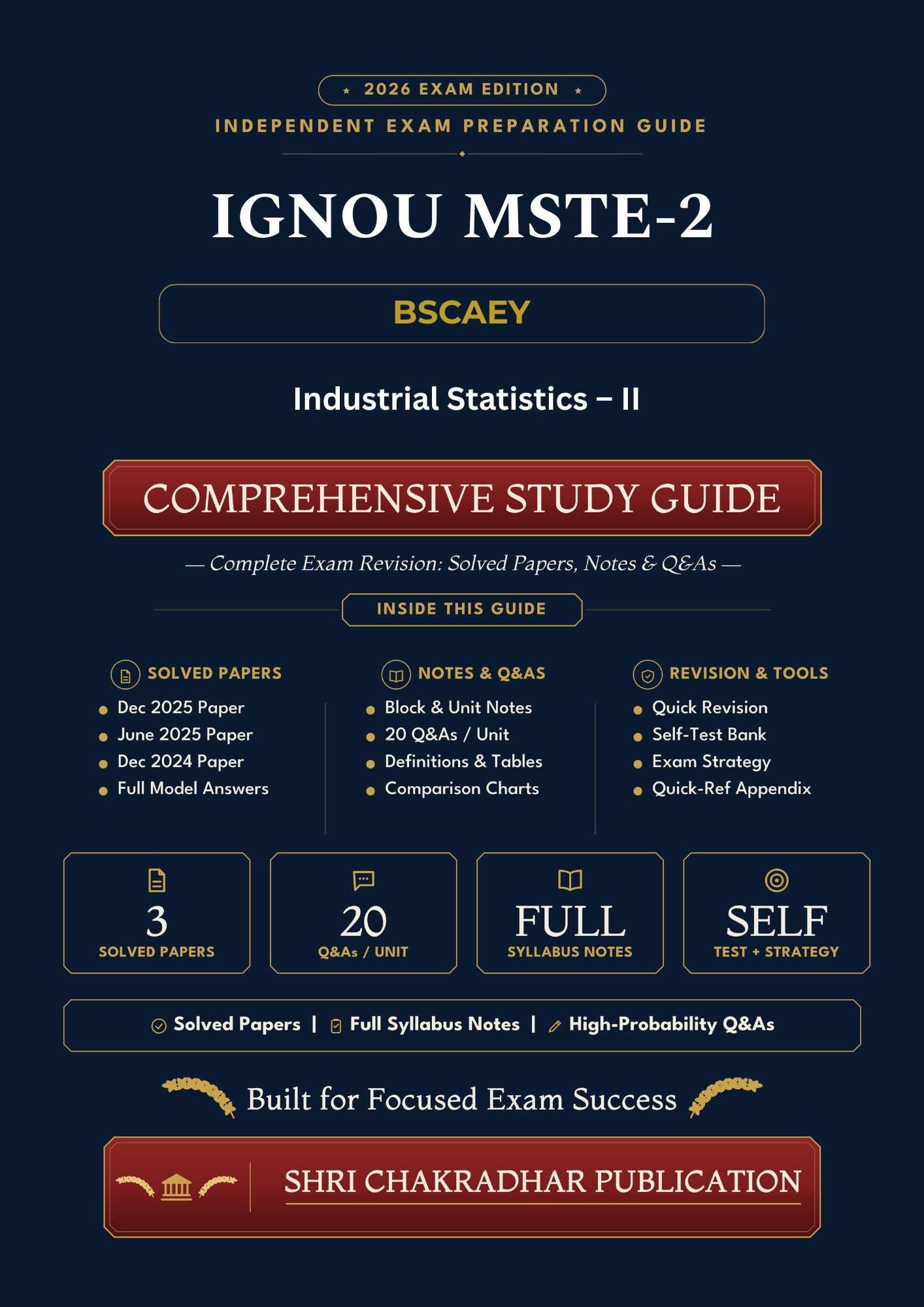
IGNOU MSTE-002 Book (Industrial Statistics – II) is a 2026 English-medium study companion for BSCAEY, built around the verified syllabus, Unit-wise revision and TEE-oriented answer practice across 4 Blocks.
Students often know individual points in Industrial Statistics – II but struggle to convert them into a complete answer. Study every topic by definition, worked example, method conditions and independent practice. Rework problems without looking at the solution and check each algebraic or logical step. The revision flow uses Optimisation Techniques-I, Optimisation Techniques-II and later course areas as linked checkpoints.
For more IGNOU study material, visit IGNOU Study Material. Use this independent guide together with IGNOU’s official study material, assignments and current examination information.
An Overview of the IGNOU MSTE-002 Help Book
Industrial Statistics – II becomes easier when the learner knows the role of each course area. This guide uses the verified structure to place Optimisation Techniques-I and Time Series Modelling in context and then turns that structure into a revision schedule.
The official IGNOU material remains the primary syllabus source.
Course-specific revision lens: Treat Optimisation Techniques-I as an active-recall checkpoint: explain it without notes, identify one connection to another Unit and then attempt a written question. For Optimisation Techniques-II, first state the governing idea, then add the process, evidence or method that makes it meaningful in this course. With Regression Modelling, focus on the relationship between the core concept and the way IGNOU expects it to be interpreted, applied or demonstrated. While revising Time Series Modelling, separate the essential definition from the application and finish with one example, calculation or observation.
Answer architecture for this course: Use Optimisation Techniques-I to practise synthesis by linking the immediate Unit with one earlier concept and one later application from the verified course sequence. For Optimisation Techniques-II, build the response in layers: key term, main explanation, supporting step or evidence, and a short concluding interpretation. Use Regression Modelling to practise synthesis by linking the immediate Unit with one earlier concept and one later application from the verified course sequence. When a TEE question targets Time Series Modelling, identify the command word first and choose only the facts, calculations or examples that directly support that task.
This Book Is Useful For
The guide suits learners who prefer a visible course map, manageable Unit-wise targets and exam-focused practice rather than last-minute rereading.
- Learners mapping the full MSTE-002 syllabus before revision.
- Students who need extra practice with Optimisation Techniques-II and related concepts.
- TEE candidates improving answer organisation.
- Students returning to weak Units after self-testing.
- Learners using assignments as concept checks while preparing their own responses.
What’s Inside This MSTE-002 Book
The book is arranged as a working revision tool: course map first, Unit-level study next, followed by practice and final recap.
- Unit-wise notes: concepts arranged around the verified MSTE-002 sequence.
- Course cues: focus on Optimisation Techniques-I, Optimisation Techniques-II and connected topics.
- Answer practice: worked problems, proofs, algorithmic exercises, theorem applications and mixed TEE-style calculations.
- PYQ orientation: practice based on recurring examination task-types, without prediction claims.
- Final recap: quick checkpoints for weak areas before the TEE.
Complete Syllabus Coverage – All 4 Blocks
The official course organisation is the control point for coverage. Use the table to check each study area against your current IGNOU material before final revision.
| Block | Official title | Revision focus |
|---|---|---|
| Block 1 | Optimisation Techniques-I | Optimisation Techniques-I |
| Block 2 | Optimisation Techniques-II | Optimisation Techniques-II |
| Block 3 | Regression Modelling | Regression Modelling |
| Block 4 | Time Series Modelling | Time Series Modelling |
After each course area, test recall and write one answer before moving ahead.
How This Book Maps to the IGNOU MSTE-002 Exam Pattern
The guide maps syllabus content to common examination actions rather than promising repeated questions. In MSTE-002, written practice should demonstrate definitions, theorems, algorithms, derivations, worked calculations, proofs and interpretation of results.
Why Students Prefer Our IGNOU MSTE-002 Guide Book & Study Material
The guide is useful because coverage and practice stay connected. Students can see where Optimisation Techniques-I belongs, what remains unread and which written responses still need work.
That visible progress is more useful than repeatedly rereading familiar Units.
Compiled & Reviewed By
The SCP Panel of Experts, under BK Sahni at Shri Chakradhar Publication, compiles this independent guide. The 2026 review checks the MSTE-002 syllabus map against official IGNOU/eGyanKosh sources before the revision copy is organised.
How to Use the IGNOU MSTE-002 Help Book for TEE and Assignments
Turn each course area into a small cycle of reading, self-testing and writing before advancing to the next one.
- Preview the course area and its Units.
- Read the explanation and make a compact recall list.
- Attempt a question on Optimisation Techniques-II or the current Unit without looking back.
- Compare your answer with official concepts, not with memorised wording.
- Before the TEE, prioritise weak Units and timed practice.
High-Probability Questions from IGNOU MSTE-002 (Sample)
These prompts are selected for revision value because they require explanation, application or comparison of important course areas.
- Solve or demonstrate the method for Optimisation Techniques-I in the context of Industrial Statistics – II.
- State the relevant definition or theorem for Optimisation Techniques-II in the context of Industrial Statistics – II.
- Compare mathematical approaches to Regression Modelling in the context of Industrial Statistics – II.
- Explain the reasoning behind Time Series Modelling in the context of Industrial Statistics – II.
- Build a comparative answer linking Optimisation Techniques-I with Time Series Modelling.
- Write a structured short note on one recurring concept from Industrial Statistics – II, using definition, explanation and a relevant example, calculation, process or evidence as appropriate.
- Using the official course sequence, explain how the early topics in Industrial Statistics – II prepare the learner for the later analytical or applied areas.
IGNOU MSTE-002 Sample Question Paper (TEE Format Template)
Use this non-official paper format to rehearse answer selection and pacing before checking the latest IGNOU MSTE-002 question paper.
Section A – Extended Answers
- Solve or demonstrate the method for Optimisation Techniques-I in the context of Industrial Statistics – II.
- State the relevant definition or theorem for Optimisation Techniques-II in the context of Industrial Statistics – II.
- Compare mathematical approaches to Regression Modelling in the context of Industrial Statistics – II.
Section B – Analytical / Short Answers
- Explain the reasoning behind Time Series Modelling in the context of Industrial Statistics – II.
- Build a comparative answer linking Optimisation Techniques-I with Time Series Modelling.
- Write a structured short note on one recurring concept from Industrial Statistics – II, using definition, explanation and a relevant example, calculation, process or evidence as appropriate.
Use the exercise to improve both content recall and answer organisation, not to predict the examination.
Related IGNOU MSTE-002 Additional Supports
Use these add-on supports only when needed; the main guide remains the course-study product.
- IGNOU MSTE-002 Solved Assignment
- IGNOU MSTE-002 Handwritten Assignment
- IGNOU MSTE-002 Solved PYQs
- IGNOU MSTE-002 Solved Guess Paper
Delivery, Returns & Payment Options
Shipping timelines, payment availability and return eligibility depend on the current store terms; check them before ordering the A5 paperback.
How Students Use This Guide
Many learners benefit from dividing MSTE-002 into small milestones and completing a written task after each milestone instead of postponing practice until the end.
Integrated recall map: Use Optimisation Techniques-I for a one-minute oral explanation, then convert that explanation into a short written response containing the essential terminology and one course-specific connection. After revising Optimisation Techniques-II, write down one common confusion, the correct distinction and a concrete example, calculation, process or case that resolves the confusion. Use Regression Modelling for a one-minute oral explanation, then convert that explanation into a short written response containing the essential terminology and one course-specific connection. After revising Time Series Modelling, write down one common confusion, the correct distinction and a concrete example, calculation, process or case that resolves the confusion.
Free Downloads: IGNOU MSTE-002 Exam Support PDFs
For MSTE-002, verify the current syllabus and downloadable material through official IGNOU/eGyanKosh resources before using supplementary notes.
- Official IGNOU/eGyanKosh material for MSTE-002.
- IGNOU Assignments for current papers and instructions.
- IGNOU Previous Year Question Papers for available TEE papers.
Download MSTE-002 Study Material Free via eGyanKosh (Step-by-Step)
Use MSTE-002 as the search key in eGyanKosh, then confirm the course title before saving any PDF.
- Open eGyanKosh.
- Search MSTE-002.
- Confirm the title Industrial Statistics – II.
- Open the available Blocks, Units, Themes or manual.
- Keep those official PDFs as the syllabus reference while using this guide for revision.
Frequently Asked Questions (FAQ)
These answers clarify the most common questions about the guide, syllabus verification and exam use.
What is the verified syllabus structure for MSTE-002?
The researched official structure contains 4 Blocks, all represented in this edition.
Which subject is linked to MSTE-002?
Industrial Statistics – II is the course subject; this guide follows the researched official sequence and focuses on Unit-wise revision.
Who can use this MSTE-002 book?
This edition is prepared for BSCAEY learners studying MSTE-002.
What medium is the MSTE-002 guide?
This product is prepared in English; students should match it with their intended study and examination medium.
Does the book help with exam-question practice?
Yes. Previous-paper-oriented practice is included to improve answer skills, without promising that a question will repeat.
Can I consult this book while preparing assignments?
Use it for concept understanding and planning, while writing and submitting your own assignment work according to IGNOU guidelines.
Is Shri Chakradhar Publication affiliated with IGNOU?
No. It is independent academic study support from Shri Chakradhar Publication and is not affiliated with or endorsed by IGNOU.
Where can I get official MSTE-002 material?
Search the exact code MSTE-002 on eGyanKosh and use the official IGNOU links provided above.
What is a practical final-revision plan for MSTE-002?
Follow the official sequence, use active recall, practise written responses, review recent papers and return to weak Units before the examination.
Conclusion
The final aim of this MSTE-002 guide is simple: understand the verified syllabus, retrieve it confidently and practise presenting that understanding clearly in the TEE.
To order, visit the IGNOU MSTE-002 Book order page.
Disclaimer: This is an independent academic study-support resource published by Shri Chakradhar Publication (Pvt.) Ltd. It is not affiliated with, endorsed by, or an official publication of IGNOU. It is designed to supplement, not replace, IGNOU’s official study material. Syllabus and exam patterns may change – please verify the latest information through official IGNOU channels. Students should prepare and submit their own work as per IGNOU guidelines. All trademarks belong to their respective owners.