Description
In short. MSCIS is the Master of Science (Information Security), a 64-credit programme run by IGNOU’s School of Vocational Education and Training across four semesters, and its nineteen printed course codes sit under five prefixes: MSEI on six theory papers, MSE on eight more, MSEL on the two practical courses, MSEP on the two project courses and MCS on one paper borrowed from the computer-science school. Shri Chakradhar Publication writes the answers for those codes out by hand and couriers the bundle to you. Two things about MSCIS are unlike most IGNOU programmes and both change what arrives: the School of Vocational Education and Training publishes one booklet per semester rather than one per course, and instruction 6 on that booklet asks for foolscap size writing paper with a 4 cm margin on the left, not the A4 that almost every IGNOU guide on the internet recommends. The rate is ₹320 per subject, hard copy only, with courier included in that price and no separate shipping charge. No soft copy or PDF is sold. Any session is accepted, current cycle or older, including backlog courses, at the same ₹320 per subject. Delivery depends on your pin code and is confirmed for your order before you pay. No figure is promised on this page.
Inside the Bundle That Reaches Your Door
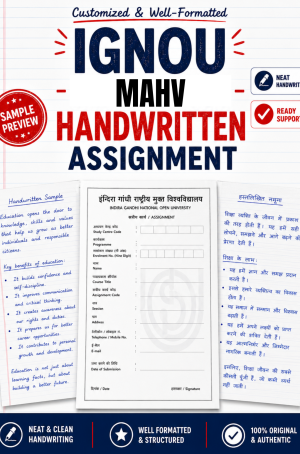
One bundle is prepared for each course code you order, and each bundle holds four things. The first is the written answer set itself, produced on foolscap sheets in blue or black ink with a 4 cm margin kept on the left and at least four clear lines between one answer and the next, because those three specifications are printed as instruction 6 of the MSCIS assignment booklet rather than invented as a house style. The second is an IGNOU-format cover sheet, filled in with the fields the booklet asks for on the first page of a response sheet: programme title, enrolment number, course code, name, course title, address, signature and date. That cover sheet is free with every order.
The third item is a printed copy of the official assignment paper the answers were written against, which matters more on MSCIS than on most programmes because the SOVET booklet is a semester-wide document. A learner who orders MSE-030 receives the MSE-030 page as it appears inside the Semester-III booklet, so the questions in hand and the questions on the desk can be checked line by line before anything is signed. The fourth is the packaging and the courier, which are already inside the ₹320.
What does not arrive is a file. Nothing is emailed, nothing is sent as a download link, and there is no scanned version waiting behind a payment. The service covers all mediums IGNOU issues the TMA paper in, at the same price, which on MSCIS resolves to English alone, because section 3.68 of the July 2026 Common Prospectus records the medium of instruction for this programme as English.
Where ₹320 Stops, and Where It Does Not
The figure is per course code, not per semester and not per bundle of pages. A Semester-I learner ordering all four of MSEI-021, MSEI-022, MSEI-023 and MSE-024 is quoted four times ₹320. A learner who only needs MSE-024 because the other three cleared last cycle is quoted once. There is no minimum order: one subject or fourteen, same rate.
Length does not move the price either, and on MSCIS that is worth saying plainly, because the assignment papers are not the same size as each other. A two-question MSEI-022 paper and a ten-question MCS-226 paper are both ₹320. The section below on marks explains why those two papers differ so sharply despite belonging to one degree.
Three things sit outside the rate. Submission is one: the bundle is couriered to the address you give, and carrying it to the Regional or Study Centre, or scanning it for the email route the booklet also permits, remains yours to do. Evaluation is the second. No claim is made about the marks any assignment will receive, about how an evaluator will assess it, or about whether it will be accepted. Assignment evaluation is entirely a matter for IGNOU. The third is the project work. MSEP-028 and MSEP-038 are project courses carrying four and two credits, and a project report is a different deliverable from a written assignment answer.
Reference File or Submittable Bundle: Telling the Two Apart
These two products are confused constantly, and on MSCIS the confusion has a specific cost, so it is worth defining both before comparing them. A solved assignment is a soft-copy reference file of model answers for one course code and one session, opened on a phone or laptop and read. A handwritten assignment is those same kinds of answers written out by hand on paper and handed in as a hard copy, and that written object is the one a Study Centre counter accepts.
The MSCIS booklet settles the question in its own words rather than leaving it to interpretation. Instruction 3 tells students to write the responses in their own hand and states that they should not print or type the answers. Instruction 8 then explains how the finished work travels: scanned copies of handwritten assignments go by email to the respective Regional Centre, or are uploaded on the link the Regional Centre provides, or the hard copy of handwritten assignments goes to the Regional or Study Centre. Read the two together and the shape is clear. Even the electronic route on MSCIS carries a scan of something handwritten. Printing a downloaded PDF does not produce that object.
| Solved assignment | Handwritten assignment | |
|---|---|---|
| Format | Soft copy, read on a screen | Hard copy, written on foolscap by hand |
| What you do with it | Read it, then write your own answers from it | Check it, sign the declaration, submit it |
| Who it suits | Learners who have the writing hours but want a worked model | Learners short of hours, or facing five Semester-III codes at once |
| Rate here | Sold separately in the MSCIS assignment category | ₹320 per subject, courier included |
Scroll the table sideways on a narrow screen.
If what you actually want is the reading material rather than the writing service, the honest answer is that this page is not it. The reference files live in the MSCIS solved-assignment section, arranged by course code, and that is where the query belongs. This page sells the written bundle and nothing else.
Working out what a semester costs before you commit?
₹320 per subject covers the writing, the foolscap, the cover sheet, the assignment paper and the courier. Four Semester-I codes come to ₹1,280; five Semester-III codes come to ₹1,600. Nothing is paid until the covered codes and the handwriting sample are settled.
All Nineteen MSCIS Codes, Semester by Semester
The table below reproduces section 3.68 of the IGNOU Common Prospectus, July 2026, in full. The credits were added independently rather than taken on trust: sixteen in each of the four semesters, sixty-four in total, which matches the figure the prospectus itself prints. Course titles are given exactly as the prospectus spells them, including the places where its spelling is unusual.
| Semester | Code | Official title | Credits |
|---|---|---|---|
| I | MSEI 21 | Introduction to Information Security | 4 |
| I | MSEI 22 | Network Security | 4 |
| I | MSEI 23 | Cyber Security | 4 |
| I | MSE 24 | Policy, Standards and Laws | 4 |
| II | MSEI 25 | Application and Business Security Developments | 4 |
| II | MSEI 26 | BCP, DR Planning and Audit | 4 |
| II | MSEI 27 | Digital Forensics | 4 |
| II | MSEP 28 | Project-1 | 4 |
| III | MSE 29 | Cyber Attack: use of Technology in Cyberspace | 2 |
| III | MSE 30 | Cloud and Infrastructure Security | 2 |
| III | MSE 31 | Cyber Security using Python | 4 |
| III | MCS 226 | Data Science and Big Data | 4 |
| III | MSEL 32 | Practical (Cyber Attacks, Cloud Security and Data Recovery etc.) | 4 |
| IV | MSE 33 | Web Application Testing and Audit | 4 |
| IV | MSE 34 | E-commerce and Cyberspace | 2 |
| IV | MSE 35 | IoT Security | 2 |
| IV | MSE 36 | Latest Trends in Information and Cyber Security (this course is based on OERs) | 2 |
| IV | MSEL 37 | Practical (Web Application, Audits, e-commerce security and IoT) | 4 |
| IV | MSEP 38 | Project-II | 2 |
Scroll the table sideways on a narrow screen.
Two features of that list trip learners up regularly. The first is that the prefix loses its letter I partway through and then gets it back. The sequence runs MSEI 21, MSEI 22, MSEI 23, then MSE 24, then back to MSEI 25, MSEI 26, MSEI 27, then MSEP 28, and from MSE 29 onward the I never returns on a theory paper. This is not a typing error in the prospectus. The same pattern appears in the SOVET Advanced Certificate in Information Security, where OSEI 41 and OSEI 42 sit either side of a plain OSE 43. The assignment booklets print the same forms, with three digits rather than two: MSEI-021, MSEI-022, MSEI-023, MSE-024.
The second is MCS 226. Data Science and Big Data is a computer-science paper that MSCIS borrows, and the borrowing is genuine rather than nominal, which is why the MCS-226 assignment behaves differently from every other MSCIS paper. More on that immediately below, and more still in the conflicts section, because the same code is published by three different IGNOU schools in one cycle.
Why One MSCIS Paper Carries 20 Marks and Another Carries 100
On most IGNOU programmes the assignment papers within a degree are built to one template. MSCIS is not built that way, and the difference is large enough to change how long a bundle takes to write. The figures below were read off the assignment booklets themselves, not inferred from the credit table.
| Booklet page read | Credits | Maximum marks | Question pattern |
|---|---|---|---|
| MSEI-022 Network Security, Jan 2026 | 4 | 20 | Two questions, answer all, 10 marks each |
| MSEI-023 Cyber Security, July 2025 | 4 | 20 | Two questions, answer all, 10 marks each |
| MSE-029 Cyber Attack, July 2025 | 2 | 100, weightage 30 per cent | Attempt any five of seven, 20 marks each |
| MCS-226 Data Science and Big Data, Jan 2026 | 4 | 100, weightage 30 per cent | Ten questions of 8 marks, answer all; remaining 20 marks for viva voce |
Scroll the table sideways on a narrow screen.
Read that table the obvious way and it looks inverted. The two four-credit first-semester papers carry a twenty-mark assignment of two questions. The two-credit MSE-029 carries a hundred-mark assignment of five questions at twenty marks each. Smaller course, much larger assignment. The Semester-I pages print no weightage line at all, while the Semester-III pages print one and set it at 30 per cent. Assignments carry 30 per cent of the final course result and the term-end examination carries the remaining 70 per cent. The missing line on the Semester-I pages is therefore an omission in the printing rather than a different rule.
MCS-226 is the outlier even inside that outlier. It is the only MSCIS paper found in this research whose assignment reserves marks for a viva voce, twenty of its hundred, and the only one that asks for a written computer program: its tenth question asks for R code building a decision-tree classifier and applying K-means clustering, with the visual output explained. That question has to be produced by hand on foolscap like everything else, which is worth knowing before the writing starts rather than after.
A practical consequence follows for anyone budgeting time. Semester I is four codes of two questions each. Semester III is five codes, of which three are hundred-mark papers and one of those carries ten questions. The two semesters are not comparable amounts of writing even though both are worth sixteen credits.
Eight Places the MSCIS Paperwork Disagrees With Itself
Every item below was found by reading two documents against each other rather than by repeating what a single source says. Two of the eight are errors on properties owned by this publisher, and those are listed alongside the rest rather than quietly left out.
Where the MSCIS record contradicts itself, and what to do about each.
1. The (P) codes appear for PGDIS and vanish for MSCIS. In the July 2026 Common Prospectus, section 8.32 lists the PG Diploma in Information Security with paired codes, MSEI 21 alongside MSEI 21 (P), and the same pairing for MSEI 22, 23, 25, 26 and 27. Section 3.68, seven pages earlier and from the same school, lists those identical courses for MSCIS with no (P) form at all. Read your own registration record, not either table, for the form your enrolment carries.
2. MSEP 28 has two titles in one document. The MSCIS table calls it Project-1. The PGDIS table calls it Project. Same code, same prospectus, same school.
3. IGNOU printed 31th October, not 31st. The July 2025 Semester-I booklet prints the ordinal incorrectly on its contents page and again on each course page. The January 2026 booklet prints 31st March correctly. The date is right in both; only the ordinal is wrong in one.
4. The July-cycle date has moved. The July 2022 Semester-III booklet printed 30th November with no year attached to it at all. The July 2024 and July 2025 booklets print 31st October. Do not carry a date forward from an older booklet you still have.
5. The booklet covers name MSCIS only, the exam papers name both. Semesters I and II are the same codes for MSCIS and PGDIS learners, yet every assignment booklet cover read here says Master of Science (Information Security) and nothing else. IGNOU’s own term-end question papers for those codes are headed MSCIS/PGDIS and are filed in a PGDIS folder. PGDIS learners are using a booklet whose cover does not mention them.
6. Three schools publish an MCS-226 assignment in one cycle. SOVET issues it inside the MSCIS Semester-III booklet. The School of Computer and Information Sciences issues a standalone MCS-226 file for the same session. The School of Engineering and Technology issues another inside the M.Sc. Renewable Energy and Environment booklet. An MSCIS learner who answers the wrong one has answered a different set of questions. The SOCIS file returned no readable text when fetched for this page, so whether its questions differ from the SOVET version is stated here as unverified rather than assumed.
7. This store’s own pages disagree with each other and with the booklet. The handwritten category hub says assignments must be handwritten on A4; the MSCIS booklet asks for foolscap. Legacy MSCIS product pages print a delivery window of 8 to 10 working days, the hub prints 7 to 9, and the linked Amazon listing prints 5 to 6 alongside a rate of 300 and a rate of 350. Only ₹320 per subject is correct, and no delivery figure should be on any of them.
8. The wider internet has the code and the date wrong. Several study-material sites write the fourth Semester-I code as MSEI-024; IGNOU’s booklet and its own eGyanKosh repository both write MSE-024. Aggregator pages circulate 15 September 2026, 30 April and 31 May as the IGNOU assignment last date. None of those three appears on any SOVET MSCIS booklet read for this page.
The Two SOVET Deadlines Your Own Booklet Prints
Submission dates at IGNOU are set school by school, and the School of Vocational Education and Training does not follow the pattern most widely quoted online. Two booklets were opened for this page and both printed their date on the contents page and again at the foot of each course page.
The January 2026 Semester-I booklet gives 31st March, 2026 for MSEI-021, MSEI-022, MSEI-023 and MSE-024 alike. The July 2025 Semester-I booklet gives 31st October, 2025 for the same four codes. The Semester-III booklets for those two cycles carry the identical dates, 31st March for the January cycle and 31st October for the July cycle, across MSE-029, MSE-030, MSE-031, MCS-226 and MSEL-032. So the SOVET pair is 31 October for a July admission cycle and 31 March for a January one.
That pairing belongs to no other school this publisher has documented. The School of Management Studies prints 31 October and 30 April. The School of Humanities prints 31 March and 30 September. SOVET takes October from one and March from the other, which is precisely how a learner who trusts a generic IGNOU deadline article ends up five months out. Both booklets also carry the same hedge next to the date, asking students to check IGNOU’s website for the latest update and referring them to the SED notification, so the printed date is the floor and an extension is always possible in either direction of publicity.
One more caution follows from conflict 4 above. These dates are not stable across years. A booklet from the July 2022 cycle carried 30th November, and carried it without a year. Download the booklet for your own admission cycle from IGNOU’s assignment download service and read the date off that, rather than trusting a figure from a previous attempt at the same paper.
MSCIS/ASSIGN/2026 Is Not a Course Code
Most IGNOU programmes print a per-course assignment code on the paper, something on the pattern of a course code followed by TMA and a session. MSCIS does not do this. Every SOVET booklet read for this page carries a single line under the university address on its cover, and that line reads MSCIS/ASSIGN/2026 on the January 2026 booklets, MSCIS/ASSIGN/2025 on the July 2025 booklets, MSCIS/ASSIGN/2024 and MSCIS/ASSIGN/2022 on the older ones. The letters TMA appear nowhere in these documents.
Three things follow. First, that line identifies the whole booklet and its year, not your individual paper, so quoting it as though it were a course code confuses rather than clarifies. Second, the year in it is the calendar year the deadline falls in, which is how a July 2025 admission cycle produces a booklet stamped 2025 and a January 2026 cycle produces one stamped 2026. Third, because the booklet is semester-wide, the file you download covers every code in that semester at once. When ordering, the useful thing to quote is the semester, the individual codes and the year printed on that ASSIGN line, because those three together identify exactly one document.
The booklet filenames on IGNOU’s own servers are worth a warning too. The same publisher has used at least five naming conventions across cycles, some carrying the MSCIS prefix and some not, some padding the course number to three digits and some abbreviating the year to two. A filename is not a reliable way to confirm you have the right paper. The cover page and the ASSIGN line are.
Matching the Hand That Fills Your Foolscap Sheets
Instruction 3 of the MSCIS booklet asks students to write the responses in their own hand. Where a learner uses a writing service, the practical reading of that instruction is that the submitted work should be consistent with the rest of what the Study Centre has seen from that enrolment number. Send a photo of a page you have written yourself and the handwritten set is matched to your handwriting at no extra charge.
What makes a usable sample photo
A sample is more useful when it is ordinary. Half a page of continuous prose in your normal speed, on ruled or plain paper, photographed straight on in daylight, tells a writer far more than a carefully drawn specimen line. Capital forms, the slant, how you close your loops, how much space you leave between words and whether your lines run level all read off a paragraph and none of them read off a single sentence. English text is best, since MSCIS is an English-medium programme and the whole set will be in English.
The match is reviewed before the full set is written, so the point at which to say the hand is wrong is at the sample stage and not after five bundles exist. Nothing is paid before that stage is settled.
English Only, Any Semester, Backlogs Included
Section 3.68 of the Common Prospectus records the medium of instruction for MSCIS as English, with no Hindi alternative listed, and every assignment booklet opened for this page was an English document throughout. That makes the medium question simpler here than on a dual-medium programme: there is one paper per code and it is the English one. The service covers all mediums IGNOU issues the TMA paper in, at the same price, which on MSCIS means the single English paper.
Session coverage is wider than the current cycle. Any session is accepted, current cycle or older, including backlog courses, at the same ₹320 per subject. On MSCIS this matters more than usual for two reasons. The programme runs semester-wise across a minimum of two years and a maximum of four, so a learner in the fourth year may be carrying a Semester-I code alongside Semester-IV work. And PGDIS holders enter MSCIS at Year 2 under the lateral-entry route described in section 3.68, with credits transferred as per University norms, which routinely produces a code list that matches no single semester booklet. Neither situation is a complication here; both are ordinary orders.
What to Send Across Before Writing Starts
Five items settle an MSCIS order completely, and nothing else is needed. Send more and the reply will only use these.
- The course codes exactly as your registration record prints them. Whether yours reads MSEI 22 or MSEI-022, and whether the fourth Semester-I code appears as MSE 24 or otherwise, copy what your own record shows rather than correcting it.
- The semester those codes belong to, because the SOVET booklet is organised by semester and the right file is found that way.
- The year printed on the ASSIGN line of your booklet, or the admission cycle if you do not have the booklet to hand.
- A photo of half a page in your own handwriting, for the match described above.
- Your delivery pin code, which is what the delivery estimate is worked out from.
Enrolment number, study centre code and full postal address are collected at the point the order is confirmed rather than at the enquiry stage, so there is no need to send personal identifiers into a first message.
Have your codes in front of you?
Send them with the semester and the ASSIGN year, and the covered codes, the rate at ₹320 per subject and a delivery estimate for your pin code come back together in one reply. The handwriting sample can follow afterwards.
Once the Bundle Is in Your Hands
Check the course code and course title on the cover sheet against the paper before anything else, because on a semester-wide booklet the adjacent codes look alike and MSE-029 and MSE-030 sit on facing pages. Then read the answers. You sign the declaration on the assignment cover page, so you should read and review the content before submitting it, and satisfy yourself that it represents your own understanding of the course.
Submission then follows instruction 8 of the booklet, which gives three routes: scanned copies of the handwritten pages emailed to your Regional Centre, an upload on the link your Regional Centre publishes, or the hard copy delivered to your Regional or Study Centre. The booklet is explicit that one of these must happen before the term-end examination or the hall ticket will not be issued, and equally explicit that the work should under no circumstances be sent to the Student Evaluation Division for evaluation. Which of the three routes applies to you is a Regional Centre question, and Regional Centres differ.
Keep a copy. Instruction 7 of the guidelines asks students to retain a copy of every assignment response they submit, and since the original leaves your hands on the hard-copy route, a phone photograph of each page before it goes is the cheapest insurance available. Guideline 9 records that assignments are not subject to re-evaluation, which makes that record worth more than it looks.
What MSCIS and PGDIS Learners Pick Up Alongside
The written bundle answers the submission problem and nothing else, so most MSCIS learners are assembling two or three things at once. For the reading that has to happen before any answer can be written, the MSCIS help books and unit-wise notes condense the blocks; a learner working specifically on the third Semester-I paper often starts with the Cyber Security guide built around the four MSEI-023 blocks.
Because the assignment carries 30 per cent and the examination carries 70, the exam side usually gets ordered in the same conversation. Expected-question sets for the MSCIS term-end paper cover the Semester-III group including MCS-226, and past MSCIS question papers with worked solutions show how a hundred-mark MSE paper is actually laid out against a seventy-mark one.
The two project codes need something different again. MSEP-028 and MSEP-038 are covered by the MSCIS project material for both project courses, with a bound report for the same two codes where a physical submission is wanted. Learners on the diploma rather than the degree will find the PGDIS side of those shared first-year codes filed separately, and anyone tracking down the computer-science version of the borrowed paper should look at where the MCA copies of MCS-226 are kept, if only to be sure of which one not to answer.
Learners on other programmes entirely can start at the handwritten hub covering every IGNOU programme, or use the open order route for any course and session where no programme page exists yet. For the wider question of how IGNOU project work differs from assignment work, the editorial side of this publisher covers the MSEP-028 and MSEP-038 project requirements on ignouproject.com, which is the place to read rather than buy.
Before They Order, MSCIS Learners Ask These
Is the MSCIS assignment written on A4 or foolscap?
Foolscap. Instruction 6 of the MSCIS assignment booklet says students should use only foolscap size paper, allow a 4 cm margin on the left and leave at least four lines between answers, and it repeats that wording in every SOVET booklet opened for this page. The A4 advice circulating on general IGNOU guides, including on this publisher’s own handwritten category page, is wrong for this programme and is listed in the conflicts section above as an error to be corrected at source.
My study centre told me A4 is fine. Who do I follow?
Follow your Study Centre if it gives you a direct instruction, and get it in writing if you can, because the counter that accepts your work is the one that decides. The default here is foolscap because that is what the booklet prints. Say which you want when you order and the set is written on that size.
Is it MSE-024 or MSEI-024?
IGNOU’s own assignment booklet prints MSE – 024 on its Semester-I contents page, and IGNOU’s eGyanKosh repository files the study material as MSE-024 Policy, Standards and Laws. Several commercial study-material sites write it as MSEI-024. Both refer to the same four-credit course. Order using whichever form your registration record shows and the correct paper is used either way.
Is the MSCIS last date 15 September 2026, as several sites say?
Not according to any SOVET booklet read for this page. The January 2026 MSCIS booklets print 31st March, 2026 and the July 2025 booklets print 31st October, 2025. The 15 September figure, along with 30 April and 31 May, comes from general IGNOU aggregator coverage that does not separate schools. IGNOU can extend a deadline by notification, so check the SED notification on ignou.ac.in for your own cycle.
Can I submit a printed solved assignment instead of writing it out?
No. Instruction 3 of the MSCIS booklet states that students should write the responses in their own hand and should not print or type the answers. Instruction 8 adds that even the electronic route takes scanned copies of handwritten assignments. A downloaded PDF is a reading reference; it is not the object IGNOU collects.
Solved assignment aur handwritten assignment mein exactly kya difference hai?
A solved assignment is a soft-copy file of model answers for one code and one session, which you read and write from. A handwritten assignment is the finished written answer set on foolscap that you sign and submit. The first is study material, the second is the submission. This page sells only the second; the first is stocked separately in the MSCIS assignment category linked above.
Which MCS-226 assignment paper applies to me as an MSCIS learner?
The one inside the MSCIS Semester-III booklet published by the School of Vocational Education and Training, which lists MSE-029, MSE-030, MSE-031, MCS-226 and MSEL-032 together on its cover. Two other IGNOU schools publish an MCS-226 assignment file for the same session, so downloading by course code alone can produce the wrong questions. Send the semester with the code and the SOVET version is used.
Does MCS-226 really have a viva voce?
Its assignment page prints Maximum Marks 100 with ten questions of 8 marks each and states that the remaining 20 marks are for viva voce. That viva is conducted by IGNOU, not by this service, and nothing about it is arranged here. The written eighty marks are what the bundle covers.
Do the two-credit MSCIS courses have shorter assignments?
Not necessarily, and MSE-029 is the clearest example: it is a two-credit course whose July 2025 assignment carries Maximum Marks 100 and asks for any five of seven questions at 20 marks each. The four-credit MSEI-022 and MSEI-023 papers, by contrast, carry Maximum Marks 20 and two questions. Credits and assignment length do not track each other on this programme. The rate is ₹320 per subject either way.
Do MSEP-028 and MSEP-038 need a handwritten assignment?
Those two codes are project courses, carrying four and two credits, and a project is submitted as a report rather than as an answer set to a question paper. The Semester-II contents lines recovered for this page list MSEI-025, MSEI-026 and MSEI-027; the line for MSEP-028 was not among them, so whether that booklet carries a separate page for the project is stated here as unconfirmed rather than guessed. Project work is covered by the MSCIS project material linked above, not by this product.
I finished PGDIS and am joining MSCIS at Year 2. Which codes do I order?
Section 3.68 of the Common Prospectus provides lateral entry for PGDIS holders into the second year of MSCIS with credits transferred as per University norms, which normally means Semesters III and IV: MSE-029, MSE-030, MSE-031, MCS-226 and MSEL-032, then MSE-033 to MSE-036, MSEL-037 and MSEP-038. Your transferred-credit letter is the authority on what you still owe, so order against that rather than against the semester list.
Are Semester-IV assignment booklets available for order?
Semester-I and Semester-III MSCIS booklets were opened directly for this page and Semester-II was confirmed in part. A Semester-IV booklet was not opened during this research, so its contents, dates and question patterns are not asserted here. Send your Semester-IV codes and availability is checked against the live portal before anything is quoted.
What does MSCIS/ASSIGN/2026 on my booklet mean?
It identifies the booklet and the calendar year its deadline falls in, not your individual course. MSCIS booklets carry no per-course TMA code at all, unlike most IGNOU programmes. When ordering, quoting the semester, the codes and that year together identifies exactly one document.
Is MSCIS available in Hindi?
No. Section 3.68 of the July 2026 Common Prospectus records the medium of instruction for MSCIS as English, and every booklet read for this page was in English. The service covers all mediums IGNOU issues the TMA paper in, at the same price, which for this programme means the single English paper.
Can I order just one MSCIS code rather than a whole semester?
Yes. There is no minimum order: one subject or fourteen, same rate. A single backlog code is as ordinary an order here as a full Semester-III set of five.
Do you send a PDF as well, or a scan of the written pages?
No soft copy or PDF is sold. The bundle is hard copy only. If your Regional Centre requires the email route, photograph or scan the pages yourself after they reach you, which also leaves you the personal record instruction 7 of the booklet asks students to keep.
The Three Sources Behind This Page
Three separate bodies of evidence sit behind everything above, and they are kept apart deliberately, because they carry different weight and go stale at different speeds.
The prospectus. The course table, the official titles, the credit figures, the 64-credit total, the English medium, the PGDIS exit option and the lateral-entry route all come from section 3.68 of the IGNOU Common Prospectus, July 2026, with section 8.32 read alongside it for the PGDIS comparison and section 11.32 for the ACISE prefix pattern. The credits were summed independently before the table was trusted: sixteen per semester, sixty-four in total, matching the printed figure.
The live booklets. Four MSCIS assignment booklets were opened on ignou.ac.in for this page: Semester I for January 2026 and July 2025, and Semester III for January 2026 and July 2025. The submission dates, the ASSIGN line, the foolscap instruction, the 4 cm margin, the marks, the question patterns and the cover-page programme lists were all read off those documents. Semester II was seen only in a contents-page extract from the January 2025 booklet, and Semester IV was not opened at all, which is why this page makes no claim about Semester-IV question patterns. A School of Computer and Information Sciences MCS-226 file was fetched and returned no readable text, so the comparison of its questions with the SOVET version could not be completed and is reported above as unverified.
This publisher’s own commercial terms. The rate of ₹320 per subject, the inclusion of courier and cover sheet, the absence of any soft-copy product, the handwriting match and the refusal to quote a delivery figure are commercial decisions by Shri Chakradhar Publication Pvt. Ltd. They are not IGNOU rules and should never be read as such. Where this publisher’s other pages contradict these terms, those pages are wrong and are listed in the conflicts section for correction.
Important Notice
Shri Chakradhar Publication Pvt. Ltd. and shrichakradhar.com form an independent IGNOU study-support publisher. This is not the official website of Indira Gandhi National Open University, is not affiliated with, endorsed by or authorised by the university, and no page on this site should be treated as an official IGNOU communication.
Programme structures, course codes, submission dates and rules change, and only ignou.ac.in and your Regional Centre can confirm the current position for your enrolment.
You sign the declaration on the assignment cover page, so you should read and review the content before submitting it, and satisfy yourself that it represents your own understanding of the course.
No claim is made about the marks any assignment will receive, about how an evaluator will assess it, or about whether it will be accepted. Assignment evaluation is entirely a matter for IGNOU.
Send Your MSCIS Codes
₹320 per subject, hard copy only, courier included. Foolscap as the SOVET booklet asks, an IGNOU-format cover sheet and a printed copy of the assignment paper in every bundle. Any semester, any admission cycle, backlogs included.
Two routes in. Send the codes and semester straight through if you already know what you need.
Not sure which codes are still outstanding? Send your admission cycle and the papers you have cleared and the outstanding list is worked through with you before any figure is quoted.