Description
In short. M.Sc. (Analytical Chemistry), programme code MSCANCHEM, runs 80 credits across four semesters at the School of Sciences, and of its twenty-five courses only fourteen are theory papers that carry a tutor-marked assignment: MCH 011, MCH 012, MCH 013, one of MCH 014 or MCH 015, MCH 016, MCH 017, MCH 018 and MCH 019 in the first year, then MCH 001, MCH 002, MCH 023, MCH 024, MCH 003 and MCH 004 in the second, with the eleven MCHL laboratory codes assessed through practical work instead. Shri Chakradhar Publication writes any of those fourteen by hand on foolscap paper with the 4 cm margin the booklets ask for. The rate is ₹320 per subject, hard copy only, with courier included in that price and no separate shipping charge. Any session is accepted, current cycle or older, including backlog courses, at the same ₹320 per subject, and the parcel carries an IGNOU-format front page and a copy of the official question paper alongside the written sheets.
What Comes in the MSCANCHEM Parcel
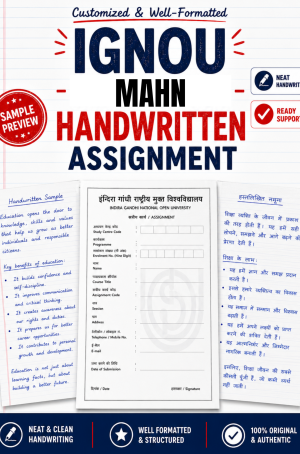
Four physical things travel together. The first is the written answer set itself, one bundle per MCH code, answered in the order the booklet numbers its questions so an evaluator can follow the paper without cross-referencing. The second is an IGNOU-format front page, prepared free with every order, with the enrolment number, name, address, course code, course title, assignment number, study centre name and code, and date laid out in the block that the MSCANCHEM booklets themselves print on their instruction page. The third is a copy of the official tutor-marked assignment paper for that code and validity window, so the questions being answered are visible beside the answers rather than taken on trust. The fourth is the packaging, and it is the least interesting item until you notice it is included: courier is inside the rate.
What does not travel is a file. No soft copy or PDF is sold. Nothing is emailed, nothing is uploaded to a drive, and there is no download link. That is a deliberate scope, not an oversight, and the reason sits in the next two sections.
Handwriting is the variable most learners worry about, and it is settled before money moves. Send a photo of a page you have written yourself and the handwritten set is matched to your handwriting at no extra charge. Analytical chemistry papers carry structures, reaction schemes, thermograms and derivations, so the writer works from the same booklet you are looking at rather than transcribing a generic answer bank.
Where ₹320 Per Subject Starts and Stops
Priced per subject means priced per MCH code. A learner sitting three papers in a semester and a fourth carried over from an earlier cycle is buying four subjects, and the arithmetic is the same four times over. There is no minimum order: one subject or fourteen, same rate. On MSCANCHEM that upper figure is not rhetorical, because fourteen is precisely how many theory codes the programme has.
Inside the rate: the writing, the foolscap sheets, the IGNOU-format front page, the copy of the question paper, and the courier. Outside the rate: nothing that is then charged extra later. There is no packing fee, no handling fee, and no premium for a longer paper. MCH 001, MCH 002, MCH 003 and MCH 004 are six-credit courses and their booklets run to ten substantial questions apiece; MCH 019 and MCH 024 are two-credit courses. All of them cost ₹320.
The one thing deliberately absent is a date. Delivery depends on your pin code and is confirmed for your order before you pay. No figure is promised on this page. A working-day count printed on a product page is a promise made to a stranger in a place the publisher has never shipped to, and it is the kind of promise that gets broken by a courier hub rather than by the writer. Confirming it per order against a real pin code is slower to state and more likely to hold.
Reference PDF or Written-Out Hard Copy: Telling the Two Apart
These are two different products and the confusion between them is the single most common reason an MSCANCHEM order goes wrong. A solved assignment is a soft-copy reference file of model answers for one course code and one session, downloaded and read on a screen. A handwritten assignment is the answers written out by hand on paper and submitted in hard copy at the study centre. One is study material. The other is the submission.
| Point of difference | Solved assignment | Handwritten assignment |
|---|---|---|
| Physical form | PDF file, read or printed at your end | Written sheets, couriered to your address |
| What you do with it | Read it, then write your own answers from it | Add your details to the front page and hand it in |
| Who it suits | A learner who wants to write the paper themselves and needs a reference to work against | A learner short of writing time who still has to meet the hard-copy requirement |
| Where it is sold | The store’s course-wise soft-copy listing | This page |
| Rate | Set on the soft-copy listing, not here | ₹320 per subject, courier included |
Scroll the table sideways on a phone to read every column.
The scoping matters and it cuts against an easy sale, so it is worth stating plainly: a downloaded PDF is not a submission. Printing it and handing the printout in at the study centre is not what the booklet asks for. Every MSCANCHEM booklet read for this page tells the learner to write answers on foolscap sheets with a 4 cm margin and to submit those answer sheets to the study centre; that instruction describes writing, not printing. A solved assignment is a reference to write from, and it is a good one, but it is a different purchase.
If reading and writing it yourself is the plan, that purchase lives elsewhere on this site. The MCH codes and the rest of the postgraduate list sit on the master’s degree solved assignment listing, which is where a search for a soft-copy MCH answer file should land rather than here.
Fourteen theory codes, one rate.
₹320 per subject. Hard copy, courier included, IGNOU-format front page free, question paper enclosed.
The Fourteen MCH Theory Codes This Order Can Cover
These come from the MSCANCHEM table in the IGNOU Common Prospectus for July 2026, section 3.60, with the credit column summed independently: twenty credits in each of the four semesters, eighty in total, which matches the figure the prospectus itself prints at the foot of the table. Semester one contains a conditional choice that catches people out, so it is marked in the table rather than buried in a footnote.
| Code | Official title | Credits | Semester |
|---|---|---|---|
| MCH 011 | Inorganic Chemistry -I | 4 | I |
| MCH 012 | Organic Chemistry-I | 4 | I |
| MCH 013 | General Physical Chemistry | 4 | I |
| MCH 014 | Mathematics for Chemists (take this one if you studied biology at 10+2) | 2 | I |
| MCH 015 | Biology for Chemists (take this one if you studied mathematics at 10+2) | 2 | I |
| MCH 016 | Inorganic Chemistry -II | 4 | II |
| MCH 017 | Organic Chemistry-II | 4 | II |
| MCH 018 | Quantum Chemistry and Group Theory | 4 | II |
| MCH 019 | Green Chemistry | 2 | II |
| MCH 001 | Basic Analytical Chemistry | 6 | III |
| MCH 002 | Separation Methods | 6 | III |
| MCH 023 | Environmental Chemistry (printed as MCH 0023 in the MSCANCHEM table) | 4 | III |
| MCH 024 | Introduction to Research | 2 | IV |
| MCH 003 | Spectroscopic Methods of Analysis | 6 | IV |
| MCH 004 | Electroanalytical and Other Analytical Methods | 6 | IV |
Scroll the table sideways on a phone to read every column.
Fifteen rows, fourteen courses. MCH 014 and MCH 015 are a pair from which exactly one is taken, and the prospectus rule is counter-intuitive enough to be worth repeating in plain words: a learner who did biology at 10+2 takes Mathematics for Chemists, and a learner who did mathematics at 10+2 takes Biology for Chemists. The course fills the gap in your school background rather than continuing it. Read your admission record before ordering either, because ordering the wrong one of the pair is the easiest mistake on this programme.
The theory codes account for 58 of the 80 credits. Notice that the second-year codes drop from the 011 to 019 range down into 001 to 004: that is not a typographical accident on this page, it is how the prospectus prints them, and it means an MSCANCHEM learner in semester three is working with codes that look older than the ones they finished in semester one.
The Eleven MCHL Laboratory Codes Nobody Can Sell You a TMA For
The remaining eleven courses carry the MCHL prefix and two credits each, twenty-two credits in total, and they complete the eighty. MCHL 011, MCHL 012 and MCHL 013 are Chemistry Lab-I, Lab-II and Lab-III; MCHL 014, MCHL 015 and MCHL 016 are Lab-IV, Lab-V and Lab-VI; MCHL 001 is Basic Analytical Chemistry Lab, MCHL 002 is Separation Methods Lab, MCHL 018 is Environmental Chemistry Lab, MCHL 003 is Spectroscopic Methods of Analysis Lab and MCHL 004 is Electroanalytical and Other Analytical Methods Lab.
Not one MCHL code appears on the MSCANCHEM assignment index on IGNOU’s own portal, and none of the booklets fetched from the School of Sciences assignment folder for this page carries an MCHL cover. Laboratory work on this programme is assessed through the practical arrangements your learner support centre runs, which is also why the prospectus carries a note warning that a laboratory course may have to be attended at a centre other than the one you chose. The practical consequence for an order is simple and slightly unwelcome to a seller: there is no handwritten assignment to buy for an MCHL code, from this publisher or from anyone else, and a vendor offering you one for MCHL 002 is selling something IGNOU has not issued.
Three Spellings, One Programme: What IGNOU’s Own Files Disagree About
Everything below was found by opening two or more official documents and reading them against each other. None of it is a complaint; it is the working state of the paperwork, and knowing it saves an order from going out against the wrong code.
Conflicts found while researching this page, September 2026.
1. The programme code is spelled three ways on IGNOU’s own systems. The Common Prospectus and the booklet covers print MSCANCHEM. The assignment portal serves the programme’s index page from a directory named MSCNACHEM, and the heading on that page reads MSCNACHEM as well. A 2024 file still linked from both index pages is named for MSCCHEM and MSANCHEM. Searching the portal for the correct spelling can therefore return nothing.
2. A file named for MCH-003 contains the MCH-004 paper. The document served from the School of Sciences assignment folder under the filename MCH-003-2025 opens on a cover reading MCH-004, Electroanalytical and Other Analytical Methods, and its assignment code line reads MCH-004/TMA/2026. There is no MCH-003 content in it. Open the file before assuming the filename describes it.
3. The prospectus prints MCH 0023 and MCHL 0018 in the MSCANCHEM table. Both carry a four-digit number in a series that is otherwise three digits. The MSCCHEM table on the following page of the same prospectus prints MCH 023 Environmental Chemistry and MCHL 018 Environmental Chemistry Lab for the identical course titles and identical credits. The three-digit forms are the ones to quote when ordering.
4. The same eight courses carry different codes in a cognate diploma. The Post Graduate Diploma in Analytical Chemistry, run by the same school, prints MCH 1, MCH 2, MCH 3 and MCH 4 with MCHL 1 to MCHL 4 for the theory and laboratory titles that MSCANCHEM prints as MCH 001 to MCH 004 with MCHL 001 to MCHL 004. If you hold a PGDAC credit being counted towards MSCANCHEM, the two code formats describe the same content.
5. Two validity windows are live at the same time. The MCH-013 and MCH-011 booklets are valid from 1 July 2025 to 30 June 2026. The MCH-019 booklet, dated 2026 on the same cover block, is valid from January 2026 to December 2026. The programme index page above both of them still carries a heading reading 1 January 2025 to 31 December 2025.
6. Four assignment-code formats coexist. MCH-011/TMA/2025-26, MCH-013/TMA/2025, MCH-004/TMA/2026 and MCH-019/TMA/2026 were all read off live booklets in the same School of Sciences folder.
7. The cover pages disagree about who the paper is for. MCH-011 names M.Sc. in Chemistry (MSCCHEM) only, although MCH 011 is the first course in the MSCANCHEM prospectus table. MCH-013 and MCH-019 name MSCCHEM and MSCANCHEM together. MCH-004 names MSCANCHEM only.
8. The programme’s own index lists nine codes and links two. The MSCANCHEM index page lists MCH-011 through MCH-019 under its current heading, of which only MCH-011 and MCH-012 are live links; no second-year code appears on it at all, and no MCHL code appears on it at all. Booklets for several of the unlinked codes do exist elsewhere on ignou.ac.in.
9. Two booklets with one window give different rollover years. MCH-011 tells a learner who misses the window to obtain the assignment for the year 2026. MCH-013, valid over exactly the same dates, says the year 2027.
10. This publisher’s own pages are not yet consistent. Other pages on shrichakradhar.com still carry a courier figure in working days, a founding year of 2012 beside a byline reading 2010, and older per-subject rates. Those are being corrected at source. The figures on this page are the current ones, and where they differ from an older page on the same site, this page is the one to go by.
Why Your MCH Booklet Prints a Validity Window Instead of a Last Date
Learners arrive at this page expecting a date, usually because a general assignment article told them 30 September or 31 March. Neither figure appears on any MSCANCHEM booklet. The School of Sciences does not print a calendar cut-off on these papers at all. What it prints is a validity window, and the two are not the same thing.
The MCH-013 booklet reads that it is valid from 1 July 2025 to 30 June 2026, and that a learner who fails it or fails to submit within that period must obtain the following year’s assignment. The MCH-019 booklet, sitting in the same folder with 2026 on its cover, runs from January 2026 to December 2026 instead. So the honest answer to when your MSCANCHEM assignment is due is: open your own booklet, read the window printed on the cover, and treat the closing date of that window as the outer limit. Alongside it, each booklet carries the instruction that answer sheets are submitted to the study centre within the due date and that sheets received after it will not be accepted, and that you cannot fill the examination form for the course until the assignment is in. Your study centre or regional centre sets that operative due date inside the window; the booklet sets the window.
One booklet adds a further line the others do not. The MCH-004 paper advises that although the assignment is valid for a year, the learner should submit within twelve weeks of receiving it. That is guidance rather than a deadline, but it is the only timing figure the School of Sciences prints anywhere on these papers, and it is worth respecting. Assignments carry 30 per cent of the final course result and the term-end examination carries the remaining 70 per cent, so the window closing on an unsubmitted MCH paper is not a bureaucratic inconvenience; it removes almost a third of the marks available in that course.
What MCH-013/TMA/2025 Tells You, and Why MCH-004 Says 2026
Every booklet prints an assignment code on the page where the questions begin, and it is not decoration. Written out, MCH-013/TMA/2025 says: course MCH-013, tutor-marked assignment, the 2025 issue. That last element is the one that decides whether the set you submit matches the set your evaluator holds. Two learners on the same programme can be sitting with papers whose codes end 2025 and 2026 respectively, because the School of Sciences has not standardised the element across its 2026 set.
Four formats were read off live papers for this page. MCH-011 uses a hyphenated span, MCH-011/TMA/2025-26. MCH-013 uses a single year that is one behind its cover block, MCH-013/TMA/2025 on a booklet whose cover prints 2026. MCH-004 and MCH-019 both use MCH-004/TMA/2026 and MCH-019/TMA/2026. Copy the code exactly as your own booklet prints it onto the front page, digit for digit, including whichever of those four shapes it happens to use. Correcting it to look like a neighbour’s is how a set ends up filed against the wrong cycle.
The rest of the front-page block is fixed across all four papers: enrolment number, name, address, course code, course title, assignment number, study centre name and code, and date. One booklet prints that first field as ENROLAMENT NO. and the others print ENROLMENT NO.; the field means the same thing either way and your enrolment number goes in it. The instruction below the block, in capitals on every paper, is that the format is followed strictly to facilitate evaluation and avoid delay.
Your Own Handwriting, Copied From a Photo You Send
Send a photo of a page you have written yourself and the handwritten set is matched to your handwriting at no extra charge. The sequence runs sample first, then order, then payment, which puts the only genuine risk in the transaction on the publisher rather than on the learner: if the returned sample does not look like your hand, nothing has been spent.
Analytical chemistry makes this harder than it is on a text programme and worth more when it works. An MCH-004 answer sheet carries cell notation, Nernst calculations, a labelled three-electrode diagram and a thermogram sketch. An MCH-018 sheet carries character tables and symmetry elements. An MCH-012 or MCH-017 sheet carries reaction schemes with arrows that have to point at the right atom. These are drawn in the same hand as the prose around them, on the same foolscap sheet, which is precisely why a printed answer set does not pass as a written one.
What the sample photo needs to be
A single page of your ordinary handwriting, photographed straight on in daylight, with enough text to show how you form letters at speed rather than how you form them when concentrating. Chemistry-specific characters help if you have any to hand: a benzene ring, a couple of subscripts, an arrow. A page from an old notebook is better than a page written carefully for the purpose, because the set has to match what an evaluator has seen from you before.
English-Only Medium, Old Cycles and Carried-Over Codes
The service covers all mediums IGNOU issues the TMA paper in, at the same price. On MSCANCHEM that resolves to one medium and it is worth saying so rather than leaving the sentence abstract: the Common Prospectus records the medium of instruction for M.Sc. (Analytical Chemistry) as English, and every booklet read for this page is an English paper. There is no Hindi MCH booklet to order, so a learner should not be sold one.
Session coverage is wider than medium coverage. Any session is accepted, current cycle or older, including backlog courses, at the same ₹320 per subject. This matters more on MSCANCHEM than on most programmes, because the assignment portal still displays a 2024 row beside its current row and because the two live validity windows mean a learner can legitimately hold a paper from either. Send the code and the window printed on your own booklet and the set is written against that paper, not against whichever version happens to be newest.
Carried-over codes behave the same way. A learner who cleared the first year but is repeating MCH 018, or who has come into semester three and needs MCH 001 and MCH 002 written while sitting MCH 023, orders exactly those codes at exactly that rate. There is no bundle, no semester package and no discount structure to work out, which is the practical meaning of pricing per subject.
The Five Things to Send on WhatsApp
Nothing else is needed and nothing else should be sent. Five items settle an MSCANCHEM order.
- Your MCH codes. Written the way your own booklet or admission record writes them, including the leading zeros.
- The validity window on your booklet cover. Either the July to June span or the January to December one. This is the field that decides which paper is used.
- Your handwriting sample photo. One page, as described above.
- Your delivery pin code. Used to confirm the courier position for your address before anything is agreed.
- Your name and enrolment number. For the front page, and only for the front page.
Login credentials are not required and should never be shared with any assignment vendor. Nothing on this order needs access to your Samarth account, your registered email or your date of birth.
MCH codes confirmed before writing starts.
₹320 per subject. Any session, current or backlog. Sample photo before payment.
Once the Parcel Lands at Your Address
Open it and check three things against your own booklet before you go anywhere near the study centre. First, that the code on each front page matches the code you are registered in. Second, that the assignment code line matches the one printed on your booklet, digit for digit, including the year element. Third, that the number of question responses matches the number of questions your paper asks, which on MSCANCHEM is not a constant: MCH-011, MCH-013 and MCH-004 each print ten questions, and MCH-019 prints twenty.
Then write your details onto the front page in your own hand and sign it. You sign the declaration on the assignment cover page, so you should read and review the content before submitting it, and satisfy yourself that it represents your own understanding of the course. On a programme where an evaluator may ask you about a mechanism you handed in, that reading is worth the hour it takes.
Submission goes to the coordinator at your allotted study centre, bundled by course rather than mixed together, and the booklets are explicit that sheets arriving after the due date are not accepted. Ask for an acknowledgement and photograph it. Every booklet also strongly suggests retaining a copy of your answer sheets, which on a hard-copy submission means photographing the set before you hand it over. Status appears later on IGNOU’s own student portal, and if it has not appeared some weeks after submission the acknowledgement you kept is the thing your regional centre will ask for.
What MSCANCHEM Learners Add to the Same Order
Most MCH orders arrive alongside something else, and the combinations are predictable enough to be worth naming. Learners preparing for the term-end paper as well as the assignment usually pick up a course guide from the master’s degree help book shelf, where the analytical chemistry titles already include an MCH 13 guide filed under the MSCANCHEM heading. Those wanting question patterns from earlier cycles look at the postgraduate guess paper section, and those who prefer to read a full answer set on screen while writing their own work from the course-wise soft-copy hub or, if a printed volume suits better, a bound solved-assignment book covering any session.
Learners registered on two programmes at once, or helping a family member on a different one, can reach every other written set through the handwritten assignment counter for all programmes, or place a customised order covering any course and session when the programme has no page of its own yet. The management equivalent of this page, built the same way against MMPC booklets, is the MBA handwritten assignment product. Anyone reaching the fourth semester and thinking ahead to research work will find dissertation and report support on the IGNOU project shelf, which is the natural companion to MCH 024. The full catalogue of printed study material sits at the IGNOU books department.
If the preference is to write the whole thing yourself and simply do it properly, the method is documented rather than sold: the step-by-step handwritten assignment guide on ignouproject.com walks through format, front page and submission without any purchase attached.
Before Ordering, MSCANCHEM Learners Ask These
How many MSCANCHEM subjects do I actually have to submit assignments for?
Fourteen across the whole programme, one tutor-marked assignment per theory course. The programme has twenty-five courses in total, but eleven of them carry the MCHL prefix and are laboratory courses assessed through practical work, with no TMA booklet issued. So the maximum an MSCANCHEM learner ever orders on this page is fourteen, and in a single semester it is between three and five.
Should I take MCH 014 or MCH 015?
The prospectus rule inverts what most people guess. If you studied biology at 10+2, you take MCH 014, Mathematics for Chemists. If you studied mathematics at 10+2, you take MCH 015, Biology for Chemists. The course is there to fill the subject you did not do. Check your admission record before ordering, because the two codes are adjacent and easy to transpose.
Why does the MCH-003 file on ignou.ac.in open on an MCH-004 cover?
Because the file is misnamed on IGNOU’s server. The document served under that filename carries an MCH-004 cover, the title Electroanalytical and Other Analytical Methods, and the assignment code MCH-004/TMA/2026. It is the MCH-004 paper. If you need MCH-003, Spectroscopic Methods of Analysis, do not assume you have it because the filename said so; check the cover of whatever opens, and ask your regional centre if the correct paper is not findable.
Can I just print a solved assignment PDF and submit that instead?
No. The booklets ask for answers written on foolscap sheets and submitted as answer sheets to the study centre, which describes handwriting rather than printing. A solved assignment is a reference file to write from and it is genuinely useful for that; it is not a submission. If a reference file is what you want, the soft-copy listing linked above is the right place rather than this page.
What is the difference between a solved assignment and a handwritten assignment for MCH codes?
Format and purpose. The solved assignment is a soft-copy file of model answers for one code and session that you read on a screen. The handwritten assignment is that content written out by hand on paper and couriered to you as a physical set ready to hand in. One is study material you work from; the other is the object you submit.
My booklet says foolscap, but every website says A4. Which is right?
Your booklet. All four MSCANCHEM and MSCCHEM papers read for this page instruct the learner to use only foolscap size paper, and not of a very thin variety, with about a 4 cm margin on the left, top and bottom. The A4 advice circulating on general assignment blogs is a reasonable summary of what many IGNOU schools ask for, but it is not what the School of Sciences prints on these particular papers. The sets prepared here follow the booklet.
What is the last date for the MSCANCHEM assignment?
No calendar last date is printed on these booklets. What is printed is a validity window, and there are currently two live ones: 1 July 2025 to 30 June 2026 on the MCH-011 and MCH-013 papers, and January 2026 to December 2026 on the MCH-019 paper. Read the window on your own cover, treat its closing date as the outer limit, and ask your study centre for the operative due date inside it. Aggregator figures such as 30 September or 31 March are not from these booklets.
Is there a Hindi medium MCH assignment?
Not for this programme. The Common Prospectus records the medium of instruction for M.Sc. (Analytical Chemistry) as English, and every booklet read for this page is in English. Any vendor offering a Hindi MCH paper is offering something IGNOU has not issued for MSCANCHEM.
Can I order for MCHL 002 or any other lab code?
No, and neither can anyone else. No MCHL code appears on the MSCANCHEM assignment index, and no laboratory booklet was found in the School of Sciences assignment folder while researching this page. Laboratory courses are assessed through the practical arrangements at your learner support centre. If a seller offers you a handwritten assignment for an MCHL code, ask them to show you the booklet first.
My codes are from an older session. Is that a problem?
No. Any session is accepted, current cycle or older, including backlog courses, at the same ₹320 per subject. Send the code and the validity window printed on the booklet you actually hold, and the set is written against that paper rather than against the newest one. MSCANCHEM makes this common, because the assignment portal still shows a 2024 row alongside its current row.
Why can I not find MSCANCHEM on the IGNOU assignment portal?
Because the portal serves that page from a directory spelled MSCNACHEM, with the same transposition in the heading on the page itself. A third spelling, MSANCHEM, survives in the filename of a 2024 file linked from it. Searching the correct spelling can therefore return nothing. Reaching the master’s degree index and following the MSCANCHEM link works, even though the address it lands on is spelled differently.
How many questions will my set answer?
As many as your booklet asks, and the number is not fixed on this programme. MCH-011, MCH-013 and MCH-004 each print ten questions carrying 100 marks in total. MCH-019 prints twenty. Each booklet also states that 40 per cent of the total is needed to pass it. The set answers every question the paper asks, numbered as the paper numbers them.
Does the rate change for a six-credit paper?
No. MCH 001, MCH 002, MCH 003 and MCH 004 are six-credit courses with longer papers, and MCH 019 and MCH 024 are two-credit courses with shorter ones. All of them are ₹320 per subject. There is no minimum order: one subject or fourteen, same rate.
When will it reach me?
Delivery depends on your pin code and is confirmed for your order before you pay. No figure is promised on this page. If an older page on this site still shows a working-day figure, it is being corrected; ask on WhatsApp with your pin code and you will get the position for your own address rather than an average.
Will the assignment be accepted, and what marks will it get?
No claim is made about the marks any assignment will receive, about how an evaluator will assess it, or about whether it will be accepted. Assignment evaluation is entirely a matter for IGNOU. What can be stated is what is done: the set answers your own booklet’s questions in its own numbering, on the paper size the booklet specifies, in handwriting matched to your sample.
Which Document Each Fact on This Page Came From
From the Common Prospectus, July 2026. Section 3.60 supplied the programme description, the School of Sciences attribution, the eligibility routes, the medium of instruction, the full semester-wise course table with codes, official titles, nature of course and credits, and the total of 80 credits. The credit column was summed independently before the table was used: 20 credits in each of the four semesters, 80 in total, which matches the printed figure. Section 3.61, the MSCCHEM table, and section 8.8, the PGDAC table, were read against 3.60 to establish conflicts 3 and 4 above.
From live tutor-marked assignment booklets on ignou.ac.in. Four papers were opened in the School of Sciences assignment folder in September 2026: MCH-011, MCH-013, MCH-019 and the paper served under the MCH-003 filename that turns out to be MCH-004. From those came the validity windows, the assignment code formats, the cover-page programme lists, the 30 per cent weightage and 40 per cent pass mark, the foolscap and 4 cm margin instructions, the front-page block, the question counts, the twelve-week advisory on MCH-004, and the rollover-year discrepancy. The MSCANCHEM programme index on IGNOU’s assignment portal supplied the directory spelling, the list of linked and unlinked codes, and the January to December 2025 heading. Both can be checked directly: the official IGNOU assignment download service, the MSCANCHEM index page served from the MSCNACHEM directory, and the file named for MCH-003 that opens on an MCH-004 cover.
From this publisher’s own commercial terms. The rate of ₹320 per subject, hard copy only, courier included, the free IGNOU-format front page, the enclosed question paper, the handwriting match from a sample photo at no extra charge, the absence of a minimum order, the acceptance of any session including backlogs, and the refusal to print a delivery figure are all commercial positions set by Shri Chakradhar Publication Pvt. Ltd. They are not IGNOU rules and are not represented as such.
Important Notice
Shri Chakradhar Publication Pvt. Ltd. and shrichakradhar.com form an independent IGNOU study-support publisher. This is not the official website of Indira Gandhi National Open University, is not affiliated with, endorsed by or authorised by the university, and no page on this site should be treated as an official IGNOU communication.
Programme structures, course codes, submission dates and rules change, and only ignou.ac.in and your Regional Centre can confirm the current position for your enrolment.
You sign the declaration on the assignment cover page, so you should read and review the content before submitting it, and satisfy yourself that it represents your own understanding of the course.
No claim is made about the marks any assignment will receive, about how an evaluator will assess it, or about whether it will be accepted. Assignment evaluation is entirely a matter for IGNOU.
Place Your MSCANCHEM Order
₹320 per subject. Hard copy only, courier included, IGNOU-format front page free, official question paper enclosed. No soft copy or PDF is sold.
Two ways to start. Send your MCH codes and the validity window off your booklet cover, or send a photo of the cover itself and the codes will be read off it.