Description
In short. This is a handwritten answer set for the Tutor Marked Assignments of IGNOU’s Master of Library and Information Science, the one-year, forty-credit School of Social Sciences degree open only to graduates who already hold a Bachelor’s in Library and/or Information Science or an Associateship from NISCAIR or DRTC, and it is written subject by subject against the exact paper your course code belongs to. MLIS lists ten courses, but only eight of them generate a Tutor Marked Assignment: the six core papers MLI-101, MLI-102, MLII-101, MLII-102, MLII-103 and MLII-104, plus the two MLIE electives you selected out of six, because MLII-105 Internship and MLIP-2 Project have no entry in the assignment booklet at all. The rate is ₹320 per subject, hard copy only, with courier included in that price and no separate shipping charge. Papers are written on foolscap with a three-inch left margin, which is what the Library and Information Science booklet asks for rather than the A4 sheet most vendors default to, and the July intake submits by 31 March while the January intake submits by 30 September.
Inside the Parcel That Reaches Your Door
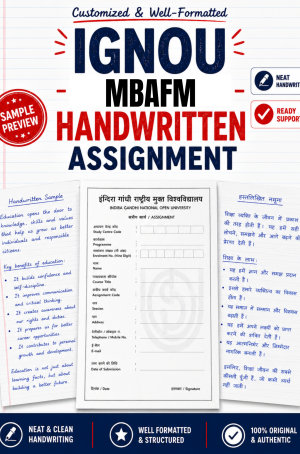
Four physical things arrive, and it is worth being precise about them because MLIS learners are frequently sold a download and left to do the writing themselves. The first is the answer set, written by hand on foolscap sheets in blue ink, one file per course code, with the question number written beside each answer and roughly four blank lines left between answers so the counsellor has room to comment. The second is the IGNOU-format cover sheet, filled in with the programme title and code, course title and code, assignment number, study centre name and code, and space for your enrolment number, name and address in the top right corner as the booklet’s specimen layout demands. The third is a copy of the official Tutor Marked Assignment question paper the answers were written against, so that you and your counsellor can check the set against the questions without hunting for the booklet. The fourth is the packaging and the courier itself.
No soft copy or PDF is sold. That is a deliberate scope, not an omission: the MLIS booklet’s instruction list states that typed and computer-printed assignments are not permissible, so a downloadable file cannot be the thing you hand in. Shri Chakradhar Publication treats the handwritten hard copy as the entire product and does not attach a PDF to it.
Where the ₹320 Stops and Where It Does Not
The figure covers one course code, written out in full, couriered to your address, with the cover sheet and the question paper in the same envelope. There is no minimum order: one subject or fourteen, same rate. An MLIS learner who is short of only MLIE-104 pays for MLIE-104 and nothing else, and an MLIS learner starting the whole year from scratch pays eight times the same figure, because the eight-paper ceiling is fixed by what the booklet actually contains.
What the figure does not cover is anything IGNOU keeps for itself. The seminar sessions attached to MLI-101, MLI-102 and your two electives are presented in person at the study centre and marked on your presentation and your participation in the discussion, and no publisher can produce those for you. Neither can anyone sit the computer practicals attached to MLII-101, MLII-102, MLII-103 and MLII-104, which the programme guide schedules as five, ten, fifteen and twenty two-hour sessions respectively, fifty sessions and one hundred hours in total, with a seventy-five per cent attendance floor. The handwritten set covers the written Tutor Marked Assignment component and nothing beyond it. Saying so plainly is more useful than a claim that would fall apart at the study centre counter.
Delivery depends on your pin code and is confirmed for your order before you pay. No figure is promised on this page.
Reference File or Submission Copy: Telling the Two Apart
These two products are constantly confused, and the confusion costs MLIS learners a session when it goes wrong. A solved assignment is a soft-copy reference file of model answers for a particular course code and session, downloaded and read. A handwritten assignment is the answers written out by hand on paper and submitted in hard copy at the study centre. One is study material. The other is the thing that goes into the assignment box.
| Question | Solved assignment | Handwritten assignment |
|---|---|---|
| What it is | A soft-copy reference file of model answers for one course code and session | The answers written out by hand on foolscap and handed in as a hard copy |
| Format | PDF, read on a phone or laptop | Physical sheets with a filled cover page, couriered to you |
| What you do with it | Read it, understand the concept, then write your own answer in your own language | Check it against your question paper, sign the declaration and submit it |
| Who it suits | An MLIS learner who has the time to write and wants a model to work from | An MLIS learner working full time in a library who has run out of writing time |
| Price on this store | Priced separately in the solved-assignment section | ₹320 per subject, courier included |
Scroll the table sideways on a narrow screen.
The booklet settles the practical question that sits underneath all of this. Its instruction list says that typed and computer print assignments are not permissible, and it also warns that reproducing the language of the course material earns a zero and that copying from another learner’s answer sheet gets the assignment rejected. So a downloaded file, however good, is a reference to write from and never a submission in itself. If a model answer set is what you actually want, the MLIS solved assignment range on this store is priced and organised code by code and session by session, and that is the right place for it rather than this page.
Eight papers is the whole list. Send yours.
₹320 per subject, hard copy only, courier included, any session including backlogs.
Eight Compulsory Papers, and the Two That Produce No TMA
The Common Prospectus, July 2026 edition, section 3.23, lists MLIS under the School of Social Sciences as eight compulsory courses and two elective courses, forty credits in total. Summing the table independently confirms it: eight compulsory rows at four credits each is thirty-two, two electives at four credits each is eight, and the total is forty, which matches the figure printed at the foot of the prospectus table. No column bleed from a neighbouring programme was found in this extraction.
What the prospectus does not tell you, and what only the live assignment booklet does, is that two of those eight compulsory courses produce no Tutor Marked Assignment. The booklet’s contents page runs from MLI-101 to MLIE-106 and contains twelve papers. MLII-105 Internship and MLIP-2 Project are simply not in it. The booklet’s own instruction paragraph is consistent with that: it says each candidate does one Tutor Marked Assignment and a seminar or practical in each of the six core courses and two electives selected by them. Six plus two is eight. That is your order ceiling, whatever the ten-course structure implies.
| Code | Title of the course | Credits | TMA in the booklet | Other component |
|---|---|---|---|---|
| MLI 101 | Information, Communication and Society | 4 | Yes | Seminar |
| MLI 102 | Management of Library and Information Centres | 4 | Yes | Seminar |
| MLII 101 | Information Sources, Systems and Services | 4 | Yes | Practical |
| MLII 102 | Information Processing and Retrieval | 4 | Yes | Practical |
| MLII 103 | Fundamentals of Information Communication Technologies | 4 | Yes | Practical |
| MLII 104 | Information Communication Technologies: Applications | 4 | Yes | Practical |
| MLII 105 | Internship | 4 | No entry in the booklet | Refer to the internship procedure |
| MLIP 2 | Project | 4 | No entry in the booklet | Dissertation, 50 per cent pass bar |
Scroll the table sideways on a narrow screen.
Codes are shown in the spacing the prospectus itself uses. The booklets and your admission record hyphenate them, so MLI 101 and MLI-101 are the same paper and the difference is typographic rather than substantive. State the code exactly as it appears on your own record when you order and nothing is left to interpretation.
Choosing Two Electives From the Six MLIE Papers
Six electives are offered and exactly two are taken, which means four of the rows below will never appear on your grade card and you should never be quoted for them. The booklet prints an assignment for all six because it cannot know which two you chose; your admission record and your study centre can.
| Code | Title of the course | Credits | Assessment alongside the TMA |
|---|---|---|---|
| MLIE 101 | Preservation and Conservation of Library Materials | 4 | Seminar |
| MLIE 102 | Research Methodology | 4 | Seminar |
| MLIE 103 | Academic Library System | 4 | Seminar |
| MLIE 104 | Technical Writing | 4 | Seminar |
| MLIE 105 | Informetrics and Scientometrics | 4 | Seminar |
| MLIE 106 | Public Library System and Services | 4 | Seminar |
Scroll the table sideways on a narrow screen.
One title above needs a note. The Common Prospectus prints MLIE 105 as “Informatrics and Scientometrics”. Both the live assignment booklet and the official MLIS programme guide print it as “Informetrics and Scientometrics”, and informetrics is the actual discipline, so the prospectus spelling is a typographical slip rather than a different course. The table above follows the two documents that agree.
Three IGNOU Documents, Three Different Answers
Reading the Common Prospectus, the live assignment booklet and the official MLIS programme guide against one another produces a set of contradictions that no single document reveals. They are listed rather than smoothed over, because an MLIS learner who meets one of them at the study centre counter is better served by having seen it here first.
Disagreements found in IGNOU’s own MLIS documents, and one found in this store’s own material.
1. The programme guide’s own credit table lists only seven compulsory rows, ending at MLII-105 Internship, and omits the project entirely. Seven compulsory courses plus two electives at four credits each sums to thirty-six, yet the same table prints a total of forty. The missing four credits are exactly MLIP-2.
2. The programme guide states that every student submits one assignment for each course except MLIP-002, which would leave nine assignments including one for the Internship. The assignment booklet contains no paper for MLII-105 at all, and its instruction paragraph counts six core courses plus two electives. Eight and nine cannot both be right.
3. The booklet’s weightage arithmetic does not close. It states that the assignment and the seminar or practical carry thirty per cent weightage each and that the term-end examination carries seventy per cent, which totals one hundred and thirty. The programme guide’s continuous evaluation at thirty per cent and term-end at seventy per cent is the version that adds up, and the sensible reading is that the single thirty per cent is shared between the assignment and the seminar or practical.
4. MLIE-105 is titled “Informatrics and Scientometrics” in the Common Prospectus and “Informetrics and Scientometrics” in both the booklet and the programme guide.
5. MLII-104’s title appears in at least four forms across IGNOU’s own documents, including “INFORMATION AND COMMUNICATION TIECHNOLOGIES – APPLICATIONS”, with the misspelling printed twice in the programme guide.
6. The project course is written as MLIP 2 in the prospectus and MLIP-002 in the programme guide, and this store’s own project pages use MLIP-2. Three renderings of one code.
7. The booklet’s worked example on late submission tells a July 2021 learner who misses the deadline that the cut-off was 31 March 2021, a year before the date the same page has just set. The intended date is 31 March of the following year.
8. The booklet prints six different assignment-code strings where three would do, including AST/TMT in place of AST/TMA on MLII-101, AST/SEM printed on the Tutor Marked Assignment for MLII-102, a two-digit year on MLIE-102, and a reversed session order with the wrong years on the MLIE-106 seminar.
9. The programme guide contradicts itself on how many courses there are, referring to nine courses taken in one sitting and then to the tenth course being the internship, and separately to “four of the seven core courses” against a stated eight core courses.
10. In-house, and disclosed rather than hidden: this store’s navigation names the programme “Master of Library and Information Sciences” in the books section and “Master of Library & Information Sciences” in the solved-assignment section, while the guess-paper slug reads “ma-library-and-information-sciences”. IGNOU prints “Master of Library and Information Science”, singular, in both the prospectus and the programme guide. The store’s handwritten category page also states A4, where the MLIS booklet specifies foolscap. Both are queued for correction.
Programme structures, course codes, submission dates and rules change, and only ignou.ac.in and your Regional Centre can confirm the current position for your enrolment.
Why Your July Deadline Falls in March
MLIS sits with the Faculty of Library and Information Science inside the School of Social Sciences, and that faculty runs its submission calendar the opposite way round to the management programmes whose dates get copied onto MLIS pages across the web. The MLIS booklet prints 31 March for the July intake and 30 September for the January intake. The current-cycle Library and Information Science booklet fetched for this page repeats the pattern with live years: 30 September 2026 for the January 2026 session and 31 March 2027 for the July 2026 session.
Aggregator sites routinely publish 31 October and 30 April against MLIS. Those are School of Management Studies dates. Applying them to an MLIS file puts the submission seven months late, and the consequence is set out in the booklet itself: the validity of an assignment is one year, and a learner who misses the due date for a session has to attempt the fresh set of assignments for the following corresponding session. Miss 31 March as a July learner and you are writing the next July paper, not a late version of this one.
Assignments carry 30 per cent of the final course result and the term-end examination carries the remaining 70 per cent. The programme guide adds a floor most learners do not notice: a minimum of forty per cent in continuous evaluation is required, and a candidate becomes eligible for the term-end examination only after the assignments are in and the seminars and practicals are attended. The deadline is therefore an examination gate, not only a marks question.
Decoding AST/TMA and the Codes That Break the Pattern
Every MLIS paper carries an assignment code in its header, and the code is the safest way to confirm you have the right paper before anyone writes a word. The standard MLIS form is AST, then the component, then the session span: AST/TMA for the Tutor Marked Assignment, AST/SEM for the seminar and AST/PRAC for the practical, followed by the two sessions the booklet covers, as in AST/TMA/Jul.2021-Jan.2022.
Two structural features matter. First, one MLIS booklet serves both intakes, so the code names a July session and a January session together rather than one session on its own. Second, the header also prints the unit coverage and the total marks, which are fifty for each paper, and the coverage differs by course: sixteen units for MLI-101, nineteen for MLII-101 and MLII-102, eighteen for MLI-102 and MLIE-105, fourteen for MLII-103, MLIE-103 and MLIE-104, sixteen for MLII-104, fifteen for MLIE-101, and seventeen for MLIE-106.
Then there are the codes that do not follow the pattern, and they are worth naming because a learner who spots one usually assumes the file is fake. On MLII-101 the Tutor Marked Assignment header reads AST/TMT rather than AST/TMA. On MLII-102 both the Tutor Marked Assignment and the practical print AST/SEM, so that course has no TMA or PRAC code printed anywhere in the booklet. MLIE-102 uses a two-digit year, Jul.21-Jan.22, where every other paper uses four digits. The seminar papers for MLIE-101 and MLIE-104 print AST/TMA instead of AST/SEM. And the MLIE-106 seminar prints AST/SEM/Jan.2021-Jul.2022, reversing the session order and misstating both years. These are template carry-over errors in IGNOU’s own file. The paper is still the right paper; the header is simply wrong.
The question pattern is uniform even where the codes are not. Each MLIS Tutor Marked Assignment carries five questions for fifty marks. Questions one to four are worth ten marks each and offer a choice, printed as 1.1 or 1.2, so you answer one of the two. Question five is worth ten marks and asks for short notes on any two of four or five listed items. One exception surfaced: MLIE-106 prints two questions both numbered 4.2 and no 4.1, another template slip.
Your Own Handwriting, Copied From a Photo
An MLIS file that arrives in a hand nothing like yours is a problem, particularly for a one-year programme where the same counsellor sees your seminar work and your written submissions in the same window. Send a photo of a page you have written yourself and the handwritten set is matched to your handwriting at no extra charge. The writer works from that photo, and a sample photo of the writing goes back to you before anything is paid, so the risk of a mismatch sits with the publisher rather than with you.
What Makes a Usable Sample Photo
A single page is enough. Write eight or ten lines of ordinary prose, not your signature and not block capitals, on lined or plain paper in the pen you normally use. Photograph it flat in daylight with the whole page in frame and no shadow across the writing. What the writer needs to see is your letter slant, your spacing and how you form the letters that vary most between people, so a short paragraph of connected writing is far more useful than a heading or a list.
Foolscap, Three Inches and Four Blank Lines
The MLIS booklet is specific about the physical page, and it does not ask for A4. It asks for foolscap size paper, ordinary writing paper, neither too thick nor too thin, with a three-inch margin left on the left-hand side and at least four lines between each answer so the counsellor can write comments in the right places, and with the question number written against every answer. The booklet also requires the specimen header block on the first page of each answer sheet, with the programme title and code, course title and code, assignment number and study centre name and code on the left, and enrolment number, name, address and date on the right, and it warns that assignments may not be evaluated if the format is not followed. Sets prepared here follow the foolscap specification for MLIS rather than the general A4 default.
English Instruction, Hindi Answer Scripts, Any Session
MLIS has an unusual medium rule that catches learners out in both directions. The prospectus states that the medium of instruction is English, and then adds that students can write assignments and the term-end examination in Hindi as well. The booklet says the same thing in one line: you can write your assignments in English as well as in Hindi medium. So the study material is English, the answer script need not be, and choosing Hindi for your written work does not require a change of programme or a different course code. The service covers all mediums IGNOU issues the TMA paper in, at the same price.
Session coverage is equally flexible, which matters more for MLIS than for most programmes. The maximum duration for MLIS is two years from the date of registration, half the four years given to almost every other IGNOU master’s degree, so a learner carrying two or three papers into a second cycle is working against a much shorter clock. Any session is accepted, current cycle or older, including backlog courses, at the same ₹320 per subject. If you are ordering for a programme other than MLIS at the same time, the handwritten assignment hub covering every other programme lists the rest of the range.
What to Send Before Anything Is Written
Five things, and deliberately nothing more. Your course codes exactly as they appear on your admission record, including which two MLIE electives you selected. Your session, whether that is the current July or January cycle or an older one you are clearing. Your medium, English or Hindi. Your handwriting sample photo. Your delivery address with the pin code, since dispatch is confirmed against the pin code before payment.
No enrolment number, no password, no Samarth login and no scanned identity document is needed to place the order, and none should be sent. Anyone asking an MLIS learner for portal credentials to prepare an assignment is asking for something the work does not require. If your codes span more than one programme, or you are ordering for a family member on a different course, the customised handwritten order route handles mixed lists.
Not sure whether your list is six papers or eight?
₹320 per subject, hard copy only, courier included in the price, no minimum order.
Once the Parcel Is in Your Hands
Open it and check the course codes against your own record before anything else, because a wrong code is far easier to fix on the day the parcel lands than in the week the assignment box closes. Check that the cover sheet carries your study centre code and that the question paper matches the session you are submitting for.
Then read it. You sign the declaration on the assignment cover page, so you should read and review the content before submitting it, and satisfy yourself that it represents your own understanding of the course. The MLIS booklet is direct about why this matters: it instructs learners to give the relevant points from the course material and elaborate in their own language rather than reproducing the language of the units, and states that reproducing from the units earns a zero. Reading the set through before you sign is the step that protects you.
Submission goes to the Coordinator or Programme In-charge of the study centre allotted to you, and the booklet asks for it to be handed in at the concerned study centre within the due date. Keep the receipt. Evaluated assignments come back to you through the study centre coordinator, which is how you learn what to change for the next paper. No claim is made about the marks any assignment will receive, about how an evaluator will assess it, or about whether it will be accepted. Assignment evaluation is entirely a matter for IGNOU.
Other Library Science Material MLIS Learners Pick Up
Most MLIS orders arrive alongside something else, because a one-year programme compresses everything into a single window. Learners who want the concepts before they write usually take the MLIS guide books shelf for the core papers, and those preparing for the annual examination in all courses at one sitting tend to add solved guess papers for the MLIS term-end.
The two courses that produce no Tutor Marked Assignment still have to be completed, and they are handled separately. Synopsis and dissertation support for the project sits under MLIP-2 project material in soft copy, while learners who need the finished dissertation bound and delivered use a bound MLIP-2 hard copy. The project carries a fifty per cent pass bar rather than the forty per cent that applies elsewhere in the programme, which is worth knowing before you start it.
Learners who came into MLIS through IGNOU’s own library science ladder often still have papers open lower down. The BLIS assignment section covers the bachelor’s stage, CLIS certificate books cover the entry certificate, and PGDLAN study material covers the automation and networking diploma that shares the same faculty. That diploma is a useful comparison point: it runs two Tutor Marked Assignments per course and weights assignments at twenty per cent against an eighty per cent examination, where MLIS runs one assignment plus a seminar or practical against a seventy per cent examination. Two programmes, one faculty, two different schemes.
What MLIS Learners Want Cleared Up First
How many MLIS handwritten assignments do I actually need?
Eight at most. Six core papers, MLI-101, MLI-102, MLII-101, MLII-102, MLII-103 and MLII-104, plus the two MLIE electives you selected. If you are clearing only some of them, order only those.
Do MLII-105 and MLIP-2 need a handwritten assignment too?
No. Neither appears anywhere in the MLIS assignment booklet. The Internship follows its own standard operating procedure and the project is a dissertation, so no Tutor Marked Assignment exists for either and you should not be quoted for them.
What is the difference between an MLIS solved assignment and a handwritten one?
A solved assignment is a soft-copy reference file of model answers for a course code and session. A handwritten assignment is those answers written out by hand on paper and handed in at the study centre. The first is something you read; the second is something you submit.
Can I print a solved assignment PDF and submit that?
The MLIS booklet’s instruction list states that typed and computer print assignments are not permissible. A printed file is not a submission in the form the booklet asks for, so a solved assignment is best treated as reference material to write from.
Does IGNOU reject typed MLIS assignments?
The booklet states the format requirement rather than the consequence, and the consequence rests with the evaluator and the study centre. What it does say explicitly is that the specimen header format must be followed or the assignment may not be evaluated, that reproducing the units earns a zero, and that copying another learner’s answers gets the assignment rejected.
Should I buy the solved PDF as well as the handwritten set?
Only if you want the model answers to read. The handwritten set already includes the written answers and the question paper, so the PDF adds a study aid rather than anything you need in order to submit.
My July session deadline is in March. Is that correct?
Yes. The Library and Information Science booklets print 31 March for the July intake and 30 September for the January intake. The 31 October and 30 April dates circulated by aggregator sites belong to the School of Management Studies and do not apply to MLIS.
Can I write my MLIS answers in Hindi?
Yes. The medium of instruction is English, but the prospectus and the booklet both state that assignments and the term-end examination may be written in Hindi. The service covers all mediums IGNOU issues the TMA paper in, at the same price.
What paper size does the MLIS booklet ask for?
Foolscap, not A4, described as ordinary writing paper that is neither too thick nor too thin, with a three-inch margin on the left and at least four lines between answers.
What does AST/TMA mean on my MLIS paper?
AST identifies the assignment, TMA marks it as the Tutor Marked Assignment as opposed to a seminar or practical, and the dates that follow name the two sessions the booklet covers. One MLIS booklet serves both the July and January intakes, which is why two sessions appear in one code.
My booklet prints AST/SEM on what looks like a Tutor Marked Assignment. Is the file fake?
No. On MLII-102 the booklet prints AST/SEM on both the Tutor Marked Assignment and the practical, and similar slips appear on MLII-101, MLIE-102, MLIE-101, MLIE-104 and MLIE-106. These are template carry-over errors in IGNOU’s own document, not a sign of a fake paper.
Do you cover backlog codes from an older MLIS cycle?
Yes, at the same rate. Any session is accepted, current cycle or older, including backlog courses, at the same ₹320 per subject. Send the session year along with the codes so the right paper is used, since assignment validity is one year and a missed session means a fresh paper.
How long will delivery take to my address?
Delivery depends on your pin code and is confirmed for your order before you pay. No figure is promised on this page.
Do I still have to attend the seminars and practicals?
Yes, and nobody can do them for you. The seminar is presented in person and marked on your preparation, presentation and participation, and the four MLII practicals run to fifty sessions and one hundred hours with a seventy-five per cent attendance requirement. The handwritten set covers only the written assignment component.
What if my elective choice is different from what you assumed?
Nothing is assumed. Papers are written only against the codes you send, so if your two electives are MLIE-103 and MLIE-106 those are the two written, and the other four MLIE papers never enter the order or the price.
Which Document Each Fact on This Page Came From
From the Common Prospectus, July 2026 edition. Section 3.23 supplied the programme’s placement in the School of Social Sciences, the eight compulsory and two elective structure, every course code with its official title and four credits, the forty-credit total, the one-year minimum and two-year maximum duration, the restricted eligibility requiring a Bachelor’s in Library and/or Information Science or an Associateship from NISCAIR or DRTC, and the medium rule allowing Hindi for assignments and the term-end examination. The credit total was verified by independent summation before the table was used.
From live IGNOU assignment booklets and the official programme guide. Two Tutor Marked Assignment booklets from the Faculty of Library and Information Science were fetched from IGNOU’s own servers, together with the MLIS programme guide published by the School of Social Sciences. They supplied the two submission dates, the one-booklet-covers-both-sessions structure, the AST assignment-code format and its variants, the five-question fifty-mark pattern, the unit coverage per course, the foolscap and three-inch margin specification, the header block layout, the seminar and practical allocation, the fifty sessions and one hundred hours of practical work, the seventy-five per cent attendance floor, the forty per cent continuous-evaluation pass mark, the fifty per cent project pass bar, and every contradiction listed in the warning box above. The comparison with the library automation diploma’s twenty per cent assignment weighting also came from a current-cycle booklet of the same faculty. IGNOU’s assignment downloads are published at the university’s assignment download service, and current notifications sit on ignou.ac.in.
From this publisher’s own commercial terms. The rate, the hard-copy-only scope, the courier inclusion, the free cover sheet, the included question paper, the handwriting matching, the absence of a minimum order and the backlog coverage are Shri Chakradhar Publication’s own trading terms and are not IGNOU rules. They are stated here so that the boundary between university requirement and publisher offer is visible rather than blurred. If you would rather write the set yourself, the method is laid out step by step in the handwritten assignment guide on ignouproject.com.
Important Notice
Shri Chakradhar Publication Pvt. Ltd. and shrichakradhar.com form an independent IGNOU study-support publisher. This is not the official website of Indira Gandhi National Open University, is not affiliated with, endorsed by or authorised by the university, and no page on this site should be treated as an official IGNOU communication.
You sign the declaration on the assignment cover page, so you should read and review the content before submitting it, and satisfy yourself that it represents your own understanding of the course.
Send Your MLIS Course Codes
₹320 per subject, hard copy only, courier included in that price, any session including backlogs, no minimum order.