

Description
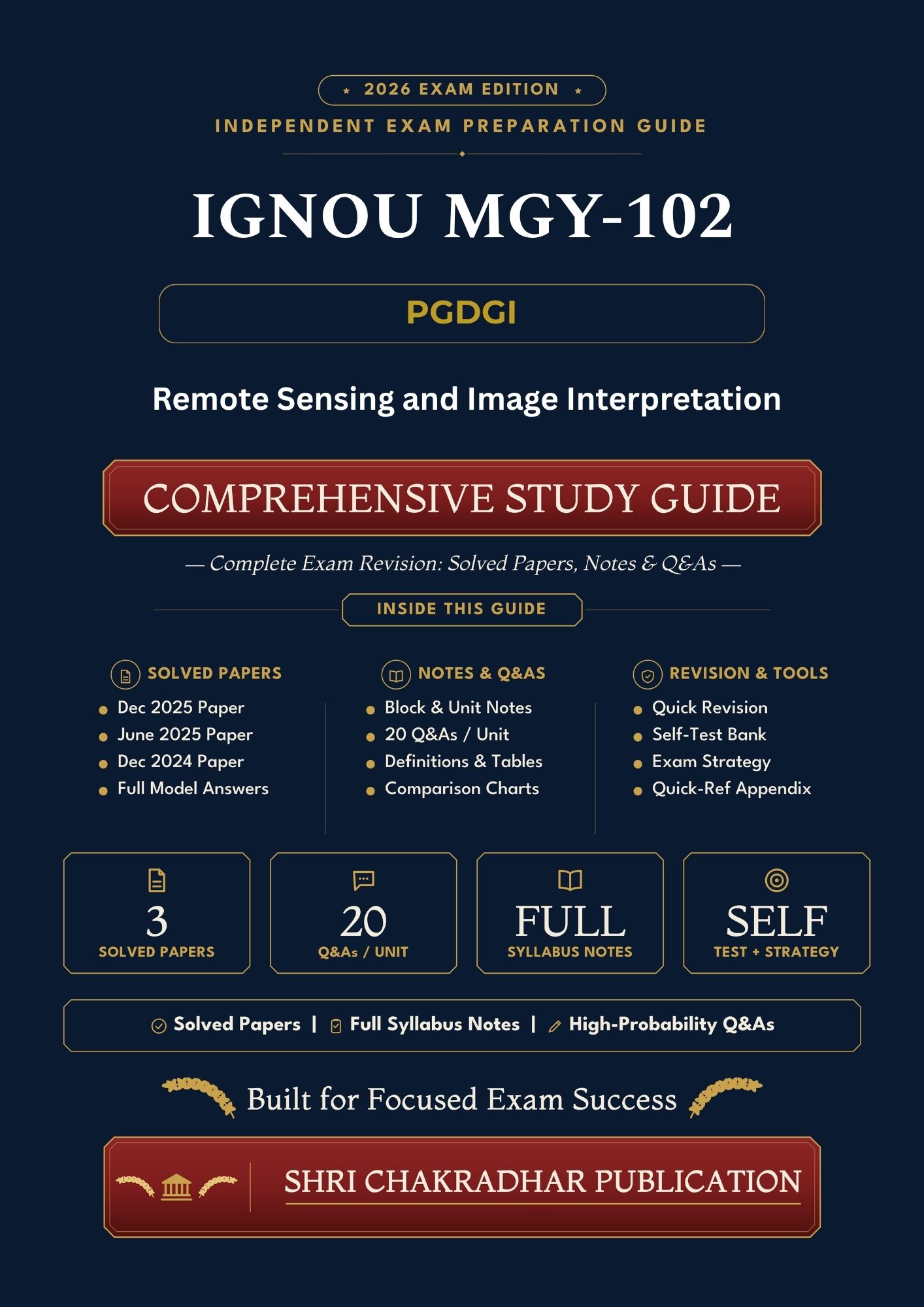
IGNOU MGY-102 Book (Remote Sensing and Image Interpretation) gives Post Graduate Diploma in Geoinformatics (PGDGI) learners a course-code-first route through Remote Sensing and Image Interpretation. The verified syllabus order remains visible while every study stage moves from understanding to recall and then to answer writing.
Students frequently over-revise easy chapters and under-practise difficult ones because there is no visible coverage plan; the guide is arranged to correct that imbalance. In this course, links among Introduction to Remote Sensing, Sensors and Space Programmes and Visual Interpretation deserve particular attention because they shape both understanding and exam-ready explanation.
For more IGNOU study material, visit IGNOU Study Material. Use this independent guide alongside the latest official IGNOU study material and current examination instructions.
An Overview of the IGNOU MGY-102 Help Book
The fastest way to understand this course is to see its parts before reading them in depth. This section places Introduction to Remote Sensing, Sensors and Space Programmes and Visual Interpretation inside the larger logic of Remote Sensing and Image Interpretation.
The revision method keeps the subject language intact while shortening the route to recall. Definitions, relationships and examples are treated as separate building blocks that can be recombined in different answers.
Keep a running glossary of course terms, a one-page Block summary and a separate list of examples or scholars so recall is fast during the final revision cycle.
This Book Is Useful For
Use this guide when official material feels extensive and you want a compact route through the course without losing the verified sequence.
- MGY-102 students who want to separate strong Units from weak Units
- Learners building concept maps around Introduction to Remote Sensing, Visual Interpretation and Introduction to Remote Sensing
- Students practising compare, explain, discuss and critically examine questions
- Repeat learners who need a more disciplined coverage-and-recall cycle
- Anyone combining eGyanKosh reading with compact revision and question practice
What’s Inside This MGY-102 Book
The book brings together course mapping, concept revision and writing practice so learners can switch from reading mode to exam mode without rebuilding their notes from scratch.
- Unit-wise study notes: official sequence converted into concise revision points
- Concept links: connections among definitions, arguments and neighbouring themes
- Answer frames: course-specific ways to organise Introduction to Remote Sensing and Sensors and Space Programmes
- Practice prompts: questions for explanation, comparison, application and evaluation
- Final recap cues: headings and reminders for the last revision cycle
Complete Syllabus Coverage – All 4 Blocks
Use the table as a coverage control sheet: it shows the researched structure that the rest of the guide follows.
| Official Block | Official Block Name | Revision Focus |
|---|---|---|
| Block 1 | Introduction to Remote Sensing | Revise definitions, major arguments, examples and Unit-wise answer points linked with this Block. |
| Block 2 | Sensors and Space Programmes | Revise definitions, major arguments, examples and Unit-wise answer points linked with this Block. |
| Block 3 | Visual Interpretation | Revise definitions, major arguments, examples and Unit-wise answer points linked with this Block. |
| Block 4 | Digital Image Interpretation | Revise definitions, major arguments, examples and Unit-wise answer points linked with this Block. |
Do not treat every segment as equally difficult. Build a three-column revision list—clear, partial and weak—and move Sensors and Space Programmes or Introduction to Remote Sensing into the weak column whenever you cannot produce a short answer from memory.
How This Book Maps to the IGNOU MGY-102 Exam Pattern
TEE preparation should train the action hidden in the command word. Explain, discuss, analyse, compare and critically examine require different levels of organisation even when they refer to the same topic.
Use Introduction to Remote Sensing, Visual Interpretation and Digital Image Interpretation to practise transitions between ideas. Examiners can change the wording, but a learner who understands the relationships can still build a coherent response.
Why Students Prefer Our IGNOU MGY-102 Guide Book & Study Material
The guide is organised as a revision system rather than a shortcut. Its value comes from linking the researched syllabus with recall and written rehearsal.
Because Remote Sensing and Image Interpretation contains several related strands, the guide uses Introduction to Remote Sensing, Visual Interpretation and Introduction to Remote Sensing as cross-links. This keeps revision subject-specific and discourages generic answers.
Compiled & Reviewed By
This independent guide is compiled and reviewed by the Shri Chakradhar Publication (SCP) Panel of Experts / BK Sahni. Editorial work focuses on verified syllabus organisation, clear study support and original practice material.
Course terminology is kept close to IGNOU sources, while explanations and practice prompts are independently prepared. Students should use the book with official self-learning material and current University notices.
How to Use the IGNOU MGY-102 Help Book for TEE and Assignments
The most efficient method is staged: first establish coverage, then test retrieval, and only then spend time on complete answers.
- Locate Introduction to Remote Sensing in the course map and read the related official material.
- Reduce Introduction to Remote Sensing to five recall headings without copying whole paragraphs.
- Connect those headings with Sensors and Space Programmes or Visual Interpretation where the syllabus links them.
- Write a short response from memory and mark what was missing.
- Practise one longer question using an introduction, ordered body and conclusion.
- Revisit Digital Image Interpretation during the next cycle only if retrieval remains weak.
Assignment responses should be prepared and submitted by the student in accordance with IGNOU guidelines; use the guide to understand and practise, not to bypass academic requirements.
High-Probability Questions from IGNOU MGY-102 (Sample)
Use these questions to test whether the course can be retrieved without looking at notes. They are practice prompts and carry no guarantee of appearing in a TEE.
- Explain Introduction to Remote Sensing with reference to Remote Sensing and Image Interpretation.
- Discuss the main issues connected with Introduction to Remote Sensing and give suitable examples.
- Explain Sensors and Space Programmes with reference to Remote Sensing and Image Interpretation.
- Discuss the main issues connected with Sensors and Space Programmes and give suitable examples.
- Explain Visual Interpretation with reference to Remote Sensing and Image Interpretation.
- Discuss the main issues connected with Visual Interpretation and give suitable examples.
- Explain Digital Image Interpretation with reference to Remote Sensing and Image Interpretation.
- Discuss the main issues connected with Digital Image Interpretation and give suitable examples.
Do not memorise the sample wording. Practise changing the command word from explain to discuss, compare or critically examine and adjust the depth of the answer accordingly.
IGNOU MGY-102 Sample Question Paper (TEE Format Template)
This is an independent practice template, not an official IGNOU paper. Its function is to create a timed rehearsal using course-specific questions.
Practice instruction: Attempt the set under a self-imposed time limit and follow the latest official pattern for question choice and marks.
- Q1. Explain Introduction to Remote Sensing with reference to Remote Sensing and Image Interpretation.
- Q2. Discuss the main issues connected with Introduction to Remote Sensing and give suitable examples.
- Q3. Explain Sensors and Space Programmes with reference to Remote Sensing and Image Interpretation.
- Q4. Discuss the main issues connected with Sensors and Space Programmes and give suitable examples.
- Q5. Explain Visual Interpretation with reference to Remote Sensing and Image Interpretation.
- Q6. Discuss the main issues connected with Visual Interpretation and give suitable examples.
- Q7. Explain Digital Image Interpretation with reference to Remote Sensing and Image Interpretation.
- Q8. Discuss the main issues connected with Digital Image Interpretation and give suitable examples.
Use a second attempt to shorten introductions and strengthen the middle of the answer, where explanation and evidence usually carry most of the academic value.
Related IGNOU MGY-102 Additional Supports
The following four support categories can be used separately from the study guide when a learner needs more targeted practice.
- IGNOU MGY-102 Solved Assignment
- IGNOU MGY-102 Handwritten Assignment
- IGNOU MGY-102 Solved PYQs
- IGNOU MGY-102 Solved Guess Paper
Delivery, Returns & Payment Options
The study guide is a physical A5 paperback unless the product page states otherwise. Courier coverage, dispatch timing and payment choices are those available on the website for the delivery address.
Check the current store policy before purchase. Where a legitimate damage or printing issue occurs, the order and parcel details help support review the request efficiently.
How Students Use This Guide
Students can use the guide as a progress board: each Unit moves from first reading to recall and finally to writing practice. That makes unfinished preparation visible.
For difficult areas such as Introduction to Remote Sensing and Introduction to Remote Sensing, write the key term on one side of a card and the explanation, example and significance on the other. Retest cards that still require prompts.
Free Downloads: IGNOU MGY-102 Exam Support PDFs
The best preparation combines original IGNOU material with a clear revision system. Download the official material first, then use the guide to plan retrieval and writing.
- Official IGNOU/eGyanKosh self-learning material for MGY-102
- Current assignment booklet for the applicable session
- Available previous TEE question papers from official IGNOU channels
- Programme guide or prospectus information relevant to PGDGI
Download MGY-102 Study Material Free via eGyanKosh (Step-by-Step)
The official eGyanKosh repository is the preferred source for self-learning PDFs. A quick code-and-title check prevents accidental use of the wrong course file.
- Open the official eGyanKosh course/resource page.
- Check that the page or PDF corresponds to MGY-102 and Remote Sensing and Image Interpretation.
- Open the required Block, Unit or course file and verify its title before saving it.
- Store the PDFs in a folder named MGY-102 and keep the verified sequence intact.
- Use the official PDFs for detailed study and this independent guide for Unit-wise revision and answer rehearsal.
Frequently Asked Questions (FAQ)
The FAQ focuses on coverage, revision, medium, practice and the independent status of the guide.
What is the IGNOU MGY-102 book used for?
It is an independent 2026 study guide for Remote Sensing and Image Interpretation, built for Unit-wise revision, active recall and TEE answer practice.
How much of the MGY-102 syllabus is covered?
The guide follows the researched official structure: 4 verified Blocks. Unsupported Block headings are not added where the official hierarchy cannot be confirmed.
Is this an official IGNOU publication?
No. The guide is privately published study support and does not claim IGNOU authorship, affiliation or endorsement.
Can I use this MGY-102 book for TEE revision?
Yes. Use it to revise Introduction to Remote Sensing, Sensors and Space Programmes and Visual Interpretation, practise outlines and rehearse complete answers while checking the latest official exam instructions.
Does the guide include solved-question practice?
It includes solved-question guidance, answer frameworks and practice prompts. Students should also work with official previous TEE papers.
What medium is this MGY-102 guide prepared in?
This product is prepared for the English medium shown on the product page, while necessary course terminology is retained for accuracy.
Can this guide replace eGyanKosh material?
No. The guide is a companion to, not a substitute for, official IGNOU study material.
How should I revise MGY-102 in the final week?
Prioritise weak areas, especially Digital Image Interpretation and Introduction to Remote Sensing; rehearse key definitions, write short outlines and complete a few timed answers instead of rereading everything.
Where can I get order or soft-copy support?
Use the WhatsApp support link on this product page for availability and order assistance. Academic updates should still be verified through official IGNOU channels.
Conclusion
The purpose of this MGY-102 guide is disciplined preparation: cover the researched structure, condense each theme, retrieve it without prompts and practise the question forms that expose weak understanding.
To order, visit the IGNOU MGY-102 Book order page. Re-check the latest syllabus, assignment and TEE instructions through official IGNOU channels before examination.
Disclaimer: This is an independent academic study-support resource published by Shri Chakradhar Publication (Pvt.) Ltd. It is not affiliated with, endorsed by, or an official publication of IGNOU. It is designed to supplement, not replace, IGNOU’s official study material. Syllabus and exam patterns may change – please verify the latest information through official IGNOU channels. Students should prepare and submit their own work as per IGNOU guidelines. All trademarks belong to their respective owners.