

Description
IGNOU MBA 2nd Semester Book — Seven Technical, Legal and Managerial Papers in One Revision Guide
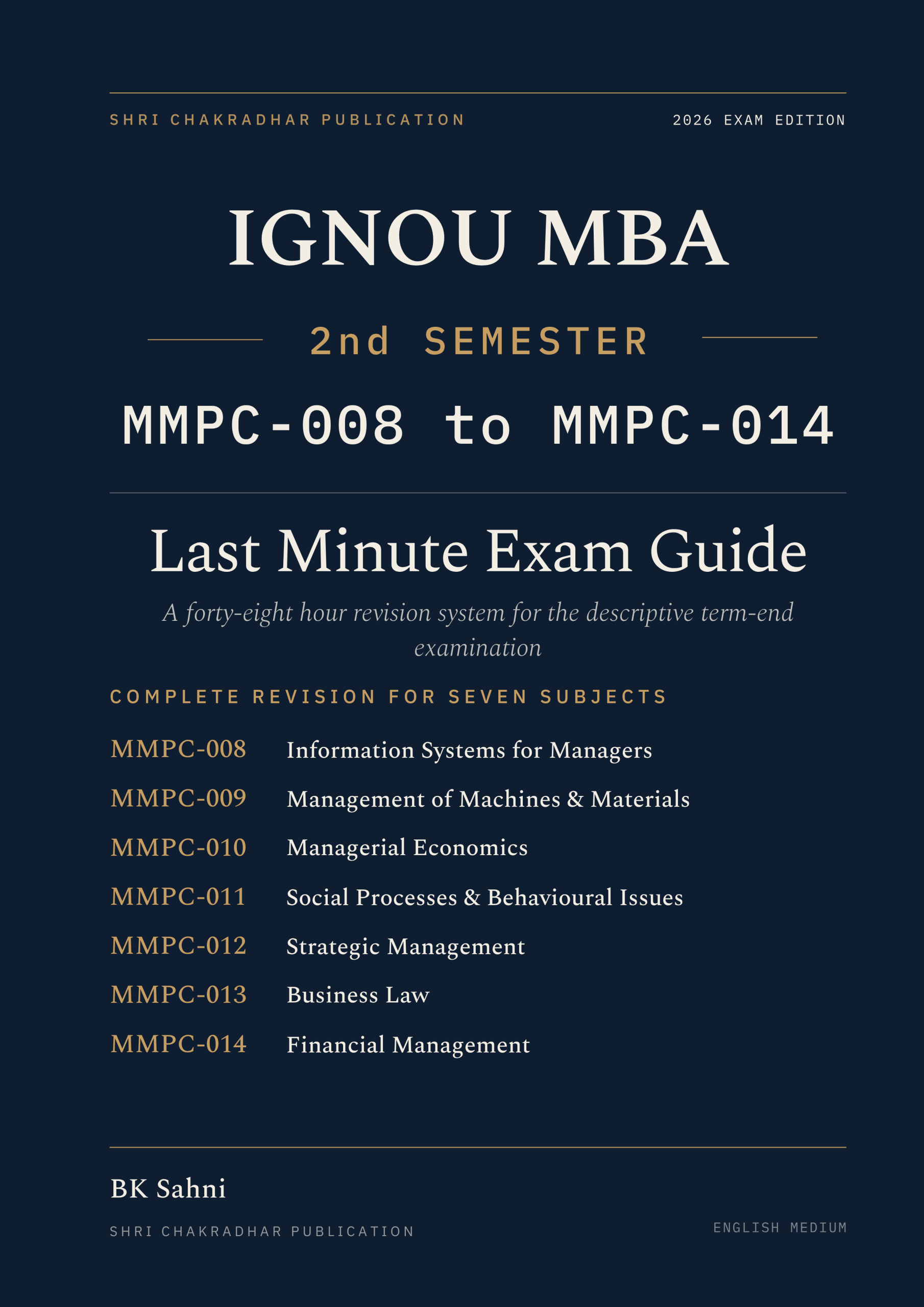
This 2026 English Medium IGNOU MBA 2nd Semester Book compiles MMPC-008 through MMPC-014 as one 156-page examination-revision companion. It forms part of our IGNOU books, study material and helpbooks range for all programmes. It targets students who have already worked through IGNOU course blocks and need to structure the closing preparation period for either TEE session. Seven courses with very different response demands are therefore arranged inside a uniform, quick-navigation system.
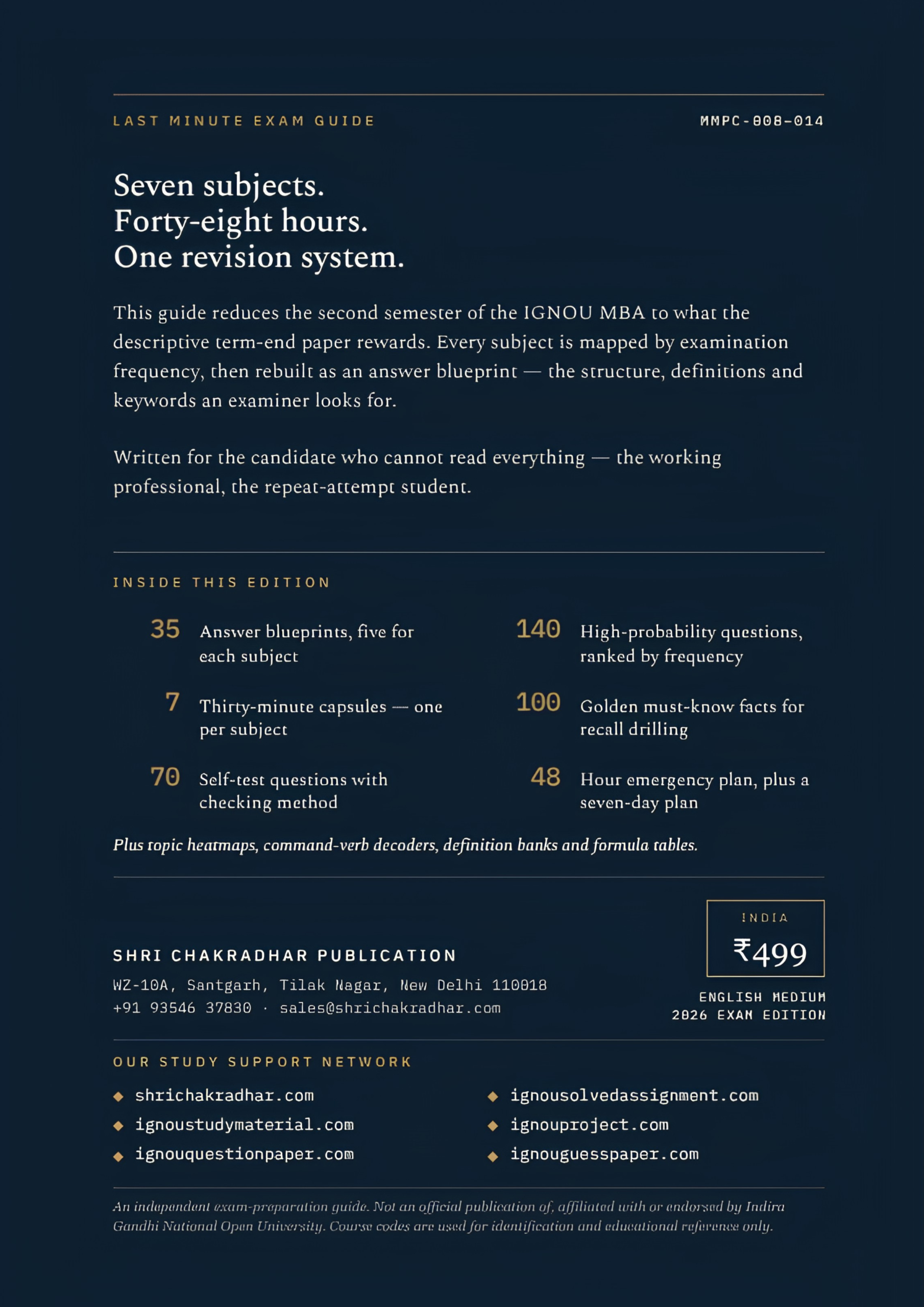
The content moves across information technology, operations, economics, workplace behaviour, corporate strategy, legal regulation and finance. To make that range workable, the book uses five subject-specific response frameworks per course, twenty model Q&As for every code, separate priority maps, instruction decoders, condensed toolkits and final-half-hour capsules. Semester recall is strengthened through 100 facts and seventy answer-backed test items.
About the IGNOU MBA 2nd Semester
2nd Semester study in the IGNOU MBA links managerial decisions with systems, processes, markets, people, competition, law and capital. Information Systems for Managers examines how data and technology support different management levels. Management of Machines & Materials deals with facilities, production and inventory, while Managerial Economics supplies demand, cost and pricing logic. Social Processes & Behavioural Issues addresses behaviour at individual and group levels.
The remaining courses widen the perspective. Strategic Management studies environmental analysis, choice and execution; Business Law introduces statutes that shape commercial activity; and Financial Management evaluates investments, funding, payout and liquidity. Because these papers require diagrams, curves, matrices, statutory citations and numerical workings, one generic note-taking method is insufficient.
What This Book Covers
The volume brings together revision material for each core paper between MMPC-008 and MMPC-014. A stable six-part design appears in every course, but the contents inside that design change according to whether the subject needs technology diagrams, operating formulas, economic graphs, named theories, strategic models, legislation or finance calculations.
- Section A — Subject Opener and Topic Heatmap: introduces the block arrangement, paper character, recommended response approach and ranked revision areas.
- Section B — Command Verb Decoder: converts wording such as explain, derive, compare, apply, describe and evaluate into an answer task.
- Section C — Five Answer Blueprints: presents flexible response plans, miniature skeletons and a vocabulary set suited to the course.
- Section D — Twenty High-Probability Q&As: shows how the plans operate in theory, comparison, legal, application and numerical questions.
- Section E — Revision Toolkit: assembles key contributors, concise definitions, equations, legal references, contrast tables and avoidable errors.
- Section F — Thirty-Minute Revision Capsule: reduces the paper to core concepts, chosen questions, opening formulations and recall keywords.
Five blueprints across seven chapters create 35 reusable structures, while twenty responses per chapter produce 140 model Q&As. Every model response is followed by its own Exam Note, so the book contains 140 such reminders. Semester-wide additions include seven toolkits, seven capsules, six reading-depth options, 100 golden facts, a seventy-question self-assessment, its solutions and one examination-day checklist.
Subject-wise Coverage
MMPC-008: Information Systems for Managers
The MMPC-008 material explains business information systems from management level to emerging technology. Topics include Anthony’s Triangle, TPS, MIS, DSS, EIS, ERP, systems development, databases, warehouses, mining, networks, DFDs, software and programming generations. Later coverage addresses AI, information security, cloud services, Big Data, IoT, blockchain and competitive use of IT. Thinker references include Davis and Olson, Gorry and Scott Morton, Robert Anthony, E.F. Codd, Alan Turing, John McCarthy and Porter. The chapter asks learners to combine components, diagrams and an organisational use case rather than writing technology definitions in isolation.
MMPC-009: Management of Machines & Materials
This operations chapter spans transformation systems, volume-variety choices, factory layouts, location, capacity, work measurement, project networks and materials planning. It revises EOQ and associated assumptions, ABC-VED-FSN classification, MRP inputs, aggregate planning, PERT-CPM distinctions, JIT, Kanban, 5S and Lean waste. Quality and value topics include Deming’s PDCA, Juran’s trilogy, Crosby’s zero-defect idea, Ishikawa tools, Six Sigma DMAIC and Lawrence Miles’s Value Engineering plan. Formula blueprints require units and interpretation, while layout and network questions are paired with rough-diagram guidance and Indian operating examples.
MMPC-010: Managerial Economics
The MMPC-010 section structures economic reasoning around managerial use. Learners review demand and its exceptions, elasticity measures, qualitative and quantitative forecasting, short-run production, long-run scale, cost behaviour, break-even logic and the four market structures. It also addresses monopoly, Chamberlin’s monopolistic competition, Sweezy’s kinked demand, Cournot and Bertrand models, economies of scale, firm objectives and pricing strategies such as skimming, penetration and discrimination. Curves and equations are treated as parts of an answer, not optional decoration. Each numerical result is followed by a business meaning, and Indian market illustrations clarify pricing or competitive behaviour.
MMPC-011: Social Processes & Behavioural Issues
MMPC-011 gathers the major individual, interpersonal and group frameworks used in Organisational Behaviour. It covers personality through Big Five OCEAN, values and attitudes, perception and attribution, Pavlovian, Skinnerian and Bandura learning, and motivation through Maslow, Herzberg, McGregor, Vroom and McClelland. Further material explains Tuckman’s group stages, Thomas-Kilmann conflict styles, Selye’s stress sequence, empowerment, Organisational Citizenship Behaviour, workplace diversity, Goleman’s emotional intelligence and Seligman’s positive psychology. The book repeatedly connects a theory to its originator, diagram, criticism and Indian workplace application.
MMPC-012: Strategic Management
Strategic Management is presented through a collection of attributed analysis and decision models. It includes vision and mission, the strategic-management process, SWOT-TOWS, PESTLE, Five Forces, generic strategies, value chain, Ansoff growth options and BCG portfolio classification. Corporate stability, expansion, retrenchment and combination strategies are followed by mergers, joint ventures, implementation challenges, governance, strategic evaluation and the Balanced Scorecard. Core competence, VRIO and Blue Ocean concepts extend the analysis. The chapter identifies model creators and uses drawable grids plus Indian corporate situations to move from framework description to recommendation.
MMPC-013: Business Law
Business Law preparation begins from exact statutory identification. The chapter addresses valid contracts, offer and acceptance, consideration, capacity, free consent, indemnity, guarantee, bailment and pledge under the Indian Contract Act 1872. It also covers company formation and documents, partnership and LLP, sale-of-goods rules, negotiable instruments, banking recovery, foreign exchange, insolvency, competition, intellectual property, consumer rights, environmental protection and digital personal data. Comparisons and procedure answers require the legislation, enactment year, section or authority, followed where relevant by an Indian judicial or regulatory example.
MMPC-014: Financial Management
The final course combines financial theory with transparent calculation. It revises objectives and CFO functions, present and future value, annuities, portfolio risk, beta, CAPM, security valuation, component costs and WACC. Investment appraisal includes Payback, ARR, NPV, IRR and PI, followed by working capital, markets, financing sources, capital-structure theories, leverage and dividend models. Behavioural biases, Pecking Order, buybacks and restructuring receive separate attention as well. Students are directed to begin with the equation, identify variables, display substitutions and units, then state what the answer means for project acceptance, financing or shareholder policy.
MMPC-008 to MMPC-014 at a Glance
| Code | Subject Title | Main Revision Area | What You Take Away |
|---|---|---|---|
| MMPC-008 | Information Systems for Managers | Information architecture, databases, development and digital tools | Labelled system models tied to management use |
| MMPC-009 | Management of Machines & Materials | Production design, inventory, scheduling, Lean and quality | Operational equations, networks and comparison logic |
| MMPC-010 | Managerial Economics | Demand response, output, costs, competition and price | Graphs and calculations translated into decisions |
| MMPC-011 | Social Processes & Behavioural Issues | Individual differences, learning, motivation and groups | Attributed behavioural frameworks with critique |
| MMPC-012 | Strategic Management | Scanning, positioning, portfolio choice and execution | Named matrices applied to business situations |
| MMPC-013 | Business Law | Commercial statutes, rights, remedies and regulation | Legislation-centred answers supported by sections |
| MMPC-014 | Financial Management | Valuation, investment, funding, payout and liquidity | Complete computations with a finance conclusion |
Key Features — All Verified From the Book
- A single volume in English bringing together the seven MBA 2nd Semester core subjects.
- 156 printed pages in the annual 2026 examination edition.
- Five tailored frameworks per paper, totalling 35 Answer Blueprints.
- Twenty selected questions under every course, producing 140 model Q&As across the volume.
- One follow-up Exam Note for every model response, amounting to 140 targeted cautions or reminders.
- Fourteen navigation aids through seven heatmaps and seven examiner-command decoders.
- Seven subject toolkits plus seven half-hour summaries for staged compression.
- Six preparation windows covering 48, 24, 12, 6, 3 and 1 hour.
- 100 concise semester facts arranged by subject.
- Seventy multiple-choice checks and their answers, with ten questions assigned to every course.
- A separate final-day checklist included after the golden-facts section.
Who Should Use This Book
The intended reader has begun MBA 2nd Semester study and needs to transform seven large courses into a feasible revision sequence. The book is relevant when employment, travel or domestic commitments divide study time, and when a learner must alternate between technical explanation, operations arithmetic, economic analysis, behavioural theory, strategic application, statutory writing and financial computation.
It also suits students who lose marks through presentation rather than complete lack of knowledge. The frameworks indicate whether a response should begin from a definition, creator, formula, Act, diagram, comparison basis or business case, helping the learner match the method to the question type.
How This Book Helps Students
The volume changes revision from passive rereading into a sequence of specific tasks. The priority chart narrows the starting point, the verb guide identifies the required response, and the blueprint supplies a structure for development. Those elements are adapted separately for system comparisons, project scheduling, demand analysis, motivation models, strategic matrices, legal remedies and financial appraisal.
Model Q&As show the resulting form, while each Exam Note highlights a high-value detail or frequent omission. Definitions, equations, Acts and theorists are then consolidated in the toolkits. Short capsules, the golden-fact bank and the answer-backed quiz create progressively faster retrieval cycles near examination time.
This Exam Guide and IGNOU’s Official Study Material
Full programme learning should begin with the university’s prescribed resources. Those blocks contain the detailed concepts, unit connections and explanations that a compact revision title necessarily shortens. Learners may download the official IGNOU MBA study material free in PDF from eGyankosh and should consult it whenever a model answer, theory or equation requires deeper study.
The guide performs a different role: it reorganises material already encountered into examination actions and recall layers. Its heatmap categories are advisory, so they should guide sequence without being treated as a boundary around the complete syllabus.
Why Choose This Last Minute Exam Guide
The combined volume preserves the method appropriate to each course instead of forcing every subject into generic notes. Technology answers use architecture and labelled diagrams; operations and financial questions display variables and units; economics uses curves; behavioural responses begin from recognised theorists; strategic answers employ creator-linked matrices; and legal discussion starts from legislation and sections.
The book also defines what its compression can and cannot do. The short schedules assume prior reading, probability labels remain estimates, and IGNOU resources continue to carry primary authority. Students therefore receive a bounded semester-revision instrument, not a replacement for detailed academic blocks.
About the Author — BK Sahni
BK Sahni (Bhavya Kumar Sahni) is an IGNOU education expert, author, and the founder of Shri Chakradhar Publication Pvt. Ltd. and ignouproject.com, and he has guided 5,00,000+ IGNOU distance-learning students since 2010. He writes the Last Minute Exam Guide series — including this book — building every title on the method he has refined across a decade of IGNOU-focused work: high-probability questions, reusable answer blueprints, topic heatmaps and quick-revision capsules aligned to the current IGNOU exam pattern. He also publishes open-access research-methodology guides for IGNOU students, archived with permanent DOIs on Zenodo and indexed on Google Scholar and ORCID (0009-0005-8092-459X). Learn more about his work at bksahni.com, or browse his complete catalogue of IGNOU books on the Amazon Author Store.
How to Use the Book Effectively
Open with the semester dashboard, assess your weakest course and enter that chapter through its opener. Study the examiner-command table before reading the blueprints so the difference between derive, discuss, distinguish, apply and critically examine is clear. Recreate selected model responses without copying. Add a labelled figure where the chapter recommends one; write enactment details in MMPC-013; and show every step, symbol, unit and conclusion in MMPC-009 or MMPC-014.
For paper-oriented extension, use IGNOU solved previous years question papers; separately published IGNOU solved guess papers can provide another practice layer. Match the reading route to completed preparation, answer all seventy self-test items and revisit only mistakes before opening that paper’s capsule. When the programme reaches its research requirement, consult the separate IGNOU projects, synopsis and dissertation support range.
Frequently Asked Questions
What course codes and titles does the MBA 2nd Semester volume contain?
Seven core courses are brought together: MMPC-008 Information Systems for Managers, MMPC-009 Management of Machines & Materials, MMPC-010 Managerial Economics, MMPC-011 Social Processes & Behavioural Issues, MMPC-012 Strategic Management, MMPC-013 Business Law and MMPC-014 Financial Management. Each receives an independent revision chapter.
Will the order include one bound book or seven subject-wise volumes?
The product is a single 156-page combined volume. Seven subject chapters sit inside one English Medium 2026 edition, and each chapter contains its own opener, command guide, five frameworks, twenty model responses, toolkit and thirty-minute summary. It is therefore not supplied as a separate-book bundle.
Is the content prepared for both IGNOU TEE sessions?
Yes. Its revision structure is applicable before the June and December Term-End Examinations. The material supports theory, diagram, law and calculation practice, although no topic list can establish a future paper. Heatmap levels and selected questions are planning aids rather than confirmed examination content.
Are solved assignments, handwritten work or complete PYQ papers included?
No. These are not part of the 156-page guide. It contains model revision Q&As, blueprints, toolkits and a self-test instead. Students needing separate support can view IGNOU solved assignments or IGNOU handwritten assignments; full solved-paper practice is also offered separately.
Is it sufficient to read this book without the prescribed IGNOU blocks?
No. The guide is written for condensation and answer preparation after foundational study. Prescribed course materials contain the complete unit treatment and remain the main academic source. Use this volume to retrieve, organise and practise the content, not as a replacement for reading the applicable blocks.
Which learners are likely to make practical use of this combined helpbook?
It serves 2nd Semester MBA students seeking one controlled workflow across seven contrasting papers. Distance learners, employed students and anyone needing clearer answer presentation may use it to decide when a diagram, equation, named theory, matrix, statutory citation or comparison table is appropriate.
What is the correct way to choose among the 48-hour to 1-hour routes?
Select a schedule by available time and prior preparation. Longer routes include model-answer practice, whereas shorter versions move towards blueprints, capsules and back matter. The 1-hour endpoint is restricted to the golden-fact bank and checklist. A compressed route should never be treated as first exposure to the course.
Do the high-probability labels confirm the examination paper?
No. The guide describes them as estimates drawn from previous paper patterns and the prominence of themes in study material. Their function is to sequence revision where time is limited. Learners remain responsible for the broader syllabus because an examiner can frame questions beyond the highlighted topics.
Is checking the latest university information still necessary?
Yes. Review www.ignou.ac.in for the current MBA structure, code list, examination timetable, instructions and learning resources. This confirms that MMPC-008 through MMPC-014 correspond to your cycle and identifies any change made after preparation of the annual edition. Current university notices remain final.
Important Note on Syllabus Verification
IGNOU periodically updates its programme structure, assignment requirements, examination schedule and study material. Before purchasing and while preparing, students should verify the latest MBA syllabus, course list, date sheet and official instructions on the official IGNOU website (www.ignou.ac.in). This book is aligned to the MMPC-008 to MMPC-014 structure and refreshed as an annual exam edition, but official IGNOU sources are always the final authority.
Non-Affiliation Disclaimer
shrichakradhar.com is an independent educational publishing platform. This book and this website are not officially affiliated with, endorsed by, or operated by the Indira Gandhi National Open University (IGNOU). Course codes such as MMPC-008 to MMPC-014 are used solely to identify the subjects the book covers. IGNOU’s official study material and notifications remain the primary and authoritative sources for the programme.
Get Your Copy
Use this title when one semester-level revision companion is more practical than scattered notes for seven papers. Keep it beside IGNOU course materials, rehearse each subject’s required format and reserve capsules for end-stage retrieval. For a digital edition, get the IGNOU MBA 2nd Semester Book (MMPC-008 to MMPC-014) — Combined Last Minute Exam Study Guide as a soft-copy PDF on WhatsApp.