Description
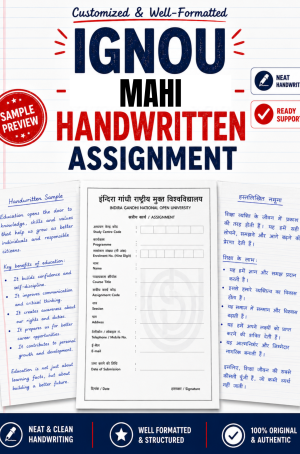
In short. MASO is the code IGNOU gave Master of Arts (Sociology) when the School of Social Sciences rebuilt it into four semesters of twenty credits each, and it is a programme code that appears on none of its own course codes — every paper inside it still begins MSO or MSOE, which is why a learner enrolled in MASO downloads a booklet filed as MASO-MSO-101 and writes against an assignment code reading MSO-101/AST/TMA/2026-27. Shri Chakradhar Publication prepares a handwritten answer set for any of those papers, and for the older MSO-001 to MSO-004 and MSOE-001 to MSOE-004 booklets that learners admitted before January 2026 are still submitting against. The rate is ₹320 per subject, hard copy only, with courier included in that price and no separate shipping charge. Each set arrives with an IGNOU-format front page and a copy of the official TMA paper, matched to a handwriting sample you send first, and there is no minimum order: one subject or fourteen, same rate. Assignments carry 30 per cent of the final course result and the term-end examination carries the remaining 70 per cent.
What Lands on Your Doorstep in a MASO Packet
Four physical things travel together in one envelope, and it helps to know what they are before the courier reaches you. The first is the answer set itself: five answers per paper, written out by hand on plain sheets, one paper per bundle so that MSO-107 and MSO-108 never get mixed at the counter. The MASO booklets ask for answers of roughly five hundred words each, so a single paper runs to a meaningful stack rather than a page or two.
The second is the IGNOU-format front page, filled in and free, ready for your enrolment number, your name, your Study Centre code and the assignment code as it is printed on your own booklet. The third is a printed copy of the official TMA paper the answers were written against, which matters more in MASO than in most programmes because the same course title exists at two different credit weights in two different code series — having the paper in the envelope is how you and the counter clerk both confirm which one you actually answered.
The fourth thing is a boundary rather than an object. No soft copy or PDF is sold. Shri Chakradhar Publication does not email a scan, does not sell a downloadable version of the handwritten set, and does not offer a cheaper digital tier of the same product. What is couriered is what exists.
Everything Folded Into the ₹320 Rate, and the Things That Sit Outside It
The figure is flat and it is per paper, not per semester and not per bundle. A learner ordering only MSO-116 pays the same per-paper rate as one ordering an entire semester. Courier is inside the number. The front page is inside the number. The copy of the question paper is inside the number. Matching the handwriting to your own sample is inside the number.
What sits outside it is anything IGNOU itself charges for — your programme fee of ₹8,200 a year, your term-end examination form, your re-registration. Also outside it is any promise about what happens after you hand the set in. Delivery depends on your pin code and is confirmed for your order before you pay. No figure is promised on this page.
| Item | Inside the ₹320 | Detail |
|---|---|---|
| Handwritten answer set | Yes | Five answers per paper, written by hand, one bundle per MSO or MSOE code |
| Courier across India | Yes | No separate shipping or packing line is added at checkout |
| IGNOU-format front page | Yes | One per paper, blank fields ready for your enrolment details |
| Copy of the TMA paper | Yes | The exact booklet page the answers were written against |
| Handwriting matching | Yes | Worked from a photo of your own writing, no surcharge |
| Hindi or English paper | Yes | Same rate whichever medium IGNOU issued for your code |
| Soft copy or scanned PDF | Not sold | The product is a hard copy and only a hard copy |
| IGNOU programme or exam fees | No | Paid by you to the university, never through this store |
Scroll the table sideways on a narrow screen.
A Downloadable Model Answer or a Written Set: Telling the Two Apart
These two products get confused constantly, and the confusion costs learners money in both directions. A solved assignment is a soft-copy reference file of model answers for a course code and session — you download it, read it, and write your own answers from it. A handwritten assignment is the answers written out by hand on paper and submitted in hard copy at the study centre. One is study material. The other is the thing you physically hand over.
The MASO booklets themselves are unambiguous about where the finished work goes. The 2026-27 MSO-101 paper directs the completed set to “The Coordinator of the Study Centre allotted to you”, and tells you to obtain a receipt for the submission and keep it. Nothing in that instruction can be satisfied by a file on your phone. A downloaded PDF is a reference to write from; it is not a submission, and printing one out does not convert it into one.
| Solved assignment | Handwritten assignment | |
|---|---|---|
| Format | Soft copy, downloaded as a file | Hard copy, written by hand, couriered |
| What you do with it | Read it, then write your own answers | Check it, sign the front page, hand it in |
| Who it suits | Learners who will write but want a reference | Learners short of writing hours, not of understanding |
| Rate on this store | Priced per code on the solved-assignment shelf | ₹320 per subject, courier included |
Scroll the table sideways on a narrow screen.
If a reference file is what you actually want, this is not the page for it — the store keeps a separate per-code shelf, and you will find every MSO and MSOE solved paper listed by course code there rather than here.
Ready to hand a written set over instead of writing one?
₹320 per subject. Hard copy. Courier inside the figure.
The Twelve MSO Core Papers Every MASO Learner Writes
Twelve papers are compulsory and identical for everyone in the programme, and they are not spread evenly: four fall in semester one, four in semester two, then two each in semesters three and four, because the later semesters hand more of their weight to electives. Every core is worth four credits, which is itself a change worth registering — the legacy sociology papers were eight-credit courses, so a MASO learner writes roughly twice as many assignments for the same total credit load.
| Code | Official title | Semester | Credits |
|---|---|---|---|
| MSO 101 | Sociological Concepts and Theories-I | One | 4 |
| MSO 102 | Sociological Concepts and Theories-II | One | 4 |
| MSO 103 | Sociology in India -I | One | 4 |
| MSO 104 | Sociology in India -II | One | 4 |
| MSO 106 | Rural Sociology | Two | 4 |
| MSO 107 | Foundations of Social Science Research | Two | 4 |
| MSO 108 | Research Methods | Two | 4 |
| MSO 109 | Analysis and Presentation of Data | Two | 4 |
| MSO 111 | Sociology of Development | Three | 4 |
| MSO 112 | Development and Global Society | Three | 4 |
| MSO 116 | Sociology of Eduation -I (spelling as printed) | Four | 4 |
| MSO 117 | Sociology of Eduation -II (spelling as printed) | Four | 4 |
Scroll the table sideways on a narrow screen.
Twelve cores at four credits each account for forty-eight of the eighty credits. Note also what is absent: there is no project code, no dissertation code and no MSOP paper anywhere in the MASO table. Sociology learners at IGNOU do not write a project, which is why this page does not link to a project category the way a rural development or public administration page would.
Where the Elective Papers Come From, Inside Sociology and Outside It
The seven MSOE discipline-specific rows
Six elective papers are actually written across the programme, chosen from seven MSOE rows. Semesters one and two allow one each; semesters three and four allow two each. The fourth-semester rows are unusual in that each row is itself an either-or between two different courses, and one of the two options in each carries an Anthropology cross-code in brackets — the same paper issuing under an MAN number in the Anthropology programme.
| Code | Official title | Slot label as printed | Credits |
|---|---|---|---|
| MSOE 105 | Introduction to Urban Sociology | DSE1* | 4 |
| MSOE 110 | Urbanisation and Urban Development | DSE2** | 4 |
| MSOE 113 | Sociology of Religion | DSE 003 | 4 |
| MSOE 114 | Sociology of Diaspora | DSE 004 | 4 |
| MSOE 115 | Globalisation and Transnational Communities | DSE 005 | 4 |
| MSOE 118 (MAN 107) | Sociology of Food or Environmental Anthropology | DSE 006 / DSE 007 | 4 |
| MSOE 119 (MAN 105) | Sociology of Health or Tribes in India | DSE 008 / DSE 009 | 4 |
Scroll the table sideways on a narrow screen.
Order against the code your admission record carries, not against the title. Sociology of Diaspora at four credits and the legacy Diaspora and Transnational Communities at eight credits are not the same paper, and the questions on their booklets are not the same questions.
Open electives borrowed from four other disciplines
Two of the papers counting toward the eighty credits are not sociology at all, eight credits between them. Semester three and semester four each allow one open elective drawn from another discipline entirely, and the list crosses four teaching units — Political Science, the journalism and new media school, gender and development studies, and environmental studies. The practical consequence for a handwritten order is simple: those papers are written by a different faculty, published on a different booklet, and may carry a different code format from the MSO series you are used to.
| Code | Official title | Issued by | Semester |
|---|---|---|---|
| MPSE 004 | Social and Political Thought in Modern India | Political Science | Three |
| MPSE 007 | Social Movements and Politics in India | Political Science | Three |
| MJM 024 | Media and Society | SOJNMS | Three |
| MGSE 1 | Gender Planning and Development Policies | SOGDS | Four |
| MGSE 7 | Gender, Organisation and Leadership | SOGDS | Four |
| MGSE 10 | Gender and Entrepreneurship Development | SOGDS | Four |
| MED 002 | Sustainable Development: Issues and Challenges | SOS | Four |
| MED 008 | Globalisation and Environment | SOS | Four |
Scroll the table sideways on a narrow screen.
Learners who pick a gender paper here often want the wider reading list as well, and the store keeps the Gender and Development Studies shelf and the Women and Gender Studies papers as separate per-code catalogues.
Adding it up: forty-eight core credits, twenty-four elective credits from six MSOE papers, and eight open-elective credits gives eighty. That figure has to be derived, because it is never printed. The Common Prospectus July 2026 prints “Total 20 Credits” four times under section 3.20 and stops there, while the MA Economics section immediately after it states its eighty-credit total in words. The arithmetic was summed independently before this table was trusted.
Eight Places the MASO Paperwork Contradicts Itself
This is the part no aggregator publishes, because finding it means reading IGNOU’s documents against each other rather than copying one of them. Every item below was read off the prospectus or off a booklet opened directly on ignou.ac.in.
Disagreements found in IGNOU’s own MASO documents, and two of our own.
1. A misspelling that survived into print twice. The Common Prospectus July 2026 gives MSO 116 and MSO 117 as “Sociology of Eduation -I” and “Sociology of Eduation -II”. Education is misspelled the same way in both rows. The tables above reproduce the titles as printed rather than silently correcting them, because your admission record may carry the printed form.
2. MASO is labelled two different things inside one PDF. On page one of the 2026-27 MSO-101 booklet, MASO appears under the heading Course Code. On the assignment page of the very same file, MASO appears under Programme Code and MSO-101 appears under Course Code. Both labels are IGNOU’s, in one document, three pages apart.
3. The covering letter describes a paper that is not printed. Both 2026-27 MASO booklets tell you there are ten questions in two sections of five. The MSO-104 question page then runs one to ten with no section headings and no instruction to take a minimum from each section — it simply says to answer any five. The legacy MSOE-001 2025-26 paper, from the same faculty, does print Section-I and Section-II and does require at least two from each. The section language in the new booklets looks like a template carried forward. Its own letter, in turn, describes ten-mark questions of 250 words that appear nowhere on its paper, where every question is worth twenty.
4. One programme, three file-naming conventions, one directory. The SOSS assignments folder currently serves this programme’s papers as MASO-MSO-101-2026-English.pdf, as MSOE-001-2025-26.pdf, and as MSO-004(E)(2025-2026).pdf. Alongside that, the prospectus writes course codes with a space (MSO 101) while both booklets print them with a hyphen (MSO-101), and the prospectus title “Sociology in India -II” appears on the booklet as “Sociology in India-II”.
5. Legacy sociology codes are still alive inside other programmes, spelled two ways. The same eight-credit course, Research Methodologies and Methods, appears in the July 2026 prospectus as MSO2 in the Public Administration table and as MSO 002 in the Migration and Diaspora table. MSOE 002, Diaspora and Transnational Communities, survives at eight credits inside a Population and Family Health Studies table while MASO’s own diaspora paper, MSOE 114, is worth four.
6. Third-party pages are circulating the wrong cut-offs. Several widely-read aggregator pages give 30 April and 31 October for MASO papers. Those are another school’s dates. Both live SOSS booklets read off ignou.ac.in for this build print 30 September and 31 March, anchored to admission batch.
7. Our own editorial site disagrees with the current prospectus. An older programme page on ignouproject.com still states a minimum of two years and a maximum of five, at ₹5,400 a year for a ₹10,800 total. The Common Prospectus July 2026 states two years minimum, four years maximum, at ₹8,200 a year for a ₹16,400 total. The prospectus figure is the current one and that page is queued for correction.
8. Our own article headline counts differently from this page. The companion ignouproject.com article headlines twenty MASO course codes. The prospectus table carries nineteen MSO and MSOE codes plus eight open-elective codes owned by other disciplines, so the two counts are drawing the boundary in different places. This page states nineteen and shows its working above.
Which Cut-Off Applies to You Depends on Your Admission Batch
MASO does not print a single deadline per session the way the management papers do. It prints a table of admission batches, and you find your own row. The 2026-27 booklets cover three batches at once on a single cover reading January 2026 sessions and July 2026 and January 2027 sessions.
| Admitted in | Submit by | Submit to |
|---|---|---|
| January 2026 batch | 30th September, 2026 | Coordinator of your allotted Study Centre |
| July 2026 batch | 31st March, 2027 | Coordinator of your allotted Study Centre |
| January 2027 batch | 30th September, 2027 | Coordinator of your allotted Study Centre |
Scroll the table sideways on a narrow screen.
The legacy 2025-26 elective booklet prints only two rows — 31st March 2026 for the July 2025 batch and 30th September 2026 for the January 2026 batch. A learner admitted in January 2026 therefore sits inside both tables at once, with the same date on each, which is fortunate rather than designed. Dates shift by session and by Regional Centre, so confirm yours before you plan any writing. Programme structures, course codes, submission dates and rules change, and only ignou.ac.in and your Regional Centre can confirm the current position for your enrolment.
Decoding MSO-101/AST/TMA/2026-27, Piece by Piece
The assignment code is the single most useful string on your booklet and the one most often copied wrong onto a front page. MASO’s has four parts where many programmes have three, and the extra one throws people.
- MSO-101 — the course code, hyphenated on the booklet even though the prospectus spaces it.
- AST — the assignment token this faculty inserts. It appears on the new MASO papers and on the legacy MSO and MSOE papers alike, and it is not present on the management or humanities codes many learners have seen elsewhere.
- TMA — Tutor Marked Assignment, the assignment type.
- 2026-27 — the two-year span the paper is valid across, not a single session year.
Two practical warnings follow from that shape. Third-party listings widely render the final block as 2026-2027 with the second year in full; the booklets print 2026-27. And a paper is valid only for the span it names, so a 2025-26 elective booklet and a 2026-27 core booklet answer different questions even where the course title is unchanged. Copy the code from your own downloaded file, not from a search result.
Your Own Handwriting, Copied From a Photo You Send
A handwritten set that looks nothing like the learner who signed the declaration on the front page is a set that invites questions at the counter. Send a photo of a page you have written yourself and the handwritten set is matched to your handwriting at no extra charge. The sample reaches a writer before anything is written, and it comes back to you as a photograph before any money changes hands.
What Makes a Usable Sample Photo
Half a page of ordinary writing in the pen you normally use is plenty — there is no need to write anything sociological. Photograph it flat, in daylight, with the whole sheet in frame rather than a close crop of three words. Include a few capital letters and a couple of numerals, because those carry more of a hand’s character than lowercase running text does. If you write in Devanagari for a Hindi-medium paper, send a Devanagari sample; a Roman sample will not help a writer working in another script.
See the writing before you spend anything.
₹320 per subject, whichever hand it is written in.
Hindi, English and Older Sessions Nobody Else Will Touch
MASO’s medium of instruction is recorded in the Common Prospectus July 2026 as English and Hindi, and IGNOU issues the TMA papers accordingly — the SOSS folder carries MSO booklets in both. A learner writing MSO-108 as अनुसंधान की विधियां pays what a learner writing Research Methods pays.
Sessions are where sociology learners get stuck more than most, because the January 2026 code change split the programme into two live populations. Anyone admitted before that date continues on the old MSO structure with its eight-credit papers; anyone admitted from January 2026 onward is on the MASO semester structure. Both sets of booklets are still being published. Any session is accepted, current cycle or older, including backlog courses, at the same ₹320 per subject — a 2022-23 MSOE-003 backlog and a fresh 2026-27 MSO-111 can sit in the same order.
The Five Things Shri Chakradhar Publication Needs From You
Ordering is deliberately short. Five items settle a MASO order, and anything beyond them is noise.
- The course codes. Written as they appear on your booklet — MSO-111, MSOE-114, MPSE-004 — not as semester names.
- Your admission batch. January 2026, July 2026 or January 2027, or the older cycle if you are on the legacy MSO structure. This decides which cut-off row and which booklet apply.
- Your medium. Hindi or English, per paper if they differ.
- A handwriting sample photo. Half a page, as described above.
- Your delivery address with pin code. Pin code is what makes a delivery window confirmable at all.
What is not needed: your enrolment number, your password, your Samarth login, or any payment before you have seen the handwriting sample.
Five items, one message, one rate.
The rate is ₹320 per subject, hard copy only, with courier included in that price and no separate shipping charge. There is no minimum order: one subject or fourteen, same rate.
Once the Envelope Arrives at Your Address
Open it and read before you sign anything. You sign the declaration on the assignment cover page, so you should read and review the content before submitting it, and satisfy yourself that it represents your own understanding of the course. In MASO that check has a specific shape: confirm that the five answers in each bundle correspond to five of the ten questions on the paper enclosed, and that the paper enclosed carries the same two-year span as the one on your own download.
Then fill the front page in your own hand, one per paper, and keep the bundles separate. When you submit, the booklet’s own instruction is to obtain a receipt from the Study Centre and retain it — that receipt is what settles an argument months later if a course shows as not completed on your grade card. Photograph every bundle before it leaves your hands.
What Sociology Learners Add to the Same Order
Most MASO orders are not standalone. Learners who want a reading spine for the theory papers usually pick up the printed MSO help books alongside the writing, and those revising for the term-end examination rather than the assignment tend to look at the sociology solved guess papers or work backwards through previous years’ MSO question papers with worked solutions.
Learners carrying codes from outside sociology have their own routes. The full master’s-degree assignment index covers the open electives this programme borrows, and anyone who came to sociology from an undergraduate honours route may still need BA Sociology Honours codes for a pending backlog. If your programme is not sociology at all, the handwritten shelf for every other programme is the place to start, or use the open customised handwritten listing for a code combination nothing else covers. Management learners land on the MBA handwritten product instead, which runs on a different school’s cut-off dates entirely.
Doubts MASO Learners Raise Before They Pay
Is MASO the same programme as MSO, or a different one?
Same subject, restructured programme, new code. IGNOU moved Master of Arts (Sociology) onto the MASO code with a four-semester, twenty-credit-per-semester structure. Learners admitted before January 2026 stay on the older MSO structure and its eight-credit papers; fresh admissions from January 2026 onward follow MASO. Both sets of assignment booklets are currently live on ignou.ac.in, and handwritten sets are prepared against either.
Why does my booklet say MASO at the top but MSO-101 as the course code?
Because MASO is the programme code and MSO-101 is the course code, and IGNOU’s own file labels them inconsistently. Page one of the 2026-27 booklet puts MASO under the heading Course Code; the assignment page inside the same PDF puts MASO under Programme Code and MSO-101 under Course Code. Write MSO-101 in the course code field on your front page and MASO in the programme field.
What does the AST in MSO-101/AST/TMA/2026-27 stand for?
It is the assignment token the sociology faculty inserts between the course code and the assignment type. It appears on the MASO papers and on the legacy MSO and MSOE papers, giving this programme a four-part code where several other IGNOU programmes run three parts. Copy the string exactly as your own booklet prints it, hyphen and all.
Can I download a solved assignment PDF and submit that instead?
No. A solved assignment is a soft-copy reference file of model answers for a course code and session, meant to be read and written from. The MASO booklet directs a completed set to the Coordinator of your allotted Study Centre and tells you to collect a receipt, and neither of those things happens with a file. Printing a downloaded PDF does not turn it into a submission.
Kya typed ya printed MASO assignment chalega?
IGNOU’s assignment guidance treats submitting typed or printed work in place of handwritten work as a rejection-causing error, and study centres apply that in practice. That is the whole reason a handwritten hard copy exists as a product at all. What the study centre does with any given bundle is still the study centre’s decision, not something this page can settle in advance.
Solved assignment aur handwritten assignment mein exactly kya difference hai?
One is a file, the other is paper. The solved assignment is downloadable study material priced per code; the handwritten assignment is the answers written out by hand and couriered as a hard copy at ₹320 per subject. Learners who have the hours and want a reference buy the first. Learners who understand the course but cannot spare twelve thousand words of longhand a semester buy the second.
How many questions actually have to be answered on a MASO paper?
Five. Each MASO TMA prints ten questions of twenty marks and instructs you to answer any five in about five hundred words each, for a hundred marks at thirty per cent weightage. The covering letter mentions two sections of five, but the printed question page on the 2026-27 papers carries no section headings and no minimum-per-section rule. The older MSOE booklets do print sections and do require at least two from each, so check which generation of paper you hold.
My deadline is different from my friend’s, and we are both in MASO. Why?
Because MASO cut-offs are anchored to admission batch rather than to session. The 2026-27 booklet prints three rows: 30th September 2026 for the January 2026 batch, 31st March 2027 for the July 2026 batch, and 30th September 2027 for the January 2027 batch. Two learners on the same course code can be looking at dates a year apart.
Aggregator sites say my last date is 30 April. Is that right?
Not according to the booklets. Both live SOSS sociology papers opened for this page print 30 September and 31 March, set against admission batch rather than session. The 30 April and 31 October pair belongs to another school’s programmes and has been copied across onto sociology pages by several widely-read aggregators. Trust the table printed on your own download over any third-party summary of it.
Do the open elective papers cost more than the sociology ones?
No. MPSE-004, MJM-024, MGSE-7, MED-002 and the rest are written at the same flat rate as MSO and MSOE papers, even though they are issued by different faculties on different booklets. The only practical difference is that a borrowed paper has to be matched against its own faculty’s booklet rather than the sociology one, so send the code exactly as your download prints it.
Is there a MASO project or dissertation to order?
There is not. The Common Prospectus July 2026 lists no project code, no dissertation and no MSOP paper anywhere in the MASO structure — all eighty credits are taught courses. If someone has quoted you for a sociology project, check whether they have confused MASO with a programme that does carry one, such as Public Administration with MPAP 2.
Can I order Hindi-medium papers, and does it cost extra?
Yes, and no. MASO’s medium of instruction is recorded as English and Hindi, and IGNOU publishes the sociology TMA booklets in both. The service covers all mediums IGNOU issues the TMA paper in, at the same price. Send a Devanagari handwriting sample if your papers are Hindi-medium.
I have a backlog from the old MSO structure. Is that still possible to order?
Yes. Any session is accepted, current cycle or older, including backlog courses, at the same ₹320 per subject. Send the code exactly as your old booklet prints it, because MSO-002 in the legacy structure was an eight-credit course while nothing in the current MASO table exceeds four, and the questions differ accordingly.
How long will delivery take to my city?
Delivery depends on your pin code and is confirmed for your order before you pay. No figure is promised on this page. Send your pin code with your code list and you will get a window for your own address rather than a national average.
What if I only need one paper, not a whole semester?
That is a normal order. There is no minimum order: one subject or fourteen, same rate. Learners frequently order a single paper they ran out of time for — MSO-109 with its data work is the one that most often gets ordered alone — and write the rest themselves.
Where Each Line on This Page Came From
Three sources sit behind this page and they are kept apart deliberately, because they carry different weight.
The IGNOU Common Prospectus, July 2026, section 3.20. Every course code, official title, credit value, semester placement, elective slot label, eligibility line, medium of instruction and exit award above was read from it. The eighty-credit total was summed independently and checked against the four printed semester totals before the tables were trusted, because the prospectus does not print a programme total for this section. Titles are reproduced as printed, including the misspelling in MSO 116 and MSO 117.
Live TMA booklets on ignou.ac.in. Three were opened for this build: the 2026-27 MSO-101 sociology paper, the 2026-27 MSO-104 paper, and the legacy MSOE-001 elective booklet for 2025-26. Submission dates, the assignment code format, the marks and question pattern, and the cover-page applicability lists were read off those files and off nothing else. Your own current paper is on IGNOU’s assignment download service and overrides anything here.
Shri Chakradhar Publication’s own commercial terms. The ₹320 rate, the hard-copy-only format, courier inclusion, the free front page, the included question paper, handwriting matching, backlog acceptance and the absence of a minimum order are the publisher’s terms, not IGNOU’s, and IGNOU neither sets nor endorses them. If you would rather write the papers yourself, the companion step-by-step handwritten assignment guide on ignouproject.com walks through format, front page and submission at no cost.
Important Notice
Shri Chakradhar Publication Pvt. Ltd. and shrichakradhar.com form an independent IGNOU study-support publisher. This is not the official website of Indira Gandhi National Open University, is not affiliated with, endorsed by or authorised by the university, and no page on this site should be treated as an official IGNOU communication.
Programme structures, course codes, submission dates and rules change, and only ignou.ac.in and your Regional Centre can confirm the current position for your enrolment.
You sign the declaration on the assignment cover page, so you should read and review the content before submitting it, and satisfy yourself that it represents your own understanding of the course.
No claim is made about the marks any assignment will receive, about how an evaluator will assess it, or about whether it will be accepted. Assignment evaluation is entirely a matter for IGNOU.
Send Your MSO Codes Across
Codes, admission batch, medium, handwriting sample, pin code. That is the whole order.
The rate is ₹320 per subject, hard copy only, with courier included in that price and no separate shipping charge. No soft copy or PDF is sold.
Start your MASO order now · Check whether your backlog code is covered