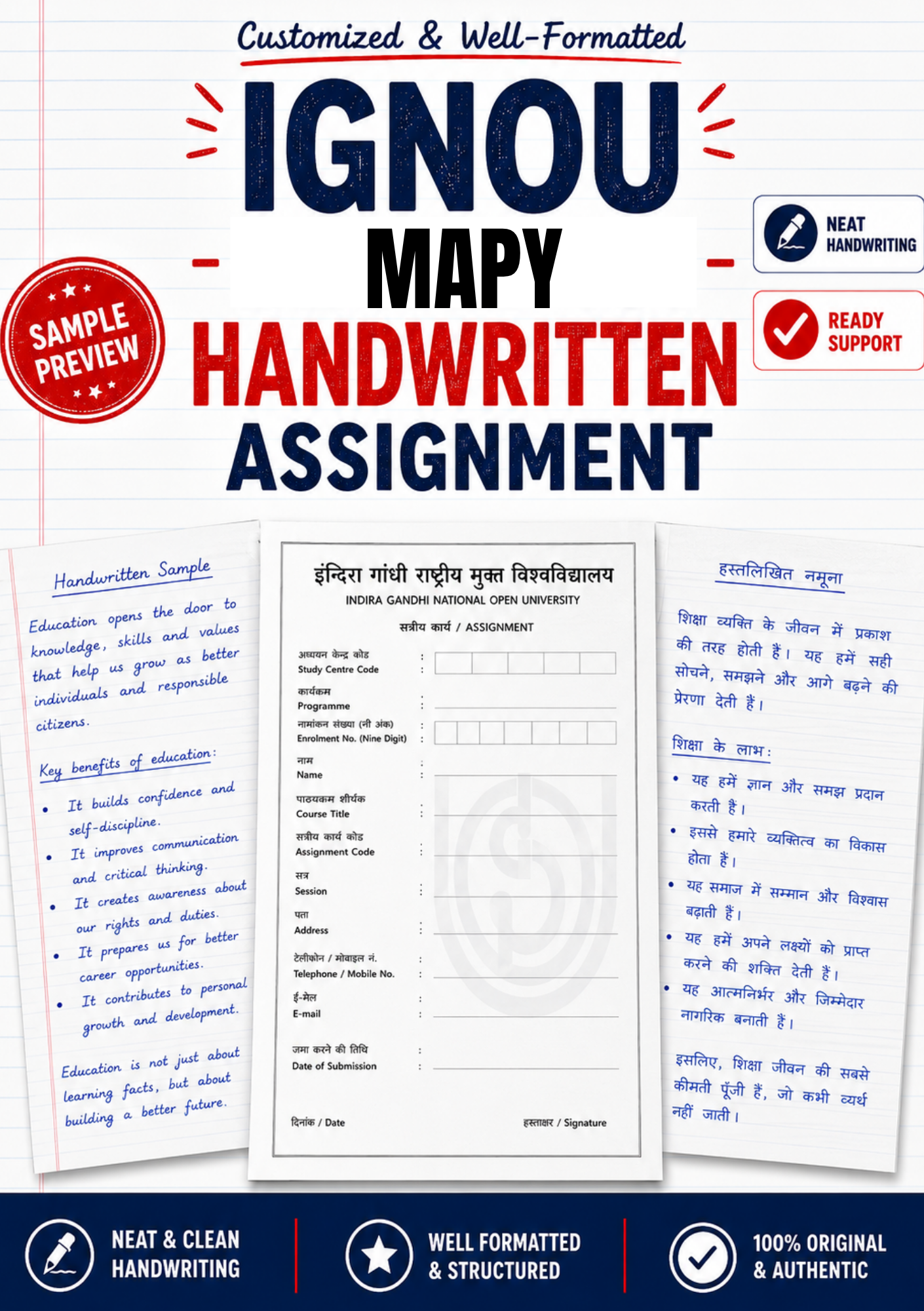


Description
In short. Shri Chakradhar Publication prepares handwritten Tutor Marked Assignment sets for IGNOU’s MA (Philosophy), covering all twenty course codes the programme draws on: MPY-001 and MPY-002, the sixteen MPYE electives, MGP-005 borrowed from Gandhi and Peace Studies, and the MPYP-001 dissertation that carries no TMA at all. The rate is ₹320 per subject, hard copy only, with courier included in that price and no separate shipping charge. Each paper is written out on A4 in ink against the exact five-question MAPY format, which runs to two 500-word essays, two 250-word answers, four 150-word answers and five 100-word notes for every code, and arrives with a free IGNOU-format front page and a copy of the official question paper. Any session is accepted, current cycle or older, including backlog courses, at the same ₹320 per subject. No soft copy or PDF is sold.
Inside the Parcel a MAPY Learner Receives
A MAPY order arrives as paper, in a courier packet, ready to be walked into a study centre. There are four things inside it and nothing else. The first is the answer set itself: one bundle per course code, written by hand on A4 sheets in blue or black ink, with the question number from the official booklet written above each answer so an evaluator can follow the paper without hunting.
The second is the IGNOU-format cover sheet, prepared free with every order. It is filled in with your enrolment number, programme code, course code, course title and session, which are the fields that get transcribed wrongly most often when a learner rushes them on submission day. Your name, your signature and your study-centre code are deliberately left blank, because those are yours to write in front of the counter.
The third is a printed copy of the official TMA paper the answers were written against. On a philosophy programme this matters more than it does elsewhere. MAPY questions almost always carry an alternative introduced by “Or”, so two learners answering the same paper can hand in visibly different scripts and both be correct. Keeping the question sheet in the packet lets you check which branch was taken before you sign anything.
The fourth is the pagination and stapling done course-wise. IGNOU asks that assignments be submitted as one document per course and that two courses never be combined into a single bundle. Sets leave here already separated that way, so a learner ordering six first-year electives receives six bundles rather than one thick stack to divide at the counter.
No soft copy or PDF is sold. There is no download link, no scanned version and no email attachment version of a MAPY set. What is sold is the physical writing.
Where the ₹320 Stops, and Where It Does Not
The rate is ₹320 per subject, hard copy only, with courier included in that price and no separate shipping charge. On a programme where a learner may hold anything from one backlog elective to a full fourteen-course load, per-subject pricing is the only honest way to quote, because no two MAPY learners sit the same set of papers.
Inside the ₹320 sit the writing of all five questions on the paper, the cover sheet, the question-paper copy, course-wise stapling, and the courier to your address. Handwriting matched to your own sample is inside it too, at no additional charge. There is no minimum order: one subject or fourteen, same rate. A learner who needs only MPYE-006 Dalit Philosophy because it was the one paper missed in a previous cycle pays ₹320 and nothing more.
Outside the ₹320 sit three things worth naming plainly. The first is anything IGNOU charges you directly: term-end examination fees, re-registration fees and the ₹300 registration fee are the university’s, not this publisher’s. The second is the MPYP-001 dissertation, which is project work rather than an assignment and is handled through a different route entirely. The third is a promised delivery date. Delivery depends on your pin code and is confirmed for your order before you pay. No figure is promised on this page.
Assignments carry 30 per cent of the final course result and the term-end examination carries the remaining 70 per cent. Across fourteen MAPY courses that is a very large share of a degree resting on paper that has to physically exist and physically arrive.
Reference File or Submittable Copy: Telling the Two Apart
These two things get confused constantly, and the confusion costs learners a submission cycle. A solved assignment is a soft-copy reference file of model answers for a course code and session, read on a phone or laptop and used as raw material while you write. A handwritten assignment is the answers written out by hand on A4 and submitted in hard copy at the study centre. The first is study material. The second is the thing you hand in.
| Point of difference | Solved assignment (soft copy) | Handwritten assignment (this page) |
|---|---|---|
| Format | PDF file, read on screen | Ink on A4 paper, couriered to you |
| What you do with it | Read it, then write your own answers in your own hand | Check it, sign the cover page, submit it |
| Who it suits | A learner who has time to write and wants a model to work from | A learner short of writing time before a cut-off |
| Price on this store | Listed on the MAPY solved-assignment category | ₹320 per subject, courier included |
| Can it be submitted as it stands | No. Printing a PDF does not make it a handwritten assignment | Yes, once you add your name, signature and centre code |
Scroll the table sideways on a narrow screen.
The MAPY booklet itself settles the argument about format. Every MPYE paper opens with instructions telling the learner how many questions to answer and in roughly how many words, and the Gandhi and Peace Studies booklet that MAPY learners are redirected to for MGP-005 puts it in writing: all assignments have to be submitted to the Coordinator of the Study Centre allotted to you, with a receipt obtained and retained. That is a physical counter transaction. A downloaded file is not a submission and printing it does not turn it into one.
If a reference file is what you actually want, the store sells those separately and this page is not the place to buy one. Learners who prefer to write the answers themselves usually start from the course-wise MAPY solved assignment files listed under MA Philosophy and then write the pages out in their own hand. Both routes are legitimate. Only one of them ends with paper in your bag.
Send the codes you are actually registered in, not the whole syllabus. MAPY electives vary so much between learners that a code list is the only useful starting point. Message the course codes off your admission record along with the session printed on your booklet.
₹320 per subject. Courier included. No minimum order.
First-Year Papers: MPY-001 and the Eight You Choose Six From
The first year of MAPY is one compulsory eight-credit course plus six electives chosen from eight options, each worth four credits. That is 8 plus 24, or 32 credits, and it produces seven assignment papers rather than the nine a learner might expect from counting rows in the table. The two codes you do not choose produce nothing at all.
| Code | Official title | Credits | Status |
|---|---|---|---|
| MPY-001 | Indian Philosophy | 8 | Compulsory |
| MPYE-001 | Logic | 4 | Elective, choose any six |
| MPYE-002 | Ethics | 4 | Elective, choose any six |
| MPYE-003 | Epistemology | 4 | Elective, choose any six |
| MPYE-004 | Philosophy of Human Person | 4 | Elective, choose any six |
| MPYE-005 | World Religions | 4 | Elective, choose any six |
| MPYE-006 | Dalit Philosophy | 4 | Elective, choose any six |
| MPYE-007 | Research Methodology in Philosophy | 4 | Elective, choose any six |
| MGP-005 | Introduction to Peace and Conflict Resolution | 4 | Elective, issued by another school |
Scroll the table sideways on a narrow screen.
MGP-005 is the row that behaves differently from every other code on the programme. It is a Gandhi and Peace Studies course, owned by the Centre for Gandhi and Peace Studies in the School of Social Sciences, where it sits as a compulsory second-year paper of the MA in Gandhi and Peace Studies and also appears in the Post Graduate Certificate. MAPY, which belongs to the School of Inter-disciplinary and Trans-disciplinary Studies, borrows it as an optional first-year elective. One course, two schools, two entirely different roles.
The practical consequence lands on the first line of the MAPY assignment booklet, which does not print the MGP-005 questions at all. It prints a redirection instead, telling MAPY learners to look for the MGP-005 assignment under the Gandhi and Peace Studies booklets. A learner who downloads only the MAPY file and takes six electives including MGP-005 will have five papers in hand and one missing, with no error message to warn them. Sets prepared here cover both files at the same rate, and learners ordering that paper often pick up the matching MGP and MGPE course files kept under Gandhi and Peace Studies at the same time.
Second-Year Papers: MPY-002, Nine MPYE Options and a Dissertation
The second year repeats the shape of the first with a wider elective pool. One compulsory eight-credit course, then six electives chosen from ten options at four credits each. Nine of those ten options are taught papers with a written assignment. The tenth is a dissertation, and it changes what your order looks like.
| Code | Official title | Credits | Carries a TMA |
|---|---|---|---|
| MPY-002 | Western Philosophy | 8 | Yes, compulsory |
| MPYE-008 | Metaphysics | 4 | Yes |
| MPYE-009 | Philosophy of Science and Cosmology | 4 | Yes |
| MPYE-010 | Philosophy of Religion | 4 | Yes |
| MPYE-011 | Philosophy of Art (Aesthetics) | 4 | Yes |
| MPYE-012 | Tribal Philosophy | 4 | Yes |
| MPYE-013 | Philosophy of Technology | 4 | Yes |
| MPYE-014 | Philosophy of Mind | 4 | Yes |
| MPYE-015 | Gandhian Philosophy | 4 | Yes |
| MPYE-016 | Philosophy of Sri Aurobindo | 4 | Yes |
| MPYP-001 | Dissertation / Project work | 4 | No, project work instead |
Scroll the table sideways on a narrow screen.
The credit arithmetic was checked against the stated totals before this table was published. Compulsory courses come to 8 plus 8, which is the 16 the prospectus states. Twelve electives at four credits each come to 48, which is the elective figure the prospectus states. The two together come to 64, which is the programme total. Where an extracted table and a stated total disagree, the table is wrong; here they agree.
MPYP-001 deserves its own paragraph because two things about it are unusual for an IGNOU master’s degree. First, it produces no assignment. The second-year booklet runs from MPY-002 through MPYE-016 and stops. There are no MPYP-001 questions in it, because a dissertation is assessed as project work with a supervisor rather than as a Tutor Marked Assignment. Second, it is optional. It sits inside the “choose any six” elective pool rather than above it, so a MAPY learner can finish all 64 credits without ever writing one. Most IGNOU master’s programmes make the project compulsory; this one does not.
What that means for an order is simple. If you have taken MPYP-001 as one of your six second-year electives, you will be submitting thirteen assignment papers across the degree and one dissertation, not fourteen assignments. Guidance on the dissertation route sits on the editorial side at the MPYP-001 project and synopsis walkthrough on ignouproject.com, and it is a separate piece of work from anything on this page.
Four Places IGNOU’s Philosophy Paperwork Contradicts Itself
Building this page meant reading the Common Prospectus, the live assignment booklets and IGNOU’s own MAPY programme page against one another. They do not agree. None of these are guesses about what IGNOU meant; each is a difference between two documents the university publishes itself, and each one is disclosed here rather than quietly resolved, because a learner who runs into the discrepancy later deserves to have been warned.
Disagreements found between IGNOU’s own MAPY documents, checked on 29 August 2026.
1. Maximum duration, stated twice on one page. IGNOU’s MAPY programme page says in its opening paragraph that the 64 credits are earned “over a period of 2 to 5 years”. The Duration and Fee Structure panel further down the same page says maximum duration is 48 months, which is four years. The Common Prospectus July 2026 says four years in both its narrative and its fee table. One IGNOU page carries both answers.
2. Course codes printed in three different shapes. The Common Prospectus programme table prints MPY 1, MPYE 1, MGP 5 and MPYP 1 with a space and a single digit. The assignment booklets and the programme page print MPY-001, MPYE-001, MGP-005 and MPYP-001 with a hyphen and three digits. Annexure I(c) of the same prospectus prints a third form with no separator at all: MPYE1 through MPYE7 and MGP5. The codes are identical; only the typography moves.
3. MPYE-011 has two titles. The prospectus table and the assignment booklet both call it Philosophy of Art (Aesthetics). The course card on IGNOU’s own MAPY programme page calls it Philosophy of Art, without the parenthesis. Similarly, MPYP-001 is Dissertation in the prospectus and Dissertation/Project work on the programme page.
4. Printing errors inside the booklets themselves. In the 2024-25 first-year paper, MPYE-004 asks the learner to “Explain Volitional Dynamism” twice, as parts (b) and (e) of the same question. In the 2023-24 second-year paper, MPYE-012 prints its question 3 total as “2*10= 10” where every other paper in the same file prints 20, and MPYE-008 leaves one sub-question with no mark figure at all. IGNOU’s own index also titles the 2023-24 first-year file “for TEE Dec 2023 and for June 2023”, where every other year reads December of one year and June of the next.
Disclosed in-house as well. Older product pages on this store still carry a marks assurance, an acceptance claim and delivery windows stated as figures. Those claims are wrong and are being removed. Nothing on this page makes any of them.
The Paper With No Date, and the Elective That Has Two
Most IGNOU assignment booklets open with a submission schedule. The MAPY booklets do not. Both the 2024-25 first-year file and the 2023-24 second-year file were read line by line for this page, and neither prints a last date of submission anywhere. What they print is a session in the title: “Assignments for TEE December 2024 and for TEE June 2025”. That tells you which two examinations the paper is valid for. It does not tell you when to hand it in.
The one MAPY elective that does come with printed dates is MGP-005, because it travels with the Gandhi and Peace Studies booklet rather than the philosophy one. The 2025-2026 Gandhi and Peace Studies assignment booklet prints its schedule in a table: 31 March 2026 for the July 2025 session and 30 September 2026 for the January 2026 session, both to the Coordinator of the study centre allotted to you. Those are School of Social Sciences dates. They are not automatically the dates your philosophy papers run to, and it would be a mistake to assume they were.
The honest position, and the one a learner is better served by, is this: because the MAPY booklet prints no date, the operative deadline for your MPY and MPYE papers is whatever your Regional Centre publishes for your session, not a figure copied off an aggregator site. Those aggregator figures are wildly inconsistent. A survey of them while researching this page turned up 31 March, 30 September, 31 May, 31 October and 30 April all presented as the MAPY deadline, several on pages that also contradicted themselves within a single paragraph. Programme structures, course codes, submission dates and rules change, and only ignou.ac.in and your Regional Centre can confirm the current position for your enrolment.
There is a second timing point specific to MAPY right now. As of 29 August 2026, the newest MAPY booklet published on IGNOU’s programme-wise assignment index for MA Philosophy is the 2024-25 file, with 2023-24, 2022-23 and 2021-22 archived below it. Learners admitted in the July 2026 cycle should check that page before ordering rather than assuming a newer paper exists. Any session is accepted, current cycle or older, including backlog courses, at the same ₹320 per subject, so an older cycle costs no more than a current one.
Why Your MPYE Sheet Carries No TMA Number
Learners often ask what to write in the “Assignment Code” box on the IGNOU front page, having looked for it on the philosophy paper and found nothing. They are not missing it. The MAPY booklets genuinely do not print one. There is no MPY-001/TMA/2024-25 line, no assignment number above the questions, nothing but the course code and its title.
Compare that with the paper a MAPY learner gets sent to for MGP-005. The Gandhi and Peace Studies booklet prints a full four-part code above each course: the course code, then ASST, then TMA, then the session, in the form MGPE-010/ASST/TMA/2025-26. Two booklets, from two schools, that one MAPY learner may be holding at the same time, built to completely different conventions.
What to do about the empty box is practical rather than philosophical. Write the course code and the session in the form your booklet uses, which for a philosophy paper means the code as printed on the booklet, MPY-001 or MPYE-009, alongside the session the booklet names in its title. If your study centre asks for something more specific, they will say so at the counter, and cover sheets prepared here are filled in the booklet’s own convention so nothing is invented that IGNOU did not print. Where a paper has no code to copy, none is fabricated.
The five-question structure is the other thing worth knowing before your set is written, because it determines how much paper an order actually produces.
| Question | What it asks | Word guidance | Marks |
|---|---|---|---|
| 1 | One long essay, with an alternative introduced by “Or” | About 500 words | 20 |
| 2 | One long essay, again with an “Or” alternative | About 500 words | 20 |
| 3 | Answer any two of four | About 250 words each | 2 x 10 = 20 |
| 4 | Answer any four of six | About 150 words each | 4 x 5 = 20 |
| 5 | Short notes on any five of eight | About 100 words each | 5 x 4 = 20 |
Scroll the table sideways on a narrow screen.
Five questions, twenty marks each, one hundred marks per course. Adding the word guidance gives roughly three thousand words of philosophy per code, which is why a six-elective first-year block is a substantial amount of physical writing rather than an afternoon’s work. MGP-005 breaks this pattern too: its booklet asks for five answers selected across two sections, with at least two taken from each, which is a different instruction from “answer all five”.
Your Own Hand, Copied From a Photo You Send
An assignment set that looks nothing like your own writing is a problem waiting at the counter. Send a photo of a page you have written yourself and the handwritten set is matched to your handwriting at no extra charge. Slant, letter size, the way you form descenders and how tightly you space lines are all read off the sample and reproduced.
On a philosophy programme the sample matters more than usual for one specific reason: transliterated Sanskrit. MAPY papers are dense with terms like pratityasamutpada, anekantavada, saptabhanginaya, arthapatti and anyathakhyativada, and a writer unfamiliar with them will produce plausible-looking nonsense. Sets prepared here are written by people who can spell them, and the sample photograph is used to match the hand rather than to guess at the vocabulary.
What makes a usable sample photograph
Half a page of ordinary writing on ruled or plain paper is enough. Photograph it flat in daylight, from directly above rather than at an angle, and send the image uncropped. A shopping list works as well as an essay. What does not work is a photograph of an assignment somebody else wrote, because the point of the exercise is to match your hand and not a stranger’s. If you would rather see the standard before sending anything, sample pages go out on request first, and nothing is paid until you have looked at them.
Ask for sample pages before you pay anything
English Question Paper, Hindi Answer Script: How Far That Goes
MAPY has a medium rule that catches people out, and it is worth stating exactly as IGNOU states it. The programme is offered only in English. However, a student is permitted to write the examination in Hindi. Both halves of that sentence come straight from the university, and the gap between them is where the confusion lives.
What it means in practice is that the study material and the assignment papers are issued in English. There is no Hindi MAPY booklet on the assignment portal. The permission to answer in Hindi is written for the term-end examination, and it does not by itself settle what a study centre will accept on an assignment script. Some learners write assignments in Hindi against an English paper without difficulty; others are asked for English. That decision belongs to your study centre and your Regional Centre, and asking them before you order is a five-minute conversation that avoids a rewrite.
The service covers all mediums IGNOU issues the TMA paper in, at the same price. For MAPY that presently means English, because English is what IGNOU issues. If your centre has confirmed in writing that a Hindi script is acceptable for your courses, say so when you send your codes and it will be discussed before anything is written rather than after.
One more scope note. IGNOU’s own MAPY programme page records that the programme is not offered to international students. That constrains who can be enrolled in it, and by extension who can be ordering these papers at all.
What to Message Before the Writing Starts
Five pieces of information settle a MAPY order. Anything beyond them is unnecessary, and no enrolment password, payment credential or scanned identity document is ever needed.
- Your course codes, exactly as they appear on your admission record. On MAPY this is the item that cannot be guessed, because two learners in the same year hold different elective sets. MPYE-003 and MPYE-012 are a completely different order from MPYE-005 and MPYE-015.
- Whether MGP-005 is among them. It changes which booklet the answers come from and which format the paper follows, so it is worth flagging rather than leaving to be spotted.
- The session printed on your booklet. Not the year you enrolled and not the year of your examination, but the session in the booklet title, such as December 2024 and June 2025.
- Your handwriting sample photograph. One page, photographed flat, as described above.
- Your delivery pin code. Delivery depends on your pin code and is confirmed for your order before you pay. No figure is promised on this page.
Year one or year two does not need to be specified separately, because the course codes already say which. Nor does the number of pages, since that follows from the paper.
Two things to confirm before writing begins: the elective set and the session. Those are the only variables on a MAPY order that cannot be worked out from the programme structure. Everything else follows from the codes.
₹320 per subject. Free IGNOU-format front page. Question paper copy included.
Once the Courier Reaches Your Address
Open the packet and count the bundles against your code list before doing anything else. Six ordered electives should be six separate stapled sets, each with its own cover sheet. If a bundle is missing or a code is wrong, that is easier to fix on the day of delivery than on the day of submission.
Then read what has been written. You sign the declaration on the assignment cover page, so you should read and review the content before submitting it, and satisfy yourself that it represents your own understanding of the course. On a philosophy programme this is not a formality. An evaluator may ask you about the position you took on the “Or” branch of question 2, and a learner who has not read their own script cannot answer.
Fill in the three fields deliberately left blank: your name, your signature and your study-centre code. Then submit course-wise to the Coordinator of your allotted study centre, obtain a receipt, and keep it. The Gandhi and Peace Studies booklet spells out why the receipt matters, noting that the study centre records the marks awarded for each assignment and forwards them to the Student Evaluation Division at IGNOU. Your receipt is the only proof you hold that the paper entered that chain.
Keep a photograph of each set before it leaves your hands. It costs nothing and it settles disputes about what was submitted. No claim is made about the marks any assignment will receive, about how an evaluator will assess it, or about whether it will be accepted. Assignment evaluation is entirely a matter for IGNOU.
Other MAPY Material Learners Pick Up With This
Handwritten sets solve the submission problem and nothing else. The examination is a separate battle worth 70 per cent, and MAPY learners ordering assignments usually pick up two or three other things at the same time.
For the term-end paper, the condensed MA Philosophy guide books held under the MAPY books shelf compress the blocks into something readable in the weeks before an examination, which is a real advantage on eight-credit courses like MPY-001 and MPY-002 where the official material runs long. Alongside those, worked guess papers for MA Philosophy and the archive of previous-year MAPY question papers with solutions show which themes recur, and on this programme they recur heavily.
Learners taking MGP-005 sometimes want the underlying reading too, which sits with the Gandhi and Peace Studies study guides rather than with philosophy. Where an answer file is wanted in hard copy rather than as a download, the printed solved-assignment book covering any programme and session is the route.
Two other pages are worth knowing about. Learners holding codes from more than one programme, or from a diploma taken alongside, can order everything through the customised handwritten assignment listing that accepts any course code instead of splitting the order. And learners who came to MAPY from a BA with philosophy papers behind them, or who still have one outstanding, will find those under the undergraduate philosophy assignment listings for the BA programme. The full range across every programme sits on the handwritten assignment category page.
If writing the pages yourself is the plan and only the method is missing, the editorial side covers it free in the step-by-step guide to writing an IGNOU handwritten assignment. Nothing needs to be bought here to use it.
MAPY Doubts That Come Up at the Ordering Stage
My MAPY booklet has no submission date on it. Have I downloaded the wrong file?
No. The MAPY booklets genuinely print no last date of submission. Both the 2024-25 first-year file and the 2023-24 second-year file were read for this page and neither carries one. What the booklet gives you is the session in its title, which tells you which two examinations the paper is valid for. The operative date is whatever your Regional Centre publishes for your session.
Why is MGP-005 missing from the MAPY assignment paper?
Because MGP-005 is not a philosophy course. It belongs to the Centre for Gandhi and Peace Studies in the School of Social Sciences, where it is a compulsory second-year paper of the MA in Gandhi and Peace Studies. MAPY borrows it as an optional first-year elective. The MAPY booklet’s first line redirects you to the Gandhi and Peace Studies booklet for it. Both files are covered on an order here.
Can I just print a solved assignment PDF and submit that instead?
No. A printed PDF is a printed document, not a handwritten assignment, and IGNOU’s guidance treats typed or printed submissions as a rejection risk. A solved assignment is a soft-copy reference file of model answers for a course code and session; a handwritten assignment is the answers written out by hand on A4 and submitted in hard copy at the study centre. Reading one and writing your own pages is fine. Handing the printout in is not.
What is the difference in price between the MAPY solved file and the handwritten set?
They are different products and are priced separately. Handwritten sets are ₹320 per subject with courier included in that price and no separate shipping charge. Soft-copy reference files for MA Philosophy course codes are listed at their own rates on the MAPY solved-assignment category, and this page does not sell one.
How many assignments does a MAPY learner actually submit?
Fourteen courses are taken across the degree: two compulsory and twelve electives. Thirteen or fourteen of those produce a Tutor Marked Assignment. The variable is MPYP-001, the dissertation, which is one of the ten second-year elective options and carries project work rather than an assignment. Take it and you submit thirteen assignments plus a dissertation; skip it and you submit fourteen assignments.
Is the MPYP-001 dissertation compulsory on MAPY?
No, and that is unusual for an IGNOU master’s degree. MPYP-001 sits inside the second-year “choose any six” pool rather than above it, so all 64 credits can be earned without ever writing one. The Common Prospectus lists it as one of ten elective options at four credits.
What do I write in the Assignment Code box if the paper has no code?
Write the course code and session in the form your booklet uses, which for MPY and MPYE papers means the code as printed alongside the session named in the booklet title. Nothing is invented on cover sheets prepared here. Note that the MGP-005 paper does carry a full code, in the form MGPE-010/ASST/TMA/2025-26, so a learner holding both booklets will legitimately be writing two different things.
Can I order just one MPYE paper I missed two years ago?
Yes. There is no minimum order: one subject or fourteen, same rate. Any session is accepted, current cycle or older, including backlog courses, at the same ₹320 per subject. Send the code and the session printed on the booklet you were issued.
Will my MAPY set be written in Hindi if I ask?
MAPY is offered only in English, so IGNOU issues no Hindi assignment booklet for it, though a student is permitted to write the examination in Hindi. Whether a Hindi assignment script is acceptable is a decision for your study centre. The service covers all mediums IGNOU issues the TMA paper in, at the same price. If your centre has confirmed Hindi in writing, mention it when you send your codes.
How long is one MAPY assignment once it is written out?
The paper asks for two answers at about 500 words, two at about 250, four at about 150 and five short notes at about 100, which comes to roughly three thousand words per course code before diagrams or examples. Six electives is a substantial bundle. No page count is quoted in advance because handwriting size varies with the sample you send.
Are the Sanskrit and Pali terms written correctly?
They are written by people who can spell them. MAPY papers are dense with transliterated terms such as anekantavada, saptabhanginaya and pratityasamutpada, and a writer copying them unfamiliarly produces errors an evaluator will notice immediately. The sample photograph is used to match your hand, not to guess your vocabulary.
Do I get the question paper with the set?
Yes, a copy of the official TMA paper the answers were written against travels with every packet. On MAPY it earns its place, because nearly every question offers an alternative introduced by “Or” and the question sheet is how you check which branch was answered before signing the cover page.
Which MAPY session should I order for if IGNOU has not published a new booklet?
Order against the newest booklet on IGNOU’s MA Philosophy assignment index. As of 29 August 2026 that is the 2024-25 file, with earlier sessions archived below it. If your Regional Centre has told you a different session applies to your enrolment, follow them rather than the portal, and say so when ordering.
Can somebody else send the handwriting sample on my behalf?
The sample should be your own writing, because matching a stranger’s hand defeats the purpose. A relative can send the photograph from their phone if that is easier, as long as the page in the photograph was written by you.
Will this get my assignment accepted, or improve my marks?
No claim is made about the marks any assignment will receive, about how an evaluator will assess it, or about whether it will be accepted. Assignment evaluation is entirely a matter for IGNOU. What is offered here is the physical writing, the correct format, the cover sheet and the courier, and nothing beyond that is promised.
Three Sources Behind Every Line Above
Source one, the Common Prospectus July 2026. Every course code, official title and credit figure in the two tables above was extracted from IGNOU’s Common Prospectus for July 2026, section 3.37, and from Annexure I(c) of the same document. The credits were summed independently against the stated totals of 16 compulsory, 48 elective and 64 overall before the tables were published. The prospectus is also the source for the eligibility, the fee of ₹8,200 per year, and the school attribution to the School of Inter-disciplinary and Trans-disciplinary Studies.
Source two, live IGNOU assignment booklets. Three were opened for this build rather than recalled. The MAPY first-year booklet for TEE December 2024 and TEE June 2025 supplied the question pattern, the MGP-005 redirection line and the confirmation that no submission date is printed. The MAPY second-year booklet for TEE December 2023 and June 2024 supplied the second-year code coverage and confirmed that MPYP-001 carries no assignment. The Gandhi and Peace Studies modular assignment booklet for 2025-2026 supplied the two submission dates, the four-part assignment-code format and the study-centre submission instruction quoted above. Programme details were cross-checked against IGNOU’s official MA Philosophy programme page, and the booklet inventory against the university’s programme-wise assignment portal.
Source three, this publisher’s own commercial terms. The price of ₹320 per subject, courier inclusion, the free cover sheet, the question-paper copy, the handwriting match, the absence of a minimum order and the refusal to state a delivery figure are Shri Chakradhar Publication’s own terms. They are not IGNOU rules and are not presented as any. Where this page states a fact about IGNOU it comes from source one or source two; where it states a term of business it comes from source three.
Important Notice
Shri Chakradhar Publication Pvt. Ltd. and shrichakradhar.com form an independent IGNOU study-support publisher. This is not the official website of Indira Gandhi National Open University, is not affiliated with, endorsed by or authorised by the university, and no page on this site should be treated as an official IGNOU communication.
Programme structures, course codes, submission dates and rules change, and only ignou.ac.in and your Regional Centre can confirm the current position for your enrolment.
You sign the declaration on the assignment cover page, so you should read and review the content before submitting it, and satisfy yourself that it represents your own understanding of the course.
No claim is made about the marks any assignment will receive, about how an evaluator will assess it, or about whether it will be accepted. Assignment evaluation is entirely a matter for IGNOU.
Place Your MAPY Order
The rate is ₹320 per subject, hard copy only, with courier included in that price and no separate shipping charge. There is no minimum order: one subject or fourteen, same rate. No soft copy or PDF is sold.
Send your MPY, MPYE and MGP codes with the session printed on your booklet, and a photograph of a page in your own handwriting. Sample pages go out before anything is paid.
Start your MAPY order on WhatsApp, or message +91 93546 37830 directly. Delivery depends on your pin code and is confirmed for your order before you pay. No figure is promised on this page.