Description
In short. MA History at IGNOU currently runs on two live course-code series at once, and this product covers both: the twelve papers listed in the 80-credit MAHI table of the Common Prospectus July 2026 — MHI-101, MHI-104 and MHI-105 in semester one, MHI-102, MHI-106 and MHI-107 in semester two, MHI-103 and MHI-109 plus one of MPSE-004 or MGP-004 in semester three, and MHI-108, MHI-110 and MHI-111 in semester four — and the older MAH-era papers in the MHI-01 to MHI-10 range for which the Faculty of History is still publishing separate booklets in the same July 2025 and January 2026 cycle. The rate is ₹320 per subject, hard copy only, with courier included in that price and no separate shipping charge. Every MHI paper is marked out of 100, asks for any five answers of roughly 500 words each across two sections, and prints an assignment code containing both an AST and a TMA token. The two cut-off dates the School of Social Sciences prints on the MHI paper are 31 March for the July intake and 30 September for the January intake — not the 31 October that management-school programmes carry, and not the 31 October that several aggregator sites circulate for MA History. Shri Chakradhar Publication writes the set by hand against the codes on your own admission record, matches the handwriting to a sample page you send first, and confirms the dispatch position for your pin code before payment.
What Reaches Your Address in the MAHI Packet
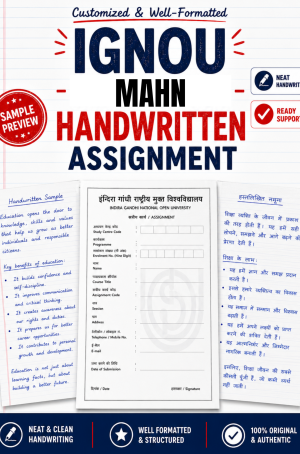
A MAHI order arrives as paper, not as a download. For each MHI code on your list the packet holds a full handwritten answer set on A4 sheets, written in a single consistent hand from first page to last, with the answers laid out in the order the Faculty of History printed the questions and each answer left with space beneath it for the evaluator’s remarks. No soft copy or PDF is sold.
Stapled to each set is an IGNOU-format front page carrying the course code, the programme code, the session and the assignment code exactly as the booklet prints them, with the enrolment number, name, study-centre code, date and signature blocks left blank. Those blanks are deliberate: the declaration on that sheet is yours to sign. A photocopy of the official TMA question paper for that code travels in the same packet, so you can hold the answer set against the paper before you carry it to the Study Centre counter.
Sets for different codes are bundled separately rather than clipped together, because the MHI-103 booklet instructs that each assignment covers the whole course and is submitted as its own document. A learner carrying MHI-108, MHI-110 and MHI-111 in semester four walks into the centre with three separate submissions, not one thick file.
What ₹320 a Subject Buys, and What It Leaves to You
The figure is flat and it is per MHI code, not per semester and not per page. It already contains the writing, the paper, the IGNOU-format cover sheet, the photocopied question paper and the courier. There is no minimum order: one subject or fourteen, same rate. A learner who has cleared everything except MHI-109 pays for MHI-109 and nothing else.
What the rate does not buy is the part IGNOU reserves for you. You sign the declaration on the assignment cover page, so you should read and review the content before submitting it, and satisfy yourself that it represents your own understanding of the course. No claim is made about the marks any assignment will receive, about how an evaluator will assess it, or about whether it will be accepted. Assignment evaluation is entirely a matter for IGNOU. Delivery depends on your pin code and is confirmed for your order before you pay. No figure is promised on this page.
Reference PDF or Submission Copy: Choosing Between the Two MAHI Products
These are two different things and the words are used loosely almost everywhere else, so it is worth being exact. A solved assignment is a soft-copy reference file of model answers for a course code and session — a PDF you read, study and write from. A handwritten assignment is the answers written out by hand on A4 and submitted in hard copy at the study centre. One is study material. The other is the thing that crosses the counter.
The distinction matters more in MA History than in most programmes, because the answers are long. The MHI-101 booklet sets essay questions at about 500 words for 20 marks and short notes at about 250 words for 10 marks, and asks for five answers per paper. Reading a model answer takes minutes; transcribing five of them by hand takes an evening per code. A learner with six papers in a year is looking at a multi-week copying job either way.
| Question | Solved assignment (soft copy) | Handwritten assignment (hard copy) |
|---|---|---|
| What it is | A PDF of model answers for one MHI code and session | Those answers written by hand on A4, in a matched hand |
| What you do with it | Read it, then write your own copy in longhand | Check it, fill in your enrolment details, sign, submit |
| Can it be handed in as it stands | No — a printed or typed file is not a handwritten submission | Yes, once your own details and signature are on the cover |
| Who it suits | Learners with time who want to write the MHI answers themselves | Learners short of weeks before 31 March or 30 September |
| Price on this store | Listed per code on the MA History assignment shelf | ₹320 per subject, courier included |
Scroll the table sideways on a narrow screen.
The booklets themselves are unambiguous about the destination. Each MHI paper states that the assignment should be submitted to the Coordinator of your Study Centre, that you must obtain a receipt for it and retain it, and that the Study Centre will return the assignment to you after evaluation. A downloaded file does not satisfy that instruction on its own; something written has to reach the counter. If a reference PDF is what you actually want, the MHI solved-assignment PDFs listed under MA History are the right shelf and this page is not — that catalogue is priced per code and sold as study material, not as a submission.
Two code series, one flat rate. Whether your admission record says MHI-105 or MHI-05, the quote is the same and the paper is written against the booklet IGNOU currently has live for that code.
₹320 per subject. Hard copy. Courier included. No minimum order.
Twelve Papers, Thirteen Rows: Reading the 80-Credit MAHI Table
The Common Prospectus July 2026 places Master of Arts (History), programme code MAHI, in the School of Social Sciences, sets it at 80 credits across four semesters of 20 credits each, and opens it to graduates of any discipline. The medium of instruction is printed as English and Hindi. The credit weights are unusual for an NEP-era semester programme: the papers are worth six or eight credits, never four, and the four semester subtotals add to exactly the stated 80.
Note the prefix. The programme code is MAHI; the course codes are MHI. Those are two different labels for two different things, not a contradiction, and the prospectus prints the course codes without a hyphen while every booklet prints them with one.
The table below has thirteen rows but you sit twelve papers. MPSE-004 and MGP-004 occupy a row each because the prospectus lists them as alternatives; only one of the two counts towards your 80 credits, and the other is simply not yours.
| Semester | Code | Official title | Credits |
|---|---|---|---|
| Year 1, Semester 1 | MHI-101 | Ancient and Medieval Societies | 6 |
| Year 1, Semester 1 | MHI-104 | Political Structures in India through the Ages | 8 |
| Year 1, Semester 1 | MHI-105 | History of Indian Economy-1: From Earliest Times to C.1700 | 6 |
| Year 1, Semester 2 | MHI-102 | Modern World | 6 |
| Year 1, Semester 2 | MHI-106 | Social Structures in India through the Ages | 8 |
| Year 1, Semester 2 | MHI-107 | History of Indian Economy-2: C.1700 to 2000 | 6 |
| Year 2, Semester 3 | MHI-103 | Historiography and Research Methods | 8 |
| Year 2, Semester 3 | MHI-109 | Indian National Movement | 8 |
| Year 2, Semester 3 | MPSE-004 | Social and Political Thought in Modern India — one of these two only | 4 |
| Year 2, Semester 3 | MGP-004 | Gandhi’s Political Thought — one of these two only | 4 |
| Year 2, Semester 4 | MHI-108 | Environmental Histories of the Indian Subcontinent | 8 |
| Year 2, Semester 4 | MHI-110 | Urbanization in India-1 | 6 |
| Year 2, Semester 4 | MHI-111 | Urbanization in India-2 | 6 |
Scroll the table sideways on a narrow screen.
Semester three carries the one structural oddity worth planning around. Two of its three papers are History papers, and the third is not: you take either MPSE-004, which sits in the Political Science course family, or MGP-004, which sits in Gandhi and Peace Studies. Only one of the two counts, both are worth four credits, and whichever you registered for is the one whose booklet you need. Because these papers belong to other disciplines, their TMA booklets are published outside the History set on the assignment portal, which is the usual reason a MAHI learner reports being unable to find their third semester-three paper.
The arithmetic holds: 6 + 8 + 6 in semester one, 6 + 8 + 6 in semester two, 8 + 8 + 4 in semester three and 8 + 6 + 6 in semester four, giving four subtotals of 20 and a programme total of 80. No project or dissertation course appears in the MAHI table, and no exit award is printed against it — which is worth noting, because MASO, the Sociology programme immediately alongside it in the same prospectus at the same 80 credits, does carry a printed exit award after semester two.
The MAH-Era MHI Papers Still Being Issued Alongside
The older Master of Arts (History) design, programme code MAH, does not appear anywhere in the Common Prospectus July 2026. It has not stopped existing on the assignment portal. The Faculty of History published booklets for MAH-series MHI codes in the same July 2025 and January 2026 cycle as the MAHI ones, and those booklets print MAH on the cover where the MAHI booklets print MAHI.
| Code | Title as the booklet prints it | Cover code | Where it is documented |
|---|---|---|---|
| MHI-01 | Ancient and Medieval Societies | MAH | Live booklet on ignou.ac.in, issued twice under two file names |
| MHI-10 | Urbanisation in India | MAH | Live booklet on ignou.ac.in; also listed at 8 credits inside the MAUS table of the prospectus |
| MHI-02, MHI-03, MHI-06, MHI-09 | Titles as printed on each individual booklet | Read it off your own paper | Carried on this store’s MA History assignment catalogue; confirm the current title on the portal |
Scroll the table sideways on a narrow screen.
This is the single most practical thing to get right before ordering. MHI-01 and MHI-101 share the identical title, Ancient and Medieval Societies, and they are not the same paper — different booklets, different questions, different assignment codes. A learner who orders by subject name rather than by code has a real chance of receiving answers to the wrong paper. Read the code off your admission record or your re-registration slip, not off a book spine or a search result, and send that. If your own record is ambiguous, the paper you download from the portal settles it, because the code is printed on the cover, in the header and again in the assignment-code line.
If you are still stocking up on reading material for either series, the store keeps MAHI help books arranged by MHI code and, separately, the older MAH book shelf — a split that mirrors IGNOU’s own and is discussed further down this page.
Where the Prospectus and the Faculty of History Booklets Part Company
Building this page meant reading the prospectus table against three live booklets and against the store’s own catalogue. They do not all agree. Every disagreement found is set out below rather than quietly reconciled, because a learner who knows a document is inconsistent can check their own paper, and one who has been handed a tidy summary cannot.
Nine documented disagreements affecting MA History: seven inside IGNOU’s own documents, two on this publisher’s own pages.
1. One subject, two credit values, one document. The MAHI table splits urbanisation into MHI-110 Urbanization in India-1 and MHI-111 Urbanization in India-2 at six credits each. Elsewhere in the same Common Prospectus July 2026, inside the MA Urban Studies (MAUS) table, MHI-10 Urbanization in India is listed as a single eight-credit option. The same material is carried at 12 credits in one table and 8 in another.
2. Two programme codes on booklets of the same cycle. The MHI-101 and MHI-103 booklets for July 2025 and January 2026 print MAHI on the cover. The MHI-10 booklet for the same cycle, same faculty, same school, prints MAH.
3. A title spelled two ways. The prospectus lists MHI-103 as Historiography and Research Methods. The live booklet’s own cover and header read Historiography and Research Method, singular.
4. A session label that cannot be right. The MHI-101 booklet’s date table reads “For January 2025 Session Students — 30th September 2026”. The MHI-103 and MHI-10 booklets, same cycle, print “January 2026 Session Students — 30th September 2026”. The date is consistent; the year on the session label in MHI-101 is not.
5. Three assignment-code formats live at once. MHI-101 prints MHI-101/AST/ TMA/2025-26 and MHI-103 prints MHI-103/AST/ TMA/2025-26, both with a stray space after the AST token. MHI-10 prints MHI-10/AST/TMA/ July 2025-January26, with the space in a different place and the session written out instead of abbreviated.
6. An instruction at odds with the marks printed beside it. Every MHI paper states that all questions carry equal marks, then prints the essay questions at 20 marks and the short-note question at 10+10. Follow the marks printed against each question, not the blanket sentence.
7. Spelling of the same word, two ways. The MHI-10 booklet uses Urbanisation; both prospectus tables use Urbanization.
8. In-house: two MA History shelves for one programme. This store runs both a MAH and a MAHI book category, while its solved-assignment, guess-paper and previous-year-paper categories are all filed under MAH alone. That mirrors IGNOU’s own split, but it is confusing to navigate and is on the correction list.
9. In-house: a course title carrying a typing error. The store’s MHI-104 book page renders the title as “Political Structures in India thorugh the Ages”. The prospectus reads through. Flagged for correction.
One further caution belongs here even though it is nobody’s document. Several MA History aggregator pages currently publish 31 October as the January-session MAHI cut-off, and at least one publishes 30 March. Neither appears on any of the three booklets read for this page. The dates in the next section are the ones IGNOU printed.
31 March and 30 September: The Two Dates Printed on Your MHI Paper
Submission deadlines at IGNOU are set per school, and the School of Social Sciences does not use the management school’s calendar. All three MHI booklets read for this page print the same pair.
| Your intake | Cut-off printed on the booklet | Term-end exam it clears you for | Where it goes |
|---|---|---|---|
| July 2025 session | 31st March 2026 | June term-end examination | The Coordinator of your Study Centre |
| January 2026 session | 30th September 2026 | December term-end examination | The Coordinator of your Study Centre |
Scroll the table sideways on a narrow screen.
Two things follow. First, if you have carried a management-school date in your head from a colleague on another programme, it is the wrong one; 31 October belongs to that calendar, not to History. Second, the papers themselves expire. Each booklet is stamped for one cycle, and when a new cycle opens, IGNOU issues a fresh MHI paper with different questions and the old one stops being valid for submission. Submitting last year’s answers against this year’s paper is the most common avoidable rejection in any programme, and it is entirely a question of which booklet you downloaded.
IGNOU does extend these dates in some cycles by public notification, so a booklet date is a floor rather than a ceiling. The current position for your enrolment is only ever confirmed by the official IGNOU assignment download service and by your Regional Centre.
Decoding AST and TMA in Your MAHI Assignment Code
Copying the assignment code onto the front page is the last mechanical step before submission, and MAHI’s version has a quirk worth understanding, because it carries two tokens where most programmes carry one.
Take the live line from the MHI-101 booklet: MHI-101/AST/ TMA/2025-26. The first block is the course code. AST is IGNOU’s assignment abbreviation, TMA stands for Tutor Marked Assignment, and the final block is the academic session the paper was issued for. Most programmes print only the TMA token; the History papers print both, which is why a MAHI code looks longer than the ones your friends on other programmes are copying.
The MAH-series papers format the same information differently again — MHI-10 prints MHI-10/AST/TMA/ July 2025-January26, spelling out the sessions rather than abbreviating them to a hyphenated year pair. There is no correct universal form to memorise. Copy the assignment code exactly as it appears on the paper you downloaded, spacing included, and let the inconsistency be IGNOU’s rather than yours.
Your Own Handwriting, Copied From a Photo You Send
The set is written to look like your work because a set that visibly does not is a set you will hesitate to hand in. Send a photo of a page you have written yourself and the handwritten set is matched to your handwriting at no extra charge. The writer studies the letterforms, the slant, the spacing and the general density of your hand, and works to that reference across every MHI paper in the order, so the MHI-108 set and the MHI-111 set look like the same person wrote them in the same fortnight.
What Makes a Usable Sample Page
Half a page of ordinary writing is enough — notes, a rough answer, a letter. Write in the pen you normally use, on ruled or plain paper, and photograph it flat in daylight rather than under a lamp that throws a shadow across the page. Avoid block capitals and avoid writing unusually neatly for the photo, because both produce a match to a hand that is not the one you actually write in. If your hand has changed since school, send something recent.
The sample goes first and the payment follows, which is the point of the sequence: you see the matched writing before you have committed anything.
Send a sample page photo and see the matched writing first.
English, Hindi, Old Cycles and Backlog MHI Codes
IGNOU prints the MHI papers in both languages, and the prospectus records the MAHI medium of instruction as English and Hindi. The service covers all mediums IGNOU issues the TMA paper in, at the same price. A learner writing MHI-102 as Modern World and a learner writing it as आधुनिक विश्व pay the same and receive the same treatment; what changes is which booklet the answers are written against.
Backlogs are ordinary rather than exceptional in MA History, because the two-year programme carries a four-year maximum span and learners routinely spread it. Any session is accepted, current cycle or older, including backlog courses, at the same ₹320 per subject. One qualification is worth stating plainly: for a backlog paper, IGNOU generally expects the current booklet rather than the one issued in the year you first registered, so send the code and let the current paper be located rather than assuming the old questions still stand.
The Five Things a MAHI Order Needs From You
Orders stall on missing information far more often than on anything else, and the list is short.
- Your MHI codes, written as codes. MHI-110, not “the urbanisation one”. If you are in semester three, say whether you registered for MPSE-004 or MGP-004.
- Your session. July or January, and the year. This decides which booklet the answers are written against.
- Your medium. English or Hindi, for the whole order or per code if you have mixed them.
- A photo of a page in your handwriting. One page is plenty; see the guidance above.
- The delivery pin code. This is what the dispatch position is worked out from.
Nothing else is needed at the ordering stage. Your enrolment number, your name, your study-centre code and your signature all belong on the cover page in your own hand on the day you submit, and are deliberately left blank in the packet.
Send those five details in one message and get a rate back.
Semester three sorted out before you order. MHI-103 and MHI-109 are fixed; the third paper is either MPSE-004 or MGP-004 and only your own record says which. Send the code and the right booklet gets used.
₹320 per subject, courier included. Handwriting matched free. Any session, including backlogs.
When the MAHI Parcel Lands at Your Door
Open it and count the sets against your code list before anything else — one set per MHI code, each with its own front page and its own photocopied question paper. Then read. The booklets ask you to write the answers in your own words and to keep within the word limits set for each question, and reading the set through is how you satisfy yourself that it does represent your understanding before you put your name to it.
Fill in the cover pages by hand: name, enrolment number, programme code MAHI or MAH as your record says, course code, session, study-centre code, date and signature. Take the whole thing to the Coordinator of your Study Centre, and insist on a receipt — the MHI booklets say so explicitly, and that receipt is the only proof you hold if a submission goes missing from the system. A photocopy of what you submitted is worth keeping too, for the same reason.
The booklets also state that the Study Centre will return the evaluated assignment to you and forward the marks to the Student Evaluation Division, where they enter your grade card. Assignments carry 30 per cent of the final course result and the term-end examination carries the remaining 70 per cent.
What MA History Learners Add to a MAHI Order
Most MAHI orders sit inside a wider term of preparation, and the store carries the neighbouring material. For revision against the term-end paper rather than the assignment, the guess papers for the History term-end exam are organised by MHI code, and previous-year History question papers show how the same themes recur across cycles. Learners reading in Hindi often take an eleven-book Hindi-medium set covering MHI-101 through MHI-111 in one go rather than buying code by code, though a standalone MHI-103 guide for the historiography paper is a common single purchase, since that is where most learners lose time.
If a family member or a colleague is on a different programme, the handwritten-assignment shelf for every other programme works the same way at the same rate, and the broader catalogues of every master’s programme the assignment catalogue covers and of master’s-level guide books across the catalogue are the places to start. Learners who would rather write the MHI answers themselves and simply want the process explained will find a fuller walkthrough of format, cover page and submission in the step-by-step handwritten assignment guide on ignouproject.com, the editorial sister site of this store.
What MAHI Students Ask Before They Send the First Message
My admission record says MAHI but my booklet cover says MAH — which am I?
Both, in a sense, and it does not matter as much as the course code does. MAHI is the programme code the Common Prospectus July 2026 uses; MAH is the older programme code, and the Faculty of History still prints it on the covers of the MHI-01 to MHI-10 series booklets it continues to publish. What decides your order is the course code — MHI-110 or MHI-10, MHI-101 or MHI-01 — not the programme label on the cover. Send the course codes and the correct series is used.
MHI-01 and MHI-101 have the same title. How do I know which one I need?
Only your own record tells you. Both are called Ancient and Medieval Societies, and they are separate papers with separate booklets, separate questions and separate assignment codes. Check your admission or re-registration record, or download the paper from the assignment portal and read the code off the cover. Ordering by subject name rather than by code is the one mistake that reliably produces the wrong set in MA History.
Is MHI-103 called Historiography and Research Method or Methods?
The Common Prospectus July 2026 prints Methods, plural. The live booklet prints Method, singular, on both the cover and the header. It is the same paper and the same eight credits. Use whichever form appears on the booklet you downloaded when you copy the title onto your front page, and the mismatch will not cause you a problem.
Which paper do I take in semester three — MPSE-004 or MGP-004?
Whichever one you registered for. The MAHI table lists them as an either/or pair worth four credits, so only one counts towards your 80. MPSE-004 is Social and Political Thought in Modern India and MGP-004 is Gandhi’s Political Thought. Because neither carries an MHI prefix, their booklets are not filed with the History papers on the assignment portal, which is usually why learners cannot find them. Tell us which one you took and it is written like any other subject at ₹320.
Why does my MAHI assignment code have both AST and TMA in it?
Because the Faculty of History prints both tokens. A MHI-101 code reads MHI-101/AST/ TMA/2025-26 — AST is IGNOU’s assignment abbreviation and TMA is Tutor Marked Assignment. Most other programmes print only the TMA half, which is why a MAHI code looks longer than the ones learners on other programmes are copying. Reproduce it exactly as printed, including the spacing.
Is the MAHI last date 31 March or 31 October?
31 March, for the July intake. All three MHI booklets read for this page print 31st March for July-session students and 30th September for January-session students. The 31 October date belongs to the School of Management Studies calendar and is circulating incorrectly on several MA History pages. IGNOU sometimes extends these dates by notification, so confirm the live position for your enrolment on ignou.ac.in before you plan around either.
How many answers does one MHI paper actually need?
Five. Each MHI paper is out of 100 marks, is divided into Sections A and B, and asks you to attempt any five questions with at least two from each section. Essay answers run to about 500 words for 20 marks and short notes to about 250 words for 10 marks. Across a six-paper year that is a substantial amount of longhand, which is the reason most MAHI learners look for this service in the first place.
The paper says all questions carry equal marks but the marks printed differ. Which do I follow?
Follow the numbers printed against each individual question. The standing instruction on the MHI papers says all questions carry equal marks, and then the same page prints essay questions at 20 and the short-note question at 10+10. It is an inconsistency in IGNOU’s own template rather than something you need to resolve. Allocate your length to the marks beside each question.
Can I hand in a printed MHI solved assignment PDF instead?
No — a soft-copy solved assignment is study material to write from, not a submission. The MHI booklets direct you to submit the assignment to the Coordinator of your Study Centre and to collect a receipt, and the answers are expected in your own hand. If a reference file is what you want, buy it from the MA History solved-assignment catalogue; if you need something that can cross the counter, that is what this page sells.
I have MHI backlogs from an older cycle. Same price?
Yes. Any session is accepted, current cycle or older, including backlog courses, at the same ₹320 per subject. One practical note for MA History specifically: because the MHI papers are reissued each cycle with different questions, IGNOU generally expects the current booklet rather than the one from the year you registered. Send the codes and the live paper for each is located before writing starts.
Do you write MHI answers in Hindi?
Yes, at no difference in price. The service covers all mediums IGNOU issues the TMA paper in, at the same price, and the prospectus records MAHI as an English and Hindi programme. You can also mix — MHI-105 in Hindi and MHI-102 in English in the same order — as long as you say so when you send the code list.
Do I have to order a whole MAHI semester?
No. There is no minimum order: one subject or fourteen, same rate. A single stranded MHI-109 is a perfectly normal order, and so is a full four-semester catch-up.
What is left blank in the packet for me to complete?
The identifying fields on the cover page: your name, enrolment number, study-centre code, the date and your signature. Those are left empty on purpose, because the declaration printed beside them is a statement you are making about your own work. Read the set through before you put your name to it, and treat that reading as part of the job rather than a formality.
How soon will a MAHI order reach me?
Delivery depends on your pin code and is confirmed for your order before you pay. No figure is promised on this page. Send your codes and your pin code together and the current dispatch position for that route comes back with the rate, so you can judge it against your own 31 March or 30 September date rather than against an advertised average.
Will this get me good marks in MHI?
No claim is made about the marks any assignment will receive, about how an evaluator will assess it, or about whether it will be accepted. Assignment evaluation is entirely a matter for IGNOU. What this product does is remove the transcription work and hand you a submission-ready set in your own hand, with the correct booklet’s questions and the correct assignment code on the front page.
How the MAHI Facts on This Page Were Checked
Important Notice
Shri Chakradhar Publication Pvt. Ltd. and shrichakradhar.com form an independent IGNOU study-support publisher. This is not the official website of Indira Gandhi National Open University, is not affiliated with, endorsed by or authorised by the university, and no page on this site should be treated as an official IGNOU communication.
Programme structures, course codes, submission dates and rules change, and only ignou.ac.in and your Regional Centre can confirm the current position for your enrolment.
You sign the declaration on the assignment cover page, so you should read and review the content before submitting it, and satisfy yourself that it represents your own understanding of the course.
No claim is made about the marks any assignment will receive, about how an evaluator will assess it, or about whether it will be accepted. Assignment evaluation is entirely a matter for IGNOU.
Send Your MHI Code List
Codes, session, medium, a handwriting photo and a pin code. That is the whole order. The rate is ₹320 per subject, hard copy only, with courier included in that price and no separate shipping charge.
There is no minimum order: one subject or fourteen, same rate. Any session is accepted, current cycle or older, including backlog courses, at the same ₹320 per subject.
Start a MAHI order on WhatsApp — or call +91 93546 37830 and read the codes out.