Description
In short. MAFCS, the Master of Arts in Folklore and Culture Studies run by IGNOU’s School of Inter-Disciplinary and Trans-Disciplinary Studies, is a 64-credit programme built from nine course codes, and only eight of them carry a Tutor Marked Assignment: MFC-001, MFC-002, MFC-003 and MFC-004 at 6 credits each in year one, then MFC-006, MFC-007, MFC-008 and MFC-009 at 8 credits each in year two, with the 8-credit project course sitting outside the assignment cycle entirely. Every one of those eight papers carries 100 marks, is marked “Coverage: All Blocks”, and must be written out in longhand on A4 and handed in at your Study Centre. Shri Chakradhar Publication prepares that set for you. The rate is ₹320 per subject, hard copy only, with courier included in that price and no separate shipping charge. Assignments carry 30 per cent of the final course result and the term-end examination carries the remaining 70 per cent, so four unwritten MFC papers cost a year’s worth of that share. The service covers all mediums IGNOU issues the TMA paper in, at the same price, and any session is accepted, current cycle or older, including backlog courses, at the same ₹320 per subject. Delivery depends on your pin code and is confirmed for your order before you pay. No figure is promised on this page.
Inside the MAFCS Packet When It Reaches You
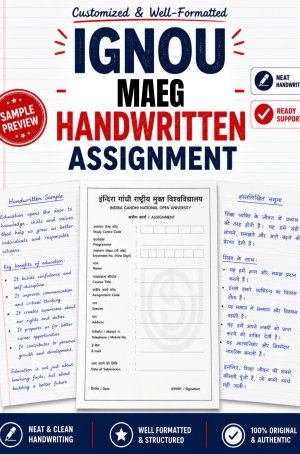
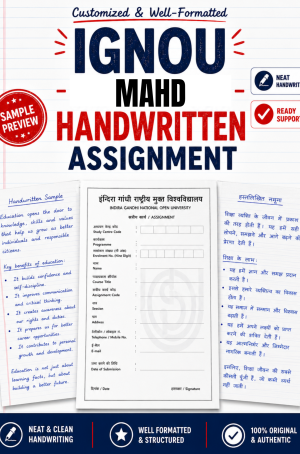
Four physical things travel in one envelope, and none of them is a file. The first is the answer set itself: your MFC responses written out by hand on A4 sheets, question numbers marked at the head of each answer the way the booklet asks, and the pages tagged rather than loose. The second is the IGNOU-format front page, prepared free with every order and pre-filled with your enrolment number, programme code, course code, assignment code and session, so that the only fields left empty on submission day are your name, your signature and your Study Centre code.
The third is a printed copy of the official MFC Tutor Marked Assignment paper the answers were written against. That copy matters more on MAFCS than on most programmes, because the MFC question set changed materially between the July 2023 and July 2024 booklets: MFC-001’s opening question moved from a discussion of folklore’s relations with other disciplines to an explanation of folklore genres, and the rubric on the first-year papers moved from “Attempt any five questions” to “Attempt all questions”. Holding the paper your answers match lets your evaluator see immediately which version was answered. The fourth is nothing at all, and that is deliberate. No soft copy or PDF is sold.
Shri Chakradhar Publication writes each MFC paper as its own set rather than binding the year together, because a Study Centre coordinator logs assignments course code by course code. Four separate first-year sets are easier to receipt than one thick folder, and a receipt per course code is what protects you if a submission later shows as missing.
Where the ₹320 Line Starts and Stops
One rate covers one MFC course code. It buys the handwriting, the paper, the front page, the copy of the question paper, and the courier. There is no minimum order: one subject or fourteen, same rate. A learner ordering only MFC-008 pays the same per-paper rate as one ordering all four second-year papers together, and ordering the year in one go simply means a single packet and a single tracking reference rather than four.
The credit weight of the course makes no difference to the rate. MFC-001 is a 6-credit course and MFC-009 is an 8-credit course, but both papers carry 100 marks and both are priced identically, because the work is the answer set, not the credit line. That is worth saying plainly on a programme where the credit split between the two years is uneven.
What the rate does not cover is anything IGNOU charges you for directly: your programme fee, which the Common Prospectus records as Rs. 7,500 per year for MAFCS on a year-wise schedule, your registration fee, and your examination fee. It also does not cover the project. MFCP-005 is a project course with a Project Manual, a synopsis and a supervisor, and no Tutor Marked Assignment exists for it, so it cannot be ordered as a handwritten paper at any price. Nor does the rate buy any outcome. No claim is made about the marks any assignment will receive, about how an evaluator will assess it, or about whether it will be accepted. Assignment evaluation is entirely a matter for IGNOU.
Reference File or Submission Copy: Telling the Two MAFCS Orders Apart
Two different things are sold under names that look alike, and folklore learners lose money confusing them. A solved assignment is a soft-copy reference file of model answers for one course code and one session, downloaded and read. A handwritten assignment is the answers written out by hand on A4 and submitted in hard copy at your Study Centre. The first is study material. The second is the thing you actually hand over.
| Question | Solved assignment | Handwritten assignment |
|---|---|---|
| What form does it take | A PDF file for one MFC code and session | Answer sheets written by hand on A4, plus front page and question paper |
| What you do with it | Read it, check it against your MFC blocks, then write your own answers | Check it, sign the declaration on the cover page, submit it |
| Who tends to order it | Learners who intend to write the four papers themselves and want a model to work from | Learners short of writing days, or handling both MFC years in one cycle |
| How it is delivered | Download after payment | Couriered to your address, timing confirmed per pin code |
| Price | Varies by course code and session | ₹320 per subject, courier included |
Scroll sideways to read the full comparison on a narrow screen.
The deciding point is not preference, it is what IGNOU’s own MFC paper instructs. Instruction 6 on every MAFCS assignment booklet reads: “You should write the answer in your own handwriting.” Instruction 4 adds: “Use only A4 paper size for your assignment and tag all the pages carefully.” A downloaded PDF satisfies neither line. Printing a solved assignment and handing the print-out in is not a submission of the kind the booklet describes, and nothing on this page should be read as suggesting otherwise.
If a reference file is what you actually want, that is a different order and it lives elsewhere on this store. The MAFCS solved assignment listings run code by code from MFC-001 through MFC-009, and that is the right place to look for downloadable model answers rather than this page. Second-year learners who entered MAFCS through the diploma route will find the overlapping first-year material filed under the PGDFCS reference set, which covers the same four MFC papers.
Ordering the four folklore papers you actually hold
₹320 per subject · hard copy only · courier included · any MAFCS session including backlogs
Send your MFC codes and admission year on WhatsApp and each code is checked against the current MAFCS booklet before a page is written. Send the codes exactly as they appear on your admission record, your admission batch, and your pin code.
The Four First-Year MFC Papers Your Order Can Cover
Year one of MAFCS is five course codes and 32 credits, but only four of those codes produce an assignment. The titles and credit values below are read from the Common Prospectus July 2026, section 3.39, and cross-checked against the course structure published on IGNOU’s own MAFCS programme page. The 6 plus 6 plus 6 plus 6 plus 8 arithmetic sums to the 32 credits the prospectus states for the year, and the two years together sum to the 64 the table totals, so this is not a bled column from an adjacent programme.
| Code | Official title | Credits | Assignment |
|---|---|---|---|
| MFC-001 | Folklore and Culture: Conceptual Perspectives | 6 | Yes, 100 marks |
| MFC-002 | Tradition, Identity and Cultural Production | 6 | Yes, 100 marks |
| MFC-003 | Cultural and Societal Transformation | 6 | Yes, 100 marks |
| MFC-004 | Tribes of India: Identity, Culture and Lore | 6 | Yes, 100 marks |
| MFCP-005 | Project Manual | 8 | No TMA, project course |
Scroll sideways to see the credit and assignment columns on a narrow screen.
Those four papers are the same four that PGDFCS learners write, which is why one IGNOU booklet covers both cohorts. If you completed the diploma and joined MAFCS in year two on the modular route, these four codes are already behind you and your order should start at MFC-006. If you are a direct MAFCS entrant in your first year, all four are live for you.
The question pattern on the first-year papers changed between sessions and the change matters when you order. The 2023-24 booklet prints five questions under the heading “Attempt any five questions. All questions carry equal marks. (20×5=100)”, which offers a choice that does not exist, because exactly five are printed. The 2024-25 booklet corrects the rubric to “Attempt all questions. All questions carry equal marks.” and drops the arithmetic line. Either way the practical answer is the same: on a first-year MFC paper you write every question. Questions four and five are always compound, four sub-parts each at five marks, so a first-year MFC paper is really eleven pieces of writing, not five.
The Four Second-Year MFC Papers, Every One Worth Eight Credits
Year two drops the project and raises every course to 8 credits. Four codes, four papers, 32 credits, and no exceptions to order around.
| Code | Official title | Credits | Assignment |
|---|---|---|---|
| MFC-006 | Folklore: Canon, Multimediality, Interdisciplinarity and Social Epistemology | 8 | Yes, 100 marks |
| MFC-007 | Theories and Pedagogy of Folklore | 8 | Yes, 100 marks |
| MFC-008 | Folk Representations | 8 | Yes, 100 marks |
| MFC-009 | Approaches to Folklore | 8 | Yes, 100 marks |
Scroll sideways to see the credit and assignment columns on a narrow screen.
The second-year papers carry a genuine choice that the first-year papers do not. Each of MFC-006 to MFC-009 prints six questions under “Answer any 5 questions. All questions carry equal marks. (20 X 5 = 100)”, so one question can be left out. That is a real saving of twenty marks’ worth of writing across four papers, and it is the single most useful thing to know before pricing a second-year order. Tell Shri Chakradhar Publication if you want a particular question dropped; otherwise the strongest five are answered.
These are also the papers where the named texts appear. MFC-008 asks about Sitakant Mahapatra’s “The Awakened Wind”, about Verrier Elwin in the 2023-24 paper and Paula Richman in the 2024-25 one, and about a Mahabharata study attributed on the paper to “Alf Hilterbetel”, which is IGNOU’s spelling of Alf Hiltebeitel. MFC-009 asks about Levi-Strauss on the Oedipus myth and Barthes on the death of the author. Answers are written against the named texts as the paper prints them, spellings and all, because the evaluator is marking against the paper in front of them.
Four Names for One Project Course, and a Code the Prospectus Never Prints
MAFCS is unusually inconsistent across IGNOU’s own documents, and every disagreement below was found by reading two official sources against each other rather than by copying any of them. They are set out here because a learner who does not know about them will send the wrong code, or look for a date that is not there.
Six things IGNOU’s own MAFCS documents do not agree on.
1. The project course is coded four different ways. The prospectus MAFCS table at section 3.39 calls it MFCP 005 at 8 credits. The prospectus PGDFCS table at section 8.37 calls it MFCI 5 at 6 credits. The MAFCS assignment booklet calls it MFC-005. The PGDFCS assignment booklet gives it no code at all and calls it “Course 5”. IGNOU’s MAFCS programme page uses the first of those four, punctuated as MFCP-005. This store’s own project listings have used MFCP-5, a further punctuation of the same stem, which is being corrected.
2. There is a live MFC-010 that the prospectus never prints. IGNOU’s MAFCS course structure lists MFC-010: Translation work, 2 credits, year two. The prospectus table stops at MFC 009 and totals 64 credits, describing the same thing only in a footnote as a “2 credits ‘Translation of Folklore Coursework'” allotted to learners who finished PGDFCS at 30 credits between 2009 and 2020 and joined year two modularly, subject to the Programme Coordinator’s email approval of the folk texts to be translated. Neither assignment booklet mentions it.
3. MFC-004 is titled two ways in one document. The MAFCS table calls it “Tribes of India: Identity, Culture and Lore”. The PGDFCS table, in the same prospectus, calls it “Tribes of India: Identity, Culture and Folklore”. Both booklets and the IGNOU programme page use “Lore”.
4. PGDFCS is 32 credits and 30 credits in the same prospectus. The MAFCS section states the first-year programme is “PGDFCS: 32 credits”. The PGDFCS section’s own table totals 30. The footnote in the MAFCS section refers to a 30-credit PGDFCS as a historic 2009 to 2020 structure, which does not resolve what the section 8.37 table is currently describing.
5. The school’s name is spelled five ways. “School of Interdisciplinary and Trans-disciplinary Studies” in the MAFCS prospectus section, “School of Intra-Disciplinary & Trans-Disciplinary Studies” in the PGDFCS section, “School of Interdisciplinary and Transdisciplinary Studies” in the section immediately after, “School of Inter-disciplinary and Transdisciplinary Studies” on both booklet covers, and “School of Inter-Disciplinary and Trans-Disciplinary Studies” on ignou.ac.in. Intra and inter are not the same word.
6. The MAFCS booklet describes its own courses as belonging to a diploma. Both the 2023-24 and the 2024-25 MAFCS booklets open: “You are required to do one assignment for each Course (MFC-001 TO MFC-009, MFC-005 being a project paper) of the PG Diploma in Folklore and Culture Studies.” The cover says MAFCS. The instruction says PG Diploma. It has carried across at least two sessions.
| Source document | Code printed | Credits printed |
|---|---|---|
| Common Prospectus July 2026, section 3.39 (MAFCS) | MFCP 005 | 8 |
| Common Prospectus July 2026, section 8.37 (PGDFCS) | MFCI 5 | 6 |
| MAFCS assignment booklets, 2023-24 and 2024-25 | MFC-005 | Not stated |
| PGDFCS and MAFCS assignment booklet, 2023-24 | “Course 5”, no code | Not stated |
| ignou.ac.in MAFCS course structure | MFCP-005 | 8 |
Scroll sideways to compare the code and credit columns on a narrow screen.
Two smaller defects sit inside the papers themselves rather than the structure. In MFC-003 question 4, both the 2023-24 booklets label the four sub-parts a, b, c and e, skipping d, while the marks line still reads 4×5=20. In the 2024-25 MFC-002 question 5, the four short notes are labelled (A), (B), (C) and (B). Neither is a scanning error; they are printed that way. Answer all four parts, number them as the paper numbers them, and let the mislabelling stand rather than silently renumbering, so the evaluator can match your answer to their copy.
None of this is resolved here on your behalf. Only ignou.ac.in and your Regional Centre can say which code and which structure applies to your enrolment, and the point of listing the disagreements is so that you can ask a precise question rather than a vague one.
Why Your MFC Booklet May Carry No Cut-Off Date at All
Most IGNOU programmes print two submission dates on the assignment paper. MAFCS often does not, and this is the finding that most changes how a folklore learner should plan.
Instruction 7 on the MAFCS-only booklets, both the July 2023 and January 2024 edition and the July 2024 and January 2025 edition, reads in full: the completed assignment should be sent to the Coordinator of the Study Centre allotted to you “as per the dates given on the University website i.e. www.ignou.ac.in”. That is the whole instruction. No date follows it. A learner holding only the MAFCS booklet has no cut-off printed anywhere on their paper.
The companion booklet does print them. The combined PGDFCS and MAFCS paper covering MFC-001 to MFC-004, same 2023-24 session and same school, extends the identical instruction with the words “or 30th September for December TEE and 31st March for June TEE”. Two papers, one session, one school, the same four course codes, and one of them carries the dates while the other omits them.
Read the pairing carefully, because it is keyed differently from most schools. These dates are keyed to which term-end examination you are sitting, not to which session you took admission in: 30 September if you are heading for the December TEE, 31 March if you are heading for the June TEE. That is not the 31 October and 30 April pair the School of Management Studies prints on its papers, and it is not safe to carry a management deadline onto a folklore paper.
Layered on top of both is the fact that IGNOU issues central extensions each cycle through its Student Evaluation Division, and those override the printed date when they are issued. The practical consequence for a MAFCS order is simple: treat 30 September and 31 March as the planning anchors, confirm the operative date for your enrolment with your Regional Centre, and place the order with real weeks in hand rather than days. No delivery figure is offered on this page, and working backwards from a date you have confirmed is the only sound way to plan.
One more timing point specific to this programme. As at this build, the MAFCS assignment index on IGNOU’s assignment portal lists three booklets only, the newest being July 2024 and January 2025, with no 2025-26 or 2026-27 MAFCS paper posted. If you have taken admission for a later cycle and cannot find your paper, that is why. Send the newest booklet you can download and the set is written against it.
Decoding MFC-001/TMA-01/2024-25 Before You Post It
The assignment code printed at the head of each MFC paper is not decoration, and it is the field most often filled in wrongly on a front page. The MAFCS format runs to four parts. MFC-001 is the course code. TMA marks it as a Tutor Marked Assignment, the continuously assessed component. 01 is the assignment number within that course, and on MAFCS it is always 01, because each MFC course carries exactly one assignment covering the whole course rather than a series. 2024-25 is the two-year validity span of that paper.
Three details follow from that shape. First, the span is a range, not a single year, so a paper marked 2024-25 is the paper for both the July 2024 and the January 2025 intakes; the booklet cover confirms this by naming both sessions at once. Second, the “TMA-01” segment distinguishes the MAFCS format from schools that print a session name in the code instead, so do not reformat your code to match a friend’s on another programme. Third, the papers do expire. The 2023-24 and 2024-25 MFC-001 papers ask different questions, and answering the older one against the newer session is one of the more common reasons an assignment comes back.
Copy the assignment code onto the front page character for character from the paper you downloaded, including the hyphens and the slashes. If you send Shri Chakradhar Publication a photograph of the first page of your booklet, the code is transcribed from the paper itself rather than reconstructed.
Your Own Handwriting, Copied From a Photo You Send
The set arrives looking like your work because it is matched to your work. Send a photo of a page you have written yourself and the handwritten set is matched to your handwriting at no extra charge. That matters on a programme like MAFCS, where a learner may hand in four essay papers of 100 marks each within a fortnight and a visible change of hand between MFC-006 and MFC-007 is exactly the kind of thing a coordinator notices.
What to photograph, and what happens before you pay
Half a page is enough, written normally rather than carefully, on ruled or plain paper, photographed straight on in daylight. Ordinary joined handwriting is easier to match than an unusually decorative hand. A short sample in your matched hand comes back to you on WhatsApp before any payment is taken, so the risk of paying for handwriting you have not seen does not exist on this order. The whole MAFCS set is then written by a single writer, so all four papers of a year carry one hand rather than four.
The physical specification follows what the MFC booklet asks for and nothing beyond it. A4 paper, as instruction 4 requires. Pages tagged, which is the booklet’s word, rather than stapled at the corner or spiral bound. Blue or black ink. Question numbers written at the head of each answer as instruction 5 requires. Compound questions numbered part by part, matching the paper’s own labelling even where that labelling is faulty.
English Medium, Old Sessions and PGDFCS Carry-Overs
MAFCS is an English-medium programme. Both the Common Prospectus programme table and IGNOU’s own MAFCS page record the medium of instruction as English, and no Hindi-medium MFC assignment booklet is posted on the assignment portal. Practically, that means a MAFCS order is written in English. The publisher’s general commitment still stands, and it is worth stating because learners reach this page from Hindi-medium programmes. The service covers all mediums IGNOU issues the TMA paper in, at the same price. On MAFCS, IGNOU issues one.
Session coverage is broader than the portal listing suggests. Any session is accepted, current cycle or older, including backlog courses, at the same ₹320 per subject. A learner clearing an MFC-003 backlog from the 2022-23 cycle alongside three current second-year papers pays the same rate for all four, and they travel in the same packet.
The modular route deserves its own note. Because MAFCS year one is PGDFCS, learners join at two different points. A direct entrant writes all eight MFC papers across two years. A learner who came in through the diploma writes only MFC-006 to MFC-009, and may also be carrying the 2-credit translation coursework that appears on IGNOU’s course structure as MFC-010 and in the prospectus only as a footnote. That translation work is coursework requiring the Programme Coordinator’s approval of your chosen folk texts, not a Tutor Marked Assignment, and it is not part of a handwritten order. Say which route you came in on when you send your codes and the covered set is confirmed accordingly.
Five Things to Send on WhatsApp, and Nothing Further
Ordering does not need a form or an account. Five pieces of information settle a MAFCS order.
- Your MFC course codes, copied from your admission record rather than from memory, since MFC-004 and MFC-006 are easy to transpose.
- Your admission session and year, which decides which booklet version your answers are written against.
- Whether you entered MAFCS directly or through PGDFCS, which decides whether year-one codes are live for you.
- A photo of a page in your handwriting, for the matching sample that comes back before payment.
- Your delivery address with pin code, which is what the courier timing is confirmed against.
Nothing else is asked for. No password, no Samarth login, no scan of your identity card, no payment before you have seen a sample in your own hand. If you also have a photograph of the first page of your MFC booklet, send it, because the assignment code is then transcribed rather than reconstructed.
One MFC paper or a full folklore year, written to the booklet you hold
₹320 per subject · front page free · question paper included · no soft copy or PDF is sold
Start the MAFCS order on WhatsApp at ₹320 per subject. Attach a photo of your handwriting in the same message and the matched sample comes back before anything is paid.
Once the Folklore Packet Is in Your Hands
Open the envelope and check three things before you go anywhere. That the course codes on the front pages match the codes on your admission record. That the assignment code on each front page matches the code printed on the booklet you downloaded. That the number of separate sets equals the number of papers you ordered. Anything that does not match is easier to correct before submission than after.
Then read the answers. You sign the declaration on the assignment cover page, so you should read and review the content before submitting it, and satisfy yourself that it represents your own understanding of the course. On a folklore paper that reading is worth doing on its own terms as well: MFC-007 and MFC-009 are theory-dense, and reading the answers through is a reasonable first pass at the same material you will meet in the term-end examination.
Submit at the Study Centre allotted to you, which is what instruction 7 on the MFC booklet specifies, and collect a receipt or submission slip for each course code separately. Keep them. Marks appear on the grade card some weeks later, and if an MFC entry is missing, the per-code receipt is the only evidence that settles it quickly. Some Regional Centres now accept scanned uploads instead of hard copy for particular cycles; that is a Regional Centre instruction rather than a programme rule, so check yours rather than assuming from another learner’s experience.
What Folklore Learners Add to a MAFCS Order
Handwritten papers are one part of a MAFCS cycle, and the rest of what learners need sits elsewhere on this store. For the term-end examination, the MAFCS help books condense the MFC blocks into revision-length guides, which is a different job from the assignment set and a useful one when four 8-credit papers arrive in the same exam window. Closer to the exam, the MAFCS guess papers gather the question patterns that recur across MFC sittings.
Year-one learners eventually reach the project, and that is a separate piece of work with its own supervisor and synopsis: the MAFCS project samples for the folklore project course are stocked as hard copies, and there is a parallel set for the diploma at the PGDFCS project shelf for learners still on the first-year route. Diploma learners looking for reading material rather than a project sample will want the PGDFCS help books covering the same first-year folklore blocks.
If you are carrying a course code from outside MAFCS, a bridging paper or something picked up on an earlier enrolment, the handwritten assignment section covers every IGNOU programme at the same rate, and there is a general handwritten listing for any course code and any session if your programme has no page of its own yet. Learners who want printed reference answers rather than a download can order the bound solved-assignment book covering all programmes and sessions.
On the editorial side, the companion site carries the working guides rather than the products. The MAFCS project guide walks through the folklore synopsis and report format if the project rather than the assignment is what you are facing, and there is a general step-by-step explanation of how IGNOU handwritten assignments work for learners who would rather write the four papers themselves.
Things MAFCS Learners Check Before Paying
How many handwritten assignments does a MAFCS learner actually need?
Eight across the whole degree, not nine. MFC-001, MFC-002, MFC-003 and MFC-004 in year one, then MFC-006, MFC-007, MFC-008 and MFC-009 in year two. The project course carries no Tutor Marked Assignment, so it is never part of a handwritten order. If you entered MAFCS through PGDFCS on the modular route, your handwritten need is the four second-year papers only.
Why is there no MFC-005 assignment anywhere on the portal?
Because MFC-005 is not a taught course. It is the project, and the MAFCS booklet states plainly that MFC-005 is a project paper and excludes it from the assignment set. It appears under several codes across IGNOU’s documents, MFCP 005 in the prospectus MAFCS table, MFCI 5 in the PGDFCS table, MFC-005 on the booklet, and simply “Course 5” on the diploma booklet. Whichever code your record shows, it is written as a project with a synopsis and a supervisor, not as a Tutor Marked Assignment.
My MFC booklet has no submission date printed on it. Have I downloaded the wrong file?
Probably not. The MAFCS-only booklets for both 2023-24 and 2024-25 print no date; instruction 7 sends you to www.ignou.ac.in instead. The companion PGDFCS and MAFCS booklet for the same session does print dates, 30 September for the December term-end examination and 31 March for the June one. So an absent date is normal for this programme, not a sign of a bad download. Confirm the operative date for your enrolment with your Regional Centre.
Are the MAFCS dates the same 31 October and 30 April everyone quotes?
No, and that pairing belongs to a different school. The dates printed on the folklore booklet are 30 September and 31 March, and they are keyed to which term-end examination you are sitting rather than to your admission session. IGNOU also issues central extensions each cycle that supersede the printed date. Programme structures, course codes, submission dates and rules change, and only ignou.ac.in and your Regional Centre can confirm the current position for your enrolment.
Can I download a solved MFC PDF, print it and submit that instead?
No, and the booklet says why. Instruction 6 reads: “You should write the answer in your own handwriting.” A printed file is not handwriting. A solved assignment is a soft-copy reference to read and write from; it is not a submission. If a reference file is what you want, the MAFCS solved-assignment listings are the right place, and this page is not selling one.
What is the difference between ordering the solved file and ordering this?
The solved file is a PDF of model answers for one MFC code and session, delivered by download, and you write your own answers from it. This is the finished answer set in longhand on A4, with a front page and a copy of the question paper, couriered to you. Learners who have the writing days usually take the file. Learners handling four 100-mark folklore papers in one window usually take the handwritten set.
Does the price change between a 6-credit and an 8-credit MFC paper?
No. MFC-001 is 6 credits and MFC-006 is 8, and both are ₹320. Every MFC assignment carries 100 marks and covers all blocks regardless of the credit line, so the writing is comparable. There is no minimum order: one subject or fourteen, same rate.
Is MAFCS available in Hindi medium?
Not according to IGNOU’s own records. Both the Common Prospectus programme table and the MAFCS page on ignou.ac.in give the medium of instruction as English, and no Hindi MFC booklet is posted on the assignment portal. If your admission record shows something different, send it, because that would be a discrepancy worth taking to your Regional Centre before you order.
Do I have to answer all five questions on a first-year folklore paper?
On the current paper, yes. The 2024-25 first-year booklet says “Attempt all questions”. The 2023-24 version said “Attempt any five” but printed exactly five, so the choice was illusory either way. Second-year papers are different: MFC-006 to MFC-009 each print six questions and ask for any five, so one can be dropped.
Question 4 on my MFC-003 paper is labelled a, b, c, e. Which part is missing?
None. The paper prints a, b, c and e and skips d, and it does so in both the 2023-24 booklets, so it is a printing fault rather than a missing part. There are four sub-parts and the marks line reads 4×5=20. Answer all four and label them exactly as the paper labels them, so your evaluator can match your sheet to their copy.
My MFC booklet says these courses belong to a PG Diploma. Am I on the wrong programme?
No. Both MAFCS booklets carry that line in their opening paragraph while the cover names MAFCS, and it has persisted across at least two sessions. It is IGNOU’s template carried over from the diploma paper. Your enrolment is what your admission record says, not what the booklet’s introductory sentence says.
There is no 2026-27 MAFCS booklet on the portal. What do I submit?
As at this build, the MAFCS assignment index lists three booklets, the newest covering July 2024 and January 2025. If nothing newer has appeared for your cycle, send the most recent booklet you can download and the set is written against that paper, with the assignment code transcribed from it. Ask your Regional Centre to confirm which paper is current for your enrolment before you submit.
Can I order an MFC backlog from an older cycle at the same price?
Yes. Any session is accepted, current cycle or older, including backlog courses, at the same ₹320 per subject. A 2022-23 MFC-002 backlog and three current second-year papers can go in one order and one packet. Send the session for each code, because older codes are written against the booklet that was live then, not the newest one.
What is MFC-010, and do I need an assignment for it?
MFC-010 is a 2-credit “Translation work” course listed on IGNOU’s MAFCS course structure and absent from the prospectus course table, which mentions the same thing only in a footnote about learners who finished a 30-credit PGDFCS between 2009 and 2020. It requires the Programme Coordinator’s email approval of the folk texts you propose to translate. It is coursework, not a Tutor Marked Assignment, and no booklet exists for it, so it is not part of a handwritten order.
When will the packet reach me?
Delivery depends on your pin code and is confirmed for your order before you pay. No figure is promised on this page. Because the MAFCS booklet itself prints no cut-off date, there is no fixed target on the paper to work back from either, so confirm the operative date with your Regional Centre first and place the order with weeks rather than days in hand.
Which Document Each Line on This Page Came From
Programme structure, course titles and credits. Read from the IGNOU Common Prospectus July 2026, section 3.39 for MAFCS and section 8.37 for PGDFCS, and cross-checked against the course structure published at the MAFCS programme page on ignou.ac.in. Credits were summed independently before the table was trusted: 6 plus 6 plus 6 plus 6 plus 8 gives the 32 stated for year one, four papers at 8 give the 32 for year two, and the total matches the 64 the prospectus prints. MFC-010 appears on ignou.ac.in and not in the prospectus table; that gap is reported above rather than reconciled.
Submission instructions, assignment codes, question patterns and dates. Read directly off three live booklets on IGNOU’s assignment portal: the MAFCS assignment booklet for July 2024 and January 2025, the corresponding 2023-24 MAFCS booklet, and the combined PGDFCS and MAFCS booklet for MFC-001 to MFC-004. The rubric change between sessions, the missing date on the MAFCS-only papers, the sub-part labelling faults and the diploma line in the opening paragraph were all read off those files, not taken from any third party. Current papers are downloaded from IGNOU’s own assignment download service, and that is where you should get yours.
Price, format, medium, session coverage and handwriting terms. These are Shri Chakradhar Publication’s own commercial terms, not IGNOU rules, and they are set by the publisher: ₹320 per subject, hard copy only, courier included, front page free, question paper included, no minimum order, handwriting matched from your sample at no extra charge, any session including backlogs. Keeping them separate from the university’s rules is deliberate, because conflating a seller’s terms with a university’s requirements is how learners end up believing something is compulsory when it is a shop’s policy, or optional when it is a university instruction.
Important Notice
Shri Chakradhar Publication Pvt. Ltd. and shrichakradhar.com form an independent IGNOU study-support publisher. This is not the official website of Indira Gandhi National Open University, is not affiliated with, endorsed by or authorised by the university, and no page on this site should be treated as an official IGNOU communication.
Programme structures, course codes, submission dates and rules change, and only ignou.ac.in and your Regional Centre can confirm the current position for your enrolment.
You sign the declaration on the assignment cover page, so you should read and review the content before submitting it, and satisfy yourself that it represents your own understanding of the course.
No claim is made about the marks any assignment will receive, about how an evaluator will assess it, or about whether it will be accepted. Assignment evaluation is entirely a matter for IGNOU.
Send Your MFC Codes
The rate is ₹320 per subject, hard copy only, with courier included in that price and no separate shipping charge. Eight MFC papers carry an assignment; the project course does not. Any MAFCS session, including backlogs and PGDFCS carry-overs, is written at that same rate.
Ask which of your MFC codes carry a TMA if you are not sure whether a code on your record is a taught paper or the project.
Or send codes, session, pin code and a handwriting photo in one message and the matched sample comes back before payment.