Description
In short. The Master of Arts (Environmental and Occupational Health) carries twenty courses across two years, and nineteen of them have a tutor-marked assignment; the twentieth, MEVP-001, is the project and has no TMA booklet on IGNOU’s assignment portal in any session it has run, so it is never part of an assignment order. Shri Chakradhar Publication writes those nineteen papers out by hand for MAENOH learners, and for the PGDENOH learners whose Year I paper is printed on the same cover sheet. The rate is ₹320 per subject, hard copy only, with courier included in that price and no separate shipping charge. The Year I codes run MEV-001, MEV-002, MEV-003, MEV-004, MEV-005, MEVE-001, MEVE-002, MEVE-003, MEVE-004 and MEVE-005; Year II adds MGSE-009, MEVE-015, MEV-014, MIS-021, MPA-006, MEVE-011, MGSE-004, MED-008 and MGY-001. Those Year II papers are set by more than one school, and three of them printed three different assignment-code formats, three different question rules and three different positions on submission dates for the very same 2025 cycle, so each set is written to the paper you actually downloaded rather than to one house pattern. Any session is accepted, current cycle or older, including backlog courses, at the same ₹320 per subject.
What Lands on Your Doorstep
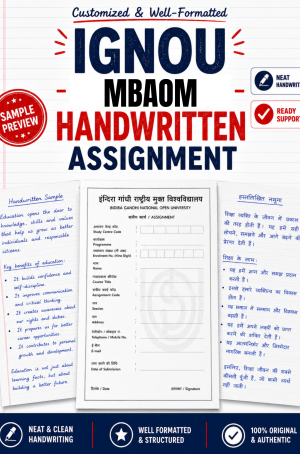
A MAENOH order arrives as paper, tied and ordered course by course, and nothing else. For each code you send, the packet holds the answers written out by hand on A4 sheets in the layout a Learner Support Centre expects, an IGNOU-format cover sheet left blank in the places only you can fill, and a printed copy of the official tutor-marked assignment paper the answers were written against. That last item matters more on this programme than on most. A MAENOH learner is downloading papers from a folder that mixes four schools’ output, and the fastest way to confirm that the set in your hands answers the paper your Regional Centre is expecting is to hold the two side by side.
The cover sheet stays unfilled on purpose. Your enrolment number, your name, your address, your study centre code and your signature are yours to write, and the MEV-001 booklet is specific that they belong in the top right corner of the first page of your response sheet, with the course title, assignment number and study centre name set in the centre. Nothing on the cover is pre-completed for you, because a pre-filled enrolment number on somebody else’s set is exactly the kind of error that sends a file back across the counter.
No soft copy or PDF is sold. There is no download link waiting in an account, no scanned version emailed afterwards, and no file to print. That is a deliberate scoping decision rather than an oversight: a MEV or MEVE answer set that has been printed rather than written is the single format IGNOU’s own guidance flags as a reason a study centre may refuse a submission.
Where the ₹320 Stops and Where It Does Not
One number covers one course code. The rate is ₹320 per subject, hard copy only, with courier included in that price and no separate shipping charge. Inside that figure sit the writing of every answer on the paper, the blank IGNOU-format cover sheet, the printed question paper, and the courier that carries the parcel to your address. There is no packing fee added at checkout, no separate charge for a longer paper, and no premium for a Year II code that happens to be set by a different school from your Year I codes.
What the figure does not cover is the part that was never for sale. No claim is made about the marks any assignment will receive, about how an evaluator will assess it, or about whether it will be accepted. Assignment evaluation is entirely a matter for IGNOU. The MGSE-009 booklet issued under the MAENOH folder for the 2025 cycle goes further than most and states that a learner must secure at least 40 per cent in the assignment to complete the course; that threshold belongs to IGNOU’s evaluation process, and nobody outside the university can promise a learner will clear it.
There is no minimum order: one subject or fourteen, same rate. A Year II learner who is short only MPA-006 and MGY-001 pays for two papers. A learner restarting a lapsed registration and rewriting the whole Year I block pays for ten. The per-subject figure does not move with volume in either direction, which also means there is no bundle price to chase and no reason to add codes you are not registered for.
Delivery depends on your pin code and is confirmed for your order before you pay. No figure is promised on this page. Ask on WhatsApp with your pin code and the team will tell you what is realistic for your address rather than quoting a national average that may not hold for it.
A Reference File and a Submission Set Are Not the Same Thing
Two products get searched with almost identical words and do completely different jobs, and MAENOH learners run into the confusion more often than most because MEV and MEVE codes are shared across several programmes and the reference files floating around are not always cut for this one.
A solved assignment is a soft-copy reference file of model answers for a course code and session. You read it, understand how an answer is framed, and then write your own response. A handwritten assignment is the answers written out by hand on A4 and submitted in hard copy at the study centre. The first is study material. The second is the thing that crosses the counter.
| Question | Solved assignment | Handwritten assignment |
|---|---|---|
| What form does it take | A soft-copy PDF of model answers for a code and session | Answers written by hand on A4 sheets, delivered as paper |
| What you do with it | Read it, then write your own answer in your own words | Add your cover-sheet details and submit it |
| Who it suits | A learner with time to write, who wants a worked model first | A learner short of writing time across nineteen codes |
| Can it be handed in as it is | No. A printed file is not a submission | Yes, once your own details are on the cover sheet |
| Rate on this store | Priced separately in the MAEOH solved-assignment category | ₹320 per subject, courier included |
Scroll the table sideways on a narrow screen.
IGNOU’s own MEV-001 booklet settles the format question without ambiguity in its instruction block: it directs learners to use only A4 paper size and to tag all the pages carefully, and states plainly that the answer should be written in the learner’s own handwriting. It also asks that answers not reproduce passages from the units, which is precisely why a model file is a reference and not a shortcut. Reading a worked answer to understand structure is study. Copying it out unchanged is the practice the same instruction warns against.
If a soft-copy reference is what you actually want, it is a different aisle of the same store and it is not this page. The MAEOH solved-assignment listings hold the code-by-code reference files, and that is where a search for a downloadable MEV or MEVE answer file should end up rather than here.
Nineteen codes, one rate, and a sample photo before anything is written.
Send your MAENOH course codes, your admission cycle and your pin code. The team confirms which papers are currently live on the portal, sends a handwriting sample, and only then takes an order at ₹320 per subject with courier included.
Year One: The Ten MEV and MEVE Codes You Write First
The Year I block is the tidiest part of this programme and the only part where every paper is set by a single school. All ten courses are marked Compulsory in the Common Prospectus for July 2026, all ten carry four credits, and together they total forty credits. That figure is worth holding on to, because it is also the exact credit load of the Post Graduate Diploma that sits underneath this MA as an exit award, and the same ten rows appear in both tables.
| Code | Official title | Type | Credits |
|---|---|---|---|
| MEV-001 | Introduction to Environmental Health | Compulsory | 4 |
| MEV-002 | Environmental and Occupational Hazards | Compulsory | 4 |
| MEV-003 | Environmental Law and Management | Compulsory | 4 |
| MEV-004 | Environmental Toxicology | Compulsory | 4 |
| MEV-005 | Occupational Health and Safety | Compulsory | 4 |
| MEVE-001 | Environmental Impact Assessment for Environmental Health | Compulsory | 4 |
| MEVE-002 | Health Care | Compulsory | 4 |
| MEVE-003 | Agriculture and Allied Sector | Compulsory | 4 |
| MEVE-004 | Industrial Sector | Compulsory | 4 |
| MEVE-005 | Disability Studies and Occupational Health | Compulsory | 4 |
Scroll the table sideways on a narrow screen.
One detail in that table did not come straight off the MAENOH page. In the prospectus, the MEVE-005 row falls across the page break between pages 94 and 95, and its credit figure is lost in the break: the row reads “Compulsory” and then stops. The four credits printed above are recovered from the Post Graduate Diploma table later in the same document, where the identical row is printed complete and the block is footed “Total Credits 40”. Nine printed fours plus that recovered four is forty, and forty plus a matching Year II total is the eighty the MAENOH page itself declares. The arithmetic closes, which is the only reason it is safe to state.
Learners who want the block explained unit by unit before writing anything will find the MAEOH study guides organised against these same ten codes, and the compressed revision route sits with the MAEOH guess-paper sets built around the Year I list.
Year Two: Seven Prefixes, Nine Papers and One Project With No TMA
Year II is where MAENOH stops looking like a single-school programme. Ten rows sit in the table, and between them they carry seven different course prefixes: MGSE, MEVE, MEV, MIS, MPA, MED and MGY. Those prefixes belong to gender studies, environmental studies, industrial safety, public administration, development studies and geoinformatics respectively, and the booklets follow their home schools rather than converging on one format. Nine of the ten rows carry a tutor-marked assignment. The tenth is the project.
| Code | Official title | Credits | TMA on the portal |
|---|---|---|---|
| MGSE-009 | Gender Issues in Work, Employment and Productivity | 4 | Yes |
| MEVE-015 | Disaster Management | 4 | Yes |
| MEV-014 | Sustainable Natural Resource Management | 4 | Yes |
| MIS-021 | Safety Philosophy and Principles of Accident Prevention | 4 | Yes |
| MPA-006 | Disaster Medicine | 4 | Yes |
| MEVP-001 | Project | 4 (see note below) | No booklet in any session |
| MEVE-011 | Global Climate Change | 4 | Yes |
| MGSE-004 | Gender issues in Agriculture, Rural livelihoods and Natural Resource Management | 4 | Yes |
| MED-008 | Globalization, Environment and Development | 4 | Yes |
| MGY-001 | Introduction to Geoinformatics | 4 | Yes |
Scroll the table sideways on a narrow screen.
The MEVP-001 row deserves the note it carries. The prospectus prints its type as Compulsory and then leaves the credit column empty, and unlike the MEVE-005 gap this one is not a page-break artefact: the row sits in the middle of the table with complete rows above and below it. The figure of four is arrived at by arithmetic rather than by reading. Eighteen rows across the two years print four credits each, which is seventy-two; the programme total is stated as eighty; and the two rows with no printed figure are MEVE-005 and MEVP-001. Since the Post Graduate Diploma table independently fixes MEVE-005 at four, the residue leaves MEVP-001 at four as well. That is stated here as a derivation, not as a quotation, and the derivation is disclosed because it disagrees with a figure this publisher’s own editorial site has carried.
What matters commercially is simpler. MEVP-001 has no assignment booklet on IGNOU’s MAENOH index for the 2025 cycle, the 2024-2025 cycle or the July 2022 and January 2023 cycle. There is nothing to write out by hand, so it is not counted, not quoted and not billed as an assignment. Learners looking for help with the report itself are looking at a different category altogether, and the MAEOH project listings in hard copy are where that request belongs.
Three MAENOH Booklets, Three Different Sets of Rules
Three papers were pulled from the same MAENOH folder for the same January and July 2025 cycle. They agree on almost nothing except the maximum mark.
| Printed on the paper | MEV-001 | MGSE-009 | MIS-021 |
|---|---|---|---|
| Assignment code | MEV-001/TMA-01/2025 January & July session | MGSE 009/ AST/2024-25 | MIS-021/TMA/2024 |
| Submission date | None printed anywhere on the booklet | 30 April 2025 and 31 October 2025 | 30 April 2025 only |
| Question rule | Attempt any five, 5 x 20 = 100 | Answer all; Section A 20 marks each, Section B 12 marks each | Attempt all ten, 10 marks each |
| Programme on the cover | PGDENOH and MAENOH I Yr | MAEC, Master of Arts (Economics), Fourth Semester | No programme named at all |
| School named | School of Inter-disciplinary and Trans-disciplinary Studies | School of Social Sciences | None named |
| Minimum assignment mark | Not stated | At least 40 per cent, stated explicitly | Not stated |
Scroll the table sideways on a narrow screen.
Every disagreement found while building this page, including the ones on this publisher’s own properties.
1. The prospectus states the exit threshold twice in consecutive sentences and gives two figures. The MAENOH section says the programme was designed with a Post Graduate Diploma exit after a study of 36 credits, and the very next sentence says the exit option follows a study of 40 credits. The Post Graduate Diploma section later in the same document prints 40 and foots its own table at Total Credits 40. Both figures are on the page; only the university can say which governs your enrolment.
2. MEV-001 is titled three different ways across IGNOU’s own documents. The MAENOH and Post Graduate Diploma tables print “Introduction to Environmental Health”. A different diploma table in the same prospectus prints “Indroduction to Environmental Health”. The MEV-001 booklet’s own cover prints “Introduction to Environmental Health” while the tutor-marked block a few lines below it prints “Introduction to Environmental and Occupational Health”. Copy whichever wording appears on the paper you downloaded.
3. MIS-021 is titled two ways in the prospectus. The MAENOH table and one diploma table print “Safety Philosophy and Principles of Accident Prevention”; a different master’s table prints “Safety Policy and Principles of Accident Prevention”. The MIS-021 booklet itself prints Philosophy.
4. The MGSE-009 paper served from the MAENOH folder is an MA Economics booklet. Its cover reads MAEC, Master of Arts (Economics), Fourth Semester Courses, issued by the School of Social Sciences, and its opening notices concern MGG-011, MGGL-004, MECP-201, MECP-202, MCS-226 and MCS-224, none of which are MAENOH courses. The MGSE-009 assignment itself is at the end of that booklet and is the one a MAENOH learner writes.
5. The MEV-001 booklet tells its readers there are ten courses in the programme and that one assignment is due for every course. That is true of the Post Graduate Diploma named alongside MAENOH on the same cover. It is not true of the MA, which has twenty courses across two years.
6. IGNOU’s own assignment portal spells the programme two ways in one path. The 2024-2025 first-year booklets sit in a folder named MAEOH-IST-2024 inside a directory named MAENOH.
7. MPC-051, a psychology code, appears in the MAENOH second-year list for the July 2022 and January 2023 cycle on the official portal and appears in no MAENOH table in the Common Prospectus for July 2026.
8. The school’s own name is printed three ways in one prospectus: Interdisciplinary and Trans-disciplinary Studies on the MAENOH page, Interdisciplinary and Transdisciplinary Studies on the diploma page, and Intra-Disciplinary and Trans-Disciplinary Studies on the page after it.
9. The prospectus marks all twenty MAENOH courses Compulsory, yet the same section’s prose refers to an additional four-credit course taken “under elective courses of I year”. No Year I row in the table is marked elective.
10. In-house, and disclosed rather than quietly fixed: this store labels the programme MAEOH in its category slugs and menu, and titles one category “Master of Environmental and Occupational Health” with the word Arts missing, while IGNOU’s code is MAENOH and the award is a Master of Arts. This store also sells under PGDEOH and PGDEOHOL where the July 2026 prospectus uses PGDENOH and PGDENOHOL. The categories are correct destinations; the labels need correcting.
11. In-house, and the sharper one: this publisher’s editorial site states that MEVP-001 carries 8 credits. The arithmetic set out above puts it at 4, and a third-party summary of the same project also says 4. The editorial page is being corrected; the figure on this page is the derived one, and the derivation is shown so you can check it.
What Your Own Paper Says About Cut-Off Dates, and What It Leaves Blank
Most programme pages can print two dates and stop. MAENOH cannot, and pretending otherwise would be inventing a rule the university has not published for this programme.
The MEV-001 booklet for the January and July 2025 sessions prints no submission date at all. Its instruction block covers paper size, handwriting, tagging, where to send the completed set and which sessions the questions are valid for, and then says only that assignments must be submitted before a learner can sit the term-end examination. There is no April date, no October date and no March or September date anywhere on it. The MGSE-009 booklet served from the same folder prints two: 30 April 2025 for the June examination and 31 October 2025 for the December examination. The MIS-021 booklet prints one, 30 April 2025, and prints it as the last date of submission without naming an examination.
Aggregator sites circulate 31 March and 30 September for MAENOH, and separately circulate 31 May, 15 June and 31 August as extended dates from various notifications. None of those figures appears on the three MAENOH booklets read for this page. That is not an argument that they are wrong; extensions are issued centrally and often after a booklet is published. It is an argument for reading your own paper and then confirming with your Regional Centre, because those are the two sources that bind you.
What is constant across every IGNOU programme, MAENOH included, is the weighting. Assignments carry 30 per cent of the final course result and the term-end examination carries the remaining 70 per cent. Nineteen writable codes at four credits apiece means the assignment component of this MA is not a formality attached to the degree; it is close to a third of everything.
Decoding MEV-001/TMA-01/2025 Before You Copy It Onto the Cover
The assignment code is the line most often written wrong on a MAENOH cover sheet, because the programme has no single format to memorise. Reading it left to right on the MEV-001 paper: MEV-001 is the course code, TMA-01 marks it as the first tutor-marked assignment for that course, and 2025 January & July session states the two admission cycles the questions are valid for. One booklet, both cycles, which is why the same paper is served to a January learner and a July learner.
Set that beside MGSE 009/ AST/2024-25 and the differences are structural rather than cosmetic. The middle segment reads AST rather than TMA. The tail is a two-year span rather than a single year. The course code carries a space rather than a hyphen. And MIS-021/TMA/2024 drops the numbered suffix entirely and prints a year that is already behind the folder it was filed in.
The working rule is short. Copy the assignment code exactly as it is printed on the paper you downloaded for that specific course, including the spacing and the year, even when it looks out of step with the folder it came from. Do not normalise three codes into one house format to make your set look tidy, and do not carry a Year I code format onto a Year II cover sheet. The evaluator is matching your sheet against the paper that was issued, not against a pattern.
Your Sample Photo Decides the Handwriting
Nineteen codes written across two years in a hand that shifts halfway through is a problem you would rather not explain at a counter. The matching step exists to remove it, and it happens before money moves rather than after.
Send a photo of a page you have written yourself and the handwritten set is matched to your handwriting at no extra charge. A single page is enough. It does not need to be a MEV answer or anything academic; a page of ordinary writing shows the slant, the letter shapes, the spacing and the pressure, which is everything the matching needs. The team writes a sample line in that hand and sends it back on WhatsApp. If it is close, the order proceeds. If it is not, nothing has been spent.
What Makes a Sample Photo Usable
Daylight rather than a flash, the page flat rather than curled, the whole sheet in frame rather than a crop, and ordinary blue or black ink rather than a fine-liner that will not reproduce. Eight or ten lines of continuous writing tells a writer far more than a signature does. If your own hand has changed since you enrolled, send the current one; the point is that the set looks like your writing today, not the writing on a form you filled in years ago.
English-Only Medium, Any Cycle, Backlogs Included
MAENOH is an English-medium programme. The Common Prospectus for July 2026 lists its medium of instruction as English with no Hindi alternative, and the assignment booklets on the portal follow, which is why the Year I files carry an English marker in their filenames and no parallel Hindi set exists to download. That is a real restriction rather than a gap in this store’s catalogue, and it is worth knowing before you go looking for a Hindi MEV-002 paper that has never been issued.
The service covers all mediums IGNOU issues the TMA paper in, at the same price. For MAENOH that resolves to one medium, and the sentence is still worth stating, because MAENOH learners frequently hold codes shared with programmes that do run bilingual papers and reasonably want to know whether a medium choice exists here. It does not.
Session coverage is wider than the portal’s own index suggests. Any session is accepted, current cycle or older, including backlog courses, at the same ₹320 per subject. The MAENOH index currently lists January to July 2025, 2024-2025 and July 2022 to January 2023, and the newest block on it is the 2025 one. A learner sitting on a MEVE-003 backlog from the 2022-23 cycle is not in a worse position than a learner on the current paper, provided the question paper is sent along with the code so the answers are written against the right questions.
Two small holes in the portal itself are worth naming, because they cause avoidable WhatsApp round trips. In the 2024-2025 first-year list, MEV-005 and MEVE-002 appear as plain text with no link. In the 2024-2025 second-year list, MPA-006 appears the same way. If your code is one of those, send whatever paper your Regional Centre or Learner Support Centre issued you instead.
The Short List of Things to Send on WhatsApp
Five items settle a MAENOH order. Anything beyond them slows the exchange rather than speeding it.
- Your course codes, written as they appear on your paper. MEV-004 and MEVE-004 are different courses and a missing E is the single most common ordering error on this programme.
- Your admission cycle. January or July, and the year. This decides which booklet applies, and on MAENOH it is not always the year printed on the file.
- Whether you are on MAENOH or PGDENOH. The Year I cover sheet names both, so the paper alone does not say which you are, and the count of codes differs sharply between them.
- The question paper itself, or its portal link. Given that three papers in one folder printed three different question rules, the safest input is the file you downloaded.
- Your pin code and delivery address. This is what the delivery estimate is built from, and it is confirmed to you before payment rather than published as a figure here.
A handwriting sample photo makes it six, and it is the one worth sending unprompted. If you are ordering for a mixed set that spans both years, say so in the first message; the Year II papers need checking individually against their home schools’ formats and knowing that up front avoids a second round.
The rate holds whether you order two Year II codes or all ten Year I papers.
₹320 per subject, courier included, IGNOU-format cover sheet free with every order, and the official question paper packed alongside the answers. Backlog codes from earlier MAENOH cycles are handled at the same rate.
Once the Parcel Is in Your Hands
Open the parcel and check it against your own list before anything else, code by code. Count the sets, confirm each course code on each cover sheet, and confirm that the printed question paper packed with each set matches the questions the answers respond to. On a programme where the assignment code format changes between papers, this three-minute check is the whole of your quality control.
Then fill in the cover sheets. Enrolment number, name, address, study centre code, signature and date, in your own hand, in the positions the booklet specifies. Keep each course separate rather than binding nineteen sets into one file, because they are evaluated as separate submissions and study centres return mixed bundles.
You sign the declaration on the assignment cover page, so you should read and review the content before submitting it, and satisfy yourself that it represents your own understanding of the course. That is not a formality on this programme. The MEV-001 booklet asks its readers not to reproduce passages from the units and to write in their own words, and the person whose signature is on the cover is the person that instruction is addressed to.
Submit to the Coordinator of the Learner Support Centre allotted to you, which is where the MEV-001 booklet directs completed sets, and get a receipt. Photograph the receipt and every set before you hand it over. When your marks appear on the grade card weeks later, that photograph is the only evidence you will have that a particular code went in on a particular date.
What Else MAENOH Learners Pick Up in the Same Order
Most MAENOH orders are not a single line item, because the programme’s shape pushes learners toward two or three different kinds of help at once. The handwritten assignment hub covers the format rules that apply across every IGNOU programme, which is the right starting point for a learner who has never submitted a tutor-marked set before.
Learners who hold codes outside the standard list, or who are ordering for a cycle the portal no longer indexes, are usually better served by the open handwritten order that takes any course code and any session than by a programme page. Learners who exited at the diploma and are now returning to the second year will want the PGDEOH guides that cover the same ten Year I codes and, where their registration ran in online mode, the separate online-mode diploma listings, since IGNOU runs the diploma in both modes while the full MA runs in distance mode only.
Diploma learners chasing reference files rather than books will find them under the PGDEOH assignment listings. Because MEV and MEVE codes are shared across several environmental programmes, a learner who is registered on more than one will sometimes find the neighbouring paper easier to locate through the MSCENV assignment listings, and the whole catalogue is browsable from the course-wise assignment hub.
For learners who would rather write the set themselves, the free route is genuinely free: the official papers sit on the IGNOU assignment portal’s MAENOH index, and the companion editorial guide at ignouproject.com on preparing a handwritten set from scratch walks through the format rules without asking for anything. The project course, being a different kind of work altogether, is covered separately at the MEVP-001 guide on the same site.
MAENOH Learners Ask These Before They Pay
Does MAENOH have twenty assignments or nineteen?
Nineteen. The programme has twenty courses across the two years, but MEVP-001 is the project and has no tutor-marked assignment booklet on IGNOU’s MAENOH index in any of the sessions currently listed there. An assignment order therefore covers at most nineteen codes, and MEVP-001 is never quoted or billed as one of them.
What does MEV-001/TMA-01/2025 January & July session actually mean?
MEV-001 is the course code, TMA-01 marks it as the first tutor-marked assignment for that course, and the tail names the two admission cycles the questions are valid for. One booklet serves both a January and a July learner. Note that this format is specific to that paper: MGSE-009 prints AST instead of TMA and a two-year span, and MIS-021 prints neither a numbered suffix nor a session name.
My MEV-001 booklet prints no last date. What am I supposed to do?
That is correct rather than a missing page: the 2025 MEV-001 booklet carries no submission date anywhere on it, and states only that assignments must be submitted before the term-end examination. The MGSE-009 paper in the same folder prints 30 April and 31 October, and MIS-021 prints 30 April alone. Since the papers disagree, confirm the operative date for your enrolment with your Regional Centre rather than adopting a date from a neighbouring booklet.
Why is my MGSE-009 paper labelled MA Economics?
Because the booklet served under MAENOH for that code is an MA Economics fourth-semester booklet from the School of Social Sciences, complete with notices about MGG-011, MECP-201 and MCS-226 that have nothing to do with this programme. The MGSE-009 assignment sits at the end of it and is the part a MAENOH learner writes. Ignore the front matter, write the assignment, and copy the assignment code exactly as that paper prints it.
Can a downloaded solved assignment PDF be submitted at the study centre?
No. A solved assignment is a soft-copy reference file of model answers for a course code and session, meant to be read before you write. A handwritten assignment is the answers written out by hand on A4 and submitted in hard copy at the study centre. Printing a reference file and handing it in is submitting a printed assignment, which IGNOU’s own guidance identifies as a reason a set may be refused.
What is the difference between the MAENOH solved assignment and the handwritten one?
Format and purpose. The solved version is a PDF you read and learn from, priced separately in the MAEOH solved-assignment listings. The handwritten version is paper that arrives at your address, ready for your cover-sheet details, at ₹320 per subject with courier included. Learners short of writing time across nineteen codes take the second; learners who have time and want a worked model first take the first.
Will a typed MEV answer sheet be accepted?
The MEV-001 booklet states that you should write the answer in your own handwriting, and IGNOU’s general guidance lists submitting typed or printed work in place of handwritten work as a reason sets get refused. Some online-mode registrations upload scans instead, but the pages being scanned are still handwritten. Nobody outside your Regional Centre can tell you what it will accept, so ask it rather than a website.
Is a MAENOH handwritten set available in Hindi?
IGNOU lists MAENOH’s medium of instruction as English, and no Hindi MEV or MEVE booklet is issued for this programme. The service covers all mediums IGNOU issues the TMA paper in, at the same price, which for MAENOH means English. If you have been given a Hindi paper for a shared code under a different programme registration, send it and it will be checked.
I am on PGDENOH, not MAENOH. Does this order work for me?
Yes, and the paper itself says so: the MEV-001 cover names the Post Graduate Diploma and the MA together. The difference is the count, not the content. The diploma is the ten Year I codes totalling forty credits, so a full diploma order is ten papers rather than nineteen. Say which registration you hold when you message, because the cover sheet cannot tell the team apart from your paper alone.
How many credits is MEVP-001 worth?
Four, by arithmetic rather than by quotation. The prospectus leaves the credit column blank on that row, but eighteen of the twenty rows print four credits, the programme total is stated as eighty, and the Post Graduate Diploma table independently fixes the other blank row at four. That leaves four for the project. This publisher’s editorial site currently states eight, which is being corrected; the derivation above is shown so you can check the figure rather than take it.
My study centre mentioned foolscap but the booklet says A4. Which one?
The MEV-001 booklet instructs learners to use only A4 paper size and to tag all pages carefully, so A4 is what a MAENOH set is written on here. Paper-size instructions do vary between schools and occasionally between Regional Centres, and where a centre has issued a written instruction of its own, that instruction governs your submission. Tell the team before writing starts if your centre has specified something different.
Can I still order a backlog code from the 2022-23 MAENOH cycle?
Yes. Any session is accepted, current cycle or older, including backlog courses, at the same ₹320 per subject. Send the question paper along with the code, because the older MAENOH blocks on the portal differ from the current one: the July 2022 and January 2023 first-year list stops at MEVE-004 and does not include MEVE-005, and its second-year list carries MPC-051, a code that appears in no current MAENOH table.
Why does this store call the programme MAEOH when IGNOU calls it MAENOH?
Because both spellings are in circulation, including inside IGNOU’s own systems: the assignment portal files the 2024-2025 first-year booklets in a folder named MAEOH-IST-2024 sitting inside a directory named MAENOH. This store’s category slugs use MAEOH and one category label drops the word Arts from the award name. The categories point at the right material; the labels are on the correction list, and the correct programme code for your records is MAENOH.
Do I get the solved PDF as well when I order the handwritten set?
No. No soft copy or PDF is sold. What arrives is paper: the handwritten answers, a blank IGNOU-format cover sheet and a printed copy of the official question paper the answers were written against. If you want a soft-copy reference file to study from as well, it is a separate purchase from the MAEOH solved-assignment listings rather than an add-on to this one.
How quickly will a nineteen-code order reach me?
Delivery depends on your pin code and is confirmed for your order before you pay. No figure is promised on this page. Send your pin code with your codes and the team will give you a realistic window for your address. A full nineteen-code set is a substantially larger job than two papers, so ask early rather than close to a submission date.
Where Every Line on This Page Came From
The IGNOU Common Prospectus, July 2026. Section 3.40 supplied the MAENOH programme structure, both course tables, the official titles, the Compulsory markings, the stated total of eighty credits, the English medium, the two-year minimum and four-year maximum duration and the fee of ₹7,700 per year. Section 8.36 supplied the Post Graduate Diploma table that recovered the MEVE-005 credit lost at a page break and footed the Year I block at forty credits. Sections 3.71 and 8.64 supplied the alternative spellings of the MEV-001 and MIS-021 titles. The MEVP-001 credit figure is a derivation from those tables, not a quotation, and is labelled as such wherever it appears.
Live IGNOU assignment booklets, read in full for this page. The MEV-001 booklet for the January and July 2025 sessions supplied the cover-page programme list, the assignment-code format, the instruction to use A4 and to write in your own handwriting, the five-of-ten question rule, the absence of any submission date and the direction to submit to the Learner Support Centre Coordinator. The MGSE-009 booklet supplied the MA Economics cover, the two 2025 dates, the AST code format, the sectioned question rule and the 40 per cent minimum. The MIS-021 booklet supplied a third code format, a single April date and a ten-question pattern. The MAENOH programme index supplied the session blocks, the unlinked entries and the confirmation that MEVP-001 has no booklet.
This publisher’s own commercial terms. The ₹320 per-subject rate, hard copy only, courier included, the free IGNOU-format cover sheet, the included question paper, the handwriting match from a learner’s own sample at no extra charge, the absence of a minimum order and the acceptance of backlog sessions are all Shri Chakradhar Publication’s terms and not IGNOU rules. They are set by the publisher and can be changed by the publisher. Nothing in this group has been sourced from the university, and nothing in it should be read as one.
Important Notice
Shri Chakradhar Publication Pvt. Ltd. and shrichakradhar.com form an independent IGNOU study-support publisher. This is not the official website of Indira Gandhi National Open University, is not affiliated with, endorsed by or authorised by the university, and no page on this site should be treated as an official IGNOU communication.
Programme structures, course codes, submission dates and rules change, and only ignou.ac.in and your Regional Centre can confirm the current position for your enrolment.
You sign the declaration on the assignment cover page, so you should read and review the content before submitting it, and satisfy yourself that it represents your own understanding of the course.
No claim is made about the marks any assignment will receive, about how an evaluator will assess it, or about whether it will be accepted. Assignment evaluation is entirely a matter for IGNOU.
Send Your MAENOH Codes and Start
₹320 per subject, hard copy only, courier included in that price, IGNOU-format cover sheet free with every order, and the official question paper packed alongside the answers. Any session, current or backlog, at the same rate.
Message your course codes, your admission cycle and your pin code, and ask for a handwriting sample before you decide anything: start a MAENOH order on WhatsApp.
Not sure yet which of your nineteen codes still have a live paper? Ask for a code check first.