

Description
In short. Shri Chakradhar Publication prepares IGNOU MAEDU Tutor Marked Assignment answers by hand on A4 sheets and couriers the finished bundle to you, ready to hand in at your Programme Study Centre. Coverage runs across the whole Master of Arts (Education) structure: the six compulsory first-year courses MES 011 to MES 016, and every second-year specialised-area code in all five streams, which means MES 101 to MES 104 for Higher Education, both the Revised MES 211 to MES 215 and the Unrevised MES 111 to MES 115 for Distance Education, both the Revised MES 131 to MES 134 and the Unrevised MES 031 to MES 034 for Educational Technology, MES 041 to MES 044 for Educational Management, and MAE 001 to MAE 004 for Adult Education. The rate is ₹320 per subject, hard copy only, with courier included in that price and no separate shipping charge. No soft copy or PDF is sold. Every MAEDU question asks for roughly 500 words, three questions per course, and the paper IGNOU issues for this programme prints no submission date on it at all, which is why the date has to come from your Regional Centre rather than from the booklet. Assignments carry 30 per cent of the final course result and the term-end examination carries the remaining 70 per cent.
What Lands on Your Desk in the MAEDU Packet
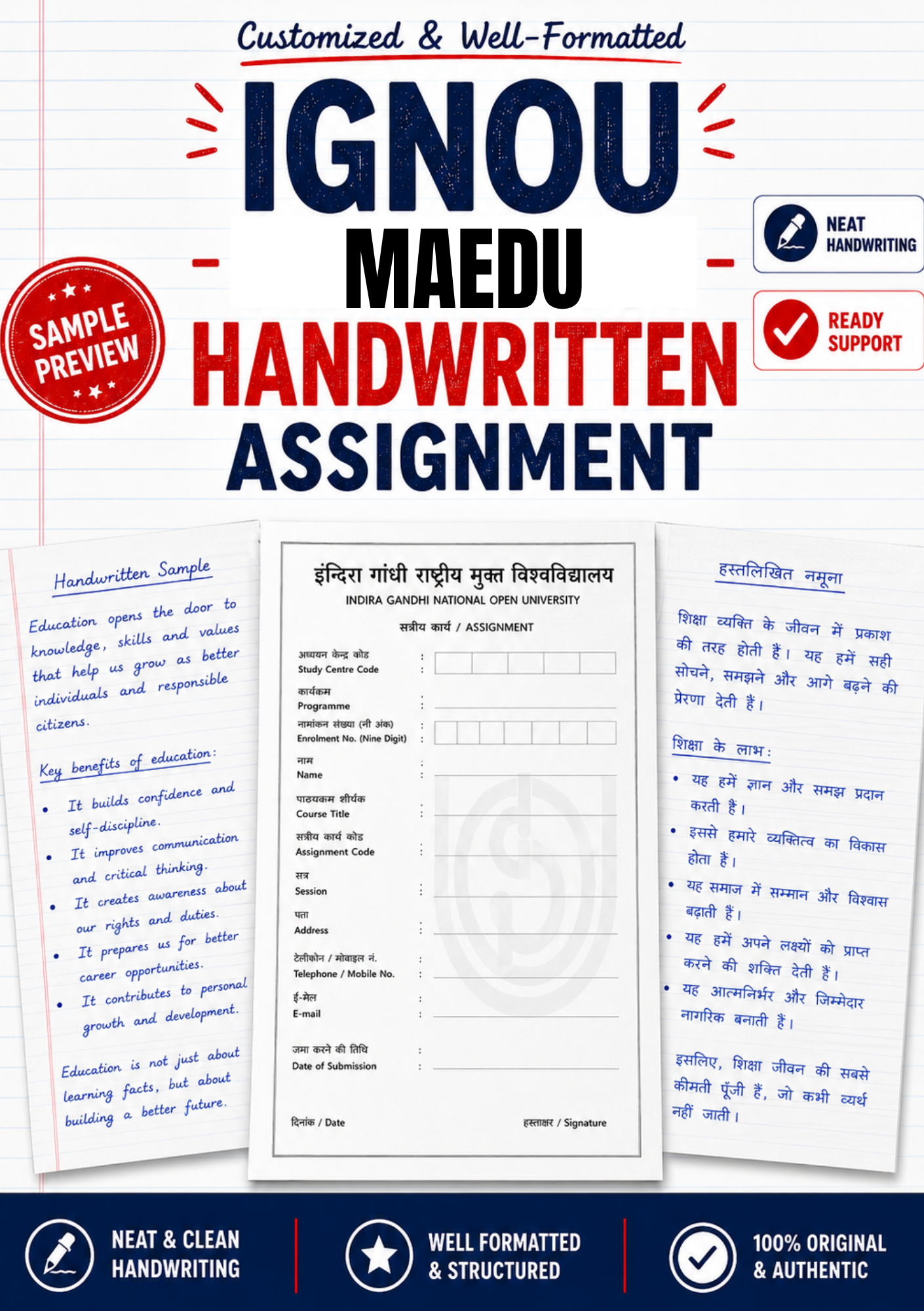
A MAEDU order arrives as paper, not as a download link. For each course code you name, the bundle contains the full set of answers written out by hand on plain A4 sheets in blue ink, an IGNOU-format cover sheet for that course left blank where your enrolment number, name, signature and study-centre code belong, and a printed copy of the official MES or MAE question paper the answers were written against, so you can check answer against question before you sign anything.
Because a MAEDU paper poses three questions of roughly 500 words each, one course code produces a substantially thicker bundle than a four-credit paper from a management programme. A learner ordering the whole of year one is asking for eighteen long-form answers across MES 011, MES 012, MES 013, MES 014, MES 015 and MES 016. A second-year learner ordering a full specialised area is asking for twelve, or fifteen if the Distance Education stream applies, since that stream carries five courses where the other four carry four.
Two things are deliberately absent. No soft copy or PDF is sold, so there is no file to download and nothing to print. And nothing arrives pre-signed: the declaration line on the cover sheet stays empty, because that signature is yours to give after you have read what is inside.
Where the ₹320 Rate Starts and Where It Stops
One MAEDU course code, written out in full, costs ₹320. That single figure already contains the writing, the paper and stationery, the IGNOU-format front page, the copy of the question paper, and the courier to your address. There is no minimum order: one subject or fourteen, same rate. A learner who only needs MES 016 written because the other five are already done pays exactly the same per-code rate as a learner clearing an entire specialised area.
No soft copy or PDF is sold, so nothing in that ₹320 is a file. The rate does not buy an outcome, and this page will not pretend otherwise. No claim is made about the marks any assignment will receive, about how an evaluator will assess it, or about whether it will be accepted. Assignment evaluation is entirely a matter for IGNOU. Nor does the rate buy a delivery date stated in advance on a web page. Delivery depends on your pin code and is confirmed for your order before you pay. No figure is promised on this page.
Two further things sit outside the rate because MAEDU does not treat them as Tutor Marked Assignments at all. MESP 1, the ten-credit dissertation that completes year two, is project work with its own synopsis and approval route, not an assignment paper, and it is handled separately through the MESP 1 dissertation and report service for MA Education. Term-end examination preparation is likewise a different product line.
Reference File or Written Set: Telling the Two MAEDU Options Apart
Two very different things circulate under similar names, and MAEDU learners lose time to the confusion every session. A solved assignment is a soft-copy reference file of model answers for a course code and session, read on a phone or laptop and used as raw material for writing your own. A handwritten assignment is the answers written out by hand on A4 and submitted in hard copy at the study centre. One is something you read from. The other is the thing you hand over.
| Point of difference | Solved assignment for MAEDU | Handwritten assignment for MAEDU |
|---|---|---|
| Format | Soft copy, read on screen | Hard copy, hand-written A4 sheets |
| What you do with it | Read the model answer for MES 013 or MES 042, then write your own version in your own words | Check it against the question paper, fill in the cover sheet, submit it |
| Who it suits | A learner with time to write and who wants the concepts modelled first | A learner short on time, or with eighteen year-one answers still outstanding |
| Handwriting | Not applicable | Matched to a sample page you send |
| Price line on this store | Priced separately in the MAEDU solved-assignment section | ₹320 per subject, courier included |
Scroll the table sideways on a narrow screen to see all three columns.
The honest scope line matters here: a solved assignment is a reference to write from, not a submission. A downloaded PDF cannot be handed in at the study centre, and printing one does not convert it into a submission either. The MAEDU booklet is explicit about the physical route. The Jan and July 2025 papers for both years carry the same instruction, that Assignment Responses may be submitted by hand or sent by registered post to the Programme-in-Charge of your Programme Study Centre, and they add that you should retain a copy of all the assignments in your own interest. Hand-delivery or registered post both assume something physical exists.
If a reference file is what you actually want, go straight to the right shelf rather than ordering here: the MAEDU solved-assignment section holds the course-wise MES and MAE reference files. This page sells the written bundle only.
Have your MAEDU codes handy? That is all the ordering takes.
The rate is ₹320 per subject, hard copy only, with courier included in that price and no separate shipping charge. One code or the whole year, the rate does not move. Message the codes and your admission session and the matched-handwriting sample comes back before any payment.
The Six First-Year MES Codes Nobody in MAEDU Can Skip
MAEDU carries 68 credits in total and the Common Prospectus for July 2026 expects 34 of them each year. Year one has no choices in it whatsoever. All six courses below are compulsory for every MAEDU learner regardless of which specialised area is chosen later, and they add up to exactly the 34 credits the prospectus states, which is a check worth doing rather than assuming.
| Course code | Official title | Credits | Prospectus group |
|---|---|---|---|
| MES 011 | Understanding Education | 4 | Group A, Basic Course on Education |
| MES 012 | Education: Nature and Purposes | 6 | Group B, Core Courses |
| MES 013 | Learning, Learner and Development | 6 | Group B, Core Courses |
| MES 014 | Societal Context of Education | 6 | Group B, Core Courses |
| MES 015 | Operational Dimensions of Education | 6 | Group B, Core Courses |
| MES 016 | Educational Research | 6 | Group C, Knowledge Generation in Education |
Scroll the table sideways on a narrow screen to see the credits and group columns.
Group C also contains MESP 1, the ten-credit dissertation, which is why year two adds up to 34 as well: 24 credits of specialised-area courses plus the ten-credit dissertation. Read the prospectus body and it prints these codes without the leading zero, as MES 11 through MES 16. Read the live paper on the assignment portal and the same six courses are headed MES-011 through MES-016. They are the same courses under two renderings of one code, not two different course sets.
Choosing One of Five Specialised Areas, and the Codes Inside Each
Year two is where MAEDU stops being one programme and becomes five. Under Group D you complete four or five courses worth 24 credits inside a single specialised area, and the five areas on offer are Higher Education, Distance Education, Educational Technology, Educational Management and Adult Education. Each area totals 24 credits, so no stream is lighter than another, but Distance Education reaches that total across five courses where the other four reach it across four.
| Specialised area | Codes on the live paper | Official titles | Credits |
|---|---|---|---|
| Higher Education | MES 101, MES 102, MES 103, MES 104 | Higher Education: Its Context and Linkages; Instruction in Higher Education; Higher Education: The Psycho-social Context; Planning and Management of Higher Education | 6 each, 24 total |
| Distance Education (Revised) | MES 211, MES 212, MES 213, MES 214, MES 215 | Growth and Philosophy of Distance Education; Instructional Design; Learner Support Systems and Services; Management of Distance Education; Educational Communication Technologies | 4, 4, 4, 6, 6, 24 total |
| Distance Education (Unrevised) | MES 111, MES 112, MES 113, MES 114, MES 115 | Growth and Philosophy of Distance Education; Design and Development of Self-Learning Print Materials; Learner Support Services; Management of Distance Education; Communication Technology for Distance Education | 4, 4, 4, 6, 6, 24 total |
| Educational Technology (Revised) | MES 131, MES 132, MES 133, MES 134 | Educational Technology: An Overview; Computer in Education; Selection and Integration of Technology in Educational Processes; Design, Development and Delivery of Courseware | 6 each, 24 total |
| Educational Technology (Unrevised) | MES 031, MES 032, MES 033, MES 034 | ET: An Overview; Communication and Information Technology; Computer Technology; Designing Courseware | 6 each, 24 total |
| Educational Management | MES 041, MES 042, MES 043, MES 044 | Growth and Development of Educational Management; Dimensions of Educational Management; Organizational Behaviour; Institutional Management | 6 each, 24 total |
| Adult Education | MAE 001, MAE 002, MAE 003, MAE 004 | Understanding Adult Education; Policy Planning and Implementation of Adult Education in India; Knowledge Management, Information Dissemination and Networking in Adult Education; Extension Education and Development | 6 each, 24 total |
Scroll the table sideways on a narrow screen to read the titles and credit columns.
Revised or Unrevised: Which Distance Education Set Is Yours
Two of the five streams are printed twice on the same live paper, once as Revised and once as Unrevised, and this is the single most common source of MAEDU second-year confusion. It is not an error and it is not a duplicate. IGNOU is still evaluating learners on both syllabus versions, so both question sets sit inside one booklet under headings that read, word for word, SPECIALIZED AREA: DISTANCE EDUCATION (REVISED) and SPECIALIZED AREA: DISTANCE EDUCATION (UNREVISED).
The distinction is not cosmetic renumbering. MES 212 in the Revised set is Instructional Design; MES 112 in the Unrevised set is Design and Development of Self-Learning Print Materials. Those are different courses asking different questions. The same holds for the Educational Technology pair, where MES 132 is Computer in Education and MES 032 is Computer Technology. Nothing on the page tells you which one applies to you. Your admission record and study material do, and the code printed on your own booklet is the only reliable answer. When you order, quote the code exactly as your record shows it and the matching version is written.
Which Diploma Blocks Which Stream
MAEDU carries a restriction that most master’s programmes do not. If you already hold a Diploma or Post-Graduate Diploma in one of the five specialisation areas, you are required to choose your specialised area from the remaining ones. The prospectus gives its own worked example: a learner holding a PG Diploma in Educational Technology must choose from Distance Education, Higher Education, Educational Management or Adult Education instead.
In practice that maps the diploma you already finished onto the stream now closed to you. A learner who came through the PGDET route in educational technology cannot take the MES 131 or MES 031 sets. A learner holding the higher-education diploma known as PGDHE loses the MES 101 stream, and one holding the educational management and administration diploma, PGDEMA loses the MES 041 stream. This is worth settling before ordering, because a full stream is twelve to fifteen written answers and re-picking after the fact is expensive in time.
Where IGNOU’s Own MAEDU Papers Contradict Each Other
Reading the Common Prospectus for July 2026 against the live MAEDU papers on IGNOU’s own assignment portal turns up several places where the university’s documents disagree with each other. None of these are reasons to panic, but all of them are reasons to work from the code printed on your own record rather than from any single document, including this one.
Disagreements found between IGNOU’s own MAEDU documents, and one found on this store.
1. The same prospectus prints two different code sets for the same streams. Section 3.33 lists Distance Education as MES 211 to MES 215 and Educational Technology as MES 131 to MES 134. Annexure I(a) of the same prospectus, listing MAEDU elective streams, prints those two streams as MES111 to MES115 and MES31 to MES34. The live second-year paper resolves it: both sets exist, one labelled Revised and one Unrevised, and a learner sits on one or the other.
2. Course codes are rendered three different ways across IGNOU’s own documents. The prospectus body prints MES 11, MES 41 and MAE 1. Annexure I(a) prints MES101, MES41 and MAE1 with no space at all. The live paper prints MES-011, MES-041 and MAE-001 with a leading zero. Even inside one booklet the styling shifts between MES 103, MES-104 and MES 131 with a colon.
3. The prospectus states the medium of instruction for MAEDU is English. IGNOU’s own MAEDU assignment index nonetheless publishes a Hindi booklet alongside the English one for every session listed, first year and second year alike.
4. On that same index page, the July 2024 second-year row has its two links crossed: the link labelled English opens a file named for the Hindi medium, and the link labelled Hindi opens the file named English Medium.
5. The programme index has not kept pace with the papers. It lists January and July 2025 as the most recent MAEDU session, while a January and July 2026 second-year paper for MES 102 is already live under IGNOU’s School of Education file path.
6. Typographic errors sit in the source documents themselves. The prospectus spells the MES 133 title as Selection and Intergration of Technology in Educational Processes, where the live paper spells it Integration. The 2025 second-year booklet heads MAE 002 as Policy Palnning and Implemenation of Adult Education in India.
7. In-house, and disclosed here rather than hidden: shrichakradhar.com’s own MAEDU book, solved-assignment and previous-paper category pages currently carry a claim that a minimum of 60 to 80 per cent of exam questions will come from the guide books. That is a performance claim this publisher cannot substantiate and it is queued for removal. Legacy pages elsewhere on the store also quote delivery windows and per-subject rates that do not match the ₹320 courier-included rate stated here.
Why Your MAEDU Paper Carries No Printed Cut-Off
Most IGNOU programmes print two submission dates on the front of the assignment booklet, one for the January intake and one for July. MAEDU does not. The January and July 2025 first-year paper opens with the programme name, the School of Education line, and two notes: that Assignment Responses may be submitted by hand or sent by registered post to the Programme-in-Charge of your Programme Study Centre, and that you should retain a copy in your own interest. The second-year paper of the same session adds only a third note, advising you to select assignments from the specialised area you opted for. Neither prints a date. Neither prints a mark split. Neither prints a Tutor Marked Assignment reference code of the kind other schools use.
The January and July 2026 second-year paper for MES 102 goes further and drops the notes block entirely, leaving the programme heading and the three questions.
What this means practically is that the MAEDU cut-off is not a property of your paper, it is a property of the term-end examination cycle you are submitting against, set by university-wide notification and revised more than once in recent cycles. IGNOU’s own announcements for the June 2026 term-end examination show the assignment submission date being extended to 30 April 2026 and then extended again. Third-party sites circulate 30 September, 31 March, 31 May, 31 October and 16 August for the same period, which is exactly what happens when a figure is copied rather than sourced.
So this page states no MAEDU deadline as fact, because IGNOU’s MAEDU paper does not state one. Confirm the current date for your enrolment with your Regional Centre or on ignou.ac.in, and treat the term-end examination you intend to sit as the real anchor. Programme structures, course codes, submission dates and rules change, and only ignou.ac.in and your Regional Centre can confirm the current position for your enrolment.
What the MAEDU Assignment Heading Actually Tells You
Without a TMA reference code to read, the heading block at the top of the MAEDU paper is the thing that identifies which paper you are holding. It runs to four lines and each one carries information you need before ordering.
- Indira Gandhi National Open University, School of Education. The school matters because submission rules, and the absence of a printed date, are set at school level rather than centrally.
- Master of Arts (Education) – MAEDU. The programme code, not the course code. MAEDU is what you are enrolled in; MES 013 is what you are writing.
- First Year or Second Year. MAEDU issues one paper per year of the programme rather than one per course, so this line decides whether you are looking at the MES 011 to MES 016 block or at all seven specialised-area blocks at once.
- Assignments, January and July, followed by the year. One paper serves both admission cycles. A January and July 2026 paper is valid for a learner admitted in either cycle of that year, which is why the medium and the year matter more than the intake month when you place an order.
Below the heading, every course block opens with the same instruction: answer the following questions in about 500 words each. Three questions follow. There is no per-question mark split printed, and none is invented here. Some MAEDU questions are not essays at all: MES 013 asks you to pick a school textbook in your own subject and write a report analysing its objectives, difficulty level and treatment of local knowledge, and MES 016 asks you to prepare a research proposal on a problem you choose. Those are written to your own choice of material, which is a detail worth flagging when you order so the answer is built around a subject you can defend.
Your Own Handwriting, Copied From a Photo You Send
A MAEDU set can run past a hundred pages once six courses at three long answers each are written out. Handing in a hundred pages in a hand that looks nothing like yours is a poor idea, and the fix is straightforward. Send a photo of a page you have written yourself and the handwritten set is matched to your handwriting at no extra charge.
Sending the Handwriting Sample
A single page is enough. Write out any paragraph you like, in the language you will be submitting in, on ruled or plain paper, and photograph it flat in daylight so the letter shapes are legible. Slant, letter spacing, capital forms and the general weight of the hand are what get matched. A page you wrote quickly is more useful than a page you wrote carefully, because the finished MAEDU bundle should look like a hundred pages written under time pressure, which is what a genuine one looks like.
The matched sample comes back to you before payment, so you can see the hand before you commit to it. If it is wrong, say so and it is redone. Nothing is paid until the sample is approved.
English, Hindi, Old Sessions and Carried-Over Codes
The MAEDU medium question has a slightly odd answer, and it is worth stating precisely because the prospectus and the assignment portal appear to disagree. The Common Prospectus lists English as the medium of instruction for MAEDU. IGNOU’s own MAEDU assignment index nonetheless carries a Hindi booklet next to the English one for every session it lists, both years. Practically, MAEDU learners write in Hindi as well as English, and the service covers all mediums IGNOU issues the TMA paper in, at the same price.
Sessions work the same way. Any session is accepted, current cycle or older, including backlog courses, at the same ₹320 per subject. This matters more in MAEDU than in most programmes for two reasons. First, the maximum duration is four years against a minimum of two, so a learner clearing year-one codes alongside year-two ones is completely normal here. Second, MAEDU questions are genuinely replaced between cycles rather than lightly edited: the 2025 MES 102 paper asked about instructional systems, ineffective lectures and evaluation tools, while the 2026 MES 102 paper asks about teacher competence, preparing an undergraduate question paper and building a lesson plan. A set written against the wrong year is not a near miss, it answers different questions. Name the session as well as the code when you order.
The Five Things to Message, and Nothing Beyond That
Ordering does not need a form, an account or a document upload. Five pieces of information settle a MAEDU order completely.
- Your course codes. MES 011 through MES 016 for year one, or the specific specialised-area codes for year two. If your stream is Distance Education or Educational Technology, quote the code exactly as printed on your own booklet so the Revised and Unrevised versions are not mixed up.
- Your admission session and year. January or July, and the year, so the correct paper is used rather than the previous cycle’s.
- Your medium. English or Hindi.
- A photo of a page in your handwriting. One page, photographed flat.
- Your delivery pin code. This is what the courier timeline is confirmed against before you pay.
Nothing else is needed. No enrolment number, no identity document, no advance. Your enrolment number stays in your hands and goes onto the cover sheet in your own writing on the day you submit.
Send the five details and the sample comes back first.
Both years and all five specialised areas are covered, English or Hindi, at ₹320 per code with the courier already inside that figure. Delivery depends on your pin code and is confirmed for your order before you pay. No figure is promised on this page.
Once the MAEDU Bundle Is in Your Hands
Open the packet and check the bundle against the question paper included with it, course by course. Confirm that each answer is answering the question printed for that code, that the codes match your own record, and that the year on the heading is the year you intended.
Then fill in the cover sheet for each course in your own hand: enrolment number, name, address, programme code MAEDU, course code, study centre code, and the date. Sign the declaration only after you have read the answers. You sign the declaration on the assignment cover page, so you should read and review the content before submitting it, and satisfy yourself that it represents your own understanding of the course.
Submission follows what the MAEDU paper itself specifies, which is hand delivery or registered post to the Programme-in-Charge at your Programme Study Centre. Take the acknowledgement and keep it. The booklet’s own advice, that you should retain a copy in your own interest, is worth acting on: photograph the pages before they leave your hands, because if marks fail to appear on the grade card months later, the acknowledgement and your own copy are what the conversation with the Regional Centre will run on.
What Else MAEDU Learners Pick Up in the Same Order
The written bundle rarely travels alone. Learners clearing year one usually pair it with the MA Education help books and unit-wise study guides, because a MES 016 research-proposal question is much easier to argue about once the research methods block has been read in summary. Closer to the term-end examination, the MA Education solved guess papers built code by code and the previous-year MAEDU question papers with worked solutions tend to go out together, because assignments carry 30 per cent of the final course result and the term-end examination carries the remaining 70 per cent.
Second-year learners in specific streams often need neighbouring material. The Distance Education stream sits close enough to IGNOU’s MA in Distance Education that the MADE study material on distance-education theory is frequently useful for MES 211 and MES 111 work, and the Adult Education stream overlaps with the MA Adult Education titles covering the same MAE course numbers. Learners enrolled in a programme with no dedicated page yet can use the open handwritten order for any programme and any session, and the full handwritten assignment section listing every programme covered is the place to start if you are ordering for more than one degree in a household.
Doubts MAEDU Learners Raise Before Placing an Order
My second-year booklet shows two Distance Education sets. Which one do I order?
Order the one whose codes match your own admission record and study material. IGNOU prints both because both syllabus versions are still being evaluated: the Revised set is MES 211 to MES 215 and the Unrevised set is MES 111 to MES 115. They are not interchangeable, since MES 212 is Instructional Design while MES 112 is Design and Development of Self-Learning Print Materials. Send the code as your record prints it and the matching version is written.
Why does my MAEDU paper not print a last date anywhere on it?
Because the School of Education issues the MAEDU paper without one. The January and July 2025 papers for both years print only the submission route and the advice to keep a copy, and the January and July 2026 second-year paper prints neither. The date for your enrolment comes from the university-wide term-end examination notification and from your Regional Centre, not from the booklet, and it has been extended more than once in recent cycles.
Can I download a MAEDU solved assignment and hand that in instead?
No. A solved assignment is a soft-copy reference file of model answers, meant to be read and written from. The MAEDU paper specifies hand delivery or registered post of Assignment Responses to your Programme Study Centre, which assumes a physical set. Printing a downloaded file does not make it a submission either, since the submission is expected in your own hand.
What is the actual difference between the MAEDU solved assignment and this handwritten set?
Format and purpose. The solved assignment is a file you read from to write your own answers; the handwritten set is the completed answers on A4, in a hand matched to yours, with the front page and question paper attached, ready to submit. They are priced and sold separately. This page sells only the second one.
How many answers am I actually ordering if I take the whole of year one?
Eighteen. MAEDU issues three questions per course at roughly 500 words each, across MES 011, MES 012, MES 013, MES 014, MES 015 and MES 016. A full second-year specialised area is twelve answers, or fifteen if your stream is Distance Education, which carries five courses rather than four.
I hold a PG Diploma in Educational Technology. Does that change what I can order?
It changes what you are allowed to study, which in turn changes what there is to order. MAEDU requires a learner who already holds a Diploma or PG Diploma in one of the five specialisation areas to choose from the remaining ones, and the prospectus uses the educational technology diploma as its own example. Settle the stream with your Regional Centre first, then order the codes for whichever area is open to you.
Is the MAEDU paper available in Hindi, given the prospectus says English?
Yes. The Common Prospectus lists English as the MAEDU medium of instruction, but IGNOU’s own MAEDU assignment index publishes a Hindi booklet alongside the English one for every session it lists, in both years. The service covers all mediums IGNOU issues the TMA paper in, at the same price.
MESP 1 is on my record. Is the dissertation part of this order?
No. MESP 1 is the ten-credit dissertation in Group C and it is project work with its own synopsis, approval and report stages rather than a Tutor Marked Assignment. It is not written as part of an assignment order and is handled through the separate MA Education dissertation service.
My session is three years old and I still have MES codes pending. Is that a problem?
No. Any session is accepted, current cycle or older, including backlog courses, at the same ₹320 per subject. MAEDU allows four years against a two-year minimum, so learners clearing older codes alongside current ones are ordinary here. Name the session with the code so the correct year’s paper is used, because MAEDU questions are genuinely replaced between cycles.
Can I order only two codes rather than a full year?
Yes. There is no minimum order: one subject or fourteen, same rate. Learners frequently order two or three codes to close a gap left from an earlier cycle and write the rest themselves.
Do I have to pay before I see the handwriting?
No. Send a photo of a page you have written yourself and the handwritten set is matched to your handwriting at no extra charge. The matched sample is sent back on WhatsApp and nothing is paid until you approve it. If the match is off, it is redone before any money changes hands.
Will the packet include a PDF copy for my records?
No. No soft copy or PDF is sold. What arrives is the written set on A4, the IGNOU-format front page for each course and a printed copy of the MES or MAE question paper. If you want a record, photograph the pages yourself before submitting, which the booklet advises in any case.
How much does the assignment actually count towards my MAEDU result?
Assignments carry 30 per cent of the final course result and the term-end examination carries the remaining 70 per cent. Submission is also the gate for sitting that examination in the course concerned, so an unwritten MES paper costs more than its 30 per cent.
MES 013 asks me to analyse a textbook I choose. How is that handled?
By asking you first. Several MAEDU questions are built around material you select, including the MES 013 textbook analysis and the MES 016 research proposal. Name the subject and level you want used when you place the order, so the answer is written around something you can discuss if asked.
Can you promise the assignment will be accepted or scored well?
No, and no such promise is made anywhere on this page. No claim is made about the marks any assignment will receive, about how an evaluator will assess it, or about whether it will be accepted. Assignment evaluation is entirely a matter for IGNOU.
Where Every Line on This Page Came From
Important Notice
Shri Chakradhar Publication Pvt. Ltd. and shrichakradhar.com form an independent IGNOU study-support publisher. This is not the official website of Indira Gandhi National Open University, is not affiliated with, endorsed by or authorised by the university, and no page on this site should be treated as an official IGNOU communication.
Programme structures, course codes, submission dates and rules change, and only ignou.ac.in and your Regional Centre can confirm the current position for your enrolment.
You sign the declaration on the assignment cover page, so you should read and review the content before submitting it, and satisfy yourself that it represents your own understanding of the course.
No claim is made about the marks any assignment will receive, about how an evaluator will assess it, or about whether it will be accepted. Assignment evaluation is entirely a matter for IGNOU.
Order Your MES and MAE Codes
First year, second year, all five specialised areas, both the Revised and the Unrevised sets, English or Hindi. The rate is ₹320 per subject, hard copy only, with courier included in that price and no separate shipping charge. Any session is accepted, current cycle or older, including backlog courses, at the same ₹320 per subject.
Delivery depends on your pin code and is confirmed for your order before you pay. No figure is promised on this page.