

Description
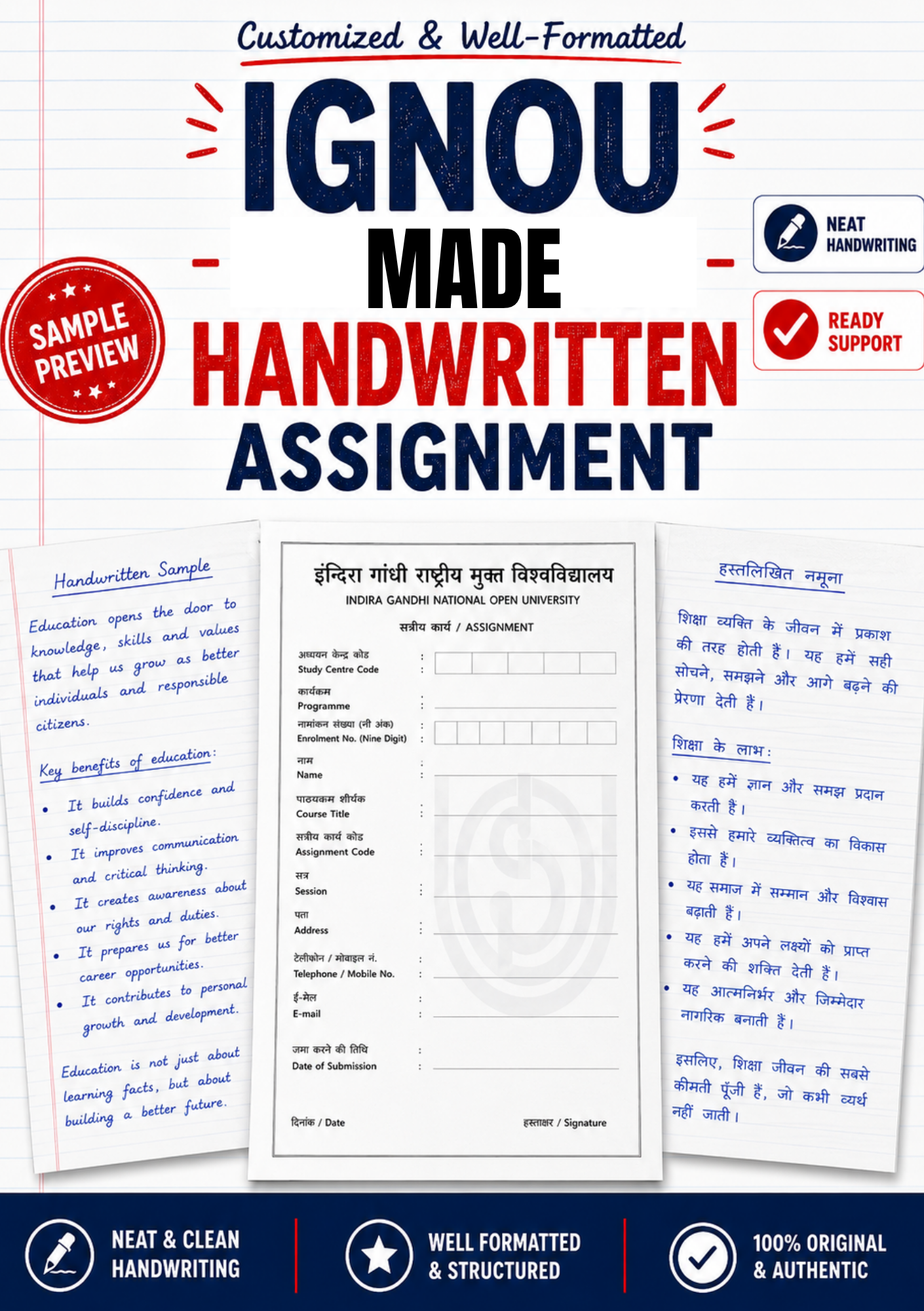
In short. This product is a handwritten set of IGNOU MADE tutor marked assignments, written out by hand on A4 and couriered to you as a physical packet, covering the nine MDE course codes that the Staff Training and Research Institute of Distance Education issues assignment papers for: MDE 411, MDE 412, MDE 413, MDE 414 and MDE 518 in year one, and MDE 415, MDE 416, MDE 417 and MDE 419 in year two, with MDEP 520 handled as project work rather than a written assignment. The rate is ₹320 per subject, hard copy only, with courier included in that price and no separate shipping charge. Any session is accepted, current cycle or older, including backlog courses, at the same ₹320 per subject. Every MADE assignment paper published by STRIDE asks for two answers of roughly 800 words and three of 250 to 300 words, so nine codes is a substantial quantity of longhand; Shri Chakradhar Publication writes that longhand, matched to a sample of your own handwriting sent by photo, and includes an IGNOU-format front page and a copy of your official MDE question paper in the same packet. Delivery depends on your pin code and is confirmed for your order before you pay. No figure is promised on this page.
What Lands on Your Desk When the MADE Packet Arrives
A MADE order is a physical object, not a download, and it helps to know exactly what is inside the envelope before you place one. Shri Chakradhar Publication ships four things for every course code you order, and nothing that has to be printed at your end.
The first is the written answer set itself: your MDE answers on A4 sheets, in a single consistent hand, numbered continuously in the sequence the booklet prints them. The MADE booklet asks in instruction 6 that each answer starts on a new page and that longer answers carry an introduction, sub-titles through the main body, and a conclusion, so the sets are laid out that way rather than as unbroken blocks of text.
The second is the IGNOU-format front page, prepared with your programme code, course code, enrolment number, study centre and session already entered. Instruction 1 on the MADE paper is specific about this: programme code, course code, name, address, mobile number, email and study centre code go on the first page of each assignment, in capital letters. The cover sheet is free with every order and you sign it yourself on the day you submit.
The third is a printed copy of the official MDE question paper the set answers, taken from the STRIDE directory on ignou.ac.in for the intake you name. That copy exists so a coordinator can check the answers against the paper without you fetching anything, and so you can see for yourself which session’s questions you are holding.
The fourth is the packing that keeps all of it flat and dry in transit, which is included in the rate rather than added at checkout. No soft copy or PDF is sold. There is nothing to open on a phone and nothing to print, because a printed file cannot satisfy instruction 9 on your own booklet, which states plainly that assignments should be handwritten.
Everything Folded Into ₹320, and the Three Things That Are Not
The rate is ₹320 per subject, hard copy only, with courier included in that price and no separate shipping charge. For a MADE learner that means a single first-year code costs ₹320 and the full five-code first year costs five times that, with no bundling premium and no bundling discount either. There is no minimum order: one subject or fourteen, same rate.
Inside the rate sit the writing itself, the handwriting match, the front page, the question paper copy, the packing and the courier. Send a photo of a page you have written yourself and the handwritten set is matched to your handwriting at no extra charge. That matching is not an upsell tier here; it is the default, and you approve the sample before money changes hands.
Three things are outside the rate, and stating them plainly is more useful than a longer list of inclusions. The first is your submission. Nobody from this publisher goes to your study centre, and instruction 11 on the MDE booklet gives you two routes, deposit at your study centre or post to the Director, STRIDE, Block 16, IGNOU, Maidan Garhi, New Delhi 110068. Choosing between them is your call and your Regional Centre’s instruction, not a service this product covers.
The second is any statement about your result. No claim is made about the marks any assignment will receive, about how an evaluator will assess it, or about whether it will be accepted. Assignment evaluation is entirely a matter for IGNOU. The MADE booklet sets its own minimum standards, a D grade in continuous evaluation for each assignment, a C grade in the term-end examination for each course, and a final combined grade of at least C, and none of those thresholds are within any publisher’s gift.
The third is your project. MDEP 520 is eight credits of project work rather than a tutor marked assignment, and the second-year MADE assignment booklet for the January and July 2025 sessions does not carry a MDEP 520 paper on its cover at all. Project work is a separate piece of study support entirely, and MADE learners who need it are pointed at the bound MADE project reports prepared for STRIDE submission rather than being sold a handwritten assignment that cannot stand in for one.
Reference File or Written Set: Telling the Two MADE Products Apart
Two different things are sold under names that sound almost identical, and MADE learners lose money on the confusion every cycle. Defining both once, in plain terms, prevents that.
A solved assignment is a soft-copy reference file of model answers for a course code and session. You download it, read it, and write your own answers from it. A handwritten assignment is the answers written out by hand on A4 and submitted in hard copy at the study centre. One is study material; the other is the thing you actually hand in.
| Point of difference | MADE solved assignment | MADE handwritten assignment |
|---|---|---|
| Format | Soft copy, a PDF you download | Hard copy, written by hand on A4 and couriered |
| What you do with it | Read it, then write your own MDE answers from it | Check it, sign the cover page, submit it |
| Who it suits | Learners who want to write their own answers but need the model first | Learners short of writing time across nine MDE papers |
| Handwriting | Not applicable, the file is typeset | Matched to a photo of your own handwriting, free |
| Rate on this store | Priced separately in the MADE solved-assignment category | ₹320 per subject, courier included |
| Can it be submitted as it stands | No, it is a reference to write from | Yes, it is prepared as a submission-ready set |
Scroll the table sideways on a narrow screen to see every column.
The honest scoping matters here. A downloaded solved assignment is a reference you write from; it is not a submission. Printing one out and handing it in is not what it is for, and IGNOU’s own instruction on your MDE paper closes the question: instruction 9 says assignments should be handwritten, and instruction 7 asks that answers be specific, in your own words, and not copied directly from the printed self learning material. A reference file used as a reference is consistent with both of those. A reference file printed and submitted is not.
If what you actually want is the reference file rather than the written set, this page is not where you should buy it. The store’s MADE solved assignment files, listed course code by course code, are the right destination, and they are cheaper because they are a different product doing a different job.
Nine MDE papers, one hand, one packet.
₹320 per subject, hard copy, courier included in that price. Send the MDE course codes you are registered for, your intake month and year, and a photo of a page in your own handwriting.
Message the MADE desk on WhatsApp or call +91 93546 37830.
The Five First-Year MDE Codes STRIDE Issues Papers For
MADE is a 64-credit programme run by the Staff Training and Research Institute of Distance Education, and its first year is 32 of those credits across five courses. The titles and credit weights below are read off the Common Prospectus July 2026, with one caveat about how they had to be read that is set out further down this page.
| Course code | Official title | Credits | Assignment paper issued |
|---|---|---|---|
| MDE 411 | Growth and Philosophy of Distance Education | 6 | Yes |
| MDE 412 | Instructional Design | 6 | Yes |
| MDE 413 | Learner Support Systems and Services | 6 | Yes |
| MDE 414 | Management of Distance Education | 6 | Yes |
| MDE 518 | Educational Communication Technologies | 8 | Yes |
| First-year total | 32 | ||
Scroll the table sideways on a narrow screen to see every column.
Two features of that table are worth pausing on because they surprise learners. MDE 518 is the only first-year course carrying eight credits rather than six, and it sits out of numerical sequence between MDE 414 and the second-year block. Its numbering is a leftover from a revision: the same title, Educational Communication Technologies, previously ran as MDE 418 at six credits, and MDE 418 study material is still published on IGNOU’s own eGyanKosh repository under the STRIDE imprint. If your admission record or an older reading list shows MDE 418 rather than MDE 518, that is a version difference and not a typing error, and it is worth confirming with your Regional Centre which of the two your enrolment is registered against before ordering.
The second is that these same five codes are the entire PGDDE programme. A Post Graduate Diploma in Distance Education learner and a MADE first-year learner sit the same five papers. That is why lateral entry into MADE year two exists for PGDDE holders at all, and it is also why the assignment files for these codes carry two different programme brandings on the STRIDE server, which is dealt with in its own section below. Learners who hold the diploma and are moving up can order against either code list; nothing about the writing changes. The store’s PGDDE guide books for the same five MDE courses serve both groups for the same reason.
Second-Year MDE Papers and the MDEP 520 Project Course
Year two is the other 32 credits, and it is where MADE stops overlapping with the diploma. Four courses carry written assignments; the fifth is project work.
| Course code | Official title | Credits | Assignment paper issued |
|---|---|---|---|
| MDE 415 | Research Methods for Distance Education | 6 | Yes |
| MDE 416 | Curriculum Development in Distance Education | 6 | Yes |
| MDE 417 | Distance Education: Economic Perspective | 6 | Yes |
| MDE 419 | Staff Training and Development in Distance Education | 6 | Yes |
| MDEP 520 | Project Work | 8 | No, project work |
| Second-year total | 32 | ||
| MDE 521 | Technology and Resources for Teaching Learning Process (bridge course, only for learners enrolled before July 2020) | 2 | Confirm with STRIDE |
Scroll the table sideways on a narrow screen to see every column.
Add the two years and the arithmetic closes: 32 plus 32 is 64, which is the total the prospectus itself states for the revised MADE structure. That check matters more than it looks, because the prospectus note records that MADE moved from 60 credits to 64 credits with effect from July 2020, and a table that summed to 60 would mean you were reading a pre-revision list.
Two codes in that table need explaining rather than just listing. MDEP 520 carries a different prefix from every other course in the programme, MDEP rather than MDE, and that prefix is the signal that it is project work assessed on a submitted report rather than on a tutor marked assignment. The second-year assignment booklet for the January and July 2025 sessions lists only MDE 415, MDE 416, MDE 417 and MDE 419 on its cover; an older second-year booklet for the July 2020 session listed the same four codes and then added instructions for the MDEP 520 project proposal alongside them. If your cycle’s booklet carries no MDEP 520 material, that is not an omission you should work around, it is a signal to ask STRIDE for the current project handbook.
MDE 521 is a two-credit bridge course and it is not part of anybody’s 64 credits. The prospectus restricts it to learners who finished first-year MADE or PGDDE before July 2020 and are re-registering into year two by lateral entry, in order to reach equivalence with the revised structure. If you fall in that group, it is worth naming MDE 521 explicitly when you send your codes, because whether a written assignment is issued for it in your cycle is a question for the programme coordinators rather than something to assume in either direction. Learners studying the same subject in the online mode should check their code list against the MADEOL study materials for the online-mode version of this programme, since the mode is listed separately by IGNOU.
Four Places IGNOU’s Own MADE Paperwork Contradicts Itself
Everything above was assembled by reading IGNOU’s Common Prospectus against three live assignment booklets from the STRIDE directory on ignou.ac.in. Doing that turns up disagreements. They are printed here rather than smoothed over, because a learner who meets one of them halfway through a cycle is better off having seen it in advance.
Conflicts found while preparing this page. Confirm anything that affects your enrolment with STRIDE or your Regional Centre before acting on it.
1. Assignment weightage: 25 per cent or 30 per cent. Assignments carry 30 per cent of the final course result and the term-end examination carries the remaining 70 per cent. That is the figure IGNOU applies across its programmes and the figure this publisher states everywhere else on this site. Instruction 3 on all three MADE and PGDDE booklets read for this page states instead that the assignments have 25 per cent weightage while calculating the overall grade for each course. The two cannot both describe your MDE grade. STRIDE’s own booklet is the document that governs your papers, so ask the programme coordinators which applies to your cycle.
2. PGDDE credits: 32, 30 or 24. The Common Prospectus July 2026 gives the PGDDE credit total three different ways. Its PGDDE course table totals 32 credits. Its programme-list eligibility entry says lateral entry into MADE is for those who completed PGDDE of 32 credits. The eligibility paragraph in the PGDDE section itself, sitting on the same page as the 32-credit table, says 24 credits. Separately, the MADE note refers to learners who completed first-year MADE or PGDDE having 30 credits before July 2020, which is a legitimate pre-revision figure rather than a fourth error. If you are applying for lateral entry, the number on your own diploma record is what the Student Registration Division will act on.
3. The current first-year paper is branded PGDDE, not MADE. The STRIDE assignments directory carries a file at MDE-411.pdf headed MADE, first year, January 2025 and July 2025 sessions, and a second file at MDE-411-2026.pdf headed PGDDE, January 2026 and July 2026 sessions, for students appearing in the December 2026 and June 2027 term-end examinations. Both list the identical five codes on the cover. The newer, current-cycle file is the PGDDE-branded one. A MADE learner who downloads by programme name rather than by session will answer last cycle’s questions, and the two files ask genuinely different questions: the 2025 MADE paper for MDE 411 asks about educational challenges in India after 1947 and the theory of Borje Holmberg, while the 2026 PGDDE paper for the same code asks about the nomenclature of distance education and the theory of Otto Peters.
4. The PGDDE booklet tells you to write MADE. Instruction 1 in the January and July 2026 PGDDE booklet asks learners to write their programme code as MADE, and its instruction 15 refers to completion of the MADE programme. This appears to be template carry-over from the MADE file rather than guidance for diploma learners. Write the programme code that appears on your own admission record and enrolment, and raise the discrepancy with your Regional Centre if a study centre queries it.
In-house disclosure. Older product pages on this store still carry claims this page does not make, including a marks assurance, a no-rejection claim, delivery windows stated as fixed figures, and two different rates alongside the current ₹320. Those pages are being corrected. Where an older page on this site disagrees with this one on price, delivery or outcomes, this page is the current position and the older page is the error.
Why Your MDE Paper Prints No Last Date At All
This is the section where most programme pages print two cut-off dates. For MADE, printing two dates would be an invention, because the STRIDE booklets do not carry any.
Assignment booklets from other IGNOU schools print their deadlines on the paper itself. A School of Management Studies paper prints 31 October and 30 April. A School of Humanities paper prints 31 March and 30 September. The MADE and PGDDE booklets print neither. Instruction 14 on all three papers read for this page says only that learners should visit the IGNOU website for the last date of submission of the assignments. There is no date on the cover, none in the general instructions, and none beside any individual question.
That is a real finding and not a gap in this research, and it changes what you should do. The date that governs your MDE papers is whatever the current university-wide notification says for your session, published on ignou.ac.in and repeated by your Regional Centre. During the 2026 cycle alone, three different figures circulated widely for the same submission window as the university extended it, which is exactly the situation in which a third-party page quoting a single confident date does more harm than good. Take the date from the IGNOU assignment download service on the university’s own site and from your Regional Centre, and treat anything else, including a date on any commercial page, as hearsay.
Two hard rules on your booklet do not move, though, and they are the ones worth planning around. Instruction 13 states that it is mandatory for all learners to submit assignments before filling up the term-end examination form, which puts your real personal deadline earlier than the published one. And instruction 15 sets the minimum standards for completing a course: a D grade in continuous evaluation for each assignment in each course, a C grade in the term-end examination in each course, and a final combined grade of at least C. Submitting late enough to miss the examination form window costs you the cycle regardless of how the assignment itself is graded.
What to Write on Page One When the Booklet Says MADE and the Cover Says PGDDE
Most IGNOU programmes give you an assignment code to copy onto your cover page, something in the shape of a course code followed by TMA and a session. The MADE and PGDDE booklets do not print one. There is no TMA string anywhere on the three papers read for this page, which means there is nothing for you to transcribe and nothing for anyone to get wrong in transcription.
What the booklets do specify is the identifier block, and instruction 1 lists it in order: programme code, course code in the MDE-xxx form, name, address, mobile number, email ID and study centre code or name, all in capital letters, on the first page of each assignment. Each course code gets its own first page. Nothing is bundled.
The programme code is the only genuinely ambiguous field, because of the template carry-over described above. The rule that resolves it is simple: write the programme code that IGNOU itself has registered you under. A MADE learner writes MADE. A PGDDE learner writes PGDDE, notwithstanding what instruction 1 of the 2026 diploma booklet says, and keeps a note of the discrepancy in case a coordinator queries it. Guessing from the booklet header rather than from your own record is how a set ends up filed against the wrong programme.
One further instruction shapes how the pages look before they leave here. Instruction 2 asks that you write the question before each answer, using the same question number the assignment prints, and maintain the word limit given for each question. Sets prepared by Shri Chakradhar Publication carry the question text above each answer for that reason, and hold to the stated 800-word and 250 to 300-word limits rather than padding past them.
Your Own Hand, Copied From a Photo You Send
Send a photo of a page you have written yourself and the handwritten set is matched to your handwriting at no extra charge. That is the entire mechanism, and it is worth explaining what it does and does not mean.
Matching means a writer studies your letterforms, slant, spacing and general density, and writes your MDE answers in a hand built to resemble yours. The same writer takes every code in one order, so nine papers do not arrive in four different hands. It does not mean a forensic reproduction, and no publisher should claim one. What it means practically is that a set does not look conspicuously unlike the rest of your submission history.
What makes a usable sample photo
A single A4 side of your ordinary handwriting is enough, and ordinary is the operative word: write a paragraph at the speed you would actually write an assignment rather than your best careful hand, because the careful version is not what the rest of your work looks like. Photograph it flat, in daylight, with the whole page in frame and no shadow across the middle. Blue or black ink on plain or lightly ruled paper reproduces best. Send it on WhatsApp with your MDE codes in the same message, and you will see the writer’s match before you are asked to pay for anything.
English Only, Any Intake, Backlogs Included
The service covers all mediums IGNOU issues the TMA paper in, at the same price. For MADE, that set has exactly one member. The Common Prospectus July 2026 lists the medium of instruction for both MADE and PGDDE as English, with no Hindi alternative, and all three STRIDE booklets read for this page are English only. There is no Hindi MDE assignment paper to order, and any page offering you one is describing a document IGNOU does not publish. That single-medium position is unusual among IGNOU master’s programmes and is one of the reasons MADE learners so often land on pages written for a different programme.
Session coverage is broader. Any session is accepted, current cycle or older, including backlog courses, at the same ₹320 per subject. MADE runs on January and July intakes with a minimum duration of two years and a maximum of four, and that four-year window is precisely why backlog orders are routine rather than exceptional: a learner who took admission in a July intake and is clearing a first-year MDE code three years later needs the paper valid for the cycle they are submitting in, not the one they enrolled in. Name your intake and the cycle you are submitting for, and the correct paper is sourced from the STRIDE directory before writing starts. Ask about a backlog cycle at ₹320 per subject if the code you are clearing is older than your current registration.
Programme confusion is the other thing worth clearing up here, because MADE sits next to two programmes with similar names. MADE is Master of Arts in Distance Education, run by STRIDE, and it studies distance education itself as a field. MAEDU is Master of Arts in Education, run by the School of Education, and its codes are MES rather than MDE. If your codes begin MES you are on the wrong page and want the MAEDU assignment material prepared for the MES course codes instead. The distinction is not academic pedantry: ordering against the wrong programme means answering questions from a paper you are not registered for.
The Five Things STRIDE Needs From You Before Writing Starts
Ordering is short, and the list below is complete. Nothing else is required and nothing else should be asked of you.
- Your MDE course codes. Exactly the ones on your admission record, in the MDE-xxx form. Not the year, not the semester, the codes. Electives and backlogs mean two MADE learners in the same intake frequently hold different lists.
- Your intake and the cycle you are submitting for. January or July, and the year. These are two different pieces of information and both matter, because they determine which STRIDE file is the valid paper for you.
- Your programme code as IGNOU has registered it. MADE, MADEOL or PGDDE. This goes on every front page and it is the field the booklet template carry-over makes ambiguous.
- A photo of a page in your own handwriting. One A4 side, written at your normal speed, photographed flat.
- Your enrolment number, study centre and delivery address with pin code. The first two go on the front pages; the third sets the courier route and lets the delivery window be confirmed for your order specifically.
That is the whole list. No file uploads, no account, no advance payment before you have approved the handwriting sample.
First year, second year, or a single backlog code.
₹320 per subject, courier included, no minimum order. Confirm the writer’s sample first, then pay.
Start a MADE order on WhatsApp and send your codes, intake and handwriting photo in one message.
When the Courier Reaches Your Address
Delivery depends on your pin code and is confirmed for your order before you pay. No figure is promised on this page. What is worth setting out is the sequence after the packet lands, because a MADE set has one checking step that other programmes do not.
Open the packet and check the question paper copy first, not the answers. Confirm that the paper enclosed is headed for the session you are submitting in, and that the question numbers on it match the questions written above your answers. Given that MDE 411 carries two live files with different questions on the same STRIDE directory, this thirty-second check is the single most valuable thing you can do on arrival.
Then read the answers. You sign the declaration on the assignment cover page, so you should read and review the content before submitting it, and satisfy yourself that it represents your own understanding of the course. That is not a formality on a MADE paper: instruction 7 asks that answers be specific and in your own words, and a set you have not read is one you cannot honestly declare.
Fill in your name, signature and study centre code on each front page, in your own hand, on the day you submit. Then follow instruction 11: deposit at your study centre or post the set to the Director, STRIDE, Block 16, IGNOU, Maidan Garhi, New Delhi 110068. Whichever route you take, take a photocopy or scan of every page first, because instruction 10 asks you to keep a copy for your own study and record, and because a submission receipt plus a copy is the only evidence you hold if the assignment status page is slow to update.
What MADE Learners Add to the Same Order
Handwritten sets rarely travel alone, and the pairings below are the ones that come up in MADE orders specifically rather than a generic list.
The most common addition is reading material for the codes being written. MADE has no single popular commercial guide, which is why learners working through Growth and Philosophy of Distance Education or Research Methods for Distance Education tend to want the MADE help books written against the MDE syllabus alongside the written set, using the book to follow the answers rather than to replace the self learning material.
Second is examination preparation, which for MADE is where the 70 per cent actually lives. Learners approaching a term-end examination on four second-year papers at once frequently take the MADE guess papers built from previous term-end question papers in the same order, because the assignment and the examination test the same blocks from different angles.
Third is the project, for second-year learners. MDEP 520 is a separate submission on a separate timetable and it is not covered by anything on this page.
Fourth, for diploma learners moving between programmes, the online-mode equivalent of the diploma has its own listing, and PGDDEOL learners should work from the PGDDEOL material for the online-mode distance education diploma rather than the ODL one, since IGNOU maintains them as distinct programmes even where the codes overlap.
Finally, learners carrying codes outside MADE in the same cycle, which is common for anyone re-registering across programmes, can put everything in one packet. The customised handwritten assignment order for mixed code lists exists for exactly that, and the handwritten assignment service across every IGNOU programme lists what else is covered. Same rate, same writer, one courier.
What Learners Ask Before They Send Their MDE Codes
Which MDE codes does one MADE order actually cover?
All nine that carry a tutor marked assignment: MDE 411, MDE 412, MDE 413, MDE 414 and MDE 518 in year one, and MDE 415, MDE 416, MDE 417 and MDE 419 in year two. You order the codes you are registered for rather than a fixed bundle, so a single backlog code and a full year are both ordinary orders. MDEP 520 is project work and is not covered.
My MDE assignment paper does not print a submission date anywhere. Where is it?
It is not on the paper, and that is correct rather than a defective download. Instruction 14 on the MADE and PGDDE booklets directs learners to the IGNOU website for the last date of submission. Unlike management or humanities papers, STRIDE papers carry no printed cut-off. Take your date from ignou.ac.in and your Regional Centre for the cycle you are submitting in.
The MDE 411 file I downloaded says PGDDE on the cover but I am a MADE student. Is it the wrong paper?
Probably not. IGNOU’s STRIDE directory currently holds a MADE-branded first-year file for the January and July 2025 sessions and a PGDDE-branded file for the January and July 2026 sessions, and both carry the same five course codes. The newer file is the current one. Match by session rather than by the programme name on the cover, and write your own registered programme code on your front page.
Do MADE assignments count for 25 per cent or 30 per cent of the grade?
Assignments carry 30 per cent of the final course result and the term-end examination carries the remaining 70 per cent. Instruction 3 on the STRIDE booklets says 25 per cent instead. This page reports both rather than choosing, because it is IGNOU’s own disagreement and only the programme coordinators at STRIDE can settle which figure applies to your cycle.
Can I submit a printed solved assignment for MDE instead of a handwritten one?
Instruction 9 on your own MDE booklet states that assignments should be handwritten, so a printed file is not what the paper asks for. A solved assignment is a soft-copy reference file of model answers you write your own answers from. It is study material, not a submission.
What is the difference between the MADE solved assignment and this handwritten set?
Format and purpose. The solved assignment is a PDF you read and write from, priced separately in its own category. The handwritten set is physical, written by hand on A4, matched to your handwriting and couriered to you as a submission-ready packet at ₹320 per subject. One helps you write; the other is written.
I am a PGDDE holder taking lateral entry into MADE year two. Does that change the order?
No. Send your second-year MDE codes and your intake and the order runs exactly as it would for a direct-entry learner. What lateral entry does affect is your credit transfer, which the Student Registration Division handles, and there the prospectus itself gives conflicting PGDDE credit totals of 32 and 24, so work from the figure on your own diploma record.
My reading list says MDE 418 but the prospectus says MDE 518. Which do I write?
They are the same subject, Educational Communication Technologies, at different credit weights from different revisions, and MDE 418 material is still published on IGNOU’s eGyanKosh. The Common Prospectus July 2026 carries only MDE 518, at eight credits. Write whichever code your admission record shows, and confirm with your Regional Centre if the two disagree.
Is a Hindi medium MDE assignment paper available?
No. The Common Prospectus July 2026 lists the medium of instruction for MADE and PGDDE as English, and every STRIDE booklet is English only. There is no Hindi MDE paper to order. The service covers all mediums IGNOU issues the TMA paper in, at the same price, and for this programme that set is English alone.
How much writing is nine MDE papers, really?
Each paper asks for one 800-word answer, three answers of 250 to 300 words chosen from a list, and a second 800-word answer. That is roughly 2,500 words per code before headings and question text. Across nine codes it is a substantial block of longhand, which is the practical reason most orders here are for more than one code.
Will the handwriting look like mine across all nine papers?
The same writer takes every code in one order and works from the sample photo you send, so the set is internally consistent and built to resemble your hand. Send a page written at your normal speed rather than your best hand, since the normal version is what the rest of your submission history looks like. You approve the match before paying.
Can I get a MADE handwritten assignment for an old backlog session?
Yes. Any session is accepted, current cycle or older, including backlog courses, at the same ₹320 per subject. With a maximum programme duration of four years, backlog orders are routine for MADE. Name your intake and the cycle you are submitting in, because the valid paper is the one for the submission cycle rather than the enrolment year.
Is MADE the same as MAEDU?
No. MADE is Master of Arts in Distance Education, run by STRIDE, with MDE course codes, and it studies distance education as a field. MAEDU is Master of Arts in Education, run by the School of Education, with MES course codes. If your codes begin MES, this is not your programme page.
Does the packet include the front page and the question paper?
Both, free, for every course code ordered. The front page is prepared in IGNOU format with your programme code, course code, enrolment number, study centre and session filled in; you add your name and signature on the day you submit. The question paper copy is the official STRIDE file for your session, so you can confirm on arrival that the answers match the right paper.
What happens if I do not submit my MDE assignments at all?
Instruction 13 states that it is mandatory for all learners to submit assignments before filling up the term-end examination form, so non-submission affects examination eligibility rather than just the assignment component. Instruction 15 also sets a minimum D grade in continuous evaluation for each assignment in each course as a completion requirement.
Where Each Line on This Page Came From
Three sources sit behind this page and they are kept separate here so you can weigh each one differently.
From the IGNOU Common Prospectus, July 2026
Every course code, official title and credit weight on this page, the 64-credit total, the 32-credit split between years, the English medium, the two-year minimum and four-year maximum duration, the STRIDE attribution, the MDE 521 bridge course and its pre-July-2020 restriction, and the PGDDE credit figures reported in the conflict box. Sourcing note: the MADE course table in that document does not print as a single block. Its first three rows sit under the MADE section heading and the remaining rows, including both year totals, appear separated from them within the adjacent Adult Education section. The table above was reassembled from both fragments and then checked by summing the credits against the 64-credit total the document itself states. It reconciles. Where a table has to be reassembled, saying so is more useful than presenting it as though it printed cleanly.
From live STRIDE assignment booklets on ignou.ac.in
Every instruction number quoted on this page, the question pattern, the word limits, the absence of any printed submission date, the absence of any assignment code format, the 25 per cent weightage, the minimum grade standards, and the submission routes. Three files were read in full: the first-year MADE booklet for the January and July 2025 sessions at the MDE 411 paper on the STRIDE directory, the first-year PGDDE booklet for the January and July 2026 sessions at the current-cycle file carrying the same five codes, and the second-year MADE booklet at the MDE 419 paper for the 2025 sessions. Reading more than one is what surfaced the branding discrepancy; a single file would have shown none of it. Assignment papers expire and are replaced each cycle, so every reference here is to the files live at the time of review and not to a permanent position.
From this publisher’s own commercial terms
The ₹320 rate, the hard-copy-only format, the inclusion of courier and packing, the free front page and question paper copy, the free handwriting match, the absence of a minimum order, the acceptance of backlog sessions, and the fact that no delivery figure is stated on this page. These are the publisher’s terms and carry no university authority whatever. They are listed separately from the two sources above for exactly that reason.
Important Notice
Shri Chakradhar Publication Pvt. Ltd. and shrichakradhar.com form an independent IGNOU study-support publisher. This is not the official website of Indira Gandhi National Open University, is not affiliated with, endorsed by or authorised by the university, and no page on this site should be treated as an official IGNOU communication.
Programme structures, course codes, submission dates and rules change, and only ignou.ac.in and your Regional Centre can confirm the current position for your enrolment.
You sign the declaration on the assignment cover page, so you should read and review the content before submitting it, and satisfy yourself that it represents your own understanding of the course.
No claim is made about the marks any assignment will receive, about how an evaluator will assess it, or about whether it will be accepted. Assignment evaluation is entirely a matter for IGNOU.
Send Your MDE Codes
The rate is ₹320 per subject, hard copy only, with courier included in that price and no separate shipping charge. There is no minimum order: one subject or fourteen, same rate.
Send the MDE course codes on your admission record, your intake month and year, your registered programme code, and a photo of a page in your own handwriting. You see the writer’s match before you pay for anything.
Send your MDE list on WhatsApp, or call +91 93546 37830 and read the codes out.