Description
What this guide helps you do
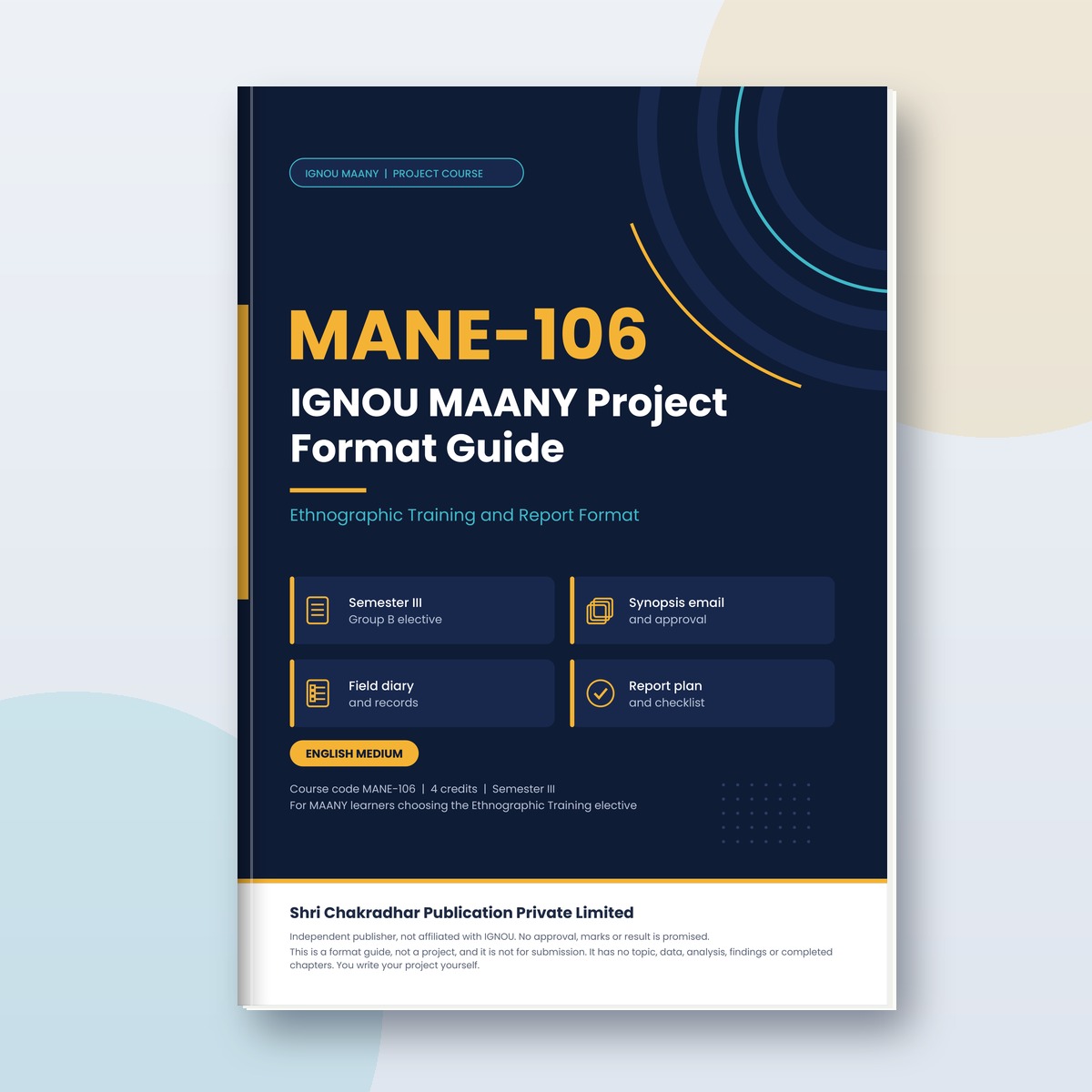
MANE-106: Ethnographic Training is a 4-credit project elective in Semester III of IGNOU’s Master of Arts (Anthropology), MAANY. Learners choosing this course from Group B undertake a small ethnographic inquiry in social anthropology, rather than the separate MANP-101 Dissertation in Semester IV. This format guide is a way to organise your own synopsis, field observations, diary, source notes and final account without pretending the University has published a chapter or page-count rule where it has not.
The preparation follows IGNOU’s MAANY Programme Guide and the Common Prospectus. Ethnographic documentation, consent and careful interpretation matter here. The guide distinguishes the course instructions from optional publisher worksheets, including a blank front-page layout. You research and write the work yourself.
What is different in the MANE-106 rules
- MANE-106 is a 4-credit Semester III Group B elective, not a project every MAANY learner must select.
- Group B learners choose two of four courses: MANE-105, MANE-106, MANE-107 and MANE-108.
- The course is Ethnographic Training and calls for a small-scale ethnographic study in social anthropology.
- The synopsis approval mailbox is mane106@ignou.ac.in, separate from the mailbox for the compulsory MANP-101 Dissertation.
- IGNOU’s programme guidance routes the finished report to the Registrar (SED), or to the notified upload link where an online-only route applies.
- The Common Prospectus lists Rs 300 per course for project evaluation of work up to 4 credits, which covers MANE-106.
- The MAANY Programme Guide does not prescribe the MANE-106 report’s pages, word count, font, margins or fixed chapter headings; those details must be checked in the course manual.
What is inside
The English medium PDF has 16 A4 pages and these 12 sections:
- 1. MANE-106 in MAANY: an elective field project, not the dissertation
- 2. The MANE-106 route: proposal email, approval and report
- 3. Defining the field inquiry and practical access
- 4. MANE-106 synopsis writing outline: suggested, not prescribed
- 5. Building an ethnographic record: observation and field notes
- 6. Field diary and source trail: empty planning tables
- 7. Organising the MANE-106 project report without a fixed chapter rule
- 8. A blank cover-page layout and forms the guide does not supply
- 9. Layout, references and confidentiality: stated versus unspecified
- 10. Submitting to SED and checking the evaluation fee
- 11. MANE-106 checklist from elective choice to final file
- 12. Preventable errors in ethnographic training submissions
Working tables and the blank front-page layout are marked as publisher suggestions, not compulsory University forms.
What is not inside
This guide has no topic, data, analysis, findings or completed chapters. It is not a sample project and is not for submission. You write your project yourself.
How to use this guide
- Check the Group B choice, credits and the distinct MANP-101 code in section 1 before preparing any paperwork.
- Use the two-stage route in section 2 to send your MANE-106 synopsis to the correct mailbox and retain the approval.
- Build a feasible, ethical field plan with sections 3 and 4; the synopsis outline is expressly a publisher suggestion.
- Keep your own observation records and diary with the guidance and empty working tables in sections 5 and 6.
- Use section 7 as a possible report arrangement, then check whether your MANE-106 manual specifies a different one.
- Read the notes about non-prescribed forms and layout in sections 8 and 9 before finalising the document.
- Follow the applicable SED route in section 10, and finish with the checklist and error checks in sections 11 and 12.
Formats, price and delivery
- PDF guide: Rs 19. Purchase through the shrichakradhar.com store checkout and download after payment.
- Printed hard copy: Rs 199 including Delhivery courier. No extra courier charge. Order through the WhatsApp button below at +91 93546 37830.
- The hard copy is posted by Delhivery on the next working day after payment to the Shri Chakradhar Publication Private Limited company account.
- Available in English medium.
- Refund policy: Read the refund policy before purchase.
Payments are received by Shri Chakradhar Publication Private Limited.
FAQ
Is this a ready project?
No. The MANE-106 guide provides instructions and empty planning aids, not a research topic, field notes, findings or completed work for submission.
Is it available in Hindi?
No. The guide is available in English medium only.
When is the hard copy sent?
It is posted by Delhivery on the next working day after payment. Rs 199 includes Delhivery courier with no extra courier charge.
Must every MAANY student take MANE-106?
No. Ethnographic Training is a Semester III Group B elective. Choose two Group B courses; MANE-106 is required only if it appears among your selected courses.
Which mailbox receives the MANE-106 synopsis?
The MAANY Programme Guide gives mane106@ignou.ac.in for MANE-106 synopsis approval. It is different from the MANP-101 Dissertation mailbox.
Does the programme guide set a MANE-106 page limit?
No fixed page or word limit is stated for this elective in the MAANY Programme Guide. Follow the course manual and any current instructions rather than borrowing limits from an older anthropology programme.
Can I use the MANP-101 dissertation synopsis instead?
Do not treat the courses as interchangeable. MANE-106 is the ethnographic elective and MANP-101 is the separate compulsory dissertation, with its own approval route.
Disclaimer
Shri Chakradhar Publication is an independent publisher and is not affiliated with IGNOU. No approval, marks or result is promised.
Course information: IGNOU’s MAANY programme page.