

Description
In short. This product is the hand-written version of the IGNOU DPLAD Tutor Marked Assignment, supplied as A4 hard copy, one bundle for each BPR paper that IGNOU actually issues an assignment against: BPR-001, BPR-002, BPR-003 and BPR-005. The rate is ₹320 per subject, hard copy only, with courier included in that price and no separate shipping charge. The fifth course in the Diploma in Panchayat Level Administration and Development, printed as BPR 4 Project Work in the Common Prospectus July 2026, carries no Tutor Marked Assignment at all, so a complete DPLAD year of assignment writing is four bundles rather than five. Every BPR paper is scored out of 100 across three sections, two long answers at 20 marks each, two medium answers at 15 and five short notes at 6, and the 2025-26 files print that the assignment must be submitted in handwritten form only. Any session is accepted, current cycle or older, including backlog courses, at the same ₹320 per subject.
The Four Things a Panchayat Learner Unwraps
A DPLAD order is a physical parcel, not a download link, and it is worth knowing exactly what is inside one before the first rupee moves. Each ordered BPR code arrives as its own bundle, tagged and kept separate, because the study centre counsellor marks DPLAD paper by paper and a merged file invites a merged rejection.
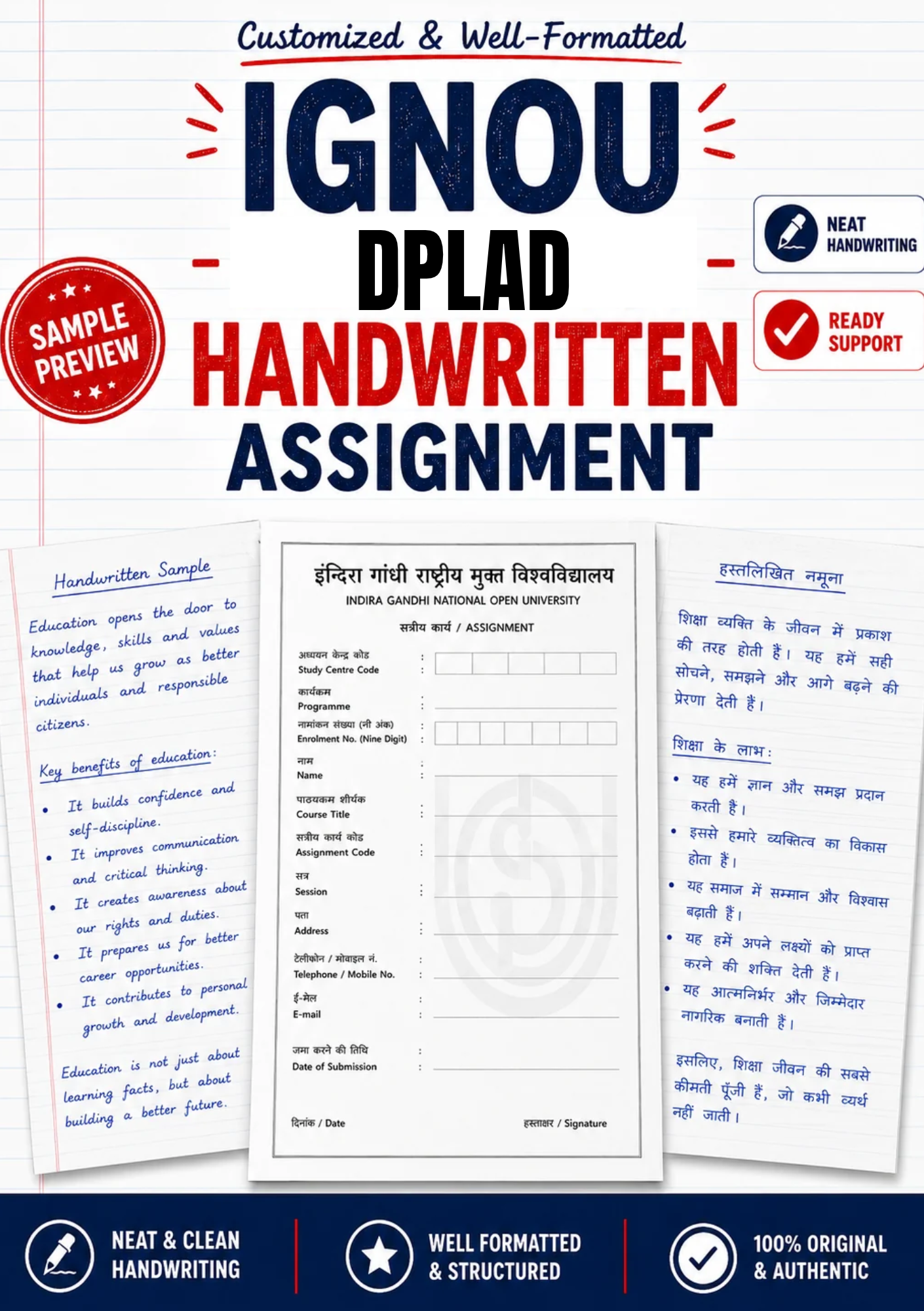
Inside each bundle sit four items. The answer pages come first: ruled or plain A4, written on one side, with the question reproduced above each answer in the sequence the paper prints it, because the 2025-26 BPR files instruct learners to attempt a specific count from each section rather than everything on the sheet. Second is the IGNOU-format cover sheet, filled in with the programme code DPLAD, the course code, the assignment number for your cycle, your enrolment number and your study centre, supplied free with every order. Third is a copy of the official BPR question paper for the session you named, so the counsellor can read the answers against the questions they were actually set rather than against a paper from an adjacent cycle. Fourth is the tag or thread the study centre expects, since several centre guideline sheets specifically refuse plastic files.
What does not arrive is a file. No soft copy or PDF is sold. That is deliberate rather than restrictive: a DPLAD learner who wanted a PDF already has one, free, from IGNOU, and what the counter accepts is paper in a particular hand.
Where the ₹320 Rupee Rate Stops on a BPR Paper
Pricing on a per-subject basis matters on DPLAD more than on most diplomas, because the four writable codes are not equal in effort and the rate does not pretend they are. BPR-005 Basic Computer Literacy asks for network diagrams and, in some cycles, a general journal worked through from opening capital. BPR-003 asks for the implementation procedure of a named rural employment scheme. The copying load is similar; the drawing load is not. One flat figure covers both.
Inside the rate: the writing of every section the paper asks for, the IGNOU-format front page, the printed question paper, the courier to your pin code, and the handwriting match against a sample you send first. There is no minimum order: one subject or fourteen, same rate. The service covers all mediums IGNOU issues the TMA paper in, at the same price, which on DPLAD is a shorter list than most learners expect and is covered further down this page.
Outside the rate, and said plainly: nothing about the outcome. No claim is made about the marks any assignment will receive, about how an evaluator will assess it, or about whether it will be accepted. Assignment evaluation is entirely a matter for IGNOU. The store also sells no re-evaluation, no grade follow-up and no submission service. The bundle reaches you, and you hand it in. Delivery depends on your pin code and is confirmed for your order before you pay. No figure is promised on this page.
A File You Download Beside a Bundle Somebody Signs For
Two different things get called the same thing in DPLAD search results, and the confusion is expensive. A solved assignment is a soft-copy reference file of model answers for a course code and session, read on a phone or printed to study from. A handwritten assignment is the answers written out by hand on A4 and submitted in hard copy at the study centre. The first is reading material. The second is a submission.
IGNOU settles the point itself. The 2025-26 BPR files carry the line that the assignment must be submitted in handwritten form only, and that instruction is printed on the paper, not inferred from a forum. It appears on the 2024-25 and 2025-26 DPLAD files and is absent from the 2022-23 and 2023-24 ones, which is why older advice circulating about DPLAD does not mention it. A downloaded PDF does not become a submission by being printed, and nothing on this page should be read as suggesting otherwise.
| Dimension | Solved assignment file | Handwritten assignment bundle |
|---|---|---|
| Format | Soft copy, read or printed | Hard copy A4, written by hand |
| What you do with it | Read it, then write your own answers | Check it, sign the cover page, hand it in |
| Who it suits | A learner with time who wants a model to work from | A learner short of writing time, not of understanding |
| Submission status | Not a submission in any form | The object the counter receives |
| Rate on this store | Priced per code on the solved assignment shelves | ₹320 per subject, courier included |
Scroll the table sideways on a narrow screen.
If a reference file is what you actually want, this is not the page for it. The store keeps the diploma-level solved assignment files arranged by code and session, and a learner who intends to write the pages themselves should start there instead. If you are unsure which of the two you need, ask the desk which of the four papers you still owe before ordering anything.
Four codes, one quote, nothing paid before the sample is agreed.
₹320 per subject, hard copy only, courier included, IGNOU-format front page and the printed BPR paper in the packet. Backlog cycles at the same rate.
Send your BPR code list to +91 93546 37830 with the session printed on your paper, and the quote comes back with a request for one page of your handwriting.
Four BPR Papers Carry a TMA, and the Fifth Never Has
The single most useful fact about ordering DPLAD assignments is a subtraction. The programme holds five courses. The assignment booklet, in every cycle opened for this page from 2021-22 to 2025-26, names four: BPR-001, BPR-002, BPR-003 and BPR-005. BPR 4 is Project Work. It is assessed as a project report, not as a Tutor Marked Assignment, and no assignment file has ever been issued against it. A learner who has been told they owe five DPLAD assignments has been told wrong.
| Prospectus code | Code on the booklet | Official title | Credits | 2025-26 assignment number | Written to order |
|---|---|---|---|---|---|
| BPR 1 | BPR-001 | Panchayats in India: The Context | 6 | BPR-001/AST/TMA-1/2025-2026 | Yes |
| BPR 2 | BPR-002 | Decentralized Planning and Panchayati Raj | 6 | BPR-002/AST/TMA-2/2025-2026 | Yes |
| BPR 3 | BPR-003 | Panchayati Raj Institutions and Anti Poverty Programme | 6 | BPR-003/AST/TMA-3/2025-2026 | Yes |
| BPR 4 | No assignment file issued | Project Work | 6 | None | No |
| BPR 5 | BPR-005 | Basic Computer Literacy | 6 | BPR-005/AST/TMA-4/2025-2026 | Yes |
Scroll the table sideways on a narrow screen.
Read the first two columns against each other, because they do not agree and both are IGNOU. The Common Prospectus July 2026 course table prints the codes as BPR 1 through BPR 5, with a space and a single digit. Every assignment file prints BPR-001 through BPR-005, hyphenated and zero-padded. The term-end question papers print BPR–001, with an en dash. Three forms of the same code, and a learner searching for one of them will miss material filed under the others. Order against the form printed on your own paper and the bundle is prepared for the code you were actually set.
The project course is not sold here, and that boundary is firm. A DPLAD project report is a different artefact with a different approval chain, and the bound DPLAD project report and synopsis shelf is where that work sits in this catalogue.
Thirty Credits, Five Courses, and the Four You Can Order
DPLAD is a 30-credit diploma, and that number is worth checking rather than assuming. Five courses at six credits each sum to thirty, which is exactly the total the Common Prospectus July 2026 prints under the DPLAD course table. The arithmetic closes, which matters because prospectus tables are extracted from a document where adjacent programmes bleed into one another and a table that does not sum is a table that has been read wrong.
Thirty is also unusual company. The two sibling diplomas from the same school, Early Childhood Care and Education and Nutrition and Health Education, are both 32-credit programmes built from four eight-credit courses. DPLAD is built from five six-credit courses instead. The assignment booklet states the consequence directly: one assignment per course of six credits. So where a DECE learner faces three assignment papers and a DNHE learner faces three, a DPLAD learner faces four.
The titles those four papers go by are less settled than the credit count. The table below records every spelling found while assembling this page, with the document each one came from, because a learner who types one form into a search box and finds nothing has not necessarily looked in the wrong place.
| What it names | Form printed | Document it appears in |
|---|---|---|
| The programme | Diploma in Panchayat Level Administration and Development | Common Prospectus July 2026 section 9.3 heading; 2025-26 booklet covers |
| The programme | Diploma in Panchayat Level Administration & Development | 2022-23 and 2023-24 booklet covers |
| The programme | Diploma in Panchayat level Administration & Development | DPLAD programme page on ignou.ac.in, with a lower-case level |
| The programme | DIPLOMA IN PANCHAYAAT LEVEL ADMINISTRATION AND DEVELOPMENT | 2024-25 booklet cover, with a doubled vowel |
| The programme | DIPLOMA IN PANCHAYAT LEVEL ADMINISTRATION AND DEVELOPMENT PROGRAMME | June 2026 BPR-001 term-end paper |
| The programme | Panchayat Level Development and Administration | Common Prospectus section 9.3 body text, words inverted |
| BPR-003 | Panchayati Raj Institutions and Anti Poverty Programme | Common Prospectus course table, plural noun, singular programme |
| BPR-003 | Panchayati Raj Institution and Anti-Poverty Programmes | 2025-26 BPR-003 booklet, singular noun, plural programmes |
| BPR-005 | Basic Computer Literacy | Prospectus, 2025-26 booklet heading, December 2025 term-end paper |
| BPR-005 | Computer Literacy | Course Title line inside the same 2025-26 booklet |
| The school | School of Continuing Education | Common Prospectus section 9.3 and the 2022-23 booklet |
| The school | School of Continuous Education | 2025-26 booklet covers |
Scroll the table sideways on a narrow screen.
None of this changes what you submit. It changes what you should type on a cover page, and the answer is always the form printed on your own paper rather than the form printed in the prospectus.
Twenty-Two Places Where DPLAD’s Own Files Contradict Each Other
Everything below was found by opening six cycles of DPLAD assignment files against the Common Prospectus July 2026 and against IGNOU’s own term-end papers, and reading them against each other rather than against a summary. Three of the twenty-two are this publisher’s, and they are listed with the rest rather than quietly fixed, because a learner deciding whether to trust a commercial page is better served by seeing the whole list.
Disagreements found in IGNOU’s own DPLAD documents, and in this store’s own pages. Confirm your own position with ignou.ac.in and your Regional Centre.
1. Two live BPR-005 assignment files sit in the same directory on ignou.ac.in and name different sessions. One heads its table Schedule for January 2025 and July 2025; the other heads it Schedule for July 2025 and January 2026.
2. As a result, the January 2026 cut-off of 30 September 2026 appears on exactly one of the five live DPLAD files, and that file is the computer-literacy paper rather than any of the three panchayat papers.
3. The covers disagree too. BPR-001, BPR-002, BPR-003 and one BPR-005 file print Assignments January 2025-2026. The second BPR-005 file prints Assignments July 2025 to January 2026.
4. The DPLAD submission date has moved four times across five cycles. The 2021-22 file prints 1 September 2021 and 1 May 2022. The 2022-23 and 2023-24 files print 1 September and 1 March. The 2024-25 and 2025-26 files print 30 September and 31 March.
5. Section A changed shape between cycles. The 2022-23 and 2023-24 papers set long answers at a maximum of 40 marks and ask for any one of three. The 2025-26 papers set them at 20 marks each and ask for any two of three. The section total stayed at 40; the number of answers to write doubled.
6. BPR-005 has carried two Tutor Marked Assignment serials in alternate cycles: TMA-5 in 2021-22, 2022-23 and 2024-25, and TMA-4 in 2023-24 and 2025-26.
7. The 2022-23 file prints both serials for BPR-005 inside one document, TMA-4 on the heading line and TMA-5 on the Assignment No. line.
8. The 2023-24 file does the same in reverse, printing TMA-5 in the schedule table and TMA-4 in the body section.
9. The 2023-24 schedule table carries the previous cycle’s year in all four assignment numbers, printing AST/TMA-1/2022-23 on a file whose body sections all read 2023-24.
10. The 2022-23 file prints the year with a slash rather than a hyphen in two body lines, giving BPR-005/AST/TMA-5/2022/2023 and BPR-002/AST/TMA-2/2022/2023 alongside hyphenated forms of the same codes elsewhere in the file.
11. The 2025-26 files print two year formats for one paper. The schedule table reads BPR-001/ AST/TMA-1/2025-26 and the body line reads BPR-001/AST/TMA-1/2025-2026.
12. The 2025-26 schedule tables also print a space inside the code, after the course code and before AST, which the body lines do not.
13. BPR-005 carries two course titles inside one file. The 2025-26 heading prints BASIC COMPUTER LITERACY and the Course Title line two lines below prints Computer Literacy.
14. BPR-003’s title inverts its plurals between documents. The prospectus prints Panchayati Raj Institutions and Anti Poverty Programme; the 2025-26 booklet prints Panchayati Raj Institution and Anti-Poverty Programmes.
15. The 2025-26 BPR-003 paper misprints the programme code in short-answer topic seven, asking about the need for DPAD rather than DPLAD.
16. The programme name appears in six forms across IGNOU’s own files, including PANCHAYAAT on the 2024-25 cover and the prospectus’s own body sentence inverting it to Panchayat Level Development and Administration.
17. The school is named School of Continuing Education in the prospectus and School of Continuous Education on the 2025-26 booklet covers.
18. The course code appears in three forms: BPR 1 in the prospectus, BPR-001 in assignment files, and BPR–001 with an en dash on the term-end papers.
19. The 2024-25 file heads its schedule Schedule for January 2024 and July 2024, naming only 2024 sessions, while the dates underneath run to 31 March 2025.
20. The 2022-23 BPR-001 paper labels its third section Short Medium Answers Questions where the other three papers in the same file print Short Answers Questions.
21. This store’s own defect. The DPLAD guess-paper category on shrichakradhar.com carries a meta description promising 90 plus marks in BPR exams. No marks claim of any kind is supportable on externally graded work and the line is wrong. It is listed in this page’s correction queue for removal.
22. This publisher’s own naming inconsistency. The DPLAD project category on this store, and the matching DPLAD project article on ignouproject.com, both name the project course BPRP 004. The Common Prospectus prints it as BPR 4, and no IGNOU document opened while building this page uses a BPRP prefix. Treat BPR 4 as the code and BPRP 004 as this publisher’s own label until IGNOU is seen to print otherwise.
Why the January 2026 Date Sits on the Computer Paper Alone
DPLAD learners are badly served by circulated deadline lists, and the reason is structural rather than careless. IGNOU publishes the DPLAD schedule as a table reproduced on the front matter of each individual course file, and those files are republished at different moments. The result is that the same cycle can carry two different session pairs depending on which of the five files a learner happens to open.
The practical consequence is worth stating slowly. If you were admitted in January 2026 and you download BPR-001, BPR-002 or BPR-003, the table in front of you names January 2025 and July 2025 and gives you dates of 30 September 2025 and 31 March 2026. Neither of those is your date. Your date, 30 September 2026, is printed on the second BPR-005 file, which is the Basic Computer Literacy paper. A panchayat learner has no reason to open the computer paper first, which is precisely why this gets missed.
| Cycle | Sessions the file names | Dates printed on that file |
|---|---|---|
| 2021-22 | July 2021 and January 2022 | 1 September 2021 and 1 May 2022 |
| 2022-23 | July 2022 and January 2023 | 1 September 2022 and 1 March 2023 |
| 2023-24 | July 2023 and January 2024 | 1 September 2023 and 1 March 2024 |
| 2024-25 | January 2024 and July 2024 | 30 September 2024 and 31 March 2025 |
| 2025-26, BPR-001 to BPR-003 and one BPR-005 file | January 2025 and July 2025 | 30 September 2025 and 31 March 2026 |
| 2025-26, second BPR-005 file | July 2025 and January 2026 | 31 March 2026 and 30 September 2026 |
Scroll the table sideways on a narrow screen.
Two things follow. The first is that a DPLAD deadline cannot be carried across from a sibling programme or from a general listing page, even one covering the same school, because the School of Continuing Education does not run a single date pair across its diplomas. The second is that the shift from the first of the month to the end of the month happened between the 2023-24 and 2024-25 cycles, which is why advice written before that change still circulates with 1 March on it. Every bundle on this store is prepared against the pair printed on the file for the session you name, and the file it was read from is quoted back to you.
Where IGNOU issues a separate extension notification for a term-end cycle, that notice overrides the printed date for that cycle only. It never changes which code a date belongs to, and a notice for one examination cycle should not be read as moving the printed schedule of the next.
Decoding BPR-001/ AST/TMA-1/2025-26, Segment by Segment
That string goes on the cover page of the bundle, and a wrong version of it is among the easiest ways to have a correct set misfiled. It has four segments and each one is independently fixed.
The first segment is the course code, BPR-001 through BPR-005, in the hyphenated zero-padded form the assignment file uses rather than the spaced form the prospectus uses. The second is AST, which is constant across DPLAD and is IGNOU’s marker for an assignment rather than a tutorial or a project. The third is the Tutor Marked Assignment serial, TMA-1 through TMA-4 in the current cycle, and this one is not simply the course number: BPR-005 is the fourth assignment in the 2025-26 set because BPR 4 is a project and takes no serial. That is also why the serial on BPR-005 has oscillated between TMA-4 and TMA-5 across cycles, depending on whether the compiler counted the project slot or skipped it. The fourth is the year, printed as 2025-26 in the schedule table and as 2025-2026 in the body line of the same file.
The guidance that follows from this is unglamorous and reliable: copy the string from the body line of your own paper, character for character, including whichever year format it uses. Do not reconstruct it from the schedule table, do not normalise the space, and do not renumber the serial to match the course number. Every bundle leaves here carrying the string as printed on the paper it was written against.
Settling the Hand Before Any Money Moves
A handwritten set that does not look like the learner who signed for it is a problem, and the ordering sequence here is built around removing that risk before payment rather than after delivery. Send a photo of a page you have written yourself and the handwritten set is matched to your handwriting at no extra charge.
The sample comes first, the match is confirmed, and only then does anything get paid. That ordering is the whole point. A learner who looks at the matched sample and decides it is not close enough has spent nothing. Shri Chakradhar Publication runs a printing press with its own team of writers, so the match is made by assigning a writer whose natural hand is closest to the sample rather than by asking one writer to imitate every hand that arrives.
Which sheet to photograph, and why it matters
Photograph a full page of ordinary continuous prose written at your normal speed, in the pen you usually use, on the paper you usually use. A page of your own class notes works better than a page written carefully for the purpose, because a deliberately neat page is not the hand that will appear on the cover-page declaration you sign in front of the counsellor. Avoid a page of numbers, a page of headings, or a page written in block capitals; none of those carry enough joined letterforms to match against. Natural daylight, the whole sheet in frame, and no filter.
One Medium, One Script, and Any Session You Still Owe
DPLAD is narrower than its sibling diplomas on medium, and the narrowness is worth knowing before ordering. The Common Prospectus July 2026 gives the medium of instruction for DPLAD as English, in both the admission table and the section 9.3 entry. The two sibling diplomas from the same school are wider: Nutrition and Health Education runs in English and Hindi, and Early Childhood Care and Education is listed with four mediums. Listing sites that generalise across the school will tell a DPLAD learner their paper comes in Hindi. On the prospectus, it does not.
DPLAD is also absent from the prospectus list of programmes offered in online mode, where the only diplomas named are the online variants of Nutrition and Health Education, Urdu Language and Creative Writing in English. The DPLAD programme page on ignou.ac.in carries an open and distance learning tag and no online variant. So there is no DPLADOL code to confuse an order with.
None of that restricts what can be written. The service covers all mediums IGNOU issues the TMA paper in, at the same price. If IGNOU issues your BPR paper in a medium the prospectus does not list, send the paper and the bundle is written against the paper rather than against the prospectus.
Session coverage is deliberately wide, because DPLAD runs a one-year minimum against a three-year maximum duration and most enquiries that reach this desk concern a paper from a cycle that has already closed. Any session is accepted, current cycle or older, including backlog courses, at the same ₹320 per subject. The paper for that cycle is sourced rather than substituted, which matters on DPLAD specifically: a 2022-23 BPR-001 paper asks for one long answer of 40 marks and a 2025-26 paper asks for two of 20, so handing in the current year’s answers against an older code produces the wrong number of answers in the wrong shape.
What the Opening Message Has to Carry
Five things, and nothing else is needed to produce a quote.
- The BPR codes still open. Any of BPR-001, BPR-002, BPR-003 and BPR-005, in whatever combination you owe. Not BPR 4, which is the project.
- The session printed on your paper. January or July, with the year, read off the file itself rather than from your admission year, because the two diverge once a backlog is involved.
- The medium your paper is issued in. Named, so the right paper is sourced rather than assumed from the prospectus.
- One photograph of your handwriting. A full page of ordinary prose, as described above.
- Your delivery pin code. Which is what the delivery window is confirmed against before you pay.
Your enrolment number, your name and your study centre code go on the front page at the writing stage and are asked for then. They are not needed to quote, and sending them early speeds nothing up.
The sample page is the first step, not the payment.
₹320 per subject, four writable BPR codes, courier included, printed question paper in the packet, and no claim at all about what the counsellor will award.
Start a DPLAD order with one page of your handwriting and the match is confirmed before anything is charged.
What the Study Centre Does With the Bundle After That
The parcel arrives, and from that point the process is yours rather than this publisher’s. It is worth knowing the shape of it, because several steps are irreversible once taken.
Read the bundle before you submit it. You sign the declaration on the assignment cover page, so you should read and review the content before submitting it, and satisfy yourself that it represents your own understanding of the course. On DPLAD this is a real exercise rather than a formality: BPR-005 answers in some cycles include a worked general journal, and BPR-002 answers turn on named planning tiers, so a learner who has not read the pages cannot defend them if a counsellor asks.
Then submit at the study centre named on your record. The 2025-26 DPLAD files print the instruction to submit the assignments to the coordinator of your study centre, and the schedule table says so in the Whom to Send column. Where your centre or Regional Centre has opened an upload route for the cycle, the same written pages are scanned and submitted there instead; what the file instructs is that the pages be handwritten, not that they travel on paper to the counter.
Keep two things. Keep an acknowledgement or a dated upload confirmation, because a DPLAD assignment that cannot be traced is indistinguishable from one never submitted. And keep a photograph of each bundle before it leaves your hands, which costs nothing and settles any later question about what was handed in. The files also advise submitting each paper as you finish the course rather than holding all four for the last date, which is sensible advice independent of where the pages came from.
After that, marks and status sit with IGNOU. No claim is made about the marks any assignment will receive, about how an evaluator will assess it, or about whether it will be accepted. Assignment evaluation is entirely a matter for IGNOU.
Where Else Panchayat Material Sits in This Catalogue
A DPLAD enrolment rarely needs only one thing, and the handwritten bundle is the narrowest of the shelves this press keeps. For the term-end paper that carries the other 70 per cent, the DPLAD guess papers built around the BPR term-end pattern are the closest fit, and a learner comparing across programmes can browse every diploma guess paper this press keeps in print. Reading material for the courses themselves sits among the help books across the diploma catalogue, and the broader reference shelf is the whole solved assignment library.
Learners holding more than one enrolment, which is common among panchayat functionaries studying alongside a job, often want the sibling sets. The same school issues the nutrition and health education set, built on three papers rather than four, and an early childhood diploma where the published paper stops at sixty of a hundred marks. Both are useful as a comparison, because reading two of these pages against each other shows how differently one school dates and structures its own diplomas. Beyond DPLAD, the full handwritten shelf covers every programme the press writes for, and project work for other programmes sits under hard copy project reports across the catalogue.
Questions That Surface Once the BPR Dates Are Read
Four bundles or five for a full DPLAD year?
Four. BPR-001, BPR-002, BPR-003 and BPR-005 each carry a Tutor Marked Assignment and each is quoted at ₹320 per subject. BPR 4 is Project Work and no assignment file has ever been issued against it, so there is no fifth bundle to order.
Why is BPR 4 missing from the assignment booklet?
Because it is not an assignment. The Common Prospectus July 2026 lists BPR 4 as Project Work at six credits, assessed as a project report with its own approval chain. Every DPLAD assignment file from 2021-22 to 2025-26 names only BPR-001, BPR-002, BPR-003 and BPR-005.
If I print a BPR model-answer file, is that a submission?
No. A solved assignment is a soft-copy reference file of model answers; it is not a submission. The 2025-26 DPLAD files print that the assignment must be submitted in handwritten form only, and a printed PDF does not satisfy that.
The file says handwritten form only. What happens if I print it?
The DPLAD files print the handwritten-only instruction from the 2024-25 cycle onward and many study centre guideline sheets repeat it, so a typed set is at real risk of refusal. Acceptance is the centre’s decision and no claim about it is made here. Only ignou.ac.in and your Regional Centre can confirm the position for your enrolment.
What are the last dates printed on the 2025-26 BPR papers?
The BPR-001, BPR-002 and BPR-003 files print 30 September 2025 for the January 2025 intake and 31 March 2026 for the July 2025 intake. The second BPR-005 file prints 31 March 2026 for July 2025 and 30 September 2026 for January 2026. Read the pair on your own file.
A 2023 DPLAD file gave me 1st March. Why has my date moved?
Not for a current cycle. Those dates are from the 2022-23 and 2023-24 files. IGNOU moved the DPLAD cut-off to the end of the month from the 2024-25 cycle, and the 2021-22 file printed 1 May for its January session, so four different pairs exist across five cycles.
Why does one BPR-005 file say January 2025 and another say January 2026?
Because two BPR-005 files are live in the same directory on ignou.ac.in and were republished at different moments. One heads its table with January 2025 and July 2025; the other with July 2025 and January 2026. The discrepancy is IGNOU’s, not a transcription error on this page.
Is my paper TMA-4 or TMA-5 for BPR-005?
Whichever your own file prints. The serial has oscillated: TMA-5 in 2021-22, 2022-23 and 2024-25, TMA-4 in 2023-24 and 2025-26. Two of those files print both serials inside one document, so copy the Assignment No. line from the body section rather than the schedule table.
Which part of BPR-001/ AST/TMA-1/2025-26 do I copy, and from where?
Four segments. BPR-001 is the course code in its hyphenated zero-padded form, AST marks it as an assignment rather than a project, TMA-1 is the assignment serial within the DPLAD set, and 2025-26 is the cycle. The space after the course code appears in the schedule table and not in the body line.
Why does my paper print 2025-26 in the table and 2025-2026 in the body?
Both are on the same IGNOU file. The schedule table uses the two-digit second year and the Assignment No. line inside each section uses the four-digit form. Copy the body line, since that is the one printed directly above the questions you are answering.
Does DPLAD run in Hindi like the other diplomas from the same school?
The Common Prospectus July 2026 gives DPLAD’s medium of instruction as English, in both the admission table and the programme entry, and no Hindi DPLAD assignment file surfaced while building this page. Listing sites often carry over the wider medium lists of the sibling diplomas from the same school.
Is BPR-003 called Institution or Institutions in the title?
Both, in different IGNOU documents. The prospectus course table prints Panchayati Raj Institutions and Anti Poverty Programme. The 2025-26 booklet prints Panchayati Raj Institution and Anti-Poverty Programmes. Use the form on your own paper for the cover page.
I never submitted BPR-002 in 2023. Can that cycle still be written?
Yes, at the same rate. The paper for that cycle is sourced rather than substituted with the current one, which matters here because the 2022-23 papers ask for one long answer of 40 marks and the 2025-26 papers ask for two of 20 marks each.
Why does my BPR-003 question paper say DPAD?
It is a misprint in IGNOU’s own 2025-26 BPR-003 file, in short-answer topic seven, which asks about the need for DPAD. The programme is DPLAD. Answer the topic as asked and write the correct programme code on your cover page.
Does the store’s BPRP 004 code mean the same thing as BPR 4?
It refers to the same project course, but BPR 4 is the form the Common Prospectus prints and no IGNOU document opened for this page uses a BPRP prefix. The BPRP 004 label on this store’s project pages is this publisher’s own and is queued for correction.
Whose handwriting ends up on the four bundles?
Send a photo of a page you have written yourself and the handwritten set is matched to your handwriting at no extra charge. The sample is agreed before any payment, so a learner who is not satisfied with the match has spent nothing.
Every DPLAD File Opened to Settle This Page
Three kinds of source sit behind this page and they are kept apart on purpose, because they carry different authority and a reader deserves to know which is which.
Where the thirty credits were confirmed
The course codes, the official titles, the six-credit weighting, the thirty-credit total, the English medium, the 10+2 eligibility and the absence of DPLAD from the online-mode list all come from the IGNOU Common Prospectus July 2026, section 9.3 and the diploma admission table. The credit arithmetic was summed before the table was trusted: five courses at six credits, totalling thirty, matching the printed total. The prospectus is authoritative for structure. It is not authoritative for dates, and it prints no assignment weightage percentage for DPLAD.
Six assignment cycles read against each other
The dates, the assignment code strings, the section structure, the marks split and the handwritten-only instruction come from IGNOU’s own live assignment files, opened rather than summarised: the 2025-26 BPR-001, BPR-002, BPR-003 and BPR-005 files, the second BPR-005 file carrying the July 2025 and January 2026 pair, and the 2024-25, 2023-24, 2022-23 and 2021-22 DPLAD booklets. The December 2025 and June 2026 BPR term-end papers were read for the course titles and the en-dash code form. Current files for any cycle are published on IGNOU’s own assignment download service, and a learner should always read their own. A companion walkthrough of the project side of this programme sits on this publisher’s editorial domain, as a guide to the DPLAD project report on ignouproject.com.
Terms that belong to this publisher and to nobody else
The ₹320 rate, the included courier, the free IGNOU-format front page, the included question paper, the no-minimum rule, the handwriting match and the backlog acceptance are Shri Chakradhar Publication’s own commercial terms. None of them originate with IGNOU and none of them should be read as an IGNOU position. Equally, the correction queue items numbered 21 and 22 in the box above are this publisher’s own errors and are recorded as such.
Important Notice
Shri Chakradhar Publication Pvt. Ltd. and shrichakradhar.com form an independent IGNOU study-support publisher. This is not the official website of Indira Gandhi National Open University, is not affiliated with, endorsed by or authorised by the university, and no page on this site should be treated as an official IGNOU communication.
Programme structures, course codes, submission dates and rules change, and only ignou.ac.in and your Regional Centre can confirm the current position for your enrolment.
You sign the declaration on the assignment cover page, so you should read and review the content before submitting it, and satisfy yourself that it represents your own understanding of the course.
No claim is made about the marks any assignment will receive, about how an evaluator will assess it, or about whether it will be accepted. Assignment evaluation is entirely a matter for IGNOU.
Assignments carry 30 per cent of the final course result and the term-end examination carries the remaining 70 per cent. The DPLAD files opened for this page print no weightage percentage of their own, so that figure is the university-wide position rather than a DPLAD-specific statement, and your own Programme Guide should be read alongside it.
Name the BPR Papers You Still Have to Hand In
₹320 per subject, hard copy only, courier included, four writable BPR codes, the printed question paper in the packet, and your own hand agreed from a sample before anything is paid.
Two routes. Open a DPLAD quote on WhatsApp with your codes and the session printed on your file. Or, if what you owe is from a closed cycle, confirm a backlog BPR paper at the same rate and the paper for that cycle is sourced rather than substituted.
There is no minimum order: one subject or fourteen, same rate. Delivery depends on your pin code and is confirmed for your order before you pay. No figure is promised on this page.