

Description
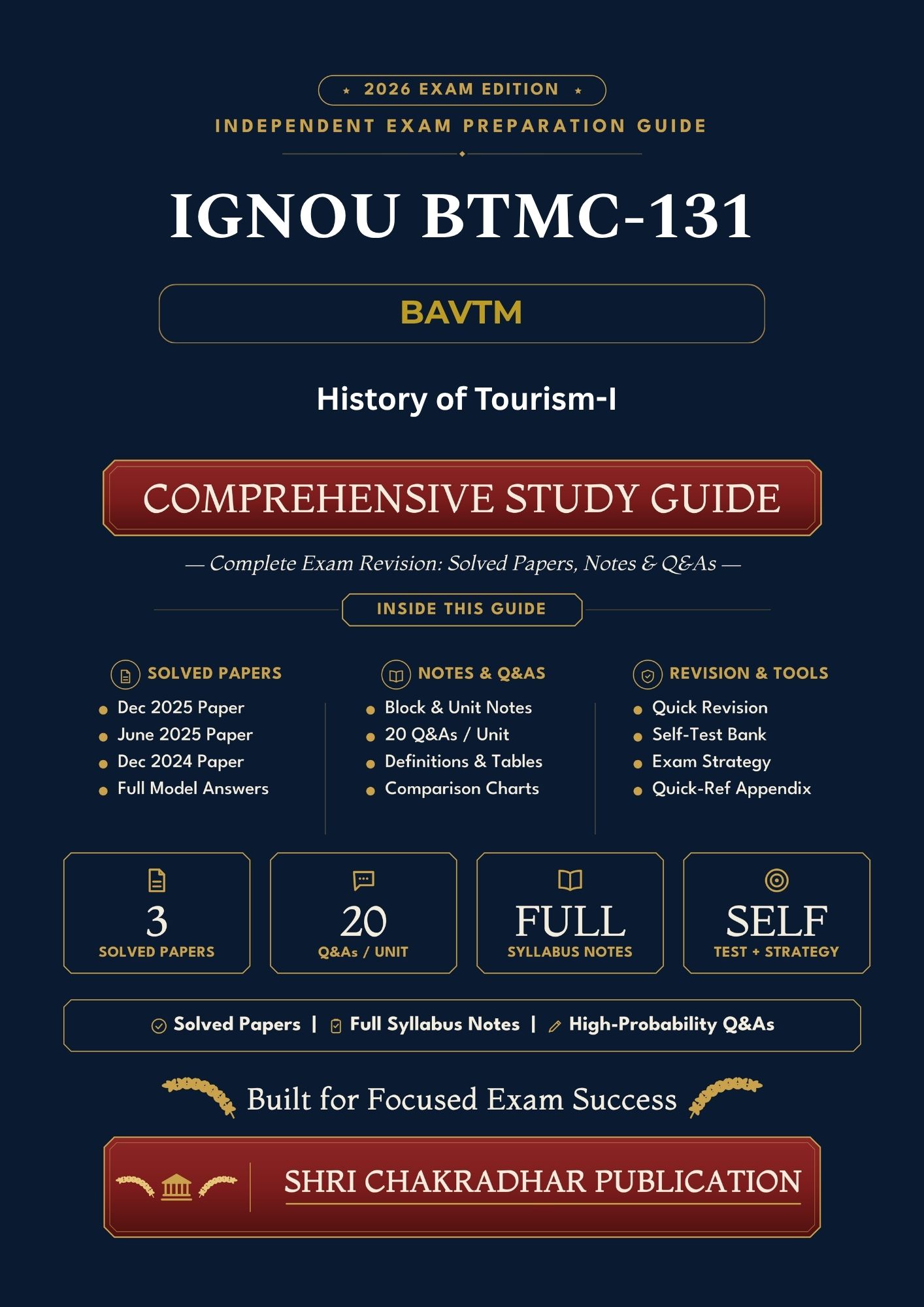
IGNOU BTMC-131 Book (History of Tourism-I) is organised for BAVTM students who want a 2026 English-medium guide that keeps the verified 6 Blocks visible while supporting Unit-wise study and exam writing.
Students often know individual points in History of Tourism-I but struggle to convert them into a complete answer. Revise each area through concept, tourism context, stakeholder or destination, operational implication and a relevant Indian or global example. Use maps, timelines and service-process steps where they improve recall. The revision flow uses Tourism Phenomenon, Tourism: The Cultural Heritage and later course areas as linked checkpoints.
For more IGNOU study material, visit IGNOU Study Material. Use this independent guide together with IGNOU’s official study material, assignments and current examination information.
An Overview of the IGNOU BTMC-131 Help Book
History of Tourism-I becomes easier when the learner knows the role of each course area. This guide uses the verified structure to place Tourism Phenomenon and Discovery, Urbanization and Sea-Voyages in context and then turns that structure into a revision schedule.
The official IGNOU material remains the primary syllabus source.
Course-specific revision lens: While revising Tourism Phenomenon, separate the essential definition from the application and finish with one example, calculation or observation. With Tourism: The Cultural Heritage, focus on the relationship between the core concept and the way IGNOU expects it to be interpreted, applied or demonstrated. With Ancient Civilizations, focus on the relationship between the core concept and the way IGNOU expects it to be interpreted, applied or demonstrated. Treat Evolutions and Development as an active-recall checkpoint: explain it without notes, identify one connection to another Unit and then attempt a written question.
Answer architecture for this course: Use Tourism Phenomenon to practise synthesis by linking the immediate Unit with one earlier concept and one later application from the verified course sequence. An answer on Tourism: The Cultural Heritage should move from context to the central mechanism or argument, then close with the consequence, result or practical significance. When a TEE question targets Ancient Civilizations, identify the command word first and choose only the facts, calculations or examples that directly support that task. For Evolutions and Development, build the response in layers: key term, main explanation, supporting step or evidence, and a short concluding interpretation.
This Book Is Useful For
This book is most useful when a learner needs structure, not just more reading. It supports planned coverage of History of Tourism-I and repeated answer practice.
- Learners mapping the full BTMC-131 syllabus before revision.
- Students who need extra practice with Tourism: The Cultural Heritage and related concepts.
- TEE candidates improving answer organisation.
- Students returning to weak Units after self-testing.
- Learners using assignments as concept checks while preparing their own responses.
What’s Inside This BTMC-131 Book
The contents combine syllabus mapping, Unit-wise explanation, active-recall prompts and written practice for History of Tourism-I.
- Unit-wise notes: concepts arranged around the verified BTMC-131 sequence.
- Course cues: focus on Tourism Phenomenon, Tourism: The Cultural Heritage and connected topics.
- Answer practice: tourism case answers, destination-based explanations, history timelines, marketing questions and travel-operation scenarios.
- PYQ orientation: practice based on recurring examination task-types, without prediction claims.
- Final recap: quick checkpoints for weak areas before the TEE.
Complete Syllabus Coverage – All 6 Blocks
The verified IGNOU structure is reproduced as the syllabus anchor for this guide. Where IGNOU publishes Blocks, they are named directly; where it publishes a practical, Theme or course-level structure, that format is preserved rather than converted into invented Blocks.
| Block | Official title | Revision focus |
|---|---|---|
| Block 1 | Tourism Phenomenon | Tourism Phenomenon |
| Block 2 | Tourism: The Cultural Heritage | Tourism: The Cultural Heritage |
| Block 3 | Ancient Civilizations | Ancient Civilizations |
| Block 4 | Evolutions and Development | Evolutions and Development |
| Block 5 | Discovery, Urbanization and Sea-Voyages | Discovery, Urbanization and Sea-Voyages |
| Block 6 | Development of Travel and Tourism | Development of Travel and Tourism |
Use the structure as a revision tracker and return to any area where written recall remains weak.
How This Book Maps to the IGNOU BTMC-131 Exam Pattern
TEE preparation should train the task behind the question: explaining, comparing, applying, calculating or evaluating. For History of Tourism-I, practise tourism case answers, destination-based explanations, history timelines, marketing questions and travel-operation scenarios and check the latest official paper for the current pattern.
Why Students Prefer Our IGNOU BTMC-131 Guide Book & Study Material
Students can use the guide as a revision dashboard for History of Tourism-I: verified structure, Unit-wise notes, practice and final recap appear in one sequence.
The aim is steady preparation rather than unsupported marks or pass claims.
Compiled & Reviewed By
The SCP Panel of Experts, under BK Sahni at Shri Chakradhar Publication, compiles this independent guide. The 2026 review checks the BTMC-131 syllabus map against official IGNOU/eGyanKosh sources before the revision copy is organised.
How to Use the IGNOU BTMC-131 Help Book for TEE and Assignments
Do not make rereading the only revision method. Combine comprehension with recall and written application.
- Begin with the official course map.
- Study one manageable Unit at a time.
- Use active recall before checking the notes again.
- Write answers in your own words and keep assignments original.
- Use the final week for retrieval and practice rather than first-time reading.
High-Probability Questions from IGNOU BTMC-131 (Sample)
These prompts are selected for revision value because they require explanation, application or comparison of important course areas.
- Explain the tourism significance of Tourism Phenomenon in the context of History of Tourism-I.
- Compare tourism approaches to Tourism: The Cultural Heritage in the context of History of Tourism-I.
- Discuss the destination or business implications of Ancient Civilizations in the context of History of Tourism-I.
- Apply tourism-management principles to Evolutions and Development in the context of History of Tourism-I.
- Explain the tourism significance of Discovery, Urbanization and Sea-Voyages in the context of History of Tourism-I.
- Build a comparative answer linking Tourism Phenomenon with Discovery, Urbanization and Sea-Voyages.
- Write a structured short note on one recurring concept from History of Tourism-I, using definition, explanation and a relevant example, calculation, process or evidence as appropriate.
IGNOU BTMC-131 Sample Question Paper (TEE Format Template)
Use this non-official paper format to rehearse answer selection and pacing before checking the latest IGNOU BTMC-131 question paper.
Section A – Extended Answers
- Explain the tourism significance of Tourism Phenomenon in the context of History of Tourism-I.
- Compare tourism approaches to Tourism: The Cultural Heritage in the context of History of Tourism-I.
- Discuss the destination or business implications of Ancient Civilizations in the context of History of Tourism-I.
Section B – Analytical / Short Answers
- Apply tourism-management principles to Evolutions and Development in the context of History of Tourism-I.
- Explain the tourism significance of Discovery, Urbanization and Sea-Voyages in the context of History of Tourism-I.
- Build a comparative answer linking Tourism Phenomenon with Discovery, Urbanization and Sea-Voyages.
While answering, make tourism concepts, destination examples, historical developments, business processes, marketing decisions and stakeholder implications visible and finish with a concise conclusion or result.
Related IGNOU BTMC-131 Additional Supports
The following optional resources extend preparation beyond the study guide without changing the official syllabus.
- IGNOU BTMC-131 Solved Assignment
- IGNOU BTMC-131 Handwritten Assignment
- IGNOU BTMC-131 Solved PYQs
- IGNOU BTMC-131 Solved Guess Paper
Delivery, Returns & Payment Options
This product is an A5 paperback. Current checkout and product-page terms govern payment, dispatch, delivery and eligible returns.
How Students Use This Guide
Use the guide as a cycle rather than a one-time read: study, retrieve, write, check and revisit the weakest part of History of Tourism-I.
Integrated recall map: Link Tourism Phenomenon to the next course area by identifying one dependency, one contrast and one practical consequence; this makes the topic easier to retrieve in an integrated answer. After revising Tourism: The Cultural Heritage, write down one common confusion, the correct distinction and a concrete example, calculation, process or case that resolves the confusion. Use Ancient Civilizations for a one-minute oral explanation, then convert that explanation into a short written response containing the essential terminology and one course-specific connection. For Evolutions and Development, create a three-column recall cue covering the core idea, the evidence or working method, and the result or implication that an examiner could ask you to explain.
Free Downloads: IGNOU BTMC-131 Exam Support PDFs
For BTMC-131, verify the current syllabus and downloadable material through official IGNOU/eGyanKosh resources before using supplementary notes.
- Official IGNOU/eGyanKosh material for BTMC-131.
- IGNOU Assignments for current papers and instructions.
- IGNOU Previous Year Question Papers for available TEE papers.
Download BTMC-131 Study Material Free via eGyanKosh (Step-by-Step)
eGyanKosh is the official digital repository; verify the code, title and structure there before beginning detailed revision.
- Visit eGyanKosh.
- Enter the exact course code BTMC-131.
- Choose the record matching History of Tourism-I.
- Check its structure against your programme information.
- Download the official material and use the guide only as supplementary support.
Frequently Asked Questions (FAQ)
These answers clarify the most common questions about the guide, syllabus verification and exam use.
What is the verified syllabus structure for BTMC-131?
The researched official structure contains 6 Blocks, all represented in this edition.
What subject does BTMC-131 cover?
History of Tourism-I is the course subject; this guide follows the researched official sequence and focuses on Unit-wise revision.
Who can use this BTMC-131 book?
This edition is prepared for BAVTM learners studying BTMC-131.
What is the study medium for this product?
This product is prepared in English; students should match it with their intended study and examination medium.
Are PYQ-oriented questions included?
Yes. Previous-paper-oriented practice is included to improve answer skills, without promising that a question will repeat.
Can I consult this book while preparing assignments?
Use it for concept understanding and planning, while writing and submitting your own assignment work according to IGNOU guidelines.
Is this an official IGNOU publication?
No. It is independent academic study support from Shri Chakradhar Publication and is not affiliated with or endorsed by IGNOU.
Where can I get official BTMC-131 material?
Search the exact code BTMC-131 on eGyanKosh and use the official IGNOU links provided above.
What is a practical final-revision plan for BTMC-131?
Follow the official sequence, use active recall, practise written responses, review recent papers and return to weak Units before the examination.
Conclusion
The final aim of this BTMC-131 guide is simple: understand the verified syllabus, retrieve it confidently and practise presenting that understanding clearly in the TEE.
To order, visit the IGNOU BTMC-131 Book order page.
Disclaimer: This is an independent academic study-support resource published by Shri Chakradhar Publication (Pvt.) Ltd. It is not affiliated with, endorsed by, or an official publication of IGNOU. It is designed to supplement, not replace, IGNOU’s official study material. Syllabus and exam patterns may change – please verify the latest information through official IGNOU channels. Students should prepare and submit their own work as per IGNOU guidelines. All trademarks belong to their respective owners.