

Description
In short. Shri Chakradhar Publication writes IGNOU BSCM assignments by hand for the Bachelor of Science (Multidisciplinary), the 120-credit School of Sciences degree in which you take three of seven science disciplines, and the order covers the 28 discipline theory codes from BBYCT-131 to BZYCT-137 together with the interdisciplinary, language, skill, vocational and value-added codes such as BEGG-171, BEVAE-181 and BEDSV-101, while the 21 laboratory codes are removed from your list because IGNOU sets no written assignment against them. The rate is ₹320 per subject, hard copy only, with courier included in that price and no separate shipping charge. Every 2026 paper for these codes is valid for the calendar year and lapses on 31 December 2026, and the three School of Sciences booklets read for this page print three different rules about when the answers are due, which the sections below set out booklet by booklet.
What Comes Inside a BSCM Handwritten Packet
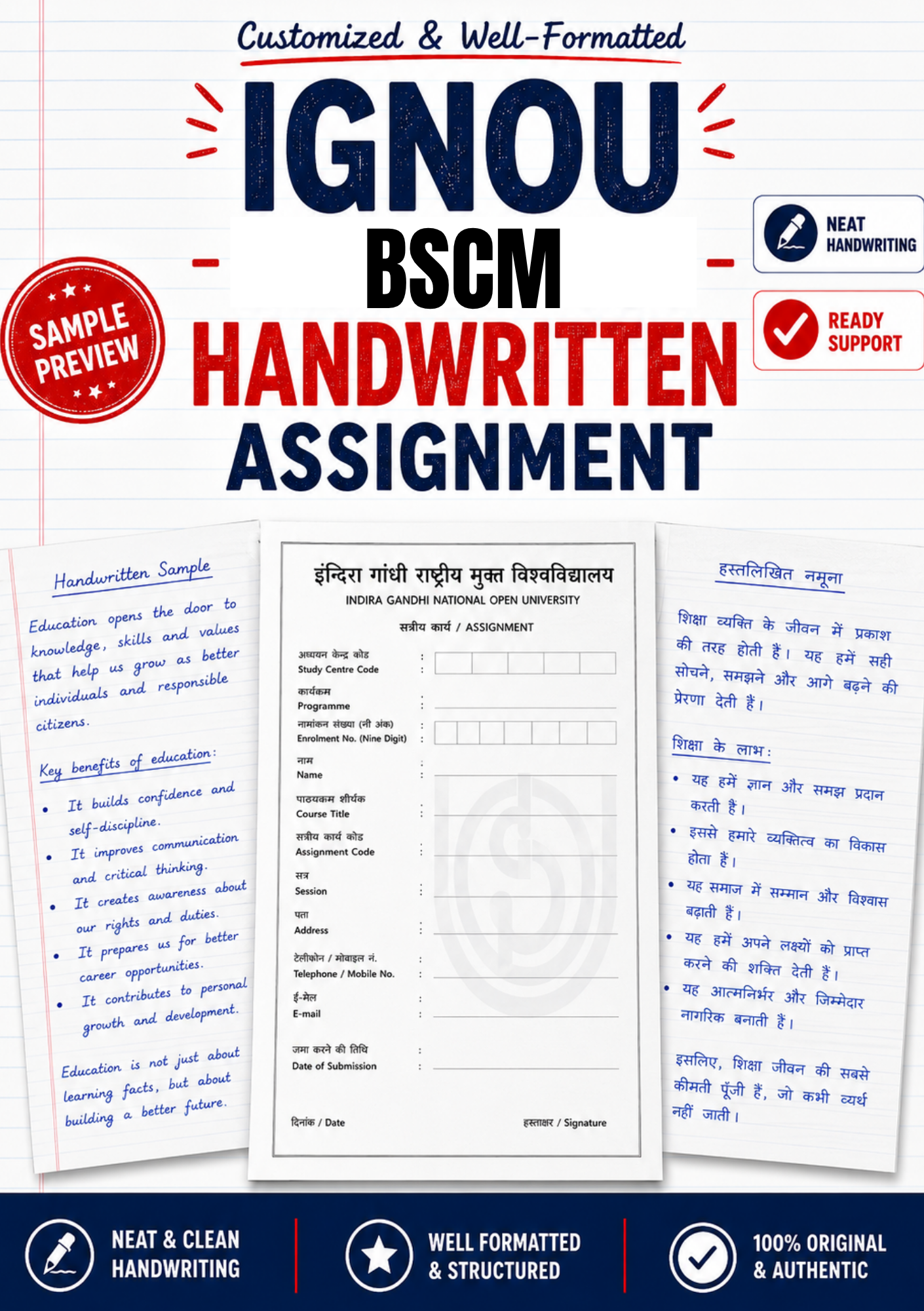
Each BSCM course code you order becomes one separately tied set of answer sheets. The answers are written by hand on foolscap-size paper of the ordinary, not very thin, variety, with a four-centimetre margin on the left, at the top and at the bottom, because that is what the 2026 BMTC-131, BZYCT-131 and BGYCT-131 booklets print in their formatting instructions and what the BSCM Programme Guide repeats in its own list of rules for tutor-marked work. Most general advice about IGNOU assignments says A4. For the School of Sciences, the paper itself says foolscap, and the set follows the paper.
On top of each set sits the free IGNOU-format front page. The School of Sciences booklets ask for a header block on the first answer sheet, and the front page is laid out with those fields in the order your own booklet prints them, so that the Study Centre coordinator and the counsellor who marks it can match the sheets to the course without searching. Behind the answers sits a copy of the official question paper for that code and that year, which lets you check at a glance that the questions answered are the questions IGNOU set.
Science answers are not only prose. The 2026 Zoology paper asks for the canal system in Porifera and the water vascular system of echinoderms, the Geology paper asks three times for neat, well-labelled diagrams of glacial landforms, faults and joints, and the Calculus paper asks you to trace a curve and to draw the circle described by a complex number. Where a question asks for a figure, the figure is drawn by hand inside the answer with its labels, rather than described in a sentence or left as a gap. Where a mathematics question asks for working, the working is shown line by line, because the BMTC-131 booklet tells you to indicate clearly which part of which question is being solved.
Nothing digital travels with the packet. No soft copy or PDF is sold. What you receive is paper, and the paper is the whole product.
Where Your ₹320 Goes on a BSCM Order, and Where It Stops
The rate is ₹320 per subject, hard copy only, with courier included in that price and no separate shipping charge. Inside that figure sit the writing of every answer to the booklet you name, the foolscap sheets, the free IGNOU-format front page, the copy of the question paper, the matching of the handwriting to a sample if you send one, and the courier to your address. There is no packing line, no handling line and no second charge for a Hindi paper.
The arithmetic is simple because BSCM is built in a fixed pattern of theory courses. A first-semester learner holds two discipline theory codes and one interdisciplinary code, so three papers come to ₹960. A second-semester learner holds two discipline theory codes, BEVAE-181 and the value-added course, so four papers come to ₹1,280. From the third semester onward every semester carries two discipline theory codes and two further theory codes, a language course and a skill course in the third, then a vocational course and a skill course in each of the last three, so a whole-semester order from the third semester on is four papers, or ₹1,280. If your disciplines include Physics, Chemistry, Botany, Zoology or Geology, the laboratory half of each pair is not counted, because there is nothing to write for it.
Several things sit outside the rate on purpose. Laboratory record books and practical files are not part of this product, since the BSCM laboratory courses are assessed on the experiments you perform at the Study Centre, not on a submitted assignment. IGNOU’s own examination form fee and any practical examination fee a Study Centre collects are paid by you to IGNOU. Delivery depends on your pin code and is confirmed for your order before you pay. No figure is promised on this page.
Assignments carry 30 per cent of the final course result and the term-end examination carries the remaining 70 per cent. The BSCM Programme Guide adds a condition worth knowing before you order anything: you must reach at least a D grade, which is 35 per cent, in the assignment component and in the term-end examination separately, and the two scores do not make up for each other.
BSCM Solved Assignment or Handwritten Set: Reading Copy Versus Submission Copy
The two products answer different needs, and learners searching for one often mean the other. A solved assignment is a soft-copy reference file of model answers for one course code and one session, meant to be read and understood. A handwritten assignment is the answer set for your Tutor Marked Assignment written out by hand on paper and handed in as a hard copy at your Study Centre. One is study material; the other is the thing the counsellor receives.
| Point of comparison | Solved assignment | Handwritten assignment set |
|---|---|---|
| Format | Soft-copy file of model answers | Answers written by hand on foolscap sheets, posted as paper |
| What you do with it | Read it, understand it, write your own answers | Review it, sign the declaration, hand it in at the Study Centre |
| Who it suits | A learner with time to write who wants a worked reference | A learner who needs the submission copy prepared on paper |
| Laboratory codes | Not applicable, no TMA exists | Not applicable, filtered out before quoting |
| Price line | Set per file on the solved-assignment shelves | ₹320 per subject, courier included |
On a narrow screen, swipe the table sideways to read every column.
IGNOU’s own documents settle the submission question more firmly than any seller can. The BSCM Programme Guide, in its instructions for tutor-marked assignments, says: “Write the response in your own hand. Do not print or type the answers.” The same list tells you not to reproduce answers from the units the University sends, and warns that assignments showing copying from other learners’ sheets will be rejected. The 2026 BGYCT-131 booklet adds a line directly under its note: “Write all answers in your own words; do not copy from the course material.” A printed or downloaded file is therefore not a submission, and nothing on this page suggests otherwise. You sign the declaration on the assignment cover page, so you should read and review the content before submitting it, and satisfy yourself that it represents your own understanding of the course.
If what you actually want is a reference to write from, the shared B.Sc. theory codes that BSCM inherits are shelved under the store’s Bachelor of Science solved assignment section. That shelf still carries the older BSCG heading because the store has not yet opened a BSCM-named one, which is listed in the warning box further down.
Three disciplines, one list, one quote.
Copy the theory codes from your registration record, including the codes outside your disciplines, and say which year is printed on your booklet cover. Laboratory codes are taken out before any total is worked out.
₹320 per subject · hard copy · courier included in the price
Which BSCM Discipline Codes Get a Written Paper
The Common Prospectus for July 2026 divides the seven BSCM disciplines into five Groups and lets you take only one discipline from each Group: Physics alone in Group 1, Chemistry alone in Group 2, Mathematics or Botany in Group 3, Zoology or Geography in Group 4 and Geology alone in Group 5. Disciplines A and B start in the first semester and Discipline C joins in the second, and over six semesters you complete four courses of six credits in each of the three, which is 72 discipline credits in all.
How those six credits are packaged decides what you order. In Botany, Chemistry, Geology, Physics and Zoology a six-credit course is a four-credit theory code taken together with a two-credit laboratory code, and the two must be taken as a pair. Mathematics has no laboratory work, so each of its four courses is one six-credit code. Geography is mixed: three of its courses are six-credit theory codes and one, General Cartography, is a theory and laboratory pair. The Programme Guide states plainly that there will be no written assignments for laboratory courses, and the lab codes are evaluated on the experiments you perform at the Study Centre instead. The table below therefore lists every theory code that carries a Tutor Marked Assignment with its laboratory partner beside it, so that you can see at once which half of a pair you are paying for.
| Group and discipline | Theory code (TMA) | Official title | Credits | Paired lab code (no TMA) |
|---|---|---|---|---|
| Group 1 Physics | BPHCT-131 | Mechanics | 4 | BPHCL-132 (2) |
| Group 1 Physics | BPHCT-133 | Electricity and Magnetism | 4 | BPHCL-134 (2) |
| Group 1 Physics | BPHCT-135 | Thermal Physics and Statistical Mechanics | 4 | BPHCL-136 (2) |
| Group 1 Physics | BPHCT-137 | Wave and Optics | 4 | BPHCL-138 (2) |
| Group 2 Chemistry | BCHCT-131 | Atomic Structure, Bonding, General Organic Chemistry and Aliphatic Hydrocarbons | 4 | BCHCL-132 (2) |
| Group 2 Chemistry | BCHCT-133 | Chemical Energetics, Equilibria and Functional Group Organic Chemistry-I | 4 | BCHCL-134 (2) |
| Group 2 Chemistry | BCHCT-135 | Solutions, Phase equilibrium, Conductance, Electrochemistry and Functional Group Organic Chemistry-II | 4 | BCHCL-136 (2) |
| Group 2 Chemistry | BCHCT-137 | Coordination Chemistry, States of Matter and Chemical Kinetics | 4 | BCHCL-138 (2) |
| Group 3 Mathematics | BMTC-131 | Calculus | 6 | None |
| Group 3 Mathematics | BMTC-132 | Differential Equations | 6 | None |
| Group 3 Mathematics | BMTE-141 | Linear Algebra | 6 | None |
| Group 3 Mathematics | BMTE-144 | Numerical Analysis | 6 | None |
| Group 3 Botany | BBYCT-131 | Biodiversity (Microbes, Algae, Fungi and Archegoniates) | 4 | BBYCL-132 (2) |
| Group 3 Botany | BBYCT-133 | Plant Ecology and Taxonomy | 4 | BBYCL-134 (2) |
| Group 3 Botany | BBYCT-135 | Plant Anatomy and Embryology | 4 | BBYCL-136 (2) |
| Group 3 Botany | BBYCT-137 | Plant Physiology and Metabolism | 4 | BBYCL-138 (2) |
| Group 4 Zoology | BZYCT-131 | Animal Diversity | 4 | BZYCL-132 (2) |
| Group 4 Zoology | BZYCT-133 | Comparative Anatomy and Developmental Biology of Vertebrates | 4 | BZYCL-134 (2) |
| Group 4 Zoology | BZYCT-135 | Physiology and Biochemistry | 4 | BZYCL-136 (2) |
| Group 4 Zoology | BZYCT-137 | Genetics and Evolutionary Biology | 4 | BZYCL-138 (2) |
| Group 4 Geography | BGGCT-131 | Physical Geography | 6 | None |
| Group 4 Geography | BGGCT-132 | Human Geography | 6 | None |
| Group 4 Geography | BGGCT-133 | General Cartography | 4 | BGGCL-134 (2) |
| Group 4 Geography | BGGCT-135 | Environmental Geography | 6 | None |
| Group 5 Geology | BGYCT-131 | Physical and Structural Geology | 4 | BGYCL-132 (2) |
| Group 5 Geology | BGYCT-133 | Crystallography, Mineralogy and Economic Geology | 4 | BGYCL-134 (2) |
| Group 5 Geology | BGYCT-135 | Petrology | 4 | BGYCL-136 (2) |
| Group 5 Geology | BGYCT-137 | Stratigraphy and Palaeontology | 4 | BGYCL-138 (2) |
On a narrow screen, swipe the table sideways to read every column.
Each discipline adds up to 24 credits whichever way it is packaged: four pairs of four and two in the laboratory disciplines, four single codes of six in Mathematics, and six, six, four plus two, and six in Geography. Across the seven disciplines that is 28 theory codes with a written paper and 21 laboratory codes without one. Whatever three disciplines you choose, you will write exactly twelve discipline assignments across the degree, four per discipline; what changes between combinations is only how many laboratory codes you also carry. A Chemistry, Mathematics and Physics learner holds eight laboratory codes, while a Mathematics, Geography and Geology learner holds five.
Two titles in this table are printed differently elsewhere in IGNOU’s own paperwork. BPHCT-137 appears as Wave and Optics in the prospectus and as Waves and Optics in the Programme Guide, and BMTE-144 appears as Numerical Analysis in the BSCM list but as Algebra in the Mathematics list of the neighbouring BAM chapter of the same prospectus. The table follows the BSCM list, and the four-year Mathematics programme guide also names BMTE-144 Numerical Analysis. Your registration record is the final word on your own code and title.
Courses Outside Your Three Science Disciplines
Forty-eight of the 120 credits come from outside your three disciplines, and none of those courses is a laboratory code, which means each of them is normally a written paper you can order. One interdisciplinary course of six credits is taken in the first semester from a discipline other than your three. BEVAE-181 Environmental Studies is the compulsory first ability-enhancement course and a second ability-enhancement course in English, Hindi, Urdu or Sanskrit follows in the third semester. Four skill-enhancement courses of four credits run from the third semester to the sixth, three vocational courses of four credits run from the fourth to the sixth, and the value-added course BEDSV-101 carries six credits.
| Semester | Courses in the slot pattern | Credits | Exit available |
|---|---|---|---|
| 1 | Discipline A and Discipline B (6 each), one interdisciplinary course (6) | 18 | None |
| 2 | Discipline C starts and Discipline A continues (6 each), BEVAE-181 (4), value-added course (6) | 22 | UG Certificate at 40 credits plus a 4-credit vocational course |
| 3 | Disciplines B and C (6 each), second ability-enhancement course (4), skill course 1 (4) | 20 | None |
| 4 | Disciplines A and B (6 each), vocational course (4), skill course 2 (4) | 20 | UG Diploma at 80 credits plus a 4-credit vocational course |
| 5 | Disciplines C and A (6 each), vocational course (4), skill course 3 (4) | 20 | None |
| 6 | Disciplines B and C (6 each), vocational course (4), skill course 4 (4) | 20 | UG Degree at 120 credits |
On a narrow screen, swipe the table sideways to read every column.
The six semesters add up to 120, and so do the prospectus category totals of 72 discipline credits, 12 vocational credits, 8 ability-enhancement credits, 22 credits across the interdisciplinary and skill slots, and 6 value-added credits. The codes that fill the non-discipline slots are listed next, with titles exactly as the prospectus prints them.
| Slot | Code | Title as printed | Credits |
|---|---|---|---|
| Interdisciplinary | BEGG-171 | Media and Communication Skills | 6 |
| Interdisciplinary | BPAG-171 | Disaster Management | 6 |
| Interdisciplinary | BPCG-171 | General Psychology | 6 |
| Interdisciplinary | BPYI-101 | Applied Ethics | 6 |
| Interdisciplinary | BMDG-171 | Disability, Society and Culture | 6 |
| Interdisciplinary | BABG-171 | Understanding Ambedkar | 6 |
| Interdisciplinary | BDIG-171 | Introduction to Migration and Diaspora | 6 |
| Interdisciplinary | BSOG-171 | Indian Society: Images and Realities | 6 |
| Interdisciplinary | BHDG-175 | Madhyakaneen Bharatiya Sahitya Evam Sanskriti | 6 |
| Interdisciplinary | BSKG-178 | Pracheen Bharatiya Rajniti | 6 |
| Ability enhancement | BEVAE-181 | Environmental Studies | 4 |
| Ability enhancement | BEGAE-182 | English Communication Skills | 4 |
| Ability enhancement | BHDAE-182 | हिंदी भाषा और संप्रेषण (Hindi language and communication) | 4 |
| Ability enhancement | BUDAE-182 | Study of Urdu Progressive Poetry | 4 |
| Ability enhancement | BSDAE-182 | Sanskrit | 4 |
| Value-added | BEDSV-101 | Value Education | 6 |
| Skill enhancement | BMPS-183 | Employability and AI Skills | 4 |
| Skill enhancement | ENV-104 | Fundamentals of Plastic Waste Management | 4 |
| Skill enhancement | BANS-183 | Tourism Anthropology | 4 |
| Skill enhancement | BCHS-183 | Laboratory Management Skills | 4 |
| Skill enhancement | BCOS-183 | Computer Application in Business | 4 |
| Skill enhancement | BEGS-183 | Writing and study Skills | 4 |
| Skill enhancement | BHDS-183 | Anuvaad Sidhaant Evam Pravidhi | 4 |
| Skill enhancement | BHIS-183 | Traditions and Perception of Craft in Bharat | 4 |
| Skill enhancement | BPCS-183 | Emotional Intelligence | 4 |
| Skill enhancement | BPCS-185 | Developing Emotional Competence | 4 |
| Skill enhancement | BSSS-183 | Life Skills | 4 |
| Skill enhancement | BTTS-183 | An Introduction to Machine Translation | 4 |
| Skill enhancement | ONR-02 | Basics of Hydrology | 4 |
| Skill enhancement | BANS-184 | Public Health and Epidemiology | 4 |
| Skill enhancement | BPCS-184 | School Psychology | 4 |
| Skill enhancement | BSOS-184 | Techniques of Ethnographic Film Making | 4 |
| Skill enhancement | BCOS-184 | E-Commerce | 4 |
| Skill enhancement | BSLS-183 | Elementary Spanish | 4 |
| Skill enhancement | BFDI-073 | Introduction to Fashion Industry | 4 |
| Skill enhancement | BSOS-185 | Society through the Visual | 4 |
| Skill enhancement | BEGS-185 | English Language Teaching | 4 |
| Skill enhancement | BFLS-183 | Elementary French | 4 |
| Skill enhancement | BEGS-186 | Business Communication | 4 |
| Skill enhancement | BPAS-186 | Stress and Time Management | 4 |
| Skill enhancement | BPCS-186 | Managing Stress | 4 |
| Skill enhancement | BPCS-187 | Managing Human Resources | 4 |
| Skill enhancement | BPCS-188 | Application of Social Psychology | 4 |
| Vocational | BHDS-184, BPAS-184, BECS-184, BCOS-185, BCOS-186 | No title printed in the BSCM section | 4 each |
On a narrow screen, swipe the table sideways to read every column.
The vocational row is left without titles deliberately. The BSCM chapter of the prospectus prints those five codes in the semester menus and gives no title for any of them, so a title quoted from another source cannot be checked against this programme’s own document. Read the title off your registration record and name the code exactly as it prints there when you order. The same caution applies to three interdisciplinary codes, BHIE-143, BSOG-173 and BPYG-171, which appear in the first-semester menu but not in the interdisciplinary list beneath it.
Fifteen Points Where the BSCM Paperwork Disagrees With Itself
The prospectus, the BSCM Programme Guide and the 2026 booklets were read against each other for this page, and so were this publisher’s own store pages and its sister site. Every disagreement found is listed below, including the ones that are this publisher’s own. None of them has been silently resolved.
Read these before you order. Where two documents disagree, follow the one printed for your own enrolment and ask your Study Centre in writing.
1. Four covers, four programme labels. Among the 2026 School of Sciences files, IGNOU’s own listing shows the BBYCT-131 booklet headed BSCM alone, the BGYCT-131 booklet names BSCG and BSCM together, the BZYCT-131 booklet names BSCG only, and the BMTC-131 booklet names no programme at all. All four codes are BSCM first-semester discipline codes. A cover that says BSCG is not a wrong paper; the older and newer B.Sc. programmes share these codes.
2. A paper announced in three parts and printed in none. The 2026 BZYCT-131 booklet says the assignment consists of Parts A, B and C and asks you to complete each part separately, but the question section prints ten numbered questions with no part headings. BGYCT-131 announces two parts and prints them. BMTC-131 has no parts. The Programme Guide says two to three parts depending on the course.
3. Three different rules on when to submit. BGYCT-131 prints a table of dates. BZYCT-131 prints none and says the Study Centre sets the schedule. BMTC-131 prints only its validity window. The section after this box sets them out side by side.
4. A pass mark printed on some papers only. BZYCT-131 and BGYCT-131 state that 35 per cent of the 100 marks is needed to pass the assignment. BMTC-131 says nothing about a pass mark. The Programme Guide requires a D grade, which is 35 per cent, in the assignment component for every course.
5. Two different header blocks. All three booklets read ask for ROLL NO. and ASSIGNMENT NO. on the first answer sheet. The Programme Guide’s own template asks for ENROLMENT NO., PROGRAMME TITLE, ASSIGNMENT CODE and a SIGNATURE line. The section on decoding the assignment code explains what to write.
6. One code, two titles in one prospectus. BMTE-144 is Numerical Analysis in the BSCM list and Algebra in the BAM Mathematics list of the same July 2026 prospectus.
7. One code, two prefixes. The Programme Guide’s fourth-semester row prints BMTC-141 where the prospectus and the fifth-semester row print BMTE-141 Linear Algebra.
8. Wave or Waves. BPHCT-137 is Wave and Optics in the prospectus and Waves and Optics in the Programme Guide.
9. Two names for the degree. The prospectus calls it Bachelor of Science (BSCM); the Programme Guide calls it Bachelor of Science (Multidisciplinary) under the UGC-FYUP scheme.
10. Two fees. The prospectus prints Rs. 6,500 per year. The Programme Guide prints Rs. 16,500 for the full programme at Rs. 5,500 per year. Confirm the current fee with your Regional Centre; it has no bearing on the assignment rate here.
11. The value-added course in two semesters. Both documents say in their text that the value-added course is offered only in the first semester, and both tables place VAC-01, BEDSV-101, in the second.
12. A science list introduced as an arts list. The prospectus heads the BSCM code lists as courses of the Bachelor of Arts Programme for the first to forth semesters. The Programme Guide’s own list stops at the second semester and still carries an editor’s note asking when and how the later courses will be added.
13. Typesetting slips in the slot tables. The prospectus labels the sixth-semester skill slot SEC-3 a second time, labels all three vocational slots VOC-1, prints BFDI73 in the menu against BFDI073 in the list, lists ENV-104 twice and BSDAE-182 twice, and the Programme Guide’s Table 2 prints 40 credits against all three exits where its Table 1 correctly prints 40, 80 and 120.
14. An error on this publisher’s sister site. The ignouproject.com BSCM article states that the 2026 BSCM booklets print a validity window rather than a cut-off. The 2026 BGYCT-131 booklet prints a submission table with two dates. That article is being corrected; the booklet is right.
15. Errors on this store’s own shelves. Solved files for BSCM codes sit under a BSCG heading because no BSCM-named solved shelf exists yet; the BEDSV-101 guess paper, a BSCM value-added course, is filed under the BSCG guess-paper category; one solved-assignment page lists BSCM among the programmes for BPCM-161, a code that appears nowhere in the BSCM lists; the store’s handwritten category page still says A4, a 7 to 9 working day window and a founding year of 2012; and several solved-assignment pages still quote ₹350 and a working-day window for handwritten work. This page states ₹320, foolscap for School of Sciences papers, and no delivery figure.
Three 2026 School of Sciences Booklets, Three Different Deadline Rules
Deadlines at IGNOU are set per school, and at the School of Sciences they are not even uniform per school. The 2026 booklets for three first-semester BSCM codes were opened and read in full for this page, and a fourth was checked in IGNOU’s own file listing. Each one fixes the same validity window, from 1 January 2026 to 31 December 2026, and each one says that a paper failed or not submitted by December must be replaced by the next year’s paper. Beyond that, they diverge.
| Booklet | Programme on cover | What it says about the due date | Parts | Pass mark printed |
|---|---|---|---|---|
| BGYCT-131 Physical and Structural Geology (read in full) | BSCG/BSCM | Table: January 2026 admission, 31 March 2026; July 2026 admission, 30 September 2026, at the Study Centre; may be changed by the University | A and B, as announced | 35 per cent |
| BZYCT-131 Animal Diversity (read in full) | BSCG only | No date; submit as per the schedule made by the Study Centre; late sheets not accepted | A, B and C announced, none printed | 35 per cent |
| BMTC-131 Calculus (read in full) | None named | No date; validity window only | None | Not printed |
| BBYCT-131 Biodiversity (listing checked) | BSCM | Validity window; replace with next year’s paper if missed | Not read | Not read |
On a narrow screen, swipe the table sideways to read every column.
Read the table as three rules, not one. If your code’s booklet prints a date table, as the Geology paper does, that printed date is the one to plan against, and for a July 2026 admission it is 30 September 2026. Note that the Geology table pairs the January admission with the March date and the July admission with the September date, which is the reverse of how several other schools pair them; copy it from your own booklet rather than from memory. If your booklet defers to the Study Centre, as the Zoology paper does, the date is whatever your Study Centre coordinator announces, and it is worth asking for it in writing. If your booklet prints only the validity window, as the Calculus paper does, the practical deadline is set by a different rule that every one of these booklets shares.
That shared rule is the examination form. Every booklet read says you cannot fill the examination form for the course until you have submitted the assignment, and the Geology cover prints the same warning in bold under its title. The Programme Guide goes further and says a term-end result obtained without the required assignments submitted is liable to be cancelled. In practice, then, the latest safe point for a BSCM set is not 31 December; it is before the examination form for that course, and in the Geology case it is the date printed in the table. The Programme Guide adds one allowance worth knowing: if your study material and assignment reached you late, the responses may be submitted within one month of receipt or by the last date printed in the booklet, whichever is later. Programme structures, course codes, submission dates and rules change, and only ignou.ac.in and your Regional Centre can confirm the current position for your enrolment.
If your printed date is close, say so in the first message. Writing a set takes real days and courier takes real days, and a straight answer on whether a set can reach you in time is more useful than an optimistic one.
Decoding BMTC-131/TMA/2026 and the Cover Lines Above It
Every School of Sciences paper read for this page prints its assignment code in one pattern: course code, the letters TMA for Tutor Marked Assignment, and the year, separated by single slashes. The three read in full print BMTC-131/TMA/2026, BZYCT-131/TMA/2026 and BGYCT-131/TMA/2026. The year in that string is the calendar year of validity, not an admission session, and one booklet serves both the January and the July intakes of that year. That is different from schools that print a session pair such as July and January, and it is why a BSCM learner is asked for the year on the booklet cover rather than for a session name.
The code tells you whether the paper is still live. A booklet carrying 2025 in its code has, by its own printed text, lapsed at the end of December 2025, and a learner who did not submit it is told to take the next year’s assignment instead. A set written against a lapsed paper answers questions IGNOU no longer asks, so the year is checked before a single answer is drafted.
The header block is where learners hesitate. The booklets ask for ROLL NO., NAME, ADDRESS, COURSE CODE, COURSE TITLE, ASSIGNMENT NO., STUDY CENTRE and DATE, in that order, and ask you to follow the format strictly. Write your enrolment number against ROLL NO. and the full assignment code, such as BMTC-131/TMA/2026, against ASSIGNMENT NO. The Programme Guide’s version asks additionally for the programme title and your signature; adding BSCM as the programme title and signing costs nothing and satisfies both. The free front page is prepared with these fields, and you complete and sign the personal ones yourself.
The Calculus paper also carries one working instruction that the life-science papers do not: while solving problems, indicate clearly which part of which question is being solved. With sub-parts carrying ten, five, three and two marks, that labelling is how a counsellor finds the four-mark verification of Lagrange’s mean value theorem among the six-mark reduction formula around it.
A BSCM Set Written in a Hand That Looks Like Yours
Send a photo of a page you have written yourself and the handwritten set is matched to your handwriting at no extra charge. A counsellor at your Study Centre may see your handwriting more than once across a semester, on several assignments and sometimes in counselling sessions, and a set that looks like the rest of your work reads naturally beside it. Before you pay anything, a sample of the matched writing is shared with you on WhatsApp, so you judge the match rather than taking it on trust.
Matching matters more in a science degree than in most. A BSCM answer moves between sentences, symbols, subscripts, units, chemical formulae and labelled figures, sometimes within a single line, and a hand that changes character between prose and notation is noticeable. The match therefore attends to how you form digits, Greek letters, arrows and fraction bars, not only to your slant and letter size.
Taking the Sample Photo for Formula-Heavy Pages
Photograph half a page of your own ordinary writing in daylight, held flat, with the camera directly above it. For a BSCM order the most useful sample includes a few lines of prose and a few lines of working: a short equation with a fraction and an exponent, a chemical formula with subscripts, or a labelled line in a diagram. One such photo covers all your codes. If you write differently in Hindi and in English, and you are ordering in Hindi, send a Hindi sample.
Send My Handwriting Photo for the BSCM Set
English or Hindi, 2026 or a Backlog Year: What the BSCM Order Accepts
The service covers all mediums IGNOU issues the TMA paper in, at the same price. For BSCM that is a genuine choice between two papers, because the prospectus records the medium of instruction as English and Hindi, and IGNOU’s B.Sc. assignment index has historically listed a Hindi and an English file against each science theory code. Tell us which medium you registered in. The Programme Guide allows a change of medium only within 30 days of receiving the first set of material in the first year, so the medium on your record is almost certainly the one your answers must be in.
Any session is accepted, current cycle or older, including backlog courses, at the same ₹320 per subject. For BSCM, one caution goes with that line. Because each School of Sciences paper is valid for one calendar year and must be replaced if missed, a backlog code is normally written against the current year’s paper, not the year you first registered. A 2025 Calculus paper left unsubmitted is, on IGNOU’s own wording, replaced by the 2026 paper. Name the year printed on the booklet you intend to submit, and the set is written to that booklet.
There is no minimum order: one subject or fourteen, same rate. A single BEVAE-181 is a complete order, and so is a Discipline C code alone. Learners who exited with the UG Certificate or UG Diploma and have since returned simply order the codes still open on their record.
The Five Facts a BSCM Order Needs From You
A BSCM order starts well when the first message carries five things. The theory course codes exactly as they print on your registration or re-registration record, with any laboratory codes left in if you are unsure; they will be taken out and you will be told which ones. The year printed on each booklet cover, which for most codes today is 2026. The medium, English or Hindi. Your pin code, so that delivery can be confirmed before payment. And, if you want the writing matched, the photo of your own handwriting described above.
It also helps to say which of your disciplines is A, B and C, because the semester your codes belong to follows from that order. It does not change the price. It does help catch a mistake early, such as a second-semester list that carries a 131 code for Discipline A instead of the 133 code the slot table expects.
Codes, year, medium, pin code, photo. That is the whole order.
Send the five details in one message and receive a count of papers, a total at ₹320 each, and a sample of the writing before any payment.
₹320 per subject · no minimum · English or Hindi
Between Courier Delivery and the Study Centre Counter
When the packet arrives, read each set against its question paper before doing anything else. Check the code and the year on the front page, check that the answers follow the booklet’s own question numbering, and check that every figure the paper asks for is drawn. You sign the declaration on the assignment cover page, so you should read and review the content before submitting it, and satisfy yourself that it represents your own understanding of the course.
Complete the personal fields the header block asks for, sign, and tie each code’s sheets separately, since the Programme Guide asks for each assignment to be written separately rather than run together. Hand the sets to the coordinator of the Study Centre allotted to you. The Programme Guide is explicit that tutor-marked sheets must never be sent to the Student Registration and Evaluation Division at headquarters, and it asks you to collect an acknowledgement from the coordinator on the prescribed remittance-cum-acknowledgement card. If you have applied for a change of Study Centre, the guide says to keep submitting to the original centre until the change takes effect.
Keep a photocopy of everything you submit. The counsellors at the Study Centre evaluate the sets and the coordinator returns them with comments and marks; the guide suggests collecting them in person if they have not come back within a month of submission. No claim is made about the marks any assignment will receive, about how an evaluator will assess it, or about whether it will be accepted. Assignment evaluation is entirely a matter for IGNOU.
Other Shri Chakradhar Shelves for BSCM Learners
The handwritten set is one product among several that BSCM learners order, and each of the others lives on its own shelf rather than being bundled here. For preparation, the store keeps a BSCM new-syllabus help book shelf organised by discipline. Learners taking the six-credit Mathematics codes can go straight to the BMTC and BMTE guide books, and those facing the paired theory and laboratory codes of Group 1 can start with the Physics help books for BPHCT codes.
The courses outside your three disciplines have shelves of their own. Your first-semester choice is covered by the interdisciplinary course books for BSCM, the language slots by the ability enhancement books such as BEVAE-181, and the second-semester value course by the Value Education book shelf.
For the term-end examination, the BEDSV-101 Value Education guess paper is written for BSCM learners, and guess papers for the shared science theory codes sit in the B.Sc. solved guess paper category. A household with a learner on the sister arts degree can use the BAM multidisciplinary handwritten product, which runs at the same rate, and every other programme is listed on the IGNOU handwritten assignment category page.
If you would rather write the BSCM answers yourself, the free BSCM code-by-code guide on ignouproject.com covers the same programme from the writing side, and the 2026 question papers are free from IGNOU’s assignment download service.
BSCM Order Doubts, Settled Before Payment
Does BSCM mean B.Sc. Mathematics?
No. BSCM is the three-year Bachelor of Science (Multidisciplinary) run by the School of Sciences, in which you take three of seven disciplines: Botany, Chemistry, Geography, Geology, Mathematics, Physics and Zoology. Mathematics is one option inside Group 3. The four-year Mathematics degree is a separate programme with the code BSCFMT.
Do the lab courses like BPHCL-132 need a written assignment?
No. The BSCM Programme Guide states that there will be no written assignments for laboratory courses. Codes ending in CL, such as BPHCL-132, BCHCL-134 or BGGCL-134, are assessed on the experiments you perform at the Study Centre, with guided experiments carrying 70 per cent and an unguided test 30 per cent. Send them in your list if unsure; they are removed and not charged.
My booklet says BSCG on the cover but I am in BSCM. Is it the wrong paper?
Usually not. The 2026 BZYCT-131 booklet names only BSCG, the BGYCT-131 booklet names BSCG and BSCM, and the BMTC-131 booklet names no programme, yet all three are first-semester BSCM discipline codes. The older and newer B.Sc. programmes share these course codes, so the code and year matter more than the label.
What is the last date to submit a BSCM assignment in 2026?
It depends on the booklet. The 2026 Geology paper BGYCT-131 prints 31 March 2026 for the January 2026 admission and 30 September 2026 for the July 2026 admission. The Zoology paper defers to the Study Centre schedule, and the Calculus paper prints only its validity window ending 31 December 2026. All of them require submission before you fill the examination form for that course.
Can I submit the assignments in printed form or is it only allowed in written format?
Written by hand. The BSCM Programme Guide tells learners to write the response in their own hand and not to print or type the answers, and the School of Sciences booklets specify foolscap writing paper with a 4 cm margin. A printed or typed BSCM assignment does not follow the guide.
Is a BSCM solved assignment the same thing as a handwritten one?
No. A solved assignment is a soft-copy reference file of model answers that you read and write from. A handwritten assignment is the answer set on paper that you review, sign and hand in. IGNOU’s own BGYCT-131 booklet asks for answers in your own words, without copying from the course material, so a downloaded file is never a submission.
Assignment ke answer plain paper par likhe ya lines wale paper par?
For BSCM, the School of Sciences booklets say foolscap-size writing paper that is not of a very thin variety, with a 4 cm margin on the left, top and bottom, and the Programme Guide adds at least four lines of space between answers. The booklets do not specify ruled or plain, so size, thickness and margin are the rules to follow.
How many BSCM assignments will I write in a semester?
Usually three in the first semester, two discipline codes and one interdisciplinary code, and four in the second, two discipline codes plus BEVAE-181 and BEDSV-101. Later semesters carry two discipline codes plus one or two language, skill or vocational codes. Across the degree that is twelve discipline papers plus the non-discipline theory courses, with no paper for any laboratory code.
What does BMTC-131/TMA/2026 mean on my Calculus paper?
It is the course code, the letters for Tutor Marked Assignment, and the year of validity. The 2026 paper is valid from 1 January to 31 December 2026 and serves both intakes of that year. Write the full string against ASSIGNMENT NO. in the header block on your first answer sheet.
Is the BSCM assignment available in Hindi medium?
Yes. The prospectus records English and Hindi as the medium of instruction for BSCM, and IGNOU’s B.Sc. assignment index has listed Hindi and English files against the science theory codes. The service covers all mediums IGNOU issues the TMA paper in, at the same price, so a Hindi set is also ₹320 per subject.
I never submitted my 2025 BSCM paper. What should be written?
By the wording of every School of Sciences booklet read, a paper missed in its own year is replaced by the next year’s paper, so a 2025 backlog code is normally written against the 2026 booklet. Name the year printed on the booklet you will actually submit, and the set is written to that booklet.
Is BMTE-144 Numerical Analysis or Algebra?
The BSCM list in the July 2026 prospectus and the Mathematics programme guide both call BMTE-144 Numerical Analysis. The BAM Mathematics list in the same prospectus prints it as Algebra, which is the title of a different code, BMTC-134, in the four-year Mathematics degree. Order by the code and check the title on your own record.
How much will a first-semester BSCM order cost?
Three theory papers at ₹320 each, so ₹960, with courier included. That covers two discipline codes and your interdisciplinary code. If one of your first-semester disciplines is Physics, Chemistry, Botany, Zoology or Geology, its laboratory code is not counted.
Can the handwriting be matched when my answers are full of formulae?
Yes, and a sample with some working in it helps most. Send half a page that mixes a few lines of prose with an equation, a chemical formula or a labelled line, so the digits, subscripts and symbols are matched along with the letters. A sample of the matched writing is shared before you pay.
How soon will the BSCM set reach me if my printed date is 30 September?
Delivery depends on your pin code and is confirmed for your order before you pay. No figure is promised on this page. If the date on your Geology booklet or your Study Centre’s notice is close, say so in your first message and you will get a straight answer on whether a set can reach you in time.
How This BSCM Page Was Checked, and Against What
Three kinds of statement appear on this page, and they come from three different places. They are kept apart below so that you can tell an IGNOU rule from a commercial term.
Important Notice
Shri Chakradhar Publication Pvt. Ltd. and shrichakradhar.com form an independent IGNOU study-support publisher. This is not the official website of Indira Gandhi National Open University, is not affiliated with, endorsed by or authorised by the university, and no page on this site should be treated as an official IGNOU communication.
Programme structures, course codes, submission dates and rules change, and only ignou.ac.in and your Regional Centre can confirm the current position for your enrolment.
You sign the declaration on the assignment cover page, so you should read and review the content before submitting it, and satisfy yourself that it represents your own understanding of the course.
No claim is made about the marks any assignment will receive, about how an evaluator will assess it, or about whether it will be accepted. Assignment evaluation is entirely a matter for IGNOU.
Order the BSCM Theory Codes You Actually Hold
The rate is ₹320 per subject, hard copy only, with courier included in that price and no separate shipping charge. There is no minimum order: one subject or fourteen, same rate.
Laboratory codes are filtered out, the booklet year is checked against your cover, and the writing is matched to your own hand before you pay.
Check My BSCM Code List First · Order a Single BSCM Paper
WhatsApp +91 93546 37830 · Shri Chakradhar Publication is an independent publisher, not IGNOU.