

Description
In short. A BSCFFSQM handwritten assignment is the answer set for one Tutor Marked Assignment of B.Sc. (Food Safety and Quality Management), the 120-credit four-year-framework degree the School of Agriculture (SOA) runs under code BSCFFSQM, written out by hand on paper and handed in at your Learner Support Centre, and Shri Chakradhar Publication prepares that set one course code at a time across the ten discipline-specific core papers BPVC-101 to BPVC-110 and the Minor, Skill Enhancement, Ability Enhancement, Interdisciplinary and Value-Added papers that fill the rest of each semester. The rate is ₹320 per subject, hard copy only, with courier included in that price and no separate shipping charge. No soft copy or PDF is sold. The service covers all mediums IGNOU issues the TMA paper in, at the same price, and for BSCFFSQM that means English, the only medium the July 2026 Common Prospectus and the School of Agriculture programme guide record. Every BPVC booklet is worth 100 marks split into Part A, five questions of 10 marks each answered in about 500 words, and Part B, a set of activities worth the other 50, and both parts are handed in together. The July-cycle last date printed on the BPVC papers is 30 March of the following year and the January-cycle date is 30 September of the same year, and orders go through WhatsApp on +91 93546 37830.
What Reaches You When a BPVC Set Is Couriered
A BSCFFSQM order arrives as paper, tied and ready to carry into a Learner Support Centre. Four things are inside it for every code you ordered.
- The written answer set. Part A of the booklet answered by hand, each of the five questions numbered and answered at roughly the 500-word length the paper asks for, on foolscap sheets with the 3 inch left margin that General Instruction 9 of the BPVC booklets specifies.
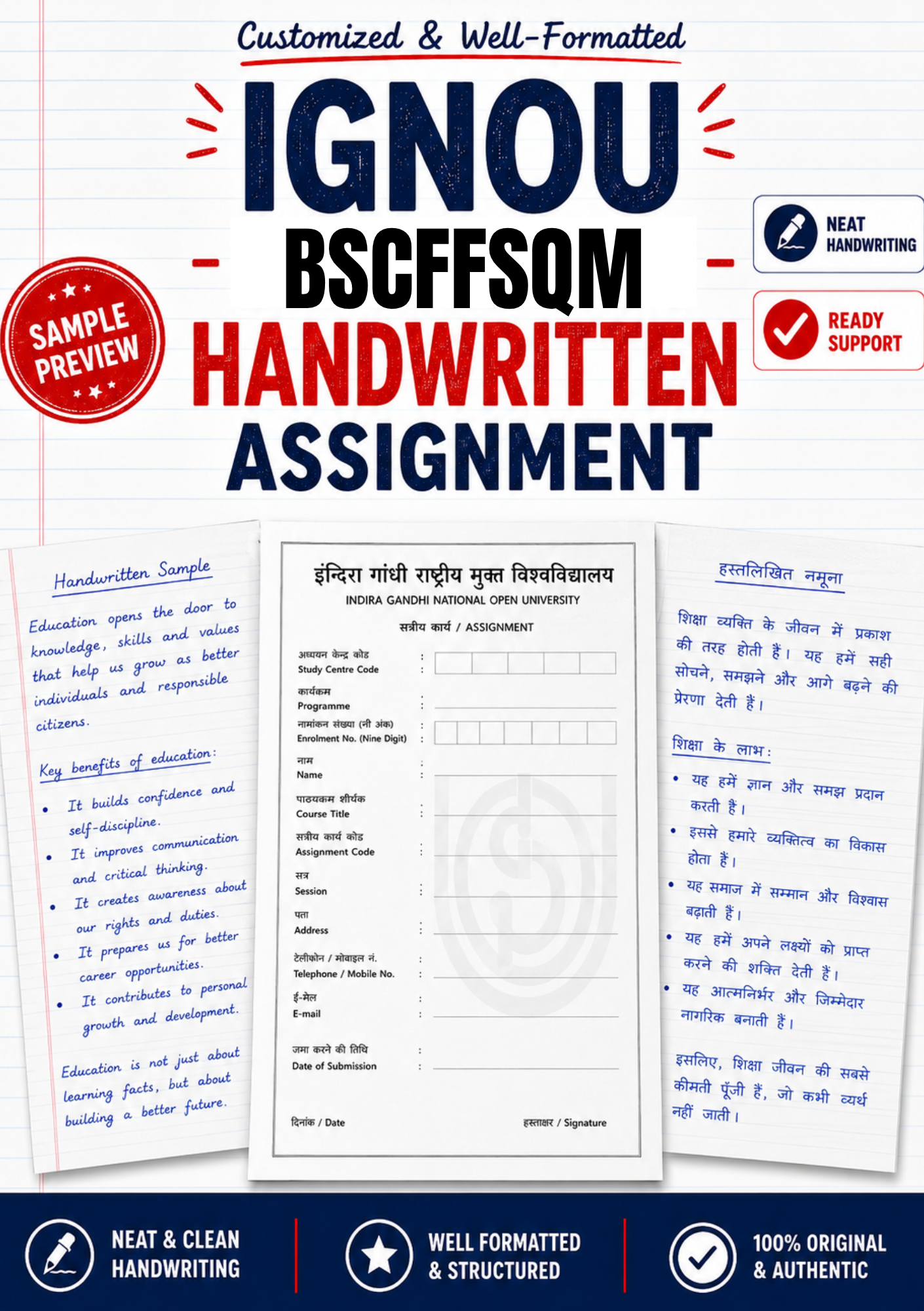
- The IGNOU-format front page, free. Programme title, course code, course title, study centre code and place laid out on the left, with the enrolment number, name, address and date block on the right, matching the format box printed inside the BPVC booklet itself. The booklet notes that students are required to follow this format strictly.
- A copy of the official question paper. The BPVC booklet for your session, so the evaluator can see the questions against the answers. Regional Centre circulars ask for a photocopy of the downloaded question paper to travel with the set, and they ask that it not be copied out by hand.
- Each code as its own bundle. Seven codes means seven separate sets, not one continuous run of sheets. Assignments for different courses are submitted separately, and a bundle that has to be pulled apart at the counter is a bundle that slows you down.
What does not arrive is a file. No soft copy or PDF is sold. If a downloadable answer key is what you actually want, that is a different product and it is named further down this page.
Where ₹320 a Subject Starts and Where It Stops
The rate is ₹320 per subject, hard copy only, with courier included in that price and no separate shipping charge. There is no minimum order: one subject or fourteen, same rate. A first-year learner short on BPVC-101 alone pays ₹320. A learner clearing a stalled third year across BPVC-107, BPVC-108, BPVC-109, BPVC-110 and two Minor papers pays six times that, in one packet, with one tracking number.
Inside the price: the writing, the front page, the question-paper copy and the courier to your address. Outside it: nothing is added at the door, and there is no packing charge, no per-page charge and no charge for matching your handwriting.
Outside the service altogether, and stated here rather than discovered later, is Part B. The activities half of every BPVC assignment asks you to do things in the physical world. BPVC-101 asks you to calculate the body mass index of each member of your family and compare it with WHO standards. BPVC-102 asks you to boil eggs and observe the change in physical state, and to prepare curd and learn the science behind it. BPVC-104 asks for a report on the cold-chain infrastructure existing in your district or state. BPVC-106 asks for a ten-minute video on coconut products available in your locality. Those are your observations, your family, your district and your video. The written-up portion of an activity can be prepared once you supply what you observed, but the observing is not something any publisher can do on your behalf, and this page will not pretend otherwise.
Delivery depends on your pin code and is confirmed for your order before you pay. No figure is promised on this page.
Reference PDF or Written-Out Hard Copy: Telling the Two Apart
Two very different things get called an assignment, and BSCFFSQM learners ask about the difference more than almost anything else, because the programme is new and there is very little written about it.
A solved assignment is a soft-copy reference file of model answers for one course code and one session. You download it, read it and write from it. A handwritten assignment is the answers written out by hand on paper and submitted in hard copy at the study centre. The first is study material. The second is the submission.
| Question | Solved assignment (soft copy) | Handwritten assignment (this product) |
|---|---|---|
| What format is it | A PDF file of model answers for one BPVC or generic code | Foolscap sheets written by hand, tied per code |
| What you do with it | Read it, then write your own answers from it | Check it, sign the cover declaration, hand it in |
| Can it be submitted as it is | No. A printout is a typed submission | Yes. It is already the submission format |
| Who it suits | Learners who have the time to write and want a reference | Learners short on time or writing out a backlog semester |
| Covers Part B activities | No. Activities are performed, not answered | Written-up portion only, once you supply the observations |
| Price on this store | Priced per code on the solved-assignment shelves | ₹320 per subject, courier included |
Scroll the table sideways on a narrow screen.
The BPVC booklets settle the question themselves, and they do it in one line. General Instruction 8 of every BPVC paper read for this page reads that only foolscap size paper is to be used, that assignments should be handwritten, and that typed assignments are not acceptable. A downloaded PDF printed out is a typed assignment. It is a reference to write from, and nothing on this page suggests it can be handed in.
If a reference file is what you wanted, this is not the product: the store keeps those on the bachelor-degree solved assignment shelves, where BSCFFSQM shares most of its generic codes with other four-year programmes, and the BPVC core codes are being added there as sessions are released.
₹320 per subject. Hard copy. Courier included in that price.
Send the BPVC codes exactly as they print on your re-registration record, the session printed on your booklet, and your pin code.
Start a BSCFFSQM order on WhatsApp at +91 93546 37830.
All Ten BPVC Discipline-Specific Core Papers, Semester by Semester
BSCFFSQM carries 120 credits over six semesters. Sixty of them sit in ten discipline-specific core courses of 6 credits each, coded BPVC-101 to BPVC-110. Every one of them carries a Tutor Marked Assignment, and every one of those assignments is worth 100 marks in two parts. The column that surprises people is the last one.
| Code | Official title | Credits | Semester | Assignment weightage |
|---|---|---|---|---|
| BPVC-101 | Food Science and Food Safety | 6 | 1st | 30 per cent |
| BPVC-102 | Food Chemistry and Nutrition | 6 | 2nd | 20 per cent |
| BPVC-103 | Food Microbiology and Toxicology | 6 | 3rd | 20 per cent |
| BPVC-104 | Post-Harvest Management of Food Produce | 6 | 3rd | 30 per cent |
| BPVC-105 | Food Safety and Quality Assurance | 6 | 4th | 20 per cent |
| BPVC-106 | Processing of Agricultural Produce | 6 | 4th | 30 per cent |
| BPVC-107 | Processing of Animal Produce | 6 | 5th | 30 per cent |
| BPVC-108 | Food Safety and Quality Management System | 6 | 5th | 20 per cent |
| BPVC-109 | Food Safety Laws and Regulations – I | 6 | 6th | 30 per cent |
| BPVC-110 | Food Safety Laws and Regulations – II | 6 | 6th | 30 per cent |
Scroll the table sideways on a narrow screen.
Assignments carry 30 per cent of the final course result and the term-end examination carries the remaining 70 per cent. That is the split for six of the ten BPVC papers and for every generic course in the programme. It is not the split for four of them. The School of Agriculture programme guide calls BPVC-102, BPVC-103, BPVC-105 and BPVC-108 integrated courses because they carry a laboratory component, and for those four the assignment is weighted at 20 per cent, the term-end examination at 50 per cent and a term-end practical examination at the remaining 30 per cent. The same guide sets a floor of 40 per cent in each component taken separately as well as in aggregate, which means the assignment on an integrated paper is worth less than on a theory paper but still has to clear the bar on its own.
Note the codes as IGNOU prints them. The prospectus structure table writes them hyphenated as BPVC-101. The course list two pages later writes them spaced as BPVC 101. They are the same ten courses. Send whichever form is on your record and the paper will be matched from the course title as well as the code.
The Minor, SEC, AEC, IDC and Value-Added Slots Around Them
The other 60 credits do not have BPVC codes. They are drawn from the university’s shared pools, six Minor slots of 4 credits each, two Ability Enhancement courses, three Skill Enhancement courses, one Interdisciplinary course, one Value-Added course and a 4-credit internship in the final semester. Minor-1, Minor-2 and Minor-6 are vocational slots; Minor-3, Minor-4 and Minor-5 are discipline-specific.
| Semester | Slots beside the BPVC papers | Credits | Examples of codes in the pool |
|---|---|---|---|
| 1st | Minor-1 (vocational), SEC-1, Interdisciplinary course | 4 + 4 + 6 | BCOS-185, BMPS-183, BEGG-171, BPCG-171 |
| 2nd | Minor-2 (vocational), AEC-1, Value-Added course | 4 + 4 + 6 | BCOS-186, BEVAE-181, BEGAE-182, BEDSV-101 |
| 3rd | Minor-3 (discipline specific), AEC-2 | 4 + 4 | BHDAE-182, BUDAE-182, BSDAE-182 |
| 4th | Minor-4 (discipline specific), SEC-2 | 4 + 4 | BCHS-183, BCOS-183, BPCS-183 |
| 5th | Minor-5 (discipline specific), SEC-3 | 4 + 4 | BEGS-183, BSSS-183, BPAS-186 |
| 6th | Minor-6 (vocational), Internship or course | 4 + 4 | BECS-184, BPAS-184, BHDS-184 |
Scroll the table sideways on a narrow screen.
Those example codes come from the shared lists the prospectus points BSCFFSQM at, and they are examples rather than a prescription, because the pools carry twenty-eight Skill Enhancement options alone and your choice is your own. The exact codes on your record are the ones to send. These generic papers are the easier half of an order in one respect: their assignments have only one part. The programme guide is explicit that the two-part structure belongs to BPVC-101 to BPVC-110, and that the assignments of the Minor, Minor-vocational, Interdisciplinary, Skill Enhancement, Ability Enhancement and Value-Added courses have only a Tutor Marked Assignment. There is no activities half to gather evidence for.
The same shared pools feed the wider B.Sc. Major programme, which is why the store’s BSCM shelf carries the ability-enhancement, value-added and interdisciplinary titles a BSCFFSQM learner will also be sitting.
Six Places the BSCFFSQM Paperwork Argues With Itself
This programme launched in the July 2024 session and its documents have not fully settled. Reading the July 2026 Common Prospectus, the School of Agriculture programme guide dated November 2025, and four BPVC assignment booklets from two different sessions against one another turns up contradictions that matter to anyone about to write or submit a set. They are listed here because knowing about them beforehand is worth more than a tidy page.
Disagreements found in IGNOU’s own BSCFFSQM documents, and one of our own.
1. Foolscap or A4. General Instruction 8 of every BPVC assignment booklet says to use only foolscap size paper, and Instruction 9 asks for a 3 inch margin on the left. Section 6 of the School of Agriculture programme guide for the same programme says to use only A4 size paper and to allow a 4 cm margin on the left. Regional Centre circulars add a third voice and ask for A4 white ruled paper. Both documents come from the same school, for the same degree.
2. Thirty per cent or twenty. Section 3.10 of the programme guide prints a weightage table putting the assignment at 20 per cent for BPVC-102, BPVC-103, BPVC-105 and BPVC-108. Section 6 of the same guide states without qualification that assignments of a course carry 30 per cent weightage while 70 per cent is given to the term-end examinations. Both sentences are in one document.
3. Which semester the booklet is pointing at. The BPVC-102 booklet is headed SEMESTER 2, and its closing note correctly sends learners to second-semester generic courses. Its submission-date table, on the front page, still reads that for other courses of semester one you should refer to the concerned assignment. That line is present in both the 2024-25 and the 2025-26 editions. The mirror of the same slip was corrected elsewhere: the 2024-25 BPVC-101 booklet, a first-semester paper, sent learners to the second-semester Minor Vocational, AEC and Value-Added courses, and the 2025-26 edition fixes it to the first-semester Minor Vocational, SEC and Interdisciplinary courses.
4. Three years or four. The prospectus lists BSCFFSQM among twenty-five four-year undergraduate programmes and states that four years and 160 credits earn a degree with Honours, and its fee table gives the duration as 3 or 4 years. No fourth-year course table is printed for BSCFFSQM anywhere in the prospectus, and the November 2025 programme guide gives the minimum duration as 3 years and the maximum as 6, with the structure ending at 120 credits and a degree with Major.
5. Where the generic course lists actually are. The BSCFFSQM section sends learners to prospectus pages 159 to 161 for its Skill Enhancement, Interdisciplinary, Ability Enhancement, Value-Added, Vocational and Minor lists, and calls them the Bachelor of Arts (Major and Hons) lists. Pages 158 to 161 are headed as the course list for BSCM, and the sentence directly beneath that heading calls them the Bachelor of Arts Programme lists. No Vocational Courses table appears anywhere in the 159 to 161 range, although the BSCFFSQM structure requires three vocational Minor slots. The Bachelor of Arts list that does carry a vocational table sits on pages 164 to 167, which is where the other four-year programmes are sent.
6. One of ours. This store’s own handwritten assignment hub page states that assignments are written on A4 sheets. For BSCFFSQM that is contradicted by IGNOU’s own BPVC booklets, which ask for foolscap. The hub is being corrected, and BSCFFSQM sets are written on the paper size the booklet names, not the one the hub currently states.
None of this is a reason to delay a submission. It is a reason to write from the booklet for your own code and session rather than from a general guide, which is what happens to every set prepared here.
Why 30 March Matters More Than 31 March on a BPVC Paper
Almost every circulating list of IGNOU assignment deadlines gives 31 March for the June term-end examination and 30 September for December. Regional Centre Delhi-2’s own June 2025 circular prints exactly that pair. The BPVC booklets do not.
Four BPVC booklets were read for this page, covering two academic session pairs, and all four print the same two dates in the same shape. For the July 2024 and January 2025 sessions, the BPVC-101 and BPVC-102 booklets give 30th March 2025 for the July session and 30th September 2025 for the January session. For the July 2025 and January 2026 sessions, the BPVC-101 and BPVC-102 booklets give 30th March 2026 and 30th September 2026. The pattern is stable: the July cycle closes on 30 March of the following calendar year, and the January cycle closes on 30 September of the same calendar year. One day earlier in March than the figure most aggregators carry.
Two further lines on the booklet decide what happens around those dates. The first is that submitting assignments is mandatory before the examination form goes in, which the booklet ties to March for the June examination and September for the December one. The second is General Instruction 1: if you fail to submit before the due date of a particular session, you are supposed to attempt a fresh set of assignments for the subsequent session. A BPVC paper does not roll over. It is replaced.
That replacement is not theoretical, and it is the strongest argument on this page against reusing an old answer set. The five Part A questions on BPVC-101 for July 2024 and January 2025 asked you to define food, differentiate the food chain from the food web, classify common food groups, draw the human digestive system, explain food attributes and classify food by perishability. The five questions on BPVC-101 for July 2025 and January 2026 ask you to explain the roles of food in human life, prepare a healthy diet plan for an adolescent or an elderly person, explain the digestive system with reference to enzyme deficiencies such as lactase deficiency, identify the causes and determinants of protein energy malnutrition, and classify food hazards with preventive measures. Not one question survived intact. The eight Part B activities, by contrast, are word for word identical across both editions. Part A rotates; Part B does not. Send the session printed on your own booklet and the correct year’s questions are the ones that get answered.
Any session is accepted, current cycle or older, including backlog courses, at the same ₹320 per subject.
Part A, Part B, and What Goes at the Top of the Sheet
Every BPVC assignment is one document in two halves, and the booklet asks for both halves to be handed in together. Part A carries five questions, each worth 10 marks, each answered in about 500 words, with the instruction to attempt all questions and the note that all questions carry equal marks. That is 50 marks. Part B carries eight activities, of which evidence for any five must be submitted, at 10 marks each, for the other 50. The booklet points you to Block 5 of your own course material, the Activities Manual, for what each activity involves.
The instruction lines that govern the writing itself are short and worth knowing before you compare any two writing services. Answers are to be in your own language rather than a reproduction of the course material, and the booklet warns that assignments found to have been copied from the study material will be awarded zero marks. Copying from another learner’s sheets leads to rejection. At least four lines are to be left between answers so the counsellor can write comments, and the question number is to be written clearly against each answer. None of that is decoration. It is the difference between a set that reads as yours and a set that reads as a photocopy.
The Code Line the Booklet Asks For but Never Prints
Learners from other programmes arrive at BSCFFSQM expecting an assignment code in the shape MMPC-001/TMA/JULY/2026 or MEG-08/TMA/2026-27. There is no such string on a BPVC paper. General Instruction 3 tells you to write the programme title, course title, assignment code, and the code and place of the study centre on the left-hand corner of the first page. The prescribed format box printed immediately below that instruction contains Programme Title, Course Code, Course Title, Study Centre Code and Place, with no assignment code field at all, and no assignment code appears anywhere else in the booklet. The programme guide compounds it by saying that the course code and assignment code may be reproduced from the assignment, when the BPVC assignment prints only the course code.
The practical answer is the plain one. On a BSCFFSQM front page, the course code is the code. Write BPVC-102, the course title exactly as the booklet prints it, your study centre code and place, and the enrolment block on the right. That is the format the booklet says students are required to follow strictly, and it is the format the free front page supplied with every order uses.
Writing That Reads Like Yours
A set that arrives in handwriting nothing like the rest of your submitted work is a set that invites a question at the counter. Send a photo of a page you have written yourself and the handwritten set is matched to your handwriting at no extra charge.
The Sample Photo, and What Happens Before You Pay
One clear photograph of a page in your own hand is enough. It is used to match slant, letter size, spacing and the general weight of your writing, and the same writer then completes all the codes in your order so that BPVC-107 and BPVC-108 do not arrive looking as though two different people sat down. You see a sample of the match before any payment is made, which means the risk of finding out too late sits with the publisher and not with you. Nothing is written until you have looked at that sample and said yes.
Blue or black ink, legible hand, question numbers marked, margins left where the booklet asks for them. For BSCFFSQM that margin is 3 inches on the left of foolscap, which is wider than most learners expect and is exactly why the paper choice matters.
English Only, Any Cycle, Backlogs Included
The service covers all mediums IGNOU issues the TMA paper in, at the same price. For BSCFFSQM that sentence resolves to a single option. Section 5.16 of the July 2026 Common Prospectus records the medium of instruction as English, and section 3.6 of the School of Agriculture programme guide repeats it. There is no Hindi BPVC booklet to choose between, which removes one decision that slows orders down on other programmes.
Sessions are a different matter, and BSCFFSQM produces more backlog orders than its age would suggest, because it admits in both January and July and because the term-end examination is annual even though the structure is semester-wise. The programme guide says so directly: even though the programme structure is based on semester, the term-end examinations are conducted annually, and a learner admitted in January is eligible for the first examination in December while one admitted in July sits the following June. Learners regularly find themselves holding two semesters’ worth of codes and one examination window.
Any session is accepted, current cycle or older, including backlog courses, at the same ₹320 per subject. An unsubmitted BPVC-103 from the July 2024 cycle is written from the July 2024 booklet, not from the current one, because the questions are not the same.
What to Send Before Anything Is Written
Five things, and nothing else is needed to start.
- Your BPVC and generic codes, copied exactly as they print on your re-registration or admission record. BPVC-105 and BPVC 105 are the same paper; BPVC-109 and BPVC-110 are not.
- The session printed on your booklet, for example July 2025 and January 2026. This decides which set of Part A questions is answered.
- Whether you want Part B written up, and if so, the observations, readings or photographs you have already gathered for the five activities you chose.
- A photo of a page in your own handwriting, for the match. One page is enough.
- Your pin code and delivery address, so the courier position can be confirmed before you pay.
There is no form to fill in and nothing to upload to an account. A WhatsApp message carrying those five things is a complete order brief.
Ten BPVC papers, six Minor slots, three SEC codes, two AEC codes, one IDC and one VAC. Each written set is ₹320.
There is no minimum order: one subject or fourteen, same rate.
Send your BPVC code list and get the position confirmed on +91 93546 37830.
Once the Bundle Is in Your Hands
Fill in the enrolment number, name, address and date on the front page of each set in your own hand. Read the answers. You sign the declaration on the assignment cover page, so you should read and review the content before submitting it, and satisfy yourself that it represents your own understanding of the course.
Then submit at the Learner Support Centre or Programme Study Centre allotted to you. The BPVC booklet is specific about this: assignments should be sent or submitted to the Coordinator or Programme In-charge of the Learner Support Centre or PSC allotted to you, and it warns that a change of centre does not take effect until the university notifies it, so the original centre stays the destination until then. Take an acknowledgement. Regional Centre circulars ask learners to get the acknowledgement receipt signed at the counter and to keep a scanned copy of the submitted assignment.
Evaluated sets come back with an assessment sheet carrying the evaluator’s comments. The programme guide asks you to chase that up at your centre if it has not reached you within a month, and notes that assignments are not subject to re-evaluation, that a failed assignment has to be attempted again with a fresh set, and that a passed assignment cannot be resubmitted to improve the grade. No claim is made about the marks any assignment will receive, about how an evaluator will assess it, or about whether it will be accepted. Assignment evaluation is entirely a matter for IGNOU.
Shelves BSCFFSQM Learners Reach For Next
Food safety learners rarely order one thing. The three that come up most are reading material for the BPVC blocks, a question-pattern reference for the term-end examination, and help with the programmes that sit on either side of this one.
For reading, the School of Agriculture’s food safety titles overlap heavily between levels, which is why learners working through BPVC-108 on management systems often order from the M.Sc. food safety book shelf, where HACCP, ISO 22000 and FSMS are covered at greater depth, and those aiming at auditing work look at the PG diploma in food safety and quality management titles. For the examination itself, the pattern of questions comes through most clearly in previous-year term-end papers, which already exist for BPVC-101 from the December 2025 and June 2026 sittings, and through the bachelor-degree guess paper shelf. Learners who want the food safety questions worked at postgraduate level use the MSCFSQM guess papers and the MVP and MVPI answer sets.
Two other routes come up often enough to name. Learners heading for the sixth-semester internship, or for the PG diploma afterwards, ask about report writing, and the bound food safety project reports show the format that work takes. Learners who want every code they are carrying in one printed volume rather than per code use the all-programmes solved assignment book for any session. And if you are here from another IGNOU degree, the full range of written sets sits on the handwritten assignment hub.
If you would rather write the set yourself and just want the rules explained, the editorial side of the same publisher keeps a step-by-step guide to IGNOU handwritten assignments across four schools, including why the paper size instruction differs between them.
What Food Safety Learners Ask Before They Order
Which BSCFFSQM codes can I order a handwritten set for?
All ten discipline-specific core papers, BPVC-101 to BPVC-110, and the Minor, Skill Enhancement, Ability Enhancement, Interdisciplinary and Value-Added codes you have chosen alongside them. Send the codes as they appear on your record. Every one of these carries a Tutor Marked Assignment, so there is no code in the programme that has nothing to order.
Is a BPVC assignment really worth 100 marks in two parts?
Yes. Every BPVC booklet prints Part A with five questions of 10 marks each, answered in about 500 words, and Part B with eight activities of which evidence for any five is submitted at 10 marks each. Both parts are handed in together as one document. Generic courses such as AEC, SEC, IDC and the Value-Added course have only the Tutor Marked Assignment part.
Can you do the Part B activities for me?
No, and the page will not pretend otherwise. Part B asks you to visit a local market, calculate your family’s body mass index, prepare curd, film a ten-minute video or report on your district’s cold-chain infrastructure. Those observations are yours. Once you have gathered them, the write-up of what you observed can be prepared in your matched handwriting alongside Part A.
Should a BSCFFSQM set be on foolscap or A4?
The BPVC assignment booklets say foolscap, with a 3 inch left margin. The School of Agriculture programme guide for the same programme says A4 with a 4 cm margin, and Regional Centre circulars say A4 ruled. Sets prepared here follow the assignment booklet, because that is the document printed for your specific course and session. If your Learner Support Centre has told you otherwise in writing, say so when ordering and the set is written to that instruction instead.
Is the BPVC assignment weightage 30 per cent or 20 per cent?
Both, depending on the paper. BPVC-101, BPVC-104, BPVC-106, BPVC-107, BPVC-109 and BPVC-110 are theory courses at 30 per cent assignment and 70 per cent term-end examination. BPVC-102, BPVC-103, BPVC-105 and BPVC-108 are integrated courses at 20 per cent assignment, 50 per cent term-end examination and 30 per cent term-end practical. Every generic course is at 30 and 70.
What is the BPVC assignment code format?
There is not one. Unlike MMPC or MEG papers, no BPVC booklet prints an assignment code, and the prescribed front-page format box has no field for one, even though the general instructions ask you to write an assignment code. For BSCFFSQM the course code is what goes on the sheet, alongside the programme title, course title, study centre code and place.
When is the last date for a BPVC assignment?
The booklets print 30 March for the July session and 30 September for the January session. For the July 2025 and January 2026 sessions that means 30 March 2026 and 30 September 2026. Note that this is 30 March, not the 31 March that most deadline lists circulate. Confirm against the booklet for your own session on the IGNOU assignment portal, since dates can be extended.
Can I print a solved assignment PDF and submit that instead?
No. General Instruction 8 of every BPVC booklet says assignments should be handwritten and that typed assignments are not acceptable. A printed PDF is a typed submission. A solved assignment is a reference to write your own answers from, which is a legitimate and useful thing to buy, but it is not a submission.
Is BSCFFSQM available in Hindi?
No. The prospectus and the School of Agriculture programme guide both record English as the medium of instruction for this programme, and there is no Hindi BPVC booklet. The service covers all mediums IGNOU issues the TMA paper in, at the same price, which for BSCFFSQM is English alone.
I missed last session’s BPVC submission. Can I use the old answers?
Not safely. The booklet says that if you fail to submit before the due date you are supposed to attempt a fresh set for the subsequent session, and the questions genuinely change: not one of the five Part A questions on BPVC-101 survived from the 2024-25 booklet to the 2025-26 one. The eight activities did carry over unchanged. Send your current booklet’s session and the current questions get answered.
Is BSCFFSQM a three-year or a four-year degree?
The documents disagree, which is worth knowing before you plan your codes. The prospectus lists it among the four-year undergraduate programmes where 160 credits earn Honours, but prints no fourth-year table for it, and the November 2025 programme guide gives the duration as a minimum of 3 years and a maximum of 6, with the structure closing at 120 credits and a degree with Major. Your Regional Centre is the only place that can confirm which applies to your enrolment.
What are the exit points in BSCFFSQM?
The programme guide names three. Forty credits plus a 4-credit vocational course gives a UG Certificate in Food Safety and Quality Management. Eighty credits plus a 4-credit vocational course gives a UG Diploma in Food Safety and Quality Management. One hundred and twenty credits gives the B.Sc. with Major. The prospectus table shows a further vocational course against the third exit that the programme guide does not.
How many subjects can go in one order?
As many as you are carrying. There is no minimum order: one subject or fourteen, same rate. Ordering several together means one writer, one handwriting across every set, one packet and one tracking number, which matters more on this programme than most because integrated and theory papers often come due in the same window.
How long will delivery take?
Delivery depends on your pin code and is confirmed for your order before you pay. No figure is promised on this page. Because a BPVC set runs to five 500-word answers plus an activities write-up per code, ordering well before 30 March or 30 September rather than in the final week is the practical advice.
Do you send a PDF copy as well?
No soft copy or PDF is sold. The product is the written paper set, couriered. If you want a soft-copy reference file, that sits on the solved assignment shelves instead and is a different purchase.
Which Document Each Statement Above Came From
Three kinds of source appear on this page, kept separate on purpose.
From the IGNOU Common Prospectus, July 2026. Section 5.16 supplies the programme title, the School of Agriculture, the eligibility condition, English as the medium of instruction, the 120-credit six-semester structure, the semester-wise table, the three exit points and the ten BPVC course titles with their 6-credit weights. The fee table in the same document gives the duration as 3 or 4 years and the examination session as year-wise. The credit arithmetic was re-added independently before the table was trusted: 10 core papers at 6 credits, 6 Minor slots at 4, 2 AEC at 4, 3 SEC at 4, one internship at 4, one IDC at 6 and one VAC at 6 sum to 120, matching the stated total, and each of the six semesters sums to 20.
From live IGNOU assignment booklets and the programme guide. Four BPVC assignment booklets were fetched from ignou.ac.in for this page: BPVC-101 and BPVC-102 for the July 2024 and January 2025 sessions, and BPVC-101 and BPVC-102 for the July 2025 and January 2026 sessions. From them come the two submission dates, the 100-mark two-part structure, the five 10-mark questions at about 500 words, the eight activities, the foolscap instruction, the 3 inch margin, the front-page format box, the absence of any assignment code, the zero-marks rule for copying from study material, and the exact Part A questions quoted in the deadlines section. The School of Agriculture programme guide dated November 2025 supplies the per-course weightage table, the 40 per cent component floor, the named exit awards, the annual examination note and the statement that only BPVC-101 to BPVC-110 have two-part assignments. Where those documents disagree with each other, the disagreement is printed in the warning box above rather than resolved silently.
From Shri Chakradhar Publication’s own commercial terms. The ₹320 per subject rate, hard copy only, courier included, the free IGNOU-format front page, the included question-paper copy, the free handwriting match from your sample photo, the absence of a minimum order, and the acceptance of any session including backlogs. These are the publisher’s terms, not IGNOU’s, and they are set out in full on the handwritten assignment hub.
Important Notice
Shri Chakradhar Publication Pvt. Ltd. and shrichakradhar.com form an independent IGNOU study-support publisher. This is not the official website of Indira Gandhi National Open University, is not affiliated with, endorsed by or authorised by the university, and no page on this site should be treated as an official IGNOU communication.
Programme structures, course codes, submission dates and rules change, and only ignou.ac.in and your Regional Centre can confirm the current position for your enrolment.
You sign the declaration on the assignment cover page, so you should read and review the content before submitting it, and satisfy yourself that it represents your own understanding of the course.
No claim is made about the marks any assignment will receive, about how an evaluator will assess it, or about whether it will be accepted. Assignment evaluation is entirely a matter for IGNOU.
Send Your BPVC Codes and the Session on Your Booklet
₹320 per subject. Hard copy. Courier included in that price. English medium, any session, backlogs included.
Two ways to start. Message the code list and session and get the position confirmed, or send your handwriting sample first and look at the match before you commit to anything.
Place a BSCFFSQM order now on +91 93546 37830, or send your handwriting sample for a free match first.
Delivery depends on your pin code and is confirmed for your order before you pay. No figure is promised on this page.