

Description
In short. BSCFAN is IGNOU’s Bachelor of Science (Anthropology) Major degree under the Four-Year Undergraduate Programme, taught by the School of Social Sciences, and the July 2026 Common Prospectus lists ten discipline papers for it, BANC 101 to BANC 110, each worth six credits, with the skill, interdisciplinary, ability, value-added, vocational and minor courses drawn from shared tables elsewhere in the same document; Shri Chakradhar Publication writes the Tutor Marked Assignment answers for those codes by hand, one code at a time, and the rate is ₹320 per subject, hard copy only, with courier included in that price and no separate shipping charge, with the handwriting matched to a sample page you send first, every medium IGNOU issues the paper in covered at the same price, and every cycle accepted from the January 2024 booklets through the July 2026 and January 2027 pair, including backlog codes, so that a learner who is short on one BANC paper and a learner clearing a whole year both pay the same rate per code and receive a bundle they read, sign and submit themselves at the learner support centre named on their own booklet.
What Lands on Your Table When a BANC Bundle Arrives
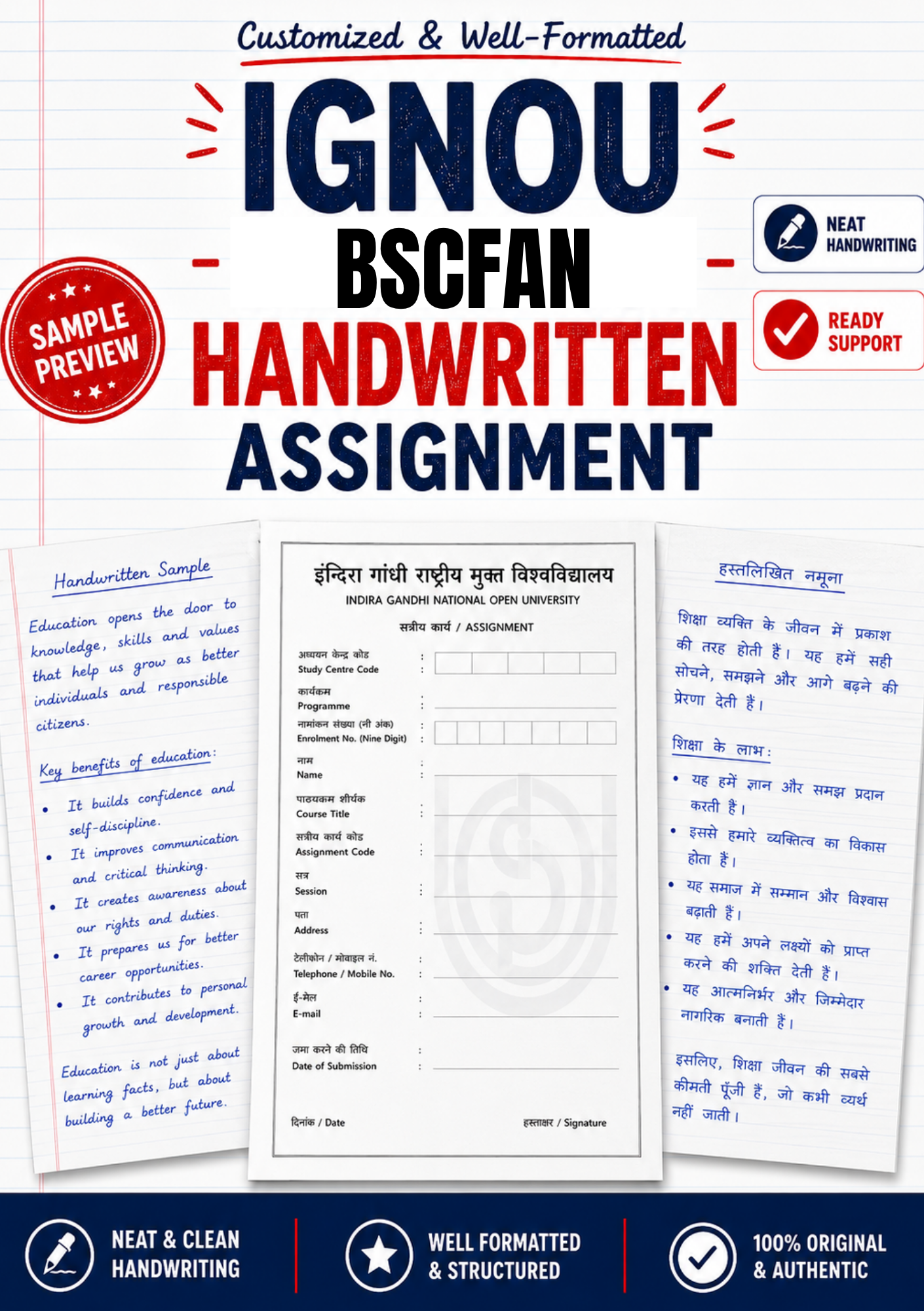
A BSCFAN order comes back as paper, one bundle per course code. Inside each bundle sit the answer sheets for that code’s Tutor Marked Assignment, written by hand on one side of the sheet in a single ink, with the three assignment sections kept visibly apart the way the booklet lays them out. An IGNOU-format cover sheet travels on top, prepared free of charge, with the header fields left empty because your enrolment number, your name, your programme code and your learner support centre code are yours to fill and not anyone else’s to invent. A photocopy of the official BANC question paper for the cycle you named is stapled behind the set, so that the evaluator reading your answers can see the questions those answers were written against.
What does not arrive is a file. No soft copy or PDF is sold. If your Regional Centre later announces an upload route, you photograph or scan the pages that reached you and submit that scan yourself; the physical set is what was bought. Delivery depends on your pin code and is confirmed for your order before you pay. No figure is promised on this page.
What ₹320 Buys for a BANC Paper, and What It Leaves Out
One code, one rate. BANC 105 Tribes and Peasants in India and BANC 110 Research Methods are both six-credit papers with a hundred-mark TMA behind them, and both cost the same, because the price is set per course code rather than per page or per credit. The rate is ₹320 per subject, hard copy only, with courier included in that price and no separate shipping charge. The IGNOU-format front page is inside that figure. The copy of the question paper is inside that figure. The courier is inside that figure, and there is no packing charge bolted on at checkout.
Two things sit outside it. The first is any claim about outcome. No claim is made about the marks any assignment will receive, about how an evaluator will assess it, or about whether it will be accepted. Assignment evaluation is entirely a matter for IGNOU, and a writing service that tells you otherwise is selling you something it cannot deliver. The second is a delivery date printed on a web page. Transit from Delhi to a metro pin code and transit to a remote one are not the same journey, and a figure that ignores the difference is a figure that will be wrong for somebody.
There is no minimum order: one subject or fourteen, same rate. BSCFAN learners frequently hand over only the papers that take longest to write out, most often BANC 110 with its research-design and interview-guide questions, and write the descriptive anthropology papers themselves.
Solved Assignment or Handwritten Set: Which One a BSCFAN Learner Needs
These are two different products and the confusion between them costs learners real money every session. A solved assignment is a soft-copy reference file of model answers prepared against one course code for one session, downloaded and read. A handwritten assignment is the answers written out by hand on paper and handed in as a physical set at the learner support centre. One is something you read from. The other is something you submit.
| Point of difference | Solved assignment for BANC codes | Handwritten set for BANC codes |
|---|---|---|
| Physical form | Soft copy, read on a screen or printed at home | Paper, written by hand, couriered to your address |
| What you do with it | Read it, check it against your study material, then write your own answers | Read it, complete and sign the cover page, submit it at your centre |
| Who it suits | A learner who has the evenings to write and wants a model to work from | A learner whose cut-off is close and whose writing time has run out |
| Relationship to submission | Not a submission. A printed download is not a handwritten assignment | The submission itself, once you have read, checked and signed it |
| Rate on this store | Priced separately on the solved-assignment shelves | ₹320 per subject, hard copy, courier included |
Scroll the table sideways on a narrow screen.
IGNOU’s own wording settles the question rather than any seller’s. The BANC 110 booklet for the July 2026 and January 2027 sessions tells learners that they need to submit all the handwritten assignments within the stipulated time to be eligible to appear in the term-end examination. The word is printed on the paper itself. A downloaded reference file, however good, does not become a submission by being printed, and nobody should imply that it does.
If what you actually want is the reference file rather than the paper set, the store keeps those separately and they are cheaper: the course-wise solved assignment shelf for the BANC anthropology codes is the right shelf for that intent, and this page is not competing with it.
Ten BANC codes, one rate, nothing hidden underneath it.
₹320 per subject · hard copy only · courier inside the price · handwriting matched from your sample at no extra charge · every cycle including backlogs.
The Ten BANC Codes the Prospectus Puts Under BSCFAN
Section 5.13 of the IGNOU Common Prospectus July 2026 prints one discipline-specific table for BSCFAN, ten courses at six credits each, sixty credits in all, laid out semester by semester. That sixty is the Major spine of a degree the same document totals at 120 credits for the three-year exit and 160 for the four-year Honours exit. Every one of these ten is a six-credit course, and the booklets state that a six-credit course carries three Tutor Marked Assignments while a four-credit course carries two.
| Semester | Course code | Official title | Credits |
|---|---|---|---|
| 1st and 2nd | BANC 101 | Introduction to Biological Anthropology | 6 |
| 1st and 2nd | BANC 102 | Introduction to Social and Cultural Anthropology | 6 |
| 3rd | BANC 103 | Archaeological Anthropology | 6 |
| 3rd | BANC 104 | Fundamentals of Human Origin & Evolution | 6 |
| 4th | BANC 105 | Tribes and Peasants in India | 6 |
| 4th | BANC 106 | Human Ecology: Biological and Cultural Dimensions | 6 |
| 5th | BANC 107 | Biological Diversity in Human Populations | 6 |
| 5th | BANC 108 | Theories of Culture and Society | 6 |
| 6th | BANC 109 | Human Growth and Development | 6 |
| 6th | BANC 110 | Research Methods | 6 |
Scroll the table sideways on a narrow screen.
Two numbers are worth holding onto. Ten times six is sixty, and sixty is exactly the Discipline Specific Course weighting the prospectus assigns to a Major degree, so this table is internally consistent and has not bled a neighbouring programme’s rows into itself. Read your own codes off your registration record rather than off this table, because electives and re-registration gaps mean two learners admitted in the same year can hold different sets.
The Courses BSCFAN Borrows, and Where the Prospectus Sends You for Them
BSCFAN prints no table of its own for six whole categories of course. For Skill Enhancement, Interdisciplinary, Ability Enhancement, Value-Added, Vocational and Minor Discipline Specific courses, the prospectus tells a BSCFAN learner that the courses offered under the Bachelor of Arts (Major/Hons) programmes are offered under BSCFAN as well, and points at pages 159 to 161. That pointer does not land where the sentence says it should, which is the subject of the next section. What follows is what actually sits in the shared pool, with the anthropology-flavoured entries first, because those are the ones a BSCFAN learner is most likely to be carrying.
| Category | Example codes | Title as printed | Credits |
|---|---|---|---|
| Skill Enhancement | BANS 183 | Tourism Anthropology | 4 |
| Skill Enhancement | BANS 184 | Public Health and Epidemiology | 4 |
| Skill Enhancement | BMPS 183 | Employability and AI Skills | 4 |
| Ability Enhancement | BEVAE 181 | Environmental Studies | 4 |
| Ability Enhancement | BEGAE 182 | English Communication Skills | 4 |
| Interdisciplinary | BSOG 171 | Indian Society: Images and Realities | 6 |
| Interdisciplinary | BPCG 171 | General Psychology | 6 |
| Value-Added | BEDSV 101 | Value Education | 6 |
| Vocational | BECS 184 | Data Analysis | 4 |
| Minor, Anthropology | BANM 161 to BANM 163 | Dimensions of Physical and Biological Anthropology; Anthropology of Society and Culture; Tribal Cultures of India | 4 each |
Scroll the table sideways on a narrow screen.
One structural point catches BSCFAN learners out. The prospectus states that discipline-based Minor courses have to come from a discipline other than the Major one. An anthropology Major therefore cannot take the BANM 161 to BANM 163 trio as their Minor, even though those codes sit in the shared pool and read as the obvious fit. They are there for learners majoring in something else. Your Minor has to come from history, sociology, psychology, economics or another discipline in that list, and the store’s anthropology course shelf on the Bachelor of Arts side is where the BANC 131 series and the anthropology Minor material sit. The four-credit shared papers carry two Tutor Marked Assignments rather than three, and they are priced at the same ₹320 as the six-credit BANC papers.
Where IGNOU’s Own Anthropology Documents Contradict Each Other
This section exists because these contradictions were found by reading IGNOU’s documents against each other, and a learner who does not know about them can order the wrong paper in good faith. None of them is a criticism of the university; large document sets drift. All of them are checkable on ignou.ac.in today.
Six disagreements a BSCFAN learner should know about before ordering, and one of our own.
1. There are two live B.Sc. Anthropology programme codes, not one. Section 5.13 of the July 2026 Common Prospectus describes Bachelor of Science (Anthropology), BSCFAN, ten BANC papers, School of Social Sciences. Section 7.6 of the same document describes Bachelor of Science (Honours) Anthropology, BSCANH, fourteen BANC core papers plus BANE electives, and totals it at 148 credits. Both name Dr Rukshana Zaman as coordinator. The objectives paragraph in the BSCFAN section is word for word the one in the BSCANH section, including a promise of a dissertation project that BSCFAN’s own course table has no code for. BSCANH has BANE 154 Dissertation; BSCFAN’s table stops at BANC 110.
2. Booklet covers disagree about which programme the paper is for. Within a single window, July 2025 to January 2026, the BANC 101, BANC 102 and BANC 112 covers read BSCANH/BSCFAN; the BANC 110 and BANC 114 covers read BSCANH alone; the BANC 108 cover for January 2026 reads BSCFAN alone; and BANC 134 reads BACHELOR OF ARTS (BAG). A BSCFAN learner taking BANC 108 and BANC 110 in the same year holds one paper that names their programme and one that does not. Both are still their paper.
3. The prospectus cross-reference points at the wrong pages. BSCFAN’s six shared-course categories all say the courses come from the Bachelor of Arts (Major/Hons) programmes at pages 159 to 161. The Bachelor of Arts Major and Honours shared tables are printed on pages 164 to 167, and every non-science FYUP programme in the document cites 164 to 167. Pages 159 to 161 belong to section 4.2, the Bachelor of Science (Multidisciplinary) programme. The two ranges are not the same list: the Sanskrit ability-enhancement course appears as BSDAE182 Sanskrit in one and BSKAE 182 Sanskrit Sahitya in the other, the value-added table gains a second course between them, and pages 159 to 161 carry no Vocational table and no Minor Discipline table at all, though BSCFAN points there for both.
4. The live assignment index offers codes the prospectus does not list under BSCFAN. IGNOU’s own four-year undergraduate assignment index heads a cell Anthropology (BSCFAN)/(BAM) and puts BANC 112 and BANE 143 inside it, in English and Hindi. Neither code appears in any BSCFAN table in the July 2026 prospectus. The same cell offers only four of BSCFAN’s ten prospectus codes and mixes the BAG series BANC 131, 132 and 133 in beside them. On that index, the English file for BANC 105 is labelled July 2025 to January 2026 while the Hindi file beside it is labelled July 2024 to January 2025.
5. One assignment code is printed six different ways. Across live BANC papers the code appears as BANC 103/ASST/TMA/ January 2025, BANC 101/ASST/TMA/July 2025-January 2026, BANC 110/ASST/TMA/July 2026 and January 2027, BANC 113/ASST/TMA/2025-26, BANC 134/ASST/TMA/ 2025-2026, and once with no course code at all as ASST /TMA /July 2023 and January 2024. Copy the shape from your own booklet rather than from any of these.
6. The paper design moved between cycles. The January 2025 BANC 103 booklet sets its short-category questions at about 50 words each and describes the third section as based on the project manual. The July 2026 to January 2027 BANC 110 booklet sets the same block at about 75 words and calls the third section’s source the practical manual. The word limit on your own paper is the one on your own paper.
And one of ours, disclosed rather than hidden. Other pages on shrichakradhar.com currently quote handwritten assignments at ₹300 and at ₹350, and quote delivery windows of 5 to 6, 7 to 9 and 8 to 10 working days. The anthropology guess-paper and books category pages still carry outcome language about marks and about the proportion of exam questions covered. None of those claims is made anywhere on this page, all of them are queued for correction, and where they disagree with this page, this page is the one to follow.
The Two Dates Printed Against Your Admission Batch
BSCFAN and BSCANH share their booklets, and those booklets set the deadline by the batch you were admitted in rather than by the examination you are heading towards. The July 2026 and January 2027 BANC 110 paper prints it plainly: learners enrolled in July 2026 submit by 30 April 2027, and learners enrolled in January 2027 submit by 30 September 2027, in both cases to the coordinator of the learner support centre. The cycle before it printed the same pattern one year earlier, 30 April 2026 for the July 2025 intake and 30 September 2026 for the January 2026 intake.
Two things follow. First, the widely circulated figure of 31 March for all IGNOU undergraduate assignments does not match what the anthropology booklets print. Commercial aggregator tables list 31 March 2026 for B.Sc. programmes generally; the BANC papers say 30 April. Second, an older booklet can print something else entirely. The January 2025 BANC 103 paper printed a single date, 30 September 2025, with no second row at all, and a January 2020 BANC 110 paper printed 31 October 2021 with a note about submission by email if lockdown conditions prevailed. If you are clearing a backlog code, the date that governs you is the one on the booklet your centre points you to, not the one on the current cycle’s paper.
Assignments carry 30 per cent of the final course result and the term-end examination carries the remaining 70 per cent. A missed BANC submission does not only lose that 30 per cent; the booklet ties eligibility for the term-end examination itself to having submitted.
Reading the Six Shapes of a BANC Assignment Code
The assignment code is the line printed just above Total Marks on the first question page, and it is what an evaluator uses to confirm that your answers belong to the paper in front of them. On a current BSCFAN paper it reads in four parts: the course code, the literal word ASST, the literal letters TMA, and the session or sessions the paper covers. BANC 110/ASST/TMA/July 2026 and January 2027 is the current shape for that code.
The trouble is that the fourth part is not stable. Some BANC papers name a single session and a year. Some join two sessions with a hyphen. Some join them with the word and. Some abbreviate to a two-digit year span. One older BAG paper in the same discipline dropped the course code from the front of the string altogether. Nothing about this affects your marks, but it does mean the code cannot be reconstructed from memory or copied from another learner’s sheet. Copy it character for character from the paper whose questions you are answering, and if you are ordering a set here, send a photograph of that line along with your codes so the bundle carries the same string your booklet does.
Your Own Letter Shapes, From One Sample Photo
A BSCFAN degree spans six semesters for the three-year exit and eight for the Honours exit, and bundles land against one enrolment number throughout. A hand that changes shape halfway through a degree is conspicuous in a way that a hand which stays consistent is not. Send a photo of a page you have written yourself and the handwritten set is matched to your handwriting at no extra charge. Nothing is added to the ₹320 for it.
What makes a useful sample page
Any page of your own writing works. A page that also carries a diagram works better, because BANC papers are not uniformly prose. BANC 103 asks for stone tool types and core tools with suitable diagrams; BANC 101 asks for Martin’s anthropometer with a diagram; BANC 110 asks you to prepare an interview guide and to set out the steps of a research design. A sample showing how you form letters and how you label a sketch lets both come back in the same hand. A returned and evaluated script is the most useful sample of all, because it shows the hand under examination conditions rather than at rest.
The sample comes back to you before anything is paid.
Send one page of your own writing on WhatsApp, receive the matched sample, then decide. ₹320 per subject · hard copy · courier included · no minimum order.
English or Hindi, Current Cycle or Backlog
The July 2026 Common Prospectus records the medium of instruction for BSCFAN as English and Hindi, and IGNOU’s live assignment index backs that up: every BANC file listed under the anthropology heading has a Hindi link beside its English one. The service covers all mediums IGNOU issues the TMA paper in, at the same price. A Hindi BANC 102 and an English BANC 102 are the same job at the same rate, and the one you receive is the one whose paper you send.
Session coverage runs the same way. Any session is accepted, current cycle or older, including backlog courses, at the same ₹320 per subject. BSCFAN booklets exist in the archive for the January 2024 session, for January 2025, for July 2025 to January 2026, for January 2026 alone, and for July 2026 to January 2027, and the questions in them do not carry over. The January 2025 BANC 103 paper asked about Attirampakkam and the Megalithic culture of South India; a later cycle asks something else. Naming your cycle is not administrative politeness, it is the difference between answers that match your booklet and answers that do not.
Five Things to Send, and Nothing Beyond Them
Ordering takes one message. What is needed is small and specific, and nothing that is not needed is asked for.
- Your BANC codes, copied from your registration record. Not from this page and not from a friend’s list. If BANC 112 or BANE 143 is on your record, say so, because those sit outside the prospectus table and need the live booklet checked.
- Your admission batch. July or January, and the year. This is what the deadline hangs on, and it is also what identifies the correct booklet.
- Your medium. English or Hindi, per code if they differ.
- A photo of one page you have written yourself. One page is enough.
- Your delivery pin code. Nothing else about your address is needed to confirm the route and the timing.
What comes back first is a count, not an invoice. Codes that have a live booklet for your cycle are named. Any code whose current paper is not yet online is flagged rather than quietly billed. Then the total is stated at ₹320 per subject. Delivery depends on your pin code and is confirmed for your order before you pay. No figure is promised on this page.
Paste the codes, get the papers that actually exist for your cycle.
Codes checked against the live BSCFAN and BSCANH booklets first, count read back, then the total at ₹320 per subject. No soft copy or PDF is sold.
Once the Bundle Reaches Your Address
Three things are yours to do and nobody else’s. Fill in the cover page header, which is why it arrives blank: enrolment number, name, programme code BSCFAN, course code, learner support centre code, session and date. Read the answers through against your own study material before you sign anything. Then submit at the learner support centre named on your booklet and, as the booklets themselves instruct, obtain the receipt and keep it, along with a photocopy of the set if you can manage one.
You sign the declaration on the assignment cover page, so you should read and review the content before submitting it, and satisfy yourself that it represents your own understanding of the course. The booklets also tell you to insist that the centre returns your evaluated assignments, and that the centre sends the marks on to the Student Evaluation Division in New Delhi. Both are worth holding them to.
What BSCFAN Learners Put in the Same Order
Handwritten sets rarely travel alone. Most BSCFAN orders arrive alongside two or three other things, and the store keeps each on its own shelf rather than bundling them into this product. Learners revising for the term-end examination usually pick up the condensed BANC guide books for the anthropology codes, which cover the same syllabus in a shorter form than the full IGNOU blocks. Closer to the examination, the anthropology guess paper sets and the previous-year BANC question papers with worked solutions come into play, since anthropology papers repeat themes such as tool typologies and research design across cycles.
Learners reaching the dissertation end of the Honours route need the bound anthropology project and dissertation service instead, because BANE 154 is fieldwork-based and is not a Tutor Marked Assignment at all. Anyone whose Minor or shared courses sit outside anthropology will find their four-credit papers on the skill enhancement course shelf, and those studying under the multidisciplinary science structure, whose tables the BSCFAN cross-reference wrongly points into, should start from the B.Sc. multidisciplinary course material rather than here. Handwritten sets for other programmes are listed together on the handwritten assignment shelf, and the full course-code index across every programme sits on the solved assignment index. For BAM learners carrying the BANC 131 series rather than the BANC 101 series, the new-syllabus BA anthropology books are the matching shelf.
If you would rather write the set yourself, that is the better outcome wherever the evenings exist for it, and the free walkthrough at ignouproject.com’s handwritten assignment guide takes you through paper, margins, ink and cover page without asking for anything. The official papers themselves are always free from IGNOU’s own assignment download service.
Questions BSCFAN Learners Ask Before They Order
Is BSCFAN the same programme as BSCANH?
No, though they share almost everything. BSCFAN is Bachelor of Science (Anthropology), the Major degree under the Four-Year Undergraduate Programme, described in section 5.13 of the July 2026 Common Prospectus with ten BANC papers. BSCANH is Bachelor of Science (Honours) Anthropology, described in section 7.6 with fourteen BANC core papers, BANE electives and a 148-credit total. Both are School of Social Sciences programmes under the same coordinator, and IGNOU issues several BANC booklets jointly to both. Your programme code is the one on your admission record.
My code is BANC 131, not BANC 101. Is that BSCFAN?
No. BANC 131 to BANC 134 are the Bachelor of Arts series, and their booklets carry a BACHELOR OF ARTS (BAG) cover. The titles differ too: BANC 133 is Fundamentals of Social and Cultural Anthropology while the BSCFAN paper on that subject is BANC 102, Introduction to Social and Cultural Anthropology. The question design differs as well. Handwritten sets are written for both series at the same rate, but the paper has to be identified correctly first.
Which BSCFAN course codes carry a Tutor Marked Assignment?
All ten discipline papers, BANC 101 through BANC 110, each six credits, each with three Tutor Marked Assignments adding to 100 marks. The shared four-credit courses you take alongside them carry two TMAs each. Codes such as BANC 112 and BANE 143 appear on IGNOU’s live index under a heading naming BSCFAN but sit in no BSCFAN prospectus table, so if one of those is on your record the booklet is checked before any price is quoted.
What is the last date for a BSCFAN assignment in this cycle?
The July 2026 and January 2027 BANC booklet prints 30 April 2027 for learners enrolled in July 2026 and 30 September 2027 for learners enrolled in January 2027, both to the coordinator of the learner support centre. The deadline follows your admission batch rather than the examination you are sitting. Aggregator tables that quote 31 March for all B.Sc. programmes do not match what the anthropology papers print, and only ignou.ac.in and your Regional Centre can confirm the position for your enrolment.
How many questions are on a BANC paper, and how are the marks split?
Three sections adding to 100. On the current BANC 110 paper, Assignment I is two descriptive questions of about 500 words at 20 marks each, Assignment II is two short notes of about 250 words at 10 marks each plus five questions of about 75 words at 2 marks each, and Assignment III carries 30 marks across manual-based questions. The split varies by code and cycle, so the paper in your hand governs. The January 2025 BANC 103 booklet, for instance, set its short block at about 50 words rather than 75.
Can I submit a printed solved assignment PDF for a BANC code?
No. The BANC 110 booklet for the current cycle states that you need to submit all the handwritten assignments within the stipulated time to be eligible to appear in the term-end examination, and IGNOU’s submission guidelines say typed submissions are not accepted. A solved assignment is a reference to write from. It does not become a submission by being printed, and this page sells the written paper set rather than a file.
Can a BSCFAN Major take the BANM anthropology Minor courses?
No. The prospectus states that discipline-based Minor courses must come from a discipline other than the Major. BANM 161, BANM 162 and BANM 163 are open to learners majoring in something else, not to an anthropology Major. Your three Minor discipline courses have to come from history, sociology, psychology, economics or another listed discipline.
Are the BANC papers available in Hindi?
Yes. The prospectus records English and Hindi as BSCFAN’s media of instruction, and IGNOU’s assignment index lists a Hindi file beside the English one for every BANC code it carries. The service covers all mediums IGNOU issues the TMA paper in, at the same price. Note that on that index the Hindi files for BANC 105 and BANC 108 are labelled with an earlier session than their English counterparts, so check the cover of the file you actually download.
I have a backlog BANC paper from an old session. Is that still possible?
Yes. Any session is accepted, current cycle or older, including backlog courses, at the same ₹320 per subject. BSCFAN and BSCANH booklets are archived back through January 2024, January 2025 and the July 2025 to January 2026 window, and the questions differ in each. Send the cycle printed on your cover so the right questions are answered rather than this year’s.
Do I have to order all ten BANC codes together?
No. There is no minimum order: one subject or fourteen, same rate. Ordering by code rather than by semester is the norm here. A learner repeating a single BANC 107 while writing the rest of their semester themselves orders exactly what they are short of.
Will the BANC diagrams be drawn by hand as well?
Yes. BANC 103 asks for core tools and blade tools with suitable diagrams, and BANC 101 asks for Martin’s anthropometer with a diagram. Those are drawn on the sheet in the same hand as the prose, which is why a sample page carrying a sketch is more useful than one carrying only running text.
Where do I submit the set once it arrives?
To the coordinator of your learner support centre. That is the instruction printed on the current BANC booklets, which also tell you to collect and keep the receipt and to insist on getting the evaluated assignments back. Use any other route, such as an upload, only if your centre or Regional Centre has announced one for your cycle.
Does the price change for a four-credit shared course?
No. The rate is ₹320 per subject, hard copy only, with courier included in that price and no separate shipping charge. A four-credit BANS 183 with two Tutor Marked Assignments costs the same as a six-credit BANC 106 with three. The price is set per course code.
How long will the bundle take to reach my pin code?
Delivery depends on your pin code and is confirmed for your order before you pay. No figure is promised on this page. Other pages on this store still quote working-day windows; those are queued for correction and this page governs where they disagree.
What marks will the assignment get?
No claim is made about the marks any assignment will receive, about how an evaluator will assess it, or about whether it will be accepted. Assignment evaluation is entirely a matter for IGNOU. What is within anyone’s control is that the answers address the questions on your booklet, stay inside the word limits it sets, and arrive as paper in your own hand with a correctly formatted cover page.
How This Page Was Put Together
From the IGNOU Common Prospectus July 2026. The section 5.13 BSCFAN course table, the ten BANC codes with their official titles and six credits each, the section 7.6 BSCANH structure and its 148-credit total, the Four-Year Undergraduate Programme credit categories and the 120 and 160 credit thresholds, the Undergraduate Certificate and Undergraduate Diploma exit points at 40 plus 4 and 80 plus 4 credits, the English and Hindi media of instruction, and the shared Bachelor of Arts Major and Honours course tables. The page-reference discrepancy in section 5.13 was found by opening the pages the sentence points to and comparing them with the pages it should point to.
From live booklets on ignou.ac.in. Three Tutor Marked Assignment booklets were opened in full for this page, BANC 110 for July 2026 and January 2027, BANC 103 for January 2025 and BANC 134 for July 2025 to January 2026, alongside IGNOU’s own four-year undergraduate assignment index. The submission dates, the assignment-code formats, the three-section question design, the word limits, the manual references and the cover-page programme lists are read off those files rather than carried from another programme. Covers for BANC 101, BANC 102, BANC 108, BANC 112 and BANC 114 were read for their programme lines. Deadlines are set per school and per booklet, and no date on this page was borrowed from a programme outside anthropology.
From the publisher’s own commercial terms. The ₹320 per subject rate, hard copy only, courier inside the price, the free IGNOU-format cover sheet, the included copy of the question paper, the handwriting match from a sample photo at no charge, the absence of a minimum order, and the refusal to promise a delivery figure or any outcome. These are Shri Chakradhar Publication’s terms and are not IGNOU rules.
Important Notice
Shri Chakradhar Publication Pvt. Ltd. and shrichakradhar.com form an independent IGNOU study-support publisher. This is not the official website of Indira Gandhi National Open University, is not affiliated with, endorsed by or authorised by the university, and no page on this site should be treated as an official IGNOU communication.
Programme structures, course codes, submission dates and rules change, and only ignou.ac.in and your Regional Centre can confirm the current position for your enrolment.
You sign the declaration on the assignment cover page, so you should read and review the content before submitting it, and satisfy yourself that it represents your own understanding of the course.
No claim is made about the marks any assignment will receive, about how an evaluator will assess it, or about whether it will be accepted. Assignment evaluation is entirely a matter for IGNOU.
Hand Over This Cycle’s BANC Papers
Ten discipline codes, the shared four-credit courses beside them, both mediums, every cycle back through the archive. The rate is ₹320 per subject, hard copy only, with courier included in that price and no separate shipping charge. There is no minimum order: one subject or fourteen, same rate.