

Description
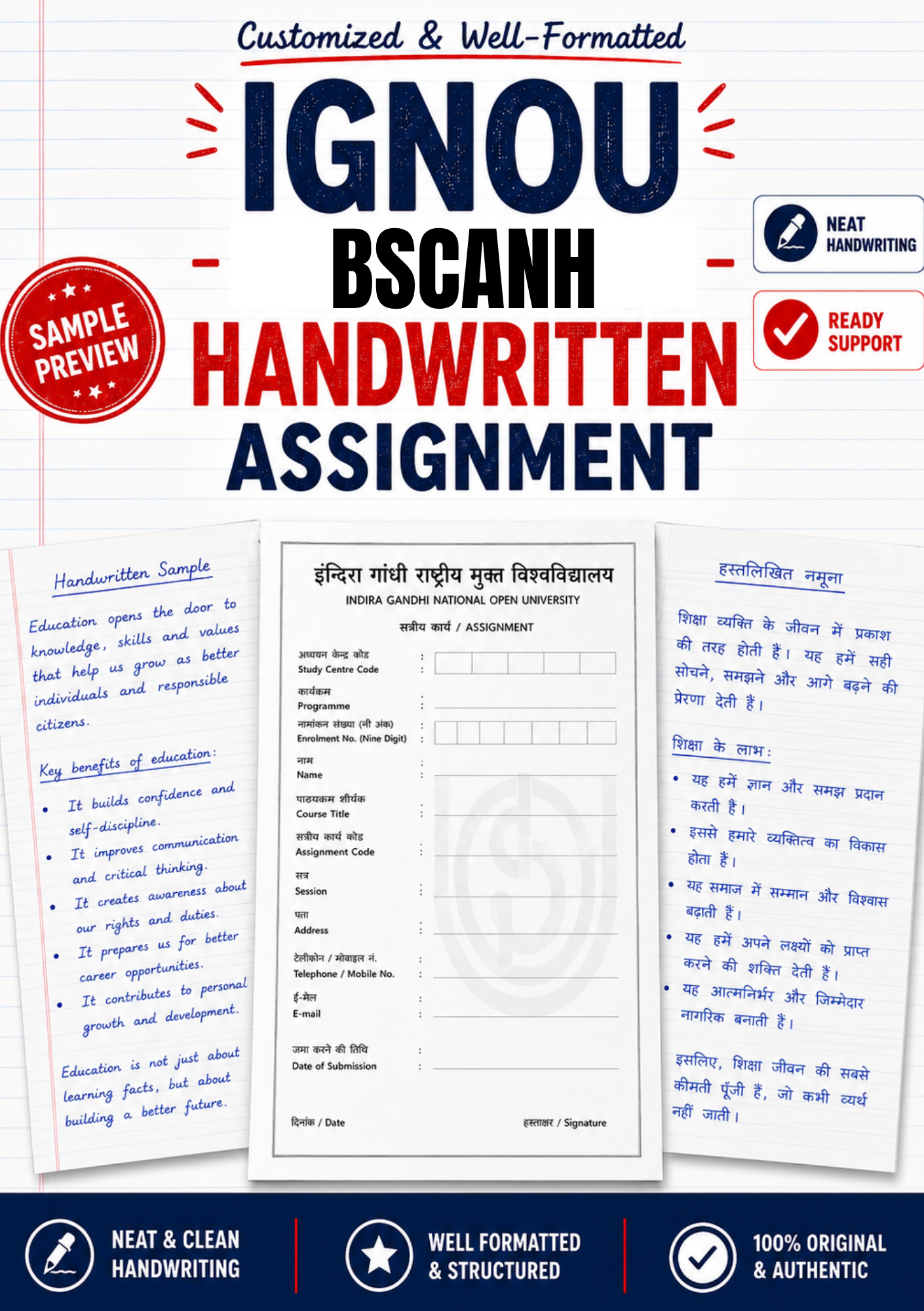
In short. This listing covers Tutor Marked Assignment answers written out by hand for IGNOU BSCANH, the Bachelor of Science (Honours) Anthropology programme of the School of Social Sciences, across the fourteen BANC core papers running from BANC 101 to BANC 114 and the BANE and BSOE papers that fill its four Discipline Specific Elective slots. The rate is ₹320 per subject, hard copy only, with courier included in that price and no separate shipping charge. Each paper arrives as a written script on A4, a blank IGNOU-format cover sheet, and a photocopy of the question paper that was answered. The live BANC booklets on ignou.ac.in print 30 April 2026 against a July 2025 enrolment and 30 September 2026 against a January 2026 enrolment, and they carry three assignments worth 100 marks between them. Older cycles and backlog papers are written at the same rate as the running one.
Opening a BSCANH Packet: Four Things Per Paper
One BANC code produces one bundle, and the bundle is physical. Inside it sit the written answer pages for all three assignments in that booklet, an IGNOU-format cover sheet with the name, enrolment number, programme code and course code fields left empty for the learner to complete, a photocopy of the exact question paper the answers were written against, and the pages fastened so the sequence survives a courier bag. Nothing in that list is charged on top of the ₹320.
The question-paper photocopy matters more on an anthropology bundle than most learners expect. A BANC booklet is not one question sheet. BANC 102 Introduction to Social and Cultural Anthropology, for instance, splits into Assignment I worth 40 marks, Assignment II worth 30 and Assignment III worth 30, and a study centre counter clerk checking a submission wants to see the paper those three sections belong to. Handing over a stack of written sheets without the matching paper invites a second trip.
What does not arrive is a file. No soft copy or PDF is sold. Shri Chakradhar Publication keeps the written set and the reference file on separate shelves deliberately, and the section below on reading material against submission material explains why mixing the two causes problems at the counter.
Everything Folded Into ₹320, and the Two Things That Are Not
₹320 is the whole figure for one BSCANH course code. It absorbs the writing itself, the IGNOU-format front page, the question-paper copy, the handwriting match and the courier to the delivery address. There is no minimum order: one subject or fourteen, same rate. A learner ordering only BANE 154 Dissertation support material pays the same per-paper figure as a learner clearing an entire semester.
Two things sit outside the price, and both sit outside anybody’s control rather than behind a surcharge. The first is time. Delivery depends on your pin code and is confirmed for your order before you pay. No figure is promised on this page. Anthropology learners are spread across regional centres from Shillong to Thiruvananthapuram, and a figure that holds for one does not hold for another.
The second is the result. An anthropology evaluator reading a 500-word answer on Durkheim and social integration applies their own judgement, and no publisher has standing in that. The closing notice on this page states the position in full, and it is not softened anywhere above it.
A File You Read Against a Set You Hand In
These are two different purchases and they are routinely confused, so both deserve a definition on first use. A solved assignment is a soft-copy reference file of model answers for one course code and one session, delivered as a download, meant to be read and written from. A handwritten assignment is the answers written out by hand on A4 and submitted in hard copy at the study centre. The first is study material. The second is the thing the counter accepts.
| Point of difference | BSCANH solved assignment | BSCANH handwritten assignment |
|---|---|---|
| Format | Soft copy, downloadable file for one BANC code and session | Written pages on A4, hard copy, couriered |
| What the learner does with it | Reads it, then writes the answers out personally | Fills the cover sheet, reviews the content, signs and submits |
| Who it suits | A learner with time to copy fourteen BANC papers by hand | A learner short of writing time before the cut-off |
| Price position | Lower, since nothing is written or couriered | ₹320 per subject with courier included |
| Accepted at the counter as supplied | No, it is a reference file | Yes, once the cover page is completed and signed |
Scroll the table sideways on a narrow screen.
IGNOU’s own instruction on the BANC booklets settles the format question without ambiguity. The BANC 108 paper for the January 2026 session tells learners that assignments are handwritten and that all of them must be submitted within the stipulated time to be eligible for the term-end examination. It also asks for a receipt at the point of submission and for the evaluated scripts to be returned. A printed file does not satisfy an instruction phrased that way.
So the honest scoping is simple. A downloaded reference file is something to write from, not something to hand in. If what is wanted is the cheaper reading material rather than a submission set, the per-code BSCANH reference files are shelved separately and that is where the search for a model-answer PDF should end. This listing does not sell one.
Thirty per cent of fourteen courses is a large number to leave blank.
₹320 per subject. Hard copy. Courier included. Any BANC or BANE code, any session.
Message the BSCANH desk on WhatsApp +91 93546 37830 with the codes and the enrolment batch.
Eighty-Four Credits of BANC Core, From 101 to 114
BSCANH is a 148-credit programme over six semesters, minimum three years and maximum six, offered in English and Hindi by the School of Social Sciences. Eighty-four of those credits are the fourteen compulsory BANC papers below, each carrying six credits, and every one of them has a Tutor Marked Assignment attached. Nothing in this table is optional for a learner on the honours route.
| Code | Official course title | Credits | Semester |
|---|---|---|---|
| BANC 101 | Introduction to Biological Anthropology | 6 | I |
| BANC 102 | Introduction to Social and Cultural Anthropology | 6 | I |
| BANC 103 | Archaeological Anthropology | 6 | II |
| BANC 104 | Fundamentals of Human Origin and Evolution | 6 | II |
| BANC 105 | Tribes and Peasants in India | 6 | III |
| BANC 106 | Human Ecology: Biological and Cultural Dimensions | 6 | III |
| BANC 107 | Biological Diversity in Human Populations | 6 | III |
| BANC 108 | Theories of Culture and Society | 6 | IV |
| BANC 109 | Human Growth and Development | 6 | IV |
| BANC 110 | Research Methods | 6 | IV |
| BANC 111 | Human Population Genetics | 6 | V |
| BANC 112 | Anthropology in Practice | 6 | V |
| BANC 113 | Forensic Anthropology | 6 | VI |
| BANC 114 | Anthropology of India | 6 | VI |
Scroll the table sideways on a narrow screen.
Three of these papers carry an unusual condition. The Common Prospectus for July 2026 attaches a footnote to the core and Discipline Specific courses stating that a manual is provided for the practical component and that no practical sessions are held at the Learner Support Centre. A science honours degree that runs its practical work off a printed manual rather than a laboratory session is uncommon, and it means the written assignment is doing more of the assessment work here than it would on a laboratory-based B.Sc. BANC 111 Human Population Genetics and BANC 113 Forensic Anthropology are the papers where learners feel that most.
Semester weight is uneven across the programme. Semesters I and II carry 22 credits each, Semesters III and IV carry 28 each, and Semesters V and VI carry 24 each. The 28-credit semesters are the ones that hurt, because they stack three BANC core papers against a Skill Enhancement Course and a Generic Elective in the same window, which is five separate assignment booklets to fill in one cycle.
Picking Four Papers From the BANE and BSOE Shelf
Twenty-four of the 148 credits come from four Discipline Specific Electives chosen from a pool of six. Two are taken in Semester V alongside BANC 111 and BANC 112, and two in Semester VI alongside BANC 113 and BANC 114. The pool is small enough that most learners end up with overlapping code lists, but the dissertation option splits the cohort sharply.
| Code | Official course title | Credits | Offered in |
|---|---|---|---|
| BANE 141 | Physiological Anthropology | 6 | Semester V |
| BANE 143 | Tribal Cultures of India | 6 | Semester V |
| BANE 147 | Urban Anthropology | 6 | Semester V |
| BANE 144 | Visual Anthropology | 6 | Semester VI |
| BANE 154 | Dissertation | 6 | Semester VI |
| BSOE 144 | Reading Ethnographies | 6 | Semester VI |
Scroll the table sideways on a narrow screen.
BANE 154 Dissertation is the one to read the footnote on. The prospectus describes it as an optional dissertation or project work of six credits in the sixth semester, and then adds, in a separate footnote, that fieldwork is compulsory for it. Optional to choose, compulsory in its demands once chosen, is a combination worth understanding before the Semester VI elective form is filled. A learner who would rather not run fieldwork takes BANE 144 and BSOE 144 instead and keeps the elective load on written assignments.
The remaining forty credits come from two Ability Enhancement Compulsory Courses at four credits each, two Skill Enhancement Courses at four credits each, and four Generic Electives at six credits each. BEVAE 181 Environmental Studies is the Semester I Ability Enhancement paper, and Semester II takes either BEGAE 182 English Communication Skills or BHDAE 182 in Hindi. On the Skill Enhancement side the anthropology-specific options are BANS 183 Tourism Anthropology and BANS 184 Public Health and Epidemiology, both four credits, alongside borrowed papers such as BECS 184 Data Analysis and the BPCS psychology series. Every one of those codes carries its own assignment, which is why the honest code count for a BSCANH learner across the degree is twenty-six separate booklets, not fourteen.
Nine Disagreements Between the Prospectus, the Portal and the Booklets
The following were found by reading the Common Prospectus July 2026, the BSCANH programme page on ignou.ac.in, and three live assignment booklets against each other during the preparation of this listing. They are published here rather than smoothed over, because a learner who knows where the documents diverge orders the right paper the first time. Two of the nine are errors on this store, and they are named alongside the rest.
Where the BSCANH paper trail contradicts itself, as checked in October 2026.
1. The live BANC 108 booklet for the January 2026 session names only the four-year route on its cover, printed as Bachelor of Science (Major/Honours) Anthropology with the code BSCFAN. BSCANH appears nowhere on it, although BANC 108 Theories of Culture and Society is a compulsory core paper of BSCANH in the Common Prospectus July 2026. The BANC 102 booklet of the same period names both codes on its cover. A BSCANH learner downloading BANC 108 is looking at the correct paper despite the cover.
2. Two assignment-code shapes are in circulation inside one programme and one school. BANC 102 prints BANC 102/ASST/TMA/July 2025 and January 2026, naming two sessions in a single string. BANC 108 prints BANC 108/ASST/TMA/January 2026, naming one. Copy whichever line your own downloaded paper shows.
3. The BSCANH course list on ignou.ac.in totals 144 credits while the same page states the programme is 148 credits. The listing also shows three Ability Enhancement papers, three Skill Enhancement papers and one Generic Elective, where the structure requires two, two and four.
4. BSOE 144 Reading Ethnographies is tagged a Generic Elective for Semester 5 on ignou.ac.in and printed as a Discipline Specific course for Semester VI in the prospectus.
5. BEVAE 181 is tagged Semester 5 and BECS 184 Semester 1 on ignou.ac.in, where the prospectus places them in Semester I and Semester IV respectively.
6. Inside one prospectus, BANC 105 to BANC 110 sit in different semesters depending on which anthropology programme you read. Under BSCANH, BANC 105 to 107 fall in Semester III and BANC 108 to 110 in Semester IV. Under the four-year BSCFAN route, BANC 105 and 106 fall in Semester IV and BANC 107 and 108 in Semester V.
7. The BSCANH semester table in the prospectus offers BCHS 183 in Semester III and BFLS 183, BSLS 183 and ONR 002 in Semester IV, none of which appear in that same prospectus’s own BSCANH course lists.
8. BEGG 174 Creative Writing is printed in the BSCANH Generic Elective list with no credit figure against it, while every other Generic Elective in the list shows six.
9. On this store, the guess-paper category for this programme is titled BA Honours Anthropology while the books category says Bachelor of Science Honours Anthropology and the previous-paper category says BSC Honours Anthropology. Separately, BANM 161 and BANM 162 are filed here under BSCANH, and the live BANE 145 booklet shows that the BANE and BANM anthropology papers of that family belong to the Bachelor of Arts route rather than to this programme. Both are this publisher’s errors and both are queued for correction.
One further wrinkle sits in IGNOU’s own filing rather than in its content. The 2024 to 2025 BANC 110 booklet is served from a path that spells January as Jauary. The paper behind it is the correct Research Methods assignment, and a learner who cannot find the file by guessing the spelling should search the course code instead of the session name.
30 April or 30 September: Which Line on the Booklet Is Yours
IGNOU submission dates are set per school and per programme, and quoting another learner’s date is the most common way a BSCANH script arrives late. Read off the live BANC booklets, the BSCANH pair is 30 April and 30 September, and which of the two applies depends entirely on the session in which the learner took admission rather than on the current calendar.
| Your admission session | Last date printed on the BANC booklet | Where it is submitted |
|---|---|---|
| July 2025 | 30 April 2026 | Coordinator of the Learner Support Centre |
| January 2026 | 30 September 2026 | Coordinator of the Learner Support Centre |
Scroll the table sideways on a narrow screen.
Two things follow from that table. First, the gap between enrolment and cut-off is roughly nine months, not a few weeks, which is why a BSCANH learner who has not started by the time the term-end examination form opens is usually already behind rather than merely early. Second, a management learner quoting 31 October and a humanities learner quoting 31 March are both reading their own school’s booklet correctly and neither date belongs on an anthropology script.
Papers expire. A BANC booklet is issued against a named session and is replaced the next cycle, so the questions inside a July 2025 and January 2026 paper are not the questions inside the paper that follows it. Writing answers against a superseded booklet produces a script that does not match the code line the study centre is checking. That is the single reason the order process below asks for the enrolment batch before anything is written, and it is also why a backlog paper has to be identified by its own session rather than by the current one.
The ASST/TMA String, and Why Two Versions Are in Circulation
Every BSCANH booklet prints a code line, and that line is copied onto the assignment cover sheet. It is built from the course code, the letters ASST and TMA, and the session or sessions the paper serves. BANC 102 for the current cycle reads BANC 102/ASST/TMA/July 2025 and January 2026. BANC 108 for the January intake reads BANC 108/ASST/TMA/January 2026. The slashes, the word ASST and the capitalisation are part of the string, not formatting choices.
The reason both shapes exist is that IGNOU issues some anthropology papers to cover two consecutive sessions and others to cover one. A single-session paper and a two-session paper can sit side by side in the same cycle for the same programme, which is exactly what BANC 102 and BANC 108 do. Neither is a misprint. The practical instruction is narrow: open the paper you actually downloaded for your own code, read the line at the head of the Tutor Marked Assignment page, and copy that line exactly, rather than adapting a classmate’s.
The question pattern behind the code line is consistent across the BANC papers checked. One booklet holds three assignments totalling 100 marks, and the whole set carries 30 per cent of the course result. Assignment I is two descriptive answers of roughly 500 words at 20 marks each. Assignment II splits into Part A, two short notes of roughly 250 words at 10 marks each, and Part B, five brief answers of roughly 75 words at 2 marks each. Assignment III is two questions totalling 30 marks, usually one definitional and one asking for a research synopsis. All questions in all three sections have to be answered.
One Photograph Sets the Hand for Every Page
An anthropology submission that arrives in a hand nothing like the learner’s own is a problem the learner has to explain, not the publisher. Send a photo of a page you have written yourself and the handwritten set is matched to your handwriting at no extra charge. The matching is reviewed against the sample before the order is confirmed, which puts the risk check ahead of the payment rather than behind it.
What Makes a Usable Sample Page
A sample is useful when it shows ordinary continuous writing rather than a careful specimen. Half a page of normal prose in the pen usually carried, photographed flat in daylight with the whole page in frame, tells the writer far more than a neatly lettered paragraph produced for the purpose. If the BSCANH scripts will be written in Hindi, the sample should be in Devanagari, because a Devanagari hand and a Roman hand from the same person are not interchangeable. Where a learner has already submitted earlier BANC papers in their own hand, a photograph of one of those returned scripts tells the writer more than anything produced from scratch.
Hindi Scripts, English Scripts and Papers Left Over From 2022
BSCANH is taught and examined in English and Hindi, and IGNOU issues the BANC booklets accordingly. The service covers all mediums IGNOU issues the TMA paper in, at the same price. A Hindi BANC 105 script on Tribes and Peasants in India is ₹320, the same as the English one, and the same figure covers the Hindi Ability Enhancement paper BHDAE 182 where a learner has taken that route instead of BEGAE 182.
Backlog papers are ordinary work here rather than an exception. Any session is accepted, current cycle or older, including backlog courses, at the same ₹320 per subject. BSCANH runs to a maximum of six years, so a learner finishing in the sixth year may be holding a Semester I paper from a cycle four years behind the current one while sitting Semester VI electives. Both get written at the same rate, provided the older paper is identified by its own session so the correct booklet is used.
Credit transfers and course changes complicate the code list more on this programme than on most, because the Generic Elective basket is drawn from psychology, public administration, sociology, Sanskrit, Hindi, English and philosophy. Two BSCANH learners in the same intake can hold entirely different Generic Elective codes. That is why the order process asks for the code list rather than the semester number.
The Five Lines a BSCANH Order Needs, and No Sixth
Nothing beyond the following is required to start, and nothing beyond the following is asked for.
- The exact course codes, written as they appear on the admission record, for example BANC 107 and BANE 143 rather than Semester V.
- The enrolment session, July or January and the year, because that decides which booklet and which cut-off apply.
- The medium, English or Hindi, stated per paper if the learner mixes the two.
- One photograph of a page in the learner’s own handwriting, in the script the set will be written in.
- The delivery pin code, so the courier position can be confirmed before payment rather than after.
Programme code is worth adding as a sixth line only where a learner holds both an anthropology honours and a four-year route letter, since the booklet covers do not always distinguish them. Beyond that, no document, no identity proof and no study-centre number is needed to place an order.
Five lines on WhatsApp, and the code list is quoted before anything is written.
₹320 a paper. Written by hand. Courier inside the price. BANC, BANE, BSOE, BANS and the Generic Elective codes alike.
Open a BSCANH order on WhatsApp +91 93546 37830 and send the five lines in one message.
Signing, Reviewing and Getting a Receipt at the Centre
The packet arrives unsigned and the cover sheet arrives blank, and both of those are deliberate. You sign the declaration on the assignment cover page, so you should read and review the content before submitting it, and satisfy yourself that it represents your own understanding of the course. On an anthropology paper that review is not a formality: Assignment III frequently asks for a research synopsis, and a learner who has not read what was written will struggle if an evaluator or counsellor asks about it.
Fill the cover sheet with the name, enrolment number, programme code BSCANH, the course code and the code line copied from the booklet, then submit at the Learner Support Centre to which the enrolment is attached. The BANC booklets themselves instruct learners to obtain a receipt at the point of submission and to insist that the evaluated assignments are returned. Both are worth doing. The receipt is the only proof of submission a learner holds until the status appears online, and the returned script is the only feedback the programme gives before the term-end examination.
After that, the Learner Support Centre forwards the marks to the Student Evaluation Division at IGNOU, New Delhi, and the result appears against the course code on the grade card in its own time. Nothing on this page speeds that up or influences it.
The Rest of the Anthropology Shelf on This Store
A written set answers one requirement. The rest of the BSCANH year usually needs reading material around it, and the catalogue is organised by the same programme code. Printed guide books for the BANC and BANE papers sit in the BSCANH help book shelf, which is the right starting point for a learner who intends to write their own answers and only wants the content. Closer to the examination, the anthropology honours guess papers and the previously set BANC question papers with worked answers cover the other 70 per cent of the course result.
Learners on the four-year anthropology route rather than the honours route should order from the BSCFAN written-set listing instead, since that programme stops at BANC 110 and maps the shared codes to different semesters. Anyone holding BANE 145 Applied Anthropology or BANE 146 will find those papers under the Bachelor of Arts anthropology shelf, because the live booklets place them on the BAG route. Learners who finish BSCANH and continue into the master’s programme move across to the MA Anthropology assignment catalogue and its matching postgraduate anthropology books.
Honours learners in neighbouring disciplines of the same school are catered for on their own listings, including the sociology honours written sets and the public administration honours equivalent, both of which carry different cut-off dates from this one. Every programme handled this way is indexed on the main written-assignment hub. A learner who would rather write the papers personally will get more out of the method walkthrough at ignouproject.com than out of this listing.
Sixteen Questions That Reach the WhatsApp Line
Can a printed BANC answer sheet be handed in at the counter instead of a written one?
The BANC booklets state that assignments are handwritten and that all of them must be submitted within the stipulated time for the learner to be eligible for the term-end examination. A printed sheet does not meet an instruction worded that way. Study centres differ in how strictly they inspect, but the instruction on the paper is the standard the counter is working to, so a written script is the safer object to carry in.
What separates a BSCANH solved assignment from a BSCANH handwritten set?
A solved assignment is a soft-copy reference file of model answers for one BANC code and one session, bought to read and write from. A handwritten assignment is those answers written out by hand on A4 and submitted in hard copy at the study centre. The first is study material and costs less because nothing is written or couriered. The second is the physical thing the counter accepts.
If a BANC solved PDF is already downloaded, is anything still missing?
The writing is still missing, and on BSCANH that is the larger share of the work. One BANC booklet holds three assignments, two 500-word answers, two 250-word notes, five 75-word answers and two synopsis questions. A learner with the file still has to produce all of that in their own hand for every code they are clearing that cycle.
Is it worth buying the reference file and the written set for the same BANC code?
Rarely. The two overlap on content and differ only in form, so paying twice for one code buys a reading copy of something already arriving on paper. The pairing that does make sense is a reference file for the codes a learner intends to write personally and a written set for the codes there is no time left for.
My booklet cover says BSCFAN but my admission letter says BSCANH. Is it the wrong paper?
Not necessarily. The BANC codes are shared between the honours route and the four-year route, and IGNOU issues some booklets naming both codes and others naming only one. The BANC 102 paper for the current cycle names BSCANH and BSCFAN together, while the BANC 108 paper for January 2026 names only BSCFAN. Go by the course code on the paper rather than the programme code on the cover, and write BSCANH on your own cover sheet.
The BANC 108 paper does not mention BSCANH anywhere. Should it still be attempted?
Yes. BANC 108 Theories of Culture and Society is listed as a compulsory core paper of BSCANH in the Common Prospectus July 2026 and on the BSCANH page of ignou.ac.in, where it sits in Semester IV. The omission is on the booklet cover, not in the programme structure. A Regional Centre can confirm it in writing for a learner who wants that on record before submitting.
I enrolled in July 2025. Is 30 April 2026 the date that applies to me?
That is the date printed against a July 2025 enrolment on the current BANC booklets, with 30 September 2026 printed against a January 2026 enrolment. Dates are set per school and are revised from cycle to cycle, so the line on your own downloaded paper is the one that governs, and your Regional Centre can confirm any extension that has been notified since.
Why does the BANC 102 code line name two sessions when BANC 108 names one?
Because IGNOU issues some anthropology papers to serve two consecutive sessions and others to serve one. BANC 102 reads BANC 102/ASST/TMA/July 2025 and January 2026 and BANC 108 reads BANC 108/ASST/TMA/January 2026. Both are correct for their own paper. Copy the line from the booklet you downloaded, not from a classmate’s.
BANE 145 and BANE 146 appear on this store under BSCANH. Are they on the BSCANH list?
No, and that tagging is an error being corrected. The live BANE 145 Applied Anthropology booklet for 2025 to 2026 names the Bachelor of Arts programme on its cover, and the BSCANH elective pool in the Common Prospectus July 2026 runs only to BANE 141, 143, 144, 147, 154 and BSOE 144. If your admission record reads BSCANH, those two codes are not among your electives.
How many answers does one BANC paper actually carry?
Eleven, across three assignments worth 100 marks in total. Assignment I is two answers of roughly 500 words at 20 marks each. Assignment II has two short notes of roughly 250 words at 10 marks each and five brief answers of roughly 75 words at 2 marks each. Assignment III is two further questions worth 30 marks between them. All of them have to be answered.
Is a Hindi-medium BANC set charged above an English one?
No. The service covers all mediums IGNOU issues the TMA paper in, at the same price. A Devanagari script takes longer to write than a Roman one and the rate does not move for it. Send the handwriting sample in the same script the set will be written in.
BANC 113 Forensic Anthropology has a practical. Does the written set cover that?
The written set covers the Tutor Marked Assignment for the code, which is the written component. The prospectus notes that core and Discipline Specific courses on this programme are served by a manual for the practical and that no practical sessions are held at the Learner Support Centre, so the practical requirement is handled through the manual and the term-end arrangements rather than through the assignment booklet.
Can two BANE electives be ordered without the core papers?
Yes. There is no minimum order: one subject or fourteen, same rate. A Semester V learner who has written BANC 111 and BANC 112 personally and only wants BANE 143 and BANE 147 written out pays for those two codes and nothing else.
BANC 105 was skipped three cycles back. Can that old paper still be written out?
Yes. Any session is accepted, current cycle or older, including backlog courses, at the same ₹320 per subject. Send the session the paper belongs to along with the code, because the BANC 105 questions from an older cycle are not the questions in the current booklet and the script has to match the paper the study centre is checking.
Does ordering all fourteen core papers change the per-paper rate?
No. The rate is ₹320 per subject, hard copy only, with courier included in that price and no separate shipping charge, and it holds whether the order is one code or the whole core. There is no bulk tier and no separate packing charge on a large anthropology order.
Is anything said here about the marks a BSCANH set will receive?
No claim is made about the marks any assignment will receive, about how an evaluator will assess it, or about whether it will be accepted. Assignment evaluation is entirely a matter for IGNOU. Any page promising a marks figure on externally graded anthropology work is promising something it cannot control.
Where Each Statement on This Page Came From
Important Notice
Shri Chakradhar Publication Pvt. Ltd. and shrichakradhar.com form an independent IGNOU study-support publisher. This is not the official website of Indira Gandhi National Open University, is not affiliated with, endorsed by or authorised by the university, and no page on this site should be treated as an official IGNOU communication.
Programme structures, course codes, submission dates and rules change, and only ignou.ac.in and your Regional Centre can confirm the current position for your enrolment.
You sign the declaration on the assignment cover page, so you should read and review the content before submitting it, and satisfy yourself that it represents your own understanding of the course.
No claim is made about the marks any assignment will receive, about how an evaluator will assess it, or about whether it will be accepted. Assignment evaluation is entirely a matter for IGNOU.
Put Your BANC List on WhatsApp
₹320 per subject, hard copy, courier included, any BSCANH code and any session including the ones left behind.
Two routes in. Send the codes, batch and medium in one WhatsApp message, or ask the question that is holding the order up and get the answer before committing to anything.
Delivery depends on your pin code and is confirmed for your order before you pay. No figure is promised on this page.