

Description
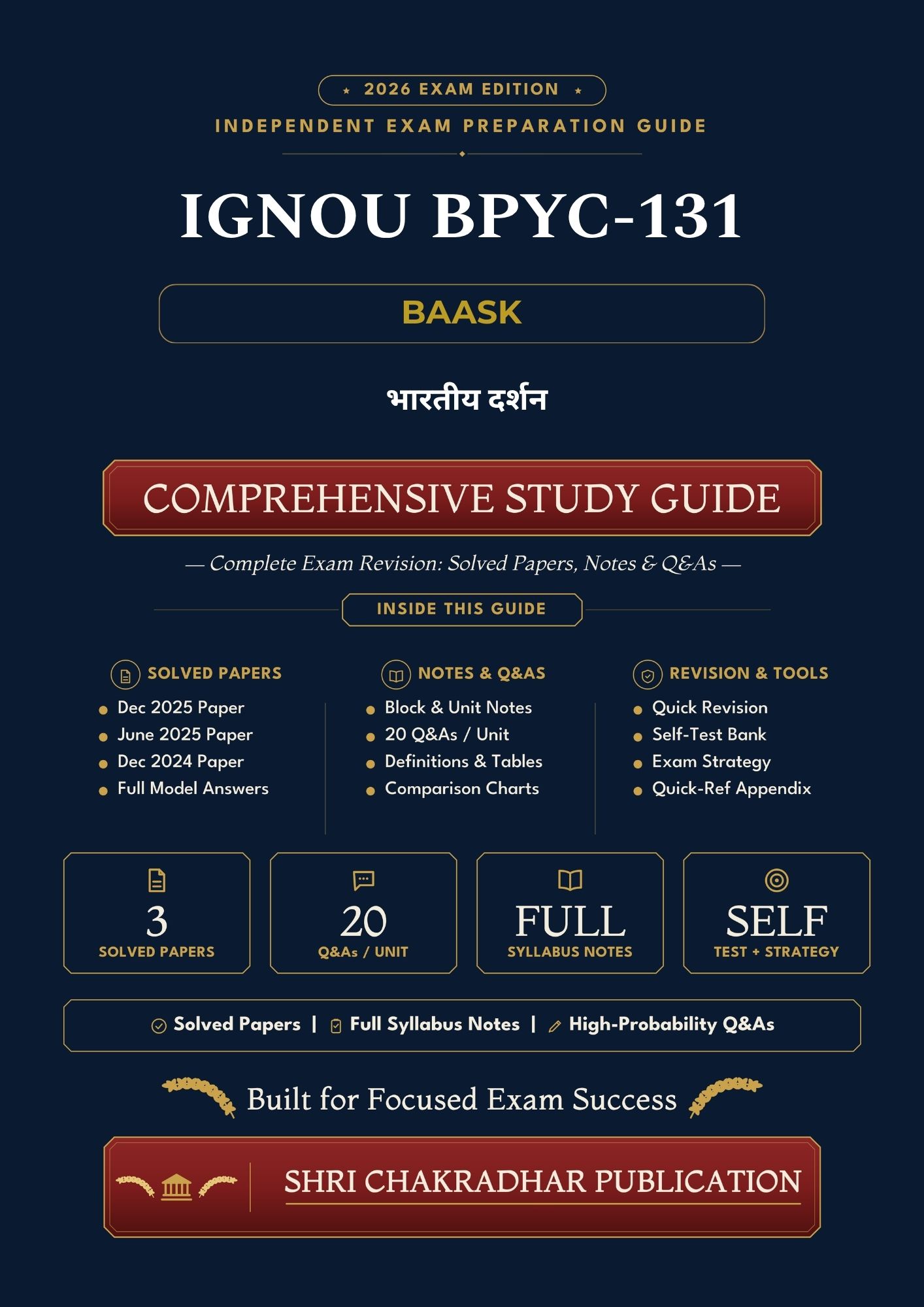
IGNOU BPYC-131 Book (भारतीय दर्शन) supports systematic preparation for भारतीय दर्शन by linking 5 verified Blocks with Unit-wise notes, question practice and final revision. The course map stays visible so study time is spent on the right areas.
The real pressure point is not access to material but converting a broad course into a smaller set of dependable recall cues and answer frameworks. In this course, links among भारतीय दर्शन, उपनिषद and नास्तिक दर्शन deserve particular attention because they shape both understanding and exam-ready explanation.
For more IGNOU study material, visit IGNOU Study Material. Use this independent guide alongside the latest official IGNOU study material and current examination instructions.
An Overview of the IGNOU BPYC-131 Help Book
The course is easier to revise when its internal relationships are visible. Here, भारतीय दर्शन, उपनिषद and नास्तिक दर्शन are positioned as anchors for the rest of the syllabus.
Each Unit-wise theme is therefore studied twice: first for understanding and then for expression. The second pass focuses on headings, transitions, examples and the exact command word used in a question.
Use the official structure as the spine: read one Unit, note its central idea in one sentence, add two supporting points and practise one likely question before moving ahead.
This Book Is Useful For
The guide suits learners who want to turn reading into a visible study plan. It can be used from the beginning of the course or as a focused TEE revision companion.
- BAASK learners mapping the full BPYC-131 course before revision
- Students strengthening recall of भारतीय दर्शन, उपनिषद and नास्तिक दर्शन
- Learners who prefer Unit-wise notes aligned with the verified syllabus
- TEE candidates practising structured descriptive answers and short notes
- Students using official IGNOU material as the primary source and this guide as revision support
What’s Inside This BPYC-131 Book
Inside the guide, every component has a job: clarify the course, shorten retrieval time or improve written practice. The parts are arranged to move from syllabus coverage to active recall.
- Course navigation: Block/Unit coverage kept in the researched order
- Key-term revision: important language drawn from भारतीय दर्शन, उपनिषद and दार्शनिक परम्पराएँ
- Applied explanation: ways to connect theory, text, policy, example or calculation as relevant
- Question rehearsal: outline practice before full-length answers
- Last-week planning: selective revision based on gaps rather than passive rereading
Complete Syllabus Coverage – All 5 Blocks
The official course organisation is the anchor for this guide. Named Blocks are reproduced where verified; Unit-level structure is preserved where a separate Block hierarchy cannot be confirmed.
| Official Block | Official Block Name | Revision Focus |
|---|---|---|
| Block 1 | भारतीय दर्शन का परिचय | Revise definitions, major arguments, examples and Unit-wise answer points linked with this Block. |
| Block 2 | औपनिषदिक दर्शन: मूल विषय-I | Revise definitions, major arguments, examples and Unit-wise answer points linked with this Block. |
| Block 3 | औपनिषदिक दर्शन: मूल विषय-II | Revise definitions, major arguments, examples and Unit-wise answer points linked with this Block. |
| Block 4 | नास्तिक दर्शन | Revise definitions, major arguments, examples and Unit-wise answer points linked with this Block. |
| Block 5 | आस्तिक दर्शन | Revise definitions, major arguments, examples and Unit-wise answer points linked with this Block. |
Use the official names as stable anchors in your notes. Under each one, keep only the definitions, arguments, examples and likely question forms needed to reconstruct a complete answer.
How This Book Maps to the IGNOU BPYC-131 Exam Pattern
For the TEE, knowing a topic is only the first step; the second is deciding how much definition, explanation, evidence and evaluation the question requires.
Use भारतीय दर्शन, नास्तिक दर्शन and आस्तिक दर्शन to practise transitions between ideas. Examiners can change the wording, but a learner who understands the relationships can still build a coherent response.
Previous-paper practice is used for rehearsal, not for claims about guaranteed repetition. Always check the latest official TEE paper for current marks, sections and instructions.
Why Students Prefer Our IGNOU BPYC-131 Guide Book & Study Material
A course-specific guide is useful when it helps a learner make decisions—what to read, what to reduce into notes, what to practise and what to revisit.
In BPYC-131, the approach keeps भारतीय दर्शन, उपनिषद and नास्तिक दर्शन visible as recurring anchors. The student can therefore trace related questions back to the same core understanding instead of memorising separate model answers.
Compiled & Reviewed By
This guide is prepared and reviewed by the Shri Chakradhar Publication (SCP) Panel of Experts / BK Sahni. Its role is to make a researched course structure easier to revise without suggesting affiliation, endorsement or official status.
Independent explanations, practice questions and revision cues supplement the official material. Current syllabus, assignment and TEE notices should always be checked from IGNOU channels.
How to Use the IGNOU BPYC-131 Help Book for TEE and Assignments
A simple routine works better than unplanned rereading. Move from map to notes, from notes to memory, and from memory to timed writing.
- Begin with the verified Block/Unit sequence and identify the next unfinished area.
- Create a one-sentence definition for भारतीय दर्शन and a two-sentence explanation for उपनिषद.
- Add one example, text reference, case, policy point or calculation as appropriate to the course.
- Turn नास्तिक दर्शन into a two-minute answer outline before writing in full.
- Compare the finished answer with your headings rather than memorising a fixed paragraph.
- Use the final week for weak themes, especially दार्शनिक परम्पराएँ and भारतीय दर्शन.
Assignment responses should be prepared and submitted by the student in accordance with IGNOU guidelines; use the guide to understand and practise, not to bypass academic requirements.
High-Probability Questions from IGNOU BPYC-131 (Sample)
A useful question bank should expose weak understanding rather than encourage guessing. These sample prompts therefore draw from the verified themes of the course.
- Explain the meaning and significance of भारतीय दर्शन in the context of भारतीय दर्शन.
- Discuss the major issues connected with भारतीय दर्शन and illustrate your answer with suitable examples.
- Explain the meaning and significance of उपनिषद in the context of भारतीय दर्शन.
- Discuss the major issues connected with उपनिषद and illustrate your answer with suitable examples.
- Explain the meaning and significance of नास्तिक दर्शन in the context of भारतीय दर्शन.
- Discuss the major issues connected with नास्तिक दर्शन and illustrate your answer with suitable examples.
- Explain the meaning and significance of आस्तिक दर्शन in the context of भारतीय दर्शन.
- Discuss the major issues connected with आस्तिक दर्शन and illustrate your answer with suitable examples.
Keep the strongest four questions for timed practice and use the remaining prompts as quick oral-recall drills during the last revision cycle.
IGNOU BPYC-131 Sample Question Paper (TEE Format Template)
Use this sample as a writing drill rather than a forecast. The official question paper for your examination session remains the authority for instructions and marking.
Practice instruction: Attempt the set under a self-imposed time limit and follow the latest official pattern for question choice and marks.
- Q1. Explain the meaning and significance of भारतीय दर्शन in the context of भारतीय दर्शन.
- Q2. Discuss the major issues connected with भारतीय दर्शन and illustrate your answer with suitable examples.
- Q3. Explain the meaning and significance of उपनिषद in the context of भारतीय दर्शन.
- Q4. Discuss the major issues connected with उपनिषद and illustrate your answer with suitable examples.
- Q5. Explain the meaning and significance of नास्तिक दर्शन in the context of भारतीय दर्शन.
- Q6. Discuss the major issues connected with नास्तिक दर्शन and illustrate your answer with suitable examples.
- Q7. Explain the meaning and significance of आस्तिक दर्शन in the context of भारतीय दर्शन.
- Q8. Discuss the major issues connected with आस्तिक दर्शन and illustrate your answer with suitable examples.
Finish the drill by listing the two Units that caused the greatest delay; those become the first topics in your next revision session.
Related IGNOU BPYC-131 Additional Supports
Students looking for additional practice can use these four independent support categories alongside the main study guide.
- IGNOU BPYC-131 Solved Assignment
- IGNOU BPYC-131 Handwritten Assignment
- IGNOU BPYC-131 Solved PYQs
- IGNOU BPYC-131 Solved Guess Paper
Delivery, Returns & Payment Options
The study guide is a physical A5 paperback unless the product page states otherwise. Courier coverage, dispatch timing and payment choices are those available on the website for the delivery address.
Check the current store policy before purchase. Where a legitimate damage or printing issue occurs, the order and parcel details help support review the request efficiently.
How Students Use This Guide
Active recall produces more value than repeated reading. A practical routine is to read a small segment, close the material, reconstruct the headings and then test the reconstruction through a question.
For difficult areas such as भारतीय दर्शन and दार्शनिक परम्पराएँ, write the key term on one side of a card and the explanation, example and significance on the other. Retest cards that still require prompts.
Free Downloads: IGNOU BPYC-131 Exam Support PDFs
The best preparation combines original IGNOU material with a clear revision system. Download the official material first, then use the guide to plan retrieval and writing.
- Official IGNOU/eGyanKosh self-learning material for BPYC-131
- Current assignment booklet for the applicable session
- Available previous TEE question papers from official IGNOU channels
- Programme guide or prospectus information relevant to BAASK
Download BPYC-131 Study Material Free via eGyanKosh (Step-by-Step)
The official eGyanKosh repository is the preferred source for self-learning PDFs. A quick code-and-title check prevents accidental use of the wrong course file.
- Open the official eGyanKosh course/resource page.
- Check that the page or PDF corresponds to BPYC-131 and भारतीय दर्शन.
- Open the required Block, Unit or course file and verify its title before saving it.
- Store the PDFs in a folder named BPYC-131 and keep the verified sequence intact.
- Use the official PDFs for detailed study and this independent guide for Unit-wise revision and answer rehearsal.
Frequently Asked Questions (FAQ)
These FAQs clarify how the guide should be used, what it covers and where official IGNOU material remains essential.
What is the IGNOU BPYC-131 book used for?
It is an independent 2026 study guide for भारतीय दर्शन, built for Unit-wise revision, active recall and TEE answer practice.
How much of the BPYC-131 syllabus is covered?
The guide follows the researched official structure: 5 verified Blocks. Unsupported Block headings are not added where the official hierarchy cannot be confirmed.
Is this an official IGNOU publication?
No. This is independent academic study support; IGNOU self-learning material and University notices remain the official sources.
Can I use this BPYC-131 book for TEE revision?
Yes. Use it to revise भारतीय दर्शन, उपनिषद and नास्तिक दर्शन, practise outlines and rehearse complete answers while checking the latest official exam instructions.
Does the guide include solved-question practice?
Practice material is included to improve answer organisation; pair it with official question papers for session-specific pattern awareness.
What medium is this BPYC-131 guide prepared in?
This product is prepared for the Hindi medium shown on the product page, while necessary course terminology is retained for accuracy.
Can this guide replace eGyanKosh material?
No. Use official self-learning material for prescribed study and use this book to organise recall, revision and writing practice.
How should I revise BPYC-131 in the final week?
Prioritise weak areas, especially आस्तिक दर्शन and दार्शनिक परम्पराएँ; rehearse key definitions, write short outlines and complete a few timed answers instead of rereading everything.
Where can I get order or soft-copy support?
Use the WhatsApp support link on this product page for availability and order assistance. Academic updates should still be verified through official IGNOU channels.
Conclusion
Use the book as a bridge between detailed official reading and timed examination writing. The strongest preparation comes from combining accurate source material with repeated retrieval and selective practice.
To order, visit the IGNOU BPYC-131 Book order page. Re-check the latest syllabus, assignment and TEE instructions through official IGNOU channels before examination.
Disclaimer: This is an independent academic study-support resource published by Shri Chakradhar Publication (Pvt.) Ltd. It is not affiliated with, endorsed by, or an official publication of IGNOU. It is designed to supplement, not replace, IGNOU’s official study material. Syllabus and exam patterns may change – please verify the latest information through official IGNOU channels. Students should prepare and submit their own work as per IGNOU guidelines. All trademarks belong to their respective owners.