

Description
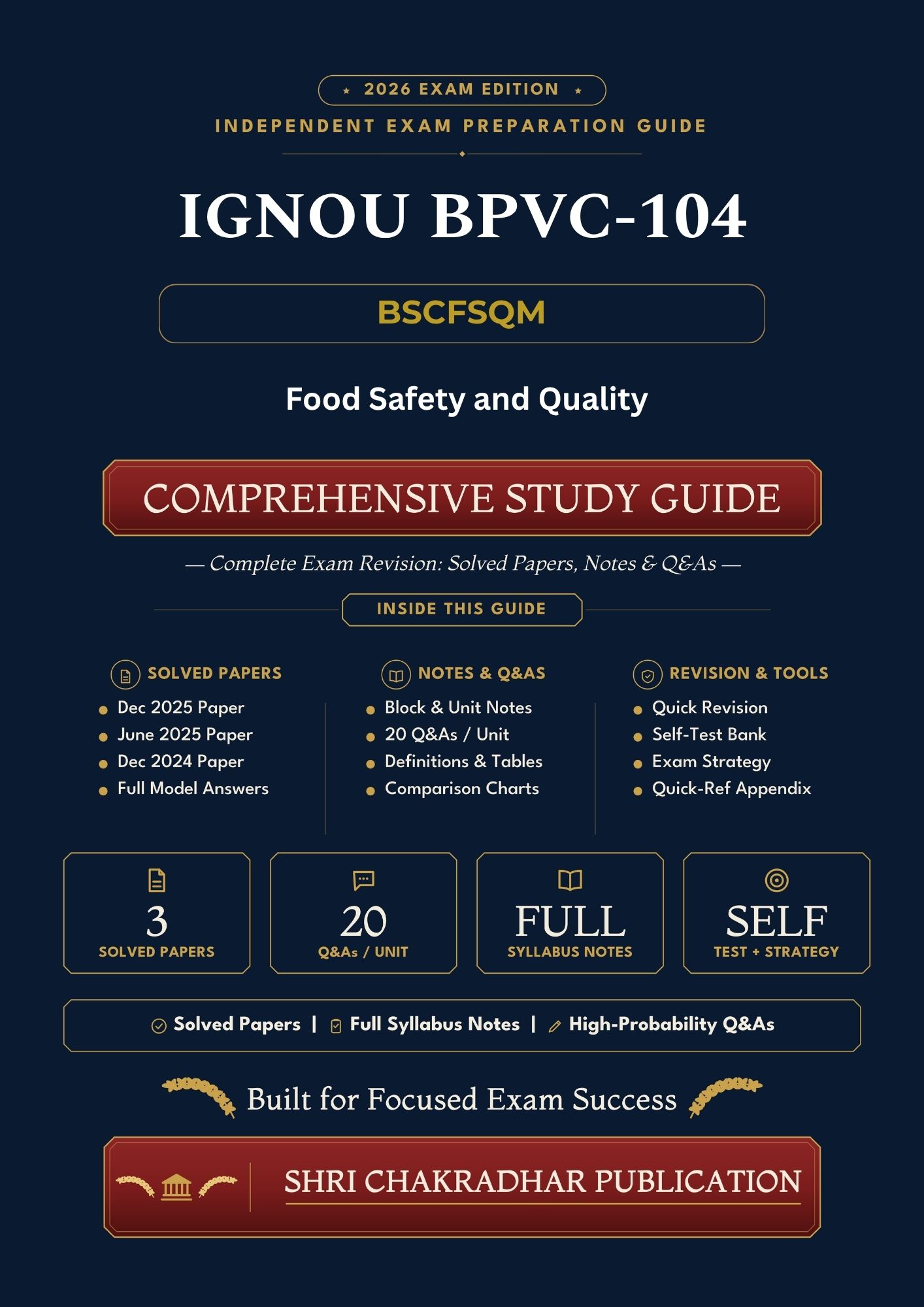
IGNOU BPVC-104 Book (Post-Harvest Management of Food Produce) gives BSCFSQM learners a 2026 English-medium route from official syllabus coverage to Unit-wise recall, written practice and final TEE revision across 7 Blocks.
The main difficulty in Post-Harvest Management of Food Produce is not simply remembering headings. Revise each Unit through principle, process, hazard or quality concern, control measure and practical application. Where manuals are included, link activities and practical exercises to the related theory Blocks. This guide therefore moves from Food Physiology towards Milk Collection, Transportation and Storage through short recall and writing tasks.
For more IGNOU study material, visit IGNOU Study Material. Use this independent guide together with IGNOU’s official study material, assignments and current examination information.
An Overview of the IGNOU BPVC-104 Help Book
The course map is the starting point: Post-Harvest Management of Food Produce is revised in the official order so earlier ideas support later ones. Begin with Food Physiology, then track how the course develops toward Milk Collection, Transportation and Storage.
Revise each Unit through principle, process, hazard or quality concern, control measure and practical application. Where manuals are included, link activities and practical exercises to the related theory Blocks. This creates a study route rather than a collection of unrelated notes.
Course-specific revision lens: While revising Food Physiology, separate the essential definition from the application and finish with one example, calculation or observation. Treat Post-Harvest Management as an active-recall checkpoint: explain it without notes, identify one connection to another Unit and then attempt a written question. While revising Storage, Transportation and Marketing, separate the essential definition from the application and finish with one example, calculation or observation. Treat Post-Harvest Management of Fruits and Vegetables as an active-recall checkpoint: explain it without notes, identify one connection to another Unit and then attempt a written question.
Answer architecture for this course: For Food Physiology, build the response in layers: key term, main explanation, supporting step or evidence, and a short concluding interpretation. When a TEE question targets Post-Harvest Management, identify the command word first and choose only the facts, calculations or examples that directly support that task. When a TEE question targets Storage, Transportation and Marketing, identify the command word first and choose only the facts, calculations or examples that directly support that task. An answer on Post-Harvest Management of Fruits and Vegetables should move from context to the central mechanism or argument, then close with the consequence, result or practical significance.
This Book Is Useful For
The BPVC-104 guide is designed for students who want to know what to revise, how the topics connect and when to move from reading to writing.
- First-time learners building a foundation in Food Physiology.
- Students revising food-science principles, processing steps, hazards, quality parameters, safety controls, regulations and practical applications.
- Learners practising recent-question styles.
- Working students using short study sessions.
- Assignment learners checking concepts before writing independently.
What’s Inside This BPVC-104 Book
Each part of the guide serves a different purpose—understand the topic, retrieve it from memory, practise an answer and return to weak areas.
- Unit-wise notes: concepts arranged around the verified BPVC-104 sequence.
- Course cues: focus on Food Physiology, Post-Harvest Management and connected topics.
- Answer practice: process explanations, hazard-control questions, quality-system cases, food-law answers and practical or activity-based revision.
- PYQ orientation: practice based on recurring examination task-types, without prediction claims.
- Final recap: quick checkpoints for weak areas before the TEE.
Complete Syllabus Coverage – All 7 Blocks
This section records the verified structure used for BPVC-104. It deliberately distinguishes Blocks from experiments, Themes or unconfirmed structures so the syllabus is not overstated.
| Block | Official title | Revision focus |
|---|---|---|
| Block 1 | Food Physiology | Food Physiology |
| Block 2 | Post-Harvest Management | Post-Harvest Management |
| Block 3 | Storage, Transportation and Marketing | Storage, Transportation and Marketing |
| Block 4 | Post-Harvest Management of Fruits and Vegetables | Post-Harvest Management of Fruits and Vegetables |
| Block 5 | Milk Collection, Transportation and Storage | Milk Collection, Transportation and Storage |
| Block 6 | Post-Harvest Management of Cereals, Pulses and Oilseeds | Post-Harvest Management of Cereals, Pulses and Oilseeds |
| Block 7 | Activities Manual | Activities Manual |
Use the structure as a revision tracker and return to any area where written recall remains weak.
How This Book Maps to the IGNOU BPVC-104 Exam Pattern
The guide maps syllabus content to common examination actions rather than promising repeated questions. In BPVC-104, written practice should demonstrate food-science principles, processing steps, hazards, quality parameters, safety controls, regulations and practical applications.
Why Students Prefer Our IGNOU BPVC-104 Guide Book & Study Material
Course alignment is kept visible throughout the book, helping learners distinguish syllabus coverage from optional revision support.
Question practice then turns that coverage into usable exam preparation.
Compiled & Reviewed By
The BPVC-104 guide is compiled by the SCP Panel of Experts under BK Sahni. Official course records are used for structure verification, while the explanatory and practice material remains independent supplementary support.
How to Use the IGNOU BPVC-104 Help Book for TEE and Assignments
Use a three-stage routine: learn the Unit, recall it without notes, then write an answer under a time limit.
- Mark the verified syllabus areas you have completed.
- For each Unit, note the concept, method and one example.
- Practise process explanations, hazard-control questions, quality-system cases, food-law answers and practical or activity-based revision after revision.
- Check current assignments and papers for task-types.
- Return to Milk Collection, Transportation and Storage and other weak areas during final revision.
High-Probability Questions from IGNOU BPVC-104 (Sample)
The following prompts target high-value syllabus connections for revision; they are practice questions, not predictions.
- Explain the food-science principles behind Food Physiology in the context of Post-Harvest Management of Food Produce.
- Discuss the safety or quality controls for Post-Harvest Management in the context of Post-Harvest Management of Food Produce.
- Compare processing or management approaches to Storage, Transportation and Marketing in the context of Post-Harvest Management of Food Produce.
- Apply the relevant standards or procedures to Post-Harvest Management of Fruits and Vegetables in the context of Post-Harvest Management of Food Produce.
- Explain the food-science principles behind Milk Collection, Transportation and Storage in the context of Post-Harvest Management of Food Produce.
- Build a comparative answer linking Food Physiology with Milk Collection, Transportation and Storage.
- Write a structured short note on one recurring concept from Post-Harvest Management of Food Produce, using definition, explanation and a relevant example, calculation, process or evidence as appropriate.
IGNOU BPVC-104 Sample Question Paper (TEE Format Template)
The template below is a study exercise, not an IGNOU-issued paper. Its purpose is to practise sequencing and written response under time pressure.
Section A – Extended Answers
- Explain the food-science principles behind Food Physiology in the context of Post-Harvest Management of Food Produce.
- Discuss the safety or quality controls for Post-Harvest Management in the context of Post-Harvest Management of Food Produce.
- Compare processing or management approaches to Storage, Transportation and Marketing in the context of Post-Harvest Management of Food Produce.
Section B – Analytical / Short Answers
- Apply the relevant standards or procedures to Post-Harvest Management of Fruits and Vegetables in the context of Post-Harvest Management of Food Produce.
- Explain the food-science principles behind Milk Collection, Transportation and Storage in the context of Post-Harvest Management of Food Produce.
- Build a comparative answer linking Food Physiology with Milk Collection, Transportation and Storage.
Use the exercise to improve both content recall and answer organisation, not to predict the examination.
Related IGNOU BPVC-104 Additional Supports
Students who need additional assignment or exam-practice formats can use the four optional supports below.
- IGNOU BPVC-104 Solved Assignment
- IGNOU BPVC-104 Handwritten Assignment
- IGNOU BPVC-104 Solved PYQs
- IGNOU BPVC-104 Solved Guess Paper
Delivery, Returns & Payment Options
The A5 paperback is supplied under the delivery, return and payment conditions shown on the live product page at the time of order.
How Students Use This Guide
Use the guide as a cycle rather than a one-time read: study, retrieve, write, check and revisit the weakest part of Post-Harvest Management of Food Produce.
Integrated recall map: Link Food Physiology to the next course area by identifying one dependency, one contrast and one practical consequence; this makes the topic easier to retrieve in an integrated answer. Link Post-Harvest Management to the next course area by identifying one dependency, one contrast and one practical consequence; this makes the topic easier to retrieve in an integrated answer. Link Storage, Transportation and Marketing to the next course area by identifying one dependency, one contrast and one practical consequence; this makes the topic easier to retrieve in an integrated answer. After revising Post-Harvest Management of Fruits and Vegetables, write down one common confusion, the correct distinction and a concrete example, calculation, process or case that resolves the confusion.
Free Downloads: IGNOU BPVC-104 Exam Support PDFs
Official IGNOU sources should be the first stop for current study material, assignments and examination documents.
- Official IGNOU/eGyanKosh material for BPVC-104.
- IGNOU Assignments for current papers and instructions.
- IGNOU Previous Year Question Papers for available TEE papers.
Download BPVC-104 Study Material Free via eGyanKosh (Step-by-Step)
To cross-check BPVC-104, open eGyanKosh and match the retrieved record with your registration and current programme information.
- Open the official repository at eGyanKosh.
- Search for BPVC-104.
- Match the title and programme context.
- Save the relevant official PDFs.
- Use those PDFs with this independent guide for Unit-wise practice.
Frequently Asked Questions (FAQ)
This FAQ separates the independent guide from official IGNOU material and explains how to use both together.
How is IGNOU BPVC-104 structured?
The researched official structure contains 7 Blocks, all represented in this edition.
Which subject is linked to BPVC-104?
Post-Harvest Management of Food Produce is the course subject; this guide follows the researched official sequence and focuses on Unit-wise revision.
Which programme is this BPVC-104 edition for?
This edition is prepared for BSCFSQM learners studying BPVC-104.
What medium is the BPVC-104 guide?
This product is prepared in English; students should match it with their intended study and examination medium.
Are PYQ-oriented questions included?
Yes. Previous-paper-oriented practice is included to improve answer skills, without promising that a question will repeat.
Can the guide help with assignments?
Use it for concept understanding and planning, while writing and submitting your own assignment work according to IGNOU guidelines.
Is this an official IGNOU publication?
No. It is independent academic study support from Shri Chakradhar Publication and is not affiliated with or endorsed by IGNOU.
How do I download the official BPVC-104 PDFs?
Search the exact code BPVC-104 on eGyanKosh and use the official IGNOU links provided above.
How can I prepare BPVC-104 efficiently?
Follow the official sequence, use active recall, practise written responses, review recent papers and return to weak Units before the examination.
Conclusion
The IGNOU BPVC-104 Book brings the verified structure of Post-Harvest Management of Food Produce together with Unit-wise revision and written practice for a balanced 2026 preparation plan.
To order, visit the IGNOU BPVC-104 Book order page.
Disclaimer: This is an independent academic study-support resource published by Shri Chakradhar Publication (Pvt.) Ltd. It is not affiliated with, endorsed by, or an official publication of IGNOU. It is designed to supplement, not replace, IGNOU’s official study material. Syllabus and exam patterns may change – please verify the latest information through official IGNOU channels. Students should prepare and submit their own work as per IGNOU guidelines. All trademarks belong to their respective owners.