

Description
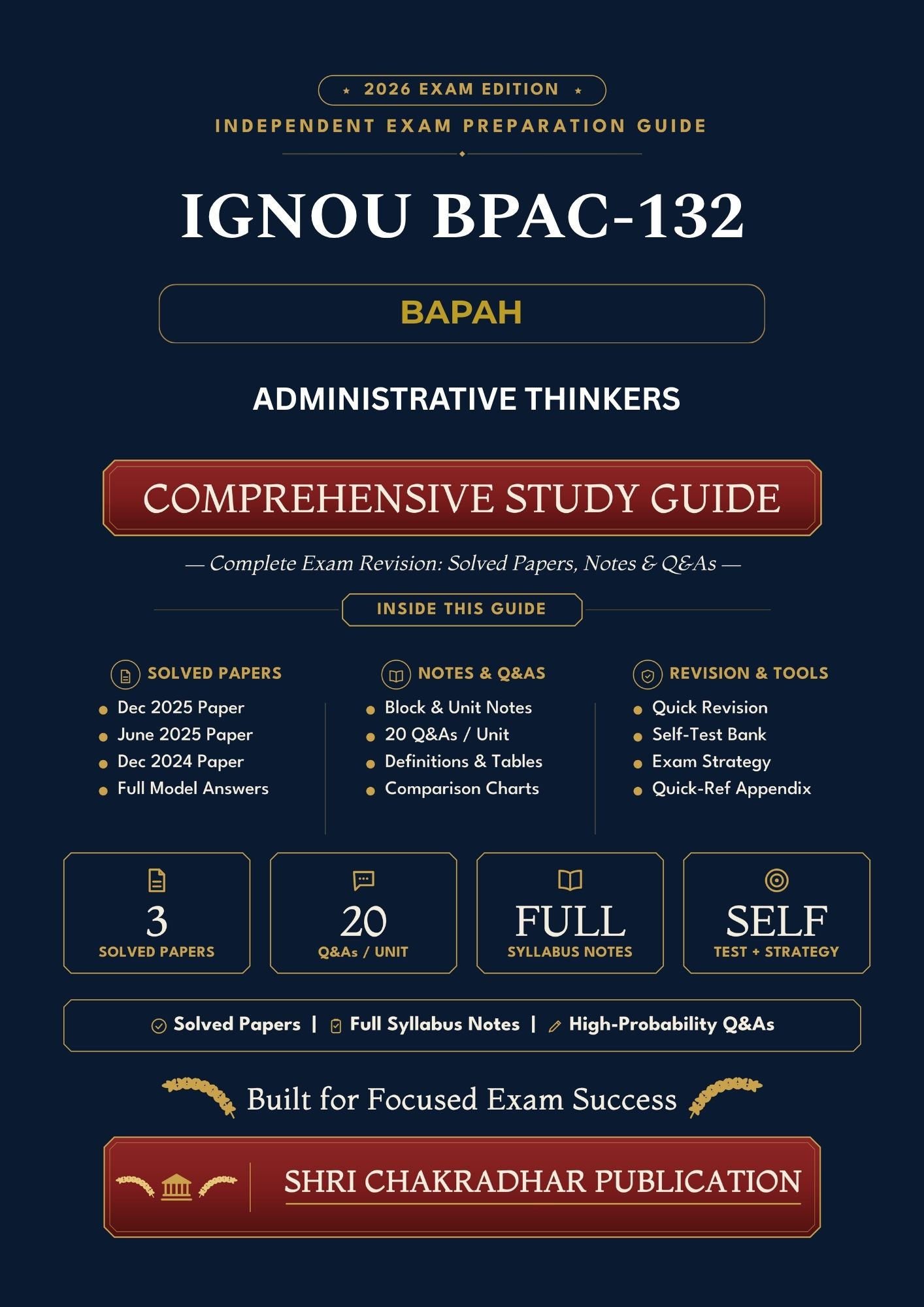
IGNOU BPAC-132 Book (Administrative Thinkers) gives Bachelor of Arts (Honours) Public Administration (BAPAH) learners a course-code-first route through Administrative Thinkers. The verified syllabus order remains visible while every study stage moves from understanding to recall and then to answer writing.
Many learners finish a first reading yet still struggle to retrieve headings, choose examples and sequence an answer when the examination clock is running. In this course, links among Indian administrative thought, classical thinkers and behavioural thinkers deserve particular attention because they shape both understanding and exam-ready explanation.
For more IGNOU study material, visit IGNOU Study Material. Use this independent guide alongside the latest official IGNOU study material and current examination instructions.
An Overview of the IGNOU BPAC-132 Help Book
Before memorising definitions, learners should know the architecture of Administrative Thinkers. The overview therefore treats Indian administrative thought, classical thinkers and behavioural thinkers as connected study areas rather than isolated chapters.
Each Unit-wise theme is therefore studied twice: first for understanding and then for expression. The second pass focuses on headings, transitions, examples and the exact command word used in a question.
For every topic, prepare a four-part answer frame—meaning, explanation, illustration and significance—then adapt that frame to the wording of the question.
This Book Is Useful For
Use this guide when official material feels extensive and you want a compact route through the course without losing the verified sequence.
- BAPAH learners mapping the full BPAC-132 course before revision
- Students strengthening recall of Indian administrative thought, classical thinkers and behavioural thinkers
- Learners who prefer Unit-wise notes aligned with the verified syllabus
- TEE candidates practising structured descriptive answers and short notes
- Students using official IGNOU material as the primary source and this guide as revision support
What’s Inside This BPAC-132 Book
The internal structure is practical: learn the idea, reduce it to recall cues, test it through a question and return to weak points before the next revision cycle.
- Unit-wise study notes: official sequence converted into concise revision points
- Concept links: connections among definitions, arguments and neighbouring themes
- Answer frames: course-specific ways to organise Indian administrative thought and classical thinkers
- Practice prompts: questions for explanation, comparison, application and evaluation
- Final recap cues: headings and reminders for the last revision cycle
Complete Syllabus Coverage – All 5 Blocks
This section makes the syllabus visible in one place. It records the verified sequence and avoids creating unsupported Block names.
| Official Block | Official Block Name | Revision Focus |
|---|---|---|
| Block 1 | Indian Thinkers | Revise definitions, major arguments, examples and Unit-wise answer points linked with this Block. |
| Block 2 | Classical Thinkers | Revise definitions, major arguments, examples and Unit-wise answer points linked with this Block. |
| Block 3 | Behavioural and Systems Thinkers | Revise definitions, major arguments, examples and Unit-wise answer points linked with this Block. |
| Block 4 | Socio-Psychological Thinkers | Revise definitions, major arguments, examples and Unit-wise answer points linked with this Block. |
| Block 5 | Management and Public Policy Thinkers | Revise definitions, major arguments, examples and Unit-wise answer points linked with this Block. |
How This Book Maps to the IGNOU BPAC-132 Exam Pattern
The guide maps content to answer tasks rather than promising repeated questions. A strong response starts by identifying what the command word demands and then selecting only the most relevant course material.
When revising Indian administrative thought and classical thinkers, prepare both a compact short-note version and a deeper long-answer version. For behavioural thinkers, add one comparison or applied example so the answer can adapt to changed wording.
Why Students Prefer Our IGNOU BPAC-132 Guide Book & Study Material
Students often prefer a guide that keeps learning and practice in the same sequence. That reduces the gap between reading a concept and using it in an answer.
Because Administrative Thinkers contains several related strands, the guide uses Indian administrative thought, behavioural thinkers and socio-psychological thinkers as cross-links. This keeps revision subject-specific and discourages generic answers.
Compiled & Reviewed By
This guide is prepared and reviewed by the Shri Chakradhar Publication (SCP) Panel of Experts / BK Sahni. Its role is to make a researched course structure easier to revise without suggesting affiliation, endorsement or official status.
Independent explanations, practice questions and revision cues supplement the official material. Current syllabus, assignment and TEE notices should always be checked from IGNOU channels.
How to Use the IGNOU BPAC-132 Help Book for TEE and Assignments
The most efficient method is staged: first establish coverage, then test retrieval, and only then spend time on complete answers.
- Locate Indian administrative thought in the course map and read the related official material.
- Reduce Indian administrative thought to five recall headings without copying whole paragraphs.
- Connect those headings with classical thinkers or behavioural thinkers where the syllabus links them.
- Write a short response from memory and mark what was missing.
- Practise one longer question using an introduction, ordered body and conclusion.
- Revisit systems thinkers during the next cycle only if retrieval remains weak.
High-Probability Questions from IGNOU BPAC-132 (Sample)
The following prompts are revision exercises, not predictions. They sample the major concepts and question actions that a learner should be able to handle after studying the course.
- Explain the meaning and significance of Indian administrative thought in the context of Administrative Thinkers.
- Discuss the major issues connected with Indian administrative thought and illustrate your answer with suitable examples.
- Explain the meaning and significance of classical thinkers in the context of Administrative Thinkers.
- Discuss the major issues connected with classical thinkers and illustrate your answer with suitable examples.
- Explain the meaning and significance of behavioural thinkers in the context of Administrative Thinkers.
- Discuss the major issues connected with behavioural thinkers and illustrate your answer with suitable examples.
- Explain the meaning and significance of systems thinkers in the context of Administrative Thinkers.
- Discuss the major issues connected with systems thinkers and illustrate your answer with suitable examples.
For a second round, rewrite two questions by combining Indian administrative thought with classical thinkers and behavioural thinkers with systems thinkers. This tests whether you understand relationships rather than memorised wording.
IGNOU BPAC-132 Sample Question Paper (TEE Format Template)
Use this sample as a writing drill rather than a forecast. The official question paper for your examination session remains the authority for instructions and marking.
Practice instruction: Attempt the set under a self-imposed time limit and follow the latest official pattern for question choice and marks.
- Q1. Explain the meaning and significance of Indian administrative thought in the context of Administrative Thinkers.
- Q2. Discuss the major issues connected with Indian administrative thought and illustrate your answer with suitable examples.
- Q3. Explain the meaning and significance of classical thinkers in the context of Administrative Thinkers.
- Q4. Discuss the major issues connected with classical thinkers and illustrate your answer with suitable examples.
- Q5. Explain the meaning and significance of behavioural thinkers in the context of Administrative Thinkers.
- Q6. Discuss the major issues connected with behavioural thinkers and illustrate your answer with suitable examples.
- Q7. Explain the meaning and significance of systems thinkers in the context of Administrative Thinkers.
- Q8. Discuss the major issues connected with systems thinkers and illustrate your answer with suitable examples.
After the session, review three things: whether the command word was answered, whether the course terminology was accurate, and whether the conclusion actually resolved the question.
Related IGNOU BPAC-132 Additional Supports
The following four support categories can be used separately from the study guide when a learner needs more targeted practice.
- IGNOU BPAC-132 Solved Assignment
- IGNOU BPAC-132 Handwritten Assignment
- IGNOU BPAC-132 Solved PYQs
- IGNOU BPAC-132 Solved Guess Paper
Delivery, Returns & Payment Options
Orders are fulfilled as an A5 paperback using the shipping services shown at checkout. Dispatch and delivery availability can vary by PIN code and operational conditions.
Current website terms govern payment, returns and replacements. If the delivered copy has a physical production or transit problem, contact support with the order information and packaging details.
How Students Use This Guide
A useful habit is to turn every study session into an output. The output may be a concept map, a short answer, a comparison table or a timed paragraph.
For BPAC-132, make one revision sheet that links Indian administrative thought, classical thinkers and behavioural thinkers. Add a second sheet for systems thinkers, socio-psychological thinkers and management thinkers. The split keeps the subject manageable while preserving relationships.
Free Downloads: IGNOU BPAC-132 Exam Support PDFs
Before relying on any third-party summary, confirm the course through official IGNOU material. The resources below are the appropriate starting points for that check.
- Official IGNOU/eGyanKosh self-learning material for BPAC-132
- Current assignment booklet for the applicable session
- Available previous TEE question papers from official IGNOU channels
- Programme guide or prospectus information relevant to BAPAH
Download BPAC-132 Study Material Free via eGyanKosh (Step-by-Step)
Downloading the official material first gives you a stable reference for definitions, prescribed sequence and any content that needs deeper reading.
- Open the official eGyanKosh course/resource page.
- Check that the page or PDF corresponds to BPAC-132 and Administrative Thinkers.
- Open the required Block, Unit or course file and verify its title before saving it.
- Store the PDFs in a folder named BPAC-132 and keep the verified sequence intact.
- Use the official PDFs for detailed study and this independent guide for Unit-wise revision and answer rehearsal.
Frequently Asked Questions (FAQ)
The FAQ focuses on coverage, revision, medium, practice and the independent status of the guide.
What is the IGNOU BPAC-132 book used for?
The book helps learners revise Administrative Thinkers in a structured way while using official IGNOU material as the primary academic source.
How much of the BPAC-132 syllabus is covered?
The guide follows the researched official structure: 5 verified Blocks. Unsupported Block headings are not added where the official hierarchy cannot be confirmed.
Is this an official IGNOU publication?
No. The guide is privately published study support and does not claim IGNOU authorship, affiliation or endorsement.
Can I use this BPAC-132 book for TEE revision?
Yes. Use it to revise Indian administrative thought, classical thinkers and behavioural thinkers, practise outlines and rehearse complete answers while checking the latest official exam instructions.
Does the guide include solved-question practice?
Yes, it provides guided practice and answer-structure support rather than a guarantee of repeated examination questions.
What medium is this BPAC-132 guide prepared in?
This product is prepared for the English medium shown on the product page, while necessary course terminology is retained for accuracy.
Can this guide replace eGyanKosh material?
No. The guide is a companion to, not a substitute for, official IGNOU study material.
How should I revise BPAC-132 in the final week?
Prioritise weak areas, especially systems thinkers and socio-psychological thinkers; rehearse key definitions, write short outlines and complete a few timed answers instead of rereading everything.
Where can I get order or soft-copy support?
Use the WhatsApp support link on this product page for availability and order assistance. Academic updates should still be verified through official IGNOU channels.
Conclusion
The purpose of this BPAC-132 guide is disciplined preparation: cover the researched structure, condense each theme, retrieve it without prompts and practise the question forms that expose weak understanding.
To order, visit the IGNOU BPAC-132 Book order page. Re-check the latest syllabus, assignment and TEE instructions through official IGNOU channels before examination.
Disclaimer: This is an independent academic study-support resource published by Shri Chakradhar Publication (Pvt.) Ltd. It is not affiliated with, endorsed by, or an official publication of IGNOU. It is designed to supplement, not replace, IGNOU’s official study material. Syllabus and exam patterns may change – please verify the latest information through official IGNOU channels. Students should prepare and submit their own work as per IGNOU guidelines. All trademarks belong to their respective owners.