

Description
In short. This order covers the nine Bachelor of Library and Information Science papers that carry a Tutor Marked Assignment, BLI 221 to BLI 225 and BLIE 226 to BLIE 229, each written out by hand on foolscap sheets as instruction 8 of IGNOU’s own BLIS booklet directs, with a free IGNOU-format front page and a copy of the official question paper in the same bundle. The rate is ₹320 per subject, hard copy only, with courier included in that price and no separate shipping charge. There is no minimum order: one subject or fourteen, same rate. Any session is accepted, current cycle or older, including backlog courses, at the same ₹320 per subject, and the handwriting is matched from a photograph of a page you wrote yourself before anything is paid. Three things make BLIS different from the programmes beside it: the Faculty of Library and Information Science prints 31 March and 30 September as its two cut-offs rather than the October and April pair, every BLIS paper carries the assignment code AST instead of its own course code, and the tenth row of the BLIS structure, BLII 230 Internship, carries no assignment paper at all.
What Reaches You When a BLIS Bundle Is Dispatched
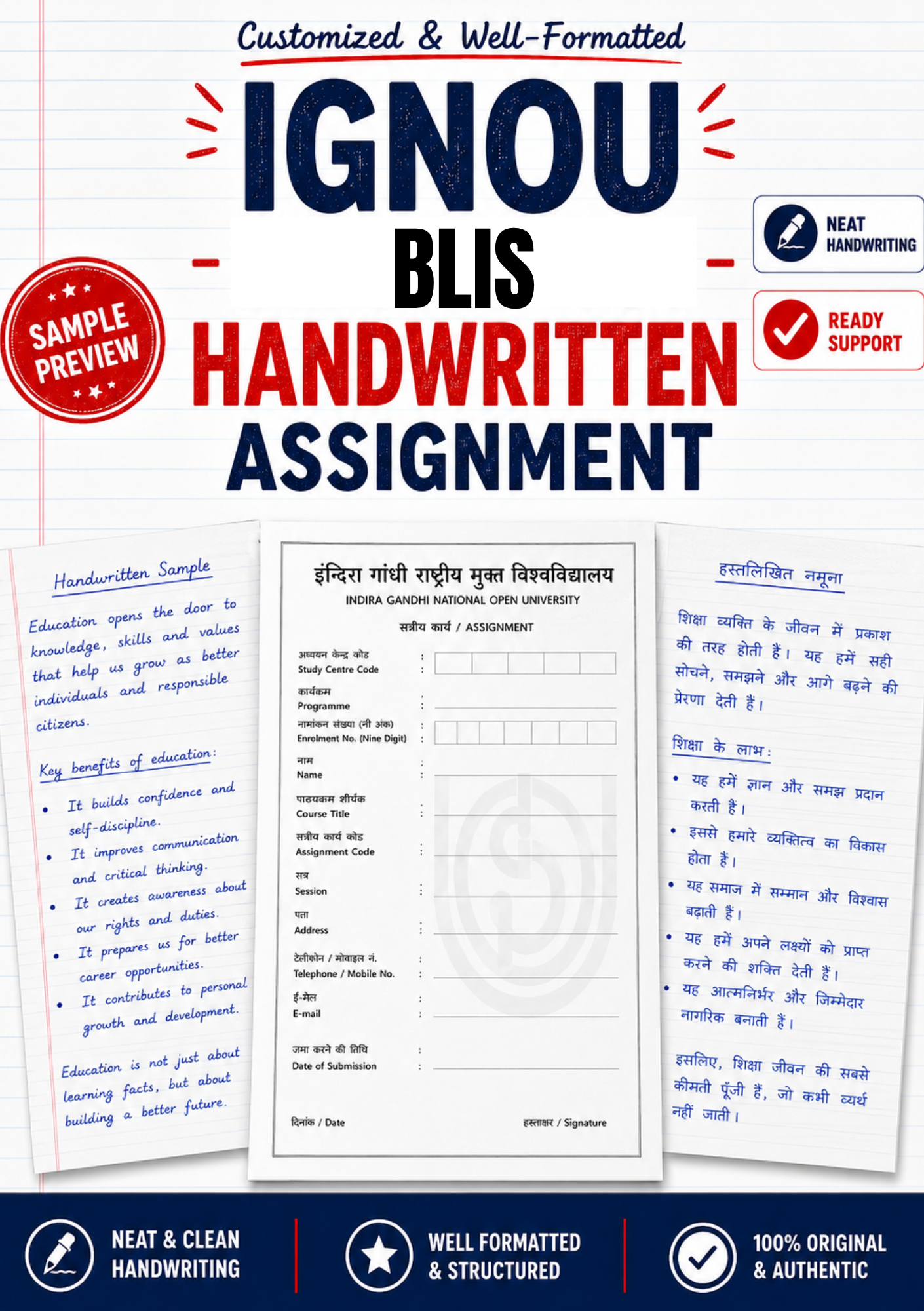
A BLIS order leaves the press as paper, tied by course code, and nothing about it needs a screen. For each code you name, the packet holds the answers written out in a single consistent hand on foolscap sheets, a filled IGNOU-format front page carrying the programme title and code, the course title and code, the assignment number, your enrolment number and your Study Centre details, and a printed copy of the official BLIS question paper that IGNOU issued for your admission cycle. The question paper travels with the set because the Coordinator at the Study Centre is asked to read answers against questions, and because the BLIS booklet instructs learners to write the question number beside every answer. A bundle that arrives without the paper makes that check awkward for the person doing it.
Sheets are written on one side only, with the three inch left margin and the four clear lines between answers that instruction 9 of the BLIS booklet asks for, so the Counsellor has room to write comments where they belong. The front page is not an extra: the IGNOU-format cover sheet is free with every order. The set is tied rather than filed in plastic, which is how most Regional Centres ask for assignments to arrive.
What does not arrive is a file. No soft copy or PDF is sold. That is a deliberate scope decision rather than a limitation, because instruction 7 printed on every BLIS assignment paper states that typed and computer print assignments are not permissible, which makes a downloadable document the wrong object to put in front of a Study Centre.
The ₹320 Line for a Library Science Paper, Item by Item
The rate is ₹320 per subject, hard copy only, with courier included in that price and no separate shipping charge. One figure covers the writing, the foolscap, the front page, the question paper copy and the courier to your address. Nothing is added at dispatch and nothing is quoted separately for packing.
Inside that figure sit several things learners often expect to pay extra for. Send a photo of a page you have written yourself and the handwritten set is matched to your handwriting at no extra charge. The service covers all mediums IGNOU issues the TMA paper in, at the same price, so a learner answering in Hindi pays what a learner answering in English pays. There is no minimum order: one subject or fourteen, same rate, which on a nine-paper programme like BLIS means a learner with one outstanding BLIE 227 is not pushed toward a bundle they do not need.
Equally, the figure buys a written set and not an outcome. No claim is made about the marks any assignment will receive, about how an evaluator will assess it, or about whether it will be accepted. Assignment evaluation is entirely a matter for IGNOU. It also does not cover the practical components that sit beside the written answers in several BLIS courses, and it does not cover BLII 230, which is addressed further down this page. Delivery depends on your pin code and is confirmed for your order before you pay. No figure is promised on this page, because a courier running to a district headquarters and a courier running to a metro pin code are not the same journey and a number printed here would be false for one of them.
A Downloaded BLIS Solution File Is Not What the Counter Accepts
Two different things get called an assignment in library science forums, and ordering the wrong one wastes a cycle. A solved assignment is a soft-copy reference file of model answers for one course code and one session, opened on a phone or a laptop and used as a source to write from. A handwritten assignment is the answers written out by hand on sheets and submitted in hard copy at the Study Centre. One is reading material. The other is the submission.
| Point | Solved reference file for a BLI or BLIE code | Handwritten BLIS set |
|---|---|---|
| Format | A document read on a screen | Foolscap sheets in ink, tied per course code |
| What you do with it | Read it, then write your own fair copy by hand | Check it, sign the declaration and hand it in |
| Who it suits | A learner who has writing time but wants a reference point | A learner short of writing time across nine papers |
| Price on this page | Not sold here; a separate shelf covers it | ₹320 per subject, courier included |
Scroll the table sideways on a narrow screen.
IGNOU’s own wording settles what the counter takes. Instruction 7 on the July 2025 and January 2026 BLIS paper reads that typed and computer print assignments are not permissible, and instruction 8 tells learners to use only foolscap size paper. A printed solution file, however accurate, fails both instructions the moment it is handed over. So a reference file is a tool for writing with, never a thing to submit, and this page does not suggest otherwise.
If a reference file is what you actually want, the store keeps a separate shelf for it: the per-code BLIS solved assignment solutions for BLI 221 through BLIE 229 live there in both mediums, and that is the right lane for a downloadable file. This page sells the written bundle only.
₹320 per subject · hard copy only · courier included · no minimum order
Name your BLI and BLIE codes and your admission session, and a quote comes back before anything is paid.
All Nine BLI and BLIE Papers This Order Can Cover
The July 2026 Common Prospectus lists ten rows for BLIS and a total of 40 credits, every row weighted at four credits. Nine of those ten rows appear in IGNOU’s own BLIS assignment booklet with a Tutor Marked Assignment against them. Those nine are what this order can be written for, and the table below gives each one with the official title the prospectus prints.
| Code | Official title | Credits | Component named in the prospectus |
|---|---|---|---|
| BLI 221 | Library, Information and Society | 4 | Theory based |
| BLI 222 | Information Sources and Services | 4 | Theory based |
| BLI 223 | Organising and Managing Information | 4 | Theory based |
| BLI 224 | ICT Fundamentals | 4 | Practical component |
| BLI 225 | Communication Skills | 4 | Practical component |
| BLIE 226 | Management of Library and Information Centre | 4 | Theory based |
| BLIE 227 | Document Processing Practice | 4 | Practical component |
| BLIE 228 | Information Products and Services | 4 | Practical component |
| BLIE 229 | ICT in Libraries | 4 | Practical component |
Scroll the table sideways on a narrow screen.
Two features of that list are worth pausing on before you order. The first is that the E in BLIE usually marks an elective across IGNOU’s code conventions, yet IGNOU’s own Samarth admission records print all four BLIE rows as compulsory and place every row in Year 1. BLIS has no elective basket, which means two BLIS learners admitted in the same cycle hold the same nine codes, unlike a BAG or an MCOM learner whose code set depends on choices made at admission.
The second is how unevenly the writing load is spread. The booklet’s own contents page gives BLI 221, BLI 222, BLI 223, BLIE 226 and BLIE 229 a single page each, BLI 224 and BLI 225 two pages between them, and then four pages to BLIE 227 and four more to BLIE 228. BLI 221 asks ten questions across two parts, four of them answered in not more than 500 words and six in not more than 250, for a total of 70 marks. BLIE 228 keeps the same 70 marks but splits them into a Part 1 of eight short questions and a Part 2 that asks you to arrange five bibliographic records in APA seventh edition, write an indicative abstract of a passage on the National Digital Library of India in not more than 50 words, and build a newspaper clipping service from seven consecutive days of one newspaper. Those are not equal evenings of work, and the flat ₹320 does not pretend they are.
One honest limit belongs here rather than in the small print. The clipping exercise in BLIE 228 asks you to browse a newspaper over seven consecutive days and select items on named themes. That is a reading task performed by the learner, and a writing service cannot do your browsing for you. Where a BLIS question requires you to observe, collect or catalogue something yourself, the written bundle carries the answer structure and the finished prose, and you supply the observations the question asks you personally to make.
The Tenth Row, BLII 230 Internship, and Why No Assignment Paper Exists For It
The prospectus table for BLIS runs to ten rows, and the tenth is BLII 230 Internship at four credits. Nine rows times four credits is 36, the internship adds four, and the total of 40 credits that the prospectus prints is reached only when the internship is counted. The arithmetic holds.
The assignment booklet, however, has a contents page that stops at BLIE 229 on page 21. BLII 230 appears nowhere in it, under any session. That is not an omission to work around; it reflects what an internship is. The internship is assessed through the work you do and the record you keep of it, not through a Tutor Marked Assignment posted to a Coordinator, which is why the store keeps it on a separate shelf as BLIS internship support rather than an assignment product.
The practical consequence for your order is simple. A complete BLIS assignment order is nine papers, which at ₹320 per subject comes to ₹2,880, and BLII 230 is not one of them. If a seller quotes you ten BLIS assignments, ask which paper the tenth is written against, because IGNOU has published none.
Five Places the BLIS Documents Argue With Themselves
These were found by reading IGNOU’s own prospectus and its own BLIS booklets against each other, and by reading this store’s own pages honestly. None of them is a transcription slip on this page. Each is reported as it stands so that you can see it before a Study Centre does.
Conflicts found in the sources this page was built from, including this store’s own.
1. The prospectus names six practical courses and then lists five. Section 6.4 of the July 2026 Common Prospectus states that the programme comprises of 10 courses of which six courses have a practical component, and the parenthesis that follows names BLI224, BLI 225, BLIE227, BLIE228 and BLIE229. That is five codes under a heading of six. The same sentence names four theory courses, BLI 221, BLI 222, BLI 223 and BLIE 226, and six plus four reaches ten only if the internship is silently folded into one group, which the sentence does not say.
2. One booklet prints two different July cut-off dates. Page 2 of the July 2025 and January 2026 BLIS booklet prints 31st March 2026 for the July 2025 session. Instruction 1 on page 4 of the same booklet says a July 2025 learner who fails to submit till 30th March 2026 must attempt a fresh set. A learner reading the booklet front to back finds 31 March on one page and 30 March on the next.
3. The same instruction sends you back to the session you just missed. Instruction 1 states that a July 2025 learner who misses the date will have to attempt the fresh assignments of the July 2025 session. Read literally that is the session whose deadline has passed. The sentence is written to describe the next cycle and does not say so.
4. Foolscap on IGNOU’s paper, A4 on this store’s own hub. Instruction 8 of the BLIS booklet says to use only foolscap size paper. The handwritten assignment category page on shrichakradhar.com describes its sample as A4 ruled. That is this publisher’s own inconsistency, it is disclosed here rather than quietly resolved, and it is on the correction list. BLIS sets prepared through this page follow the booklet.
5. IGNOU spells the programme two ways, and so does this store. Samarth admission records print BACHELOR OF LIBRARY AND INFORMATION SCIENCE on one form and BACHELOR OF LIBRARY AND INFORMATION SCIENCES on another, and the prospectus heading uses the singular while several store categories use the plural. A separate in-house error compounds it: a CLIS guess paper for BLII-012 currently sits filed under the BLIS guess paper shelf, and the two are different programmes.
The reason for printing all five rather than the tidy version is that a learner who has seen them will not be startled by one at the counter. Where a conflict touches what gets written, the live booklet wins over the prospectus and over anything on this site, because the booklet is the document the Coordinator is holding.
31 March and 30 September: Library Science Runs the Opposite Calendar to Management
Every BLIS assignment booklet fetched for this page prints its two submission dates on page 2, with no ambiguity about which session each belongs to. For the July 2025 session the date printed is 31st March 2026. For the January 2026 session it is 30th September 2026. The pattern holds back through the cycles: the July 2024 and January 2025 edition prints 31st March 2025 and 30th September 2025, and the July 2023 edition prints 31st March 2024.
This is worth stating plainly because 31 October and 30 April circulate widely as if they were universal IGNOU assignment dates. They belong to the School of Management Studies. BLIS sits with the Faculty of Library and Information Science under the School of Social Sciences, and its pair runs the other way round. A BLIS learner who plans against an MBA friend’s calendar plans against the wrong month twice a year, and the one who takes the aggregator figure of 31 October loses the July cycle entirely, since by then the March date has been gone for seven months.
One more clause on page 4 changes how these dates should be read. Instruction 1 states that the validity of the assignment is one year only. A BLIS question paper is not a permanent document; it expires with its cycle and is replaced. Combined with instruction 2, which says you will not be allowed to appear for the term-end examination for a course if you do not submit the specified number of assignments and complete the practicals in time, that makes the date a gate rather than a preference. Assignments carry 30 per cent of the final course result and the term-end examination carries the remaining 70 per cent. On BLIS the booklet words that share as assignments and practicals together, counting both into the same 30 per cent rather than splitting them.
AST Is Not Your Course Code, and What to Write on the Sheet Instead
Most IGNOU programmes build the assignment code out of the course code, so an MMPC learner copies a string that begins MMPC-001 and a MEG learner copies one that begins MEG-08. BLIS does not work that way, and the difference catches people out at the front page.
On the July 2025 and January 2026 papers, eight of the nine courses print the assignment code AST/TMA/Jul.2025/Jan.2026, identical across BLI 221, BLI 222, BLI 223, BLI 224, BLIE 226, BLIE 227, BLIE 228 and BLIE 229. BLI 225 Communication Skills prints AST-1/TMA/ Jul.2025/Jan.2026, with the suffix and an extra space. The course code is carried separately in the Course Code line directly above it, which is where BLI-221 or BLIE-228 actually appears.
Two practical consequences follow. First, the assignment code on its own does not tell anyone which paper they are holding, so your front page has to carry the course code and title in their own fields exactly as instruction 3 of the booklet lays out: programme title and code, course title and code, assignment number, enrolment number, name, address, Study Centre code and name, and the date. The booklet adds a note that candidates are required to follow this format strictly or the assignments may not be evaluated. Second, the AST prefix is not unique to BLIS. The Certificate in Library and Information Science booklet uses it too, printing codes such as AST/TMA/Jan.2024-Jul.2024 against BLII-013, with the year order and the separator written differently again. Two programmes in the same Faculty share a prefix, which is one reason a BLIS bundle is tied and labelled per course code rather than per session.
Front pages prepared through this order are filled against the booklet published for your stated session, with the assignment code copied as that booklet prints it, spacing included. If your Study Centre has issued its own facing-sheet variant, say so when you send your codes and the cover is matched to it.
Your Own Hand on Foolscap, Matched From One Photograph
The reason handwriting matching exists is that you sign a declaration on the cover page, and a bundle in a hand nothing like yours makes that declaration awkward to stand behind. Send a photo of a page you have written yourself and the handwritten set is matched to your handwriting at no extra charge. The writer assigned to your codes works from that sample: letter forms, slant, spacing and the size you naturally write at.
Across a nine-paper BLIS order, one writer is kept on the whole set wherever the timeline allows, so that BLI 221 and BLIE 229 do not arrive looking like the work of two different people. Where more than one writer is unavoidable on a large order, you are told which codes were split and why rather than finding out from the stack.
What Makes a Usable Sample Photograph
An ordinary page is better than a careful one. Half a page of your normal writing, photographed in daylight with the whole sheet in frame and the lines readable, tells a writer more than a slowly produced specimen in your best hand, because your best hand is not the hand that will appear in your term-end answer booklet. Rough notes from your BLIS blocks work well. A page written in the medium you will answer in works better still, since Devanagari and Latin letter forms do not transfer from one script to the other. The sample goes in before any payment, so you see the proposed match while the decision is still yours.
English Teaching, Hindi Answers, and Every Cycle Since
BLIS has a medium rule that reads oddly until you see both halves of it. The July 2026 Common Prospectus states that the programme is currently being offered in English medium only, and then adds in the same paragraph that students can write their assignments and term-end examination in Hindi medium also. The instruction is English, the answering is not restricted to English. The programme’s eligibility row in the prospectus repeats the point in the medium column rather than leaving it to the prose.
For an order that means exactly what the rule says. The service covers all mediums IGNOU issues the TMA paper in, at the same price. A learner who studies the English blocks and answers in Hindi is an ordinary BLIS case rather than a special request, and the sample photograph should be in the script you will actually use so that the match is made against the right letter forms.
Session coverage runs the same way. Any session is accepted, current cycle or older, including backlog courses, at the same ₹320 per subject. Because the booklet states that the validity of the assignment is one year only, an older BLIS order is written against the paper for the cycle you are clearing, not against the current one, so name the session on your enrolment record when you send your codes. A learner who took admission in a January cycle attempts the January set, and a learner who took admission in July attempts the July set; the booklet is explicit that the two are not interchangeable.
Five Details to Send on WhatsApp, and Nothing Further
Ordering does not need a form, an account or a document upload. Five pieces of information settle a BLIS quote, and anything beyond them is noise.
- Your BLI and BLIE codes. Written as they appear on your admission record, for example BLI 223 and BLIE 227. Nine codes or one.
- The session you are submitting for. A July cycle or a January cycle, and the year. Backlog cycles are named the same way.
- Your answering medium. English or Hindi, since BLIS permits both for assignments even though it is taught in English.
- A photo of a page in your own handwriting. Half a page is enough, in the script you will answer in.
- Your delivery pin code. This is what the delivery window is confirmed against before you pay.
Your enrolment number and Study Centre code are needed for the front page and can follow once the quote is agreed. Nothing is charged while you are deciding, and the handwriting match is proposed before payment rather than after it.
₹320 per subject · nine BLIS papers is ₹2,880 · courier inside the rate · handwriting matched free
Send the five details above and the quote, the handwriting sample step and the delivery window for your pin code come back in the same reply.
Once the BLIS Bundle Is in Your Hands
Open the tie and read before you sign anything. You sign the declaration on the assignment cover page, so you should read and review the content before submitting it, and satisfy yourself that it represents your own understanding of the course. On BLIS that review is not a formality: instruction 5 of the booklet warns that reproducing answers directly from the units earns a zero, and the practical questions in BLIE 227 and BLIE 228 are the ones most likely to need something only you can supply.
Check three things specifically. That the course code and title on each front page match the code on the sheets behind it, since the AST assignment code is identical across eight papers and will not catch a mix-up for you. That the question numbers written beside your answers match the paper for your session, because a paper expires after one year. And that your enrolment number, Study Centre code and Study Centre name are filled, since the booklet’s own note says the format must be followed strictly or the assignment may not be evaluated.
Then submit as the booklet directs. Instruction 11 states that the Tutor Marked Assignments should be sent to the Coordinator of the Study Centre allotted to you. Keep a photocopy or a phone scan of every sheet before it leaves your hands, and keep whatever receipt or acknowledgement the counter gives you, because that receipt is the only thing that helps if the status against a code does not update later. Evaluated assignments come back to you through the Coordinator, and instruction 10 says they arrive with the evaluator’s global comments, which are worth reading before the next cycle’s papers land.
What BLIS Learners Pick Up Alongside the Written Set
A handwritten bundle answers one question in a BLIS year, and most learners are solving two or three at once. The store carries the rest on their own shelves rather than bundling them here.
Learners who want to write their own fair copy and only need the subject matter organised usually start with the chapter-wise BLIS help books for BLI 221 through BLIE 229, which exist in both English and Hindi editions. Those studying the online-mode variant of the same programme should check the separate BLISOL shelf, where the programme is listed under its plural spelling, because the two codes are maintained as distinct categories.
For the term-end paper rather than the assignment, expected-question sets for the BLIS examination cover the same nine codes, and learners who came to BLIS after the certificate route often still need the CLIS expected-question material for the BLII codes, which is a genuinely different programme despite the shared AST prefix. The internship row is handled on its own shelf, linked earlier on this page.
If you are reading this page for a different programme, the full handwritten assignment range across IGNOU programmes lists what else is written to order, and the MMPC and MBA written sets are the closest equivalent for a management learner, though their deadlines run on the October and April pair rather than the March and September one. The reference-file library across every IGNOU programme and the main Shri Chakradhar Publication catalogue hold everything else. A single worked example is sometimes all a learner wants before committing, and the BLIE 226 expected-question booklet on Management of Library and Information Centre shows the level the written material is pitched at.
Learners who would rather write every sheet themselves and only want the method are better served by the editorial side: the step-by-step guide to preparing an IGNOU handwritten assignment on ignouproject.com covers cover pages, margins and submission without selling anything.
BLIS Ordering Questions, Answered Straight
How much does an IGNOU BLIS handwritten assignment cost per paper?
The rate is ₹320 per subject, hard copy only, with courier included in that price and no separate shipping charge. All nine BLIS papers written out comes to ₹2,880. A practical-heavy code such as BLIE 228 costs the same as a theory code such as BLI 222, because the rate is per course code rather than per page.
Which BLIS course codes can this order actually be written for?
BLI 221, BLI 222, BLI 223, BLI 224, BLI 225, BLIE 226, BLIE 227, BLIE 228 and BLIE 229. Those are the nine rows that appear in IGNOU’s BLIS assignment booklet with a Tutor Marked Assignment against them. The tenth prospectus row, BLII 230 Internship, is not an assignment paper and is not covered here.
What is the last date for a BLIS assignment?
The booklet prints 31st March for a July session and 30th September for a January session. On the July 2025 and January 2026 edition those dates are 31st March 2026 and 30th September 2026. Note that the same booklet’s instruction 1 writes 30th March rather than 31st for the July date, so work to the earlier of the two if your cycle is close, and confirm against the booklet for your own session at ignou.ac.in.
Why do other sites say 31 October for IGNOU assignments?
Because that is the School of Management Studies pair, 31 October and 30 April. BLIS sits under the Faculty of Library and Information Science in the School of Social Sciences, and its dates run the opposite way round. Taking the October figure means missing the March cut-off by seven months.
Can I submit a printed or typed BLIS assignment instead?
Instruction 7 of the BLIS booklet states that typed and computer print assignments are not permissible. That instruction appears on every BLIS paper fetched for this page across several sessions. A downloaded solution file is useful as something to write from, not as something to hand in.
Is BLIS written on A4 or foolscap?
Instruction 8 of the BLIS booklet says to use only foolscap size paper, ordinary writing paper, neither too thick nor too thin. Sets prepared through this page follow that instruction. This store’s own handwritten category page currently describes an A4 sample, which is an inconsistency on this site and is listed for correction.
What does AST/TMA/Jul.2025/Jan.2026 mean on my BLIS paper?
It is the assignment code, and unlike most IGNOU programmes it does not contain your course code. Eight BLIS papers carry that identical string; BLI 225 carries AST-1/TMA/ Jul.2025/Jan.2026 instead. Your course code goes in its own field on the front page. The Certificate in Library and Information Science uses the same AST prefix, so the code alone will not tell anyone which programme the sheet belongs to.
Can I order a BLIS assignment for an old or backlog session?
Any session is accepted, current cycle or older, including backlog courses, at the same ₹320 per subject. The set is written against the paper IGNOU published for the cycle you are clearing, so name that session when you send your codes. The booklet states that the validity of the assignment is one year only, which is exactly why the older paper rather than the current one is the right source.
BLIS is taught in English, so can I answer in Hindi?
Yes. The prospectus states the programme is offered in English medium only and in the same paragraph that students can write their assignments and term-end examination in Hindi medium also. The service covers all mediums IGNOU issues the TMA paper in, at the same price. Send your handwriting sample in the script you will answer in.
How does the BLIE 228 newspaper clipping question work if someone else writes the set?
That question asks you to browse one newspaper over seven consecutive days and select items on named themes. The browsing and the selection are yours to do, because they are observations the question asks you personally to make. The written bundle carries the answer structure and the finished prose around what you supply. The same applies anywhere a BLIS question asks you to catalogue or record something first-hand.
How many questions are on a BLIS paper?
It varies by code. BLI 221 and BLI 225 each carry ten questions in two parts, four at 500 words for 10 marks each and six at 250 words for 5 marks each, totalling 70. BLIE 228 also totals 70 but splits into a Part 1 of eight short questions and a Part 2 of three practical tasks. Every BLIS paper fetched for this page totals 70 marks.
Is there a minimum number of BLIS papers I have to order?
There is no minimum order: one subject or fourteen, same rate. One outstanding BLIE 227 is an ordinary order. Nothing is bundled and no code is priced differently for carrying a practical component.
When will my BLIS bundle reach me?
Delivery depends on your pin code and is confirmed for your order before you pay. No figure is promised on this page. Send your pin code with your codes and the window for your address comes back with the quote.
Will the handwriting really look like mine?
Send a photo of a page you have written yourself and the handwritten set is matched to your handwriting at no extra charge. You see the proposed match before paying. One writer is kept across a full nine-paper BLIS order wherever the timeline allows, and if a split is unavoidable you are told which codes were affected.
Do I get a soft copy of the BLIS set as well?
No soft copy or PDF is sold. What is dispatched is written sheets, the front page and a copy of the official question paper. If you want a file for your own records, photograph or scan the bundle before you submit it, which is sensible practice regardless of who wrote it.
Will this guarantee me marks or guarantee acceptance?
No claim is made about the marks any assignment will receive, about how an evaluator will assess it, or about whether it will be accepted. Assignment evaluation is entirely a matter for IGNOU. What is sold is the written hard copy, prepared against the paper IGNOU published for your session.
Where Every Statement on This Page Came From
Three different kinds of source sit behind this page, and they are kept apart on purpose so that you can tell which claim rests on what.
From the IGNOU Common Prospectus, July 2026. Section 6.4 supplied the programme’s School, its ten-row structure, every course code and official title, the four-credit weighting on every row, the 40-credit total, the one-year duration with a two-year maximum, the eligibility routes and the medium rule. The credit arithmetic was checked independently rather than trusted: nine assignment-bearing rows at four credits is 36, plus four for BLII 230, which reaches the stated 40.
From live IGNOU assignment booklets. Three BLIS papers from the July 2025 and January 2026 edition were fetched from ignou.ac.in for this page, covering BLI 221, BLI 225 and BLIE 228, and earlier editions back to July 2021 were read for comparison. The two submission dates, the assignment code formats, the foolscap instruction, the margin and spacing rule, the no-typed-assignments rule, the one-year validity clause, the question patterns, the mark splits and the contents page that stops at BLIE 229 all came off those papers. You can read them yourself: the BLI 221 paper for the July 2025 and January 2026 cycle and the BLIE 228 paper with its APA and clipping tasks are both public, and the current set for any session is on IGNOU’s own assignment download service. Where a booklet contradicts the prospectus, the booklet is treated as current.
From this publisher’s own commercial terms. The ₹320 per subject rate, hard copy only with courier included and no separate shipping charge, the absence of a soft copy, the free IGNOU-format front page, the included question paper copy, the handwriting matching at no extra charge, the absence of a minimum order, the acceptance of older and backlog cycles, and the refusal to print a delivery figure are commercial decisions made by Shri Chakradhar Publication Pvt. Ltd. They are not IGNOU rules and are not presented as any. Where this store’s own live pages contradict them, the contradiction is named in the conflict box above rather than hidden.
Important Notice
Shri Chakradhar Publication Pvt. Ltd. and shrichakradhar.com form an independent IGNOU study-support publisher. This is not the official website of Indira Gandhi National Open University, is not affiliated with, endorsed by or authorised by the university, and no page on this site should be treated as an official IGNOU communication.
Programme structures, course codes, submission dates and rules change, and only ignou.ac.in and your Regional Centre can confirm the current position for your enrolment.
You sign the declaration on the assignment cover page, so you should read and review the content before submitting it, and satisfy yourself that it represents your own understanding of the course.
No claim is made about the marks any assignment will receive, about how an evaluator will assess it, or about whether it will be accepted. Assignment evaluation is entirely a matter for IGNOU.
Put Your BLIS Codes in a Message
₹320 per subject · hard copy only · courier included · any session, backlogs included
Nine papers or one. Name your BLI and BLIE codes, your session, your answering medium and your pin code, and the quote comes back with the handwriting sample step before anything is paid.
Message the BLIS desk on WhatsApp or ask about a backlog BLIS cycle.